A Soul of Ash and Blood Summary, Characters and Themes
A Soul of Blood and Ash is a fantasy romance told from Casteel Da’Neer’s point of view, set in Jennifer L. Armentrout’s Blood and Ash world.
More than a simple retelling, it revisits the rise of Casteel and Poppy’s relationship while adding his private fears, guilt, and longing. The book balances war, political deception, trauma, and desire, showing how a mission built on lies turns into real love. It also widens the larger conflict around gods, Ascended, Atlantia, and the threat of Kolis. If earlier books show Poppy’s side of events, A Soul of Blood and Ash reveals what Casteel was carrying all along.
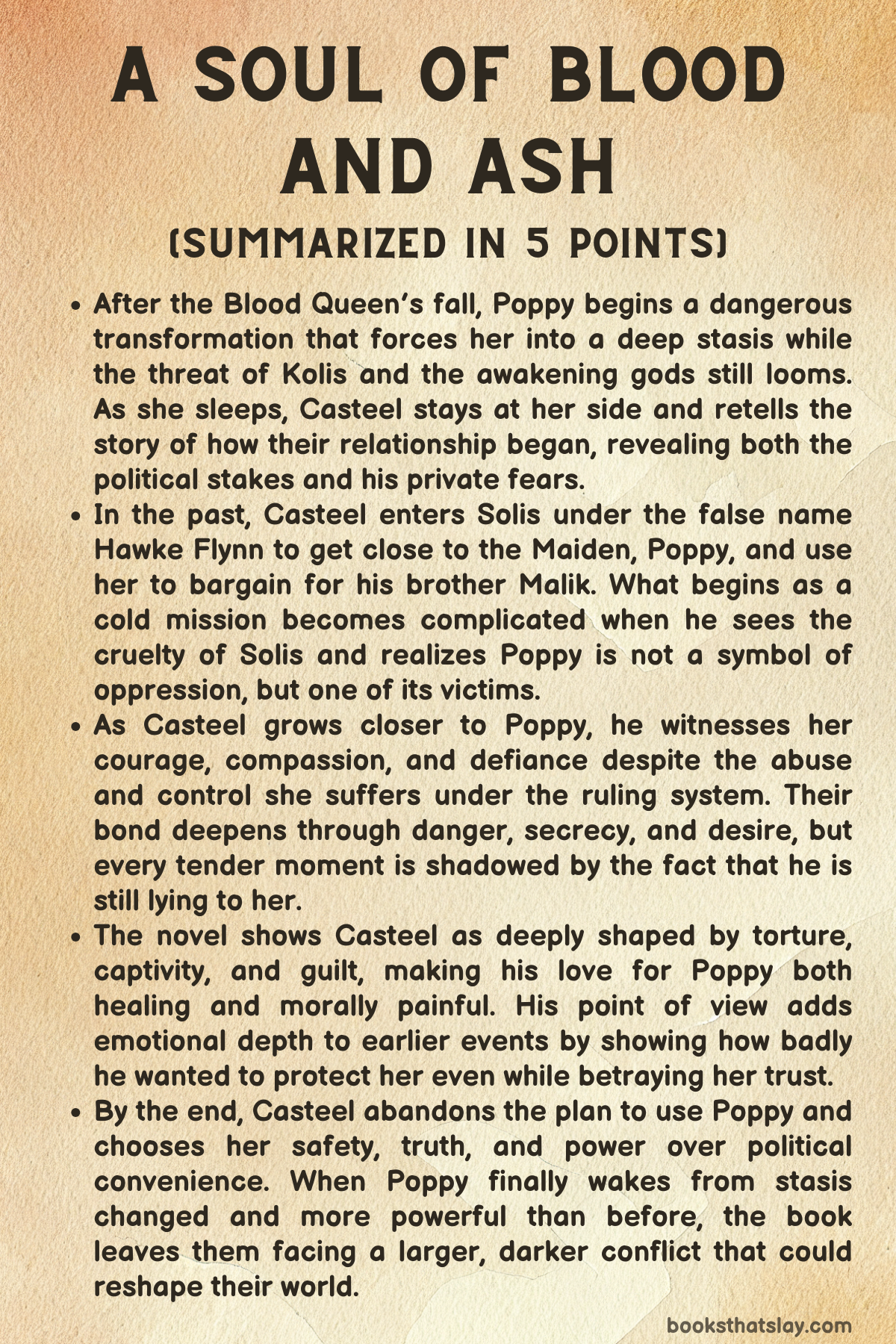
Summary
The novel begins in the aftermath of the Blood Queen’s fall. Casteel, now king beside Poppy, is helping clear Solis of hostile Ascended while their allies search for Poppy’s father, Ires, and for Malik and Millicent.
The larger danger has not passed, because the awakening gods and the coming threat of Kolis could destroy everything they have fought for. During this tense period, Poppy grows weak, cold, and unsteady.
When they finally find Ires, she uses her strange gift to calm his suffering and bring him back to himself. Soon after, it becomes clear that Poppy must enter a deep stasis to complete a transformation linked to her growing power.
Nektas warns that she may wake changed, and perhaps without memory, so Casteel stays beside her and begins speaking to her, retelling the truth of how they first met.
His account returns to the time when he lived under the false name Hawke Flynn inside Solis. He has gone there on a mission: gain access to the Maiden, Penellaphe Balfour, kidnap her, and trade her for his brother Malik.
At first, his view of Poppy is shaped by anger and suspicion. He sees Solis as a cruel kingdom built on lies, blood, and fear, where the Ascended prey on mortals and hide their crimes behind religion and ceremony.
He assumes the Maiden is just another symbol used to control people. While working as a guard in Masadonia, he witnesses the misery of ordinary citizens, the neglect of the poor, and the quiet horror of children being taken in the name of duty.
These sights sharpen his hatred of the Ascended and strengthen his belief that he must stop a wider war before more people die.
As he and his allies prepare their plan, Casteel learns more about Poppy than he expected. Rumors describe her as kind, brave, and unusually compassionate.
Even before he speaks to her, he begins to question his earlier assumptions. He kills one of her guards in order to take his place near her, a choice that stays with him because he knows the man was decent.
He also starts to sense that Poppy is not simply a sheltered ornament of the court. She moves through a brutal system, but she is not made in its image.
Everything shifts the night Poppy sneaks into the Red Pearl. Casteel expects a harmless encounter with someone else and instead finds himself alone with the Maiden.
She is masked, curious, nervous, and bold enough to go somewhere forbidden in search of one choice that belongs only to her. Their attraction is immediate, but what unsettles him more is her honesty and hunger for freedom.
He could take her then, but he chooses not to. For the first time, desire interrupts duty, and restraint becomes his first betrayal of the mission he came to complete.
After that night, he cannot stop thinking about her. He protects her from dangers she does not even know are near, worries when she vanishes from safe routes, and notices the signs of her narrow life inside the castle.
Once he officially becomes one of her guards, he sees even more clearly how controlled and mistreated she is. Duke Teerman humiliates her, restricts her movements, and uses violence to keep her obedient.
Her room is bare, cold, and joyless. Yet Poppy still finds ways to resist.
She trains in secret, carries a dagger, slips out when she can, and helps infected mortals die peacefully. Casteel finds himself admiring her courage, wit, and anger.
Their relationship grows through small, dangerous moments. He teases her to draw her out of silence.
She challenges him, threatens him, and refuses to be easily managed. He watches her fight during a Craven attack and is astonished by her skill.
He learns that she has nightmares, fears the Duke, and has lived under rules so harsh that even showing her face is treated like a crime. At the same time, she begins to see that Hawke is different from the men around her.
He steps between her and those who would hurt her, asks questions others avoid, and gives her the rare experience of being treated like a person instead of a sacred object.
Casteel’s private struggle deepens because Poppy awakens wounds of his own. He carries years of torture, sexual violence, captivity, and self-destruction from his imprisonment under the Blood Queen.
Sex has long been a way for him to escape rather than connect. But with Poppy, he starts to want something more honest.
Her touch calms him. Her presence lets him sleep.
The bond between them becomes emotional before he is ready to admit it, and that makes his plan feel uglier with every passing day.
The political world around them grows more unstable. Descenters organize, the people of Solis become restless, and the Rite approaches, bringing with it the horror of children surrendered to the Ascended.
Casteel kills Duke Teerman after confirming the man has been beating Poppy with a cane. The murder is savage and personal, driven by rage as much as justice.
Yet even this does not free Poppy. At the Rite, violence erupts, Vikter dies, and Poppy is left shattered by grief.
Casteel stays with her afterward, tending her while fighting the knowledge that he is still preparing to take her away.
When Poppy is moved toward the capital, Casteel travels with her and their growing closeness becomes impossible to ignore. He gives her small pieces of freedom, returns her dagger, talks with her openly, and watches her discover how little of the world she has truly been allowed to know.
She shares her thoughts, her fears about Ascension, and eventually her body. Their first night together in New Haven is real, loving, and unforgettable for him, which only makes his deception worse.
By then he understands that he cannot hand her over to the Blood Crown. He also knows that many of his own people believe he is compromised.
The truth breaks open when Poppy discovers that Hawke is tied to the Dark One and to Atlantia. Guards try to flee with her, Kieran’s true nature is exposed, and Casteel is forced to act.
He kills the fleeing guards, restrains Poppy when she lashes out, and finally begins telling her the truth about Solis, the Ascended, the Craven, and his own captivity. Still, he delays one truth too long: that he himself is Casteel.
When Poppy is later attacked and near death, he saves her by making her drink his blood. In the aftermath she learns who he really is, panics, stabs him, and runs.
He follows her into the snow, where pain, anger, desire, and love collide. Even after everything, they come together again, and he realizes fully that his future has changed.
From that point on, Casteel stops pretending he can use Poppy as planned. He kills those among his own side who attacked her and decides she must be protected, even from Atlantians willing to sacrifice her.
He reveals to others that she is half Atlantian and announces his intention to marry her, not as another lie, but as the only path he can see that offers her safety and power.
Back in the present, his retelling is shaped by love, regret, and fear that Poppy may wake altered. As she sleeps, old tensions remain around Malik, Millicent, the unrest in Solis, and the coming war with Kolis.
A Revenant attacks, and Casteel, driven by a new instinct in his blood, shifts into a cave cat and kills the intruder. This strange ability suggests another change tied to Poppy’s power.
At last the earth trembles, the long stasis ends, and Poppy opens her eyes, no longer green but molten silver, signaling that both she and the world around her have entered a new and dangerous stage.
Characters
Casteel Da’Neer
Casteel is the emotional center of the novel, and the story gives unusual access to his mind by showing the gap between the ruthless prince others fear and the wounded man he actually is. At the start, he sees himself as someone shaped by violence, duty, and survival.
His mission in Solis is strategic and cold on the surface: get close to Poppy, take her, and use her to recover Malik. Yet his inner life keeps resisting that role.
He is observant, intelligent, and highly controlled in dangerous situations, but emotionally he is far less steady than his public image suggests. He carries deep trauma from torture, captivity, and sexual abuse, and that history has damaged his sense of self, intimacy, and worth.
Much of his early behavior comes from compartmentalization. He tells himself he is acting for the greater good, but the novel keeps showing that he is also a man trying to live with guilt he has never fully processed.
What makes Casteel compelling is that he is not written as morally clean. He is capable of tenderness, loyalty, and sacrifice, but he is also manipulative, secretive, and sometimes brutal beyond necessity.
He arranges deaths, lies to Poppy, and hides crucial truths because he cannot bear to lose the version of himself that exists with her. His love is real, but it does not erase the harm he causes.
That tension is central to his character. He wants to be better than the Ascended, yet he repeatedly sees how close coercion can bring him to resembling them.
His self-awareness is sharp enough to make that realization painful. By the present timeline, he has changed from a man driven almost entirely by rescue, revenge, and duty into one who places emotional truth and mutual choice above political convenience.
Even then, he still judges himself harshly. He is strongest not when he fights, but when he admits that Poppy changed his values, his desires, and his understanding of who he wants to be.
Penellaphe “Poppy” Balfour Da’Neer
Poppy is seen here through Casteel’s eyes, which creates an interesting effect: the book studies her not by placing her inside her own thoughts, but by showing how profoundly she disrupts another person’s assumptions. At first she is a symbol, the Maiden, a political object wrapped in propaganda and mystery.
As Casteel gets closer, that image collapses. What emerges instead is a young woman who has been isolated, controlled, shamed, and physically abused, yet has preserved an unusual degree of moral clarity.
Poppy is restless, curious, physically brave, and emotionally sharper than the people who try to manage her. She refuses passivity even when her life has been built to enforce it.
She trains in secret, sneaks outside forbidden limits, helps dying mortals even when it is dangerous, and questions cruelty even before she fully understands the system she lives under.
Her strength is not presented as perfection. She is impulsive, suspicious, angry, and often driven by instinct before reflection.
That gives her force. She is not a soft emblem of innocence but a person whose compassion coexists with rage and violent capability.
She can soothe pain with her gift, but she can also cut through enemies without hesitation. The summary makes clear that her central conflict is about agency.
She has been told who she is, what she is for, what her body means, and what her future will be. Nearly every important turning point in her character involves her pushing back against that theft of selfhood.
Her relationship with Casteel matters because, even before the betrayal is exposed, he is one of the first people to treat her as someone with will, humor, desire, and judgment. By the present timeline, her importance expands beyond personal and political roles into something almost mythic.
Even so, what remains most striking about her is not her power, but the fact that she keeps choosing empathy in a world that has given her every reason to become cruel.
Kieran Contou
Kieran functions as far more than the loyal best friend figure. He is one of the few people who understands Casteel deeply enough to challenge him without fear, and that gives him enormous narrative importance.
He is emotionally perceptive, politically aware, and often the first to identify truths that Casteel is trying not to face. Throughout the flashback sections, Kieran sees the shift in Casteel’s priorities long before Casteel openly admits it.
He recognizes that the mission is no longer only about Malik or Atlantia, and his responses mix frustration, concern, and affection. He is practical where Casteel can become emotionally reckless, and he often acts as a stabilizing force between feeling and strategy.
At the same time, Kieran is not merely sensible support. He has his own toughness, loyalties, humor, and appetite for direct action.
He participates in violence when necessary, but he is also consistently alert to emotional fallout. His bond with Casteel is especially important because it adds a layer of mutual vulnerability.
Casteel’s self-harm harms Kieran too, which turns private suffering into shared consequence. That detail shows how closely Kieran is tied to both Casteel’s pain and recovery.
He also becomes one of the few people Poppy gradually trusts, and his relationship with her helps broaden the emotional landscape of the story. He is never threatened by her place in Casteel’s life.
Instead, he becomes part of the structure that holds them both up. Kieran’s steadiness gives him moral weight.
He is not idealized, but he is dependable in a world full of deception, and that reliability makes him one of the healthiest presences in the book.
Malik Da’Neer
Malik is defined by absence for much of the story, yet that absence shapes nearly everything. He is the reason Casteel enters Solis, the person whose captivity justifies the original plan, and the older brother whose choices have left lasting emotional damage.
Because he is missing for so long, he becomes both a loved person and a projection. Casteel builds a mission around saving him, but the eventual truth is far less simple.
Malik was not only a victim. He made decisions, withheld information, and stayed in Solis partly because of Millicent.
That revelation complicates his role and prevents him from being treated as a straightforward object of rescue.
What makes Malik interesting is that his failures do not erase his humanity. He is flawed, secretive, and in some ways irresponsible, but he is not written as malicious.
His love for Millicent explains choices that otherwise look like betrayal, and the novel uses him to explore how devotion can distort judgment. His reunion with Casteel carries both tenderness and resentment, because the brothers are dealing with the cost of silence as much as separation.
Malik also serves as a contrast to Casteel. Where Casteel often turns pain inward and blames himself, Malik seems more willing to accept his own limitations.
His acknowledgment that Casteel would make the better king is revealing. It suggests self-knowledge rather than simply defeat.
He is not a weak character, but he is one whose desires overruled duty, and that makes him an important example of how love in this world can save and ruin at the same time.
Millicent
Millicent enters the narrative as both family and disruption. She is Poppy’s sister, Malik’s heartmate, and a Revenant, which makes her existence politically and morally unstable in the world of the story.
She has been made into something unnatural by forces larger than herself, and that has clearly shaped her self-image. One of the most revealing details about her is how casually she refers to herself as an abomination.
That kind of language shows deep internalized damage. She does not speak like someone who merely knows others judge her.
She speaks like someone who has absorbed that judgment so completely that it feels factual.
Her importance lies in the tension between what she is and who she may still be. The summary suggests fear, vulnerability, and attachment beneath her altered condition.
She runs after Isbeth’s death because she expects rejection or even destruction, especially from Poppy. That fear implies that despite all she has become, she still cares deeply about being seen and spared by her sister.
Millicent represents one of the novel’s key questions: what does monstrous transformation do to personhood, and can love still survive within it? Her bond with Malik suggests that the answer is yes, though not without pain.
She complicates the easy division between pure victim and irredeemable threat, which makes her one of the more unsettling and fascinating secondary characters.
Ires
Ires occupies a relatively brief but symbolically important role. He appears after long imprisonment, neglected and reduced, and his condition reflects the cruelty of the regime that held him.
His first scenes emphasize fracture rather than authority. He is a father, but not in a traditional protective sense.
He needs rescuing, calming, and restoration. That vulnerability matters because it strips away any idealized image of paternal power.
He stands as evidence of what prolonged suffering does to identity and bodily autonomy.
His interaction with Poppy is especially meaningful. Her ability to calm him and reach him emotionally creates a bond that does not depend on history or familiarity.
Even in his damaged state, he recognizes her. That moment gives him emotional significance beyond plot function.
He becomes part of Poppy’s lineage, but he also reflects the inheritance of pain that runs through her story. He is not developed at the same depth as the central cast, yet his presence expands the family history and underlines how much has been stolen from multiple generations.
Nektas
Nektas serves as a figure of authority, mystery, and old knowledge. Unlike many rulers or powerful beings in fantasy, he is not noisy in his dominance.
His strength comes from composure, experience, and an ability to understand forces that others only partially grasp.
He knows more than he says, especially about gods, power, awakening, and Poppy’s transformation. This gives him a somewhat cryptic presence, but it also makes him trustworthy in a way that many secretive characters are not.
He withholds not to manipulate for pleasure, but because larger realities are unfolding on scales the others are only beginning to comprehend.
His attitude toward Poppy is important because he does not reduce her to someone in need of protection. He recognizes her power and repeatedly reminds others that she is more dangerous and significant than they are comfortable admitting.
That perspective helps correct the instinct, especially in Casteel and Kieran, to think of care only in protective terms. Nektas broadens the frame.
He sees Poppy not merely as beloved queen or vulnerable woman, but as a being entering a new order of existence. His presence also links the mortal struggle to the divine one, making him a bridge character between intimate emotional conflict and mythic consequence.
Vikter Wardwell
Vikter is one of the clearest examples of integrity in the novel. He is stern, often suspicious of Casteel, and not easily charmed, but all of that comes from genuine devotion to Poppy’s welfare.
Unlike those who speak of duty while enjoying power, Vikter actually lives his oath. He pays attention, sees danger early, and understands Poppy’s vulnerabilities even when he cannot protect her from every form of harm.
His role as guard is never merely professional. It is rooted in care, loyalty, and moral seriousness.
What gives Vikter emotional force is that Casteel begins by seeing him as an obstacle and ends by deeply respecting him. That shift matters because it reflects Casteel’s changing values.
Vikter becomes the measure of what honorable protection looks like. His warnings often carry greater meaning later, and his death hits with such force because he is not only a loss to Poppy but also a loss to the ethical structure of the story.
He represents the kind of man Casteel wants to be more like, even before he fully admits it. In a setting full of corrupted authority, Vikter stands out because his power is exercised in service, not control.
Tawny
Tawny brings warmth, normalcy, and emotional intelligence into a setting dominated by fear and secrecy. She understands Poppy not as symbol or obligation, but as friend.
That distinction matters. Tawny is one of the few people who gives Poppy permission to be young, curious, embarrassed, joyful, and desirous.
She notices shifts in Poppy’s mood, sees the attraction between her and Hawke early, and responds with teasing rather than judgment. In another kind of story, a companion like Tawny might be written only for lightness, but here she also carries quiet courage.
Her loyalty to Poppy is deeply human and immediate. She cannot dismantle the structures imprisoning her friend, but she does what she can inside them by listening, encouraging, and making space for honesty.
Tawny’s reactions also help frame how unusual Hawke appears within Solis. Through her eyes, his interest in Poppy seems less exploitative than the behavior of the people around them, which nudges both Poppy and the reader toward trust.
Tawny is important because she preserves softness in an atmosphere that tries to crush it.
Duke Teerman
The Duke is one of the novel’s clearest embodiments of private and public corruption. He is not only politically complicit in the crimes of Solis; he is personally cruel, controlling, and predatory.
His abuse of Poppy is rooted in power rather than passion. He humiliates her, disciplines her body, and treats her inner life as something to be broken into compliance.
The summary makes clear that he gains satisfaction from her discomfort, which places him beyond the category of merely rigid authority. He is a sadist who uses ritual, purity, and order as tools of domination.
He is also important because he reveals how systems of oppression depend on intimate violence. The horrors of Solis are not abstract policies alone.
They live inside rooms, gestures, punishments, and the entitlement of men like him. Casteel’s murder of the Duke is therefore emotionally understandable, but the novel does not let it become simple justice.
The scene is savage because the Duke has earned hatred, yet it also shows how thoroughly violence now speaks through Casteel. The Duke’s real narrative purpose is to expose the daily mechanics of abuse and the psychological damage they leave behind.
Duchess Teerman
The Duchess is less physically prominent as an abuser, but she is still a crucial part of the system that imprisons Poppy. She performs refinement, ceremony, and courtly femininity while supporting brutality beneath it.
Her role demonstrates that cruelty in this world is not limited to openly monstrous men. She participates in manipulation, enforces the ideology surrounding the Maiden, and helps maintain the fiction that justifies murder and submission.
She is polished where the Duke is overtly menacing, but she is not innocent in that difference.
Her presence helps show how power can be gendered without becoming gentler. She may not dominate Poppy in exactly the same manner as the Duke, yet she still contributes to the shaping of Poppy as an object rather than a person.
The summary also suggests a level of superficiality in how she responds to people, including Hawke. She is attuned to appearances, desirability, and social arrangement, which makes her a good representative of a court culture more interested in preserving hierarchy than truth.
Queen Ileana / Isbeth
Isbeth is one of the most consequential offstage forces in the story. Even when she is not present, her will, cruelty, and long reach structure the world around the characters.
She is the architect of multiple forms of suffering: Casteel’s torture, Malik’s entanglement, Poppy’s manipulated upbringing, the creation of Revenants, and the larger blood-soaked machinery of Solis. She is not cruel in an impulsive sense.
Her actions feel strategic, patient, and rooted in obsession. That makes her more frightening than a merely unstable tyrant.
What gives Isbeth depth is that her monstrosity is tied to love as well as ambition. The summary suggests that she is willing to sacrifice almost anything, even those she should value most, in pursuit of restoring Kolis and fulfilling her own consuming aims.
That distortion of maternal feeling is one of the darkest elements in the book. She is a character who turns attachment into possession and devotion into ruin.
In narrative terms, she functions as a mirror opposite to the care Poppy and Casteel learn to offer one another. Where they move, however imperfectly, toward choice and mutual recognition, Isbeth embodies domination disguised as necessity.
Alastir Davenwell
Alastir is shaped by betrayal, but what makes him memorable is that the betrayal cuts through a relationship built on trust and near-family closeness. For much of the backstory, he exists in Casteel’s mind as a respected elder, a counselor, and a stabilizing political figure.
That history gives his later actions far more emotional force than a straightforward villain reveal would. He becomes one of the clearest examples of how fear, ideology, and rigid loyalty to a cause can twist a person into moral monstrosity.
Casteel’s struggle to reconcile the man he thought he knew with the one who later harmed Poppy gives Alastir weight beyond plot mechanics. He represents the pain of discovering that affection and guidance do not guarantee goodness.
In that sense, he is thematically tied to the book’s larger concern with appearances and truths. He also complicates the idea of loyalty.
He likely believes, at least in part, that he is acting for the realm, but his willingness to sacrifice Poppy shows a version of political thinking that treats people as expendable pieces. The novel clearly rejects that logic through Casteel’s eventual choices.
Jansen
Jansen is a quieter but significant character because he shows that resistance inside Solis is morally complex and populated by people who have suffered dearly. He understands the costs of rebellion and does not romanticize them.
He helps Casteel because he hates the Ascended and has reason to do so, yet he still grieves the necessity of killing decent men like Rylan. That moral friction makes him feel credible.
He is not numb to bloodshed, just convinced that there are moments when it cannot be avoided.
His conversations with Casteel are also valuable because he is one of the first to correct him about Poppy’s public reputation. Jansen sees that she is beloved by ordinary people for reasons that cannot be dismissed as propaganda alone.
In that sense, he helps begin the dismantling of Casteel’s assumptions. He belongs to the category of revolutionary characters who do not lose their humanity even while operating in secrecy and violence.
Jericho
Jericho embodies the danger of men who confuse permission to fight with permission to dominate. He is not simply aggressive; he is undisciplined in a way that makes him dangerous to everyone around him.
His attempt to take Poppy for himself is a turning point because it reveals how fragile command can be when men are driven by ego, entitlement, or opportunism. Casteel’s violent punishment of him is significant not only as retribution but as a declaration of boundaries within the rebellion itself.
Jericho’s continued presence later in the story keeps him from becoming a one-note early threat. He remains a symbol of the elements within Casteel’s own side that are willing to treat Poppy as an object, spoil strategy through recklessness, or act out prejudice and resentment.
In that way, he represents a hard truth of the novel: the enemy is not the only place where dehumanization lives. Jericho is useful because he forces Casteel to confront corruption and misogyny among his own allies as well.
Emil
Emil is a supporting character, but he serves an important function in showing the wider network of loyalty around Casteel. He carries messages, provides blood, shares intelligence, and helps connect the covert mission in Solis to life in Atlantia.
Through him, readers get a sense of a living world beyond the castle and the immediate plot. He represents trust, continuity, and quiet service.
There is also something revealing in how Casteel uses Emil’s help while carrying private doubts of his own. Emil helps expose the tension between personal feeling and political strategy because he remains part of the machinery that assumes the mission will proceed as planned.
His relationship with Vonetta also gives him a personal dimension that keeps him from feeling purely functional. He belongs to the network of people whose lives are affected by Casteel’s choices, even when they are not at the emotional center of the narrative.
Delano Amicu
Delano represents the more grounded, loyal side of Atlantian support. He is one of the friends who helps anchor Casteel when the mission becomes unstable, and he is important because he shows what allegiance looks like when it is personal rather than merely hierarchical.
Delano is prepared to act, fight, and protect, but there is also a sense that he understands emotional stakes better than a purely military subordinate would.
His later survival after Poppy saves him becomes one of the moments that further complicates how others view her. Delano’s place in the narrative helps shift Poppy from enemy asset to undeniable person in the eyes of those around Casteel.
He may not be explored with the same emotional depth as the core trio, but he is part of the web of friendship that makes Atlantia feel like a real community rather than just a political cause.
Elijah Payne
Elijah is one of the characters most attuned to collective mood and factional strain. He is loyal to Casteel, but he is also honest about the limits of that loyalty within the wider group.
He warns Casteel when confidence in his leadership is weakening and does not pretend that personal feelings can remain separate from strategic consequences. That makes him especially valuable in the New Haven sections, where emotional choices begin to threaten political coherence.
He also helps prevent Poppy’s conflict with Casteel from becoming a public slaughter, recognizing the emotional complexity of what is happening. Elijah’s role is not flashy, but it is precise.
He often represents the point where private desire meets communal pressure. Characters like him keep the novel from collapsing into pure romance by reminding everyone that kingdoms, loyalties, and competing fears are still in motion.
Naill
Naill is another of Casteel’s trusted circle, and while he is less individually foregrounded, he contributes to the sense of long-standing loyalty and shared history. He arrives not as a stranger to the prince’s conflict, but as one of the people already woven into his life and responsibilities.
His presence strengthens the impression that Casteel’s decisions ripple through a network of friends who know him well enough to judge whether he is acting like himself.
Naill’s significance is therefore relational. He is one of the witnesses to Casteel’s transformation, one of the people who understands what is at stake, and one of the bodies standing behind the prince when events turn volatile.
In stories like this, such characters matter because they create social pressure and emotional context around the protagonist’s choices.
King Valyn
Valyn exists largely as looming authority in the summary, and that distance is effective. He is a father, king, and embodiment of political necessity, but he is also shaped by grief.
His willingness to kill Poppy brutally if needed is horrifying, yet the novel frames it not as random cruelty but as the reaction of a man hardened by loss and war. That does not make him right, but it makes him legible.
His role is important because he represents the path Casteel might have followed if duty had fully overcome feeling. Valyn’s perspective is the extreme political argument: protect the kingdom first, no matter what tenderness must be sacrificed.
The fact that Casteel believes he might have turned on his own father to save Poppy shows how completely his values have shifted. Valyn thus becomes less a fully present father figure and more a test of what kind of ruler and man Casteel wants to be.
Queen Eloana
Eloana is only briefly present in the summary, but even that limited presence matters. She belongs to the remembered home Casteel is fighting for and to the family structure that still exerts emotional pull over him.
Her survival, along with Valyn’s, helps counter the false narrative promoted in Solis and reinforces that Atlantia has continuity, lineage, and governance rather than merely rebellion.
She is less characterized here than many others, but her significance lies in symbolic stability. She is part of the world that should represent safety and belonging for Casteel, which in turn makes it more striking that he eventually fears what some within that world might do to Poppy.
Eloana therefore sits on the edge of a larger question about whether home can remain home when it demands moral compromise.
Shea
Shea is absent in body but powerful in memory. Her story reveals a great deal about Casteel because his recollection of her is bound up with betrayal, grief, anger, and guilt.
She once occupied an intimate space in his life, and her decision to betray Malik in order to save Casteel creates a morally tangled legacy. She acted out of love, but the consequence was devastating.
That makes her one of the novel’s clearest examples of how love can become destructive even when it is sincere.
Her importance is not just as tragic history. Shea’s memory shapes how Casteel reacts to trust, loss, and the fear of becoming the cause of another loved one’s suffering.
When he remembers killing her, the act still holds emotional violence for him, and that unresolved wound affects how he navigates Poppy. Shea’s role therefore deepens his character by showing that his fear of hurting the people he loves is not abstract.
He has already lived through the aftermath of such damage once before.
Lord Mazeen
Mazeen is a secondary antagonist whose main function is to expose the everyday predation tolerated within Solis. He is associated with sexual threat, opportunism, and callousness.
The fact that Poppy’s scent is on him alarms Casteel early, and later comments about Britta’s fear of his unwanted advances confirm that he is one of many men empowered by the system to treat women as available targets.
His death at Poppy’s hands is narratively fitting because it comes in the raw aftermath of Vikter’s death and channels both grief and fury. Mazeen is not psychologically layered, but he does not need to be.
His purpose is to represent the entitled violence of a class that assumes immunity. Poppy’s destruction of him marks one of the clearest moments where she refuses victimhood outright.
Britta
Britta is a small but telling character. At first she appears as a possible casual attachment in Casteel’s life, someone connected to his habits of using sex for escape rather than intimacy.
Once Poppy enters the emotional picture, Britta’s role changes. She helps reveal what Casteel is moving away from, not because she lacks worth, but because he no longer wants detachment in the same way.
She also provides useful social information. Through her caution, intelligence, and fear of men like Mazeen, the story shows how ordinary women survive within oppressive structures by reading danger carefully.
Britta does not occupy much narrative space, but she adds realism to the social environment around the castle.
Pence
Pence represents the ordinary mortal shaped by propaganda. He is not foolish in a caricatured way.
Rather, he is someone whose worldview has been formed by the lies of Solis, making him useful for showing how thoroughly power controls knowledge. His hopes for advancement and his acceptance of official narratives make him tragic because the reader can see how limited his understanding is.
For Casteel, Pence is a reminder that the people of Solis are not a faceless mass. They are individuals with ambitions, fears, and incomplete information.
That awareness complicates any easy military logic. Pence helps humanize the population that supposedly exists under royal and Ascended protection but is actually being consumed by it.
Lev
Lev is one of the characters who gives the rebellion visible public voice. His confrontation with authority is reckless, but it is also morally necessary.
He speaks truths in a space built on lies, and his fate exposes the violence hidden beneath ceremony. Lev is significant less as a deeply individualized figure and more as an embodiment of dissent moving from whispers into open accusation.
His impact on Poppy is especially important. His challenge plants doubt and pushes her closer to seeing that the world around her is false.
In that sense, Lev is one of the catalysts of awakening, both political and personal. His courage matters because it is costly and because others initially interpret it as foolishness before realizing how much truth it carried.
Callum
Callum’s role in the summary is brief but ominous. As an ancient Revenant supporting Kolis’s return, he represents the next phase of threat beyond the immediate conflict with the Blood Queen and Solis.
He is less a character of intimate emotional impact here and more a sign of the scale widening beyond human and courtly struggle. The fact that he can rally Revenants makes him strategically terrifying.
Even in limited mention, Callum contributes to the sense that the past is not dead in this world. Old powers, old loyalties, and old monsters are still active beneath current events.
He stands at the edge of the story’s expanding mythology.
Kolis
Kolis is not a regular scene presence in the summary, but he is vital as the shadow over the future. He represents catastrophic return, cosmic imbalance, and the possibility that all the mortal and political struggles so far are only preludes to something even larger.
Unlike Isbeth, whose danger is personal and immediate, Kolis functions as existential threat. He is what turns victory into mere pause.
Because of that, he matters thematically as well. Characters are not only trying to survive kingdoms, traumas, and betrayals.
They are also moving toward a clash with forces that challenge the order of the world itself. Kolis gives the story scale and dread.
Jadis
Jadis appears only in connection to Ires and Nektas, but her mention is important because it introduces another line of concern tied to family, loss, and rescue. In a summary-heavy view of the novel, a name like hers can seem minor, yet she signals how many lives remain unresolved even after major victories.
She belongs to the ongoing network of personal stakes that stretch into the divine and draken worlds.
Her narrative role is therefore less about present characterization and more about extending tension. She reminds readers that survival after one battle does not mean reunion or safety for everyone.
Themes
Choice as the foundation of identity
Control shapes nearly every relationship in the novel, so freedom becomes more than a social condition; it becomes the basis of personhood itself. Poppy has been raised inside a system that claims to honor her while denying her the smallest rights over her own body, face, movements, future, and desires.
She is told that her life has sacred meaning, yet that meaning is defined entirely by others. Her role as the Maiden is built on contradiction: she is publicly elevated and privately erased.
That contradiction is what gives the theme of choice so much force. Her acts of resistance are not grand at first.
They take the form of reading forbidden material, training with weapons, sneaking beyond approved spaces, helping dying people, and seeking sexual curiosity on her own terms. These moments matter because they show that agency begins long before open rebellion.
It begins the moment a person insists that inner life belongs to them.
Casteel’s development is tied closely to this theme because his deepest change is not simply that he falls in love with Poppy, but that he comes to understand how often love is confused with possession, protection, or strategy. At the beginning, he plans to take her and use her as leverage, which means he also denies her choice, even if he believes his reasons are justified.
This is why his emotional awakening is morally complicated. He may hate what Solis has done to Poppy, but he still participates in deciding her fate without her consent.
The novel does not let him escape that truth easily. Instead, it shows his growing discomfort as he begins to see that any future worth building with her must include her right to know, refuse, decide, and define herself.
That is one reason the relationship matters beyond romance. It becomes a test of whether he can love without controlling.
This theme also extends into the larger political structure. Solis survives by removing choice from ordinary people and disguising that removal as religious order, civic duty, and divine necessity.
The taking of children, the silencing of dissent, the isolation of women, and the manipulation of information all depend on making obedience feel natural. Against that system, every meaningful act of resistance is an act of reclaiming agency.
Poppy’s eventual movement toward knowledge, self-definition, and power does not just challenge individual abusers. It threatens the ideology that made them possible.
The novel therefore presents choice not as luxury, but as the dividing line between a life that is lived and a life that is managed by others.
Trauma and the struggle to remain whole
Pain in the novel is not treated as a temporary event that can be overcome through will alone. It lingers in the body, distorts memory, alters intimacy, and shapes the way characters interpret danger, touch, and self-worth.
Casteel carries some of the clearest examples of this. His years of torture and sexual abuse have not merely left scars; they have damaged his ability to trust pleasure, rest, and emotional safety.
He uses sex as escape rather than connection, harms himself to interrupt unbearable thoughts, and often sees himself through the logic of damage rather than dignity. What makes his portrayal effective is that the story does not reduce him to suffering alone.
He remains witty, capable, and dangerous, but those strengths do not erase the fact that trauma has rearranged his sense of self. He does not move forward by forgetting.
He moves forward unevenly, with setbacks, shame, and moments of painful honesty.
Poppy’s trauma takes a different but equally serious form. Her wounds come from prolonged control, humiliation, physical punishment, fear, and enforced isolation.
She has been taught to distrust her own desires, to accept surveillance as normal, and to measure her worth through obedience. The Duke’s abuse is especially important because it reveals how domination can shape a person long after the immediate violence stops.
Poppy’s reactions to exposure, authority, and vulnerability are all influenced by what has been done to her. Even when she acts boldly, the novel makes clear that boldness is not proof of being untouched by harm.
Her courage exists alongside fear, anger, and the memory of powerlessness.
What gives this theme depth is that healing is shown as relational but not simple. Neither Poppy nor Casteel is cured by love.
Instead, love creates conditions where truth can be spoken, pain can be recognized, and shame can begin to loosen its hold. Poppy’s empathic ability deepens this theme because it turns emotional and physical suffering into something she can literally feel and soothe.
Her gift becomes symbolic as well as magical: it represents the possibility that pain can be acknowledged without turning into domination. At the same time, the novel remains aware that healing is fragile.
Old memories return suddenly. Fear is triggered by sights, names, and touches.
Recovery is not linear, and the story is strongest when it allows both characters to remain marked by what they survived while still making room for tenderness, desire, and hope.
Love tested by secrecy, betrayal, and moral compromise
Affection in the novel is never separate from risk. Love begins under false names, hidden motives, political desperation, and competing loyalties, which means it cannot remain innocent even when it becomes sincere.
Casteel and Poppy are drawn to one another through attraction, curiosity, and emotional recognition, but the relationship develops inside an arrangement already poisoned by deception. He knows who she is long before she knows who he is.
He is shaping events around her while also responding honestly to her. This duality gives the romance its tension.
The feeling is real, but so is the manipulation. The novel gains much of its emotional weight from refusing to flatten either side of that truth.
Trust therefore becomes the most fragile and valuable element in the bond between them. Poppy is not merely hurt because Casteel lied; she is wounded because she gave intimacy, vulnerability, and belief to someone who was never as simple as he seemed.
Her anger after the revelation matters because it protects the moral seriousness of what happened. The story does not ask her to forgive quickly or treat love as exemption from accountability.
At the same time, Casteel’s betrayal is not presented as empty cruelty. He is under pressure from duty, grief, loyalty to Malik, fear of war, and genuine confusion about what kind of man he still is.
That does not excuse him, but it explains why the betrayal is tragic rather than flatly villainous. He hurts the person he loves while trying, too late, to become someone worthy of that love.
This theme also stretches beyond the central romance. Malik and Millicent show how love can lead to silence, divided loyalties, and choices that injure others.
Shea’s memory does the same, revealing how devotion can produce catastrophe when it overrides judgment. Even parental love is shown in distorted form through Isbeth, whose possessiveness destroys rather than protects.
Across the novel, love is never automatically redemptive. It can rescue, blind, justify, heal, or corrupt depending on the ethics attached to it.
What finally gives love meaning in the story is not intensity alone, but whether it makes room for truth, consent, and responsibility. Without those, desire becomes ownership and loyalty becomes harm.
With them, love begins to move toward something stronger than passion: a willingness to let another person remain fully themselves.
Power sustained by lies and challenged by truth
Political domination in the novel depends not only on force, but on narrative control. Solis does not rule by violence alone.
It rules by deciding what people are allowed to believe about gods, history, monsters, bloodlines, duty, and salvation. This makes truth one of the most dangerous forces in the story.
The state turns murder into ritual, abduction into sacred obligation, and exploitation into moral order. The Maiden is central to that deception because her public image helps stabilize the system.
She is presented as chosen, protected, and holy, while her actual life is defined by secrecy, fear, and confinement. That gap between public meaning and private reality is one of the novel’s sharpest political observations.
Systems of abuse survive most effectively when they can make their victims appear honored.
Casteel’s position inside Solis allows the reader to see how propaganda functions across classes. Ordinary people repeat falsehoods because those falsehoods structure daily life, religious understanding, and social hope.
Guards believe they serve a divine order. Families are persuaded to surrender children because they have been taught to interpret loss as devotion.
Even the architecture of power, with its ceremonies and titles, helps convert horror into routine. This is why rebellion in the novel is not only physical.
It is epistemic. People must learn what the Ascended truly are, what Ascension really means, what happened in the past, and who has benefited from keeping that knowledge buried.
Yet the theme is not as simple as truth being clean and lies being dirty. Casteel himself becomes one of its most painful examples.
He hates the kingdom of lies and still lies to Poppy repeatedly. He tells himself he is protecting a larger cause, but the novel keeps exposing how easily noble purpose can reproduce the very methods it claims to oppose.
This makes the conflict more interesting because it suggests that overthrowing a corrupt order requires more than replacing rulers. It requires a different relationship to truth itself.
Knowledge cannot just be another weapon used selectively. It must become the basis for ethical action.
That is why Poppy’s awakening matters so much. As she learns what has been hidden from her, she becomes dangerous not only because of supernatural power, but because she carries the capacity to expose a whole civilization built on falsehood.
In that sense, truth in the novel is revolutionary. It does not merely clarify the world.
It threatens to remake it.