Starling House Summary, Characters and Themes
Starling House by Alix E. Harrow is a Southern Gothic novel set in the decaying coal town of Eden, Kentucky, where dreams, folklore, and family legacies collide. At the heart of the story is Opal, a determined young woman bound by responsibility to protect her younger brother while yearning for a way out of their cursed town.
Her fate becomes entangled with the enigmatic Arthur Starling and the crumbling mansion known as Starling House, a place both feared and shunned by locals. What begins as a simple arrangement for survival transforms into a battle against secrets, monsters, and destiny itself, testing the boundaries of love, choice, and belonging.
Summary
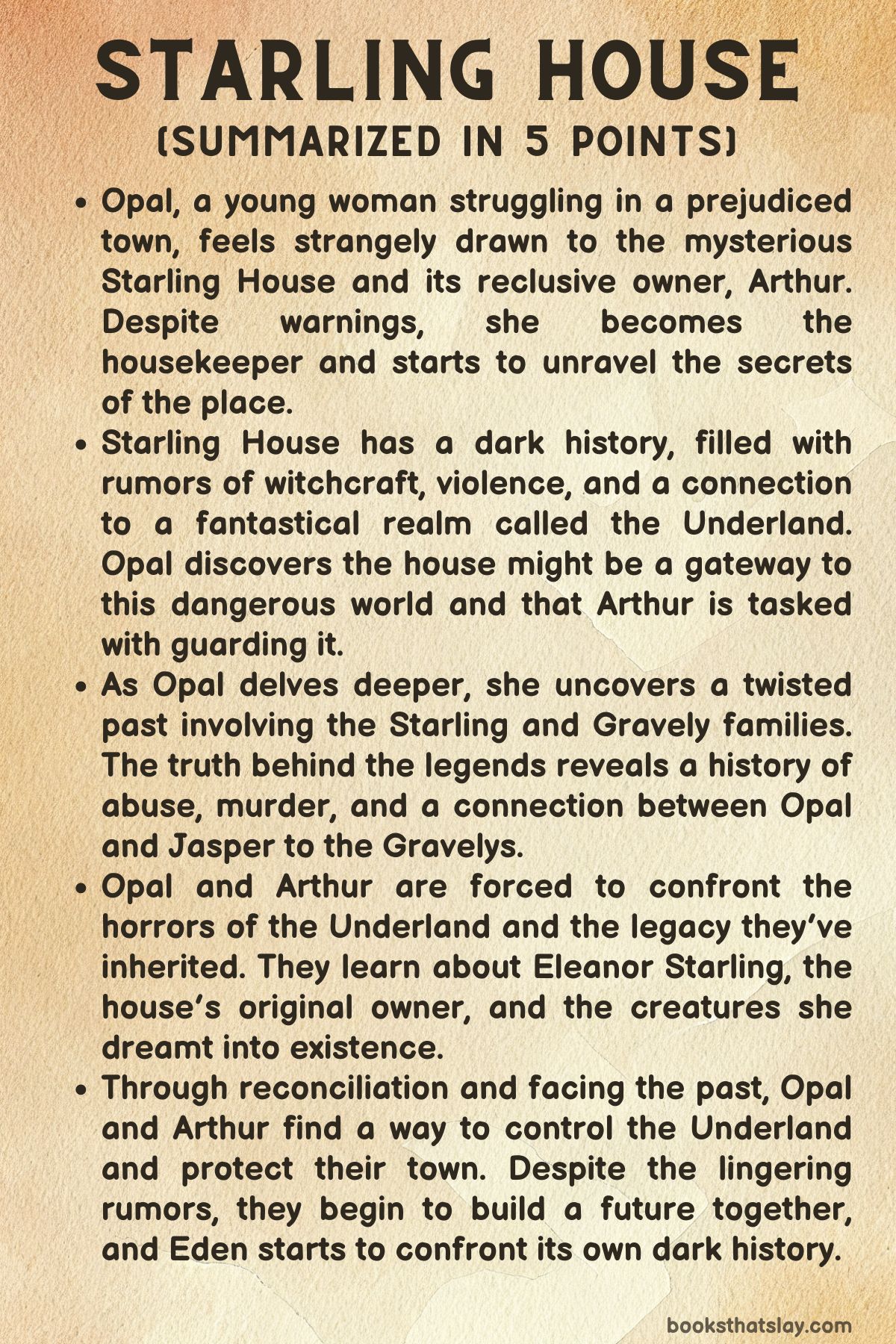
The novel follows Opal, who lives in the run-down town of Eden, Kentucky, a place poisoned by its coal-mining history and steeped in rumor about the cursed Starling House. Orphaned after her mother’s death, Opal shoulders the burden of raising her younger brother Jasper while juggling low-paying jobs.
Her dreams are dominated by visions of Starling House, a place she once obsessed over as a child after reading The Underland by E. Starling, the house’s original owner. Locals whisper of tragedy and curses surrounding the Starling family, but for Opal, the house has always been magnetic, a source of mystery and dark possibility.
One evening, she encounters Arthur Starling, the reclusive heir, outside the mansion’s gates. Their meeting is tense and strange, leaving her unsettled.
Soon, her dreams of the house grow stronger, pulling her toward its decaying halls. When the gates open to her touch, Opal finds herself inside, facing the cold and hostile Arthur.
Despite his warnings to stay away, he offers her a job as housekeeper, a decision that surprises them both. Opal, desperate for money to send Jasper to a better school, accepts, stepping into the heart of a place long feared by the town.
Inside, she finds a house alive with secrets. Its rooms are rotting, its walls marked with strange carvings, and its air thick with presence.
Portraits of generations of Starling Wardens watch her from the walls, each tied to the same silver sword. Arthur himself is bound to the role of Warden, a position passed down through blood and choice, meant to hold back the Beasts of Underland.
Though surly and secretive, he cannot completely keep Opal at a distance, and she, in turn, feels both revulsion and fascination with the house and its master. She continues her work, even stealing trinkets to sell, all while sensing the house is watching her.
As Opal digs into the history of the Starlings and Eden, she learns of Eleanor Starling, the house’s founder, who broke from the wealthy Gravely coal family under suspicious circumstances. Rumors say she built Starling House to guard a terrible secret, a truth buried beneath the earth and linked to the miners who once dug too deep.
Eleanor’s life, the book she wrote, and the curse she left behind all begin to weave into Opal’s reality, making her question what is real and what belongs to dreams.
Meanwhile, Jasper’s health struggles and future press heavily on Opal, reinforcing her need for the Starling job. Yet danger lurks beyond the house as well.
Elizabeth Baine, a representative of Gravely Power, approaches Opal with offers of money and threats against Jasper if she does not spy on Arthur. The Gravely family, once masters of Eden’s wealth, remain a corrupting presence.
Torn between survival and loyalty, Opal pretends to agree but ultimately chooses to protect Arthur and the secrets of the house. Her loyalty draws her deeper into Arthur’s world, even as she uncovers painful truths about her own family’s ties to the Gravelys.
Arthur and Opal’s bond grows more complicated as the weight of the Warden’s duty presses down on them. Arthur insists the cycle must end with him, refusing to drag anyone else into the cursed role.
Yet he admits his own guilt: years ago, while neglecting his duty, a Beast escaped, causing the crash that killed Opal’s mother. Devastated by the confession, Opal flees, but the truth of her bloodline soon emerges—her mother was herself a Gravely, linking Opal and Jasper to the same cursed legacy.
Their fates are tied to Starling House more deeply than she ever imagined.
Jasper eventually uncovers Arthur’s notes and the grim history of the Wardens. Each Warden across time had been chosen through dreams, plucked from the desperate and broken, sworn to protect the world from the Beasts of Underland.
But each eventually fell, consumed by the burden. What Arthur believed was fate was in fact choice—his mother’s letters reveal that being a Warden was never an inheritance, but a decision to fight.
This revelation unsettles Opal, especially when she discovers Jasper has begun dreaming of the house as well, marking him as a potential successor. She grows desperate to shield him from the same cycle of sacrifice.
The tension escalates when the Beasts begin to rise again. Arthur prepares to fight alone, determined to end the cycle with his own death, but Opal refuses to let him bear the burden in silence.
She confronts the house, the dreams, and the river that marks the boundary with Underland. There, she follows Arthur into the dream realm, facing Eleanor Starling herself.
Eleanor, twisted by trauma and rage, confesses her story: once trapped by the Gravely brothers’ greed and cruelty, she turned to the river and dreamt the Beasts into being. The house became her fortress, a labyrinth built to guard the gateway she had opened.
But her bitterness fed Underland, allowing Beasts to spill into the world when the house’s defenses weakened.
In the dreamlike halls of Underland, Opal refuses to succumb to Eleanor’s despair. She reshapes the space with her own memories, showing that the dreamer’s imagination has power.
Where Eleanor gave form to monsters, Opal envisions connection, love, and resilience. She soothes Eleanor’s restless spirit, guiding her into rest.
Then she finds Arthur trapped in a nightmare of his failures, endlessly fighting Beasts. By reaching out to him and showing him another path, she frees him from his self-imposed chains, allowing him to dream of peace instead of battle.
Together, they transform the Underland landscape, taming the Beasts into harmless forms.
When they return, the real world reels from disaster. A coal ash spill devastates Eden, and rumors spread of strange mist and blossoms in its wake.
Authorities investigate, but the true battle remains hidden in the shadows of Starling House. Opal and Arthur emerge changed, their bond solidified, their role in Eden’s story undeniable.
Though gossip paints them as eccentric recluses, they begin repairing Starling House, opening its gates selectively and sketching out stories that may someday tell the truth.
By the novel’s end, Starling House has shifted from a place of dread to a place of new beginnings. Opal, once desperate to escape Eden, finds herself rooted in the very house she once feared, alongside Arthur.
The dreams that haunted her have become a home, not a curse. Together, they reshape what it means to be chosen—not by fate, but by choice—and begin to write a future where the cycle of despair may finally be broken.
Characters
Opal
Opal stands at the heart of Starling House as a complex, fiercely independent young woman caught between survival and destiny. She is defined by her relentless devotion to her younger brother Jasper, which drives nearly every choice she makes.
Haunted by her mother’s death and abandoned by her father, Opal shoulders responsibility too young, carving out a life through menial jobs and sheer stubbornness. Her fascination with Starling House, born from childhood tales and deepened by recurring dreams, mirrors her inner conflict: she longs for stability yet is irresistibly drawn to the unknown.
Opal is resourceful, pragmatic, and often abrasive in her interactions, particularly with Arthur, but beneath her hardened exterior lies a deep vulnerability and yearning for belonging. Her gradual entanglement with the mansion forces her to confront not only her family’s hidden legacy but also her own capacity for sacrifice, transformation, and choice.
Arthur Starling
Arthur embodies the cursed weight of inheritance in Starling House, his life shaped by the role of Warden that has bound his family for generations. He is a man of solitude, cloaked in guilt and duty, whose scars and tattoos are outward marks of the battles he wages against the Beasts and his own despair.
Initially cold and antagonistic toward Opal, Arthur gradually reveals layers of complexity: his bitterness, his moments of unexpected generosity, and his deep conflict between wanting freedom and feeling chained to the house. His confession about Opal’s mother’s death illustrates the crushing burden of his guilt, while his eventual willingness to entrust Opal with both his secrets and his heart signals growth.
Arthur’s arc is one of reluctant vulnerability, showing that he is not simply a victim of fate but a man wrestling with the consequences of choice and the possibility of dreaming a different future.
Jasper
Jasper provides a vital emotional anchor in Starling House, serving both as Opal’s motivation and as a character with his own subtle evolution. Initially depicted as fragile, with his asthma attacks highlighting his dependence on Opal’s care, Jasper emerges as more than a passive figure.
He possesses quiet strength and a clarity that often challenges his sister’s assumptions, confronting Arthur directly when Opal is hurt and uncovering the truth about the Warden cycle. Jasper’s growing independence and his own susceptibility to the house’s call underline his significance, not just as someone Opal must protect but as an individual standing at the crossroads of choice, much like his sister and Arthur.
His love for Opal is unwavering, but it also becomes a mirror, showing her the dangers of trying to carry everything alone.
Eleanor Starling
Eleanor, though long dead, is a formidable presence in Starling House, shaping both the house’s legacy and the mythos of Underland. Her story as a young woman exploited and betrayed by the Gravely family, who transformed her trauma into power by building the house and forging the role of Warden, resonates as both tragedy and defiance.
Eleanor embodies themes of survival, rage, and the destructive weight of unresolved grief. In Underland, she appears both as a childlike specter and a powerful dreamer, representing the dangers of clinging to pain and vengeance.
Through her, the novel explores the fine line between resistance and self-destruction. Her confrontation with Opal is not just about control of the house but about the transmission of trauma, with Opal ultimately challenging Eleanor’s fatalism by offering compassion and the possibility of rest.
Bev
Bev, the motel owner, represents a quieter but crucial layer of community and care in Starling House. Outwardly brusque and practical, she serves as both a stabilizing figure for Opal and Jasper and a keeper of local memory.
Her knowledge of the town’s dark histories, her warnings about Arthur, and her subtle but steady acts of support reveal her loyalty to their late mother and her long-standing concern for the siblings. Bev complicates the theme of family by showing that kinship can exist outside of blood, and her pragmatic kindness tempers the novel’s darker elements.
She anchors Opal when she is at her lowest, helping her realize she is not as alone as she believes.
Elizabeth Baine
Elizabeth Baine operates as the corporate antagonist of Starling House, embodying the predatory persistence of Gravely Power and its exploitation of Eden. Sleek, manipulative, and calculating, she functions as a foil to Opal—another ambitious woman, but one who wields power through coercion and corruption rather than struggle and sacrifice.
Baine’s interest in Arthur and Starling House is not rooted in myth but in profit, showing how exploitation continues in modern forms. Her confrontations with Opal test the protagonist’s loyalty and resilience, and her threats toward Jasper intensify the stakes.
Baine is significant not just as a villain but as a reminder of how systemic exploitation perpetuates cycles of harm, contrasting sharply with the personal sacrifices made by Opal and Arthur.
Charlotte
Charlotte, the librarian, symbolizes knowledge and connection to history within Starling House. As someone who aids Opal in uncovering the hidden truths of Eden and the Starling legacy, she provides both practical guidance and a glimpse of another possible life—a life built on learning, escape, and community.
Though her role is quieter than others, Charlotte’s presence is pivotal in reframing the story of Eleanor and the Boone miners, shifting the narrative from myth to lived oppression and resistance. She offers Opal a path out of Eden, and her role underscores the importance of storytelling, memory, and the reclamation of silenced histories.
Themes
Family and Responsibility
In Starling House, the theme of family and responsibility is constantly tested through Opal’s fierce devotion to her younger brother, Jasper. After their mother’s death, she assumes the role of protector, working endless menial jobs and sacrificing her own ambitions to provide him a chance at a better life.
This responsibility is not simply obligation but an expression of survival in a hostile environment. Opal’s desperation to secure Jasper’s schooling at Stonewood Academy underscores the extent to which she prioritizes his future over her own well-being.
Yet, this responsibility becomes a double-edged sword. While her care for Jasper gives her life direction, it also makes her vulnerable to manipulation by outside forces, such as Elizabeth Baine, who weaponizes Jasper’s future against her.
Similarly, Arthur’s role as Warden of Starling House is framed as a kind of inherited family duty. Unlike Opal, who feels trapped by economic necessity, Arthur is ensnared by lineage and the supernatural obligation of guarding the house and its secrets.
Both characters demonstrate how responsibility for family can be consuming, limiting personal freedom and individuality. Still, responsibility is also portrayed as a source of strength.
Jasper’s confrontation with Arthur reveals that he, too, shares the instinct to protect his sister, suggesting that the burden of care is not Opal’s alone. Ultimately, family bonds in the novel create cycles of sacrifice and resilience, showing how responsibility becomes both a curse and a form of salvation.
Poverty and Power
The novel sets its characters against the decayed backdrop of Eden, Kentucky, a town poisoned by industrial exploitation and entrenched poverty. Opal’s constant hustle for money, her theft of small objects from Starling House, and her fragile existence in a cheap motel with Jasper all highlight the suffocating grip of economic hardship.
Poverty in Starling House is not simply material but also psychological—it strips Opal of a sense of choice and forces her to rationalize morally ambiguous actions. The Gravely family and their coal empire embody the theme of power, exerting dominance over Eden’s people through generations of exploitation.
The company’s legacy of mining disasters, disease, and death reveals how power perpetuates cycles of suffering while shielding the wealthy from consequence. Elizabeth Baine serves as a modern extension of this power, cloaked in corporate polish but continuing the same predatory practices.
By juxtaposing Opal’s struggle for survival with the Gravelys’ vast resources, the novel critiques systemic inequality. Starling House itself sits at the intersection of poverty and power: it is a decayed relic of resistance, but also a site where the powerful Gravelys left their imprint.
For Opal, the mansion represents both a possible escape from poverty and a reminder of the forces that keep her bound to hardship. The tension between her desire for security and the crushing influence of power illustrates how economic and social systems entrap individuals, leaving them with choices that are never truly free.
Trauma and Memory
Opal’s life is shaped by the shadows of trauma, from the night of her mother’s fatal crash to the daily struggles of raising Jasper in hostile circumstances. Her encounters with Starling House reawaken these memories, binding personal grief to the broader history of Eden and the Starling lineage.
Dreams function as an extension of memory, blurring the boundary between past and present, reality and the subconscious. Arthur, too, is a character defined by trauma.
His scars, his memories of his mother’s grim tutelage, and his guilt over failing as Warden illustrate how trauma can calcify into identity. Both characters’ pasts shape their choices, cloud their judgment, and dictate their fears.
Yet memory is not only a wound; it becomes a source of revelation. As Opal uncovers the histories of Eleanor Starling and the Boone family, she begins to see her own story as part of a longer cycle of hidden truths and suppressed pain.
Trauma in the novel is not contained within individuals but ripples across generations, carried by bloodlines and by the cursed house itself. The act of remembering becomes transformative.
When Opal confronts Eleanor in Underland, she reframes memory not as something to escape but as something to acknowledge, reshape, and release. In this sense, Starling House portrays trauma as a powerful inheritance but also as something that, once faced, can yield liberation.
Choice and Destiny
Arthur believes himself doomed by destiny, convinced that his inheritance as Warden cannot be escaped. His tattoos, his sword, and his knowledge of the house’s rituals are symbols of resignation, of a life consumed by predetermined duty.
Opal, however, represents a counterpoint: she fights against the idea of inevitability, insisting on her right to make choices—even flawed ones. Her theft, her decision to continue working at Starling House despite its dangers, and her refusal to yield to Baine’s manipulation all highlight her agency in a world where options are scarce.
As the novel progresses, the theme of choice becomes central. Jasper’s discovery that the Warden’s role is not truly an inherited curse but a decision reframes Arthur’s narrative of fate.
What Arthur had perceived as inescapable destiny was, in truth, a choice to shoulder sacrifice. This realization shifts the story’s trajectory, empowering Opal to consider her own role in relation to the house.
Destiny, in this sense, is revealed as a story told to maintain cycles of power and suffering, while choice is the act of breaking free. By the conclusion, when Opal chooses to face Underland alongside Arthur rather than abandon him, she redefines the Warden’s legacy as a shared, intentional act rather than an inherited curse.
The novel suggests that destiny only holds power if accepted, but choice, even when burdened by consequence, holds the possibility of transformation.
Survival and Belonging
From the beginning, Opal’s life revolves around survival. She takes low-paying jobs, lives in precarious conditions, and steals when necessary, all for Jasper’s sake.
Yet survival in Starling House is not only physical but emotional—finding reasons to endure in a bleak and hostile world. Opal has long felt like an outsider, a stray with no real home, and this alienation makes her susceptible to the pull of Starling House.
For Arthur, belonging is equally elusive. Though he lives within the mansion, his identity as Warden isolates him from the town, the community, and even from his own desires.
Starling House itself embodies this paradox of survival and belonging. It is decayed yet alive, hostile yet protective, a place that demands sacrifice but offers a form of sanctuary.
The house chooses Opal, reflecting her yearning for a home that accepts her despite her flaws and desperation. Survival, however, is never just endurance—it is linked to the hope of belonging somewhere.
This is why the conclusion, with Opal and Arthur stepping into a shared life in the house, carries significance. Their survival is no longer solitary but bound to one another, and belonging is not granted by lineage or inheritance but created through shared choice.
The novel presents survival as the groundwork upon which belonging can eventually be built, suggesting that to truly endure, one must find a place—or a person—where survival transforms into living.