Sword Catcher by Cassandra Clare Summary, Characters and Themes
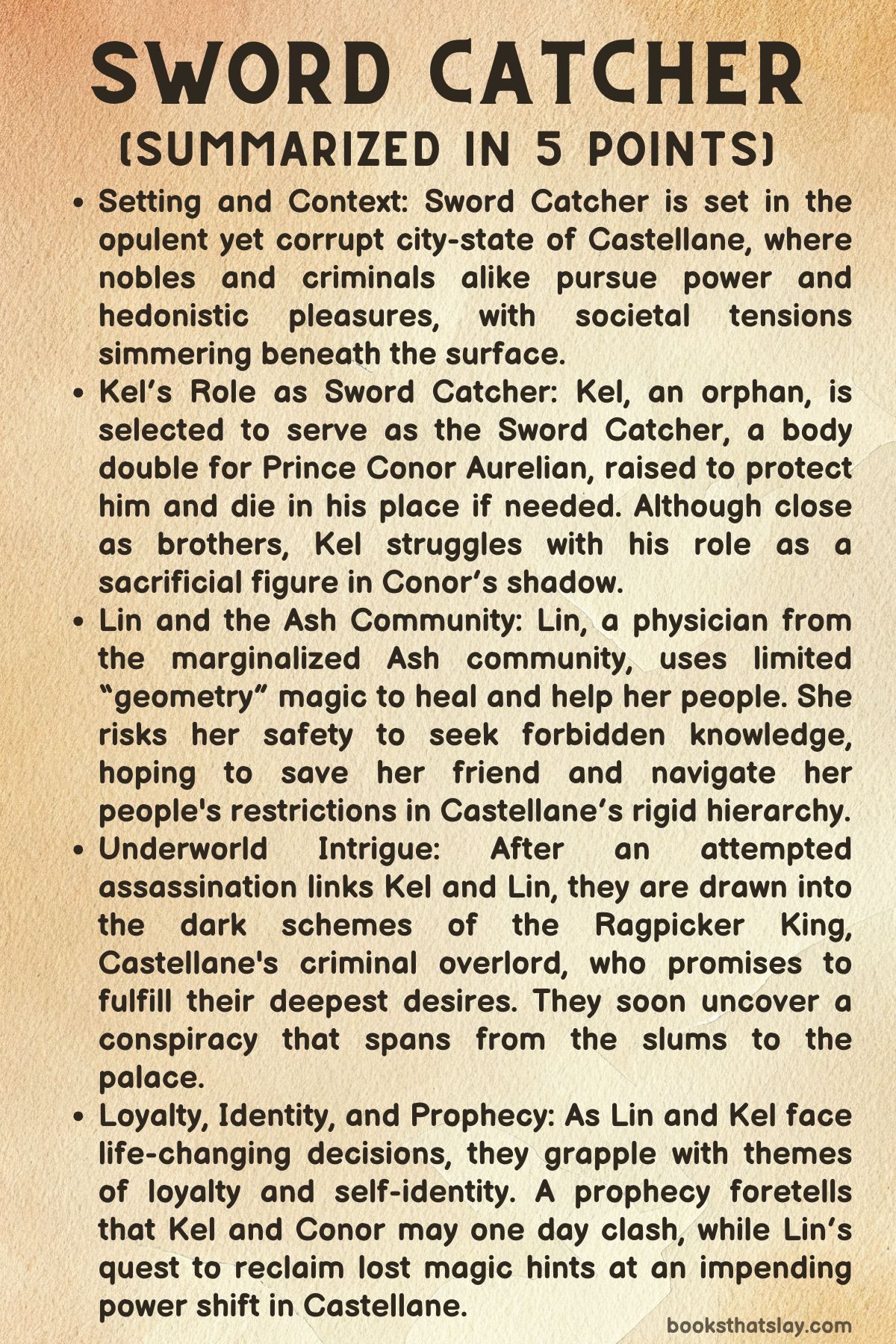
Sword Catcher by Cassandra Clare is the opening book of a new fantasy series set in the glittering, treacherous city of Castellane. At its core, the novel follows two characters whose fates intertwine with the destiny of the kingdom: Kel, an orphan chosen to become the body double of Prince Conor Aurelian, and Lin Caster, an Ashkar physician fighting prejudice and searching for knowledge forbidden to her people.
Through political intrigue, dangerous alliances, and shifting loyalties, both find themselves drawn into the hidden conflicts of nobles, criminals, and magicians. Clare builds a vivid, layered world full of secrets, ambition, and peril, where identity and power constantly collide.
Summary
The story begins with Legate Aristide Jolivet arriving at an orphanage in Castellane. His mission, under the King’s command, is to retrieve a boy named Kel, a mischievous orphan with striking features.
Despite the protests of Sister Bonafilia, Kel is taken to the Palace of Marivent, where he learns his life is about to change forever. Mayesh Bensimon, the King’s Ashkar counselor, explains that Kel will impersonate Prince Conor Aurelian at a banquet, aided by a talisman that enhances the illusion.
Though nervous, Kel succeeds in passing as the Prince, winning approval from the King and Queen. Soon after, he meets Conor himself, who reveals Kel has been chosen as the Sword Catcher, a body double destined to protect the Prince’s life.
For the first time, Kel is offered belonging, education, and purpose, and he accepts.
Years pass, and Kel grows into his role as Conor’s double and shield. At twenty-three, he faithfully serves the reckless Prince, who is pressured to marry for political advantage.
During Castellane’s Independence celebration, Kel takes Conor’s place to deliver a public speech, stirring a crowd that believes him to be their Prince. Though he knows the adoration is not meant for him, the experience leaves him shaken.
That night, Kel and Conor slip into the city for revelry, setting the tone of their close but unequal bond: one living freely as royalty, the other carrying the weight of duty.
Parallel to Kel’s story, Lin Caster is introduced. A determined Ashkar physician, she faces prejudice in her quest for medical knowledge.
Her attempts to buy a manuscript are thwarted, reminding her of her people’s exclusion from the Academie. Lin’s true motivation is more urgent—her friend Mariam suffers from a mysterious illness she cannot cure.
During the Independence festivities, Mariam collapses in Valerian Square just as Prince Conor delivers his speech. While the crowd ignores them, a royal carriage ordered by Mayesh carries them away, deepening Lin’s resentment toward her grandfather’s loyalty to House Aurelian over family.
Meanwhile, Conor and Kel explore the city’s pleasure houses, meeting nobles and courtesans in the Caravel. Kel secretly attends a meeting with Merren Asper, a chemist and poisoner, to investigate dangerous toxins that threaten Conor.
But before he can act further, Kel is kidnapped and brought before the Ragpicker King, Castellane’s criminal ruler. The Ragpicker King reveals he knows Kel’s true role as Sword Catcher and attempts to recruit him into uncovering which noble family backs his rival, Prosper Beck.
Though Kel refuses, the encounter shows him how precarious his position truly is, caught between palace and underworld.
Lin’s story deepens as she struggles with her heritage and her connection to Mayesh. Despite his claims of serving the kingdom to ensure Ashkar representation, Lin feels abandoned by him.
When she discovers hints that lost manuscripts, possibly containing crucial medical knowledge, may have fallen into the Maze, she resolves to act. She seeks out Kel’s help, and together they navigate the dangerous black markets.
Their uneasy alliance strengthens as both realize they are outsiders in their own ways. Kel’s protective instincts and Lin’s determination gradually forge trust, though neither escapes the shadow of their entanglements with greater powers.
Events escalate when Kel impersonates Conor at a grand banquet, only for assassins known as the Skulls to attack. The Gallery erupts in chaos, nobles fighting for survival, and Kel desperately struggling to protect Conor.
Despite his efforts, Princess Luisa is killed, sparking a crisis that reveals how vulnerable the royal family truly is. Amid the bloodshed, Kel witnesses unsettling displays of power—Vienne d’Este’s ferocity and King Markus’s unnatural strength.
Before dying, the noble Gremont warns Kel to “trust no one on the Hill,” leaving him with more questions than answers. Jolivet later confronts him, urging him to act as a bridge between the palace and the Ragpicker King.
In the aftermath, Castellane reels. War with Sarthe looms, the fleet is sabotaged, and Kel is pushed into working secretly with the Ragpicker King while maintaining loyalty to Conor.
He becomes entangled in double service, balancing noble intrigue with criminal power. His devotion to Conor is tested against the growing realization that the Prince’s recklessness endangers not just himself but the kingdom.
At the same time, Lin makes a bold choice during the Tevath Festival. When asked if she is the Goddess reborn, she declares “Yes.” The declaration shocks her community, but when explosions in the harbor coincide with her words, many take it as divine proof.
Lin becomes a symbol overnight—both revered and endangered. She understands that by seizing this role, she has placed herself in the heart of Castellane’s struggles, whether she is prepared for it or not.
By the novel’s conclusion, both Kel and Lin stand at critical turning points. Kel, once an orphan without purpose, is now deeply enmeshed in political and criminal plots, bearing responsibilities that stretch far beyond his vow to protect Conor.
Lin, once a physician fighting for scraps of knowledge, has elevated herself to a figure of prophecy and power, forcing her into dangerous prominence. Castellane itself stands at a crossroads, its fragile balance between nobility, underworld, and the Ashkar fractured.
Betrayals, alliances, and war hover on the horizon, promising that both Kel and Lin’s choices will shape the fate of the kingdom.
Characters
Kel
Kel is introduced as an orphan, mischievous and bright, whose life is suddenly uprooted when he is chosen to become the Prince’s Sword Catcher. His character is defined by a constant duality: though born into poverty, he is raised to mirror royalty, always inhabiting a life that is not fully his own.
Kel’s identity struggles are central to his arc—he is both indispensable and invisible, admired when mistaken for Conor, but otherwise dismissed. Despite this, Kel possesses deep loyalty, not only to Conor but also to the role he has come to embody.
His strength lies in his ability to endure danger, sacrifice his individuality for another, and yet still maintain his own cunning and wit. What makes him compelling is his awareness of the precariousness of his position—he is always walking the line between noble and expendable, protector and pawn, all while secretly longing for meaning that goes beyond mere imitation.
Prince Conor Aurelian
Conor embodies the archetype of the charming yet reckless heir. Charismatic, witty, and dazzling in public, he thrives in the adoration of his people but remains careless about the responsibilities tied to his power.
He is indulgent, preferring flirtations, gambling, and pleasures of the court over political obligations. Yet beneath this gilded surface lies insecurity and fragility—he leans heavily on Kel to stabilize him, both literally and emotionally.
Their friendship is deeply layered; Conor loves Kel as his brother and counterpart, but also takes him for granted, never truly understanding the weight of Kel’s sacrifices. His recklessness ultimately collides with tragedy, as seen in his failure to protect Luisa, forcing him to confront the consequences of his actions.
Conor is a character torn between the illusions of grandeur and the harsh realities of leadership.
Lin Caster
Lin represents resilience and defiance against systemic oppression. As a young Ashkar physician, she is constantly fighting not only for her patients but also for her right to exist in spaces that actively exclude her.
Her ambition to study, her skill in medicine, and her relentless pursuit of forbidden knowledge define her as someone unwilling to accept limitations imposed upon her by birth. Yet her motivations are not solely rooted in ambition—her desperation to save Mariam gives her struggle a deeply personal and emotional dimension.
Lin’s arc grows more precarious as she steps into larger destinies, from being a marginalized physician to declaring herself the Goddess reborn. She is both pragmatic and idealistic, determined and vulnerable, a character who channels her pain and anger into courage but also risks becoming a symbol beyond her control.
Mayesh Bensimon
Mayesh is a figure of wisdom and pragmatism, one who balances loyalty to the throne with his identity as an Ashkar. His presence is shaped by contradictions: he is a man of principle who sacrifices family ties for political duty, yet he never abandons his role as a reminder of Ashkar humanity at court.
His relationship with Lin is particularly poignant; he admires her strength and intellect, even as his own choices have distanced them. He functions as both mentor and warning—embodying the cost of compromise and the thin line between survival and betrayal.
His layered loyalties make him a deeply complex character, caught between service to power and fidelity to his people.
The Ragpicker King (Andreyen Morettus)
The Ragpicker King is Castellane’s shadow ruler, embodying the city’s underworld with charisma and menace. He thrives in secrets, manipulation, and power plays, making him as much a political force as the nobles on the Hill.
His encounters with Kel are particularly compelling, as he recognizes in Kel both a potential ally and a vulnerable pawn. What distinguishes him is his vision—he sees the corruption of the noble class and attempts to weave his influence as an alternative power structure.
Unlike Prosper Beck, who represents brute criminality, the Ragpicker King is more enigmatic, clever, and strangely principled. He forces Kel into a dangerous balancing act, becoming both adversary and uneasy ally, and his presence foreshadows that the true battles in Castellane lie as much in the shadows as in the throne room.
Antonetta Alleyne
Antonetta begins as a childhood companion in Kel’s journey, later emerging as a woman caught in the expectations and machinations of noble society. Intelligent and observant, she is too often overlooked in a world that values her beauty over her mind.
Yet her moments with Kel reveal her depth: she recognizes the emptiness behind her gilded role and yearns for genuine connection. The tragedy of her character lies in the way her cleverness is dismissed, particularly by the very nobles who once admired her.
Her forced entanglement with Artal Gremont further underlines her lack of agency in her own life, yet she continues to fight quietly, carving out dignity where little is allowed.
Merren Asper
Merren is introduced as a student chemist and poisoner, embodying a darker, sharper intellect than most of the noble youths surrounding Conor. His fascination with poisons reflects both a rebellion against the society that wronged his family and a belief in the equalizing power of death.
Merren is a foil to Kel in many ways—while Kel sacrifices his own life for Conor, Merren embraces a philosophy that strips power from those who cling to status. Their brief, charged intimacy underscores Merren’s complexity; he is drawn to Kel but repelled by his reckless devotion to an ideal of service.
His bitterness and brilliance make him a dangerous ally and a tragic figure, driven by both trauma and defiance.
Joss Falconet
Joss is the quintessential noble companion—worldly, witty, and indulgent. He represents the carefree and often shallow world Conor inhabits, but unlike some others in their circle, he shows flashes of conscience.
His willingness to apologize for past cruelty hints at self-awareness, though his primary function in the narrative is as part of the backdrop of nobility’s excess. He is not as reckless as Conor, but he remains emblematic of privilege, living in the gilded bubble that Kel and Lin so often stand outside of.
King Markus
King Markus is a figure shrouded in frailty and mystery. At times, he seems weak, incoherent, even dying—but moments of unnatural strength and cruelty suggest something more sinister beneath his exterior.
His role is pivotal in shaping the dangerous political climate of Castellane, as his decrees and actions ripple through the kingdom, but his personal presence evokes unease. His killing of Vienne in the Shining Gallery demonstrates the terrifying power he can wield when provoked, suggesting that beneath his weakness lies a ruthless survivor.
He represents the decay of monarchy but also its lingering, deadly authority.
Themes
Identity and Duality
The central premise of Sword Catcher rests on the construction of identity through duplicity. Kel, taken from obscurity and forced into the role of Prince Conor’s double, lives in constant tension between his own selfhood and the persona imposed upon him.
He embodies the paradox of being indispensable yet invisible—valued only for his ability to disappear into another’s life. His experiences at court, from impersonating Conor in ceremonies to enduring assassination attempts, reinforce the theme that identity is not always an internal truth but often a performance dictated by those in power.
The talisman that bends perception around him is a physical symbol of how society accepts appearances as reality, regardless of the person beneath. Yet, Kel’s private longings—his desire for belonging, his suppressed emotions for Antonetta, his loyalty to Conor—reveal a man struggling to define himself beyond the mask.
For Conor, the theme manifests differently. Though heir to the throne, his identity is bound by duty, politics, and expectations, leaving him envious of Kel’s freedom even as Kel envies his privilege.
Their relationship forms a mirror, each man reflecting what the other lacks, raising questions about whether identity is chosen, imposed, or an unstable blend of both. The narrative insists that duality shapes not just individuals but entire societies, where the nobility and the underworld, the Ashkar and the malbushim, exist in mirrored systems of hierarchy and exclusion.
Power and Corruption
From the gilded halls of Marivent to the shadows of the Maze, power saturates every corner of Sword Catcher, but it is never clean. The monarchy exerts authority through spectacle and tradition, parading Conor before adoring citizens while hiding Kel behind the mask of substitution.
Nobles wield influence through marriages, debts, and alliances, reducing individuals like Antonetta to pawns in dynastic games. Even the Ragpicker King, ruling Castellane’s underworld, mirrors the nobility’s machinations with his own brand of coercion and diplomacy, proving that corruption is not an exception but the very structure of governance.
The narrative emphasizes how power feeds on exploitation: orphans recruited for dangerous service, women bartered as brides, and marginalized groups like the Ashkar excluded from learning or leadership. Lin’s exclusion from medical scholarship despite her brilliance demonstrates how systems of control weaponize prejudice to maintain dominance.
Kel’s entanglement between palace and criminal underworld further highlights how corruption permeates every level, blurring the line between lawful and unlawful authority. Even Conor, with the crown within reach, is shackled by debts and reckless indulgence, his power hollowed out by irresponsibility.
Power here is never stable; it is constantly contested, corrupted, and repurposed, leaving both individuals and entire nations teetering on collapse.
Belonging and Exile
For both Kel and Lin, belonging is less a state of comfort than a battlefield. Kel, once an orphan, finds a family of sorts in Conor and the court, yet never escapes the knowledge that he is tolerated only as a replacement, not fully accepted as himself.
His proximity to power is both intoxicating and alienating, as every cheer for the “Prince” reminds him of his own disposability. Lin’s narrative parallels his in a different sphere: though she earns the distinction of being Castellane’s first female Ashkar physician, she remains excluded from scholarly circles and subjected to disdain for her heritage.
Her longing for access to knowledge and recognition reveals how exile is not always geographical—it can be social, cultural, and intellectual. Both characters navigate liminal spaces where they belong neither fully inside nor outside, creating a constant search for identity anchored in connection.
Their brief moments of intimacy—Kel kissing Lin to shield her identity in the Maze, or Lin confiding her desperation to save Mariam—show how belonging is forged in shared struggle against exclusion. The theme expands beyond individuals to encompass the Ashkar people, marked as outsiders in a city built on their labor and knowledge yet denying them equality.
Belonging, in this world, is not granted freely but must be seized, defended, and often paid for at terrible cost.
Fate and Choice
The trajectories of Kel and Lin repeatedly confront the tension between predestination and free will. Kel’s role as Sword Catcher appears to be sealed from the moment Jolivet plucks him from the orphanage, binding him to Conor’s fate by oath.
His life is structured around obedience and sacrifice, yet his defiance—refusing the Ragpicker King’s recruitment, coercing Jerrod into a deal, or risking himself for others—reveals the cracks where choice asserts itself. Lin, too, faces inherited expectations: her grandfather’s loyalty to the monarchy, her people’s diminished place in Castellane, and the Maharam’s authority over Ashkar women.
Yet she shocks all by declaring herself the Goddess reborn, a moment that transforms imposed destiny into self-claimed power. Both characters embody the precarious dance between surrendering to roles designed for them and daring to reshape those roles through will.
The narrative insists that fate is rarely absolute but instead manipulated by those who profit from control, whether kings, nobles, or criminal rulers. By acting—even recklessly—Kel and Lin remind us that choice may not erase fate but can redefine it, carving moments of agency in a world designed to strip it away.
Love, Loyalty, and Betrayal
The emotional core of Sword Catcher is built on bonds tested by loyalty and fractured by betrayal. Kel and Conor’s relationship oscillates between brotherhood and resentment, each dependent on the other yet burdened by imbalance.
Kel’s devotion often demands sacrifice of his desires, while Conor’s loyalty falters under the weight of privilege and recklessness. The theme extends into wider connections: Lin’s friendship with Mariam drives her desperate quest for forbidden knowledge, grounding her choices in love even when it risks her life.
Betrayal lurks constantly—Antonetta nearly sacrificed to a predatory noble, Mayesh accused of forsaking family for politics, the Ragpicker King demanding loyalty while holding secrets of his own. Love is not portrayed as a sanctuary but as a dangerous motivator, compelling characters to acts of defiance that reshape their lives.
Loyalty, too, is never simple; it binds Kel to Conor even when it demands he stand against justice, and it ties Lin to her people even as she defies their leaders. Betrayal becomes inevitable in a world where survival often requires choosing one bond over another, reminding us that the heart can be as dangerous a battlefield as any political intrigue.