A Tender Age Summary, Characters and Themes
A Tender Age by Chang-Rae Lee is a coming-of-age story about Jeon-Gi, a Korean American boy whose childhood is shaped by shame, fear, friendship, family devotion, cruelty, and his growing awareness of his own capacity to hurt others.
Looking back as an adult, he recognizes that childhood experiences do not simply disappear with age; they can remain active beneath later life. His memories move from the working-class world of Cove Gardens to a Korean church camp where he desperately seeks belonging, only to encounter new forms of rivalry, affection, humiliation, sexuality, guilt, and danger.
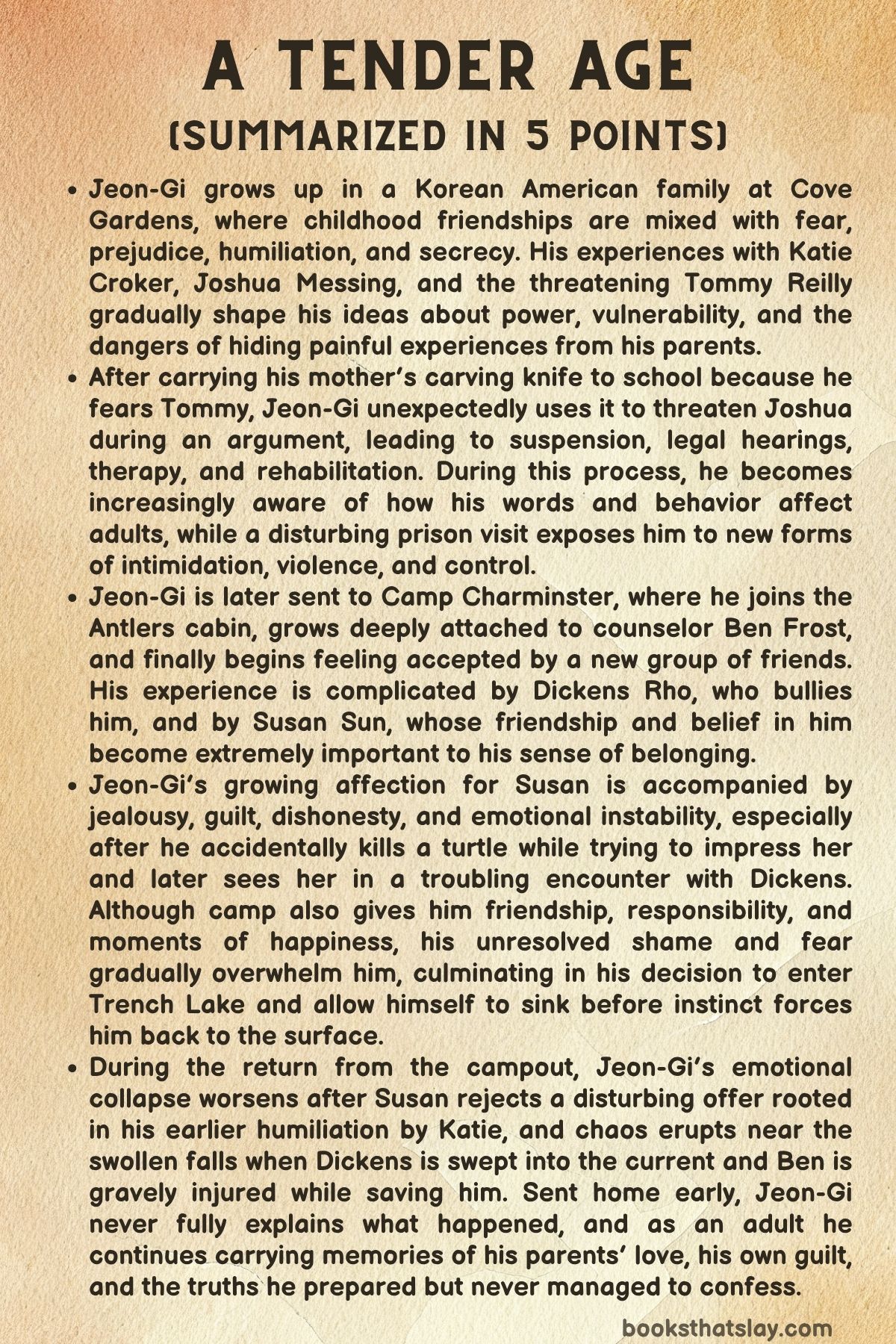
Summary
As an adult, Jeon-Gi remembers his childhood by first thinking about the family dog, Pu-chu, whose fear around food appears to have developed from earlier mistreatment. The animal’s inability to escape an old emotional wound becomes a way for Jeon-Gi to consider how experiences from childhood can survive long after the original danger has disappeared.
His own childhood takes place largely at Cove Gardens, a working-class apartment complex north of New York City where children create a social world that operates almost independently of adults. Friendship and play exist beside intimidation, rivalry, humiliation, and cruelty, and Jeon-Gi learns early that childhood relationships can carry serious emotional power.
One of the strongest figures in this world is Katie Croker, an older girl who secretly dominates Jeon-Gi. She draws him into humiliating encounters and discovers that his deepest vulnerability is his devotion to his Korean immigrant mother.
Katie eventually imitates his mother’s voice and orders Jeon-Gi to call his mother to the apartment window and shout obscenities at her. Terrified that Katie will reveal their private encounters to his father, he obeys, and his mother silently closes the window while he breaks down in shame.
For a time Jeon-Gi and his mother become emotionally distant, although she never openly confronts him about the incident. Katie eventually moves away, and mother and son recover much of their former closeness, but Jeon-Gi later recognizes the importance of what they never discussed.
His parents are also struggling with the problem of raising children in America while preserving Korean values. His mother worries that Jeon-Gi and his younger sister Ella are losing traditions of respect, while his father accepts cultural change more readily, and the family becomes increasingly involved with a Korean Presbyterian church.
Meanwhile, Jeon-Gi’s relationships at Cove Gardens become more complicated. He steals small amounts of money from his trusting friend Paul Dipinto and begins resenting Paul partly because deceiving him is so easy, revealing how quickly shame can transform into contempt.
His friendship with Joshua Messing also deteriorates. Joshua insults Jeon-Gi’s Asian appearance and uses a racial slur during basketball, Jeon-Gi answers with an antisemitic slur, and their friends prepare for the boys to settle their conflict through a fight.
A more frightening danger appears in Tommy Reilly, an isolated boy who begins threatening Jeon-Gi through a series of encounters. Tommy uses psychological intimidation and eventually confronts him with metal throwing stars, proposing that they throw the weapons at each other until the arrival of other children ends the encounter.
Jeon-Gi tells his parents nothing because he knows how much they sacrificed to move the family for better schools. His fear instead turns into fantasies of retaliation, and he takes his mother’s long carving knife, hides it in his school bag, and intends to carry it for protection against Tommy.
At school, however, events do not unfold as he expects. Tommy arrives with adults and a police officer and appears strangely powerless, which suddenly weakens Jeon-Gi’s revenge fantasy and exposes how frightened he still is.
Joshua then confronts Jeon-Gi over their unresolved feud and punches him. Jeon-Gi reacts almost instinctively by pulling out the knife and threatening Joshua in both Korean and English, using against Joshua the weapon he had actually brought because of Tommy.
The incident leads to suspension, hearings, psychological evaluations, and the possibility of juvenile punishment. Joshua’s family ultimately supports rehabilitation rather than the harshest legal response, while teachers and other adults describe Jeon-Gi’s violence as inconsistent with the child they normally know.
During therapy and assessment, Jeon-Gi gradually realizes that adults react strongly to what he says. He starts watching their pauses and expressions, experimenting with answers, and discovering that language can give him a surprising degree of control over people who are supposedly evaluating him.
His rehabilitation includes community activities and a visit to a prison meant to discourage children from future criminal behavior. There he encounters Sir Marbles, an inmate who describes having once been a promising student before violence connected to his mother and later prison experiences shaped his life.
The prison visit becomes deeply disturbing when inmates humiliate and frighten the young visitors. Jeon-Gi experiences genuine fear and sympathy but also recognizes an uncomfortable fascination with dominance, especially when he briefly feels that someone else’s fate has been placed in his hands.
His parents eventually decide to send him to Camp Charminster, a Korean church summer camp. Although he initially resists, Jeon-Gi understands that his recent troubles have exhausted his parents and affected the household, and part of him hopes the camp may offer a different experience.
At Charminster, he joins the Antlers cabin and meets boys including Mickey, Recipe, Jimmy Choi, Peter, David, and the two Sangs. Their counselor, Ben Frost, immediately becomes important to him because Ben combines confidence and physical ability with patience and kindness.
Jeon-Gi wants badly to succeed socially in this unfamiliar setting. That hope is threatened almost immediately by Dickens Rho, a confident boy who unexpectedly kicks Jeon-Gi in the chest after Jeon-Gi innocently offers him water, causing Jeon-Gi to fall and injure his face near a pump.
Despite opportunities to tell adults what happened, Jeon-Gi keeps Dickens’s attack secret. His cabinmates respond to his injury with concern and admiration, helping him feel accepted, while his silence repeats his established habit of privately carrying fear and humiliation.
His camp experience changes significantly when Susan Sun asks to speak with him privately. Susan is intelligent, outspoken, irreverent, and willing to challenge camp conventions, and Jeon-Gi is fascinated by the ease with which she speaks to him.
Susan tells him that she witnessed Dickens’s attack and knows Dickens bullied other campers previously. Her confirmation matters enormously because it assures Jeon-Gi that the violence was real and undeserved, and their private meeting begins an intense friendship.
As Jeon-Gi becomes more accepted by the Antlers, he also begins inventing stories about himself to appear more impressive. His desire to be liked makes the friendships precious to him but also gives them an unstable foundation because he fears that his real self may not be enough.
His growing attachment to Susan creates another problem. After finding a turtle for a terrarium they are making together, Jeon-Gi becomes jealous when he sees Susan playing with Dickens and forces the turtle through an opening that is too small, badly injuring it.
The turtle dies soon afterward. Susan reacts with a strange cry and runs away, while Jeon-Gi is left facing the knowledge that jealousy and the need to prove his devotion caused the needless death of something vulnerable.
The camp soon leaves for a difficult trip to Trench Lake. Jeon-Gi becomes increasingly attached to the Antlers and to Ben’s belief that the boys are capable of carrying greater responsibilities than they imagine.
During the hike, Dickens continues to irritate him, but Jeon-Gi also starts recognizing that Dickens possesses power partly because Jeon-Gi constantly reacts to him. At the falls, Jeon-Gi becomes overwhelmed by the thought that camp will soon end and cries because he loves his new friends yet feels guilty about the lies he has told them.
At the campsite, Jeon-Gi eagerly helps prepare dinner and takes responsibility for a large pot of stew. When the pot becomes too hot, he tries to move it, and Peter suffers a painful burn while assisting him.
Jeon-Gi immediately interprets the accident as proof of his failure and withdraws into the woods, imagining that everyone hates what he has done. Mickey quietly finds him and convinces him to return, where Jeon-Gi discovers that his friends have not rejected him.
The evening then turns unexpectedly joyful when Recipe and Susan appear with a birthday cake arranged by Jeon-Gi’s mother. During a group embrace, Susan’s lips touch his cheek, and Jeon-Gi happily interprets the contact as his first kiss.
Later that night, David wakes Jeon-Gi and persuades him to investigate an old pavilion where counselors have gathered privately. The boys secretly observe the adults drinking and behaving differently from their daytime roles before witnessing Herman and Brenda engaged in sexual activity.
Jeon-Gi barely understands what he sees. The experience forces him into another confusing encounter with adult behavior before he possesses the emotional or sexual knowledge necessary to interpret it.
The following day, Ben spends time with Jeon-Gi while replacing a rope swing and tells him about his own childhood and his father’s sudden death. Jeon-Gi’s admiration deepens because Ben represents the stable, capable male figure he increasingly trusts.
Jeon-Gi later sees Dickens undermine Susan by suggesting she would be prettier with long hair. His hostility toward Dickens intensifies, and he briefly imagines harming him, although Recipe pulls his attention back toward friendship and plans for staying connected after camp.
That night several campers secretly go to the Ledges and smoke stolen cigarettes. When Minha becomes sick, Jeon-Gi helps handle the situation, but during the stormy return he sees something that destabilizes him far more severely.
Near a utility hut, he sees Susan with Dickens. Susan appears rigid while Dickens presses against her and begins pushing up her shirt, and Jeon-Gi is left unable to understand whether he is witnessing intimacy, coercion, betrayal, or something even more troubling.
Jeon-Gi tells no one what he saw. During the flooded night at Trench Lake, he becomes almost emotionally empty, concentrating instead on breathing the foul air inside the crowded wet tent and almost wishing that it might somehow harm him.
Before dawn, he walks into Trench Lake wearing his clothes and deliberately allows himself to sink. His body eventually forces him back toward the surface, but the act shows how completely guilt, jealousy, shame, confusion, and accumulated fear have overwhelmed him.
During the miserable hike back, Susan notices his damaged boot and walks beside him with their arms linked. For a brief period he feels restored, but after she exchanges a silent look with Dickens, his insecurity returns and he makes a disturbing sexualized offer connected to his old humiliating experiences with Katie.
Susan reacts with disgust and leaves him. Jeon-Gi has reproduced language and behavior rooted in his own childhood victimization, turning unresolved humiliation into another act that damages a relationship he desperately values.
Near the swollen falls, events become catastrophic. Jeon-Gi rushes toward the water, Dickens is knocked into the powerful current, and Ben immediately jumps in after him.
Both are carried over the falls. Dickens survives with serious injuries, while Ben is far more gravely injured after trying to protect him, turning Jeon-Gi’s private conflicts into consequences that can no longer be contained within childhood rivalries.
Jeon-Gi is sent home early, but his parents never force him to give a complete account of what happened. Reverend Hahm believes they should demand the truth, yet the family instead resumes ordinary life and eventually stops attending the church.
Years later, Jeon-Gi still carries several possible versions of what he might have confessed. He remembers his parents’ love, his mother’s later request for forgiveness, and the many experiences that remained unspoken between them.
His return as an adult to the old church does not erase the past or provide a neat resolution. Instead, Jeon-Gi enters the crowd of another immigrant congregation still carrying the child he once was and the truths he never completely expressed.
Characters
Jeon-Gi
Jeon-Gi is the emotional and psychological center of A Tender Age, and his adult recollections present childhood not as a simpler period of life but as a time when shame, desire, cruelty, love, and fear can be experienced with enormous force. He desperately wants approval while repeatedly concealing the parts of himself that he believes will cause rejection, creating a pattern in which secrecy protects him temporarily but gradually isolates him.
His strongest contradictions emerge from his simultaneous sensitivity and capacity for harm. He feels deeply for his mother, friends, animals, and adults such as Ben, yet he steals from Paul, threatens Joshua with a knife, injures the turtle, lies to his camp friends, hides his responsibility for Mickey’s poison-oak reaction, and develops fantasies of harming Dickens.
Jeon-Gi is especially vulnerable to humiliation because he turns other people’s judgments into measurements of his own worth. Katie’s domination, Tommy’s intimidation, Dickens’s bullying, Susan’s attention, the Antlers’ acceptance, and Ben’s approval all influence how he sees himself, so his behavior often changes according to whether he feels admired, threatened, exposed, or unwanted.
His adult perspective does not erase his responsibility. Instead, maturity allows him to recognize that the frightened child and the child capable of frightening others were the same person, leaving him with memories that resist simple categories of innocence and guilt.
Jeon-Gi’s Mother
Jeon-Gi’s mother is one of the most important emotional forces in A Tender Age, representing love, cultural continuity, sacrifice, and the limitations of communication within a family. Jeon-Gi’s devotion to her is so intense that Katie recognizes it as the vulnerability through which she can most effectively control him.
Her silence after Jeon-Gi shouts obscenities from outside the apartment window becomes especially significant because neither mother nor son knows how to repair the injury openly. She continues caring for him, yet the absence of direct conversation teaches Jeon-Gi that painful experiences can remain buried even inside a loving family.
She is also concerned about what American life is doing to her children’s Korean identity. Her fear that Jeon-Gi and Ella are losing habits of respect reflects the challenges of immigrant parenting, while the language gap between her Korean and Jeon-Gi’s stronger English increasingly complicates emotional communication.
Her later request for forgiveness reverses Jeon-Gi’s assumption that he alone carries guilt. It suggests that she, too, looks back on his childhood wondering what she failed to understand, what she might have asked, and whether love without enough communication allowed some of his deepest fears to remain hidden.
Jeon-Gi’s Father
Jeon-Gi’s father brings a quieter form of parental love to A Tender Age, approaching his son with concern rather than immediate condemnation even after the knife incident. His decision to take Jeon-Gi to the waterfront and gently ask why he threatened someone reveals his wish to understand rather than simply punish.
At the same time, he cannot help Jeon-Gi with dangers he does not know exist. Because Jeon-Gi hides Tommy’s intimidation, his father and mother wrongly assume Joshua was the central cause of the knife episode, showing how even attentive parents can misunderstand a child who has learned to conceal fear.
He is more willing than his wife to accept that their children will change through growing up in America. That difference does not make him indifferent to Korean identity; rather, it presents him as someone attempting to adjust expectations to the reality of immigrant family life.
His relationship with Jeon-Gi demonstrates one of the story’s recurring tensions: parental love can be real and generous while still failing to reach the private territory where a child’s most dangerous thoughts are developing.
Susan Sun
Susan becomes one of the defining figures in Jeon-Gi’s camp experience and one of the central relationships in A Tender Age. Her intelligence, humor, irreverence, and confidence immediately distinguish her from the people Jeon-Gi usually tries to impress, because she speaks to him with unusual directness and seems willing to question the rules around them.
Most importantly, Susan believes Jeon-Gi about Dickens before Jeon-Gi even tells her the truth. By revealing that she witnessed the attack, she validates his perception and briefly offers what he has often lacked: another person who understands that something happened without requiring him to defend or explain himself.
Jeon-Gi’s feelings for Susan soon become entangled with possessiveness and insecurity. His jealousy over her interaction with Dickens contributes to the turtle’s death, while the later scene near the utility hut destabilizes him because he cannot interpret what he sees or separate concern for Susan from his own fear of losing her.
Susan finally becomes the person before whom Jeon-Gi’s unresolved childhood humiliation resurfaces most destructively. His disturbing offer during the return hike causes her to recoil, showing how intimacy becomes damaged when he tries to manage vulnerability through behavior shaped by earlier shame.
Dickens Rho
Dickens occupies an unstable position in A Tender Age because Jeon-Gi experiences him simultaneously as bully, rival, social ideal, and threat. His first unprovoked attack establishes him as dangerous, yet his calm appearance afterward makes the violence psychologically harder for Jeon-Gi to understand.
Adults seem to see a charming and admirable boy, while Susan confirms that his bullying has a longer history. This contrast intensifies Jeon-Gi’s resentment because Dickens appears capable of controlling how others perceive him, something Jeon-Gi himself increasingly wants to accomplish through lying and strategic self-presentation.
Dickens’s relationship with Susan further increases his power over Jeon-Gi. Whether Jeon-Gi sees him insulting her appearance or standing physically close to her, Dickens becomes attached in Jeon-Gi’s imagination to fears of inadequacy, sexual confusion, jealousy, and exclusion.
His fall into the swollen current transforms the rivalry into physical catastrophe. Once Ben risks his own life to save Dickens, the emotional battle Jeon-Gi has been conducting privately is connected to consequences far more serious than anything he had consciously intended.
Ben Frost
Ben Frost is Jeon-Gi’s strongest positive adult attachment at camp. His calm confidence, athletic skill, practical competence, humor, and kindness make him a figure Jeon-Gi admires almost immediately, while Ben’s willingness to entrust responsibilities to the campers gives Jeon-Gi a sense that someone believes he can be useful.
Their conversations deepen that connection. When Ben describes growing up in Vermont and losing his father suddenly, Jeon-Gi sees something vulnerable beneath the counselor’s confidence, making Ben feel more fully human rather than simply an idealized authority figure.
Ben also repeatedly refuses to define Jeon-Gi by failure. He supports the boys during difficult tasks, defends the badly smoked stew after the accident, and treats responsibility as something children can learn rather than something reserved for adults.
His decision to leap into the swollen water after Dickens represents the most extreme expression of that responsibility. The injuries he suffers turn him into a painful reminder that courage may demand action without time for certainty, and Jeon-Gi must live with the knowledge that the adult he admired was gravely hurt within a crisis connected to his own emotional collapse.
Katie Croker
Katie Croker establishes many of the emotional patterns that Jeon-Gi later repeats. Older, feared, and socially powerful, she controls him through secrecy and humiliation while making her attention feel important enough that he continues returning to her despite being frightened.
Her greatest power comes from understanding that Jeon-Gi’s love for his mother can be turned against him. By forcing him to insult his mother publicly and threatening to expose their private encounters, Katie teaches him to associate vulnerability with the possibility of domination.
The effect lasts far beyond Katie’s disappearance from Cove Gardens. When Jeon-Gi later uses a disturbing offer with Susan that is connected to his earlier experiences with Katie, the story demonstrates that humiliation can survive in behavior long after the person who originally caused it is gone.
Katie therefore matters not only because of what she does but because Jeon-Gi never fully speaks about what she did to him. The silence surrounding their encounters becomes part of the emotional structure he carries into later relationships.
Joshua Messing
Joshua begins as a friend but becomes a rival when racial and religious insults enter their conflict. His slur against Jeon-Gi leads Jeon-Gi to retaliate with an antisemitic insult, showing two children reaching for inherited forms of prejudice when trying to wound each other personally.
The knife confrontation dramatically changes Joshua’s role. He believes he is entering another stage of their playground rivalry, but Jeon-Gi’s concealed fear of Tommy causes him to respond with a level of violence Joshua could not reasonably anticipate.
Joshua’s distress afterward shows that threatening violence can have lasting consequences even when no physical stabbing occurs. His family’s eventual willingness to support rehabilitation for Jeon-Gi is therefore significant because it combines recognition of the seriousness of the act with a refusal to define a child permanently by one terrifying moment.
Tommy Reilly
Tommy is the figure who pushes Jeon-Gi from ordinary childhood conflict toward carrying a deadly weapon. His isolation, threatening behavior, slingshot encounter, psychological intimidation, and use of throwing stars make him seem unpredictable enough that Jeon-Gi begins organizing his movements around fear.
What makes Tommy especially important is that Jeon-Gi never tells his parents about him. The adults therefore investigate the knife incident without understanding the fear that originally led Jeon-Gi to bring the weapon to school.
When Tommy later appears with adults and a police officer, he suddenly seems diminished. Jeon-Gi discovers that having the knife has not made him brave and that the fantasy of violent retaliation was largely an attempt to escape the feeling of helplessness.
Paul Dipinto
Paul represents uncomplicated trust, which becomes difficult for Jeon-Gi to tolerate. Jeon-Gi secretly steals small amounts of change from him and then begins despising Paul precisely because Paul is easy to deceive.
This reaction reveals Jeon-Gi’s tendency to transfer guilt onto the person he has wronged. Instead of allowing Paul’s trust to expose his own misconduct, he treats that trust as weakness, showing how shame can be converted into contempt when admitting wrongdoing feels too threatening.
Paul’s role is comparatively small, but it provides an early example of Jeon-Gi experimenting with hidden power. The pattern anticipates the pleasure he later feels when discovering that carefully chosen answers can unsettle therapists and other adults.
Ella
Ella, Jeon-Gi’s younger sister, occupies the edge of many major events but remains important as evidence that his crises affect the entire household. Jeon-Gi snaps at her when his fear of Tommy becomes unbearable, redirecting anger toward someone who has not caused it.
Her presence also broadens the parents’ concerns about cultural identity. Their questions about how children should behave in America apply not only to Jeon-Gi but to Ella as well, making the family’s immigration experience larger than one troubled child.
Ella is often protected from the full details of what Jeon-Gi experiences. That distance emphasizes how private his emotional life becomes even among people living inside the same small apartment.
Recipe
Recipe becomes one of Jeon-Gi’s most meaningful friends among the Antlers. He offers companionship without the threatening social competition Jeon-Gi associates with Dickens and repeatedly helps redirect him toward connection rather than resentment.
Their conversation about remaining friends after camp is especially important because Jeon-Gi has come to value the Antlers intensely while knowing that some of the image he presented to them was based on lies. Recipe therefore represents the possibility that friendship might continue beyond the temporary world of camp.
He also participates in Jeon-Gi’s birthday surprise and later relies on Jeon-Gi when Minha disappears. His trust gives Jeon-Gi chances to act responsibly even while other parts of his emotional life are becoming increasingly unstable.
Mickey
Mickey offers one of the clearest examples of ordinary kindness among the Antlers. When Jeon-Gi withdraws into the woods after Peter’s injury and convinces himself that everyone despises him, Mickey seeks him out, brings him a drink, and calmly encourages him to return.
This matters because Mickey does not respond to Jeon-Gi’s failure with humiliation. Instead, he treats the accident as something survivable, providing a form of friendship that contradicts Jeon-Gi’s assumption that mistakes inevitably lead to rejection.
Jeon-Gi’s later guilt over secretly causing Mickey’s serious poison-oak reaction makes the relationship more painful. Mickey’s generosity exists beside a hidden injury for which Jeon-Gi has not accepted open responsibility.
Peter
Peter is seriously burned while helping Jeon-Gi move the overheated stew pot. His injury becomes another event Jeon-Gi immediately interprets as proof that he is dangerous to people around him.
Yet Peter’s accident is different from Jeon-Gi’s intentional cruelties because it occurs during an attempt to help the group. Jeon-Gi struggles to preserve such distinctions, tending instead to gather every mistake into a larger belief that there is something fundamentally wrong with him.
Peter therefore becomes important less through his individual development than through what Jeon-Gi’s reaction to his injury reveals about escalating guilt.
David
David shares with Jeon-Gi one of the camp’s most confusing secrets when he wakes him to investigate the counselors at the pavilion. More knowledgeable about sexuality than Jeon-Gi but still clearly unsettled by what they witness, David is another child confronting adult behavior before fully understanding it.
His invitation also reveals the intense curiosity operating beneath camp rules. The boys want access to the hidden world of adults but discover that seeing something is not the same as being emotionally prepared to interpret it.
Afterward David falls asleep while Jeon-Gi remains awake and troubled. Their different responses underline Jeon-Gi’s tendency to retain experiences and repeatedly turn them over in his mind.
Sir Marbles
Sir Marbles initially appears almost reassuring during the prison visit because he is articulate, intelligent, and willing to explain how his life changed. His story about defending his drug-addicted mother from mistreatment gives Jeon-Gi an example of how violence can emerge from love, rage, humiliation, and the belief that force is justified.
The later change in the prison encounter complicates that sympathy. Sir Marbles becomes part of an atmosphere of intimidation in which the young visitors are frightened and humiliated, exposing how a person can be both understandable and terrifying.
His greatest importance for Jeon-Gi comes when authority over another person seems briefly placed in the boy’s hands. That instant forces Jeon-Gi to experience the seductive and disturbing feeling of possessing power rather than simply being subject to it.
Dahlia
Dahlia is one of the adults who helps maintain camp life and is present when Jeon-Gi is found after entering the lake before dawn. Her role becomes especially important at the moment when Jeon-Gi’s private despair finally produces behavior that places his life in immediate danger.
She is also part of the counselors’ hidden adult world, including the late-night gathering Jeon-Gi and David secretly observe. This difference between counselor and private individual contributes to Jeon-Gi’s growing realization that adults possess identities and desires children do not normally see.
Herman and Brenda
Herman and Brenda become important primarily through the sexual encounter secretly witnessed by Jeon-Gi and David. They do not know they are being observed, yet their private behavior becomes psychologically significant to children who lack the knowledge to understand fully what they have seen.
For Jeon-Gi, the incident adds adult sexuality to an already confusing mixture of bodily shame, domination, romantic attraction, jealousy, and curiosity. Their privacy unintentionally becomes part of his rapidly changing understanding of intimacy.
Minha and George
Minha and George are connected to the secret nighttime trip to the Ledges. Recipe fears that Minha has gone there with George, leading him and Jeon-Gi to follow and discover the group smoking stolen cigarettes.
When Minha becomes violently sick, the situation gives Jeon-Gi an opportunity to behave responsibly. Instead of creating danger, he helps calm the others and supports the effort to return safely.
Their subplot therefore briefly shows Jeon-Gi functioning as someone others can depend on. That capable version of him makes his later emotional collapse more striking because it demonstrates that his instability cannot be reduced to a simple inability to act responsibly.
Cleon and Berto
Cleon and Berto inadvertently rescue Jeon-Gi during the threatening encounter with Tommy and the throwing stars. Their arrival causes Tommy to disappear before the confrontation becomes more dangerous.
Their presence demonstrates how completely Jeon-Gi’s fear has been hidden from the other children. They do not arrive as deliberate rescuers because they do not know the full situation, yet their ordinary presence is enough to break Tommy’s private control over Jeon-Gi.
Osvaldo
Osvaldo appears shortly before the knife incident while discussing an arrangement involving bribes connected with playground captaincy. His ordinary childhood concern creates a sharp contrast with the weapon Jeon-Gi is secretly carrying.
Through Osvaldo, the story briefly shows that Jeon-Gi is moving through normal school routines while privately preparing for possible violence. The contrast emphasizes how invisible serious fear can remain to people nearby.
Jimmy Choi and the Two Sangs
Jimmy Choi and the two Sangs form part of the Antlers community that gives Jeon-Gi a new opportunity for belonging. Individually they receive less attention than Recipe, Mickey, Peter, or David, but collectively they help create the cabin identity Jeon-Gi comes to treasure.
Their acceptance contributes to his emotional investment in camp. Because he has lied in order to appear more interesting, every ordinary act of friendship from the Antlers also increases his guilt about whether they would like the person he actually is.
Krista, Maggie, and Marvin
Krista, Maggie, and Marvin are fellow participants in the rehabilitation program who become targets during the frightening prison visit. Their fear makes the exercise feel real rather than theatrical to Jeon-Gi.
Watching them being intimidated forces him to consider vulnerability from an observer’s position. He feels sympathy but also becomes conscious of his own fascination with the distribution of power between the prisoners and the children.
Reverend Hahm
Reverend Hahm becomes most significant after the disaster at camp. He believes Jeon-Gi’s parents should press their son to explain exactly what happened rather than allowing the event to remain hidden.
His position contrasts with the family’s established habit of leaving certain painful experiences unspoken. The parents ultimately do not force a confession, and the family later stops attending the church.
Reverend Hahm therefore stands for the possibility of direct confrontation with truth. Whether such confrontation would have helped Jeon-Gi cannot be known, but his advice emphasizes how much of Jeon-Gi’s life has been shaped by secrets left untouched.
Pu-chu
Pu-chu, the family dog, appears at the beginning of Jeon-Gi’s adult reflections and provides an important model for understanding memory. The dog’s strange fear of eating seems connected to earlier mistreatment, even though the original source of danger is no longer present.
Jeon-Gi recognizes something of himself in this persistence. Pu-chu demonstrates that the body and mind can continue reacting to an old experience long after circumstances have changed, which helps explain why Jeon-Gi returns so powerfully to events that occurred decades earlier.
Themes
The Lasting Power of Childhood Experience
Childhood in A Tender Age is not presented as a temporary stage whose injuries naturally disappear with maturity. Jeon-Gi’s memories show how fear, humiliation, affection, guilt, and desire can become emotional habits that survive long after the original people and places have vanished.
Pu-chu’s behavior establishes this idea immediately: the dog responds to food according to an earlier experience of mistreatment rather than to the safety of the present. Jeon-Gi’s adult recollections operate similarly, because he can return mentally to Katie’s control, his mother closing the apartment window, Tommy’s threats, the knife, Susan, Dickens, Ben, and the falls with extraordinary emotional immediacy.
The most troubling example is Jeon-Gi’s interaction with Susan during the return hike. Language and behavior originating in his humiliation by Katie reappear years later in a different relationship, suggesting that unprocessed experiences may be repeated rather than merely remembered.
The book therefore treats memory as active rather than archival. Growing older gives Jeon-Gi a greater ability to interpret what happened, but understanding does not undo the past, and his final return to the church confirms that adulthood still contains the emotional presence of the child he once was.
Shame, Secrecy, and the Failure to Communicate
Jeon-Gi repeatedly responds to painful experiences by concealing them, and every major secret increases the distance between his inner life and the people who might help him. He does not explain Katie’s control, does not tell his parents about Tommy, does not fully reveal why he carried the knife, hides his lies at camp, withholds what he sees between Susan and Dickens, and never gives his parents a complete account of the catastrophe near the falls.
Silence offers temporary protection because speaking would expose him to embarrassment, punishment, disbelief, or rejection. Yet every avoided conversation also leaves him alone with interpretations formed by a frightened child who often lacks the knowledge necessary to understand what he has experienced.
His relationship with his mother demonstrates the emotional cost most clearly. Both care deeply for each other, but cultural and language differences make communication harder, while the family’s tendency to continue functioning without directly addressing certain wounds allows guilt to survive beneath ordinary affection.
The later question of confession therefore becomes larger than any single event. Jeon-Gi imagines multiple versions of truth without delivering them, and his mother eventually asks him for forgiveness, revealing that silence has produced uncertainty on both sides rather than protecting either of them from regret.
Power, Cruelty, and the Desire for Control
Power repeatedly shifts between children, adults, victims, observers, and aggressors. Katie controls Jeon-Gi through shame, Tommy controls him through fear, Dickens unsettles him through physical violence and social confidence, while Jeon-Gi himself discovers ways of gaining power through theft, lies, threats, manipulation, and carefully chosen responses during psychological evaluations.
These relationships show that cruelty is often connected to vulnerability rather than being its opposite. Jeon-Gi’s most harmful actions frequently occur after he feels humiliated, jealous, powerless, or afraid, as though hurting someone else could temporarily reverse the position in which he has been placed.
The prison visit makes this pattern especially visible. Jeon-Gi is frightened by the inmates yet becomes disturbed by his own fascination when authority over another person appears to be placed momentarily in his hands, allowing him to feel the attraction of control even while recognizing its ugliness.
The story refuses to divide everyone into permanent victims and permanent aggressors. Jeon-Gi can suffer genuine mistreatment while also harming Paul, Joshua, the turtle, Mickey, Susan, and others, making responsibility more demanding because being hurt does not erase the damage a person later causes.
Belonging, Identity, and the Fear of Rejection
Jeon-Gi openly tells Susan that what he wants is for people to like him, and that admission explains much of A Tender Age. His behavior is repeatedly shaped by the hope of belonging somewhere without being exposed as weak, strange, dishonest, culturally different, or unworthy of affection.
At Cove Gardens, belonging is tied to the dangerous social codes established by children themselves. Jeon-Gi participates in rivalries, insults, theft, fights, and secrecy partly because social survival requires understanding who possesses status and who can be safely challenged.
Camp Charminster seems to offer a chance for reinvention. Surrounded by other Korean American children, Jeon-Gi finds friends in the Antlers, admiration for Ben, and emotional excitement with Susan, yet he immediately begins inventing stories because he fears that acceptance depends on becoming more interesting than he believes himself to be.
His cultural identity produces a related uncertainty. His parents worry about whether their children are becoming too American, while Jeon-Gi moves between Korean family expectations, English-dominant friendships, church life, and a broader American childhood culture, never occupying only one world.
Belonging consequently becomes both comforting and dangerous. The Antlers show him that friendship can be generous, but his fear of losing affection makes him jealous, dishonest, and increasingly desperate, revealing that acceptance cannot provide security when a person remains convinced that the unaltered self may not deserve it.