A Thousand Painted Hours Summary, Characters and Themes
A Thousand Painted Hours by Barbara O’Neal is a historical novel about an artist whose life is shaped by India, Britain, two world wars, colonial politics, family obligation, and a love that survives decades of separation.
At its center is Elsie Turner, who looks back from wartime London on the choices that carried her from a privileged childhood in India to artistic independence and a troubled marriage in England. Her connection with Tanveer, an Indian prince she has known since childhood, becomes the emotional constant of her life. Art, memory, political change, violence, friendship, and the search for personal freedom give the story its broad historical and emotional scope.
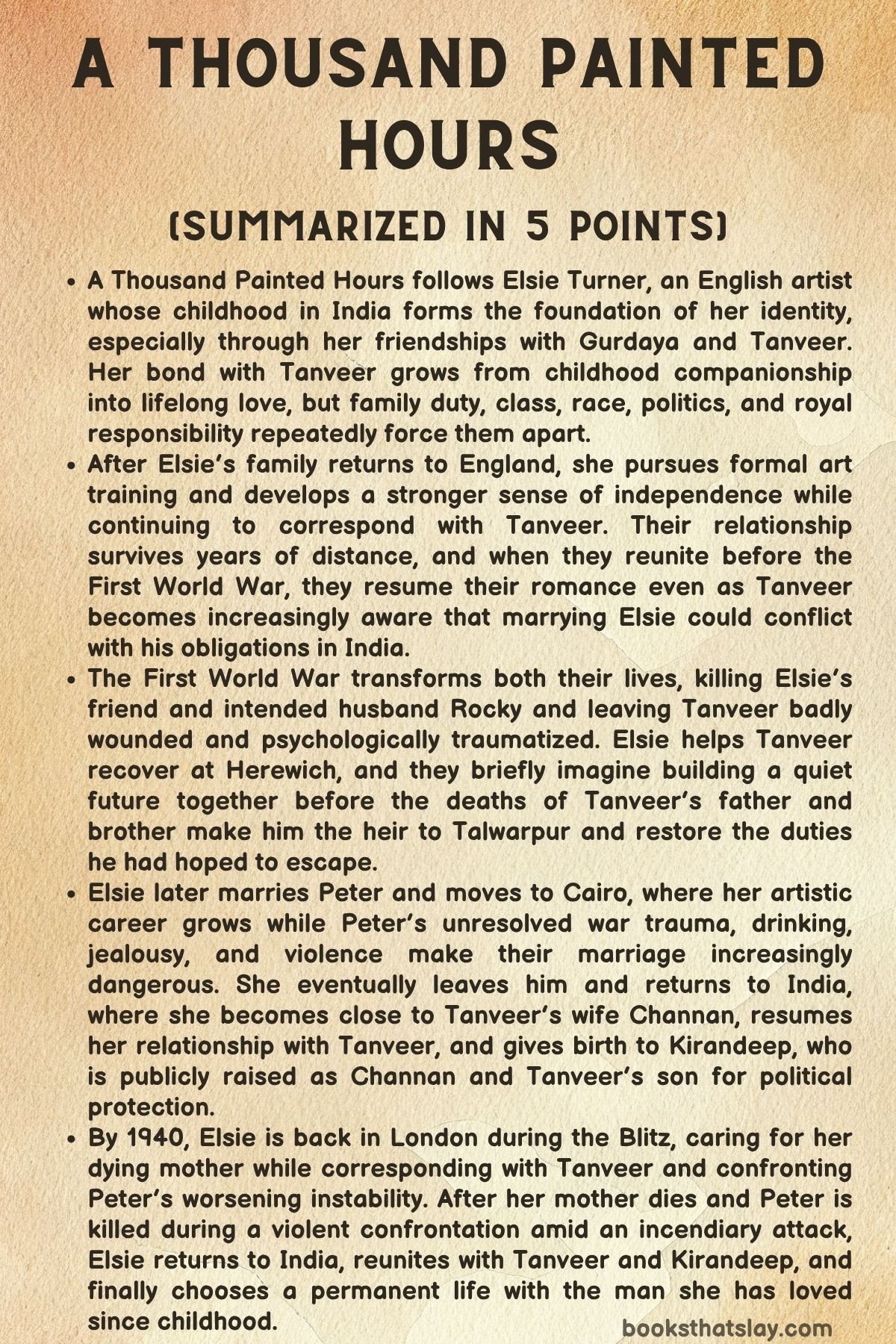
Summary
In London in 1940, Elsie Turner lives under the growing threat of German bombing with her husband Peter and her seriously ill mother. A dinner party where guests receive cyanide tablets in case Britain is invaded establishes the fear surrounding daily life, while Elsie’s attic studio and paintings continually carry her thoughts toward India, the place where her story truly began.
Elsie spent much of her childhood in Nainital, where her mother’s recurring malaria made the mountain climate preferable to the plains. At ten, Elsie met Gurdaya and Tanveer, the children of the Maharani of Talwarpur, and immediately formed a special connection with Tanveer through drawing, languages, animals, astronomy, and their shared curiosity about the world.
A tiger terrorizing nearby villages became one of the defining experiences of their childhood. Elsie and Tanveer once saw the magnificent animal near the palace garden but remained silent because they did not want it killed; after it later took another human life, the adults hunted it down, forcing the children to confront the conflict between beauty, freedom, danger, and responsibility.
As the years passed, Elsie, Tanveer, and Gurdaya spent joyful summers roaming the hills and swimming at a secluded pond. Elsie and Tanveer’s friendship gradually became romantic, and by the time Elsie was fifteen they were secretly kissing, discussing the barriers created by status and family expectations, and eventually becoming lovers.
Their happiness ended when Elsie’s father unexpectedly inherited the title of Earl of Herewich after his elder brother died. The family had to return to England, separating Elsie from the country she considered home and from Tanveer, who promised he would always love her even as both understood how many forces stood against them.
England initially felt cold, rigid, and foreign to Elsie, but she eventually found possibilities there through Nina, Peter, Rocky, and the artistic world surrounding the Slade School of Fine Art. Nina became one of her closest friends, while Rocky encouraged her seriousness about painting and helped her recognize that becoming an artist required developing a personal way of seeing rather than simply mastering technique.
Elsie and Tanveer resumed writing despite an earlier attempt to end their correspondence. Their letters preserved the childhood practice of identifying “one small beauty,” but they also matured into intellectual exchanges about empire, women’s freedom, education, politics, art, and the assumptions behind British representations of India.
When Tanveer visited England in 1914, he and Elsie immediately rediscovered their old intimacy. Their reunion culminated during a country-house weekend, where they became lovers again while political tensions in Europe and arguments about British imperial power made the uncertainty of their future impossible to ignore.
The outbreak of the First World War separated them once more. Tanveer concluded that marrying an English aristocrat would undermine his political responsibilities in India, while Elsie’s own ambitions might be diminished by becoming part of a royal household, and the two painfully agreed that love alone could not remove those realities.
Elsie then accepted an unusual proposal from Rocky, who was attracted to men and wanted a marriage that would protect both of them from social pressure. Their arrangement might have allowed Elsie to retain her independence and continue loving Tanveer, but war intervened again: Rocky joined the military and was later killed, while Tanveer was badly wounded after experiencing the horrors of industrial warfare.
When Tanveer was hospitalized in Brighton, Elsie cared for him through both his physical injuries and severe psychological distress. She later brought him to the nearly deserted Herewich estate, where gardening, food, books, walking, art, quiet companionship, and the ordinary rhythm of domestic life slowly helped him reconnect with the world.
Their effort to remain only friends eventually failed, and they became lovers again. For a brief period they imagined living modestly at Herewich after the war, supporting themselves through work and creating a life free from the expectations attached to aristocracy and royalty.
That possibility disappeared when Tanveer’s father and older brother were killed in an accident, suddenly making Tanveer the next heir. Elsie understood that his political responsibilities now required alliances, legitimacy, and a position in India that could be damaged by openly building his future around an English aristocrat, so she again chose separation rather than ask him to abandon the work that defined him.
After the war, Elsie lost her brother William to influenza and, because of inheritance laws, also lost Herewich. The 1919 massacre at Jallianwala Bagh intensified Tanveer’s opposition to British rule and complicated his emotional relationship with an Englishwoman, leading the pair toward another painful distance.
Elsie eventually married Peter, while Tanveer also entered a marriage shaped by responsibility rather than romantic fulfillment. Elsie and Peter moved to Cairo, where the unfamiliar light and surroundings revitalized her painting career, but Peter’s unresolved war trauma gradually produced nightmares, drinking, paranoia, aggression, and violence.
Elsie tried to understand Peter’s suffering and even asked Tanveer how he had survived similar psychological wounds. Compassion reached its limit, however, when Peter physically attacked her and later forced his way into her studio while intoxicated, making Elsie recognize that trauma could explain his behavior without obliging her to remain in danger.
An invitation from Channan, Tanveer’s wife, gave Elsie the opportunity to leave Cairo and return to India in 1926. Her reunion with Tanveer and Gurdaya felt like a recovery of the home she had been forced to abandon, although Elsie initially intended only to paint Channan’s portrait and then continue elsewhere.
Instead of becoming rivals, Elsie and Channan developed a genuine friendship. Channan revealed that the attack which scarred her had also left her unable to have sexual relations or bear children, that Tanveer had married her knowing the truth, and that he had also been honest about continuing to love Elsie.
Channan astonishingly encouraged Tanveer and Elsie to stop denying their relationship. The two became lovers again, while Elsie also established firm boundaries with Peter and her mother, refusing to return to a marriage in which she no longer felt safe.
The months at Talwarpur became one of the happiest periods of Elsie’s life. She painted with renewed confidence, Channan studied watercolor, and Elsie, Tanveer, and Channan formed an unconventional household whose most profound transformation came when Elsie discovered that she was pregnant with Tanveer’s child.
To protect the family politically, Channan publicly presented the pregnancy as her own. Elsie gave birth to Kirandeep, but the boy was officially raised as the son of Tanveer and Channan, creating a family founded not on conventional definitions but on secrecy, sacrifice, trust, and the love of three adults for the same child.
Political instability ultimately destroyed Elsie’s security in India once again. When angry villagers invaded the palace searching for the “foreign witch,” Elsie realized that her presence could endanger Tanveer’s political position, Channan’s safety, and Kirandeep’s future, so she made the devastating decision to leave without her son.
By 1940, Elsie is therefore living in London while Tanveer, Channan, and Kirandeep remain in India. She and Tanveer continue writing through the Blitz, sustaining one another with memories, political observations, ordinary domestic details, and the old practice of searching for modest instances of beauty amid destruction.
The bombing also forces Elsie to confront the decline of her mother and the deterioration of Peter’s stability. She learns that her mother had maintained her own secret relationship with Garvey for years, a revelation that angers Elsie because the same woman who cautioned her against an unconventional life with Tanveer had concealed an unconventional attachment of her own.
After Elsie’s mother dies during a devastating raid, Elsie discovers Peter drunk in her studio, surrounded by her private sketchbooks and turpentine. Believing she will abandon him, he threatens either a joint suicide using their cyanide tablets or death by fire, but an incendiary bomb ignites the turpentine during their struggle and Peter burns as Elsie escapes.
With her mother and Peter dead and her London home destroyed, Elsie decides to return to India permanently. During the voyage she also learns that Channan has died, making the journey both a homecoming and an encounter with another major loss.
In Bombay, Elsie is reunited not only with Tanveer but with thirteen-year-old Kirandeep. She keeps the secret that she is his biological mother, honoring the family arrangement and Channan’s place in his life, while Tanveer asks her never to leave him again.
Back at Talwarpur, Elsie and Tanveer once again stand beneath the stars as they did when they were children. After decades in which war, empire, family, duty, marriage, violence, and circumstance repeatedly decided their future, they finally choose to remain together, and Elsie accepts Tanveer’s proposal of marriage as a tiger roars in the distance, connecting their final decision to the memory that began their shared life.
Characters
Elsie Turner
Elsie is the central consciousness of A Thousand Painted Hours, and nearly every major historical event in the book is filtered through her memories, relationships, and artistic vision. Born into a British family but emotionally rooted in India, she grows up resisting the assumption that nationality, gender, class, or inheritance should dictate the shape of her life.
Her identity as an artist is inseparable from her emotional development. Painting gives her refuge during war, independence within restrictive social structures, financial resources when her marriage deteriorates, and a method of preserving people and moments that history continually threatens to erase.
Elsie is also capable of difficult forms of sacrifice. She repeatedly leaves Tanveer when remaining with him would damage his obligations, and her most painful choice is leaving Kirandeep because she believes her presence threatens the safety and political future of the people she loves.
Her return to India in 1940 completes a long movement toward self-determination. By then she no longer accepts other people’s definitions of duty automatically, and her decision to remain with Tanveer reflects a woman who has survived enough loss to understand that individual happiness also deserves protection.
Tanveer
Tanveer is Elsie’s childhood companion, intellectual equal, lover, and eventual life partner, but A Thousand Painted Hours never limits him to the role of romantic hero. From childhood onward, he is curious about language, astronomy, animals, history, and politics, while his position within the Talwarpur royal family continually connects his private life to larger responsibilities.
His adult character is shaped profoundly by colonial politics and the First World War. Military service destroys his earlier ideas about heroic combat, leaving him physically wounded and psychologically traumatized, while later events such as Jallianwala Bagh strengthen his commitment to political change in India.
Tanveer repeatedly gives up Elsie because he fears that marrying an English aristocrat would damage his credibility and responsibilities. His choices can hurt her because he sometimes turns political necessity into a decision he makes for both of them, but he gradually learns that duty cannot be the sole measure of a meaningful life.
By the final scene, his proposal represents a significant change. He still believes public service matters, but he has reached the conclusion that private love and personal existence also possess moral value.
Peter
Peter is one of the most difficult figures in A Thousand Painted Hours because the story presents both the origins of his suffering and the danger he becomes to others. Before the First World War he belongs to Elsie’s sophisticated social circle, but combat and imprisonment leave lasting psychological injuries that neither time nor ordinary domestic life resolves.
His later marriage to Elsie initially offers companionship and practical stability rather than overwhelming romance. In Cairo, however, nightmares, alcohol, jealousy, traumatic memories, and episodes of dissociation produce increasingly frightening behavior, culminating in physical and sexual violence.
The book refuses to suggest that wartime trauma makes his actions harmless. Elsie comes to understand that she can acknowledge the source of Peter’s pain while also recognizing that remaining near him has become dangerous, a distinction symbolized by her comparison of him to an injured wild animal.
Peter’s final confrontation with Elsie reveals the catastrophic result of his possessiveness and deteriorating mental state. His decision to threaten murder and suicide in the studio turns the place where Elsie creates and remembers into a site of destruction, and his death during the incendiary attack ends a marriage that had long ceased to provide safety.
Elsie’s Mother
Elsie’s mother is loving, unconventional, protective, and deeply contradictory. Having spent much of her own life in India and treated people regardless of caste, she gives Elsie a model of female capability that is far less restrictive than conventional aristocratic expectations.
Yet she is also one of the people who insists that Elsie must accept practical barriers surrounding Tanveer. She recognizes the strength of her daughter’s feelings but believes money, nationality, race, politics, and social position cannot simply be defeated through personal determination.
Their later conflict becomes sharper when Elsie learns that her mother maintained a secret connection with Garvey. The discovery makes her earlier warnings about Tanveer seem hypocritical to Elsie, especially because her mother had claimed freedoms in her own emotional life while urging greater conformity from her daughter.
Her final illness nevertheless shows the depth of the bond between mother and daughter. Elsie’s anger never erases love, and her mother’s death during the Blitz closes one of the longest relationships in Elsie’s life at the same moment that Elsie is preparing to choose a radically different future.
Nina
Nina is one of Elsie’s most important friendships in A Thousand Painted Hours, offering companionship that survives youth, marriage, war, aging, and decades of personal change. She first helps Elsie adjust to England by showing her that aristocratic society contains people capable of questioning its expectations rather than merely obeying them.
Nina understands the compromises required of women in their social class and therefore becomes someone with whom Elsie can discuss marriage, children, independence, regret, and the alternative lives neither woman lived. She also knows enough about Tanveer to understand that his position in Elsie’s emotional world is permanent.
Her loyalty is practical as well as emotional. She provides private opportunities for Elsie and Tanveer when they are young, shelters Elsie’s paintings during the Blitz, worries about Peter’s instability, and offers Elsie and her mother a place in the country when London becomes increasingly dangerous.
Nina represents the value of friendship outside romantic love. When Elsie escapes the burning studio after Peter’s death, Nina is the person she reaches, making their relationship one of the dependable structures that has carried Elsie through repeated crises.
Gurdaya
Gurdaya initially appears aloof when Elsie first meets Tanveer’s family, but she eventually becomes one of Elsie’s oldest and most enduring friends. Their shared summers in Nainital transform her from the distant older sister into an equal participant in the trio’s games, swimming, arguments, discoveries, and private adventures.
As an adult, Gurdaya develops into a confident woman whose position gives her considerable social strength. Her friendship with Elsie resumes naturally when she visits Cairo, and she quickly senses that Peter’s behavior is more dangerous than Elsie is willing to admit.
Gurdaya also serves as a bridge back to India. Her invitation and encouragement help Elsie imagine leaving Cairo, and she later assists in protecting the unusual family created by Elsie, Tanveer, Channan, and Kirandeep.
Her importance lies partly in continuity. She remembers the child Elsie was before England, war, marriage, and loss altered her life, and her presence reinforces the idea that Elsie’s Indian past has never disappeared simply because geography separated her from it.
Channan
Channan becomes one of the most remarkable figures in A Thousand Painted Hours because she refuses the role of jealous wife that Elsie initially fears she might occupy. Scarred and physically injured by an earlier attack, she entered marriage knowing that she could not have a conventional sexual relationship or bear children, while Tanveer entered it after honestly admitting that his deepest romantic love belonged elsewhere.
Her friendship with Elsie develops independently of Tanveer. During portrait sittings, the women speak about art, family, loneliness, women’s lives, physical suffering, and the identities that exist underneath public titles such as wife or maharani.
Channan’s decision to encourage Elsie and Tanveer to become lovers demonstrates unusual emotional generosity, but her role extends much further. When Elsie becomes pregnant, Channan accepts Kirandeep publicly as her own child, protects the political stability of the household, and becomes his mother in every social and emotional sense.
Her later death occurs before Elsie’s final return, but her influence remains active through Kirandeep. By preparing the boy for the possibility that Tanveer and Elsie might eventually marry, Channan continues shaping the family even after she is gone.
Kirandeep
Kirandeep gives A Thousand Painted Hours one of its most complicated forms of love because his existence binds Elsie, Tanveer, and Channan together permanently. Biologically he is Elsie and Tanveer’s son, but political necessity requires the world to believe that Channan gave birth to him.
For Elsie, motherhood becomes inseparable from sacrifice. She adores Kirandeep but eventually concludes that taking him away would deprive him of his father, Channan, his royal identity, and the future awaiting him in India.
Channan’s motherhood is equally genuine despite the biological secret. The arrangement challenges any simple assumption that parenthood belongs only to the person who gives birth, since Kirandeep is loved and protected through a deliberate family structure created by all three adults.
When Elsie meets him again at thirteen, she does not reveal the truth. Her decision honors Channan’s role and protects Kirandeep from a revelation that would transform his understanding of his family at a moment when he is already grieving.
Rocky
Rocky is central to Elsie’s development as an artist and to her understanding of unconventional adulthood. As a Slade student, he treats artistic ambition seriously and helps Elsie see professional art as something she can pursue rather than merely a genteel accomplishment.
He is especially important when Elsie begins questioning the colonial assumptions in her early paintings. Instead of protecting her from doubt, Rocky encourages her to study other artists, examine her own work honestly, and accept uncertainty as a necessary part of finding an individual artistic language.
His proposed marriage to Elsie is also an attempt to create freedom inside a restrictive society. Because he is attracted to men and she remains in love with Tanveer, their planned marriage would give both social protection without requiring either to deny an essential part of themselves.
His death in the First World War destroys that possibility. Rocky therefore represents both the creative promise of Elsie’s youth and the enormous number of alternative futures erased by war.
Betty
Betty is the household figure whose daily labor becomes increasingly important during the Blitz. Her cooking, shopping, movement through the neighborhood, and knowledge of local supplies help Elsie maintain a household when rationing and bombing make ordinary routines difficult.
Her temporary disappearances reveal how easily war disrupts the lives of ordinary civilians. During one raid she becomes stranded after transport collapses and survives because Mrs. Foster, a stranger, gives her food and shelter; later, she is badly injured and hospitalized.
Betty’s role also reflects Elsie’s attention to domestic work as meaningful rather than trivial. Food preparation, cleaning, shopping, animal care, and shelter are repeatedly shown as essential acts of survival when public systems and grand political structures fail.
William
William, Elsie’s brother, has absorbed English aristocratic expectations far more completely than Elsie has. After the family returns from India, he immediately treats her future marriage as an economic matter because Herewich is financially unstable and the family needs advantageous connections.
His attitude frustrates Elsie because he views the rules of class and inheritance as practical realities that must be managed rather than structures that can be questioned. Yet his concerns also reveal the fragile financial condition hidden beneath aristocratic status.
William survives the First World War only to die from influenza on his way home. His death also demonstrates the injustice of inheritance laws, because Herewich cannot pass to Elsie despite her connection to the estate, leaving her without the home around which so much of her wartime life had been organized.
Elsie’s Father
Elsie’s father is thoughtful and less conventionally imperial than many British officials around him, having built his earlier life in the Indian Civil Service without expecting to inherit an aristocratic title. His sudden succession as Earl of Herewich becomes one of the decisive events in Elsie’s life because it requires the entire family to leave India.
He cares for Elsie but believes responsibility can demand choices individuals dislike. His response to the dangerous tiger illustrates this outlook: although Elsie argues that the animal was there before humans, he insists that protecting human lives must come first.
His decision to return to England similarly reflects obligation rather than cruelty. To Elsie, however, it demonstrates how inheritance and institutions can alter an individual life instantly without consulting the person who must bear the emotional cost.
The Maharani of Talwarpur
The Maharani introduces Elsie to Gurdaya and Tanveer and therefore indirectly makes possible the defining relationships of Elsie’s life. Her friendship with Elsie’s mother also allows the children to spend increasing amounts of time together during the Nainital summers.
She represents a world Elsie initially encounters through friendship rather than through the distant political categories used by British society. Through the maharani’s family, palace, children, and household, India becomes personal and specific for Elsie rather than an abstract imperial possession.
Her presence also contributes to Elsie’s lifelong resistance to simplistic divisions between British and Indian life. The intimacy between the two families gives Elsie experiences that later make crude colonial assumptions increasingly difficult for her to accept.
The Maharaja of Talwarpur
Tanveer’s father embodies the royal and political responsibilities that ultimately shape his son’s choices. As Tanveer grows older, his education and future are planned around the duties expected of a prince, even though Tanveer initially assumes his elder brother will inherit instead.
His political world makes clear why Tanveer cannot treat marriage as an entirely private decision. Alliances, British authority, Indian reform, public legitimacy, and dynastic expectations all surround the family.
His death alongside Tanveer’s older brother completely changes Tanveer’s future. The accident makes Tanveer the successor and destroys the quiet life he and Elsie had begun imagining at Herewich, proving again how quickly public obligation can overtake private intention.
Garvey
Garvey appears largely through Elsie’s mother and the secrets surrounding her private life. Elsie had believed him dead long before discovering a later letter proving that her mother maintained contact with him for years.
His existence becomes important because it changes Elsie’s interpretation of her mother. The woman who once warned her about the practical impossibility of a life with Tanveer had herself preserved a relationship beyond conventional boundaries.
Garvey’s eventual death from cancer also contributes to the loneliness that draws Elsie’s mother back toward England and greater dependence on Peter. Though he remains outside the central action, his relationship with her exposes the distance between public respectability and private emotional truth.
Themes
Love Versus Duty
The central conflict between private love and public obligation begins when Elsie and Tanveer are still young enough to believe that personal desire ought to be sufficient. As they grow older, nationality, race, inheritance, colonial power, royal responsibility, money, gender, family expectation, and eventually parenthood repeatedly demonstrate that intimate decisions can carry consequences far beyond two people.
A Thousand Painted Hours does not treat duty as automatically noble or love as automatically selfish. Tanveer’s decision not to marry Elsie is rooted partly in a genuine fear that an English aristocratic wife would compromise his responsibilities in India, while Elsie’s later departure from Talwarpur comes from the equally serious belief that her presence threatens Tanveer, Channan, and Kirandeep.
The cost of these choices accumulates over decades. Both characters repeatedly sacrifice the relationship in order to protect someone or something larger, but the novel gradually questions whether endless self-denial is itself a responsible way to live.
The ending changes the balance rather than dismissing duty. Tanveer continues to value politics, reform, art, and public responsibility, yet he finally recognizes that individual human lives also possess value and that allowing outside forces to dictate every private choice has already taken too many years from them.
Art, Memory, and Preservation
Elsie’s paintings function as an alternative record of history. Wars are normally remembered through armies, leaders, battles, governments, and destruction, but her attention repeatedly settles on faces, kitchens, gardens, mothers, animals, gestures, domestic labor, friendships, changing light, and ordinary people living inside extraordinary events.
Her artistic development also requires her to question the way she looks at India. Tanveer challenges early paintings that reproduce picturesque colonial assumptions, and Elsie eventually recognizes that her strongest work comes from observing particular human beings with knowledge, attention, and affection rather than reducing them to representatives of an exotic culture.
Painting becomes especially significant because the physical world is so vulnerable. Bombs can destroy houses, studios, canvases, sketchbooks, and entire neighborhoods in minutes, which makes Elsie’s effort to move her work out of London an attempt to preserve decades of personal and cultural memory.
Even when objects disappear, however, artistic attention has changed Elsie herself. The habit of seeing carefully allows her to preserve people internally, making art not simply a collection of surviving canvases but a disciplined way of recognizing that moments matter before they vanish.
War, Trauma, and Survival
The two world wars create a continuous background of loss rather than two isolated historical episodes. Elsie experiences the deaths of friends, the psychological destruction of soldiers, rationing, aerial bombing, civilian injury, collapsing households, and the knowledge that a generation can construct an imagined future only to watch political events erase it.
Tanveer and Peter provide contrasting responses to wartime trauma. Both return from the First World War psychologically damaged, but Tanveer gradually finds ways to live with his memories through companionship, writing, study, walking, political purpose, and his relationship with Elsie, while Peter increasingly turns toward alcohol, denial, jealousy, rage, and control.
The contrast does not imply that recovery depends simply on willpower. Tanveer himself explains that mechanized war exposed soldiers to experiences for which they had little emotional preparation, and the novel repeatedly rejects contempt toward traumatized men.
At the same time, suffering does not remove personal responsibility toward others. Elsie eventually understands that acknowledging Peter’s wounds cannot require accepting violence, while caring for Tanveer succeeds partly because he allows himself to receive help without turning Elsie into the object of his pain.
Beauty, Home, and the Persistence of Life
The practice of identifying “one small beauty” begins as a childhood game between Elsie and Tanveer, but it gradually becomes an emotional philosophy. A flower, a bird feather, stars, music, a garden, a cat, food, a painting, or an ordinary conversation can temporarily restore proportion when political events make human existence appear dominated by violence.
This idea gives A Thousand Painted Hours its understanding of beauty as attention rather than escape. Elsie never denies suffering when she notices something beautiful; instead, the beautiful object exists beside destruction and reminds her that war has not acquired total ownership over human experience.
The same principle shapes the book’s treatment of home. England is Elsie’s ancestral country, yet India is where she first experiences belonging, and her repeated returns reveal that home is created through language, memory, relationships, sensory familiarity, chosen responsibilities, and the feeling of being fully recognized.
The final tiger and the stars bring childhood imagery into Elsie and Tanveer’s last decision. The tiger recalls both freedom and death, while the stars recall decades of separation and continuity, allowing the ending to acknowledge that beauty has never protected them from grief even though it has repeatedly given them a reason to continue living.