A Trade of Blood Summary, Characters and Themes
A Trade of Blood by Robert Jackson Bennett is a fantasy mystery centered on an investigation that begins with the ritualistic death of a young woman and gradually exposes a conspiracy involving rival families, biological manipulation, buried history, and imperial secrets.
Investigator Ana Dolabra and her engraver assistant Dinios Kol enter a region already close to open conflict, only to discover that the apparent murder is part of a much older pattern. The book combines detective work with questions about inherited power, family obligation, technological control, and the moral consequences of using living beings as instruments of economic or political ambition. It’s the 3rd book in the Ana and Din Mysteries series.
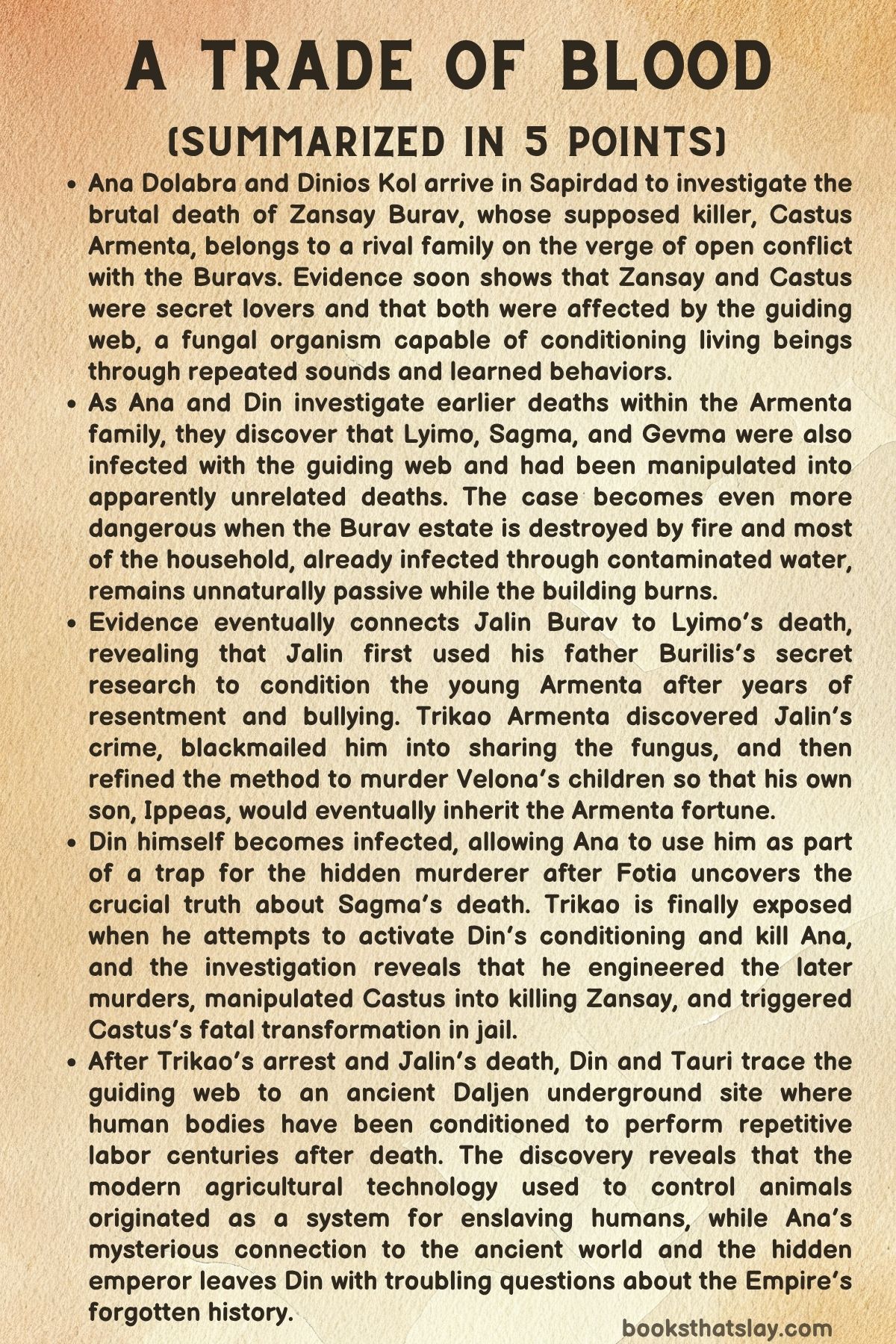
Summary
Ana Dolabra and Dinios Kol travel to the agricultural canton of Sapirdad after the murder of Zansay Burav threatens to ignite a violent feud between two powerful gentry families. Zansay belongs to the wealthy Buravs, while the man accused of killing her, Castus Armenta, comes from a rival clan whose conflict with the Buravs could destabilize one of the Empire’s important food-producing regions.
When Ana and Din arrive in Lacanthim, armed retainers from both families have nearly turned the town into a battlefield. Ana immediately establishes control, while Din begins examining the crime and learns from innkeeper Ithia that Zansay and Castus were not enemies at all but secret lovers who had met for more than a year and intended to escape their families together.
Zansay’s body presents disturbing contradictions. She has been precisely cut with a serrated blade, yet she bears no defensive wounds, and the position of the blood suggests that she calmly lowered herself to the floor after receiving injuries that should have produced panic.
Castus gives an equally strange account. He says that a beautiful song placed him in a dreamlike condition associated with memories of his work in the Armenta flensing halls, after which he regained awareness to discover Zansay cut open and dying without resistance.
Ana recognizes that the behavior resembles conditioning rather than ordinary violence. She connects the song to the guiding web, a fungal organism used to control altered drokha-cats by pairing sounds with learned actions until certain tones can compel the animals to repeat trained behavior.
Zansay’s corpse reacts when Ana tests particular tones, confirming that something biological remains active inside her. The discovery becomes more disturbing when the investigators learn that Burilis Burav, Zansay’s father, possesses expert knowledge of the guiding web and helped establish the agricultural technology used throughout the region.
Attention then turns to the Armentas, whose family has suffered several apparently unrelated deaths. Velona Armenta has lost Lyimo, Sagma, and Gevma under strange circumstances, and Castus now appears destined for execution, convincing her that a curse has been destroying her children.
Din’s investigation becomes personal when he discovers that his younger sister Fotia, whom he has not seen for six years, works closely with the Armentas. She is also in love with Ippeas Armenta, Trikao’s son, forcing Din to confront both the case and the family relationships he neglected after entering imperial service.
Ana and Din visit Velona at the Armenta estate and learn that the dead family members suffered recurring dreams before their deaths. These dreams involved repetitive familiar actions, leading Ana to suspect that the victims had been unknowingly conditioned through the guiding web before being commanded to kill themselves or place themselves in fatal situations.
Imperial Sublime Tauri and a team of Orbiis agricultural specialists examine Zansay. An autopsy reveals extensive fungal growth inside her skull, proving that the guiding web has somehow been adapted to infect human beings.
Suspicion initially points strongly toward Burilis because of his knowledge of the fungus. Before he can be questioned, however, the Burav estate is consumed by a catastrophic fire during a gathering attended by nearly the entire family.
The behavior of those trapped inside makes clear that the fire was another engineered killing. Many Buravs remain motionless or act as though dreaming while flames surround them, while Jalin Burav, who lives separately and has therefore received less exposure to the contaminated household water, remains capable of independent action.
Tests reveal that the Burav well contains the guiding web. Beneath the destroyed estate, investigators also discover a heavily protected vault, suggesting that Burilis had concealed something far more important than ordinary family wealth.
Ippeas becomes a temporary suspect because he had been seen near the estate before the fire. He explains that an anonymous message had promised evidence capable of clearing Castus, drawing him toward the Buravs and suggesting that someone deliberately intended to implicate or kill him.
Meanwhile, evidence shows that Burilis frequently entered the ancient altered forest near Lacanthim. With Fotia’s help, Din identifies a route into the forest and joins Tauri’s Orbiis officers in discovering a concealed work site filled with instruments and materials used for experiments involving the guiding web.
Ana investigates Burilis’s professional past and discovers that he once worked extensively near the forbidden forest before suddenly claiming to have discovered an unusually effective form of the guiding web. His discovery created much of the Burav family’s fortune, suggesting that his public story concealed the true source of the organism.
The danger increases when Castus’s infection suddenly erupts inside the jail. Fungal growth bursts from his skull, yet his body continues trying to perform the cutting motions he had practiced for years in the flensing halls, proving that a conditioned host can be forced to act even after suffering injuries that should make movement impossible.
The preserved remains of Lyimo, Sagma, and Gevma are consequently examined. All three show signs of guiding-web infection, establishing that the supposed Armenta curse was actually a sequence of murders carried out through biological conditioning.
Din notices a distinctive injury on Lyimo’s body that resembles the pointed hawk design on Jalin Burav’s ring. The clue connects Jalin to the earliest death and suggests that he was directly present when Lyimo drowned.
Jalin escapes medical custody before he can be questioned. Inside the Burav vault, however, Ana discovers ancient Daljen materials, biological research, and bottles connected to Lyimo’s death, along with a surviving housekeeper named Madi Istelia.
Istelia describes Jalin as a sensitive and deeply unhappy young man who despised the cattle industry on which the region’s elite families depended. Lyimo had bullied him, and evidence indicates that Jalin experimented with his father’s guiding-web research to condition Lyimo before eventually drowning him when the conditioning failed to work perfectly.
Yet Jalin cannot explain all the murders. The later killings show far greater precision, leading Ana to conclude that someone discovered Jalin’s crime, learned about the fungus, and forced him into cooperation.
Din and Tauri later travel into the deeper forest and find Jalin dead after apparently taking his own life. Nearby, Burilis’s laboratory records establish that he experimented extensively with conditioning drokha-cats but do not prove that he successfully adapted the fungus for human control.
This raises a disturbing possibility: the organism may already have been capable of controlling humans before Burilis found it. The answer must therefore lie not with modern experimentation but with the ancient Daljen civilization whose ruins survive beneath the forest.
The investigation becomes even more dangerous when Din realizes that he has been infected himself. A vivid conditioned dream reproduces his room and restricts his ability to move, but his unusual engraver memory allows part of his consciousness to remain independent enough to recognize what is happening.
Ana concludes that selected wells at inns were deliberately contaminated so targets could be exposed repeatedly over long periods. Fotia then provides a crucial clue concerning Sagma’s death: what had been described as a rope around her neck was actually a ribbon associated with her regular dressing routine.
Ana understands that Sagma had been conditioned through a familiar activity. Rather than arresting anyone immediately, she sets a trap at the Green Drover and uses Din’s infection to tempt the hidden murderer into revealing himself.
A conditioned young man carrying a pipe appears first, but he proves to be a decoy. When the triggering music begins, Din becomes trapped inside his conditioned mental state and sees the real attacker approaching.
The murderer is Trikao Armenta. Protected from his own music, he attempts to kill Din and Ana, but Din’s engraver consciousness resists the conditioning long enough for Ana to stop Trikao with a powerful lypi weapon.
Ana reconstructs the conspiracy. Jalin began the violence by targeting Lyimo because of years of bullying and his hatred of the cattle economy, but his method was crude, forcing him to physically drown Lyimo after the conditioning failed to complete the murder.
Trikao discovered what Jalin had done and blackmailed him into sharing the guiding web. Trikao’s motive was inheritance: he resented his sister Velona and wanted his own son Ippeas to inherit the enormous Armenta holdings.
He infected selected inns and conditioned Sagma, Gevma, and Castus through routines familiar to each victim. When Castus and Zansay planned to escape, Trikao used the conditioned Castus and forced Jalin to play the necessary tones, resulting in Zansay’s death.
Trikao later activated Castus’s infection in jail to eliminate him. Jalin, increasingly desperate under Trikao’s control, destroyed the Burav household, attempted to draw Ippeas into the disaster, fled into the forest, and ultimately killed himself.
Trikao’s succession scheme succeeds only in the narrowest legal sense because Velona makes Ippeas her heir. Ippeas rejects the system that produced the murders and decides to dismantle much of the family’s accumulated power rather than preserve it.
The criminal case is solved, but the origin of the fungus remains unanswered. Ana therefore sends Din and Tauri beyond Burilis’s laboratory, where they discover an ancient underground Daljen site containing a vast lake whose water carries the guiding web.
There they encounter the terrible truth of the technology’s original purpose. Ancient human bodies covered by immense fungal growths continue performing assigned labor despite having been dead for centuries, revealing that the Daljen used the organism to enslave human beings so completely that conditioned work continued beyond ordinary death.
Tauri realizes that the modern agricultural technology controlling drokha-cats descended from a system originally created to dominate people. They also understand that Ana’s unusual resistance to the fungus may be connected to her mysterious biological relationship with ancient civilizations.
Feeling deceived because Din has hidden important truths about Ana and imperial history, Tauri breaks off their new relationship. Din returns to Ana, who explains that ancient societies used claims of biological superiority to justify controlling human beings much as modern society controls altered animals.
With the murders resolved, Ana gives Din leave so he can spend time with Fotia and reconsider the family life he abandoned. Din must also face the disturbing development of his engraver abilities, because the increasingly independent voice inside his memory has taken the form of his dead mother.
Ana provides one final mystery when she reveals that she looked directly at the ancient image of Gaddar and makes an ambiguous remark about the difficulty of seeing members of one’s own family. Din begins to suspect that Ana may have a personal connection to the unseen emperor, leaving the deeper history of the Empire unresolved.
Characters
Ana Dolabra
Ana Dolabra is the intellectual center of A Trade of Blood, approaching the investigation with confidence, impatience, and an almost unnerving ability to identify patterns other people overlook. She refuses to accept easy explanations, whether the apparent solution is a family feud, a jealous lover, a supernatural curse, or a convenient suspect.
Her methods can appear insensitive because she routinely pushes grieving, frightened, or politically powerful people beyond their comfort. Yet this severity is tied to her determination to prevent further deaths, especially once she recognizes that an invisible biological mechanism may allow the murderer to control victims without their knowledge.
Ana also remains one of the book’s greatest mysteries. Her unusual relationship to ancient history, her resistance to the guiding web, and her cryptic final comments about Gaddar and the emperor suggest that her identity is connected to forces far beyond the immediate murder investigation.
Dinios Kol
Dinios Kol serves as both investigator and emotional viewpoint in A Trade of Blood, and his engraver abilities make him uniquely suited to detecting tiny inconsistencies. His perfect memory allows him to connect physical clues separated by long periods, including the unusual injury on Lyimo’s body and the design of Jalin’s ring.
The same alteration comes with significant costs. Din knows that engravers can suffer neurological deterioration, while his own increasingly independent inner memory begins speaking with the presence of his dead mother and raises troubling questions about how much control he has over his mind.
His personal development is also tied to family and intimacy. His reunion with Fotia exposes the consequences of leaving home and assuming that sending money could substitute for maintaining relationships, while his romance with Tauri shows how secrecy makes genuine closeness difficult.
Zansay Burav
Zansay is dead when the investigation begins, but her choices establish the human stakes of the entire book. In A Trade of Blood, she refuses to accept the rivalry between the Buravs and Armentas as a sufficient reason to abandon her relationship with Castus.
Her secret meetings with him show a willingness to imagine a life beyond inherited obligations. The plan to flee together could have undermined the assumptions sustaining both families, which indirectly places the couple inside Trikao’s succession scheme.
Her death is especially disturbing because her body demonstrates how completely the guiding web can erase ordinary resistance. She becomes the first clear proof that the murderer can turn a person’s learned behavior and bodily responses against that person.
Castus Armenta
Castus is initially presented as the obvious murderer, yet A Trade of Blood gradually reveals him as one of the conspiracy’s most heavily exploited victims. His love for Zansay is genuine, and his decision to flee with her represents an attempt to reject the expectations imposed by both families.
His years of work in the flensing halls give Trikao exactly the repetitive physical behavior needed for conditioning. The murder transforms a familiar skill into something horrifying by forcing Castus to reproduce those movements against the person he loves.
His final transformation in jail shows the extreme capabilities of the fungus. Even after catastrophic physical damage, the implanted command continues driving his body, demonstrating how thoroughly Trikao has converted a human being into an instrument.
Jalin Burav
Jalin is one of the morally complicated figures in A Trade of Blood because he is simultaneously a murderer, victim, accomplice, and product of the society around him. His disgust with the cattle industry and his sensitivity toward suffering separate him from the economic values of his father and the other gentry families.
His hatred of Lyimo grows from personal bullying as well as from resentment toward what Lyimo represents. Jalin’s first use of the guiding web is therefore an intentional act of revenge, although his imperfect conditioning forces him to drown Lyimo physically.
After Trikao discovers his crime, Jalin loses much of his remaining freedom. Blackmail and fear turn him into an unwilling collaborator, but his later destruction of his own family demonstrates that victimization does not erase responsibility for the terrible choices he continues to make.
Trikao Armenta
Trikao is the principal architect of the later murders and embodies resentment transformed into calculated ambition. Although family tradition denies him leadership and places Velona above him, he never accepts that outcome emotionally.
His plan depends on manipulating other people while keeping his own hands apparently clean. He turns Jalin’s crime into leverage, learns to use the guiding web, and then builds a succession scheme in which the deaths of Velona’s children will eventually make Ippeas the heir.
Trikao’s most disturbing quality is his patience. Rather than committing one obvious act of violence, he studies habits, infects locations, establishes conditioning patterns, and designs deaths that appear unrelated, showing a willingness to convert years of family life into preparation for murder.
Fotia Kol
Fotia is Din’s younger sister and an important challenge to the image he has constructed of himself as a responsible provider. From Din’s perspective, sending money home justified his long absence, but Fotia’s anger makes clear that financial support did not repair the emotional damage created by his disappearance.
She has built an independent life among the Armentas and formed a serious relationship with Ippeas. Her familiarity with the estate, Velona’s grief, the surrounding land, and Sagma’s death repeatedly gives the investigators information that formal imperial authority could not easily obtain.
Fotia also becomes a bridge between Din’s professional and personal identities. By working beside her, he begins rebuilding a sibling relationship based on direct communication rather than obligation carried out from a distance.
Ippeas Armenta
Ippeas is Trikao’s son, but he ultimately rejects the ambition that motivates his father. His love for Fotia provides him with a life and emotional attachment beyond the inheritance politics of the Armenta household.
His decision to follow the anonymous message concerning Castus shows loyalty but also dangerous impulsiveness. Trikao and Jalin are able to exploit precisely this willingness to act quickly when someone he cares about appears to be in danger.
When he finally receives the inheritance that Trikao murdered to secure, Ippeas refuses to preserve the existing system. His plan to sell and divide the holdings transforms his father’s supposed victory into failure and demonstrates that inheritance does not guarantee ideological continuity.
Velona Armenta
Velona begins as a powerful family leader who has been emotionally and physically devastated by the deaths of her children. Her belief in a supernatural curse is understandable because each death appears different, and the pattern is deliberately designed to resist ordinary explanation.
Her desperation becomes visible through the many protective rituals surrounding her estate and through the dangerous fertility treatments she undergoes in the hope of producing another heir. Grief has narrowed her life until preserving the family line becomes almost inseparable from surviving the losses themselves.
Velona also illustrates how inherited structures can trap those who appear to control them. Her position gives her authority, yet the succession system becomes the motive for Trikao’s campaign against her children.
Tauri
Tauri is both an essential scientific investigator and a moral counterweight to imperial assumptions. In A Trade of Blood, their specialized alterations allow them to understand space, biological systems, and altered organisms with extraordinary precision.
Their examinations provide the physical evidence proving that the victims were infected with the guiding web. Tauri therefore helps transform Ana’s theories from brilliant speculation into demonstrable fact.
Tauri’s growing disgust with the cattle economy is equally important. Their reaction to the suffering built into agricultural production prepares them to understand the deeper horror of the Daljen ruins, where the same logic of useful biological control was once applied directly to humans.
Their relationship with Din becomes intimate, but the discovery that he has withheld extraordinary information about Ana and ancient history destroys the trust developing between them. Tauri’s departure reflects a refusal to accept intimacy built around carefully protected secrets.
Burilis Burav
Burilis initially appears to be an angry and grieving father convinced that Castus murdered his daughter. His history eventually reveals a far more complicated figure whose scientific ambition helped create the conditions for the later killings.
As an imperial agricultural specialist, he gained access to the forbidden forest and discovered ancient biological material connected to the Daljen. Instead of revealing its true source, he studied it secretly and presented the resulting guiding-web technology as a more conventional discovery.
His work creates enormous wealth for the Buravs, but he never fully understands the origin of the organism he is exploiting. Burilis therefore becomes an example of someone who converts dangerous inherited knowledge into economic power without understanding the civilization that originally designed it.
Sagma Armenta
Sagma’s supposed suicide becomes one of the most important examples of Trikao’s ability to turn ordinary routine into a weapon. Her recurring dream of dressing initially appears strange but meaningless until Ana understands the conditioning process.
The ribbon associated with Sagma’s daily routine becomes the mechanism of her death. Because Trikao builds the command around something familiar, Sagma participates in the fatal action without consciously choosing it.
Her case is especially important because it helps Ana identify Trikao’s method. Once the investigators understand why the object around her neck was a ribbon rather than an ordinary rope, the apparent suicide can be reconstructed as carefully engineered murder.
Gevma Armenta
Gevma is another victim whose death initially supports Velona’s belief in a curse. The fatal fall from a destrier appears sufficiently different from Sagma’s hanging and Lyimo’s drowning that no obvious human connection exists among them.
The later discovery of guiding-web infection proves that the difference was intentional. Trikao designs each death around established habits so that the victims appear to die through unrelated accidents, private despair, or misfortune.
Gevma’s role therefore demonstrates the strength of Trikao’s strategy. The murders remain hidden precisely because he avoids repeating the same outward method.
Lyimo Armenta
Lyimo is the first Armenta victim and the person whose death begins the chain of manipulation that follows. His cruelty toward Jalin gives Jalin a personal reason to experiment with the guiding web as a weapon.
Because Jalin lacks the skill later demonstrated by Trikao, Lyimo’s conditioning remains incomplete. Jalin must physically hold him underwater, creating the small injury that eventually connects the drowning to Jalin’s distinctive ring.
Lyimo’s death therefore contains the imperfection that allows the entire conspiracy to be reconstructed years later. It also shows how a private act of revenge can become the foundation for a much larger system of murder once another person discovers the secret.
Seriv
Princeps Seriv represents the local custodial authority attempting to maintain order while two powerful families threaten open violence. He works under enormous political pressure because almost every action involving Castus risks being interpreted as favoritism toward one side.
Seriv gradually becomes a dependable partner for Ana and Din. His knowledge of local events, family history, and the unexplained lights in the forest helps establish connections that outsiders would otherwise miss.
His injury during Castus’s fungal transformation also demonstrates that investigators and officials are never safely outside the threat. Once the guiding web can transform an infected person into a weapon, ordinary procedures of detention become dangerously inadequate.
Madi Istelia
Madi Istelia survives the Burav estate fire because she takes refuge inside the protected underground vault. Her survival gives investigators something almost as important as the ancient materials stored there: a witness who understands the private relationship between Burilis and Jalin.
Her description of Jalin reveals his unhappiness, opposition to the cattle industry, and sense that another man had gained total control over him. These observations help Ana distinguish between the killings Jalin initiated and those carried out under Trikao’s direction.
Istelia therefore performs a crucial evidentiary role. Material evidence explains what happened biologically, while her testimony helps explain the emotional and coercive relationship behind the conspiracy.
Ithia
Ithia, the keeper of the Cat’s Eye Inn, initially lies about Zansay and Castus because she has protected their secret relationship. Her deception is not motivated by murder but by loyalty to two young people trying to escape the hatred surrounding their families.
Once Din exposes the lie, her testimony changes the direction of the investigation. By revealing that the supposed enemies had been lovers for more than a year, she destroys the simplest explanation for Zansay’s death.
Her small role illustrates how secrecy does not always indicate guilt. In a society shaped by powerful families, concealment can also be a form of protection.
Kiva Kozder
Kiva Kozder becomes a critical witness to the destruction of the Burav household. She observes that family members do not respond naturally to the spreading fire but remain trapped in strange states of obedience.
Her account allows Ana to recognize that the same mechanism involved in Zansay’s death has been applied on a far larger scale. The fire becomes evidence of mass conditioning rather than conventional arson.
Kozder’s survival also highlights Jalin’s unusual behavior during the catastrophe. He remains capable of movement, helps her escape, and returns toward the house, distinguishing him from family members who had been heavily exposed to the contaminated well.
Osumlik
Osumlik serves as Velona’s medikker and supervises the fertility treatments through which she hopes to produce another heir. His role is relatively small, but it helps reveal the degree to which Velona’s grief has overtaken her judgment.
Ana immediately recognizes the treatments as dangerous and unlikely to produce the result Velona desires. Osumlik’s presence consequently shows how wealth and desperation can sustain procedures even when their physical cost is severe.
Coral
Coral is Velona’s drokha-cat and provides one of the clearest demonstrations of how the guiding web normally functions. When Velona uses a pipe to make Coral perform a trained dance, the investigators see the relationship between sound, conditioning, and compelled behavior directly.
The moment is disturbing because the same process has already been applied to Velona’s children without her knowledge. Coral therefore becomes more than a household animal; the cat reveals in miniature the mechanism behind the entire sequence of murders.
Themes
Control, Conditioning, and the Loss of Free Will
Human autonomy becomes increasingly uncertain as the investigation reveals what the guiding web can accomplish. In A Trade of Blood, conditioning does not simply influence a person’s judgment; it can transform remembered actions, daily habits, professional skills, and sensory cues into commands that bypass conscious choice.
Castus’s experience is particularly disturbing because his own expertise becomes the weapon used against him. Years of practiced cutting motions provide Trikao with a behavioral pattern that can be activated through sound, allowing Castus’s body to perform actions his conscious mind would never choose.
Sagma’s death extends the same principle into ordinary domestic life. Dressing, touching a ribbon, or repeating a familiar routine seems harmless until conditioning converts those actions into a fatal sequence.
Din’s infection makes the issue even more personal because the investigator himself becomes vulnerable to the system he is studying. His engraver memory allows part of his consciousness to resist, but the struggle shows how fragile personal agency becomes when technology can interfere directly with perception and bodily action.
The ancient Daljen ruins reveal the final consequence of this logic. Their conditioned servants continue working after death, reducing human existence to endlessly repeated labor and making total obedience more important than life itself.
Inherited Power and Family Obligation
The two great families possess enormous wealth, influence, and social authority, yet their structures repeatedly damage the people born into them. Castus and Zansay must hide their relationship because inherited rivalry dictates whom they are permitted to love, while Velona’s life becomes dominated by the need to preserve the Armenta line.
Trikao’s resentment is also rooted in inheritance. He believes family tradition has denied him the position he deserves, and rather than rejecting the system, he commits murder so that authority will eventually pass through his son.
Ippeas provides the clearest rejection of this logic. Trikao kills several relatives to ensure that Ippeas inherits, but Ippeas refuses to treat the estate as a prize worth preserving and instead intends to break apart the concentration of wealth his father fought to secure.
Din’s family conflict presents a quieter version of obligation. He sacrifices years of his life to imperial service so his relatives can receive financial support, but Fotia forces him to see that responsibility cannot be reduced to money.
The story repeatedly distinguishes between family as an institution and family as a relationship. Institutions demand succession, obedience, reputation, and property, while genuine relationships require presence, honesty, and freely chosen loyalty.
Exploitation Hidden Beneath Progress
The guiding web is publicly treated as an agricultural innovation that makes large-scale production possible. The system appears efficient because drokha-cats can be conditioned to perform repetitive work, and this efficiency becomes one of the foundations of regional prosperity.
Yet the investigation progressively exposes what has been hidden beneath that progress. Burilis builds his family’s fortune using biological knowledge taken from an ancient source without understanding or revealing its original purpose.
Tauri’s discomfort with the cattle industry emphasizes the same contradiction. Wealth and food production are presented as practical necessities, but the system depends on immense organized suffering that powerful families have normalized because it supports their status and economic position.
The Daljen ruins remove any comfortable distinction between animal exploitation and human exploitation. The same underlying principle once justified controlling people as useful organisms whose bodies could be engineered for productivity.
The discovery forces the characters to reconsider whether technological advancement deserves admiration merely because it increases efficiency. A method can produce extraordinary material benefits while still carrying assumptions about domination that become dangerous when transferred from one category of life to another.
Buried History and the Moral Cost of Forgetting
The murders cannot be fully understood without confronting history that the Empire has neglected, concealed, or simplified. A Trade of Blood repeatedly shows that forgotten knowledge does not cease to influence the present merely because later generations no longer understand its origins.
Burilis finds ancient Daljen biological technology and treats it primarily as an opportunity. Because the civilization that created the organism has vanished from ordinary political memory, he can separate the discovery from the moral conditions under which it was developed.
Ana understands that official imperial history presents earlier conflicts in a flattering and incomplete form. The Daljen, Daavir, and other ancient peoples possessed extraordinary abilities, but the surviving stories reduce complex conquest, resistance, and destruction into cleaner narratives.
The hidden underground workers reveal the danger of that forgetting. Their bodies preserve evidence of a social order built around absolute biological control, yet centuries of lost context allow descendants to rediscover fragments of the same technology without recognizing the warning attached to it.
Din’s final suspicions about Ana and the unseen emperor extend the theme beyond the solved murders. The immediate conspiracy ends, but the Empire itself remains surrounded by missing history, suggesting that personal crimes can be solved more easily than the larger systems that made those crimes possible.