A Witch in Notting Hill Summary, Characters and Themes
A Witch in Notting Hill by Alexandra Paige is a romantic fantasy about Willow James, a famous Hollywood actor who belongs to a family of witches but has spent years believing she is the least capable among them.
Her unstable magic becomes particularly troublesome whenever she experiences strong romantic feelings, and an argument accidentally leaves her manager trapped in the body of a cat. Following advice left by her late grandmother, Willow travels to London in search of a solution. What begins as an urgent magical problem gradually becomes a six-month journey involving friendship, grief, self-confidence, love, and a skeptical bookseller who changes her understanding of both magic and herself.
Summary
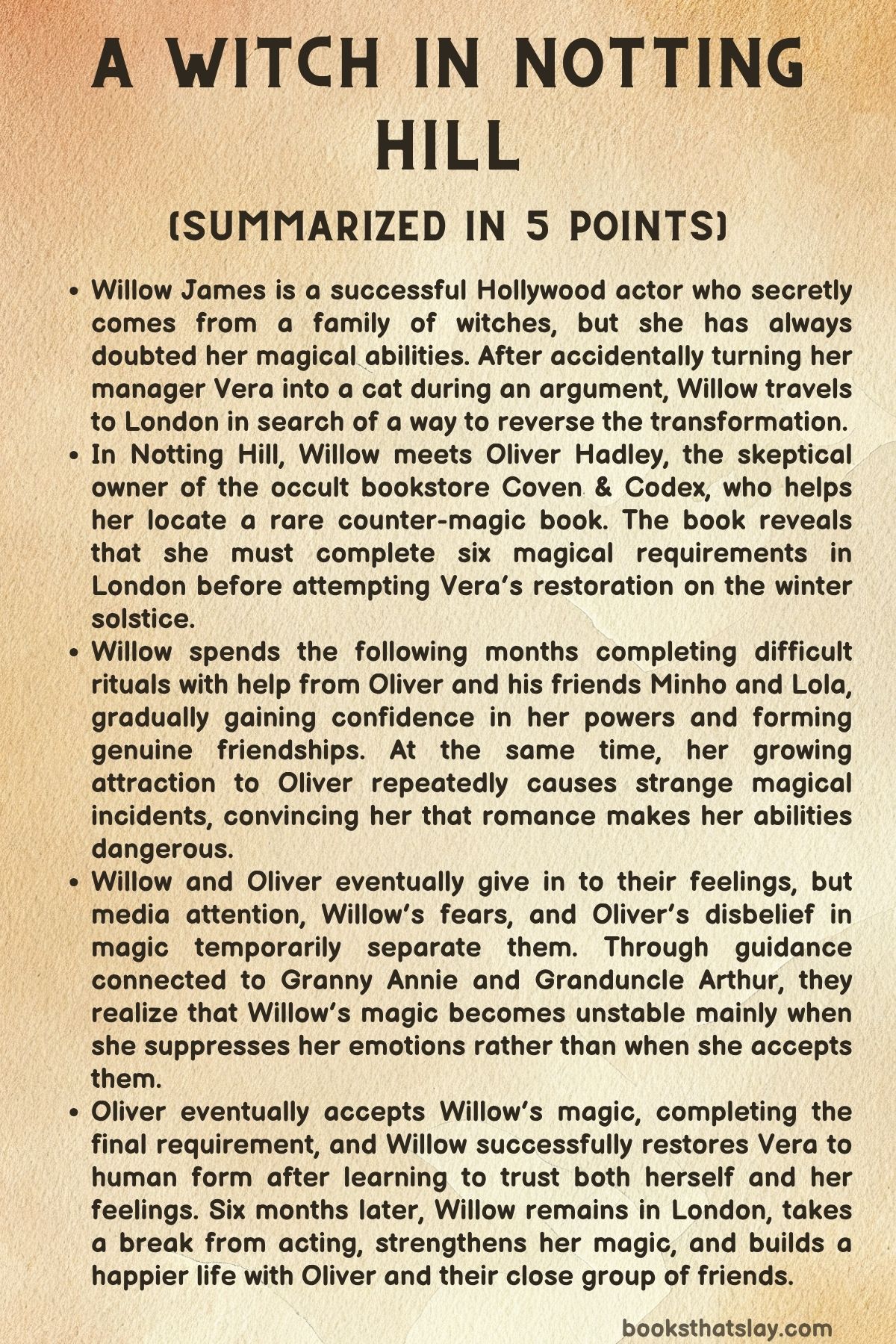
Willow James has built a successful career as a Hollywood actor, but behind the celebrity image she hides the fact that she comes from a family of witches. Her mother, sister Ivy, and late grandmother Granny Annie have always seemed comfortable with magic, while Willow has grown up believing that her own powers are unreliable, especially when romance or attraction is involved.
Her insecurity becomes impossible to ignore when she argues with her manager, Vera, about accepting a romance film opposite actor Kit Hayes. Willow loses control of her emotions and accidentally transforms Vera into a cat, yet she has no idea how to reverse the spell.
Remembering Granny Annie’s old advice, Willow decides to travel to London and visit Coven & Codex, an occult bookstore her grandmother once recommended for magical emergencies. She takes Vera with her disguised as an emotional-support animal, surviving airport complications, unwanted recognition, and the challenge of controlling magic while surrounded by fans.
During the journey, Willow successfully performs a distraction spell by drawing power through a plant, proving that she possesses more control than she normally allows herself to believe. Arriving in Notting Hill gives her a strange sense of calm, and she becomes determined to solve Vera’s problem before anyone discovers either her witchcraft or the truth about the cat.
Coven & Codex is owned by Oliver Hadley, who inherited it from his eccentric granduncle Arthur. Although Arthur believed the shop had a magical character of its own, Oliver is skeptical and explains every strange occurrence through ordinary causes.
Willow’s first encounter with Oliver immediately creates trouble because she finds him attractive. Her emotional reaction causes lights and electrical systems inside the shop to malfunction, but Oliver merely assumes the old building is responsible.
Willow initially fails to locate a solution, yet research eventually brings her back to the bookstore’s sections on magical reversal. Oliver discovers that his secretive American customer is actually the famous Willow James, and his curiosity about her becomes increasingly personal.
When Willow asks to search after closing time, she invents a story claiming that her grandmother transformed a nurse into a cat. Oliver admits that he does not believe witchcraft is real, but he nevertheless helps her locate books dealing with counterspells and transformation magic.
One especially promising text, Rewind: A Manual for Counter Magic, proves extremely rare. Oliver uses his network of collectors and booksellers to trace it, beginning a search that takes Willow through London alongside him and eventually draws his friends Minho and Lola into the effort.
The search gradually changes Willow’s relationship with Oliver. He shields her from intrusive fans on the Underground, supports her when grief over Granny Annie overwhelms her, and helps without constantly expecting something in return.
Willow begins to experience ordinary friendship through Oliver, Minho, and Lola in a way that celebrity life rarely permits. Their search finally leads to the British Library, where they obtain Rewind and learn that Vera’s transformation cannot be reversed through a simple spell.
Willow must first complete six requirements in London: consume locally grown wood calamint, perform an orientation ritual with a special pendulum, undergo a cleansing in natural water, participate in a full-moon ceremony followed by an extended period without sleep, commune with a dead person, and convince a skeptic that magic exists. Because Vera was transformed on the summer solstice, the final reversal can occur only on the winter solstice, meaning Willow must remain in London for approximately six months.
The revelation also exposes Willow’s earlier lie. Oliver realizes that Willow herself claims to be a witch, and his instinctive dismissal of literal magic deeply hurts her because disbelief touches the insecurity she has carried throughout her life.
Oliver soon recognizes that he treated her unfairly. With encouragement from Minho and Lola, he apologizes and offers to continue helping even though he remains skeptical.
Willow succeeds in casting a spell that allows Vera to speak while still in feline form. Concerned that Willow’s attraction to Oliver will destabilize her magic, Vera proposes a fake romantic connection between Willow and Kit Hayes so that Oliver will maintain his distance.
The deception works too well. Oliver assumes Willow is becoming involved with Kit and tries to suppress his growing jealousy, while Willow increasingly recognizes that pretending to want someone else cannot remove what she feels for him.
As they wait for the first task to become possible, Willow moves into a London flat and spends more time with Oliver, Minho, and Lola. Their visits to the pub, shared meals, and spontaneous outings give Willow a sense of ordinary companionship that she has rarely experienced as a public figure.
The group eventually travels to the Isle of Wight to obtain wood calamint. Willow becomes severely seasick, and Oliver takes care of her without judgment, showing a tenderness that strengthens her trust in him.
Because the herb must be prepared locally, they stay overnight at a small inn. Willow and Oliver spend part of the night quietly talking about Granny Annie and Arthur, discovering that grief is another experience connecting them.
Willow drinks the prepared herb the next morning and completes the first requirement. By this point, the quest is becoming more than a method of restoring Vera; it is slowly giving Willow a life in London that she does not want to leave.
The second requirement takes them to a museum containing the Wharram Percy Pendulum. While Willow performs the orientation ritual, the pendulum behaves unexpectedly, appearing to follow Oliver’s position before pointing northwest toward him.
The result leaves Willow wondering whether the magical object is revealing something beyond a geographic direction. Soon afterward, Oliver defends her from men making crude remarks, and his declaration that she is someone he genuinely cares about triggers another burst of uncontrolled magic, this time summoning birds.
Willow later tells Oliver more about her family and admits that romantic emotions have always seemed to make her powers dangerous. She also reveals the real circumstances of Vera’s transformation, while Oliver questions whether the relationship Willow supposedly has with Kit is truly serious.
The third requirement requires Willow to perform a cleansing ritual in a freezing pond at Hampstead Heath. Oliver enters the water to support her, but his presence makes concentration difficult, so Willow completes the ritual alone and remains submerged until she loses consciousness.
Oliver rescues her and accompanies her home. Their closeness continues into Willow’s shower, where a moment of intimacy triggers another magical disturbance and bursts a pipe.
Although Willow successfully stops the flooding through magic, Oliver still refuses to accept a supernatural explanation. His continued skepticism hurts her because she feels he is rejecting something central to who she is, and she keeps away from him until the next task forces them together again.
The full-moon ceremony becomes an important turning point. Oliver begins recognizing that Willow repeatedly softens or hides her beliefs whenever she notices his discomfort, forcing him to consider whether his skepticism has become a barrier rather than simply a rational position.
During the festival, Minho challenges Oliver to understand that supporting someone does not require sharing every belief. Oliver begins reconsidering the certainty with which he has always dismissed Arthur, Willow, and anything he cannot explain.
Later, Lola and Minho deliberately leave Willow and Oliver alone. During a lantern walk, Oliver admits that Willow has disrupted his repetitive life and tells her directly that she, rather than witchcraft itself, is what attracts him.
Willow finally stops hiding behind the invented Kit relationship and kisses Oliver. They spend the night together, and Willow is astonished when none of the magical disasters she expected occur.
Their happiness ends the following morning when photographs of them appear online. The media assumes Willow has cheated on Kit, forcing her to admit that the supposed relationship never existed and that Vera created the deception because Willow feared what genuine attraction to Oliver might do to her powers.
The scandal frightens Willow back into caution. Believing she has become careless, she distances herself from Oliver and decides to complete the remaining tasks without him.
For the fifth requirement, Willow communes with Granny Annie in Kensington Gardens. Using her grandmother’s brooch, she performs the ritual and experiences unusual signs in nature that make her feel Granny Annie is present.
Willow admits that she neglected magic because she was ashamed of not being as naturally skilled as the other witches in her family. She now understands that her abilities require trust, attention, and practice rather than constant comparison.
Meanwhile, Oliver is miserable without her. Lola points out that he is the obvious skeptic Willow must convince, while Arthur’s old ledger gives Oliver new insight into both the bookstore and magic.
He discovers references to an American woman named Anise, Willow’s grandmother, and accounts of strange magical events surrounding her. More importantly, Oliver notices a pattern in Willow’s own behavior: her most destructive magical incidents occur when she resists desire, suppresses affection, or tries to push people away.
Oliver begins understanding magic less as something that must fit his previous definition of scientific proof and more as something he can approach with trust and openness. His certainty begins giving way to a willingness to accept what he has repeatedly witnessed.
Before Willow sees Oliver again, Vera confesses that she anonymously encouraged the false gossip about Willow and Kit. Willow becomes furious but also realizes that she no longer wants a life where publicity controls every friendship, private decision, and relationship.
She begins considering a substantial break from acting and recognizes how strongly she has come to value London. When she finally visits Oliver, they apologize to each other, and he tells her what he discovered in Arthur’s ledger.
Oliver declares that he believes in Willow’s magic. His change completes the sixth requirement, and the two spend the night together knowing that the winter solstice will finally allow Willow to attempt Vera’s restoration.
The next morning, Willow performs the reversal spell, but nothing happens. She tries again and fails, leaving her devastated after months of effort.
Oliver arrives and explains the last piece Willow has misunderstood. Her magic has not become destructive because she accepts romantic feeling; it becomes unstable when she fights against what she genuinely feels.
Willow finally recognizes the pattern. Her most chaotic moments came when she resisted attraction, denied emotional connection, or tried to force Oliver away, whereas accepting him created calm rather than destruction.
She kisses Oliver, allows herself to trust both her feelings and her power, and casts the reversal spell again. This time Vera immediately returns to human form, confirming that Willow’s greatest obstacle was never an absence of magic but her fear of accepting herself.
Oliver celebrates with her and tells Willow that he loves her. Six months later, Willow remains in London on an extended acting hiatus, Vera has developed a healthier attitude toward work, and Willow’s relationships with Oliver, Lola, and Minho remain strong.
As another summer solstice approaches, Willow and Oliver prepare to attend the full-moon festival together. London has become more than the place where Willow solved a magical crisis; it has become the home where she learned to accept her abilities, choose relationships without fear, and imagine a future based on what she genuinely wants.
Characters
Willow James
Willow is the emotional and magical center of A Witch in Notting Hill, and much of her development comes from the difference between how powerful she actually is and how incapable she believes herself to be. Although she belongs to a gifted family of witches, years of comparison with her mother, Ivy, and Granny Annie have convinced her that inconsistency means failure.
Her Hollywood career adds another layer to her insecurity because acting gives her an identity in which performance, image, and control matter constantly. She knows how to play roles for audiences, yet she has far less confidence when she must confront the private parts of herself that cannot be managed through publicity or professional discipline.
Her transformation of Vera begins as evidence of everything she fears about herself. The accident is serious, but the months that follow repeatedly demonstrate that Willow possesses substantial magical ability whenever she stops panicking long enough to use it deliberately.
Her relationship with Oliver becomes the strongest test of that growth. Willow initially assumes that romantic attraction causes her magic to fail, so she interprets each magical disturbance as proof that intimacy is unsafe.
The final revelation changes her understanding of herself because she recognizes that suppression rather than affection has been triggering the most destructive incidents. By accepting her feelings and trusting her abilities, Willow develops into someone capable of choosing both magic and love instead of treating them as threats to be controlled.
Oliver Hadley
Oliver functions as both Willow’s romantic partner and the principal skeptic in A Witch in Notting Hill. He begins the story as a man committed to predictable routines, rational explanations, and a deliberate distance from the magical beliefs associated with Granduncle Arthur and Coven & Codex.
His skepticism is not simple cruelty or arrogance. Oliver has inherited a store shaped by another man’s worldview, and rejecting that worldview has partly become his method of establishing an identity separate from Arthur.
Willow disrupts this certainty because the unexplained incidents surrounding her become increasingly difficult to dismiss. More importantly, Oliver develops enough respect and affection for Willow to recognize that constantly questioning something central to her identity can wound her even when he believes he is merely being rational.
His care for Willow often emerges through practical actions before he can express himself emotionally. He shields her from crowds, comforts her when she remembers Granny Annie, helps her through seasickness, rescues her from the pond, protects her from photographers, and repeatedly makes space for her within his previously solitary life.
Arthur’s ledger ultimately allows Oliver to reconsider both his granduncle and magic without requiring him to abandon thoughtfulness. His growth lies in becoming more open to experiences that do not fit his earlier assumptions, which also allows him to admit that loving Willow matters more than defending the rigid certainty with which he began.
Vera
Vera begins A Witch in Notting Hill as Willow’s manager and the unfortunate victim of the magical accident that drives the story. Spending months trapped as a cat could have reduced her to a comic device, but her personality remains important because she continues attempting to manage Willow’s career and personal choices even in her transformed state.
Her relationship with Willow contains genuine loyalty but also serious problems involving control. Vera is so accustomed to thinking strategically about publicity, projects, and professional opportunities that she sometimes treats Willow’s private emotions as situations requiring management rather than respecting them as personal decisions.
The fake relationship with Kit demonstrates this flaw most clearly. Vera believes it will protect Willow from dangerous emotional complications, yet the deception contributes directly to Willow and Oliver’s misunderstanding and eventually to a public scandal.
Her anonymous encouragement of the Kit rumor crosses an additional boundary because it uses Willow’s personal life as a publicity instrument without permission. Vera eventually acknowledges the damage, and her own months of enforced inactivity also change her understanding of relentless work.
After returning to human form, Vera begins creating a less consuming professional life. Her development therefore parallels Willow’s in a smaller way: both women learn that constant control and productivity can prevent them from recognizing what actually makes life satisfying.
Granny Annie
Granny Annie remains one of the most influential figures in A Witch in Notting Hill even though she has died before the main events begin. Her voicemail, teachings, memories, and previous connection to London continue guiding Willow whenever fear threatens to overwhelm her.
Unlike Willow’s internal image of magical perfection, Granny Annie seems to have understood magic as something personal rather than as a competition. Her advice that Willow should trust her abilities becomes increasingly important as Willow discovers that confidence and acceptance matter as much as technical knowledge.
Sending Willow toward Coven & Codex indirectly sets the entire story in motion. The recommendation leads Willow not only to the book that can restore Vera but also to Oliver, Arthur’s history, Minho, Lola, and a different kind of life.
The communion ritual makes Granny Annie’s continuing influence especially clear. Willow cannot hold an ordinary conversation with her, yet the ritual gives her space to acknowledge shame, growth, grief, and the possibility that she has misunderstood herself for years.
Arthur’s ledger later confirms that Granny Annie also had unpredictable magical reactions connected with romantic situations. This link between generations helps transform Willow’s apparent weakness into part of a larger family history and supports her eventual realization that her powers have always been more meaningful than she assumed.
Ivy
Ivy is Willow’s sister and represents the family standard against which Willow has measured herself for years. Because Ivy appears more comfortable with witchcraft, Willow interprets the difference between them as proof that she lacks the natural ability expected of women in their family.
Ivy herself does not reinforce this judgment. When Willow confesses what happened to Vera, Ivy immediately rejects the idea that Willow is fundamentally a bad witch and argues that lack of confidence has always been a greater problem than lack of power.
Her reaction is important because it exposes how much of Willow’s inferiority exists inside Willow’s own interpretation rather than in the way her family actually sees her. Ivy provides a voice from home that encourages Willow to practice, trust herself, and continue solving the problem rather than retreating into shame.
Although she does not participate directly in the London quest, her support reinforces one of the novel’s central character developments. Willow must eventually stop using other people’s apparent strengths as evidence against her own worth.
Minho and Lola
Minho and Lola become the friendship foundation of Willow’s new life in A Witch in Notting Hill, while also serving as the people most willing to challenge Oliver when his emotional caution becomes unreasonable. Their acceptance gives Willow a form of companionship that is unusually free from the demands connected with her fame.
Minho is practical, dependable, and willing to use his professional contacts whenever the magical quest requires access or information. He also challenges Oliver directly, especially when Oliver tries to use philosophical differences as a justification for avoiding his feelings.
Lola is more openly perceptive about emotional matters. She recognizes Oliver’s attraction early, encourages him to contact Willow socially, and later forces him to confront how miserable he has become after their separation.
Together, they refuse to treat Willow as a celebrity first and a person second. Shared meals, trips, jokes, rituals, and inconveniences allow her to experience friendship without constantly wondering whether attention comes with professional motives.
Their importance becomes especially clear because neither needs to understand every aspect of witchcraft before offering support. Their willingness to participate demonstrates how acceptance can exist without complete knowledge, creating an important contrast with Oliver’s early insistence on certainty.
Granduncle Arthur
Arthur is another deceased character whose influence shapes the entire story. His decision to leave Coven & Codex to Oliver forces Oliver into continued contact with a magical worldview that he would otherwise prefer to dismiss.
At first, Oliver interprets Arthur’s beliefs as eccentric habits attached to an unusual bookstore. He respects the man but does not share his conviction that the shop and its community possess genuine magical significance.
Arthur’s ledger later reveals a much richer purpose. Coven & Codex served as a place where people who felt unusual or rejected could find acceptance, and Arthur preserved their experiences rather than immediately dismissing them.
His connection with Granny Annie links Oliver’s family history with Willow’s. The records he leaves behind ultimately help Oliver recognize the pattern behind Willow’s powers and reconsider the meaning of belief.
Arthur therefore influences the relationship long after his death. By creating the bookstore, preserving his observations, and leaving them to Oliver, he indirectly gives Oliver the tools needed to become more open-minded and helps Willow understand herself.
Kit Hayes
Kit Hayes has relatively little direct participation in the central relationship, yet his name becomes highly significant because other people repeatedly use him as an imagined romantic alternative for Willow. Vera initially pushes Willow toward a romance film opposite Kit, and the disagreement helps trigger the spell that transforms her.
Later, Vera turns Kit into the centerpiece of a defensive strategy. By pretending Willow may be romantically interested in him, she hopes to discourage Oliver and reduce the emotional intensity that seems dangerous to Willow’s powers.
Kit therefore becomes less important as an individual than as a symbol of artificial celebrity romance. Tabloid assumptions about Willow and Kit contrast sharply with the private, increasingly authentic connection she develops with Oliver.
The scandal following the festival demonstrates the consequences of allowing manufactured publicity to define real relationships. Willow’s eventual rejection of the false narrative contributes to her broader decision to reclaim control over her personal life.
Gloria
Gloria, the bartender Willow meets soon after arriving in London, represents one of Willow’s earliest experiences of moving through the city without her usual Hollywood machinery. Willow introduces herself under another surname and cautiously allows herself to behave more like an ordinary visitor.
Gloria is friendly without becoming intrusive, although she senses that Willow looks familiar. Their interaction helps establish the appeal London begins to hold for Willow: anonymity may be imperfect, but she can still find spaces where she is not constantly performing for an audience.
The pub also becomes an important social setting later. What begins as a temporary shelter from rain develops into part of the ordinary local life Willow increasingly values.
Fergus, Bromley, Diane Hughes, and Basil Whitlock
Fergus, Bromley, Diane, and Basil form the human chain that leads Willow and Oliver toward Rewind. Each contributes specialized knowledge or access that moves the search from one location to another.
Their importance lies partly in showing that Willow cannot solve her crisis alone. The solution requires booksellers, collectors, archivists, friends, and strangers, turning what initially seems like an individual magical failure into a cooperative search.
Diane is especially memorable because her resemblance to Granny Annie triggers Willow’s grief. That moment allows Oliver to show his capacity for quiet support, deepening their relationship without requiring romance to be explicitly discussed.
Basil finally produces the book that changes the scale of Willow’s problem. His contribution marks the point when finding information ends and the six-month process of transformation truly begins.
Themes
Self-Acceptance and Confidence
Willow’s central struggle is not an absence of magical power but her belief that she is inherently worse at magic than the women in her family. In A Witch in Notting Hill, every mistake therefore reinforces an identity she has already created for herself: the unreliable witch, the family disappointment, and the person whose emotions make her dangerous.
The events in London gradually contradict that belief. Willow successfully casts distraction magic, gives Vera speech, completes rituals, controls a burst pipe, communes with Granny Annie, and eventually performs the transformation reversal.
None of these achievements immediately removes her insecurity because technical success alone cannot change a belief she has practiced for years. She repeatedly interprets setbacks as proof of inadequacy while treating successes as exceptions.
Her relationship with Ivy is important because Ivy directly challenges this interpretation. The sister Willow considers more naturally talented does not agree that Willow lacks ability; instead, she identifies confidence as the missing element.
Granny Annie’s remembered guidance reinforces the same point from another direction. Willow eventually understands that magic is not something external that will certify whether she deserves to call herself a witch.
The successful reversal of Vera completes this development because Willow performs the same spell that previously failed, but her understanding of herself has changed. Accepting her emotions allows her to use her power without fighting against herself, proving that self-trust is not merely emotional comfort but a necessary part of how her magic functions.
Love, Vulnerability, and Emotional Resistance
Romantic feeling initially appears dangerous because Willow has spent years associating attraction with magical accidents. Her experiences seem to support this conclusion: lights explode, rooms freeze, objects move, birds appear, electrical systems fail, and pipes burst whenever Oliver provokes an intense emotional reaction.
The crucial distinction is that these incidents generally occur when Willow is suppressing what she feels. Her attempts to deny attraction, maintain distance, invent a relationship with Kit, or force herself back into emotional control create the very instability she fears.
Her peaceful nights with Oliver therefore become important evidence. When Willow willingly chooses intimacy rather than resisting it, the expected magical catastrophe does not occur.
This changes the meaning of vulnerability throughout the story. Willow initially treats vulnerability as loss of control because both fame and witchcraft have taught her to protect herself carefully.
Oliver experiences a parallel struggle. He uses skepticism and routine as emotional defenses, repeatedly telling himself that differences in belief and geography make a relationship impractical.
Both characters must eventually stop treating emotional distance as safety. Their relationship becomes possible when Willow accepts desire without shame and Oliver accepts uncertainty without demanding that everything fit his earlier worldview.
Love is therefore presented not as the source of magical disorder but as something that exposes the damage caused by resistance. Emotional honesty brings Willow greater stability than avoidance ever did.
Fame, Privacy, and the Desire for an Ordinary Life
Willow’s celebrity status gives her wealth and professional success but repeatedly limits her freedom. Airports, public transport, bookshops, markets, festivals, and even her temporary home can suddenly become places where strangers claim access to her face, body, relationships, and private decisions.
London initially functions as an escape only because Willow is trying to solve Vera’s transformation. Over time, however, anonymity becomes one of the most valuable things the city offers her.
Meals with Minho and Lola, conversations in the pub, the Isle of Wight trip, evenings in the bookstore, and ordinary time with Oliver matter because Willow is not required to perform. She can be tired, sick, anxious, uncertain, amused, or emotionally vulnerable without those moments automatically becoming public content.
The fabricated relationship with Kit illustrates the opposite condition. A story created for strategic reasons becomes more powerful in public than the truth of Willow’s own life, eventually making her genuine relationship with Oliver appear scandalous.
Vera’s anonymous encouragement of the rumor shows how easily professional management can cross into personal control. Willow’s anger therefore concerns more than one bad publicity decision; it reflects years of living inside narratives shaped by other people.
Her eventual acting hiatus is not a rejection of her career. It is a decision to create boundaries between work and identity, giving herself room to discover whether success still matters when it no longer determines every aspect of her life.
Belief, Skepticism, and Openness to the Unexplained
Oliver’s skepticism creates one of the central philosophical conflicts in A Witch in Notting Hill because he defines rationality through explanations that exclude literal magic. The strange behavior of Coven & Codex, Willow’s repeated magical incidents, and Arthur’s beliefs are initially treated as things that must have ordinary causes.
Willow experiences this position personally because disbelief in magic feels like disbelief in her. She can tolerate Oliver not understanding witchcraft, but his repeated insistence that her explanations cannot be true forces her to hide or minimize an essential part of herself.
The story does not require Oliver to become intellectually careless. His development instead concerns the limits he places on what he is willing to consider.
Minho helps clarify this distinction by reminding Oliver that respect does not require identical beliefs. Oliver can support Willow without pretending to understand every ritual, just as affection does not depend on philosophical agreement.
Arthur’s ledger gives skepticism a historical dimension. Oliver discovers that the relative he considered eccentric was preserving a community where unusual people could speak about their experiences without immediate ridicule.
The connection between Arthur and Granny Annie then makes the supernatural evidence personally meaningful. Oliver’s final declaration of belief matters because it represents intellectual humility as much as romance.
He accepts that experience, trust, relationships, and unexplained events may require a broader response than automatic rejection. That openness completes Willow’s final task, but it also allows Oliver to inherit the true spirit of Coven & Codex rather than merely owning the building Arthur left behind.