Ain’t Nobody’s Fool Summary and Analysis
Ain’t Nobody’s Fool by Martha Ackmann is a biographical account of Dolly Parton’s life, tracing her journey from a poor childhood in the Smoky Mountains to becoming one of the most influential entertainers in American culture. The book explores the family history, faith, hardship, and determination that shaped Dolly’s character.
It follows her early love of music, her struggles with poverty and loss, her first steps into radio and recording, and her rise to national fame. Ackmann presents Dolly not only as a star, but also as a songwriter, businesswoman, and deeply driven person.
Summary
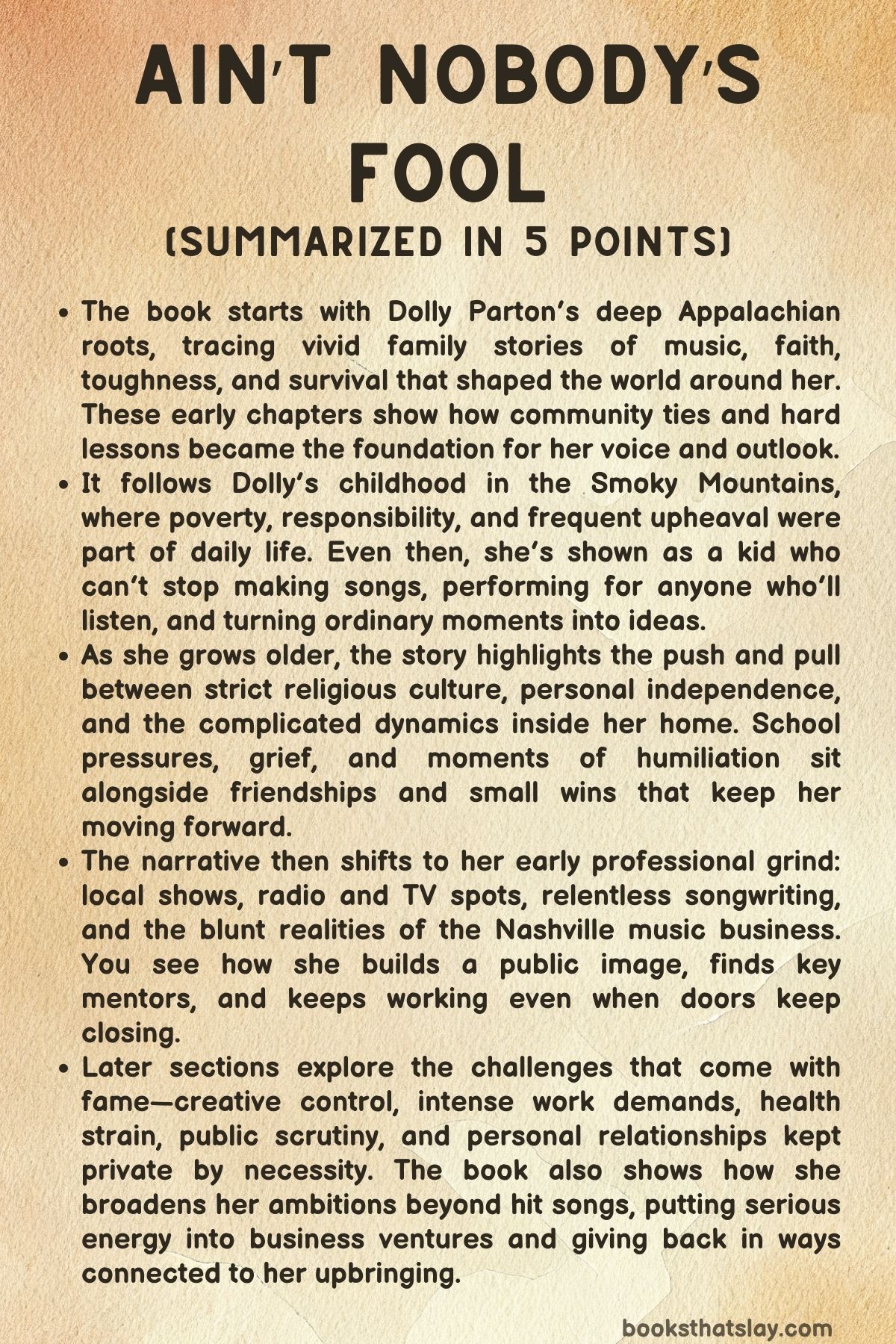
Aint Nobodys Fool begins with the deep roots of Dolly Parton’s family in the mountains of Tennessee. Her ancestors lived lives full of struggle, resilience, and strong traditions.
Her great-grandmothers were remembered for music, community gatherings, and healing work as a “granny woman” who delivered babies and used herbs for medicine. Dolly’s grandparents also faced disasters, including a devastating flood that forced them to start over with almost nothing.
These family stories created the world Dolly was born into, one shaped by faith, hardship, and the power of music.
Dolly’s parents, Avie Lee Owens and Robert Lee Parton, married young in 1939. Their life began with almost no money and no stable home.
Lee worked brutally hard but often drank heavily, leaving Avie Lee frightened and overwhelmed. Despite the instability, children arrived quickly.
Dolly was born in January 1946 during a harsh winter in a small cabin without electricity or plumbing. Her father paid the doctor with cornmeal, a sign of the poverty the family lived with daily.
From her earliest years, Dolly showed a natural connection to music. She turned everyday sounds into melodies, made up rhymes constantly, and performed for animals from a porch “stage.” Her mother encouraged her creativity and saved her first written song.
Neighbors like Martha Williams offered warmth and food, giving Dolly moments of comfort beyond the crowded family home. As more siblings were born, Dolly’s older sister Willadeene often helped care for her, becoming a protector and guide.
Life in the mountains was filled with both playful childhood games and sudden danger. Dolly and her siblings acted out Bible stories, held pretend church services, and even baptized each other in the river.
But accidents were common, and Dolly once badly injured her toes on a plow blade. Poverty meant patched clothes, crowded sleeping spaces, and long walks to school.
Children were often pulled from classes to help with farm work.
A major crisis struck when Avie Lee suffered a severe miscarriage and nearly died from bleeding. The children had to run for help, and Lee carried his wife across fields to reach an ambulance.
Though she survived, Avie Lee became physically weakened and often depressed afterward. Lee continued struggling to provide through exhausting labor jobs, even though he could not read or write.
The children faced humiliation at school, especially during holidays when they could not afford gifts like other families.
Religion played a central role in Dolly’s upbringing. Avie Lee and her father embraced Pentecostal worship, filled with intense services and belief in divine healing.
Lee Parton remained skeptical, though he protected his family when dangerous practices like snake-handling appeared in church gatherings. Dolly loved singing in church but also questioned strict rules and searched for private spaces to think and pray.
After the family moved to Caton’s Chapel, Dolly found an abandoned church nearby that became her secret refuge. Inside, she experimented with broken instruments, taught herself sounds, and began writing songs with growing seriousness.
Music became her sense of direction, even as she struggled with insecurity during early puberty and unwanted attention from men. She began experimenting with makeup, feeling both guilty and defiant against religious expectations.
Tragedy returned when Avie Lee became gravely ill with spinal meningitis during pregnancy. Though she survived after weeks of prayer gatherings, the baby was born prematurely and died within hours.
Dolly was devastated, spending long periods visiting the grave. Around this time, Dolly also faced harsh punishment at school and strict discipline at home, especially when her father drank after tobacco sales.
Despite everything, Dolly’s passion for music only grew stronger. She began performing locally and soon appeared at the Pines Theater in Sevierville.
Cas Walker noticed her talent and invited her onto his Knoxville radio and television programs. Dolly became a paid performer while still young, sometimes earning more in one show than her father made in a day.
Jealous classmates bullied her, even locking her in a closet, but she refused to stop pursuing her dream.
Her uncle Bill Owens became her strongest supporter, driving her to performances and encouraging her songwriting. Dolly recorded early songs in Louisiana, thrilled to hear her voice on the radio even though the records sold poorly.
As a teenager, she balanced school with nonstop performing. She traveled with her uncle to Nashville to pitch songs, sometimes sleeping in the car.
Music publisher Buddy Killen signed her as the youngest songwriter at Tree Publishing, though early royalties were tiny.
After graduating high school, Dolly left Sevier County for Nashville, determined to become a star. She arrived alone, homesick, carrying fruit boxes filled with clothes.
City life was harsh. She struggled with hunger, loneliness, and unsafe living conditions.
A local restaurant couple, Norman and Viola Couser, offered her kindness, food, and a sense of belonging during her hardest days.
While doing laundry, Dolly met Carl Dean. Their relationship grew quickly, though Dolly feared losing herself in early marriage.
Carl admired her deeply and insisted he wanted to marry her. Dolly focused on building independence, working receptionist and waitressing jobs while continuing to write songs.
Her career began to take shape when Monument Records producer Fred Foster signed her. Early pop-style singles did little, but her songwriting success came when Bill Phillips recorded “Put It Off Until Tomorrow.” This led to her breakthrough as a country artist with “Dumb Blonde.” Dolly and Carl married quietly in 1966, despite industry pressure to remain single for image reasons.
Dolly’s rise accelerated when Porter Wagoner hired her for his television show. At first, audiences resisted her, but their duets became hugely popular.
Behind the scenes, their partnership grew tense as Dolly demanded creative freedom. She wrote major hits, including “Jolene” and “Coat of Many Colors.” By 1974, she left Porter’s show, writing “I Will Always Love You” as a farewell.
In the early 1980s, Dolly faced severe health problems, depression, and exhaustion. After surgeries and canceled tours, she reached a terrifying low point when she considered ending her life, only stopping when her dog interrupted her.
She returned to work, endured threats from stalkers, and increased security around her home.
Later, Dolly turned her attention toward business and giving back. In 1986 she helped create Dollywood, bringing jobs and pride to East Tennessee.
She launched literacy efforts inspired by her father’s illiteracy, including the Imagination Library. Through collaborations and new musical projects, she continued evolving while staying connected to her roots.
By the end of Aint Nobodys Fool, Dolly Parton stands as an artist who survived poverty, loss, illness, and pressure while building a lasting legacy of music, independence, and generosity.
Key People
Dolly Parton
Dolly Parton is the emotional and narrative center of Ain’t Nobody’s Fool, portrayed as a woman shaped by deep Appalachian roots, relentless hardship, and extraordinary ambition. From childhood, Dolly is depicted as instinctively musical, imaginative, and driven, turning even the sounds of animals and the rhythms of farm life into songs.
Her early years reveal both vulnerability and resilience, as poverty, family instability, and community judgment become constant pressures. As she grows, Dolly’s character is defined by her determination to escape limitation without rejecting where she came from, balancing humility with an unshakable belief in her own calling.
Her journey into fame shows not only talent but fierce independence, especially in moments when she refuses exploitation, demands creative control, and protects her songwriting. Dolly’s later struggles with illness, depression, and suicidal thoughts reveal the hidden cost of stardom, making her not just an icon but a deeply human figure whose strength is continually tested and rebuilt.
Avie Lee Parton
Avie Lee Parton, Dolly’s mother, emerges as a powerful spiritual and cultural anchor in the family. She carries the traditions of mountain music, old ballads, and Pentecostal faith, passing them directly into Dolly’s earliest experiences of sound and storytelling.
Avie Lee is portrayed as nurturing yet burdened, a woman whose life is marked by repeated pregnancies, poverty, and emotional exhaustion. Her severe miscarriage, later illnesses, and the loss of her baby Larry Gerald reveal the fragility beneath her strength, and her depression underscores how hardship can erode even the most devoted caretaker.
Still, Avie Lee remains central in shaping Dolly’s identity, encouraging her creativity, preserving her first song, and embodying the blend of faith, endurance, and sorrow that defines the family’s world.
Robert Lee Parton
Robert Lee Parton, Dolly’s father, is presented as a complex figure of contradictions: hardworking, proud, protective, but also flawed and emotionally distant. His illiteracy and poverty trap him in exhausting labor, fueling frustration and sometimes alcohol-driven volatility.
Though he often stands outside the religious intensity of Avie Lee’s world, he shows a grounded practicality, even stepping in when church practices become dangerous. Lee’s character reflects the struggles of many Appalachian men of his era, carrying responsibility without resources, love without ease of expression.
His later influence on Dolly’s philanthropy, especially literacy work, reveals that his limitations became one of her greatest motivations to give back.
Willadeene Parton
Willadeene, Dolly’s older sister, plays an essential protective role in Dolly’s childhood. She often becomes a second mother, guiding Dolly into school early, watching over younger siblings, and providing stability within the chaos of a large, impoverished household.
Willadeene represents the quiet sacrifices of eldest daughters in struggling families, taking on responsibility before adulthood. Her presence reinforces the theme of family loyalty, showing how Dolly’s survival and growth were supported not only by parents but also by siblings who stepped into caregiving roles.
Jake Owens
Jake Owens, Dolly’s maternal grandfather, embodies faith, music, and the stern moral codes of mountain Pentecostal life. His life story, surviving disaster and rebuilding through belief, becomes part of the family mythology of endurance.
Jake is both inspiring and restrictive, encouraging worship and music while also clashing with Dolly’s emerging individuality, especially around appearance and self-expression. He represents the older generation’s authority, shaping the spiritual environment that both nurtures Dolly’s talent and pushes her to question and resist boundaries.
Rena Owens
Rena Owens, Dolly’s grandmother, symbolizes resilience and domestic pride. After surviving catastrophe and returning with little, she preserves dignity through small acts, such as cherishing saved dishes in her home.
Rena reflects the emotional strength of women who rebuild family life after trauma. Her influence is quieter than Jake’s, but she contributes to the sense of heritage and perseverance that surrounds Dolly’s upbringing.
Martha Williams
Martha Williams stands out as one of the earliest sources of warmth and generosity in Dolly’s childhood. As a neighbor who welcomed the Parton children with food and kindness, she represents community compassion amid poverty.
Her simple song for toddler Dolly becomes a formative memory, showing how early encouragement can leave lifelong marks. Martha’s role highlights that Dolly’s world, though harsh, contained pockets of tenderness that helped shape her confidence and sense of belonging.
Uncle Bill Owens
Uncle Bill Owens is one of the most significant supporters of Dolly’s early career, functioning as mentor, driver, collaborator, and believer in her talent. He pushes Dolly toward professional songwriting, takes her to performances, and helps her navigate Nashville before she has any real footing.
Bill’s character reflects the importance of advocacy, showing that Dolly’s success was not achieved alone but through family members who recognized her gift and invested in it. At times, his presence also underscores the sacrifices and hustle required to break into the music industry.
Cas Walker
Cas Walker is portrayed as an early gatekeeper of opportunity, a businessman and broadcaster who gives Dolly crucial exposure on Knoxville radio and television. He teaches her how to perform for the camera and shape a public persona, offering both mentorship and a tough introduction to show business realities.
Cas represents the local entertainment world that served as Dolly’s bridge between mountain childhood and national fame.
Norman and Viola Couser
Norman and Viola Couser provide Dolly with surrogate family comfort during her lonely early Nashville years. Their restaurant becomes more than a place for food, offering emotional shelter, encouragement, and a reminder of home-style belonging.
They symbolize the quiet kindness of ordinary people who sustain dreamers when the world feels indifferent.
Carl Dean
Carl Dean is depicted as Dolly’s private refuge and enduring partner, contrasting sharply with her public life. Shy, grounded, and outside the entertainment world, Carl offers stability without demanding control over her ambitions.
Their relationship is marked by tension between traditional expectations of marriage and Dolly’s fear of losing her independence. Carl’s willingness to remain in the background becomes part of their unconventional bond, showing that love for Dolly does not always mean visibility.
His death later underscores the depth of their long, quiet devotion.
Fred Foster
Fred Foster, head of Monument Records, appears as an important professional catalyst who recognizes Dolly’s uniqueness when others dismiss her. He represents the rare industry figure willing to take a chance on originality.
His support allows Dolly to transition from rejection to legitimacy, and his eventual release of her contract shows a complex mixture of business reality and respect for her future.
Porter Wagoner
Porter Wagoner is one of the most complicated relationships in Dolly’s career, functioning as mentor, collaborator, promoter, and eventual adversary. He gives her massive exposure and helps propel her into stardom, but their partnership becomes strained by control, ego, and Dolly’s growing need for independence.
Porter represents both opportunity and limitation, showing how mentorship can become suffocating when power dynamics shift. Their eventual split, crystallized in Dolly writing “I Will Always Love You,” is portrayed as both heartbreaking and necessary, marking Dolly’s full emergence as her own force.
Judy Ogle
Judy Ogle is portrayed as Dolly’s closest emotional confidante, offering friendship during periods of isolation and personal crisis. Their bond is strong enough to generate public rumors, which Dolly denies, highlighting how women’s friendships are often misinterpreted under celebrity scrutiny.
Judy represents loyalty and emotional grounding, especially during Dolly’s darkest psychological struggles.
Kenny Rogers
Kenny Rogers enters as a symbol of Dolly’s successful crossover into broader mainstream fame. Their collaboration reflects Dolly’s adaptability and ability to form creative partnerships beyond country traditionalism.
Kenny represents a stage of her career where she is no longer simply surviving but expanding her reach globally.
Larry Gerald Parton
Though he lives only briefly, Larry Gerald Parton holds enormous emotional weight in the narrative. His death becomes one of Dolly’s earliest encounters with profound grief, shaping her sensitivity, spirituality, and lifelong emotional depth.
His presence reminds readers that even unseen figures can leave permanent imprints on a family’s story.
Popeye
Popeye, Dolly’s dog, becomes an unexpected but pivotal figure during her lowest moment. His interruption when Dolly contemplates suicide serves as a symbol of fragile salvation, showing how life can be pulled back from the edge through the smallest, most innocent connection.
Popeye represents the quiet, grounding forces that keep Dolly tethered to survival when fame and despair collide.
Themes
Family Legacy and the Weight of Origins
From the very beginning of Ain’t Nobody’s Fool, the story is shaped by the powerful inheritance of family history. Dolly Parton’s world is not introduced as a blank slate, but as a place already filled with voices, struggles, and traditions passed down through generations.
Her great-grandmothers represent strength in different forms—one through community gatherings full of music, another through practical healing knowledge as a mountain midwife. These women become early symbols of endurance and resourcefulness, showing that survival often depends on both spirit and skill.
The hardships her grandparents faced, including floods, poverty, and migration across the Smoky Mountains, create a foundation where faith and determination are necessary, not optional.
Family in this narrative is not only about comfort but also about responsibility. Dolly grows up in a household where siblings care for each other, where older children step into adult roles early, and where love exists alongside exhaustion.
The family’s poverty is constant and unavoidable, shaping everyday life through patched clothing, overcrowded beds, and long walks. Yet even in scarcity, there is warmth in the way neighbors like Martha Williams provide kindness and food, showing how community becomes an extension of family when resources are thin.
The theme of origins also carries emotional weight. Dolly’s parents’ relationship, marked by love, instability, and hardship, creates a complicated home environment where security is fragile.
Her mother’s miscarriages, illnesses, and depression leave lasting impressions, teaching Dolly early about vulnerability and loss. The death of her baby brother becomes a defining moment of grief, showing how family sorrow can shape ambition and sensitivity.
Throughout the book, Dolly’s roots remain central, not as something she escapes from entirely, but as something she carries forward into everything she builds.
Faith, Religion, and Personal Searching
Religion in Ain’t Nobody’s Fool is not presented as a simple comfort but as a powerful force that shapes identity, family structure, and inner conflict. Dolly’s upbringing is deeply influenced by Pentecostal worship, where ecstatic services, divine healing, and strict moral expectations define daily life.
Her mother and grandfather embrace faith as a source of meaning and survival, especially in moments of illness or crisis. Prayer meetings become lifelines when medicine feels out of reach, and belief becomes intertwined with hope in a harsh environment.
At the same time, the narrative shows that faith is complicated. Dolly is drawn to church music, finding in it an early stage for her voice and creativity, but she also questions the rigid rules surrounding appearance and behavior.
Her conflicts with her grandfather over makeup and femininity reflect the tension between tradition and self-expression. Religion becomes something she must negotiate personally, rather than accept blindly.
Dolly’s private relationship with spirituality is especially important. She seeks solitude, praying alone and using abandoned spaces like the ruined church as a personal sanctuary.
In these moments, faith becomes less about public performance and more about inner direction. The broken piano and repaired mandolin symbolize how she builds something meaningful even in damaged spaces.
Music itself becomes a kind of spiritual practice, a way of making sense of her life.
Later in adulthood, faith returns during her darkest struggles. Depression, illness, and despair lead her back to the Bible, but also to anger and confusion.
Her story shows that belief is not always certainty—it can also be questioning, wrestling, and searching. Religion in the book is therefore not only a backdrop but a living theme of personal meaning, conflict, and resilience.
Ambition, Independence, and the Cost of Dreaming
Dolly’s rise from a mountain cabin to national stardom in Ain’t Nobody’s Fool is driven by relentless ambition, but the book makes clear that ambition comes with sacrifice. From childhood, Dolly shows an instinct to perform, turning everyday life into song and creating stages even when none exist.
Her creativity is not treated as a hobby but as a calling that grows stronger despite poverty, ridicule, and hardship.
When she leaves for Nashville, ambition becomes inseparable from loneliness. Arriving alone at the bus station, carrying fruit boxes of belongings, she faces the reality that dreams do not begin with glamour.
Hunger, unsafe living conditions, and constant rejection shape her early years. The theme of independence is built through survival—working small jobs, writing songs in quiet moments, and continuing forward even when executives mock her voice and accent.
The music industry is shown as both opportunity and obstacle. Dolly must fight for control over her sound, her songwriting, and her public image.
Her partnership with Porter Wagoner brings fame but also tension, as she struggles to be seen as more than an extension of someone else’s platform. Her decision to leave, and to write “I Will Always Love You” as a farewell, highlights her need for autonomy even when it costs emotional pain.
Her refusal to give Elvis Presley’s team half her publishing rights reveals another aspect of ambition: protecting ownership. Dolly’s drive is not only to succeed but to succeed on her own terms.
Yet the cost is heavy—grueling schedules, health breakdowns, backlash from purists, and constant pressure to prove herself. The theme shows that ambition is not simply achievement, but endurance through rejection, exhaustion, and the lifelong effort to remain true to one’s voice.
Suffering, Resilience, and Reinvention
Pain is woven into Dolly’s life story throughout Ain’t Nobody’s Fool, but what stands out most is how suffering becomes a catalyst for reinvention. From early childhood injuries and family tragedies to adult health crises, Dolly’s life is repeatedly shaped by moments where her body and spirit are pushed to the edge.
Poverty, loss, humiliation at school, and family instability create an emotional toughness that develops alongside her sensitivity.
In adulthood, the intensity of fame adds new forms of suffering. Medical problems, surgeries, depression, and isolation reveal the hidden cost of constant performance.
Dolly’s breakdown in the early 1980s is one of the most vulnerable sections of her journey, showing that success does not protect against despair. Her contemplation of suicide is a stark reminder of how fragile even the strongest public figures can feel.
The interruption by her dog Popeye becomes a turning point, symbolizing how small connections can pull someone back from darkness.
Resilience in the book is not presented as effortless strength, but as persistence through struggle. Dolly returns to work even while recovering, facing threats, controversies, and personal doubt.
Reinvention becomes essential. She shifts between music, film, business ventures, and later philanthropy, showing that survival sometimes requires transformation.
Her creation of Dollywood is a powerful act of returning home with purpose, turning personal heritage into collective opportunity. Her literacy work, inspired by her father’s illiteracy, reflects resilience transformed into giving.
Dolly’s life becomes an example of how suffering does not have to end in defeat—it can lead to rebuilding, creating, and offering something meaningful back to others.