All the Beauty in the World Summary, Analysis and Themes
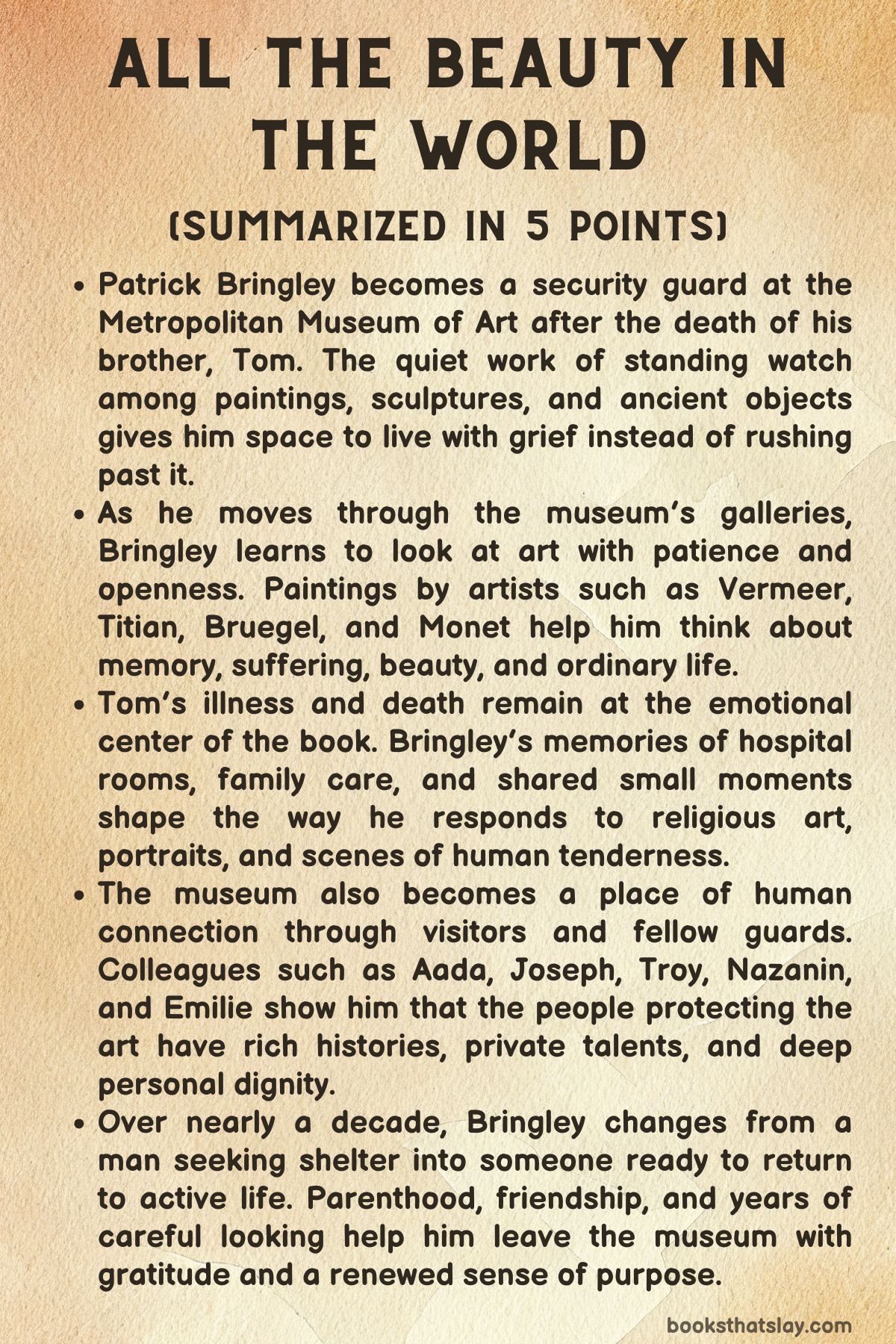
All the Beauty in the World is Patrick Bringley’s memoir about grief, art, work, and renewal. After his brother Tom dies of cancer, Bringley leaves behind the fast-moving world of office ambition and becomes a guard at the Metropolitan Museum of Art.
The book follows his years standing watch among paintings, sculptures, ancient objects, fellow guards, and visitors from around the world. In the quiet of the galleries, he learns how to look slowly, live with sorrow, notice strangers, and return to life with a deeper sense of attention, patience, and gratitude.
Summary
All the Beauty in the World follows Patrick Bringley as he begins a new life as a security guard at the Metropolitan Museum of Art in New York after the death of his brother, Tom. On his first day, he enters the museum through its hidden working spaces rather than its grand public entrance.
He is surrounded by crates, corridors, uniforms, and staff routines before being introduced to Aada, an experienced guard who teaches him the basics of the job. She explains how guards rotate between posts, how they protect the artworks, how they guide visitors, and how they endure long hours standing still.
At first, Bringley feels awkward and restless. He is young, grieving, and unsure of what he is doing in this strange new role.
Yet the museum immediately offers what he has been seeking: stillness, beauty, and a slower rhythm. He had once imagined a more ambitious career, and he had worked at The New Yorker, but after Tom’s illness and death, the usual markers of success no longer matter to him.
He does not want to hurry forward. He wants a place where he can stand quietly and live inside his grief without having to explain it.
As he settles into the museum, Bringley begins to see the galleries as a series of living worlds. In the old master paintings, he studies faces, rooms, landscapes, religious scenes, and moments of ordinary life preserved across centuries.
He thinks about how paintings operate like windows into other times, while also reflecting the concerns of the present viewer. Works by artists such as Vermeer, Velázquez, Titian, Bruegel, and others give him company.
They also help him understand his own memories of Tom. Art becomes a way of holding people and moments that would otherwise fade.
Tom’s story sits at the emotional center of the book. Bringley remembers him as brilliant, funny, kind, and intellectually alive.
Tom had studied mathematics and later biomathematics, drawn to the complexity of living systems. His illness transforms Bringley’s experience of New York.
The city of possibility becomes a city of hospitals, apartments, treatments, and waiting rooms. During Tom’s final years, small acts become meaningful: watching baseball, doing crosswords, reading aloud, and sitting together in silence.
After Tom dies, Bringley recognizes in religious paintings the same combination of suffering, love, attention, and helpless devotion that he experienced at his brother’s bedside.
The museum gives him a new relationship with time. In the Egyptian galleries, he stands among objects thousands of years old: tombs, statues, hand axes, models, and sacred objects.
These works make modern hurry seem brief and almost comic. Bringley compares ancient ideas of cyclical time with the forward pressure of modern life.
His work as a guard teaches him to accept repetition: arriving, changing into uniform, receiving assignments, standing, watching, closing galleries, and beginning again. What could seem boring becomes a discipline of attention.
He also learns from unfamiliar traditions. In the Asian galleries, Chinese scrolls and calligraphy teach him to approach art without rushing to categorize it.
He reflects that viewers often try too quickly to identify style, period, or meaning. Instead, he learns to let an object appear before judgment begins.
Monet’s Impressionist paintings, which he had once dismissed as overly popular, begin to move him because they capture light, weather, and passing sensation with unusual freshness. African art, including Benin objects and a Central African power figure, expands his understanding of what art can be: not just representation, but presence, ritual force, and spiritual function.
The job also brings him into contact with the practical realities of museum life. He sees curators, conservators, technicians, cleaners, managers, trainers, and guards all contributing to the daily life of the institution.
He works special exhibitions that draw huge crowds, including a major Picasso show, and sees how vulnerable art can be when thousands of people move through the galleries. Accidents, careless gestures, and stories of theft remind him that museums balance public access with protection.
The guard’s job may look passive, but it requires vigilance, patience, and judgment.
Over time, Bringley becomes more interested in visitors. People ask questions, share reactions, misunderstand things, become moved, grow bored, or simply pass through.
He sees how art affects each person differently. Some visitors want information; others want permission to say what they feel.
Because guards are present but not imposing, they become approachable figures. Bringley comes to appreciate strangers with greater sympathy.
Looking at art trains him to look at people: their faces, postures, expressions, and private burdens. On the subway and in the city, he begins to see ordinary people with the same generosity he brings to portraits and photographs.
His fellow guards become one of the richest parts of his museum life. They come from many countries, professions, and personal histories.
Some are artists, musicians, writers, immigrants, retirees, or people who have lived through danger and upheaval. Joseph, a guard from Togo, becomes especially important to him.
Joseph had once worked in banking and survived political violence before arriving in New York. Other colleagues share stories of Iran, jazz, family, art, teaching, and survival.
Through them, Bringley sees the museum not only as a home for art but also as a workplace filled with human depth.
Bringley’s personal life continues alongside his museum years. He remembers the beginning of his relationship with Tara, their visits to the Cloisters, their engagement during Tom’s illness, and the painful fact that Tom’s funeral coincided with what had been planned as their wedding day.
Later, Bringley and Tara have children. Parenthood changes his understanding of art and life again.
The exhaustion, mess, responsibility, and wonder of raising Oliver and Louise pull him back into active life. After years of standing still, he is now building a family world day by day.
The later parts of the book show Bringley thinking about work, effort, and incompletion. Exhibitions of unfinished art, Michelangelo drawings, and Gee’s Bend quilts help him see creation as labor rather than magic.
Michelangelo’s studies reveal practice, struggle, revision, and aging determination. The quilts, made by women in Alabama from available scraps and old clothes, show another kind of genius: practical, local, patient, and shaped by necessity.
Bringley comes to understand that beauty is not limited to famous masters or grand settings. It can emerge from hard days, limited materials, and steady hands.
After nearly a decade at the Met, Bringley realizes that his time as a guard is ending. The museum had given him shelter when he needed it.
It had allowed him to mourn, observe, learn, and recover his sense of the world. But his children are growing, his family needs him, and he feels ready for a more active role.
He becomes interested in guiding tours, writing, speaking, and sharing what he has learned rather than silently absorbing it.
On his final day, Bringley walks through the galleries and says goodbye to colleagues and artworks that have shaped him. He mentally gathers favorite pieces to carry with him into the next stage of life.
Among them, a Crucifixion by Fra Angelico stands out as an image of suffering, compassion, ordinary life, and spiritual seriousness. As the museum closes and visitors leave, Bringley reflects on what art offers: not escape from life, but a clearer way of seeing it.
The book ends with his departure from the guard’s post, grateful for the years of stillness but ready to return to the moving world.
Key People
Patrick Bringley
Patrick Bringley is the narrator and central consciousness of All the Beauty in the World. He enters the Metropolitan Museum of Art not as a scholar, curator, or visitor, but as a man trying to survive grief after the death of his brother, Tom.
His decision to become a guard is not a retreat from life in a simple sense; it is a deliberate move away from ambition, speed, and performance. At the museum, Patrick learns to stand still, watch carefully, and allow beauty to work on him without demanding immediate answers.
His character is shaped by attention. He studies paintings, sculptures, visitors, colleagues, uniforms, floors, silence, and time itself.
At first, his grief makes him inward and detached, but the museum gradually opens him outward. He becomes more sympathetic toward strangers, more curious about his coworkers, and more patient with the incomplete nature of life.
By the end, Patrick has changed from someone seeking shelter from pain into someone ready to rejoin the world with greater tenderness, discipline, and awareness.
Tom Bringley
Tom Bringley, Patrick’s brother, is the emotional center of the memoir even though he is absent for much of the present-day action. He is remembered as brilliant, warm, intellectually alive, and deeply loved.
His interest in mathematics and biomathematics reveals a mind drawn to complexity, systems, and the strange beauty of life’s design. Tom’s illness changes Patrick’s life completely, turning New York from a city of youth and possibility into a place marked by hospitals, apartments, medical routines, and waiting.
Yet Tom is not presented only as a victim of cancer. He remains curious, thoughtful, funny, and engaged even as his body weakens.
His suffering teaches Patrick to look differently at art, especially religious images of care, mourning, and death. Tom’s presence lingers in Patrick’s response to paintings and in his desire to find a space where grief can be honored rather than rushed away.
Through Tom, the book shows that love continues to shape the living long after death.
Tara
Tara is Patrick’s partner and later his wife, and she represents intimacy, steadiness, and the return of ordinary life after loss. Her relationship with Patrick begins before Tom’s death, which gives their love story a bittersweet quality.
Their early dates, including their visit to the Cloisters, show a bond built on conversation, shared curiosity, humor, and openness. Tara’s Catholic background also gives Patrick another way of understanding sacred spaces and religious imagery.
She is not merely a supporting figure in Patrick’s grief; she is part of the life that keeps calling him forward. Their planned wedding day being overtaken by Tom’s funeral captures the painful overlap between love and loss.
Later, as Tara and Patrick become parents, she becomes central to the messy, demanding, and grounding reality of family life. Through Tara, Patrick’s world expands beyond mourning and contemplation.
She helps mark his movement from stillness toward responsibility, partnership, and renewal.
Maureen Bringley
Maureen, Patrick’s mother, appears as a figure of artistic sensitivity and deep maternal grief. Her love of performance and creativity helped shape Patrick’s early openness to art.
She is connected to his childhood memories of museum visits, where art became part of family life rather than a distant intellectual subject. After Tom’s death, Maureen’s grief is shown with particular force during her encounter with a Pietà.
Her response to the image of Mary mourning Christ mirrors her own experience as a mother who has lost a son. This moment reveals how art can give form to emotions too large for speech.
Maureen’s character also helps Patrick understand that grief is not abstract. It is embodied, visible, and shared.
She represents the family bond that surrounds Tom’s illness and death, and her presence deepens the memoir’s treatment of sorrow by showing how each member of a family carries the same loss differently.
Aada
Aada is Patrick’s first mentor at the museum, and she introduces him to the practical world of guard duty. She teaches him how to move through the galleries, how to rotate posts, how to protect the works, and how to endure the physical demands of standing for long hours.
Her role is important because she grounds Patrick’s new life in routine. The museum may be filled with priceless objects and spiritual quiet, but it is also a workplace with rules, habits, uniforms, supervisors, and small tricks learned through experience.
Aada’s character brings authority without drama. She understands the job from the inside and helps Patrick see that guarding art requires both vigilance and humility.
Through her, Patrick begins to understand that museum work is not simply about admiring beauty. It is also about discipline, endurance, and service.
Joseph
Joseph is one of the most memorable guards in All the Beauty in the World because his life story reveals the hidden depth of the people standing quietly in museum uniforms. Originally from Togo, Joseph had once held a serious position in banking before political danger and violence changed the course of his life.
His survival of an assassination attempt and his later work as a guard in New York show the dramatic distance many museum workers have traveled before arriving at the Met. To Patrick, Joseph becomes both a colleague and a friend, someone much older and from another part of the world, yet close to him through shared hours in the galleries.
Joseph’s character challenges shallow assumptions about service workers. He embodies dignity, resilience, intelligence, and quiet strength.
His friendship with Patrick also shows how the museum creates unlikely human connections across age, nationality, class, and personal history.
Troy
Troy is a lively and distinctive colleague whose personality adds warmth to Patrick’s working life. He has moved from insurance into museum security and sees the guard position as a way to be near the arts.
His love of jazz and his habit of clipping newspaper articles suggest a mind that remains active, curious, and self-directed even during long hours of repetitive work. Troy helps show that the guards are not passive background figures.
They have tastes, histories, talents, and private worlds. His presence also broadens Patrick’s view of the job.
Guarding the museum can be tedious, but for people like Troy, it also offers proximity to culture, conversation, and reflection. He represents the kind of colleague who turns a workplace into a community.
Nazanin
Nazanin, a guard from Iran, represents the international character of the museum staff. Through her conversations with Patrick, the reader sees how the guards carry personal histories that stretch far beyond New York.
Her memories of family and of Shiraz add cultural richness to the world behind the museum’s public face. Nazanin’s role is not defined by a single dramatic event but by the way she contributes to Patrick’s growing appreciation of his coworkers.
She is part of the human education the museum gives him. As Patrick becomes less self-contained, he learns to listen more carefully to people like Nazanin.
Her character helps shift the museum from a place of objects to a place of stories, where the people protecting the art are themselves shaped by memory, migration, and attachment.
Emilie Lemakis
Emilie Lemakis stands out as a guard who is also a working artist. Her presence shows the creative life that exists among the museum staff, often hidden beneath uniforms and routine duties.
Through her sculpture and participation in employee art events, Emilie challenges the divide between those who make art and those who guard it. She suggests that artistic identity can survive within ordinary labor, and that a job taken for stability does not erase a person’s deeper ambitions.
Patrick’s attention to Emilie also reveals his growing respect for the inner lives of his colleagues. The museum is not only filled with masterpieces from the past; it is also filled with people still making, thinking, hoping, and experimenting.
Emilie’s character helps Patrick see creativity as something lived daily, not only something preserved in galleries.
Oliver and Louise
Oliver and Louise, Patrick and Tara’s children, mark a major change in Patrick’s understanding of life. Their arrival shifts him from the quiet, observant rhythm of the museum into the demanding reality of parenthood.
Through them, Patrick experiences exhaustion, mess, tenderness, responsibility, and constant interruption. The stillness he found at the museum contrasts sharply with the needs of young children, yet that contrast is exactly what helps him grow.
Oliver and Louise teach him that life cannot remain suspended in contemplation. It must also be built, cleaned, fed, carried, and repaired.
They change the way he looks at art, too. He begins to notice parents, children, families, and human imperfection in works he once viewed differently.
Their presence helps Patrick realize that his years of shelter at the museum have served their purpose, and that he is ready to live more actively.
Themes
Grief as a Form of Attention
Patrick’s grief does not appear as a problem to be solved quickly. It becomes a condition that changes how he sees, hears, waits, and remembers.
After Tom’s death, ordinary ambition feels false to him, so he seeks a place where he can slow down without apology. The museum gives him that space.
In the galleries, grief becomes linked to attention: standing before paintings, noticing faces, studying scenes of mourning, and allowing silence to remain silence. Religious images of death and care speak to him because they do not try to explain suffering away.
They simply hold it in visible form. This is one of the central strengths of All the Beauty in the World: it shows mourning not as a straight path toward recovery but as a long education in looking.
Patrick does not forget Tom, nor does he replace him with art. Instead, art helps him carry the loss with more clarity.
His grief slowly becomes less raw, but it also becomes part of his moral vision, teaching him tenderness toward others.
Art as a Way of Seeing Ordinary Life
Art in the memoir is not treated as decoration or as a luxury reserved for experts. It becomes a way of training perception.
Patrick learns that a painting can make a hospital room feel different, that a portrait can sharpen his understanding of memory, and that an ancient object can change his sense of time. The museum’s artworks do not remove him from the world; they return him to it with better eyes.
Vermeer helps him see domestic quiet as luminous. Bruegel helps him value daily labor, rest, food, weather, and human routine.
Religious paintings help him face suffering. Photographs and portraits help him look more generously at strangers.
This theme also challenges the idea that art must always be interpreted through academic language. Patrick often begins with direct experience: color, light, posture, silence, scale, and emotional response.
The result is a democratic vision of art. A person does not need to master every historical fact before being changed by a work.
Patient looking is itself a serious act.
The Value of Stillness in a Fast-Moving World
Patrick’s work as a guard places him outside the usual pressure to advance, produce, compete, and constantly move forward. Before joining the museum, he had experienced the prestige and restlessness of professional ambition.
After Tom’s illness, that world feels thin to him. Guard duty offers a different rhythm: standing, watching, waiting, rotating posts, closing rooms, and returning the next day.
At first, this stillness can feel uncomfortable, even boring. Over time, it becomes a discipline.
Patrick learns that boredom is not always emptiness; sometimes it is the clearing in which attention becomes possible. The museum’s ancient objects deepen this lesson by placing a single human life against thousands of years of history.
In that setting, modern urgency loses some of its authority. Stillness allows Patrick to recover from grief, but it also helps him question a culture that treats constant motion as proof of meaning.
The memoir suggests that a slower life can reveal forms of knowledge that speed usually hides: sympathy, patience, reverence, and self-understanding.
Work, Dignity, and Hidden Human Lives
The guards at the museum are often seen by visitors as part of the background, yet Patrick’s account shows them as complex people with rich histories. They are immigrants, artists, musicians, parents, survivors, thinkers, and workers with practical wisdom.
Joseph’s past in Togo, Troy’s love of jazz, Nazanin’s memories of Iran, and Emilie’s artistic practice all reveal lives far larger than the uniform suggests. This theme gives dignity to work that is often underestimated.
Guarding art may look passive, but it requires stamina, alertness, tact, and emotional intelligence. The guards protect fragile objects, guide confused visitors, handle crowds, and maintain the atmosphere that allows others to experience beauty.
Patrick also comes to understand that work is not only a career ladder. It can be a shelter, a community, a discipline, or a temporary chapter in a larger life.
By presenting the guards with care, the memoir asks readers to reconsider the people they usually overlook. Behind every quiet worker may be a history as meaningful as anything hanging on the wall.