Alcestis Summary, Characters and Themes
Alcestis by Euripides is an ancient Greek play about love, duty, hospitality, and the fear of death. It centers on Admetus, a king who has been granted a strange escape from death: someone else may die in his place.
Only his wife, Alcestis, agrees to make that sacrifice. The play examines the moral cost of this bargain, showing both Alcestis’s courage and Admetus’s weakness. It also brings in Heracles, whose gratitude for Admetus’s hospitality changes the course of the story. Alcestis is part tragedy, part rescue tale, and part sharp study of human selfishness.
Summary
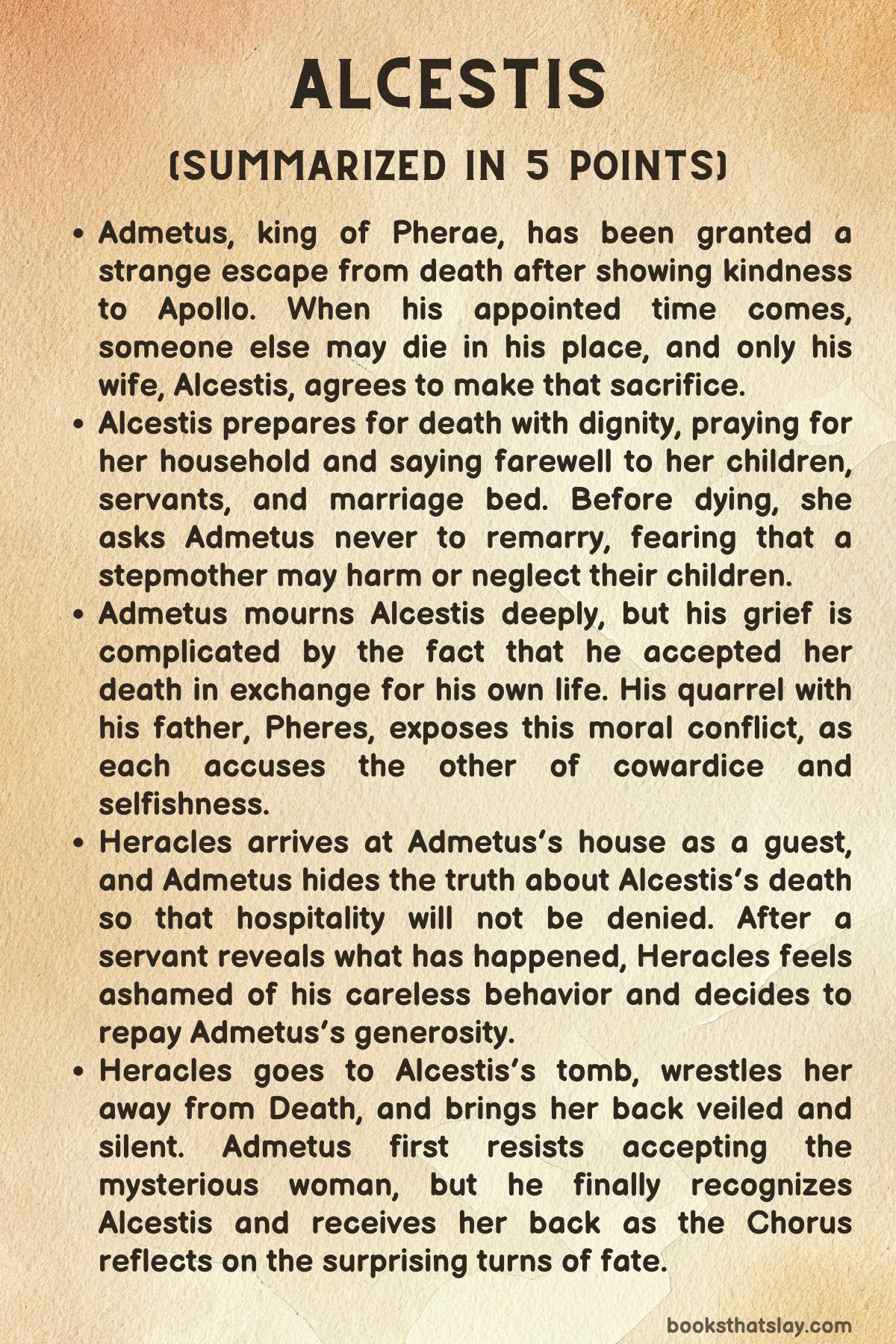
Alcestis opens outside the palace of Admetus, king of Pherae in Thessaly. Apollo appears and explains the strange history behind the sorrow now hanging over the royal house.
Zeus once punished Apollo by forcing him to serve as a slave in the household of a mortal. That mortal was Admetus, who treated the god with kindness and respect.
In return, Apollo gave Admetus an extraordinary gift. When the time came for Admetus to die, he would be allowed to escape death, but only if someone else agreed to die in his place.
Admetus asked those closest to him to make this sacrifice. His parents refused, even though they were old.
His friends also refused. Only his wife, Alcestis, agreed.
Now the day appointed for her death has arrived. Apollo knows she is doomed, but before leaving the house, he meets Death, who has come to claim her.
Apollo tries to persuade Death to spare Alcestis or at least postpone her death until she is older, but Death refuses. Apollo leaves with a warning: a guest will come to Admetus’s house, and that guest will take Alcestis back from Death.
The elders of Pherae enter and stand before the silent palace. They know that Alcestis is fated to die that day, but they do not know whether she is already dead.
The quietness of the house troubles them. They speak of Alcestis with admiration, praising her goodness as a wife and queen.
They also reflect on the power of death, which no ordinary human can escape. Even Asclepius, the great healer who could raise the dead, is gone, and with him any easy hope of rescue.
A maid comes out from the palace, and the Chorus asks her about Alcestis. The maid explains that Alcestis is still alive, but only barely.
She has prepared herself for death with dignity. She bathed, dressed in fine clothing, prayed for the safety of her husband’s household, and asked the gods to protect her children.
Then she went to her marriage bed and wept over the life she was leaving behind. She said farewell to her children and servants.
Inside, Admetus clings to her and begs her not to leave him, even though nothing can change what has been promised.
Soon Alcestis is brought out, weak and near death, supported by Admetus and attended by their children and servants. She greets the sunlight, the earth, and her home for the last time.
Her vision is already turning toward the world below. She sees Charon, the ferryman of the dead, calling her onward, and she senses the presence of Hades.
Admetus begs her to resist and says he cannot live without her.
Alcestis speaks to him with calm firmness. She reminds him that she has chosen to die so he may live.
She could have refused, remarried after his death, and raised their children in comfort, but she has given up her future for him. In return, she asks one thing: he must never remarry.
Her fear is not only jealousy but concern for their children. A stepmother, she believes, might mistreat them, especially their daughter, who will need a mother’s care as she grows toward marriage.
Admetus promises that he will never take another wife. He swears that his house will give up celebration and pleasure.
He says he will mourn Alcestis forever and even imagines keeping an image of her in his room so he can hold it and speak to it. He tells her to wait for him in the Underworld, where they will be together after his own death.
Alcestis then entrusts the children to him and dies. Their son mourns her, saying he and his sister are now deprived of their mother.
Admetus orders public mourning for Alcestis and prepares for her burial.
The Chorus honors Alcestis, saying that poets and singers will remember her as a rare and noble woman. They compare her sacrifice with the refusal of Admetus’s parents, who chose to keep their own lives.
To them, Alcestis has shown a courage few people possess.
At this moment Heracles arrives. He is on his way to perform one of his labors: capturing the dangerous mares of Diomedes, flesh-eating horses owned by a violent king.
Heracles asks for Admetus, and Admetus comes out in mourning clothes. Heracles notices his grief and asks whether Alcestis has died.
Admetus avoids telling the full truth. He says that a woman connected to the household has died, but he makes it sound as if the death is not a close family loss.
Heracles offers to stay elsewhere, not wanting to burden a grieving household. Admetus refuses.
To him, turning away a guest would add dishonor to misfortune. He insists that Heracles be welcomed and entertained.
The Chorus questions this choice, since the house is mourning Alcestis, but Admetus defends his conduct. He believes hospitality must be preserved even in sorrow.
He also knows that Heracles would not stay if he learned the truth.
The funeral procession then begins, but it is interrupted by the arrival of Pheres, Admetus’s father. Pheres brings funeral gifts and praises Alcestis.
Admetus rejects him bitterly. He says Pheres should have shown concern earlier, when Admetus was facing death.
Instead, his aged father allowed a young woman to die in his place. Admetus accuses Pheres of cowardice and declares that Alcestis, not his parents, has proven to be his true family.
Pheres answers with equal force. He says he gave Admetus what a father owes a son: birth, upbringing, and a kingdom.
He denies that any law requires a father to die for his child. Old age, he argues, does not make life worthless.
The little time left to him is still sweet. He then turns the accusation back on Admetus, calling him the coward for accepting his wife’s death instead of facing his own.
Their argument becomes harsh and personal. Admetus disowns his parents, and Pheres leaves.
The funeral procession continues.
Inside the palace, Heracles has been drinking and celebrating, unaware that Alcestis is dead. A servant comes out and complains about his behavior.
Heracles has demanded food and wine, sung loudly, and ignored the sorrow of the household. When Heracles appears, drunk and cheerful, he lectures the servant about enjoying life because no one knows what tomorrow will bring.
The servant’s sadness finally leads Heracles to press him for the truth. The servant reveals that the dead woman is not a stranger but Alcestis herself.
Heracles is shocked and ashamed. He realizes that Admetus, even in deep grief, honored him as a guest.
In gratitude, Heracles decides to repay him. He asks where Alcestis has been buried and goes to confront Death.
Admetus returns from the funeral and faces the emptiness of his house. Without Alcestis, his home feels hateful to him.
He now understands more fully what her death means. He has not only lost a devoted wife; he has also damaged his own reputation.
People will say that he lived because he allowed his wife to die for him. The Chorus urges him to endure what cannot be changed, reminding him that divine necessity is stronger than human wishes.
Heracles returns with a veiled woman. He rebukes Admetus for hiding the truth, saying friends should speak honestly.
Then he asks Admetus to keep the woman in his house, claiming he won her in a contest. Admetus resists.
He does not want to bring a young woman into the palace so soon after Alcestis’s death, and he fears it would dishonor his promise to remain faithful. Heracles keeps pressing him until Admetus reluctantly agrees.
When Admetus takes the woman’s hand, Heracles tells him to look at her closely. Admetus is stunned: she looks exactly like Alcestis.
Heracles reveals the truth. He went to her tomb, fought Death, and brought her back.
Alcestis must remain silent for three days until her obligations to the gods below are complete, but after that she will live again with Admetus.
Heracles leaves to continue his labor. Admetus, overcome by joy, orders celebration in place of mourning.
He leads the silent Alcestis back into the palace. The Chorus closes the play by reflecting that the gods often bring events to unexpected ends, and what seemed impossible has come to pass.
Characters
Alcestis
Alcestis is the moral center of Alcestis, and her presence shapes the entire action even when she is absent from the stage. She is defined by an extraordinary act of sacrifice: she agrees to die in place of her husband, Admetus, when every other person refuses.
Her decision makes her appear noble, loving, and devoted, but it also exposes the troubling expectations placed on wives in the world of the play. Alcestis does not die because death naturally comes for her; she dies because her husband accepts a bargain that lets another person take his fate.
This makes her sacrifice both admirable and painful. She chooses loyalty over self-preservation, yet the situation that demands such loyalty is morally unequal.
Her final concern is not for her own lost life but for her children, especially her daughter, who will grow up without a mother. This shows her as practical as well as loving.
She understands household life, inheritance, marriage, and the vulnerability of children more clearly than Admetus does. Her request that Admetus never remarry is not merely a romantic demand.
It is also a protective measure, since a new wife could threaten her children’s position and emotional security. Alcestis’s silence after her restoration is also important.
She returns alive, but not immediately restored to speech. This silence gives her a strange dignity and distance.
She has crossed into death and back, and the play does not allow her to easily explain what she has endured. Her character remains powerful because she represents both ideal devotion and the disturbing cost of that ideal.
Admetus
Admetus is one of the most complex figures in the play because he is both admirable and deeply flawed. As a king and host, he is generous, pious, and committed to the sacred duty of hospitality.
His kindness to Apollo earns him divine favor, and his treatment of Heracles shows that he values the reputation of his house even while suffering personal grief. Yet his goodness is shadowed by self-interest.
He accepts the chance to avoid death by allowing another person to die for him, and when only Alcestis agrees, he lets the bargain stand. His grief after her death is real, but it is also uncomfortable because he has benefited from the very loss he mourns.
He speaks as though he cannot live without her, yet he is alive because she has died. This contradiction gives his character much of its dramatic force.
His anger toward his parents also reveals his moral blindness. He condemns them for refusing to die for him, but he does not fully confront the fact that he has allowed his wife to do what he demanded of others.
Admetus is not a simple villain; he loves Alcestis and suffers deeply after her death. However, his suffering is mixed with shame, dependence, and fear of public judgment.
By the end of Alcestis, his reunion with his wife brings joy, but it does not completely erase the questions raised by his conduct. He receives a second chance, yet the audience is left to consider whether he has truly earned it.
Heracles
Heracles brings energy, movement, and eventual rescue into a household dominated by mourning. At first, he appears almost comic because he unknowingly behaves with shocking insensitivity.
While Admetus and the servants are grieving, Heracles drinks, sings, demands comfort, and urges others to enjoy life. His behavior seems crude because he does not understand the truth of the situation.
Yet his reaction after learning that Alcestis has died reveals the better part of his character. He is ashamed not because he has been embarrassed, but because he has failed to honor the grief of a generous host.
Heracles immediately decides to repay Admetus’s hospitality by challenging Death and restoring Alcestis. This makes him more than a strong hero; he becomes an agent of gratitude and justice.
His rescue of Alcestis also balances the play’s darker moral questions. Where Admetus accepts another person’s death, Heracles acts to reverse that loss.
Where others preserve themselves, Heracles risks himself. He is impulsive and excessive, but his excess can turn heroic when directed toward a worthy goal.
His character also shows the importance of friendship. Admetus shelters him while hiding his own suffering, and Heracles responds by giving back more than ordinary thanks could provide.
Through him, the play moves from mourning to restoration, though not without leaving behind the uneasy memory of why such restoration was needed.
Apollo
Apollo appears only at the beginning, but his influence reaches across the whole play. His relationship with Admetus explains the unnatural bargain at the heart of the drama.
Because Admetus treated him well during his period of divine punishment, Apollo rewarded him by finding a way around death. Apollo’s action is generous toward Admetus, but it also disrupts the ordinary limits of mortal life.
He does not abolish death; he shifts it onto someone else. This makes Apollo’s gift morally complicated.
It saves Admetus, but it creates the conditions for Alcestis’s suffering. Apollo’s confrontation with Death also shows the limits of divine power.
Though he is a god, he cannot simply command Death to release Alcestis. He can argue, threaten indirectly, and predict future rescue, but Death remains firm.
Apollo therefore stands between divine favor and cosmic law. He cares for Admetus, but his help depends on negotiation and cleverness rather than absolute authority.
His prophecy that a guest will rescue Alcestis gives the audience hope, yet it also underlines how much human life in the play depends on forces beyond human control. Apollo is protective, graceful, and loyal to those who honor him, but his intervention is not purely comforting.
It asks whether a blessing that demands another person’s death can truly be called a blessing.
Death
Death is not an abstract idea in the play but a speaking figure with authority, pride, and suspicion. He enters as a force that cannot be easily persuaded by beauty, youth, love, or argument.
His exchange with Apollo establishes him as stern and practical. He sees Apollo as a threat to his rights and refuses to surrender Alcestis merely because her death is sad or premature.
Death’s reasoning is cold but consistent: if mortals are allowed to escape whenever the gods feel affection for them, the order of existence breaks down. In this sense, Death is not simply cruel.
He represents necessity, boundary, and the final claim that must come for every mortal. His insistence on taking Alcestis makes the emotional cost of Admetus’s bargain unavoidable.
Death also gives the play a physical opponent for Heracles. When Heracles later goes to the tomb to fight him, the rescue becomes a direct contest between heroic strength and mortal limitation.
Death’s role is brief but essential because he gives shape to what everyone fears. He cannot be charmed by Apollo’s reasoning, softened by Alcestis’s virtue, or delayed by Admetus’s grief.
Only Heracles’s extraordinary intervention can overcome him, and even that feels like an exception rather than a defeat of death itself.
Pheres
Pheres, Admetus’s father, is a sharp and uncomfortable character because his arguments expose the selfishness of more than one person. At first, he appears callous because he refuses to die for his son and then arrives with funeral gifts for Alcestis.
Admetus treats this as hypocrisy and cowardice. Yet Pheres’s reply forces the audience to reconsider the situation.
He insists that a father is required to raise his son and pass on his inheritance, not to surrender his own life. His defense of old age is especially striking.
He refuses the idea that an elderly person’s remaining life is worthless simply because it is short. The sunlight is still sweet to him, and he does not apologize for wanting to live.
This does not make him noble in the same way Alcestis is noble, but it does make him honest. He names the selfishness that Admetus avoids naming in himself.
By accusing Admetus of cowardice for letting his wife die, Pheres turns the moral judgment back onto his son. Their quarrel is harsh because both men are partly right and partly shameful.
Pheres values life, but he shows little tenderness. Admetus grieves Alcestis, but he demanded from others what he was unwilling to face himself.
Pheres matters because he breaks the easy pattern of praise and mourning and introduces a harder question: who has the right to ask another person to die?
The Chorus
The Chorus of elders represents the voice of the community, and its responses guide the emotional atmosphere of the play. The elders honor Alcestis, sympathize with Admetus, comment on divine necessity, and respond to each major turn in the action.
They are deeply moved by Alcestis’s sacrifice and repeatedly describe her as rare, virtuous, and worthy of lasting fame. At the same time, they do not fully challenge the social values that make such a sacrifice possible.
Their admiration for her reflects the ideals of the society around her: a good wife is loyal, self-denying, and devoted to the survival of her husband’s house. The Chorus also helps show how public reputation works.
Admetus’s grief is not private alone; it is watched, judged, and interpreted by the citizens. When he chooses to host Heracles despite the death in his household, the Chorus first questions him but then praises his hospitality.
Their shifting reactions show the tension between personal sorrow and public virtue. They also give voice to the helplessness of mortals before divine power and death.
Their songs broaden the play beyond one family’s crisis, turning Alcestis’s death into a reflection on fate, marriage, honor, and human limitation. They do not solve the play’s moral conflicts, but they help the audience feel their weight.
The Servant
The servant gives an important view of events from inside the household. Unlike Admetus, who is concerned with honor and hospitality, the servant sees the practical and emotional strain placed on those who must maintain appearances.
He and the other servants are grieving Alcestis, yet they must hide their tears while entertaining Heracles. His anger at Heracles is understandable because the guest’s loud drinking and singing seem offensive in a house of mourning.
Through the servant, the audience sees the cost of Admetus’s decision to conceal the truth. Hospitality is preserved outwardly, but the household is forced into emotional dishonesty.
The servant also becomes the figure who reveals the truth to Heracles. This is crucial because Admetus’s silence would have prevented Heracles from understanding the situation and taking action.
The servant is not powerful, noble, or heroic in the traditional sense, but his honesty changes the outcome. His grief is direct and human, without the grand language of kings and heroes.
He reminds us that Alcestis’s death affects not only her husband and children but the entire household that loved and depended on her.
The Children
The children appear briefly, but they deepen the emotional consequences of Alcestis’s sacrifice. Their presence makes her death more than a marital tragedy.
It is also a family wound that will shape the future. Alcestis worries especially about them before she dies, and her concern gives her final request to Admetus moral urgency.
The son’s lament after her death shows the helplessness of children caught inside adult decisions. He is too young to fully understand the bargain that caused his mother’s death, but he understands loss.
His grief also challenges any simple celebration of Alcestis’s sacrifice. If her death saves Admetus, it also leaves her children motherless.
The daughter’s vulnerability is particularly important because Alcestis knows that a girl in this society depends heavily on her mother’s protection and guidance. Through the children, the play shows that one person’s survival can create suffering for others.
Their silence and dependence make them powerful symbols of what is at stake in the household after Alcestis is gone.
Themes
Sacrifice and Its Moral Cost
Sacrifice in Alcestis is presented as noble, but never simple. Alcestis gives her life for Admetus, and the play honors her courage, loyalty, and self-command.
Her death is treated as an act worthy of lasting remembrance. Yet the situation that produces this sacrifice is troubling because it comes from Admetus’s attempt to avoid his own death.
Alcestis’s nobility cannot erase the uncomfortable fact that her husband benefits from her loss. This creates a moral tension at the center of the play.
The audience is asked to admire Alcestis while also questioning the bargain that makes her sacrifice necessary. Her choice exposes the unequal expectations placed on men and women.
Admetus seeks life; Alcestis is praised for giving hers away. Pheres’s argument sharpens the issue further by asking why anyone should be expected to die for another person, even a parent for a child.
The play does not offer an easy answer. It shows that sacrifice can be beautiful when freely chosen, but it can also reveal selfishness in those who accept it.
Alcestis becomes great through her decision, but that greatness is inseparable from the failure of others to meet death honestly. Her sacrifice saves Admetus’s body while placing a lasting question over his character.
Hospitality and Public Honor
Hospitality carries enormous moral weight in the play, sometimes even rivaling family grief. Admetus welcomes Heracles into his house despite the fact that Alcestis has just died.
This decision seems shocking because it forces the household to conceal its mourning and entertain a guest while preparing for burial. Yet for Admetus, refusing a guest would damage the honor of his house.
His identity as a noble king depends on generosity, openness, and respect for sacred guest-friendship. The play treats this value seriously.
Admetus’s hospitality is not empty politeness; it is the same virtue that once won Apollo’s favor. However, the play also shows the strain that public honor can place on private suffering.
The servants must hide their grief. Heracles behaves badly because he has not been told the truth.
Admetus preserves his reputation but creates confusion and pain within his own household. Still, his hospitality leads to Alcestis’s restoration, since Heracles is moved to rescue her after learning what Admetus has endured without turning him away.
This creates a complicated moral result. A questionable act of concealment produces a miraculous reward because it is tied to a genuine virtue.
The play suggests that honor can be performative and burdensome, but it can also create bonds strong enough to change fate.
Death, Fate, and Human Limitation
Death stands over the play as both a personal terror and a universal law. Admetus’s special bargain seems to offer an escape, but it does not truly defeat death.
It merely transfers death from one person to another. This makes the play’s world feel governed by strict limits, even when gods and heroes intervene.
Apollo can delay or redirect events, but he cannot simply erase the power of Death. Alcestis can choose nobly, but she cannot choose to save Admetus and remain alive through ordinary means.
Admetus can grieve, rage, and bargain, but he cannot undo what has happened. The Chorus repeatedly emphasizes that mortals must endure what divine necessity brings.
This view gives the play a serious meditation on human powerlessness. Yet the ending complicates that seriousness.
Heracles fights Death and brings Alcestis back, creating a rare exception to the normal order. Even so, the rescue does not make death meaningless.
Alcestis returns silent and marked by obligations to the gods below, suggesting that crossing death’s boundary has consequences. The play treats mortality as a force that defines human choices.
People reveal themselves by how they face it: Alcestis with courage, Admetus with avoidance and grief, Pheres with blunt attachment to life, and Heracles with heroic action.
Marriage, Gender, and Unequal Duty
Marriage in the play is shown as a bond of love, household stability, and social duty, but it is also shaped by unequal expectations. Alcestis is praised because she gives everything for her husband.
Her virtue is measured by self-denial, loyalty, and willingness to protect Admetus’s life at the cost of her own. Admetus, in contrast, is praised for hospitality and noble status, even though his survival depends on his wife’s death.
This contrast reveals a deep imbalance. The ideal wife is expected to preserve the husband’s house, children, and reputation, while the husband receives devotion and later promises mourning in return.
Alcestis’s final request that Admetus never remarry shows her awareness of how vulnerable women and children can be within marriage structures. She knows a new wife could threaten her children, especially her daughter.
Her concern is practical, not sentimental. The play also presents marriage as emotionally real; Admetus’s grief is sincere, and Alcestis clearly cares for him.
But sincerity does not remove inequality. The play’s power comes from holding both truths together.
Their marriage contains love, yet it also permits a sacrifice that falls on the wife. Through Alcestis, Euripides presents the honored ideal of female devotion while also exposing how severe and costly that ideal can be.