Alexander Hamilton Summary and Analysis
Alexander Hamilton by Ron Chernow is a biography of one of America’s most forceful and controversial founders. It follows Hamilton from his harsh childhood in the Caribbean to his rise as a soldier, writer, lawyer, financial architect, and political combatant.
Chernow presents him as brilliant, restless, ambitious, often self-destructive, and central to the creation of the United States government. The book is not only about Hamilton’s public achievements but also about his private wounds: poverty, illegitimacy, rivalry, scandal, family loss, and the need to prove himself. It shows how one immigrant helped shape a nation’s institutions while never escaping his own inner turmoil.
Summary
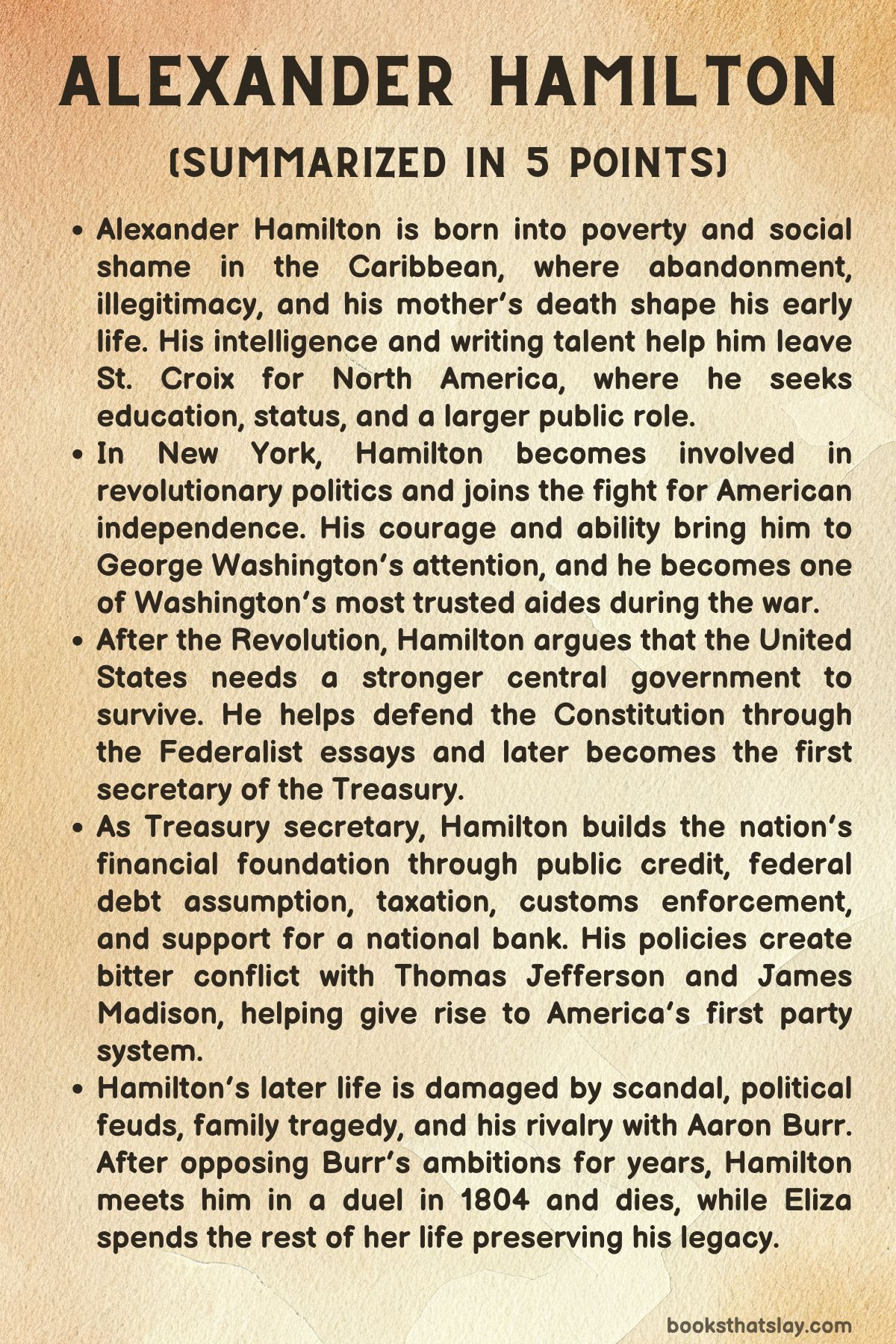
Alexander Hamilton begins with the difficult world that formed Hamilton’s character. Born in the British West Indies, Hamilton grew up far from the privileged plantation society that produced many other American founders.
His childhood was marked by abandonment, illegitimacy, poverty, and shame. His father deserted the family, his mother Rachel suffered humiliation and legal punishment, and Hamilton and his brother were denied the ordinary security of family inheritance or social standing.
When Rachel died of fever, Hamilton was left nearly alone, dependent on relatives and patrons. Yet he discovered books early and became a serious reader, developing the habits of study, discipline, and argument that would later define him.
As a teenager, Hamilton worked as a clerk in a Caribbean trading firm, where he learned shipping, finance, exchange rates, and commercial risk. These early experiences shaped his lifelong understanding of money, credit, trade, and state power.
He also saw slavery at close range, including the brutal commerce of enslaved people through Caribbean ports. This exposure helped form his later opposition to slavery, though his world remained full of compromise and contradiction.
His life changed after a hurricane struck St. Croix and he wrote a vivid account of the disaster. Local supporters recognized his talent and raised money to send him to North America for education.
In New York, Hamilton quickly entered intellectual and political life. He studied at Elizabethtown Academy and then King’s College, made connections with influential men, and began writing in support of colonial resistance to British rule.
At first he admired parts of the British imperial system, but the growing crisis pushed him toward the patriot cause. He praised resistance to British taxation, supported boycotts, and soon joined the revolutionary movement.
When war began, he enlisted and pursued military distinction with the same hunger that drove his writing and studies.
Hamilton proved himself during the Revolutionary War as an artillery officer and later as an aide to George Washington. His courage, energy, and administrative brilliance impressed senior officers.
Washington brought him onto his staff, where Hamilton became far more than a secretary. He drafted letters, organized military information, and became one of Washington’s most trusted advisers.
Yet Hamilton resented desk work and longed for battlefield glory. His relationship with Washington mixed respect, dependence, irritation, and pride.
Hamilton wanted command; Washington needed his mind. Their tension eventually led Hamilton to leave Washington’s staff, though their political partnership would later resume.
During the war, Hamilton also formed deep personal bonds. His closest friendship was with John Laurens, whose letters to him were unusually intense and affectionate.
Hamilton also met Elizabeth Schuyler, daughter of the powerful Philip Schuyler, and married her. Eliza gave Hamilton emotional stability and social connection, while her family linked him to New York’s elite.
Even so, Hamilton remained restless, ambitious, and frequently depressed. He wanted military glory, financial reform, and a stronger national government, all at once.
Hamilton finally won battlefield distinction at Yorktown, where he led a bold assault that contributed to the American victory. After the war, he returned to law, politics, and national reform.
He quickly passed the bar and became one of New York’s leading lawyers. He also entered Congress and saw clearly that the Articles of Confederation left the United States weak, indebted, divided, and nearly unable to govern.
The war had exposed the dangers of a loose union: unpaid soldiers, state resistance to taxation, poor credit, and threats of disorder. Hamilton believed the country needed a stronger central government with real taxing power, financial discipline, and national authority.
His role in the movement for the Constitution was decisive. At the Constitutional Convention, his own proposals were often too strong for other delegates, but he became one of the most important defenders of the final document.
With James Madison and John Jay, he wrote The Federalist essays under the name Publius. Hamilton wrote the majority of them, explaining why the new Constitution was necessary to prevent weakness, faction, and collapse.
His efforts were especially important in New York, where opposition was strong. Ratification gave Hamilton a rare moment of broad public admiration.
When George Washington became the first president, Hamilton was appointed secretary of the Treasury. In that role, he became one of the chief builders of the American government.
He organized public finance, created systems for revenue collection, restored public credit, proposed federal assumption of state debts, supported a national bank, promoted customs enforcement, and argued for manufacturing as a path to national strength. Hamilton believed that credit, commerce, banking, and federal authority could bind the states together and give the young republic power.
His opponents, especially Thomas Jefferson and James Madison, feared that his program favored financiers, expanded executive power, and moved the country toward monarchy or corruption.
The clash between Hamilton and Jefferson became one of the central conflicts of the early republic. Hamilton favored strong national institutions, commercial development, close economic ties with Britain, and energetic federal authority.
Jefferson favored agrarian independence, state power, sympathy for revolutionary France, and suspicion of banks and concentrated finance. Their rivalry helped create the first party system, with Hamilton’s Federalists opposing Jefferson’s Republicans.
Washington often sided with Hamilton, which made Jefferson more frustrated and suspicious.
Hamilton’s public brilliance was repeatedly damaged by private recklessness. His affair with Maria Reynolds became the first major sex scandal in American political life.
When he was accused of financial corruption, Hamilton chose to publish a long confession of the affair to prove that his payments to James Reynolds were blackmail, not misuse of Treasury power. The explanation cleared him of corruption but humiliated Eliza and damaged his reputation.
His enemies used the scandal to portray him as morally unfit, even though investigations did not prove that he stole public money or used his office for personal gain.
After leaving the Treasury, Hamilton remained influential but increasingly unstable in politics. He defended the Jay Treaty with Britain, helped Washington prepare his Farewell Address, attacked Jefferson, and later quarreled bitterly with John Adams.
His pamphlet against Adams badly harmed Federalist unity during the election of 1800. When Jefferson and Aaron Burr tied in the Electoral College, Hamilton supported Jefferson over Burr, not out of affection but because he considered Burr unprincipled and dangerous.
Jefferson became president, Burr vice president, and Hamilton’s national influence declined.
Hamilton’s personal life darkened further when his eldest son Philip died in a duel after defending his father’s honor. Hamilton had advised Philip to withhold his fire, and Philip was killed.
The loss devastated Hamilton and Eliza. Hamilton became more religious, more sorrowful, and more conscious of death, but he remained politically active.
Burr, meanwhile, grew increasingly isolated. After losing the New York governorship, Burr blamed Hamilton for helping destroy his prospects.
The final conflict began after reports spread that Hamilton had expressed a “despicable” opinion of Burr. Burr demanded an explanation.
Hamilton refused to apologize for a vague charge when he did not know which remark Burr meant. Their exchange escalated into a duel.
Hamilton opposed dueling in principle and, haunted by Philip’s death, planned not to shoot Burr. At Weehawken in 1804, Hamilton fired away from Burr, but Burr shot him.
Hamilton died the next day with Eliza and his children near him.
After his death, Hamilton’s reputation changed almost immediately. Critics acknowledged his genius, energy, and importance.
Burr was widely condemned and never recovered his public standing. Eliza lived for fifty more years, defending Hamilton’s memory, preserving his papers, and continuing her charitable work.
Chernow’s Alexander Hamilton ends by presenting Hamilton as a flawed but extraordinary founder: an immigrant orphan who rose by intellect and will, helped design the machinery of American government, and left a mark deeper than many men who reached the presidency.
Key People
Alexander Hamilton
Alexander Hamilton stands at the center of Alexander Hamilton as a figure driven by intellect, ambition, insecurity, and a fierce need to overcome the shame of his origins. His childhood in the Caribbean leaves him with a permanent sense of social vulnerability: he is illegitimate, orphaned early, financially exposed, and forced to depend on talent rather than inheritance.
These early wounds explain much of his later intensity. He studies obsessively, writes with unusual speed and force, and seeks military glory because he wants public proof that he belongs among great men.
His mind is practical, systematic, and unusually modern. He understands credit, taxation, manufacturing, banking, and administrative power before many of his peers do, and he sees that the United States cannot survive on sentiment alone.
Yet the same energy that makes him brilliant also makes him reckless. He cannot easily ignore attacks, cannot resist answering enemies, and often damages himself by saying too much.
His confession in the Reynolds scandal shows both his honesty and his poor judgment: he clears himself of corruption but wounds his family and reputation. Hamilton is heroic in his labor, visionary in finance, brave in war, and devoted to national strength, but he is also proud, combative, impulsive, and emotionally needy.
Chernow presents him as a founder whose genius helped build the American government, but whose hunger for vindication helped lead him toward ruin.
Elizabeth Schuyler Hamilton
Elizabeth Schuyler Hamilton, or Eliza, is one of the moral anchors of Alexander Hamilton. She enters Hamilton’s life as the daughter of a powerful New York family, but she becomes much more than a social connection.
She gives Hamilton a home, emotional steadiness, children, and a form of acceptance he had lacked since childhood. Her devotion is not passive.
She endures his absences, his political battles, his financial uncertainty, and the public humiliation caused by the Reynolds affair. Her pain after the scandal is immense, yet she remains tied to him by faith, family, and loyalty.
After Hamilton’s death, Eliza becomes the guardian of his memory. She collects and preserves his papers, challenges weak or hostile biographies, and works to secure his place in history.
Her charity work also reveals a life independent of her husband’s fame. She helps orphaned and vulnerable children, drawing from her religious conviction and personal suffering.
Eliza’s strength lies in endurance. She is not portrayed as politically aggressive like Hamilton, but her long commitment to his legacy gives her a quiet historical power.
Without her, much of Hamilton’s record might have been scattered, distorted, or forgotten.
George Washington
George Washington functions as Hamilton’s commander, patron, political shield, and father-like figure. Their relationship is never simple.
Washington recognizes Hamilton’s brilliance early and brings him onto his wartime staff, relying on him for correspondence, strategy, organization, and intellectual force. Hamilton, in turn, admires Washington’s dignity, courage, and authority, especially in moments of crisis.
Yet Hamilton also resents being trapped behind a desk, and Washington’s dependence on him becomes suffocating. Their wartime rupture shows how prideful both men could be, though Washington’s later conduct proves that he values Hamilton deeply.
As president, Washington again depends on Hamilton, especially in building the first administration. Washington has the public trust and symbolic authority that Hamilton lacks, while Hamilton has the administrative imagination and policy command Washington needs.
Together they help stabilize the new republic. Washington’s greatness in the biography is not only military; it lies in judgment.
He often chooses Hamilton’s practical vision over Jefferson’s suspicions, but he also tries to restrain party hatred. His death leaves Hamilton exposed, because Washington had been the one figure whose prestige could protect Hamilton’s boldest ideas from total political assault.
Aaron Burr
Aaron Burr is Hamilton’s opposite in temperament and political style. Where Hamilton is open, argumentative, and ideologically intense, Burr is controlled, guarded, flexible, and difficult to read.
He is talented, charming, and capable, but Chernow portrays him as a man without firm principles. Burr’s ambition is not tied to a clear vision of government; it is tied to advancement.
This makes Hamilton distrust him more than he distrusts Jefferson, even though Hamilton disagrees with Jefferson on almost everything. Jefferson, at least, stands for something.
Burr seems to stand mainly for Burr. His legal rivalry with Hamilton begins almost cordially, but political conflict gradually sharpens the relationship.
Burr’s creation of the Manhattan Company reveals his talent for maneuvering through loopholes and disguising self-interest as public service. His exclusion from Jefferson’s inner circle deepens his resentment, and his failed run for governor leaves him searching for someone to blame.
Hamilton’s long record of opposing him gives Burr a target. The duel is the result of wounded pride, political failure, and a culture of honor that rewards public aggression.
Burr survives the duel physically, but morally and politically he is ruined. His lack of remorse makes him appear smaller beside the man he killed.
Thomas Jefferson
Thomas Jefferson is Hamilton’s great ideological rival. He represents a different vision of America: agrarian, decentralized, suspicious of banks, wary of executive power, and emotionally attached to revolutionary France.
Jefferson fears that Hamilton’s financial system will create an American aristocracy of creditors and speculators. He also believes that Hamilton’s admiration for British finance and order masks a desire to move the United States toward monarchy.
Chernow presents Jefferson as brilliant and hypocritical. He speaks the language of liberty while owning enslaved people, attacks executive overreach while later using broad presidential power for the Louisiana Purchase, and condemns partisan manipulation while secretly encouraging attacks through newspapers and allies.
His conflict with Hamilton is not merely personal. It helps create the first American party system.
Jefferson’s strength lies in his ability to express democratic suspicion in language that appeals to ordinary citizens. His weakness lies in his tendency to see Hamilton not as a rival with a different theory of government, but as a dangerous conspirator.
In the end, Jefferson inherits many of Hamilton’s institutions and finds them too useful to destroy.
James Madison
James Madison begins as Hamilton’s ally in the fight for the Constitution but becomes one of his most important opponents. Their early cooperation shows that both men understand the weakness of the Articles of Confederation and the need for a stronger national structure.
Together, they help defend the Constitution through the Federalist essays. Yet once Hamilton begins building the financial system, Madison turns against him.
Madison fears that Hamilton’s plans favor speculators, expand federal power too far, and weaken the independence of the states. His break with Hamilton is crucial because it transforms a policy disagreement into an organized political divide.
Madison is less theatrical than Jefferson and less fiery than Hamilton, but his intellectual seriousness makes him formidable. His alliance with Jefferson gives the Republican opposition structure and legitimacy.
To Hamilton, Madison’s opposition feels like betrayal because they had once shared the same constitutional mission. Madison’s character shows how the founding generation split not because one side loved America and the other did not, but because they held different fears about how republics die.
John Laurens
John Laurens is one of Hamilton’s deepest emotional attachments. Their friendship is intense, affectionate, and unusually intimate in language.
Laurens matters because he offers Hamilton something rare: emotional companionship equal to his intellectual and moral passion. Both men are young, brave, ambitious, and committed to the revolutionary cause.
Laurens also shares Hamilton’s opposition to slavery more strongly than many other founders do. Their proposal to arm enslaved men in exchange for freedom reveals a radical edge to their wartime thinking, though Southern resistance prevents the plan from advancing.
Laurens’s death wounds Hamilton deeply because Hamilton has few true friends. He is surrounded by colleagues, patrons, rivals, and admirers, but Laurens occupies a more private place in his life.
His loss contributes to Hamilton’s recurring loneliness and emotional severity. Laurens also represents a version of revolutionary idealism that is cut short before it can mature into compromise.
Angelica Schuyler Church
Angelica Schuyler Church is intelligent, socially skilled, flirtatious, and emotionally lively. Her relationship with Hamilton carries an air of mutual fascination.
She appears to understand his wit and ambition in a way that makes their exchanges sparkle, and their flirtation creates speculation. Angelica’s presence also highlights the difference between attraction and domestic loyalty.
Hamilton may enjoy her brilliance and charm, but Eliza becomes his wife, partner, and lifelong emotional base. Angelica’s role in the narrative is not only romantic or social.
She belongs to the transatlantic elite, moving between America and Europe, and her worldliness reflects the broader political and cultural circles in which Hamilton operates. She brings out Hamilton’s playful side, but also his weakness for admiration from talented women.
Her bond with him remains suggestive, but the deeper importance lies in what it reveals about Hamilton’s hunger for recognition, conversation, and emotional intensity.
Philip Hamilton
Philip Hamilton represents Hamilton’s hopes for family continuity and social legitimacy. As Hamilton’s eldest son, Philip inherits not only his father’s intelligence and promise but also the burden of defending the Hamilton name.
His fatal duel with George Eacker is one of the biography’s most tragic events because it repeats the very code of honor that will later kill his father. Hamilton advises Philip not to fire, believing that restraint will preserve honor without bloodshed.
Philip obeys and dies. His death devastates the family and permanently alters Hamilton’s inner life.
For Hamilton, Philip’s loss is not only the death of a beloved child; it is the collapse of a future he had imagined for his line. The tragedy exposes the cruelty of elite honor culture, where reputation can become more valuable than life.
Philip becomes a mirror of his father’s ideals and mistakes, a young man destroyed by the same world of pride, insult, and public masculinity that Hamilton never fully escapes.
Philip Schuyler
Philip Schuyler, Eliza’s father, is a figure of status, authority, and acceptance in Hamilton’s life. As a wealthy and influential New Yorker, he gives Hamilton access to a world that had once been closed to him by birth.
His approval of Hamilton’s marriage to Eliza matters deeply because Hamilton has always feared social rejection. Schuyler recognizes Hamilton’s gifts and views him as worthy of his daughter, despite Hamilton’s lack of fortune and uncertain origins.
Politically, Schuyler also represents the older elite world of New York, one often in conflict with George Clinton’s populist power. Through Schuyler, Hamilton gains family, political alliance, and a social base.
Yet Hamilton is never simply absorbed into Schuyler privilege. He remains self-made, restless, and financially strained.
Schuyler’s role is important because he offers legitimacy, but Hamilton’s life shows that legitimacy does not cure insecurity.
John Adams
John Adams is presented as proud, intelligent, insecure, and deeply resentful of Hamilton. Unlike Washington, Adams does not know how to use Hamilton’s talents without feeling threatened by them.
He sees Hamilton as arrogant, meddling, and dangerous to his own authority. Their conflict damages the Federalist Party at a crucial moment.
Adams has virtues: he avoids full war with France, resists some of the more militaristic impulses around him, and acts independently when he believes peace is possible. But his temperament makes cooperation difficult.
He holds grudges, strikes back harshly, and interprets criticism personally. Hamilton, for his part, worsens the conflict by writing a destructive attack on Adams that weakens their own party.
Adams and Hamilton are alike in pride but different in method. Adams wants recognition for his judgment; Hamilton wants power for his program.
Their inability to work together helps open the way for Jefferson’s victory.
James Monroe
James Monroe appears most significantly in connection with the Reynolds scandal. His role reveals the dangerous overlap between personal scandal and partisan warfare.
When Monroe, Muhlenberg, and Venable confront Hamilton, Hamilton explains that his payments to James Reynolds were tied to an affair, not financial corruption. The matter might have ended there, but copies of the documents later circulate, eventually feeding public exposure.
Hamilton believes Monroe mishandled the material and violated confidentiality. Their conflict nearly leads to a duel, with Burr serving as mediator.
Monroe’s character in this episode is shaped by suspicion and political alignment. He does not appear as malicious as some of Hamilton’s enemies, but his conduct helps create the conditions for Hamilton’s public humiliation.
His role shows how quickly private evidence could become political ammunition in the early republic.
Maria Reynolds
Maria Reynolds is central to the scandal that damages Hamilton’s reputation and wounds his family. She first appears as a distressed young woman asking Hamilton for help, and their relationship quickly becomes sexual.
Her actions are difficult to separate from the pressure and manipulation of her husband, James Reynolds. At times she seems vulnerable; at other times she participates in the emotional and financial pressure placed on Hamilton.
Her letters help keep Hamilton attached and exposed. Maria’s role is important because she reveals Hamilton’s recklessness in private life.
He is careful with public money but careless with personal desire. She also exposes the limited power of women in her world.
Her survival may depend on male protection, sexual bargaining, and strategic dependence. She is not simply a seductress or victim; she is a morally complicated figure caught in a corrupt arrangement that becomes a national scandal.
James Reynolds
James Reynolds is a manipulative opportunist who turns Hamilton’s affair with Maria into a source of profit. He uses the threat of exposure to extort money from Hamilton, and his behavior feeds later suspicions that Hamilton may have been involved in financial corruption.
Reynolds’s importance lies less in his personal depth than in the damage he enables. He understands Hamilton’s vulnerability and exploits it.
Because Hamilton is secretary of the Treasury, private blackmail can easily be mistaken for public misconduct. Reynolds therefore becomes the bridge between sexual scandal and political accusation.
His fraud charges and imprisonment bring the matter to the attention of Hamilton’s enemies. In a life filled with powerful rivals, Reynolds is a smaller man, but he creates one of the most damaging crises Hamilton ever faces.
George Clinton
George Clinton is one of Hamilton’s major New York opponents. He represents state power, local political machinery, and resistance to Hamilton’s nationalist vision.
Hamilton sees him as narrow, self-interested, and hostile to the unity the new country needs. Clinton’s repeated success in New York frustrates Hamilton because it shows the strength of local loyalties against national reform.
Their conflict is also personal because Clinton opposes the Schuyler interest, linking political rivalry with family rivalry. Clinton’s supporters attack Hamilton’s background, legitimacy, and character, helping establish the pattern of personal abuse that follows Hamilton through public life.
As a character, Clinton is less intellectually vivid than Jefferson or Madison, but he is politically durable. He reminds readers that Hamilton’s national plans had to fight not only philosophical objections but also entrenched local power.
Henry Knox
Henry Knox plays two different roles in Hamilton’s life. Early on, he helps recognize Hamilton’s talent in the Caribbean and encourages the publication of the hurricane letter that helps send Hamilton to North America.
Later, he appears as a military and political figure in the revolutionary generation. Knox represents the importance of patronage in Hamilton’s rise.
Hamilton is self-made in talent and effort, but he also needs people who notice him and open doors. Knox’s encouragement helps turn Hamilton’s writing into opportunity.
This makes him one of the figures who helps Hamilton cross from obscurity into history. His role also shows that Hamilton’s ascent is built through networks of mentorship, recommendation, and trust.
William Duer
William Duer is a warning sign inside Hamilton’s financial world. As Hamilton’s assistant secretary, he has access to valuable information, but he uses speculation for personal gain.
Hamilton does not seem to grasp the full danger Duer represents until the damage is done. Duer’s collapse and imprisonment give Hamilton’s critics a powerful example to use against the financial system.
Even if Hamilton himself is not corrupt, Duer makes the system look corruptible. His character shows the risk in Hamilton’s vision: markets, credit, and banks can build national strength, but they can also attract greed, insider dealing, and reckless speculation.
Duer is not Hamilton’s equal in intellect or public purpose, but he becomes evidence for those who fear that Hamilton’s policies encourage moral decay.
Edmond Genet
Edmond Genet represents the danger of revolutionary enthusiasm without respect for American sovereignty. Arriving as the French minister, he tries to push the United States into supporting France against Britain by recruiting ships, raising forces, and appealing directly to the American people.
His popularity alarms Washington and Hamilton because it threatens the government’s authority and neutrality. Genet believes revolutionary sympathy should override diplomatic restraint, while Hamilton believes the young republic must avoid being dragged into European war.
Genet’s conduct tests whether the United States can act as an independent nation rather than as an emotional extension of France. Hamilton’s opposition to him is firm, yet when Genet faces possible execution in France, Hamilton supports asylum.
That response reveals Hamilton’s ability to separate political danger from personal vengeance.
James Callender
James Callender is a destructive pamphleteer whose writings expose the viciousness of early American political culture. He publishes attacks that bring the Reynolds affair into public view and later exposes Jefferson’s relationship with Sally Hemmings.
Callender’s role shows how partisan journalism could operate as a weapon. He is not guided by public virtue so much as appetite for scandal, revenge, and attention.
Yet his ugliness as a figure does not mean every claim he spreads is false. This makes him especially dangerous.
He drags private conduct into public judgment and forces powerful men to confront truths they would rather bury. For Hamilton, Callender becomes the instrument of humiliation.
For Jefferson, he becomes a reminder that political attack dogs can turn on their own patrons.
George Eacker
George Eacker is remembered mainly through his duel with Philip Hamilton. His public criticism of Hamilton’s policies leads Philip to confront him, and the conflict escalates into violence.
Eacker’s importance is symbolic. He belongs to the younger political culture that inherits the older generation’s language of honor and insult.
His quarrel with Philip shows how public attacks on fathers could become private battles for sons. Eacker does not dominate the biography, but his presence triggers the tragedy that breaks Hamilton’s family.
Through him, the personal cost of political hatred becomes painfully clear.
Gouverneur Morris
Gouverneur Morris appears as part of the founding world in which Hamilton moves, and he is important as a fellow nationalist with a strong sense of political structure. Though not as central in the provided account as Washington, Jefferson, or Madison, he belongs to the circle of men who understood the weakness of the Confederation and the need for a more powerful national government.
Morris’s presence helps place Hamilton among the bold institutional thinkers of the period. He shares with Hamilton a belief that government must have energy and authority, not merely ideals.
His role also reflects the elite political culture of the founding era: witty, ambitious, legally trained, and deeply invested in constitutional design.
John Jay
John Jay is a cautious, serious, and respected statesman whose role becomes important in both constitutional defense and foreign policy. As one of the writers of the Federalist essays, he contributes to the intellectual case for the Constitution, though illness and other demands limit his share.
Later, his treaty with Britain becomes one of the most controversial diplomatic achievements of the Washington administration. The treaty angers many Americans because it seems too favorable to Britain, but Hamilton defends it as necessary for peace and economic stability.
Jay’s character contrasts with Hamilton’s. He is less fiery and less publicly combative, but he carries enough dignity and trust to serve as an envoy in a dangerous moment.
His work helps prevent another war with Britain, even at great political cost.
Lafayette
Lafayette represents the French connection to the American Revolution and the affection many French officers felt for Hamilton. The French officers admire Hamilton’s intelligence, courage, and quickness, and their presence reinforces the international dimension of the war.
Lafayette’s broader symbolic role is that of idealistic alliance: France helps America win independence, but later the French Revolution becomes a source of bitter division among Americans. Through figures like Lafayette, the narrative shows the emotional debt America owes France, while later events show why Hamilton resists letting gratitude become reckless foreign policy.
Lafayette’s connection to Hamilton also shows Hamilton’s ability to impress men across national boundaries through energy, charm, and competence.
Henry Lee
Henry Lee belongs to the military and political world that surrounds Hamilton and Washington. His importance lies in the culture of Revolutionary War reputation, where courage, rank, and public honor shape later political authority.
Figures like Lee help show how the military generation became the governing generation. Hamilton’s own desire for battlefield glory makes sense in this world.
To be seen as brave in war could strengthen a man’s public legitimacy in peace. Lee’s presence helps frame the Revolutionary generation as a network of men whose wartime bonds, rivalries, and memories continued to shape the politics of the new republic.
Timothy Pickering
Timothy Pickering appears as part of Washington’s later cabinet and the Federalist world after Hamilton leaves office. He is capable and aligned with Federalist principles, but he lacks the brilliance and force Hamilton brought to the first administration.
His presence helps show Washington’s frustration after the departure of his strongest advisers. Pickering also belongs to the factional atmosphere that later divides Federalists under Adams.
He is part of the governing class that wants firmness against France and distrusts Republican sympathy for the French Revolution. As a character, he reflects the decline from the creative founding energy of Washington’s first cabinet to a more bitter, defensive, and divided Federalist politics.
Edmund Randolph
Edmund Randolph serves as an important legal and diplomatic figure in Washington’s administration. As attorney general and later secretary of state, he occupies a middle position in a cabinet increasingly torn between Hamilton and Jefferson.
His role shows how difficult neutrality becomes in a government divided by ideology, personality, and foreign policy. Randolph is not as dominant as Hamilton or Jefferson, but he represents the burden carried by officials trying to preserve balance while stronger personalities pull the administration apart.
His career also reflects the fragility of reputation in the early republic, where suspicion and political alignment could quickly damage public trust.
William Maclay
William Maclay represents suspicion of Hamilton from within the political class. He watches the new government with anxiety and often sees Hamilton’s influence as excessive.
His perspective matters because Hamilton’s rise alarms not only declared enemies but also observers who fear concentrated power. Maclay’s distrust reflects a larger republican fear that the new federal government could become too grand, too aristocratic, or too distant from ordinary citizens.
Through figures like Maclay, Chernow shows that opposition to Hamilton was not always petty or personal. Some of it came from genuine fear that the Revolution’s promise could be lost inside financial systems, executive authority, and elite control.
Aedanus Burke
Aedanus Burke is a minor but revealing opponent. Hamilton offends him through remarks that seem dismissive of Southern militia contributions, and the incident shows Hamilton’s recurring problem with tone.
Even when his larger argument has merit, he often speaks in a way that gives enemies an opening. Burke’s reaction points to the regional sensitivities of the new republic.
Southern honor, military pride, and suspicion of Northern condescension all shape the response to Hamilton. Burke’s role is brief, but he helps demonstrate how Hamilton could create controversy almost accidentally because he valued sharp expression more than careful diplomacy.
George Beckwith
George Beckwith, the British diplomatic contact, is important because he shows Hamilton’s early influence over foreign policy. Hamilton’s conversations with him reveal his belief that American prosperity depended heavily on stable commercial relations with Britain.
To Hamilton, Britain is not simply the former enemy; it is the world’s leading commercial power and a necessary partner. Critics could interpret such contact as suspicious or pro-British, but Hamilton sees it as practical statecraft.
Beckwith’s presence therefore brings out one of the central accusations against Hamilton: that his realism about British power made him insufficiently republican or insufficiently loyal to revolutionary France. Hamilton’s conduct shows his preference for national interest over emotional memory.
William Branch Giles
William Branch Giles acts as a political weapon for Jefferson and Madison against Hamilton. He brings charges and resolutions aimed at exposing supposed Treasury misconduct.
His attacks force Hamilton to spend huge energy defending himself through reports and explanations. Giles’s role reveals the growing use of congressional investigation as partisan combat.
He is not merely asking questions; he is helping build a public case that Hamilton’s system is corrupt. Hamilton defeats the charges, but the process exhausts him and deepens party hostility.
Giles matters because he shows how Hamilton’s enemies tried to move suspicion from newspapers into formal politics.
John Beckley
John Beckley is significant because of his connection to the circulation of the Reynolds documents. As a clerk who copies papers, he becomes part of the chain through which private scandal becomes political weaponry.
Beckley’s role shows that the early republic’s battles were fought not only by famous founders but also by clerks, printers, editors, and intermediaries who controlled information. He represents the hidden machinery of scandal.
Hamilton’s enemies do not need to invent every accusation; they need access to documents, copies, and timing. Beckley’s importance lies in how a seemingly secondary figure can influence national reputation.
Frederick Muhlenberg
Frederick Muhlenberg is one of the men who confront Hamilton over the Reynolds matter. His role is complex because he initially responds to what appears to be a possible public corruption issue.
Along with Monroe and Venable, he gives Hamilton a chance to explain himself. Yet the later spread of the documents means the episode cannot remain contained.
Muhlenberg represents the uneasy line between oversight and exposure. Public officials have reason to investigate suspected corruption, but in Hamilton’s case the investigation uncovers sexual misconduct rather than financial crime.
The moral and political consequences become impossible to separate.
Abraham Venable
Abraham Venable participates in the confrontation with Hamilton over the Reynolds documents. Like Muhlenberg and Monroe, he enters the episode as a figure of suspicion and inquiry.
His importance is tied to the collective pressure placed on Hamilton in the scandal. Venable’s presence makes the confrontation formal enough that Hamilton must answer seriously, yet private enough that confidentiality should have mattered.
The later leak makes this group’s role historically important. Venable is not the central mover of the scandal, but he belongs to the moment when Hamilton’s private weakness becomes vulnerable to public destruction.
James T. Callender
James T. Callender, also referred to as James Callender, represents the brutal edge of partisan print culture. His attacks are personal, harsh, and often designed to wound as much as inform.
He damages Hamilton through the Reynolds exposure and later turns against Jefferson with the Sally Hemmings story. His career shows that political leaders who encourage scandal journalism cannot fully control it.
Callender is morally unpleasant, but he also exposes the hypocrisy of men who present public virtue while hiding private misconduct. His character makes the political world of the biography feel raw, unstable, and dangerous.
Harry Croswell
Harry Croswell becomes important in connection with freedom of the press. His prosecution under Jeffersonian power allows Hamilton to defend a broader principle: that truth should matter in libel cases and that political criticism should not be crushed by those in office.
Hamilton’s defense of Croswell gives him one of his finest late-career legal moments. Croswell himself is less important as a personality than as a test case.
Through him, Hamilton’s battle with Jefferson moves from finance and foreign policy into civil liberty. The episode shows Hamilton still intellectually alive, still fighting, and still capable of shaping constitutional argument even after his political influence has faded.
Levi Weeks
Levi Weeks is the defendant in the Manhattan Well murder case, and his trial brings Hamilton and Burr together as legal collaborators. His case shows that, even as political rivalry grows, professional life can still produce cooperation.
Hamilton and Burr defend Weeks successfully, proving that both men are skilled lawyers capable of working on the same side when needed. Weeks’s importance lies partly in the contrast his case creates.
The two attorneys can jointly save a man from conviction, yet later they cannot save themselves from the logic of honor and resentment. The case also shows Hamilton’s continued prominence as a lawyer in New York.
Gulielma Sands
Gulielma Sands is the young woman whose death leads to the Manhattan Well case. Her story introduces a darker social world beneath elite politics: boarding houses, rumors, gendered vulnerability, and public fascination with crime.
Her death becomes a spectacle, and the trial of Levi Weeks turns private tragedy into public drama. Sands does not receive the same depth as the political figures, but her presence is important because it broadens the biography’s social range.
Her fate reminds readers that the world of Hamilton and Burr was not only made of cabinet debates and constitutional arguments; it also contained ordinary people whose suffering could become legal and media events.
William Coleman
William Coleman, editor of the New-York Evening Post, helps extend Hamilton’s political voice after Hamilton leaves formal power. By editing a Federalist newspaper connected to Hamilton’s circle, Coleman becomes part of the partisan press system that shapes public opinion.
His role shows Hamilton’s continued belief in print as a weapon of politics. Even when he is no longer in office, Hamilton fights through essays, editorials, and arguments.
Coleman’s importance lies in giving that fight an institutional home. Through him, Hamilton’s ideas continue to circulate, but so does the aggressive tone that keeps him locked in conflict.
Charles Cotesworth Pinckney
Charles Cotesworth Pinckney becomes important during the crisis with France. As one of the American envoys in the XYZ Affair and later a military figure associated with Washington’s proposed army, he represents Federalist seriousness about national honor and defense.
His experience with French intermediaries helps ignite outrage in America and strengthens calls for military preparation. Hamilton respects Pinckney enough to accept him as part of the army’s senior command structure.
Pinckney’s role shows how foreign insult could unify Federalists and push the country toward military readiness, even when full war never arrives.
Oliver Wolcott Jr.
Oliver Wolcott Jr. succeeds Hamilton at the Treasury and represents continuity without equal force. He is competent and loyal to the financial system Hamilton built, but he does not possess Hamilton’s originality or commanding presence.
His appointment shows that Hamilton’s work had become institutional enough to survive his departure. Wolcott matters because he helps maintain the machinery Hamilton created.
At the same time, his presence confirms how unusual Hamilton was. The system can continue, but the creative energy behind it is gone from office.
Rachel Faucette
Rachel Faucette, Hamilton’s mother, is central to understanding his emotional origins. Her life is marked by hardship, public shame, marital conflict, and legal punishment.
She is condemned by her husband and denied respectability, and her sons inherit the stigma attached to her. Her death leaves Hamilton exposed at a young age.
Rachel’s suffering helps explain Hamilton’s lifelong sensitivity to insult and status. He knows what it means to be branded by birth and family scandal.
His later sympathy for vulnerable women may also be connected to memories of his mother’s mistreatment. Rachel is not present for most of Hamilton’s life, but her shadow remains powerful.
The humiliation she endured becomes part of the emotional fuel behind Hamilton’s rise.
James Hamilton Sr.
James Hamilton Sr., Hamilton’s father, is defined largely by absence. His desertion leaves Rachel and the children in poverty and insecurity.
For Hamilton, paternal abandonment becomes one of the earliest betrayals. Later attempts by relatives from his father’s side to seek help from him reveal an irony: the abandoned son becomes the successful man from whom others request assistance.
James Hamilton’s weakness contrasts sharply with his son’s drive. Where the father retreats, the son overcompensates through ambition, discipline, and public achievement.
His absence helps create Hamilton’s hunger for patrons like Washington and for institutions strong enough to replace unreliable family structures.
John Lavien
John Lavien is one of the harshest figures in Hamilton’s early life. His treatment of Rachel, his legal attack on her character, and his rejection of her children deepen the stigma Hamilton carries.
Lavien’s cruelty is not only personal; it is institutional, because the law supports his ability to punish Rachel and deny legitimacy to her sons. Through Lavien, Hamilton encounters the social power of reputation, marriage law, and male authority at its most unforgiving.
Lavien’s condemnation of Hamilton’s birth follows him psychologically, even after Hamilton escapes the Caribbean. He becomes part of the world Hamilton spends his life trying to defeat through achievement.
Edward Stevens
Edward Stevens is Hamilton’s close boyhood friend and possibly, according to speculation, his half-brother. Whether or not that possibility is true, Stevens represents companionship during Hamilton’s early years and later a link to his Caribbean past.
He also reappears as a doctor who treats Hamilton and Eliza during yellow fever. His role is meaningful because Hamilton often seems to sever himself from his origins, yet figures like Stevens remind us that his past remains connected to his adult life.
Stevens also reflects the kind of educated, mobile man Hamilton might have become under different conditions. Their bond gives Hamilton a rare continuity between childhood and adulthood.
Hercules Mulligan
Hercules Mulligan helps Hamilton enter New York’s social and political world. As one of Hamilton’s early contacts, he represents the importance of hospitality, networking, and revolutionary circles in Hamilton’s rise.
Mulligan connects Hamilton to people and ideas that help move him from student life into public action. His role is not as central as Washington’s or Schuyler’s, but he belongs to the chain of supporters who help Hamilton convert talent into opportunity.
He also reflects the urban patriot world that shaped Hamilton’s early American identity.
Myles Cooper
Myles Cooper, the Tory president of King’s College, is important because Hamilton protects him despite political disagreement. When a mob threatens Cooper, Hamilton delays them long enough for Cooper to escape.
This moment reveals a key part of Hamilton’s character: he may be combative, but he is not simply tribal. He can defend someone who has treated him well even when that person stands on the opposite side of the political conflict.
Cooper’s role also shows the violence and instability of revolutionary politics. Hamilton supports resistance to Britain, but he fears mob rule.
That fear remains central to his politics for the rest of his life.
Themes
Ambition, Origin, and the Need for Self-Creation
Hamilton’s life is driven by the need to escape the limits placed on him by birth. His Caribbean childhood gives him almost none of the advantages enjoyed by many other founders.
He lacks legitimate status, family wealth, inherited land, and secure social standing. Instead of accepting those limits, he turns himself into a project.
Reading, writing, military service, law, finance, and politics become tools of self-creation. His ambition is not simple vanity.
It grows from humiliation, abandonment, and the knowledge that he must prove his worth again and again. In Alexander Hamilton, this theme explains both his greatness and his self-destruction.
The same hunger that carries him from obscurity to national power also makes him unable to tolerate insult. He answers attacks too fiercely, pursues honor too anxiously, and often mistakes silence for surrender.
Hamilton’s rise is inspiring because it shows talent defeating circumstance, but it is also tragic because he never feels fully secure. His achievements do not quiet the old wound.
He helps build a nation, yet remains haunted by the boy who had to write his way out of poverty.
Public Genius and Private Recklessness
Hamilton’s public life is marked by discipline, order, and extraordinary administrative control, while his private life often reveals impulsiveness and poor emotional judgment. As Treasury secretary, he builds systems with remarkable care: revenue collection, public credit, debt assumption, banking, customs enforcement, and financial reporting.
He is exacting, tireless, and almost obsessively responsible with public money. Yet in personal matters, he can be dangerously careless.
The Reynolds affair is the clearest example. Hamilton risks his marriage, reputation, and political future for a relationship that soon becomes a source of blackmail.
His later decision to publish a full confession shows the same contradiction. He wants to defend his public integrity, and in that narrow sense he succeeds, but he does so by exposing his wife and children to shame.
The theme matters because it resists a simple heroic portrait. Hamilton’s mind can design institutions meant to last for centuries, but he cannot always govern his own pride, desire, or anger.
Chernow’s portrait suggests that brilliance in public affairs does not guarantee wisdom in private conduct. Hamilton’s tragedy comes partly from the gap between what he can build for a nation and what he cannot control in himself.
Power, Government, and the Fight Over America’s Future
The biography presents the early United States as a nation whose survival is not guaranteed. After the Revolution, the country is burdened by debt, weak central authority, unpaid soldiers, regional rivalry, and unstable credit.
Hamilton sees these problems as existential. To him, liberty without structure can collapse into disorder, bankruptcy, or civil conflict.
His answer is energetic government: taxation, public credit, federal assumption of debt, a national bank, manufacturing, and executive strength. Jefferson and Madison fear that these solutions create a different danger.
They worry about corruption, aristocracy, centralized power, and the betrayal of republican simplicity. This conflict is not a minor policy dispute; it is a battle over what kind of country America will become.
Hamilton wants a modern commercial republic with financial power and national reach. Jefferson imagines a republic rooted in land, local independence, and suspicion of concentrated authority.
The tension between these visions creates the first party system. The theme remains powerful because neither side is entirely foolish.
Hamilton understands weakness; Jefferson understands the danger of power. The American system develops through their conflict, absorbing parts of both visions while never fully resolving the argument.
Honor, Reputation, and Political Violence
Reputation is a matter of survival in Hamilton’s world. Public men live through speeches, pamphlets, rumors, accusations, and personal challenges.
A damaged name can destroy political authority, and an unanswered insult can be read as cowardice. Hamilton understands this culture and participates in it, even when he sees its dangers.
His entire career is shaped by defense of reputation: against attacks on his birth, his loyalty, his finances, his morality, and his political motives. He writes constantly because he believes words can protect honor and establish truth.
Yet words also intensify conflict. Pamphlets, newspaper essays, and private letters become weapons that push men toward irreversible acts.
The deaths of Philip Hamilton and Alexander Hamilton reveal the lethal cost of honor culture. Both father and son enter duels intending not to fire directly at their opponents, yet both are shot.
Their restraint cannot save them because the ritual itself is built on violence. This theme shows how a society that prizes public courage can become trapped by its own codes.
Hamilton spends his life trying to master reputation through language and bravery, but in the end, reputation leads him to the dueling ground where language fails.