Alchemised Summary, Characters and Themes
Alchemised by SenLinYu is a dark, richly layered fantasy that explores survival, memory, and the moral decay left in the wake of necromantic war. The story follows Helena Marino, an alchemist and healer from the fallen Resistance, who awakens after years of imprisonment to find her mind altered by mysterious magic and her world consumed by the undead regime of the Undying.
As Helena struggles to uncover what was hidden within her transformed mind, she becomes entangled in a brutal web of control, rebellion, and forbidden love. Through haunting science and fractured humanity, the novel examines what it means to remain alive when everything else has already died.
Summary
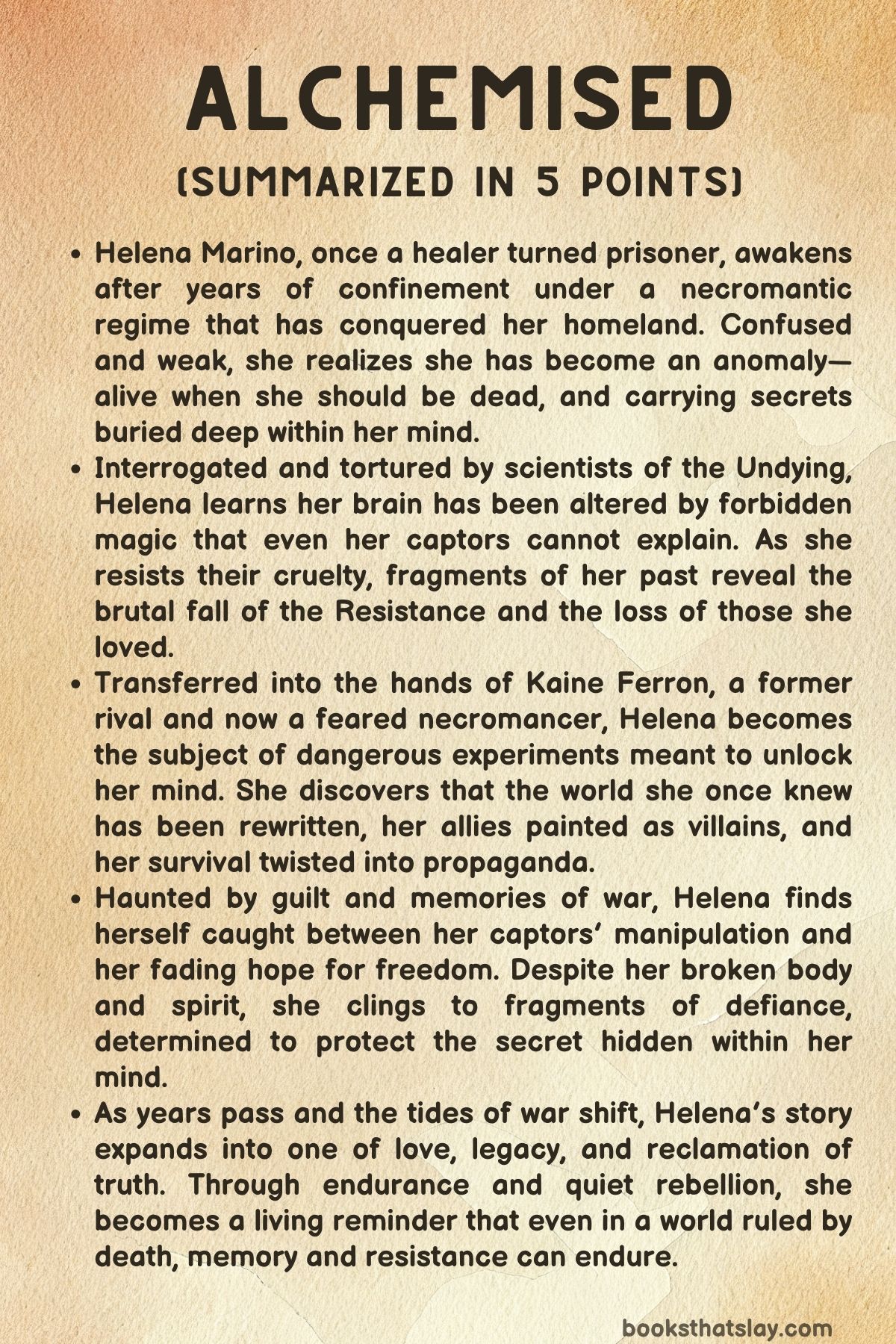
Helena Marino awakens from years of suspended animation, trapped within a necromantic world ruled by the Undying. Once a healer and alchemist of the Eternal Flame Resistance, she now finds herself in the hands of vivimancers—necromancers who manipulate the living.
Her awakening shocks her captors; she was supposed to be dead. The scientists are baffled to find that Helena’s mind has been transmuted—its pathways rerouted and sealed by an alchemical transformation no known technique could replicate.
Helena refuses to answer questions, enduring electric torture and mind probes while recalling flashes of the war that destroyed her world. She remembers Luc Holdfast, her commander and love, who was executed by the High Necromancer Morrough.
Transferred between interrogators, Helena is examined by Stroud, a cruel vivimancer fascinated by her brain’s transformation. Through fragmented memories, Helena recalls the Resistance’s last stand, the slaughter of her comrades, and the horrors of necromantic experimentation.
When Morrough himself inspects her, he recognizes that her altered brain conceals something more—a secret belonging to the Eternal Flame. Enraged by her silence, he forces the confession of Warden Mandl, who admits she had deliberately kept Helena conscious in stasis.
Morrough kills Mandl, rips out her lumithium heart, and resurrects her as a necrothrall. Helena, now marked as a scientific anomaly, becomes the subject of new experiments meant to replicate the Resistance’s rumored “animancy”—the transference of consciousness and healing of the soul.
Helena is soon transported from Central to the decaying manor of Spirefell, where she is placed under the custody of the High Reeve, Kaine Ferron. Once a brilliant alchemist and Helena’s rival at the Institute, Kaine is now something unnatural—pale, cold, and bound to the Undying.
Ordered to unlock the secrets of Helena’s mind through “transference,” he begins experiments that invade her consciousness, forcing his mind into hers in an attempt to access what lies hidden. The first attempt fails violently, leaving Helena barely alive.
Despite her desperate efforts to die, Kaine prevents her suicide, revealing that even her death would be meaningless under necromantic control.
At Spirefell, Helena learns that Kaine’s wife, Aurelia, lives in bitterness and decay, surrounded by reanimated servants. Stroud oversees the experiments and warns Ferron that the project must succeed before the solstice.
Helena, stripped of her alchemy and power, oscillates between fury and despair, haunted by the ghosts of Luc and Lila, her fallen comrades. Kaine’s control over her mind deepens, but something in Helena resists.
The experiments begin to damage both of them, and fragments of their shared past—rivalry, admiration, and guilt—emerge through the invasive resonance that binds their thoughts.
Flashbacks reveal Helena’s years in the Resistance: her healing work at the Outpost, the attacks by necromantic chimaeras, and her growing bond with Luc Holdfast, the principate who symbolized the rebellion’s hope. She witnesses his anguish when comrades die, his loss of faith in the sanctified war, and the council’s political manipulations that demand he sacrifice individuals for the cause.
When Helena and her colleagues uncover the existence of a forbidden alloy—nullium, a fusion of lumithium and imperial metal mo’lian’shi—they realize it disrupts resonance and threatens to erase alchemy itself. The discovery links the eastern empires to necromantic technology, exposing the global scale of corruption.
Helena’s research with Shiseo and Kaine deepens, even as the war turns bleak. Kaine becomes both her ally and tormentor, haunted by his own forced servitude under Morrough’s control.
During a mission, Kaine is mortally wounded by nullium, and Helena saves his life through desperate manual surgery, forging an unspoken bond between them. But their closeness sparks suspicion among the Resistance, particularly from Ilva, the austere strategist who demands loyalty at all costs.
When Helena uses a relic—the Stone of the Heavens—to heal Kaine, Ilva reveals the devastating truth: the Stone is no divine artifact, but a mass of bound souls from a necromantic atrocity. The Faith’s supposed miracle was built on murder, and the Eternal Flame’s moral foundation is a lie.
Ilva orders Helena to kill Kaine or break him into submission, giving her one month to decide. Torn between duty and love, Helena spirals into despair.
She tries to warn Luc, who still believes in the sanctity of their cause, but he refuses to accept her disillusionment. During the winter solstice, she leaves him behind, her heart shattered, and seeks out Kaine.
Their meeting is raw and wordless—a recognition that both have been destroyed by the same war.
Years later, Helena and Kaine find brief refuge in exile. Together they rescue Lila Bayard, now maimed and living in hiding, and plan an escape during the Abeyance—the receding of the seas.
Alongside Lila’s young son, Apollo, they flee across the ocean to a remote island. For the first time, Helena experiences peace, building a home stocked with tools, books, and the remnants of her alchemical past.
Kaine, tormented by his memories, begins to heal in her presence. When Helena gives birth to their daughter, Enid Rose Ferron, Kaine’s transformation is complete: the once-Undying killer becomes a father, fiercely protective of the fragile life they have created.
The world beyond their island continues to shift. The necromantic empire collapses, Morrough is hunted, and the Resistance rebuilds under distorted propaganda.
Lila, unable to bear the false peace, returns to Paladia to assassinate Morrough, dying a hero in the process. Years pass.
Enid grows into a quiet, thoughtful child, shadowed by her parents’ secrets. When Helena discovers Kaine has secretly killed Stroud to erase their past, they confront the impossibility of escape from what they once were.
Decades later, Enid leaves home to study vivimancy in Paladia, seeking her own truth. In the rebuilt city, she finds that official history portrays Kaine as a monstrous High Reeve and Helena as a forgotten prisoner who “died in captivity.
” Outraged, Enid vows to reclaim her mother’s story. Joined by Pol, Lila’s son, she promises that Helena Marino will no longer remain a footnote.
Alchemised ends where memory and myth divide—the daughter of two war-forged souls standing before a rewritten world, determined to restore the truth. Through Helena’s endurance, the novel reveals how survival is not merely living after death, but refusing to let the dead dictate what life means.
Characters
Helena Marino
Helena Marino is the emotional and moral core of Alchemised. Once a healer and scholar of alchemy, she begins her story as a captive, awakening in a world transformed by death and corruption.
Her evolution—from idealistic student to broken prisoner to a survivor shaped by loss—forms the narrative’s emotional spine. Despite enduring torture and dehumanization, Helena’s defining trait is endurance.
She refuses to yield her identity, even as her captors manipulate her body, memories, and mind. Her mind, transmuted through unknown vivimantic processes, becomes both her prison and her weapon, a living archive of forbidden knowledge.
Her silence before Stroud and Morrough is not cowardice but defiance—the act of preserving what remains of the Resistance’s legacy. Helena’s moral complexity lies in her quiet resilience: she despises violence yet becomes a vessel of it, despises necromancy yet embodies its fusion with alchemy.
Her relationship with Kaine Ferron transforms her further—from victimhood to reluctant love, from despair to creation, as she ultimately becomes a mother and symbol of renewal. By the novel’s end, Helena represents the alchemical ideal: transmuted through suffering into something enduring and luminous.
Kaine Ferron
Kaine Ferron, once Helena’s rival at the Alchemy Institute, becomes one of the most tragic figures in Alchemised. As the High Reeve, he embodies corruption—an alchemist turned necromantic enforcer, part human and part undead.
His transformation from arrogant scholar to enslaved instrument of the Undying mirrors Helena’s own descent into captivity, but where she resists domination, Kaine internalizes it. Bound by a phylactery and tortured by Morrough’s control, he oscillates between cruelty and remorse.
His interactions with Helena reveal the shattered remains of a man who once believed in reason and progress, now forced to desecrate both. Their bond is fraught with violence, dependence, and reluctant tenderness, reflecting the blurred boundary between love and survival in a world ruled by death.
By the novel’s conclusion, Kaine’s devotion to Helena and their daughter Enid suggests partial redemption—his humanity, though damaged, still flickers beneath layers of guilt and ruin. He is the novel’s alchemical counterpoint to Helena: where she refines herself through suffering, he is corroded by it.
Luc Holdfast
Luc Holdfast, the Principate of the Eternal Flame and Helena’s first love, represents the idealist’s tragedy. Born into nobility yet yearning for meaning, Luc becomes the Resistance’s symbol of hope and martyrdom.
His charm and conviction inspire loyalty, but his moral absolutism blinds him to the costs of war. Through Helena’s memories, he appears not as a flawless hero but a man consumed by the myth of heroism—haunted by his failures, paralyzed by guilt, yet incapable of abandoning faith in divine justice.
His relationship with Helena is both romantic and ideological: he sees her as the healer who tempers his fire, while she views him as the light that blinds her to moral ambiguity. His death reverberates through the entire narrative, shaping Helena’s trauma and the Resistance’s mythos.
Ultimately, Luc symbolizes lost innocence—the vision of purity that collapses under the weight of a corrupted world.
Lila Bayard
Lila Bayard, warrior and confidante, is Helena’s mirror in strength and sacrifice. Fiercely loyal, pragmatic, and unyielding, Lila survives where others perish but at great personal cost.
Her transformation—from a proud fighter to a mother scarred by war—reflects the lingering damage of resistance. She represents the kind of courage that endures without hope, acting even when the cause is doomed.
Her later life, marked by physical loss and quiet defiance, culminates in a final act of vengeance when she destroys Morrough, reclaiming agency for all who were silenced. Through her, the novel explores the persistence of memory and the moral weight of survival.
Lila’s unwavering bond with Helena—one forged in shared grief—underscores the book’s emphasis on female endurance amid systemic brutality.
Aurelia Ferron
Aurelia Ferron, the High Reeve’s wife, is an emblem of the corrupted aristocracy that thrives under necromantic rule. Petulant, vain, and terrified, she exists in a decaying echo of her former privilege.
Yet beneath her cruelty lies fear—fear of death, of irrelevance, of the monstrosity she has married. Her interactions with Helena reveal the social rot at the heart of Paladia’s new order: power without purpose, wealth without humanity.
Aurelia’s home, filled with preserved corpses and false splendor, mirrors her hollow existence. Though she wields authority, she is ultimately powerless—an ornament of a dying world, sustained only by denial.
Stroud
Stroud embodies the cold, utilitarian face of the Undying regime. A vivimancer whose scientific brilliance is matched only by her amorality, she treats living bodies as data to be extracted and rearranged.
Her fascination with Helena’s altered brain borders on reverence, yet she never sees Helena as human—only as an anomaly. Stroud’s role in developing the transference project and her participation in the regime’s breeding program expose the novel’s critique of dehumanizing science and political totalitarianism.
Her downfall, hinted to come at Kaine’s hands years later, serves as poetic justice: the destroyer undone by her own creations.
High Necromancer Morrough
Morrough is the architect of the world’s decay—the apex of necromantic power. Cold, methodical, and devoid of empathy, he represents the complete triumph of control over compassion.
His mastery of death is not motivated by faith or vengeance but by curiosity and domination. He perceives humanity as raw material for his art, reducing souls to components in his experiments.
Yet Morrough’s death at Lila’s hands is more than vengeance; it symbolizes the collapse of the necromantic order itself, the failure of a system that sought eternity by destroying all life. Through Morrough, the novel interrogates the dangers of intellect unmoored from morality.
Shiseo
Shiseo stands as the rational scholar amid chaos—a metallurgist whose discovery of the nullium alloy reveals the convergence of alchemy, politics, and war. While secondary to the main narrative, he serves as the bridge between science and conscience.
His intellectual humility contrasts sharply with the arrogance of necromancers like Stroud and Morrough. Through him, the novel preserves the vestiges of curiosity untainted by cruelty.
Enid Rose Ferron
Enid Rose Ferron, Helena and Kaine’s daughter, is the embodiment of renewal—the living synthesis of love and death, past and future. Her silver eyes mark her as both legacy and prophecy.
Growing up in the shadow of secrecy, Enid’s eventual defiance of historical distortion completes the novel’s cycle of transformation. By rejecting the falsified narrative that vilifies her parents, she restores truth to memory.
Enid represents the culmination of Helena’s journey: the alchemical child born from ruin, carrying within her the power to rewrite history.
Pol Bayard
Pol Bayard, Lila’s son, is the inheritor of a fractured legacy. His childhood friendship with Enid signifies the restoration of bonds that war once severed.
Together, they embody hope uncorrupted by ideology—the next generation destined to mend what their parents destroyed. Pol’s loyalty to Enid and his defense of her mother’s truth in the closing scene reaffirm the theme that remembrance, not revenge, is the true act of resistance.
Themes
Identity, Memory, and Transformation
The world of Alchemised centers around the instability of identity, showing how memory and selfhood can be rewritten, transmuted, or stolen. Helena Marino’s altered brain embodies this theme: her memories are fractured, rearranged, and hidden beneath layers of alchemical design.
Her struggle to understand who she is after surviving the war and imprisonment becomes both a psychological and metaphysical conflict. She is not merely remembering; she is reconstructing the person she once was from the wreckage of loss, guilt, and manipulation.
Every interaction—with Stroud’s cruel experiments, Morrough’s invasions of her mind, and Ferron’s forced transference—forces her to question whether her thoughts are still her own. The alchemical alteration of her consciousness serves as a literal metaphor for trauma’s ability to reshape identity.
Her silence during interrogations, her refusal to answer questions about who she is, becomes a rebellion against a world determined to define her. Memory in the book is never static; it is alchemic, capable of destruction and rebirth.
By the end, her transformation from a passive captive to a survivor and mother reflects how identity can survive violation through endurance rather than purity. Helena’s evolution suggests that selfhood, though mutable, remains indestructible at its core—an act of defiance against those who seek to rewrite the human spirit.
Power, Control, and Dehumanization
The story of Alchemised unfolds in a regime where necromancy and vivimancy have become tools of absolute control, erasing the boundary between life and death. Power operates through the manipulation of the body and the mind: corpses are reanimated, living beings are turned into test subjects, and the dead are used as instruments of fear.
Morrough, Stroud, and Ferron embody different forms of domination—scientific, institutional, and personal. Through them, the book examines how control strips away humanity, not only from victims but from those who wield it.
Helena’s imprisonment represents the physical manifestation of subjugation: her resonance suppressed, her movements dictated, and her autonomy erased. Yet her resistance—her insistence on retaining inner silence—reveals that power can dominate flesh but not conviction.
The necromantic state mirrors historical regimes that exploit science to justify atrocity, transforming morality into mechanism. Even Aurelia’s household, filled with pristine corpses masquerading as servants, becomes a grotesque parody of social order sustained by death.
The novel presents control as seductive and corrosive; it feeds on fear, and once internalized, it convinces the oppressed that survival requires submission. Helena’s eventual defiance, her quiet decision to live on her own terms, becomes the only true victory possible in a world designed to erase human will.
Love, Guilt, and Redemption
Love in Alchemised is inseparable from guilt. Helena’s affection for Luc Holdfast, her partnership with Kaine Ferron, and her devotion to the fallen Resistance all carry the weight of failure and betrayal.
Love becomes both a wound and a form of redemption—an emotion that binds people even when the world demands their separation. Luc represents an ideal Helena cannot reclaim: hope untainted by compromise.
Kaine, on the other hand, embodies what love becomes in a broken world—damaged, defensive, yet capable of tenderness. Their relationship is built on shared guilt, both having committed acts they cannot undo.
Helena’s healing work, her constant attempts to repair what war destroyed, are expressions of this same guilt transmuted into compassion. Even in the final act, where she and Kaine build a fragile life after years of horror, love remains marked by fear and memory.
Redemption in the novel is not achieved through grand gestures but through persistence—the daily act of living after devastation. The birth of Enid, their daughter, transforms love from a punishment into continuity, proving that even in a world of decay, connection can outlast ruin.
The Ethics of Creation and Knowledge
At the heart of Alchemised lies an unflinching examination of the moral boundaries of creation. The alchemists, vivimancers, and necromancers in the story represent divergent approaches to knowledge—each believing they can master life itself.
The war that consumes Paladia stems from humanity’s desire to transcend mortality, and Helena’s own research is caught in that moral crossfire. Her work as a healer contrasts sharply with the vivimancers who experiment on the living, suggesting that intent defines the morality of science more than capability.
Yet the novel refuses simple dichotomies: even Helena’s healing, when applied to soldiers and enemies alike, carries ethical ambiguity. The creation of the Stone of the Heavens and the manipulation of souls to forge power blur the line between salvation and sacrilege.
The story questions whether knowledge can ever be innocent once tied to human ambition. Every act of discovery in the novel exacts a cost, usually paid in lives.
In Helena’s journey, the act of creation becomes a moral crucible—her decision to heal, rather than destroy, becomes her ultimate resistance against a civilization addicted to power disguised as progress.
Survival, Resistance, and Reclamation of Humanity
Survival in Alchemised is portrayed not as victory but as endurance against annihilation. The necromantic regime destroys individuality by design, erasing names, rewriting records, and turning people into instruments.
Helena’s survival from the tank to her imprisonment in Spirefell is therefore not just physical; it is a reclamation of humanity under dehumanizing systems. Her silence, once seen as weakness, becomes her strongest weapon—an act of control in a world that denies her agency.
Resistance is shown in varied forms: Grace’s defiance despite mutilation, Lila’s final assault on Morrough, Kaine’s betrayal of the Undying. Together, they illustrate that rebellion often begins in the smallest refusals.
By the time Helena lives peacefully with Kaine and their child, survival has taken on a different meaning—not escape, but reconstruction. Her home becomes a counterpoint to the necromantic empire: a space where life is cultivated, where memory is preserved through storytelling, and where the next generation can inherit truth rather than propaganda.
The final image of Enid confronting false history completes the theme—resistance continues through remembrance, and survival becomes an act of reclaiming narrative from those who would erase it.
Truth, History, and the Power of Narrative
The closing section of Alchemised transforms personal trauma into a broader commentary on history and truth. After the wars, the victors rewrite reality, erasing Helena’s sacrifices and recasting Kaine as a monster.
The distortion of their story mirrors how empires manufacture myths to sanitize cruelty and preserve power. Helena’s life, confined to footnotes, becomes a symbol for every silenced survivor whose truth is buried beneath official memory.
Enid’s anger upon reading the falsified history and her resolve to correct it express the generational struggle against historical erasure. Through her, the novel suggests that truth survives not in monuments or institutions but in the moral determination of those who remember.
The act of storytelling becomes rebellion; history itself becomes a battlefield where memory must be fought for. The narrative closes not on despair but on continuity—Enid and Pol walking away together, vowing to preserve the real story.
In that moment, Alchemised asserts that even when truth is buried, it waits for someone brave enough to resurrect it.