Alchemy of Secrets Summary, Characters and Themes
Alchemy of Secrets by Stephanie Garber is a contemporary fantasy mystery set in a Los Angeles where old Hollywood glamour hides living folklore. Graduate student Holland St. James stumbles back into the orbit of a whispered-about class, Folklore 517, and its unnerving urban legends: a man who can tell you the moment you’ll die, a bank that exists outside normal rules, and a relic called the Alchemical Heart that can bend time.
When a date turns deadly and her twin sister vanishes, Holland is forced to test whether stories are just stories—or doors to a dangerous, secret world.
Summary
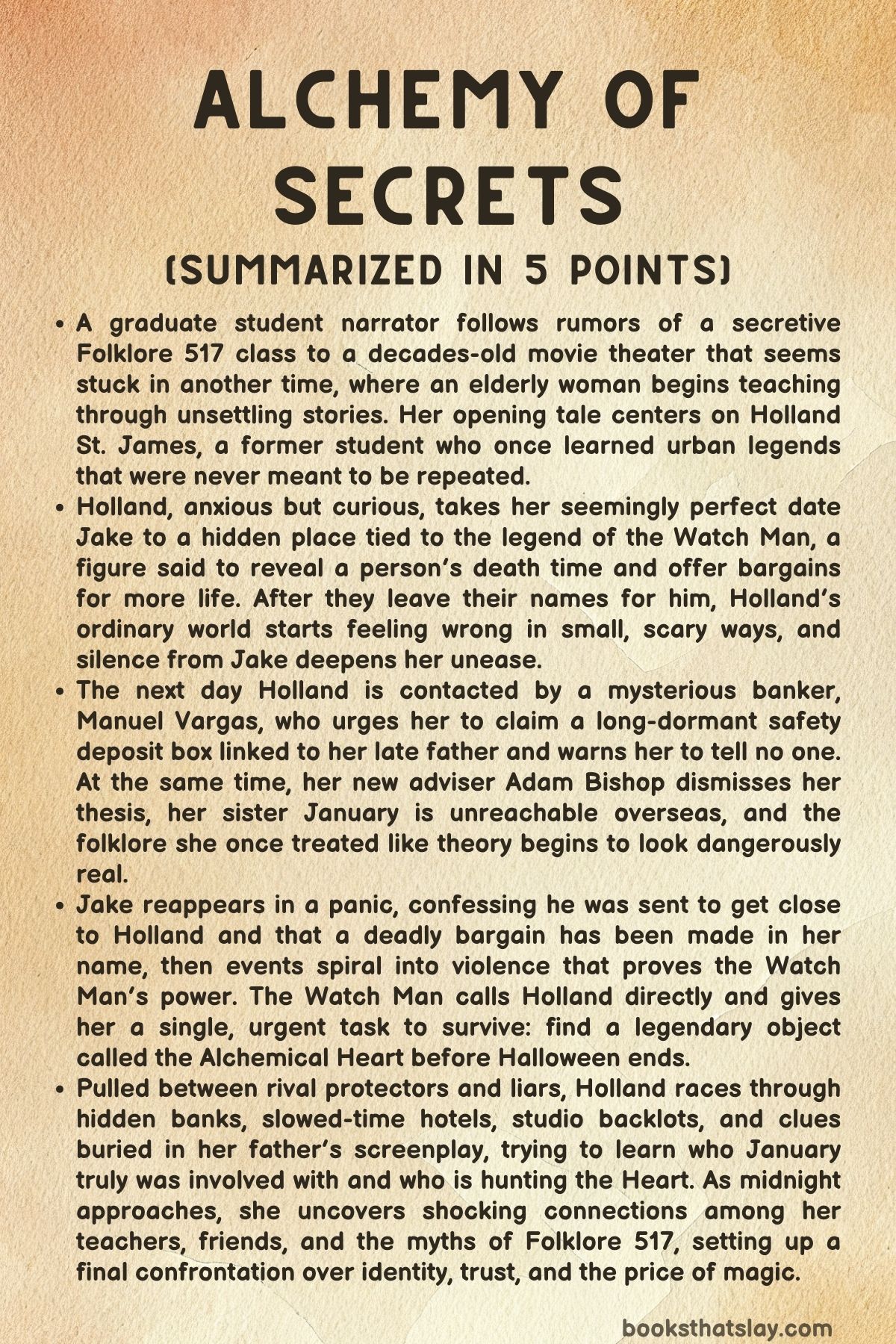
On a rainy night in Los Angeles, a young narrator searches for a rumored, unlisted course called Folklore 517. The address leads to a decaying movie theater that seems preserved from another era.
Inside, a dwindling crowd waits in darkness until an elderly woman steps into a lone spotlight. She claims the people still seated are there because of a story, and she begins telling one.
Her tale follows Holland St. James, a folklore graduate student who once attended Folklore 517 through whispered directions and a vow of secrecy. Holland is nervous about a third date with Jake, a gentle, idealistic grad student who appears almost too good to be true.
While walking with him, she spots an old poster featuring a faceless man with cuffs marked “W.M.” The image matches an urban legend she learned in the secret class: the Watch Man, a figure you can find by following hidden signs across the city. In the legend, the Watch Man will tell you the exact time you will die, and sometimes offers bargains for more time.
Spurred by a mix of curiosity and fear, Holland takes Jake to a hidden door labeled “Curios & Clockwork.” Inside, a gleaming hallway leads to two white doors. The “clockwork” door is locked.
A platinum-haired young woman opens the “curios” door, wary and impatient. Holland asks for the Watch Man.
The woman warns them to leave, but Jake insists he wants to know his fate. With clear reluctance, the woman hands them carbon slips and tells them to write their names and their request.
The Watch Man will contact them. They comply and leave, shaken but half-thrilled.
The next morning, Holland wakes to a strange quiet and a sick, drifting sense that something is off. Jake, who had texted constantly before, is silent.
A reminder pops up: she has a meeting with Adam Bishop, a new faculty member assigned as her adviser. Holland is behind on her thesis, a project rooted in old Hollywood tragedies and her belief that certain celebrity deaths were tied to supernatural deals.
Her former mentor—known only as the Professor—once supported this line of inquiry, but now refuses to answer calls. As Holland tries reaching her twin sister January in Spain, a doorbell interrupts her.
On her porch stands Manuel Vargas, an elderly banker in vintage clothes. He claims a safety-deposit box lease has expired and will be destroyed in twenty-four hours unless claimed.
The box belonged to someone who died fifteen years earlier. Vargas suggests Holland is entitled to it, insists she keep his visit secret, and hands her a card for the First Bank of Centennial City, a by-appointment-only institution with no website.
Holland suspects a scam linked to last night’s legend. But Vargas hints he knows about a death Holland and January suffered long ago—an old wound tied to their father.
The detail rattles her enough to accept the appointment.
At the university, Adam Bishop arrives looking far too young to be a professor. During their meeting Holland gets a sudden nosebleed.
Bishop confirms his identity, then dismisses her thesis as fiction and declares her former adviser a fraud. He orders Holland to start over with a new topic.
Furious and unsettled, Holland tries calling the Professor again, then leaves a message at the bank to open her father’s box. In the back of her mind, Folklore 517 legends stir: a devil’s business card, a bank that hides miracles, a price always demanded.
Later, while with friends at the Hollywood Roosevelt Hotel, Holland finally gets a bank confirmation: a 9:45 a.m. appointment.
She tries January again with no luck. Then Jake calls in a panic.
He says the Watch Man has phoned him and predicted he will die at 6:47 p.m. unless he does something he cannot explain.
Terrified, he begs Holland to come to his apartment so he won’t be alone. Still unsure whether any of this is real, Holland goes.
She arrives just before the predicted minute. Jake is frantic, hollow-eyed.
He pulls her inside, then tries to stop her, confessing his name isn’t Jake. He was hired for a “simple job”: date her, learn her habits, and deliver her to someone who wants her dead.
He says killing Holland tonight would buy him extra years, and the Watch Man offered that bargain. Holland breaks free and runs through the complex.
Outside, disoriented and unable to find her car, she sees Jake’s body under the sprinklers, bleeding and still. The time is 6:53 p.m.—close enough to confirm the legend.
Holland races into his apartment, finds mail addressed to Axel Jorgenson, and a black folder filled with surveillance and a scripted identity for “Jacob Smith.” The folder proves she was targeted for months.
The Watch Man calls Holland through a crackling line. He says he did not kill Axel; he only tells people their ending and what might delay it.
Then he delivers Holland’s own sentence: she will die the next night, Halloween, at 11:59 p.m. The only way to live past that moment is to find the Alchemical Heart.
Sirens grow near. Holland tries to leave, but her car has been sabotaged.
A dark SUV blocks her in. The driver, Gabe Cabral, orders her inside, saying she’s safer with him than with police or whoever hired Axel.
On his wrist Holland sees a tattoo like one January has. Gabe says January sent him.
He smashes Holland’s phone to prevent tracking, gives her a burner, and shows her a torn note from January: keep Holland safe or the hunter will come for her too. Gabe explains that the Alchemical Heart is a legendary source of magic—an object that can become what you need, and what secret groups have hunted for generations.
They go to the Professor’s house for help and find it broken into. The office is trashed, and January’s business card lies among the debris, suggesting deeper ties than Holland knew.
Adam Bishop arrives claiming January asked him to protect Holland. He also bears the tattoo.
Gabe calls Adam a liar who manipulated January. Guns come out, shots are fired, and both men fall wounded.
Gabe drags Holland away, refusing a hospital and insisting they hide at his place.
The next morning Holland arrives at the First Bank, trying to ignore her confusion over Gabe and the strange pull between trust and dread. A banker named Padme escorts her upward, hinting that January is important at the bank and that January’s partner Adam was recently shot.
The news clashes with Gabe’s story. Holland enters the manager’s office and finds the Professor sitting behind the desk, dressed as if she belongs there.
The Professor flips a jade hourglass and freezes time, proving the bank operates beyond ordinary reality. She admits Folklore 517 was a recruitment net for people bright enough to find magic.
January was recruited first and demanded Holland be kept out.
The Professor offers Holland a job and answers about her parents, her father’s death, and the devil. In return Holland must surrender what is inside her father’s safety-deposit box, which the Professor believes contains the Alchemical Heart.
She warns Gabe is a ruthless criminal who stole magic through marriage and murder. Holland refuses to agree without proof.
As the frozen-time sand in the hourglass nears empty, it cracks, a bird hits the window, and time lurches—an unheard-of failure that rattles the Professor. She dismisses Holland to the vault.
Inside the box Holland finds a satchel holding a manila folder. Rather than a glowing relic, she discovers her father Benjamin Tierney’s missing screenplay, titled Alchemy of Secrets.
The pages include details from classic films that don’t exist in public cuts, suggesting her father hid clues in his art. The lights shut off.
Holland escapes through a stairwell and out into daylight.
Her friend Eileen arrives in a vintage car demanding Holland get in. Holland notices Eileen carries the same tattoo as January, Gabe, and Adam.
A magical billboard appears pointing to the Regal Hotel, visible only to those with special keys. January’s plastic keychain transforms in Holland’s hand into a golden key, and Eileen drives them to the Regal, where time slows to a crawl within the property.
Staff realize Holland isn’t January and try to corral her, but Holland slips into a black-and-white bar and finds Adam alive, healed, and waiting. He makes her his guest, meaning she must remain with him for a full Regal day.
Holland tells him about her midnight deadline. Though he calls the search lethal, he agrees to help because January ordered him to keep her alive.
They head to find the Watch Man.
They hide on a studio tour while Gabe searches for a clue in a chained prop book. He unlocks it easily, finds only blank pages and a yellow pencil, then leaves.
Holland realizes the pencil connects to her father’s penciled notes. In the screenplay, a line about “my neighbor next door” and another warning about direction point them to a backlot neighborhood.
A throwaway detail about a yellow stitched house helps Holland pick the right set. Under a sycamore tree carved with her parents’ initials, Adam digs up a jar holding a scroll: her father’s note says she already has what she needs, and a final page shows a bowling ball rolling toward six pins spelling “THE END.” The clue points to the Roosevelt Hotel’s hidden bowling alley.
Gabe appears, demanding the scroll at gunpoint. Holland flees into the yellow house, drops into tunnels, and is caught.
Gabe claims he didn’t kill his wife and insists Adam is the real threat. As he speaks, his eyes bleed, triggering Holland’s own bleeding and a vision.
When she regains clarity, Gabe is gone with her satchel and the pages, leaving January’s backpack behind.
Adam finds Holland and they head for the Roosevelt Halloween Ball, a lavish costume party. Holland wears her mother’s famous Mirrorland gown from storage, hoping it will help her blend in.
At the hotel, Chance Garcia—another folklore student—pulls her aside. He has spent months investigating Adam and shows photos of him on old film sets across decades, never aging and always near later deaths.
One image shows Adam behind Holland’s parents. Chance fears Adam is the devil.
Shaken, Holland slips away to continue alone.
In the bowling alley area, Holland is confronted by Mason, Adam’s brother, who appears as a ghost bound to the hotel. Mason reveals a nightmare truth: Holland has been trapped in a repeating cycle.
She dies before midnight, time resets shortly after, and only Mason remembers each loop because he exists outside time. Her nosebleeds and visions are fragments from previous cycles.
Mason says Adam always kills her, and offers help only if Holland later uses the Heart to restore Mason to life and turn Adam into the hotel’s new ghost.
With minutes left, Holland searches January’s backpack and finds cash, a fake passport, and January’s sulfur necklace. She puts it on; her own necklace fuses into a gold choker stamped with the Alchemical Heart symbol.
Believing she has found the Heart, Holland tries to escape, but Adam finds her. His voice becomes unnaturally compelling.
He kisses her, tears off the necklace, and stabs her, taking it as she falls.
Bleeding out, Holland realizes the choker was bait. She grabs the Professor’s journal from the backpack and feels it pulse with magic.
The Heart’s symbol is embossed on its cover. The Alchemical Heart has been hiding as the journal—shifting form to stay safe.
Holland crawls into a secret sitting room with Mason and asks the Heart to heal her. Poison leaves her body, her strength returns, and midnight passes without any reset, ending the loop at last.
Holland asks the Heart to pause time, and it becomes an hourglass. Guided by Mason’s bargain, she commands the Heart to restore Mason to life and bind Adam as the hotel’s ghost, removing him from the world he’s preyed on for years.
Time resumes. Mason becomes human again, stunned by breath and warmth, and warns her that others will keep hunting the Heart.
The Heart then reveals its oldest disguise: Manuel Vargas. It explains that magic always costs something, especially resurrection.
Holland, aching for her parents, decides not to bring them back. She asks the Heart to awaken her own dormant ability, accepting whatever form it takes.
Finally, she sends the Heart forward into the future to someone kind who will use it once and then hide it again.
At dawn, Holland tells the Professor she no longer has the Heart. The Professor, knowing it has slipped out of reach, still offers Holland a position at the bank.
The next morning Holland runs along the beach, relieved to feel time moving normally. Mason joins her briefly to experience the ocean as a living man, thanks her in his guarded way, and leaves behind a black business card.
As the sun rises fully, January finally calls, and Holland answers, stepping into a future where stories are no longer distant rumors—but the rules of her life.
Characters
Holland St. James
Holland is the emotional core of the novel: intelligent, skeptical, and deeply shaped by grief and unfinished love for her family. Her defining trait is the tension between rational scholarship and inherited wonder.
She wants proof, patterns, and meaning, which is why folklore appeals to her—but she also fears being fooled, a fear rooted in losing her parents and her professor’s betrayal. Holland’s vulnerability comes from love: her devotion to January, her nostalgia for her father’s movie-linked treasure hunts, and her desire to trust romantic and academic bonds.
Yet she is not passive. When threatened, she runs, steals evidence, deciphers clues, and ultimately negotiates directly with the Alchemical Heart itself.
Her arc is about agency through discernment: she learns that survival in a world of legends depends less on blind faith and more on choosing what and whom to believe. By refusing to resurrect her parents despite temptation, she proves her maturity—the ability to accept loss without letting it hollow her out.
Jake / “Axel Jorgenson” / “Jacob Smith”
Jake is a tragedy of manufactured intimacy. Introduced as a near-ideal partner, he represents the comforting story Holland wishes were true: that goodness is simple and love is safe.
The reveal that “Jake” is a persona exposes how easily narratives can be weaponized. His panic and confession show that he is not a cold-blooded villain but a desperate pawn caught between terror and guilt.
The Watch Man’s bargain exploits his fear of death, turning him into a mirror of Holland’s own fear—except he chooses self-preservation at the cost of another. His death precisely on schedule makes him the novel’s first undeniable proof that the folklore is real, and that proof is paid for in blood.
He functions as both warning and catalyst: a demonstration that magic preys on weakness, and that even tender feelings can be staged for sinister ends.
January St. James
January is Holland’s twin and her shadow counterpart: equally brilliant but operating inside the magical world rather than outside it. Where Holland clings to scholarship and memory, January is a collector of secrets and artifacts, comfortable living in the gray zones of myth.
Her absence for most of the plot makes her feel ghostlike, yet her influence is constant through clues, tattoos, keys, and the trail of urgent protection she tries to leave for her sister. January’s greatest complexity lies in choice and consequence—she entered the Bank, fell into dangerous love, and vanished in a way that suggests both victimhood and complicity.
Her insistence that Holland be kept away implies fierce sisterly protectiveness but also a belief that Holland could be corrupted or destroyed by this world. By the time she finally calls, her survival feels less like closure and more like an opening to further mystery, emphasizing that January lives in ongoing negotiation with power.
Gabriel “Gabe” Cabral
Gabe is written as a tension engine: rescuer and captor, romantic spark and looming threat. His physical presence and decisive action make him feel reliable in crisis, yet his secrecy and the Professor’s accusations coat him in doubt.
Gabe’s tattoo links him to the magical elite, but his background positions him as an outsider who seized access through marriage, which makes him both hungry and defensive about power. He reads as someone capable of tenderness yet trained by violence, and his refusal to go to a hospital signals a survivalism that predates Holland.
The ambiguity around his wife’s death and his motives for the Heart forces Holland—and the reader—to confront the novel’s recurring question: is danger defined by intention, by history, or by what people are willing to do when time is running out? Gabe ultimately remains morally unsettled rather than conclusively redeemed or condemned, serving as the living proof that legends can’t be sorted cleanly into heroes and villains.
Adam Bishop
Adam is charisma sharpened into a weapon. He arrives as the plausible figure of authority—young adviser, rational skeptic, handsome academic—and uses that plausibility to destabilize Holland’s trust in her former mentor and in the folklore itself.
His most frightening trait is persuasion that feels like gravity: when he speaks, people lean toward belief, and Holland’s body reacts before her mind does. The photographs Chance reveals imply that Adam is a long-lived predator orbiting moments of death, which reframes his early critiques of Holland’s thesis as strategic containment rather than scholarship.
As the time-loop killer, Adam personifies the darkest edge of folklore: an immortal story that repeats itself until someone breaks it. His stabbing of Holland at the climax is not only betrayal but ritual—he enacts the same ending over and over, addicted to control.
When Holland turns him into the hotel’s ghost, his punishment fits his crime: a man who exploited time becomes trapped within it, reduced from author of endings to a cautionary tale bound to one place.
Manuel Vargas
Manuel Vargas begins as a figure of mundane oddness—a banker in suspenders—then transforms into the novel’s most radical revelation. As the Alchemical Heart, he is magic camouflaged as a person, which captures the idea that myth walks among us unnoticed.
His personality blends warmth with implacable rules: he delivers possibilities but insists on costs, embodying the ethics of equilibrium that the Professor manipulates but cannot escape. Manuel’s long companionship with Holland without her awareness makes him feel almost guardian-like, yet his sentience means he is not a tool but a character with intent.
His shifting form—journal, hourglass, person—shows that power in this world is fluid and story-shaped. By refusing to let resurrection be free, he forces Holland into moral adulthood.
In the end, Manuel is less a prize than a teacher: he shows that true alchemy is not limitless wish fulfillment, but choosing what kind of person you become when magic finally answers you.
Mason Bishop
Mason is a sorrowful hinge between horror and hope. As a ghost bound to the Hollywood Roosevelt, he exists outside time, making him both witness and prisoner to Holland’s repeated deaths.
His bitterness toward Adam is justified by betrayal and by the humiliation of being trapped while his brother moves freely through centuries. Yet Mason is not purely altruistic; his offer of help is conditional on reclaiming life and trading Adam into his place, which reveals a pragmatic, even ruthless side born of long suffering.
He is defined by longing—longing for a body, for sensation, for the ocean again—and this human ache makes his ghosthood poignant rather than abstract. When Holland fulfills the bargain, Mason’s return to life feels earned and fragile, and his quiet gratitude underscores one of the novel’s gentlest insights: revenge can coexist with healing, but both cost something.
Eileen
Eileen appears initially as a grounded friend in Holland’s ordinary world, which makes her reveal as tattooed and magically affiliated a shock of betrayal and relief at once. She is a character of strategic loyalty: her insistence that she is still Holland’s friend suggests genuine care, but her rapid competence during the bank escape implies training and hidden responsibility.
Eileen’s dual identity reinforces the theme that the magical world is not separate from the mundane—it is threaded through friendships you thought you understood. Her role is smaller than some others, but she matters because she represents a third path between Holland’s outsider status and January’s deep immersion: someone who lives in the system yet can choose personal loyalty over institutional obedience.
Chance Garcia
Chance is the skeptic-investigator archetype, the character who refuses to accept surface stories. His warnings to Holland and his months-long digging show a slow-burn courage and intelligence that parallels Holland’s own, but aimed more toward exposure than survival.
He is driven by distrust of the magical machinery around them, and his discovery of Adam’s suspicious immortality gives Holland a crucial counter-narrative when she is most vulnerable to manipulation. Chance’s value lies in what he symbolizes: rational persistence can be heroic even in a world of enchanted myths.
He does not wield an ability or a legend; he wields attention, and in Alchemy of Secrets that is a kind of power.
Cat
Cat functions as part of Holland’s social anchor to normalcy, meeting her at the Roosevelt with the easy familiarity of old friendship. Though she doesn’t directly affect the magical conflict, she matters as contrast: she shows what Holland’s life might have stayed like if folklore had remained only academic.
Cat’s presence heightens Holland’s isolation later, because the price of pursuing legends is losing the ability to lean on friends who don’t know the rules of the hidden world.
Padme
Padme is a minor but revealing figure within the Bank, notable for her calm professionalism amid Halloween costumes and time-bending stakes. She treats secrecy as routine, which implies how normalized the extraordinary is within this institution.
By speaking openly about January’s importance and Adam’s injury, she inadvertently destabilizes Holland’s assumptions, making her a narrative pivot. Padme represents the Bank’s bureaucratic face: magic administered like policy, with human employees who are neither villains nor heroes, just functionaries of a larger power structure.
Benjamin Tierney
Benjamin exists mostly through absence, memory, and the screenplay he leaves behind, yet he shapes nearly every emotional and thematic turn. His treasure-hunt games taught his daughters to see the world as layered with clues, and that childhood training becomes Holland’s survival skill.
The missing screenplay titled Alchemy of Secrets is both a literal artifact and a final paternal conversation, designed to guide rather than rescue. Benjamin’s love shows itself in riddles, in faith that Holland can interpret his trail, and in the poignant line that she already has what she needs.
He embodies the gentler side of storytelling: not stories as traps, but stories as inheritance and protection.
Themes
Storytelling as a Gate to Hidden Power
Rumors of Folklore 517 pull the narrator into an impossible theater, and that opening frames the entire novel’s attitude toward stories: they are not entertainment layered over reality, but access codes to it. Every major turn happens because someone believes, repeats, or withholds a legend.
Holland’s decision to follow the poster into the alley comes from memory of a classroom myth, not from logic, and that choice sets the plot in motion. The secrecy around Folklore 517 shows how narrative can function like an exclusive institution—knowledge shared by whisper becomes a kind of social currency, granting entry to spaces that official systems can’t map.
The Watch Man’s legend is especially revealing: a simple question (“what time is it?”) becomes a ritual that can change fate, implying that language itself has causal force. Even the bank, with its rules and appointments and blank business cards, operates like a story you step inside.
Later, Holland’s father’s screenplay—titled Alchemy of Secrets—isn’t just a keepsake; it’s a designed narrative trail, one that uses film history, backlot sets, and props to guide her toward the Heart. This ties storytelling to inheritance: parents pass down not only objects but structures of meaning that let children navigate danger.
At the same time, the book warns that stories can be weaponized. Jake is recruited through a myth and then made into its victim; Adam shapes a persuasive narrative around Holland until it becomes a trap.
Trust in stories is shown as necessary but risky, because the teller holds power over the listener. In the end, Holland survives by learning to read stories with care—seeing pencil marks as signals, spotting unnecessary details as direction, and finally speaking to the Heart with precise intent.
The theme isn’t “believe everything,” but “recognize that belief is a tool.” Stories open doors, but only the person who understands their rules can walk through safely.
Time, Mortality, and the Cost of Knowing
From the Watch Man’s first promise—he will tell you when you die—time in the novel is not a neutral background. It is personal, negotiable, and terrifying.
Holland and Jake enter Curios & Clockwork wanting knowledge, and they receive it in the cruelest possible form: a countdown. Jake’s death at the predicted minute makes time feel like a fixed sentence, yet the Watch Man’s bargain introduces a second idea—that time can be extended at a price.
This tension drives Holland’s panic once she is given her own deadline. Halloween, already a night associated with thin boundaries, becomes a literal edge of existence for her.
The bank’s frozen-time display, caused by the Professor’s hourglass, adds another layer: institutions that control time control people. When the Professor halts the world outside her office, Holland sees that power over time is also power over consent; decisions happen in trapped minutes.
The later discovery of a time loop at the Roosevelt shows mortality turning into repetition, not release. Holland’s nosebleeds and visions being fragments of previous deaths makes her body a record of time’s violence, and the loop turns her life into a test she is forced to retake.
Yet the loop also creates a path to agency. Because memory leaks through in bodily ways, Holland can learn what earlier versions of herself did wrong.
The Alchemical Heart embodies the same moral problem. It can pause time, heal wounds, restore the dead, and rewrite outcomes, but every use carries an implied toll.
The Heart’s warning about resurrection—magic always costs more when it reverses death—makes mortality feel ethically anchored even in a world where time can be bent. Holland’s final refusal to bring her parents back is not resignation; it’s a mature acceptance that living with loss may be the only way to live honestly.
By sending the Heart into the future for a single kind use, she chooses limited intervention over endless control. Time in Alchemy of Secrets becomes both threat and teacher: knowing your end can destroy you if you chase certainty, but facing the limit can also clarify what kind of life you’re willing to protect.
Trust, Deception, and the Fragility of Intimacy
Holland’s world collapses not because magic exists, but because she can’t tell who is safe. The early romance with Jake is built from deliberate performance: a carefully designed persona full of appealing ethics, habits, and shared interests.
When that persona is revealed as a job, the betrayal feels surgical, and the theme of intimacy as a site of manipulation takes root. Jake’s confession that he was hired to get close to her shows how affection can be used as surveillance, turning dating into a form of espionage.
The dossier he leaves behind makes the private visible, a violation that extends beyond him to the unseen people who planned it. After that, every relationship is tested.
Gabe rescues Holland with urgency and proximity, then destroys her phone, an act that can read as protection or control. Adam appears as an adviser and ally, then as someone who may be tied to January, then as a possible monster.
Even Eileen, a friendly constant, is suddenly marked by the same tattoo as the others, turning loyalty into a question mark. The novel makes this uncertainty felt in how Holland repeatedly revises her understanding of others based on new evidence, only to have that evidence contradicted.
January’s absence complicates things further. Holland’s twin is both motivation and mystery, and her secrecy suggests that even family bonds can include withholding for what someone thinks is love.
The setting supports this theme: hidden banks, unlisted classes, blank business cards, and secret hotel keys all produce a culture where concealment is normal. In that culture, trust becomes a scarce resource, something you grant in small quantities and retract fast.
The Roosevelt party heightens the stakes by flooding the space with costumes and roles; everyone is someone else visually, mirroring the emotional disguises already in play. Adam’s final betrayal, using an unnaturally persuasive voice that dissolves Holland’s resistance, shows deception reaching into the self, not just the world around her.
Yet the story doesn’t end in paranoid isolation. Holland learns a different kind of trust: not blind faith in a person’s story, but confidence in her own perceptions and choices.
She trusts Mason’s warning enough to act, doubts Adam at the right moment, and finally trusts the Heart’s guidance while still keeping control over her wishes. The theme argues that intimacy is fragile in a world of secrets, but survival depends on building trust that is earned, tested, and sometimes withdrawn without guilt.
Grief, Memory, and the Ethics of Letting Go
Loss sits underneath Holland’s decisions long before she knows she is in danger. Her father’s death and his treasure-hunt games shape her way of seeing the world as a puzzle with meaning hidden inside ordinary objects.
January’s disappearance reopens that old wound, turning grief into urgency. The novel treats memory as both comfort and trap.
Holland’s nostalgia for classic films and her work hosting film nights show her clinging to curated pasts where endings are scripted and knowable. Yet the magical world keeps forcing the past into the present in harsher ways.
The safety deposit box leased fifteen years earlier becomes a time capsule demanding attention now, as if grief can be postponed but not canceled. The screenplay inside isn’t just a clue; it’s a conversation her father prepared for a future version of her.
That gesture shows love continuing past death through careful planning, but it also burdens Holland with a mission she didn’t choose. The time loop intensifies grief into repetition: Holland dies again and again, reliving the ultimate loss of self.
The nosebleeds that carry memories of previous deaths imply that grief can live in the body, surfacing without permission. Mason’s existence as a ghost bound to the Roosevelt makes the theme explicit.
He is grief personified—someone stuck in what was, watching life proceed without him. His bargain with Holland, asking to be restored, exposes the ethical tangle grief creates: the desire to undo loss can lead to trading one life for another.
The Alchemical Heart offers the most direct temptation. It can resurrect her parents if she asks, and the story builds emotional weight around that possibility.
Holland’s choice not to do it is the novel’s clearest statement about grief: love for the dead does not automatically justify rewriting the living world. Her decision respects the cost that resurrection would demand and acknowledges that memory is not the same as possession.
At dawn, running on the beach, Holland experiences time as something that moves forward and can be cherished precisely because it doesn’t reverse. Mason tasting life again, briefly and quietly, reinforces that renewal is meaningful when it doesn’t erase what was lost.
Grief in Alchemy of Secrets is shown as a force that shapes identity, but it becomes survivable when memory is honored without turning into a command to restore the past at any price.
Agency, Choice, and the Limits of Power
Holland begins the story as someone acted upon: recruited into a secret class, manipulated by a boyfriend, threatened by prophecies, and pulled between rival protectors. The plot keeps presenting her with systems that want to decide for her.
Folklore 517 expects silence. The Professor expects obedience in exchange for safety.
The bank expects a trade before access. Gabe and Adam each claim authority over her survival, urging her to follow their route.
Even the Watch Man’s deadline could be read as the ultimate removal of agency—time handed down like a verdict. Against all of that, the novel charts Holland’s movement toward self-directed action.
She repeatedly refuses to accept the story others want her to live inside. She doesn’t hand over her father’s box on demand.
She leaves the bank on her own terms. She chooses to go after the Watch Man.
She chooses to read the screenplay as a map rather than a relic. The time loop seems like a cruel joke at first, but it also becomes a stage for agency, because it reveals that previous versions of Holland were not powerless; they were learning.
Each loop contained a choice, and the accumulated memory lets her refine those choices until one is right. The Heart is the climax of this theme.
It is pure potential—changing form, answering wishes—and in lesser hands it could become a tool of domination. Holland’s interaction with it emphasizes limits.
She has to speak clearly; she can’t wish lazily. She can’t choose the nature of her personal ability.
She can’t avoid the moral cost attached to resurrection. Her greatest use of power is not flashy revenge but structural protection: removing Adam’s threat by binding him to the hotel and restoring Mason without creating a new cycle of harm.
Finally, she gives up the Heart rather than keeping it, sending it to a future user who will use it once and hide it. That choice refuses the fantasy of permanent control.
The book suggests that agency is not about having endless options; it’s about making accountable decisions under pressure, accepting that power without restraint corrodes the self. Holland’s survival is less about defeating enemies and more about claiming authorship of her own life, even when every magical structure around her tries to turn her into someone else’s means to an end.