Alchemy of Souls Summary, Characters and Themes
Alchemy of Souls by Adriana Mather is a fantasy novel centered on magical inequality, political control, hidden histories, and an unexpected bond between two young Mages from radically different social worlds.
Eloise Belrose enters the University system hoping that magical success will lift her Laborer family out of danger, while Grayson Stone enters it carrying a secret campaign against his powerful uncle. When an ancient magical test mysteriously connects them and summons the legendary Archive Key, their futures become inseparable. Their search for answers gradually exposes secrets that challenge nearly everything Eloise has been taught about magic, authority, and the Lawless.
Summary
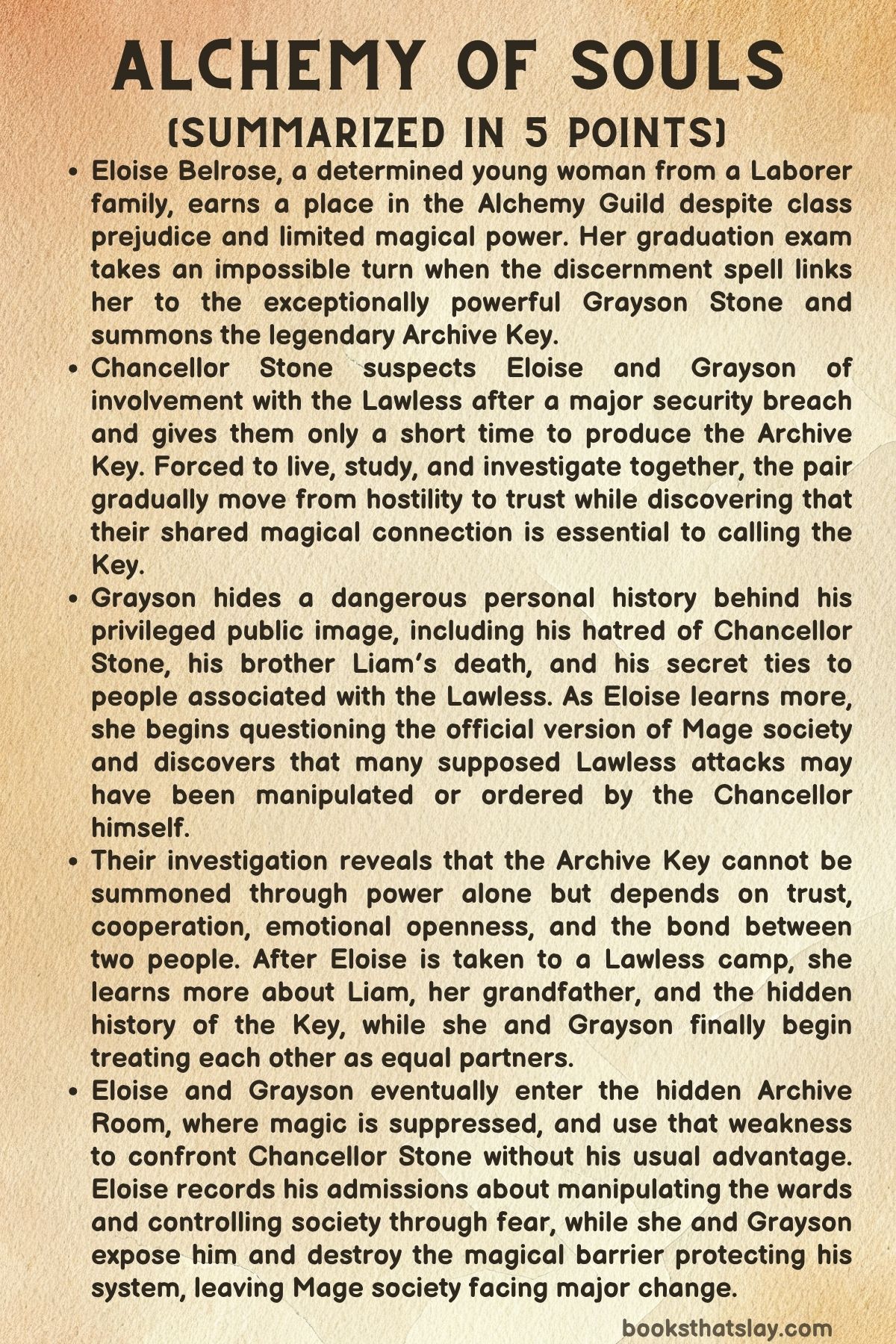
Eloise Belrose has spent years working toward one goal: graduating from the Academy and earning admission to the University of Magical Arts. Born into a Laborer family with no influential Mages, she knows that passing the discernment exam could give her mother, grandmother, and young sister Delilah a chance to escape the poorly protected area where they live.
Her social position is constantly reinforced by students such as Naomi, who treats Eloise’s poverty as evidence that she does not belong among powerful Mages. Despite these humiliations, Eloise successfully performs an Alchemy spell during the graduation examination, and the discernment spell assigns her to the Alchemy Guild.
Grayson Stone approaches the same ceremony from the opposite position. As the nephew of High Chancellor Stone and one of the most powerful young Mages of his generation, he is expected to be declared Gifted and admitted to all four magical disciplines.
What almost no one knows is that Grayson hates the family system that celebrates him. He holds his uncle responsible for the death of his older brother Liam and intends to enter the Chancellor’s inner circle so that he can eventually destroy his uncle’s power from within.
During Grayson’s discernment, he demonstrates exceptional ability in Alchemy, Botany, Illusion, and Elemental magic. Yet instead of displaying the expected guild symbols, the spell suddenly produces Eloise’s face above him.
When Eloise is tested again, the situation becomes even stranger. The legendary Archive Key briefly appears, and the discernment spell then displays Grayson’s face above Eloise, establishing a magical connection neither of them understands.
At nearly the same time, the Lawless breach the Academy’s wards and steal rare ingredients from the greenhouse. Chancellor Stone immediately suspects that the strange discernment incident may be connected to the attack, making Eloise and Grayson convenient suspects.
The Chancellor interrogates them and threatens Eloise’s family. Grayson, realizing that Eloise may be killed or used as leverage, claims that the two of them can summon the Archive Key again and promises to produce it within two weeks.
His claim is largely a bluff, but the Chancellor wants the Key badly enough to accept the bargain. Eloise and Grayson are ordered to remain together, Grayson is temporarily placed in Alchemy, and both are sent to the University under surveillance.
Their partnership begins badly. Eloise sees Grayson as an arrogant representative of everything unfair about Mage society, while Grayson assumes Eloise knows more about the Archive Key than she admits.
Their arrival at the hidden University forces them into the same suite and the same daily schedule. Grayson’s obsession with security makes Eloise feel controlled, while Eloise’s refusal to follow his instructions frustrates him.
They begin researching the Archive Key, but existing magical texts offer little useful information. Eloise wants evidence and historical context, whereas Grayson prefers direct experimentation because their deadline is rapidly shrinking.
Gradually, however, their hostility becomes cooperation. Grayson recognizes that Eloise is telling the truth when she says she does not understand how the Key appeared, and Eloise begins noticing that his actions are often more protective than his reputation suggests.
University training deepens their changing relationship. Eloise lacks Grayson’s extraordinary magical strength, but she repeatedly succeeds through creativity, persistence, and careful observation.
When a senior student named Pierce nearly causes her to fall during combat training, Grayson instinctively saves her. Akari, the formidable Guardian overseeing training, punishes them both by temporarily taking away their magic and forcing them to complete a dangerous physical challenge together.
Without magic, they must rely on judgment, physical skill, and cooperation. Grayson refuses to abandon Eloise after she injures her ankle, and their successful return before curfew proves that they can function as genuine partners.
Their constant closeness begins attracting attention from other students. To explain why they live together, train together, and repeatedly disappear for private research, Grayson suggests that they pretend to be romantically involved.
Eloise dislikes the idea, but it becomes increasingly practical. Their attempts to make the fake relationship convincing create real attraction, especially as Grayson becomes jealous of Adrien, a Gifted student who openly flirts with Eloise.
Meanwhile, Grayson is hiding far more than his feelings. He possesses secret phones, communicates with a woman named Sage, and works with people connected to the Lawless.
Bastian, one of his longtime friends, is also connected to this hidden network. Sage believes obtaining the Archive Key could transform their struggle against Chancellor Stone, and she becomes increasingly interested in Eloise as the person who may be capable of summoning it.
The research eventually leads Eloise and Grayson away from official magical scholarship. They discover references suggesting that truthful information about the Key survived in poetry rather than approved historical records.
Their search connects the poet Conri Brachan to a local cobbler and reveals that important knowledge about magical history has survived among people whom elite Mage society ignores. Grayson also begins sharing personal secrets, including his hidden ability to smell emotions.
At a party, the tension between Eloise and Grayson finally breaks. After jealousy, arguments, and months of disguised attraction compressed into their short time together, they genuinely kiss.
The Archive Key immediately appears beside them. Its arrival confirms that the Key responds not merely to Eloise’s Alchemy but to the magical and emotional connection between them.
Grayson reacts to this discovery by pushing Eloise away. He fears that genuine intimacy will expose both his secrets and her to greater danger.
Their research continues despite the emotional strain, and further experiments demonstrate that simple spells can attract the Key when they cast magic together while touching. The important force appears to be their bond rather than any single complicated spell.
Eloise eventually refuses to accept Grayson’s vague warnings and demands the truth. He finally reveals that Chancellor Stone murdered Liam after discovering that Liam had summoned the Archive Key.
The revelation completely changes the stakes. Eloise can no longer view giving the Key to the Chancellor as a simple way of satisfying their bargain and protecting her family.
The Chancellor then reduces their deadline to forty-eight hours. Grayson responds by telling Eloise more about Liam, his hatred for his uncle, and the hidden phone that allows communication beyond official surveillance.
Eloise contacts her family and confirms that they are safe. Grayson then reveals his connection to the Lawless and claims that the accepted story about them is largely false.
According to Grayson, the Lawless do not indiscriminately attack Laborer communities as Eloise has been taught. Many attacks blamed on them were orchestrated by Chancellor Stone as part of a system designed to preserve fear, justify Guardian violence, and maintain Mage authority.
Before Eloise can fully process this, Sage abducts her from the University. Maggie is injured during the attack, and Eloise is taken to a Lawless camp.
There, Eloise refuses to accept either side’s claims without evidence. Although she now doubts Chancellor Stone’s version of history, she also refuses to assume that the Lawless are automatically truthful simply because the Mages have deceived her.
Grayson follows her into the forest and reaches the camp. Instead of immediately leaving, Eloise decides that they need answers.
The camp challenges the image of the Lawless she has known since childhood. She sees families and ordinary people, including individuals rejected by Mage society who possess sophisticated magical knowledge.
Sage explains that Eloise’s grandfather Charles was known to the Lawless. She also reveals that Liam had summoned the Archive Key with Grayson’s help, although neither brother understood what they were doing at the time.
This discovery devastates Grayson. He realizes that his own bond with Liam was part of the magical process that attracted the Key and indirectly contributed to the events that ended with his brother’s death.
Studying the old poem together leads Eloise to the central discovery: the Archive Key requires two people, and the quality of their relationship matters. Trust, moral intention, cooperation, and emotional openness appear to be essential elements.
When Eloise tells Grayson that she trusts him but also demands that he trust her choices and abilities, the Archive Key finally appears directly in her hand.
They return secretly to the University and locate the Archive Room. Inside, they discover an enormous hidden library containing magical knowledge unavailable for generations.
More importantly, magic is suppressed inside the room. Eloise immediately understands the strategic significance: Chancellor Stone’s greatest advantage is his overwhelming magical strength, and inside the Archive he would be forced to confront them without it.
Rather than following Grayson’s previous plans with Sage, Eloise insists that they create a new strategy together. Their relationship has changed enough that Grayson agrees to treat her as an equal participant instead of secretly deciding what risks she should or should not take.
Their plan requires Grayson to lead the Chancellor to the Archive while Eloise waits inside. The plan becomes dangerous almost immediately when Chancellor Stone enters before Grayson can join her.
Confident that Eloise is powerless, the Chancellor reveals enough of his actions to confirm the accusations against him. He speaks openly about manipulating the wards, maintaining fear of the Lawless, threatening Laborer families, and using public violence to preserve control.
Inside the Archive, however, his magic cannot protect him. Eloise relies on the physical combat skills she has developed over years and attacks him directly.
She defeats him, restrains him, and searches for a way to preserve evidence of what he has admitted. Outside, Grayson is trapped by magical vines until Maggie frees him.
Akari arrives but does not simply obey the Chancellor. When Eloise brings the restrained Chancellor to the Archive entrance, Akari explains that his authority does not apply inside the Archive and refuses his command to kill the students.
A magical recording then broadcasts the Chancellor’s own admissions. His carefully maintained public image begins collapsing because the truth now comes from his own words rather than accusations that he can dismiss.
Eloise and Grayson finally use the living Archive Key together against the magical barrier connected to the Archive. Acting in cooperation, they destroy the structure that has protected the Chancellor’s system and accomplish what generations of powerful Mages seeking individual control could not.
The following morning, Eloise knows her family is safe. The Chancellor’s exposure has begun changing the University, although not everyone responds positively.
Naomi remains angry because the collapse of the old system threatens the privilege on which her identity depends. Bastian adapts more easily, while Maggie remains beside Eloise after everything they endured.
Grayson changes the protections on their suite so that their friends can enter, showing how far he has moved from the suspicious young man who initially tried to control every variable around him. He also gives Eloise a phone, restoring the family connection that University rules had taken from her.
For Eloise, the ending of Alchemy of Souls does not mean that every social division has disappeared. It means that rules once presented as permanent can be challenged, hidden histories can become public, and people denied authority can change the institutions that defined their lives.
Characters
Eloise Belrose
Eloise is the central protagonist of Alchemy of Souls, and much of her development comes from the conflict between the world she has been taught to accept and the reality she gradually discovers. Raised in a Laborer family, she begins with an intense belief that advancement through official Mage institutions is the safest way to protect the people she loves.
Her determination is not based on ambition alone. Every academic success carries practical consequences for her mother, Gran, and Delilah, which explains why she tolerates humiliation from wealthy Mages and puts enormous pressure on herself to succeed.
Eloise’s strongest quality is her refusal to equate magical power with personal worth. She is weaker than many elite students in raw magical ability, yet she repeatedly succeeds through observation, creativity, persistence, and physical training.
Her intellectual independence becomes increasingly important once Grayson and the Lawless challenge her beliefs. She does not immediately replace one accepted story with another; instead, she demands proof, questions motives, and insists on forming her own conclusions.
Her relationship with Grayson also develops alongside her growing insistence on personal agency. She appreciates his protection when it is necessary but becomes angry whenever protection turns into control, eventually forcing him to recognize that caring about her does not give him the right to make choices on her behalf.
By the end of the novel, Eloise has moved from seeking admission into the existing hierarchy to actively challenging the hierarchy itself. Her promise of accepting “nothing less” develops from a private commitment to her family into a broader refusal to accept injustice simply because powerful Mages have normalized it.
Grayson Stone
Grayson is one of the most conflicted figures in Alchemy of Souls because his public identity and private goals are almost complete opposites. To most students, he appears to be the ideal product of Mage privilege: wealthy, Gifted, socially admired, extraordinarily powerful, and closely connected to the Chancellor.
Privately, he despises the family structure that gives him status. Liam’s death has shaped nearly every major decision he makes, and his apparent loyalty to Chancellor Stone is actually part of a long effort to undermine the man he believes murdered his brother.
Grayson survives through secrecy. He hides his ability to smell emotions, conceals his connections with Sage and the Lawless, maintains illegal communication devices, misleads his uncle, and reveals different fragments of himself to different people.
His greatest flaw is therefore closely connected to his greatest strength. He is intelligent enough to anticipate danger and protect others, but he becomes so accustomed to managing situations alone that he often treats other people as variables in plans he believes only he can safely understand.
Eloise challenges that habit repeatedly. His instinct is to protect her physically, decide what information she can handle, and push her away when emotional closeness becomes dangerous, but she demands equal participation.
His final growth comes from learning that trust requires more than keeping someone alive. It requires accepting their decisions, sharing information, and allowing another person to stand beside him rather than behind him.
High Chancellor Stone
High Chancellor Stone functions as the principal antagonist of Alchemy of Souls, but his importance extends beyond the actions of a single corrupt leader. He represents a political system in which fear, social hierarchy, restricted knowledge, and controlled narratives reinforce one another.
His public image depends on portraying himself as the defender of Mage society against the Lawless. Behind that image, he manipulates the very dangers that justify his authority, allowing him to present oppression as protection.
His obsession with the Archive Key reveals the personal foundation beneath his political ideology. Knowledge has value to him primarily when it can be possessed, restricted, or turned into power, which explains why Liam’s ability to summon the Key becomes intolerable.
The Chancellor is especially dangerous because he understands how institutions can turn cruelty into normal procedure. Guardians, social prejudice, restricted communication, surveillance, and fear of the world beyond the wards all help him control people without personally threatening every individual.
His treatment of Eloise demonstrates this method clearly. Rather than merely imprisoning her, he threatens her family and uses their vulnerability to force obedience, recognizing that emotional pressure can be more effective than direct violence.
His eventual defeat inside the Archive is therefore symbolically important. Once stripped of magical superiority and institutional distance, he becomes an ordinary man who can be physically resisted, exposed, and held responsible for what he has done.
Maggie O’Donnell
Maggie is Eloise’s closest friend and one of the most important emotional anchors in Alchemy of Souls. Their friendship predates the crisis surrounding the Archive Key and is founded on their shared experience as students from Laborer families trying to create better futures.
Her personality provides humor and directness, but her role is much more substantial than comic relief. Eloise’s guilt about lying to Maggie repeatedly demonstrates how deeply she values relationships built on honesty.
Maggie is also fiercely protective. Her warning to Grayson about hurting Eloise may be delivered with humor, but she consistently acts when her friend is threatened.
This becomes especially important near the climax, when Maggie cuts Grayson free after Chancellor Stone traps him. She does not have complete knowledge of the conspiracy, yet she observes enough to recognize that official authority cannot automatically be trusted.
Her survival after Sage’s attack and continued loyalty afterward reinforce the idea that friendship remains one of Eloise’s strongest sources of stability. Maggie helps prevent Eloise’s transformation from becoming a story in which new knowledge requires abandoning every connection from her old life.
Sage
Sage gives Alchemy of Souls much of its moral uncertainty because she challenges the simple division between heroic rebels and cruel authorities. She works against Chancellor Stone and understands truths that Mage society has deliberately suppressed, but her methods repeatedly force Eloise and Grayson to question how far resistance can go before it reproduces the same disregard for individual choice.
She is intelligent, strategic, and deeply committed to the Lawless cause. Her knowledge about Liam, the Key, the wards, and the hidden history surrounding the conflict makes her indispensable.
At the same time, she becomes willing to treat Eloise as strategically valuable rather than fully autonomous. Her decision to abduct Eloise despite Grayson’s objections demonstrates the dangerous logic of believing that a worthy cause automatically justifies coercion.
Sage therefore serves as an important counterpoint to Chancellor Stone. The two are not morally equivalent, but both are capable of seeing Eloise in terms of what she can provide to a larger political objective.
Her presence forces Eloise to develop a position independent of both factions. Eloise can recognize that the Lawless have been lied about while still condemning Sage’s willingness to endanger Maggie and take her by force.
Liam Stone
Liam is physically absent from the central events, yet his influence shapes Grayson’s entire life. As Grayson’s older brother, he protected him from the worst aspects of the Stone family and provided the kind of genuine loyalty that Grayson rarely experienced elsewhere.
His death becomes the foundation of Grayson’s hatred for Chancellor Stone. Grayson initially understands Liam primarily as a victim whose murder must be avenged, but later discoveries make his history more complicated.
Liam had summoned the Archive Key, had connections beyond Mage society, and had been romantically involved with someone outside the wards. His life therefore contained secrets that Grayson himself only gradually discovers.
The revelation that Liam summoned the Key partly through his bond with Grayson is particularly painful. It forces Grayson to reconsider memories he had placed into a simpler story of love, loss, and revenge.
Liam ultimately represents the destructive consequences of knowledge becoming dangerous under authoritarian power. His fate also helps explain why Grayson initially associates love with vulnerability and why trusting Eloise requires confronting grief he has spent years turning into strategy.
Naomi
Naomi embodies the social entitlement produced by the Mage hierarchy. From the beginning, she treats Eloise’s Laborer background as evidence of inferiority and assumes that wealth, family influence, and magical strength naturally entitle her to greater respect.
Her cruelty is personal, but it is also learned. Naomi has grown up inside a culture in which elite Mages repeatedly receive confirmation that their status reflects merit.
Her relationship with Grayson adds another layer to her behavior. She has known him within their privileged social circle for years and assumes their shared background gives her a claim on his loyalty and attention.
Eloise therefore threatens Naomi in several ways at once. She crosses a class boundary Naomi believes should remain stable, gains Grayson’s attention, and eventually becomes connected to revelations that challenge the entire structure supporting Naomi’s identity.
Her reaction after Chancellor Stone is exposed is revealing because she responds with anger rather than relief. Accepting the truth would require admitting that the system benefiting her was sustained by manipulation and violence.
Adrien
Adrien initially appears to offer Eloise an alternative to Grayson. He is charming, Gifted, willing to criticize the Stone family, and socially comfortable in ways that make him seem less threatening than the arrogant figure Eloise initially believes Grayson to be.
His interest in Eloise, however, becomes increasingly possessive. He asks questions about the discernment incident, interferes with her relationship with Grayson, and deliberately creates situations designed to provoke jealousy.
Adrien is not presented as simply malicious. His suspicion of Grayson has understandable roots because Grayson’s public persona gives people many reasons not to trust his motives.
The problem is that Adrien begins acting on his interpretation without respecting Eloise’s right to make her own decisions. His attempt to protect her therefore begins resembling another form of control.
This makes him an effective supporting contrast to Grayson. Both men can become jealous and overprotective, but Grayson is eventually forced by Eloise to acknowledge those tendencies and change how he treats her choices.
Akari
Akari initially appears to be one of the most intimidating representatives of institutional authority. As head of the University Guardians, she possesses enormous skill, discipline, and responsibility for the safety of students.
Her training methods are deliberately severe because she expects students to survive situations where magical talent alone will not save them. The punishment in which she removes Eloise and Grayson’s magic illustrates her belief that intelligence, cooperation, and physical competence matter alongside spellwork.
Eloise strongly wants Akari’s respect because Akari represents earned strength rather than inherited social privilege. That distinction becomes increasingly important as the story progresses.
Akari’s final refusal to obey Chancellor Stone reveals that her loyalty is not personal obedience to the most powerful Mage. She recognizes older laws and limits that exist independently of his commands.
Her connection to the cobbler also links official Mage structures with hidden histories preserved outside them. She ultimately demonstrates that participation in an institution does not necessarily require unquestioning loyalty to a corrupt leader.
Bastian
Bastian begins as part of Grayson’s wealthy social circle, but his connection to the secret resistance gradually reveals that he is more complicated than his public position suggests. His cousin’s decision to reject a Laborer assignment and live beyond the wards gives him a personal reason to question Mage society.
He becomes one of the few people aware of portions of Grayson’s hidden activities. His communication with Sage makes him valuable to the secret network operating against Chancellor Stone.
Bastian also functions as someone capable of understanding how dangerous Grayson’s increasingly divided loyalties have become. He recognizes that Grayson is trying to satisfy his uncle, protect Eloise, cooperate with Sage, maintain his public friendships, and pursue the Key at the same time.
His acceptance of the revelations after the Chancellor’s fall distinguishes him from Naomi. Bastian benefits from the old social system but proves more capable of adjusting when evidence shows that the system was built on deception.
Delilah Belrose
Delilah is Eloise’s younger sister and one of the strongest motivations behind Eloise’s ambition. She is still a child, which makes the danger surrounding the Belrose family particularly difficult for Eloise to tolerate.
Eloise does not seek University admission simply for prestige. Every risk she takes is connected to the possibility of giving Delilah a childhood with stronger wards, greater security, and opportunities unavailable to their family.
Chancellor Stone’s willingness to threaten Delilah therefore crosses an especially important line. He understands that Eloise’s love for her family is the easiest way to force her obedience.
Although Delilah spends relatively little time directly involved in the central action, her presence gives practical meaning to the story’s larger political conflict. Institutional injustice matters because it determines whether children such as Delilah grow up protected or remain vulnerable because of their social class.
Eloise’s Mother
Eloise’s mother represents the sacrifices made by Laborer families living under Mage authority. She works within the limits imposed on her class and invests in Eloise’s education despite having far fewer resources than wealthy Mage families.
The travel mug she sacrifices money to purchase becomes a small but meaningful example of that effort. When Naomi damages it through casual cruelty, Eloise’s anger comes not from the object’s monetary value alone but from understanding what her mother gave up to provide it.
Her joy when Eloise earns University admission is therefore complicated for the reader because Eloise already knows the achievement has placed the family in danger. The mother believes her daughter has secured a better future at precisely the moment Chancellor Stone has begun using the family as leverage.
She represents the ordinary people who experience the consequences of political and magical decisions without access to the information that creates them.
Gran
Gran is another major influence on Eloise’s values. Her distrust of powerful Mages suggests that experience has taught her to question the benevolence of people who control social institutions.
Her most important influence appears through the lessons Eloise carries with her. The belief that dishonesty should not exist inside relationships of genuine love becomes especially important when Eloise struggles with lying to Maggie.
Gran therefore contributes to Eloise’s moral independence even while remaining outside the main magical conspiracy. Eloise’s insistence on loyalty, honesty, and protecting family does not originate at University; it comes from the household in which she was raised.
These values eventually become more useful than the ideological lessons supplied by Mage institutions. When official history begins collapsing, Eloise still has a moral framework through which she can judge the actions of Grayson, Sage, Chancellor Stone, and herself.
Damien
Damien is a senior Guardian closely associated with Chancellor Stone and represents the threatening reach of the Chancellor’s surveillance. His presence around Eloise and Grayson continually reminds them that their movements and conversations are being observed.
For Eloise, Damien initially appears as part of the institutional force capable of harming her family. His authority restricts her freedom immediately after the graduation ceremony and follows her to the University.
For Grayson, Damien is especially dangerous because Grayson understands how carefully every conversation must be managed. Eloise initially interprets Grayson’s silence around him as arrogance, while Grayson recognizes that speaking openly could expose them both.
Damien therefore plays an important role in establishing the atmosphere of control surrounding the Chancellor. He does not need to dominate the plot personally because his presence makes secrecy necessary and demonstrates how power operates through loyal agents.
Pierce
Pierce is a skilled fourth-year student whose fight with Eloise exposes the limitations of her Academy training. He shifts rapidly between multiple disciplines and repeatedly forces her to respond to unfamiliar forms of attack.
His role is important because he demonstrates the difference between theoretical competence and survival under pressure. Eloise cannot defeat him through greater magical strength, so she adapts by observing patterns and creating unexpected defenses.
The confrontation also becomes a turning point for Grayson. His decision to interfere when Eloise falls demonstrates that his concern for her has already moved beyond reluctant cooperation.
Pierce therefore contributes indirectly to both Eloise’s development as a fighter and Grayson’s emotional development. The training encounter establishes abilities that later matter when Eloise must confront Chancellor Stone without relying on magical superiority.
Alexandria Stone
Alexandria Stone, Grayson’s mother, helps explain why Grayson associates family with control rather than unconditional support. Her cold behavior reinforces his description of the Stone household as an environment dominated by reputation, expectations, and strategic relationships.
Instead of providing a clear emotional refuge from the Chancellor, she remains part of the family structure Grayson distrusts. Her warning that he should not violate whatever arrangement has been made demonstrates how thoroughly obedience and family interest have become connected.
Her presence also sharpens the contrast between Grayson and Eloise. Eloise comes from a materially struggling household filled with genuine emotional loyalty, while Grayson comes from extraordinary wealth without the same sense of safety.
The contrast helps explain why Grayson initially does not understand Eloise’s refusal to sacrifice friendships or family relationships for strategic advantage. Their definitions of security were shaped by fundamentally different childhoods.
Ivy
Ivy largely operates beside Naomi and helps reinforce the social culture that treats Laborer students as outsiders. Her participation in ridicule matters because prejudice within the University is not maintained by one exceptionally cruel individual.
Students such as Ivy normalize Naomi’s assumptions by accepting and repeating them. Their behavior creates an environment in which Eloise and Maggie must continually prove they deserve opportunities that wealthy students take for granted.
Ivy also demonstrates how social hierarchies survive through ordinary participation. Chancellor Stone controls large institutions, but smaller acts of contempt help reproduce the same structure in classrooms, dormitories, and friendships.
Her role therefore supports the broader conflict surrounding class. The political system challenged at the end of the book has been reinforced socially long before its most serious crimes become public.
Charles Belrose
Charles Belrose, Eloise’s grandfather, is crucial even though Eloise initially understands him mainly through his death. She has grown up believing the Lawless were responsible, making his loss one of the emotional foundations of her hostility toward them.
Learning that the Lawless knew Charles destabilizes this belief. Grayson’s claim that Chancellor Stone manipulated attacks forces Eloise to question whether the tragedy that shaped her family was part of a larger political deception.
Charles therefore becomes connected to Eloise’s transition from inherited belief to independent judgment. She cannot simply accept a new explanation because doing so would mean rebuilding her understanding of someone she loved.
His history also connects the Belrose family to conflicts Eloise once imagined were distant from ordinary Laborers. The truth about him helps demonstrate that political manipulation has already affected her family far more directly than she knew.
Themes
Power, Class, and Institutional Inequality
Magical ability in Alchemy of Souls exists inside a rigid social hierarchy in which power determines far more than academic prestige. Mage families receive stronger protection, better resources, political influence, and social respect, while Laborer families remain vulnerable even though their work helps sustain the society around them.
Eloise experiences this inequality personally long before she understands its political structure. Naomi’s casual contempt, the condition of Eloise’s family home, the importance of University admission, and the restrictions placed on Laborers all show that magical society has transformed differences in ability and ancestry into differences in human value.
The story repeatedly challenges the assumption that raw magical power proves superiority. Eloise often succeeds precisely because she cannot solve problems through overwhelming force, forcing her to observe carefully and think creatively.
Chancellor Stone represents the most extreme version of a culture that confuses power with entitlement. Because he possesses extraordinary magic and controls major institutions, he begins treating his desires as if they were identical to society’s needs.
The collapse of his authority therefore challenges more than one leader. It exposes the weakness of a hierarchy that has allowed powerful people to define truth, safety, education, law, and acceptable history while the people most affected by those decisions remain excluded from them.
Truth, Propaganda, and Controlled History
Eloise begins the story with a clear understanding of who threatens her society. The Lawless are dangerous, the Guardians provide protection, Chancellor Stone defends magical civilization, and the wards preserve ordinary families from chaos.
Nearly every part of that understanding eventually requires reconsideration. This transformation demonstrates how effectively political power can control people by controlling the stories through which they interpret danger.
The Chancellor does not merely conceal isolated crimes. He helps create a complete narrative in which violence can be blamed on a permanent enemy, Guardian aggression can be justified as defense, and frightened communities can be convinced that greater control is necessary for their survival.
The hidden history of the Archive Key provides another example. Reliable information survives not in official magical scholarship but in poetry, family knowledge, and records outside elite institutions.
Eloise’s response to these discoveries is especially significant because she refuses to accept a simple reversal in which everything the Mages say is false and everything the Lawless say is true. Sage’s actions prove that people resisting an unjust system can still make morally unacceptable decisions.
Truth therefore becomes something that requires evidence, comparison, memory, and independent judgment. Eloise’s maturation is partly intellectual because she learns that questioning official narratives must be accompanied by equal willingness to question the people who oppose them.
Trust, Vulnerability, and Partnership
The Archive Key transforms trust from an emotional idea into a literal source of magical possibility. Eloise and Grayson spend much of the story trying to reproduce its appearance through particular spells, emotional states, physical danger, and historical research, only to discover that the essential condition is the relationship between the people casting.
This requirement directly challenges Grayson’s personality. He has survived his family by compartmentalizing information, managing appearances, hiding vulnerability, and assuming that safety depends on knowing more than everyone around him.
Eloise repeatedly rejects that model. She refuses to accept protection that requires surrendering her agency and insists that genuine partnership means being trusted with difficult information as well as being protected from physical danger.
Their romance develops because the same conflict affects their personal connection. Attraction alone cannot sustain them when Grayson keeps deciding what Eloise should know or whether she should be allowed to risk herself.
The strongest moment in their partnership comes when Eloise tells him that trusting her means respecting her judgment. The Key appears when their relationship reaches a point where cooperation is no longer based on surveillance, necessity, or one-sided protection.
Their success therefore depends on a model of power fundamentally different from Chancellor Stone’s. He seeks control through dominance, while Eloise and Grayson become strongest when neither controls the other.
Choice, Resistance, and Breaking Inherited Systems
By the end of Alchemy of Souls, nearly every major character has been forced to decide whether inherited systems deserve obedience simply because they are familiar. Eloise must reconsider the institutions she once hoped would save her family, Grayson must decide whether revenge alone can guide him, Akari must distinguish legitimate authority from personal command, and privileged students must respond to evidence that their advantages were protected by injustice.
Resistance in the novel is therefore not presented as a single dramatic rebellion. It begins through smaller choices: Eloise touching the discernment spell, questioning official history, refusing expensive gifts that make her uncomfortable, challenging Grayson’s decisions, demanding evidence from Sage, and refusing to abandon Maggie even when time is running out.
Grayson’s development follows a similar movement. His original rebellion against his uncle is secretive and highly controlled because he believes he must personally manage every danger.
His relationship with Eloise changes that approach. Their final plan is effective precisely because they abandon separate strategies and decide together what risks they are willing to take.
The destruction of the magical barrier captures the larger meaning of their resistance. Structures that appear permanent survive partly because generations accept the assumptions on which they were built.
Once Eloise and Grayson reject domination as the natural form of power, they discover possibilities that stronger Mages overlooked. Their victory suggests that changing an unjust system begins when people stop treating its rules as unquestionable facts and begin deciding what deserves to replace them.