The Poet Empress Summary, Characters and Themes
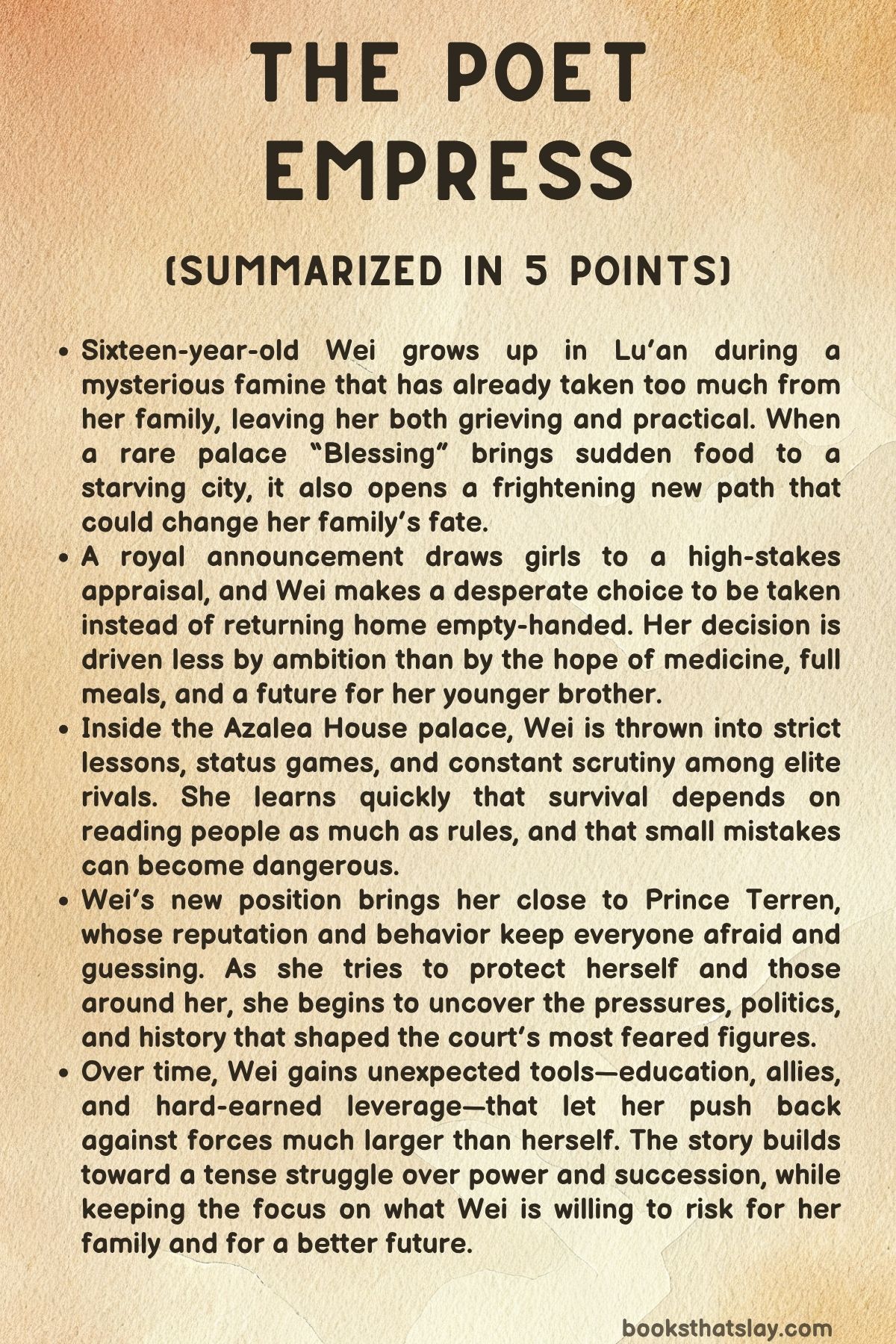
The Poet Empress by Shen Tao is a fantasy court drama set in a famine-scarred empire where magic lives in written Blessings and in the seals borne by the imperial House. Yin Wei, a sixteen-year-old village girl, travels to the capital to save her starving family and ends up chosen as the heir’s bride—an outcome that should be impossible, and that makes her both a symbol and a target.
Inside the East Palace, she faces cruelty, rival factions, and rules designed to keep women powerless. As she secretly learns to read and cast, Yin begins shaping outcomes that emperors and princes believe they control.
Summary
Wei grows up in Lu’an, a village emptied by a strange famine that has already claimed four of her younger siblings. When her newborn sister Larkspur dies, Wei buries her with quiet prayers to the Ancestors, asking that the child be sent to a kinder life.
Soon after, plants push up from the grave and wrap the bamboo casket, a sign that the offering has been received.
By New Year’s, Wei’s family is nearly out of food. Her little brother Bao begs her to take him to Guishan to receive a palace Blessing—promises said to help the people.
Wei doubts the tales, but she goes, wearing her best clothes at her mother’s insistence. Her mother hopes the city might offer Wei a husband and the family a way out of hunger.
Guishan is crowded with lanterns, firecrackers, and vendors. Wei loses Bao in the press of bodies and finds him staring longingly at sweets.
She gives him the dried prunes she has saved, trying to quiet both his hunger and her own fear. A gong rings, and a herald announces Prince Guan Isan of the Azalea House.
A radiant procession arrives, the prince and his guards decorated with living vines and blossoms. Isan bears a glowing seal on his cheek and raises his hand.
In an instant, fruit trees burst from stone and rooftops—peaches, pears, grapes—spilling food into the starving crowd. Bao runs with everyone else, laughing as he gathers fruit.
Wei bites into a peach and cries as her body registers relief.
Isan scatters red slips printed with four-character proverbs, each pulsing with magic. Wei catches two and gives them to Bao.
Then Isan makes a second announcement: the emperor has changed the heir. Prince Terren is now the chosen successor, replacing Prince Maro.
Terren seeks concubines aged fifteen to nineteen, and appraisals will be held in Guishan. Wei has heard rumors—punishments, violence, cruelty—yet she also thinks of full bellies, medicine for her parents, and Bao learning to read.
She goes home torn between dread and duty.
Back in Lu’an, the village rallies around her. Her mother collects offerings for the palace from neighbors who can barely spare them: shoes, necklaces, prunes, and even a goat named Myrna.
On the night before the appraisal, the villagers gather by the graves, release red lanterns, and speak of hope as if it might be enough to feed them. Bao insists the Blessing slips must be used.
A village elder traces one proverb into the soil; it dissolves into light, and a peach sapling grows near Larkspur’s grave—fruit that will resist the blight. The second proverb’s glow flows into Bao’s chest and disappears.
Wei’s father calls it a sign Bao will rise high. Later, Wei’s mother breaks down in private, terrified Terren will harm her daughter, and tells Wei she can refuse.
Wei realizes, with sudden ache, that her mother’s hardness has been a kind of armor. Still, Wei decides to go.
If she doesn’t, Bao’s future and the village’s survival may vanish.
At the Guishan appraisal, Wei arrives with her family and their goat and sees how far behind they are. City girls appear in silks, carrying costly gifts, confident and practiced.
The inspection is humiliating. A eunuch, Li Ciyi, and armed escorts evaluate candidates like livestock, staring at bodies and mocking flaws.
Ciyi taunts Wei for smelling like the countryside. He chooses another girl and prepares to leave, but panic overtakes Wei.
She rushes forward, kneels, and begs to be taken instead. She says she needs the palace for her brother’s sake, and in a reckless burst of anger and desperation, she claims Terren can mock her, punish her, even kill her, and she will still go.
Instead of dismissing her, Ciyi smiles and waves her into the carriage. Wei barely has time to say goodbye as Bao clings to her, her mother weeps, and her father stands frozen.
In the carriage she meets Zou Minma, the daughter of a literomancer. Minma speaks of court conflict between Maro and Terren and mentions a terrifying rumor: Terren carries a ward that makes him unable to die.
They arrive at the Azalea House palace, a place of overwhelming beauty and power, with blossoms everywhere and a vast red dragon in the sky said to strengthen imperial magic. Wei is taken into the Hall of Earthly Sanctity, where the candidates live until Selection Day.
Minma warns her that none of the women can be trusted.
Wei is scrubbed clean, fed until she can hardly breathe, and stunned by a world where hunger seems impossible. Lessons begin immediately: etiquette, palace rules, and explicit instruction from the last surviving senior concubine on techniques meant to produce a seal-bearing son.
Doctors teach pressure points with magical effects. Apothecaries display drugs and teas designed to shape desire and fertility.
Wei tries to befriend the other candidates, but her background marks her. She is mocked, dismissed, and threatened.
One girl offers a brief kindness and then leaves a severed swallow tail on Wei’s windowsill, a warning that even small contact can be weaponized.
Selection Day is held in the Palace of Blades, a hall hung with weapons and filled with powerful guests. Empress Sun Ai arrives with her infant son.
Princes and nobles watch. Prince Isan appears among them, bright and composed.
Prince Maro enters with the confident grandeur of someone used to being loved, laying stone and moss with his magic as he walks. Terren arrives last, alone, soaked, reeking of rice wine, his seal burning as arcane characters coil around him.
He looks unsteady and hostile, as if daring anyone to speak to him.
The selection becomes a nightmare. A nervous candidate, Sima Zhen, suddenly attacks Terren with a knife.
Terren’s ward lashes out like chains and stops the blade. Terren’s drunkenness falls away, replaced by icy clarity.
He offers Zhen a chance to run, promising that if she reaches the gate, he will spare her family. When she almost makes it, he drops swords from the ceiling and cuts her down.
He orders her family exterminated and commands the selection to continue as if death is simply a correction.
Wei is called next. She expects to be dismissed or killed.
She prays only to go home alive. Terren sneers at her peasant origin, then shocks everyone by choosing her.
He changes her announced rank repeatedly, then names her Empress-in-Waiting and declares he will wed her. Wei is dragged away through cold rain, stunned by the fact that her attempt to save her family has become something far more dangerous.
Installed in the Cypress Pavilion, Wei finds luxury paired with isolation. Servants furnish her rooms but treat her like a temporary mistake.
Ciyi appears again and offers to become her chief eunuch, saying she will need an ally to survive. Wei refuses, disgusted by his role in her humiliation, until he explains he brought her as an easy contrast for a bribe and warns that other concubines will try to kill her.
He also makes the threat personal: if she dies, Bao will suffer. Before leaving, he gives her a mountain-silver needle that turns black in poison and tells her to test every gift.
Wei tries to send rice and money home but learns nothing can leave the East Palace without Terren’s approval. Even her attendants—Lin Wren and Tel Pima—cannot help her beyond advice.
Wei realizes she has been placed where she can be used but not protected. Terren summons her to his tower.
Surrounded by swords and scrolls, he forces her to eat bowl after bowl of rice while he watches, mocking her hunger until she is sick. Servants bathe her with herbs meant to inflame desire, yet Terren falls asleep without touching her.
At dawn, he floats a sword as a test of fear, cuts a shallow wound under her ribs to stain the sheets, and threatens to kill her if she speaks of the night or attempts escape.
The next day she receives formal visits from the Inner Court. Noble Consort Sun Jia openly despises her, while the empress probes her with polished menace.
The women gossip about her night with Terren, and Wei repeats rehearsed bedroom talk to protect herself from suspicion. Gifts pile up—tea, wine, sweets, jewelry, even a caged peacock.
Wei tests them with Ciyi’s needle and finds poison in one offering. When Jia erupts, smashes a vase, and vows to kill Wei, the threat becomes undeniable.
Wei summons Ciyi and accepts him as chief eunuch on two conditions: he must teach her to read in secret, and he must help her free the peacock. Ciyi agrees, alarmed by the danger of a woman reading, but hungry for influence.
Under Ciyi’s instruction, Wei begins learning characters and reading histories. Ciyi urges her to punish the poisoner publicly and viciously to establish power.
Wei refuses, unwilling to mirror the court’s cruelty. Ciyi storms away, warning that mercy is a weakness the palace will exploit.
Terren continues calling Wei, not for marriage, but for torment. He forces her to drink filthy paddy water, traps her with starving rats after smearing her with rancid meat, and holds her underwater among carp while swords form a cage around her.
In public, other concubines and Terren’s officials humiliate her, sabotaging her instruments and mocking her ignorance. Wei’s secret studies deepen anyway.
She reads politics and history and begins to grasp the alliances being built, the provinces being courted, and the growing conflict around Terren’s claim.
A turning point comes when Wren drags the wounded Pima into the grove. Terren has slashed him in a rage after an ally shifts support.
Desperate, Wei copies a mending spell she has seen Terren use and heals Pima, proving she can read and cast Blessings. The act binds them together in danger.
To protect Pima and hide her treasonous literacy, Wei and Wren hide him in the servants’ cellar and plan to claim he died. Wren admits she suspected Wei’s studies and reveals the servants’ fear: Terren has harmed and killed many of them.
Wei learns of a rare killing spell, a heart-spirit poem, capable of bypassing wards and striking the heart. She also realizes Terren’s ward may drop during coronation, when he must become killable to tame the Crown dragon.
Wei decides she will kill him—not only to end her own suffering, but to protect the servants and prevent the empire from being ruled by a man who makes terror into policy.
As she maneuvers, she speaks with Hesin, Terren’s chief eunuch, who admits he knows of Terren’s cruelty but claims he cannot intervene. He says his loyalty is to the empire itself, not to any prince.
Hesin begins telling Wei the story of Terren and Maro: once-close brothers at a mountain fortress, where Maro drove himself to exhaustion forcing a tunnel through a mountain for a grand salt trade project. Maro was diagnosed with a devastating magical fatigue and ordered to rest, but he refused because he feared the emperor might change the heir.
Terren kept Maro’s secret and tried to protect him. Their bond broke under pressure, illness, and politics, until Maro beat Terren in fury and shame and they separated.
Years later, Terren returned from war celebrated as the “Winter Dragon,” gaining support to replace Maro. Reports of cruelty followed him—mutilated servants, dead animals, atrocities.
Maro tried to reach him, begged him to spare innocents, and was met with violence and silence. Maro chose to fight politically rather than assassinate his brother, until he learned Terren was close to completing the legendary Aricine Ward, a spell that would make him nearly impossible to kill.
With time running out, Maro sought to lure Terren into being alone, answering Terren’s invitation to trade verses like a duel.
Back in the present, Wei’s plan is threatened by Song Silian, her former teacher, who engineers accusations and traps meant to expose her literacy. Wei begins to see that the court’s hunger for control is not limited to Terren.
She watches Maro kill their father, and she sees how easily “justice” becomes a tool for power. Her certainty about murder weakens.
Terren, unexpectedly vulnerable, asks Wei for something quiet and human: if he dies at coronation, he wants a simple funeral, not a public performance of grief. He confides that he has hidden twenty thousand Dao Blessings for the dynasty and tells her where they are, asking her to pass them to his brother if necessary.
He admits he has not even chosen an era name, refusing to declare what his reign should mean. Wei visits the servants’ graves and confesses she no longer knows what choice is right.
She hates Silian and Maro, she fears Terren, and she also admits she wants power now that she has tasted it. An old maid, Du Hu, gives Wei Wren’s embroidered scarf and writes advice in the dirt: remember who you are doing this for.
Coronation day arrives as an arena of banners and violent wind. Terren descends protected by the Aricine Ward and eight floating swords.
The Crown dragon is summoned from the tear in the sky, and a barrier seals the arena. Terren breaks his ward to begin the ritual, making himself killable.
Silian watches, expecting Wei to write the heart-spirit poem. Instead, Wei writes meaningless characters to mislead them, having decided to let Terren live and attempt to guide his rule.
Terren fights the dragon and nearly completes the taming, but the dragon’s tail hurls him across the arena. As Terren collapses, Maro enters through the barrier using his own seal power.
In the chaos, Maro reaches Terren and strangles him. Wei, seeing Terren dying, writes at frantic speed—yet reshapes the heart-spirit poem into a healing spell.
She fills it with what she knows of Terren’s love, especially the love he once had for Maro and the small kindnesses Wei has witnessed. Maro releases Terren, believing him dead, and turns to the dragon.
Wei’s spell takes hold. The arena bursts into orchard growth, and Terren revives.
He faces Maro, and the brothers fight in full view of the empire—Maro with roads, rivers, bridges, and chasms; Terren with clean, terrifying sword formations. The battle tears the arena apart and stirs the dragon again.
Maro’s power sputters out, and the dragon kills him. Terren subdues the weakened dragon and completes the taming, turning its scales into reflective steel blades.
Wei enters the arena, and Terren realizes she healed him. In a moment of joy and disbelief, he laughs and cries, holding her hand, and kisses her as sunlight breaks through.
Wei then stabs him through the heart. She holds him as he dies in the water, choosing to end him even after saving him.
Wei is imprisoned. Isan, now the heir, arrives riding the transformed Crown that bears fruit.
He demands to know why she killed Terren after healing him. Wei tells him that after Maro’s death, the choice became clear: the empire could have fruit, not knives.
She bargains using Terren’s hidden Dao Blessings. In exchange for their location, Isan must prioritize famine aid, absolve Wei and support Lu’an with stipends, provide Bao an education, give Terren a quiet burial, and allow remaining concubines and chosen servants to learn to read and practice literomancy if they wish.
Isan agrees.
Wei leaves the palace, but Hesin meets her with a new truth: for stability, he has advised Isan to take Wei as empress. Wei returns as the “Rice Wife” in the Orchard Palace, decorating her space with both fruit and blades, refusing to let either symbol be forgotten.
A feast follows where women and servants begin learning to read, opening a future the old court tried to prevent. Threats still loom at the borders, but reforms begin.
Later, Wei joins Isan, Kiran, and Hesin to bury Terren quietly in the mountains. There, Wei sees Terren’s ghost bow to her in gratitude.
Maro’s ghost appears, embraces Terren, and the brothers depart together into a peaceful afterlife of bridges, carp, gardens, and friends. Then they vanish, leaving the living to shape what remains.
Characters
Wei / Yin Wei (later “Lady Yin,” “Rice Wife”)
Wei begins The Poet Empress as a sixteen-year-old famine survivor whose inner life is far louder than her village allows her to be: she grieves deeply, bargains with the Ancestors in private, and measures morality by whether people eat and live, not by whether customs are satisfied. Her decision to go to Guishan is not naïve ambition but a calculated sacrifice shaped by hunger and love—especially for Bao—so when the palace elevates her, it also weaponizes the very devotion that brought her there.
Inside the East Palace she evolves from frightened prey into a reader, then into a strategist; literacy becomes her forbidden doorway into power, and every lesson she absorbs—history, politics, the mechanics of Blessings—pushes her from endurance toward agency. What makes her compelling is the way her ethics keep colliding with survival: she refuses to become cruel for spectacle even when cruelty is the simplest path to safety, yet she also discovers that power feels good, and that admission destabilizes her self-image as “only” a selfless sister.
Her arc is a long argument with herself about what justice is allowed to look like in an unjust system—first she wants to save her family, then to stop a tyrant, then to stop a war, and finally to choose a future that feeds people over a future that glorifies violence. By the end, her defining trait is not purity but clarity: she learns that mercy without leverage is suicide, and leverage without compassion is corruption, so she becomes someone who can negotiate with emperors, lie convincingly to killers, heal an enemy, and still decide—at the last instant—who must die so that others can live.
Bao
Bao functions as Wei’s moral anchor and her constant reminder of the world beyond court games: he is small enough to be hungry without language for politics, yet old enough to understand that “Blessings” might be the only ladder out of starvation. His innocence is never decorative; it is the pressure that turns Wei’s choices into inevitabilities, because the story repeatedly shows that institutions will let children starve unless someone bargains violently or cleverly on their behalf.
The proverb’s glow sinking into his heart marks him as a symbol of potential—education, future, resilience—so Bao is both a person Wei loves and a promise Wei feels obligated to fulfill, which is exactly why threats against him become a tool to control her. Even when he is off-page, he shapes the narrative as the question Wei keeps asking in different forms: what does it cost to secure a child’s tomorrow, and who decides which children deserve one?
Larkspur
Larkspur appears briefly, yet her death is the book’s spiritual inciting wound: she is the fifth child lost, which makes her less a singular tragedy than evidence of a world breaking, and Wei’s act of burying her is both an ending and a vow. The vines and flowers claiming the casket turn grief into omen, tying Larkspur to the story’s recurring language of fruit, growth, and offerings—life insisting on returning even from famine-soil.
She becomes Wei’s private relationship with the Ancestors and with meaning itself; when Wei later faces palace cruelty, Larkspur is the silent counterweight reminding her what suffering looks like without ceremony, without rhetoric, without anyone important watching. In that sense, Larkspur is the seed of Wei’s eventual politics: not ideology, but the memory of a baby who never got to become anything.
Wei’s Mother
Wei’s mother initially reads as hard and pragmatic—someone so familiar with loss that visible grief would be wasteful—but the appraisal decision reveals her as a woman who has been rationing emotion the way she rations food. Her instruction for Wei to “walk like a city girl” is not vanity; it is a desperate attempt to translate a starving daughter into a commodity the world might reward, because that is the only language the empire seems to understand.
The night before the appraisal, when she cries and offers Wei the chance to refuse, the façade cracks and the reader sees that love has been present all along, simply buried under the daily arithmetic of survival. She embodies the novel’s bleakest realism: parents can love fiercely and still make choices that endanger their children, not because love is absent, but because poverty corners love into violence.
Wei’s Father
Wei’s father is a study in quietness that can look like indifference until the context clarifies it as powerlessness. He rarely directs events; instead he absorbs them, standing as famine and empire reduce a household head into someone who can only consent or refuse—and refusal has consequences the family cannot pay.
His silence at the carriage departure lands like complicity, yet it can also be read as the numb restraint of a man who knows that any visible breakdown would not save Wei, Bao, or anyone. He represents a kind of masculinity stripped of agency by systemic hunger: present, protective in intention, but outmatched by forces that do not negotiate with dignity.
Grandpa Har
Grandpa Har bridges village tradition and practical knowledge, showing how folklore in the novel is not superstition but a technology of hope. His ability to activate the Blessing proverb—turning paper into light and then into a peach sapling—gives the village a rare, tangible future and demonstrates that words can feed people, not just comfort them.
He also legitimizes Bao’s “sign” in the eyes of others, transforming a mysterious glow into communal prophecy, which matters because communities survive by agreeing on narratives that make sacrifice bearable. In a story where court literomancy becomes weapon and privilege, Grandpa Har’s small ritual feels like the same power in humbler hands: words offered for survival rather than domination.
Prince Terren
Terren is the novel’s most unsettling contradiction: a man who performs cruelty as reflex and armor, yet still contains a buried capacity for attachment, shame, and longing that occasionally surfaces in ways that make his violence feel even more tragic. In The Poet Empress, his tortures are not random sadism; they are rituals of control designed to prove that everyone is disposable, likely shaped by a lifetime of being measured against succession politics and by the terror of his own mortality during the coronation window.
His rumored ward and later Aricine Ward amplify his threat, but they also externalize his inner logic: if he cannot be killed, he never has to be vulnerable, and if he is never vulnerable, he never has to be loved honestly. The backstory with Maro reframes him as someone who learned intimacy in the language of “family keeps each other safe,” then watched that intimacy curdle into betrayal and hierarchy; once Maro rejects him, Terren’s kindness becomes dangerous to feel, so he buries it under blades.
What makes Terren more than a cartoon tyrant is that he can confess fear, entrust secrets, and hesitate over legacy, yet still choose terror as governance; the story forces the reader to sit with the possibility that understanding a person does not obligate forgiveness. His end, especially after being healed and briefly trusting peace, becomes a thesis statement: some harms are too large to gamble the realm on a single man’s potential redemption.
Prince Maro
Maro begins as the “rightful” heir figure—builder, planner, charismatic public servant—but the novel steadily corrodes that shine by showing how virtue can be entangled with entitlement. His Salt Road obsession and refusal to rest even when warned about Heavenly Fatigue reveal a man addicted to achievement as proof of worth, and that addiction makes him pliable to manipulators like Ganji and to his own fear of replacement.
His relationship with Terren is the story’s key tragedy of intimacy turned political: Maro is nurtured by Terren’s devotion when he is weak, then repulsed by it when the world starts praising Terren, because praise threatens the identity Maro has built as indispensable. The moment he beats Terren is not only sibling cruelty; it is the empire’s succession logic passing through his fists, teaching both brothers that love is conditional and power is the condition.
Later, Maro’s resolve to defeat Terren politically rather than kill him sounds noble, but it also keeps enabling the continuation of atrocities while he pursues a “clean” victory that preserves his self-image. His final act—entering the arena and strangling Terren—exposes what the book has been hinting: Maro can be as lethal and absolutist as the brother he condemns, and when he believes he is saving the realm, he grants himself permission to do anything.
His death by the dragon reads like grim symmetry: the man who tried to out-virtue violence is consumed by the same monstrous power struggle he helped create.
Prince Guan Isan / Emperor Isan
Isan enters the story as spectacle and relief—Blessings that conjure fruit, a prince who can make hunger pause—so he is first associated with nourishment rather than coercion. That association becomes politically crucial later, because the story ultimately frames the choice of ruler as a choice of what the empire will prioritize: fruit or knives.
Isan’s final negotiations with Wei reveal him as pragmatic rather than saintly; he accepts the hidden Blessings, agrees to famine aid, education, and quiet burial not purely out of tenderness, but because stability requires legitimacy and Wei has both leverage and symbolic power. Still, his willingness to formalize literacy and protection for women and servants suggests a ruler capable of turning private bargains into public reform.
Isan is, in effect, the empire’s compromise candidate—less visionary than a mythic hero, less monstrous than Terren—whose value lies in being governable and in allowing systems to bend toward feeding people.
Prince Kiran
Kiran is present at key ceremonial moments, functioning as a quiet indicator that the imperial family is larger than the Maro–Terren feud and that succession is a web, not a line. His limited direct action makes him feel like a court reality: many princes survive not by dominating events but by watching, aligning, and staying useful.
In that sense, Kiran’s narrative role is to widen the political frame and remind the reader that every act of violence in the center ripples outward to siblings, factions, and future claimants.
Empress Sun Ai
Empress Sun Ai embodies the court’s cold competence: she treats selection, marriage, and women’s bodies as instruments of stability, and she overrides Terren publicly when it serves broader political interests. She is not shocked by brutality so much as attentive to its optics and consequences, which makes her frightening in a different way than Terren—she represents violence institutionalized into procedure.
Her probing of Wei’s condition during the congratulatory visits shows how power speaks through manners; she can threaten without raising her voice, because she controls the narrative of what is “proper.” By appearing with an infant prince, she also symbolizes continuity, a reminder that the empire prefers heirs to humans, and that mothers in this system are valued primarily as vessels for political inheritance.
Infant Prince Ruyi
Ruyi’s presence is symbolic rather than personal, a living token of legitimacy that changes how adults posture. As a baby, he is both innocence and political weapon: he makes Empress Sun Ai’s authority feel anchored in a future, and he reminds every concubine that their value can be reduced to reproduction.
His role underscores the book’s recurring cruelty that children are invoked as justification for power even while other children, like Bao, are left to starve.
Noble Consort Sun Jia
Sun Jia is the court’s open hostility given a face: she loathes Wei not merely for personal reasons but because Wei’s elevation threatens the rank-ordering that keeps elite women safe. Her contempt is class violence; “village filth” is a political statement meant to reassert that power belongs to certain bloodlines and manners.
The assassination attempt through poisoned wine shows that Jia understands the palace as a battlefield where etiquette is camouflage, and her rage when Wei refuses gifts reveals how dominance in the Inner Court depends on forcing others into scripted vulnerabilities. She is important because she clarifies that Terren is not the only danger—women, too, can be agents of lethal hierarchy when a system trains them to survive by destroying rivals.
Li Ciyi
Li Ciyi is opportunism sharpened into intelligence: he recognizes early that Wei’s rise is anomalous and therefore volatile, and he attaches himself to the anomaly like a man investing in a dangerous but high-return venture. His cynicism is partly defense—he survives by assuming everyone is corruptible—yet his actions also reveal a genuine, if twisted, belief that cruelty is the only reliable language of power.
His offer to teach Wei to read is both betrayal and mentorship: he knows it is treasonous, but he also understands that literacy is the only tool that can let her compete with noble-born women. The poison-testing needle becomes his signature: a small, precise instrument that turns paranoia into practice, mirroring how he turns court terror into actionable strategy.
His conflict with Wei over punishment exposes the ideological split at the heart of the book: he believes fear produces safety, while Wei insists safety must produce something more than fear if it is to be worth having.
Hesin
Hesin is the book’s embodiment of institutional loyalty—a man branded, literally and morally, to serve “the Crown” rather than the person wearing it. This makes him appear both honorable and complicit: he can apologize sincerely for Wei’s suffering while still refusing to stop it, because his oath is designed to outlast empathy.
His willingness to tell Wei Terren’s past suggests he believes information is a safer form of intervention than action, and that shaping outcomes through knowledge preserves stability without breaking his vow. Hesin also acts as a bridge into the story’s larger political memory, showing how personal relationships are archived and repurposed as statecraft.
When he later supports the idea of Wei becoming empress for stability, it confirms his core trait: he is always choosing the arrangement that best prevents collapse, even if that arrangement is morally messy.
Lin Wren
Lin Wren begins as “head attendant,” but she becomes one of Wei’s most meaningful relationships because she represents the servant-class intelligence the palace pretends not to see. Wren is practical, observant, and already trained by terror; she reads danger in scents of ink and shifts of routine the way nobles read poems.
Her loyalty to Wei is earned through shared vulnerability rather than rank, and her willingness to hide Pima and gamble everything on Wei’s secret literacy shows that she believes Wei might be different from the court that crushes them. Wren also forces Wei into adulthood faster: she is the one who names what the servants know about Terren, and by doing so she turns Wei’s private suffering into collective responsibility.
The scarf she leaves behind, later returned through Du Hu, becomes a symbol of continuity: even when the palace kills people, their bonds can still pass from hand to hand as instructions for how to endure without losing oneself.
Tel Pima
Pima is the quiet proof that knowledge work in the palace is bodily dangerous: as a scribe, he is close enough to power to be punished when power panics. His wounding is a turning point because it forces Wei to act with her illicit literacy rather than merely hide it; healing him is both compassion and declaration of capability.
Pima’s survival also shifts Wei’s understanding of literomancy from abstract advantage into urgent medicine, connecting the art of words to the physical costs the powerless pay. By becoming someone Wei must conceal and protect, he helps convert her motive from individual escape into broader resistance.
Zou Minma
Minma arrives as a potential ally—another young woman with knowledge—but the story quickly shows her as a product of court survival training: she knows things, but she uses knowledge as a shield and sometimes as a blade. Her warning about the women not being trustworthy is accurate, yet her later denial of Wei is also a lesson in how fear rewrites social bonds in the palace.
Minma’s value as a character is the way she complicates sisterhood; she demonstrates that oppression does not automatically produce solidarity, especially when the system rewards betrayal and punishes association with weakness.
Ciera
Ciera embodies the palace’s weaponized friendliness: she offers the surface texture of kindness but exists in a space where kindness can be bait. The severed swallow tail on Wei’s windowsill turns social interaction into threat-display, teaching Wei that even “small” cruelty has messaging value in the Inner Court.
Ciera’s limited depth is purposeful; she is less an individual portrait than an example of how quickly humanity is replaced by signals when women are trained to treat one another as obstacles to survival.
Sima Zhen
Sima Zhen’s attempted assassination is the book’s clearest illustration of how rebellion is crushed not only by force but by theatrical warning. Her panic reads as human and relatable—someone reaching a breaking point—yet the narrative uses her to expose Terren’s most terrifying talent: he can offer mercy as a game, grant a “chance” that is designed to fail, and then massacre with ceremony.
Her fate also shows how the empire disciplines families through individuals; her death is not contained to her body but is announced as a promise of extermination. Zhen becomes a lesson Wei never forgets: the palace does not merely kill, it teaches.
Song Silian
Song Silian represents a different species of danger than Terren: he is the intellectual who weaponizes “law” and “treason” to eliminate threats efficiently. The literacy trap reveals how power can pretend to defend tradition while actually defending itself; Silian frames his purge as principle, but it is really preemption.
His proximity to Maro makes the critique sharper, because it implies that even the faction positioned as the “better” alternative is willing to kill through bureaucracy and accusation. Silian’s role is to show that cruelty can wear clean robes and speak in polished logic, and that a society can be just as lethal with paper as with swords.
Doctor Shu
Doctor Shu is one of the few characters in the novel who speaks truth plainly, and that plainness makes him both ethical and vulnerable. By diagnosing Heavenly Fatigue and recommending rest, he introduces the idea that limits are real even for princes, and that ignoring limits becomes a political act with catastrophic consequences.
His conflict with Ganji exposes how expertise is pressured into serving ambition; the doctor knows what will save Maro, but the state’s hunger for achievements demands that truth be hidden. He functions as a quiet moral mirror: the empire could have chosen care, but it chose performance.
Master Ganji
Master Ganji embodies the machinery that turns princes into products: he treats Maro’s health as a negotiable inconvenience and succession as a competition that must be won through optics and achievements. His influence demonstrates how violence is often delegated; Ganji does not need to swing a blade to harm people, because he can steer decisions that push Maro toward collapse and accelerate conflict between brothers.
His pressure to conceal illness is an early domino that contributes to later brutality, making him one of the story’s architects of tragedy—proof that advisors can be as dangerous as rulers when they treat human beings as tools for legacy.
Lady Autumn
Lady Autumn appears as a figure attached to Terren’s campaign arc, and she functions as a reminder that wars are social networks as much as battles. Her presence signals that Terren’s rise is supported, curated, and witnessed; he is not a lone monster emerging from nowhere, but a prince whose violence is enabled by those who travel with him and benefit from his victories.
The fact that incriminating verse is obtained through her ties her to information-as-weapon, suggesting she is positioned where secrets circulate and loyalties can shift.
Lady Sky
Lady Sky’s death lands as a quiet accelerant: it removes a maternal anchor from Maro’s life and deepens the atmosphere of loss and instability around the succession. Even without extensive page-time, she represents how the royal family’s personal griefs are quickly swallowed by political momentum, turning tragedy into one more stressor that shapes decisions and tempers.
Du Hu
Du Hu, the tongueless maid, is one of the story’s most poignant embodiments of silenced labor. Her inability to speak makes her writing in dirt feel both humble and profound; it is communication stripped down to necessity, the same way servants’ lives are stripped down to usefulness.
By delivering Wren’s scarf and advising Wei to remember who she is doing this for, Du Hu becomes a conduit for the servant community’s moral memory. She reminds Wei that the palace tries to erase the powerless, but the powerless still find ways to pass messages, preserve loyalty, and keep purpose alive.
Myrna (the goat)
Myrna is not merely a charming detail in the story; she is a measure of communal sacrifice. The Rui sisters’ gift of a milk goat despite their own need turns Myrna into embodied generosity, showing how famine forces people to treat life itself as barter.
When Myrna is brought to the appraisal among polished city offerings, she highlights the brutal class contrast: village wealth is living and essential, while elite wealth is ornamental. Myrna’s presence underscores one of the book’s persistent truths—survival economies and court economies speak different languages, and Wei is forced to translate between them with her body.
Themes
Power as a bargain that changes the person making it
Wei begins with a simple, practical relationship to power: she wants food, medicine, and a future for Bao, and she is willing to offer her own safety to get those things. That first decision—volunteering at the appraisal—sets a pattern where survival is treated like a contract signed with the body.
Inside the palace, that contract becomes more explicit and more humiliating: officials judge girls as assets, alliances are made through ownership, and the crown’s needs outweigh any private pain. What matters is not only that power is violent, but that it requires people to adopt the logic of violence to keep living.
Wei’s refusal to punish the poisoner publicly sounds like moral clarity, yet it also shows how the court pressures her to perform cruelty as proof of authority. When she secretly learns to read, power changes shape again.
Literacy is presented as treason because it breaks the court’s preferred arrangement: women displayed, managed, and kept dependent on male-controlled interpretation. By learning characters and history, Wei stops being only a person acted upon and becomes someone capable of acting strategically, negotiating, and shaping outcomes.
That shift is not clean or heroic; it also awakens appetite. She admits she wants to be empress because power feels good, and that confession matters because it refuses the comforting story that ambition only belongs to villains.
The final sequence forces the theme into a sharp question: what is power for? Wei heals Terren, then kills him, and the act refuses sentimental closure.
She uses the authority she has gained to trade information for famine aid, education, and protection for people who would otherwise be disposable. The bargain is still there, but now she is writing its terms.
The Poet Empress treats power as something that can be redirected toward repair, but never purified; even the most necessary choices leave residue, and the person who makes them does not come out unchanged.
Hunger, scarcity, and the politics of relief
The famine that kills Larkspur and empties Wei’s home is not simply background suffering; it shapes every moral decision that follows. Hunger is a force that narrows options until risk becomes routine and dignity becomes negotiable.
When Prince Isan makes fruit erupt from stone, the crowd’s scramble is both miracle and indictment: the empire has the capacity to feed people instantly, yet chooses spectacle over steady care. That moment also shows how relief can be used to manage loyalty.
The “Blessings” are a public performance of generosity tied to imperial presence, and the glowing proverbs blur the line between spiritual gift and political tool. Even the peach sapling near Larkspur’s grave carries double meaning: hope for future food, and proof that survival depends on forces far above the village.
Scarcity becomes the lever that moves bodies toward the palace. Wei’s mother asking her to “walk like a city girl” is not vanity; it is strategy under starvation, turning marriage into a potential supply line.
In the palace, the theme shifts from lack to controlled abundance. Wei is fed a feast, dressed in luxury, and taught techniques meant to secure a son, but all of it is conditional.
She cannot send food home without approval. The system keeps relief scarce on purpose, so gratitude and fear remain useful.
Terren’s torment using rice is the cruelest expression of this logic: he takes the one thing Wei needs most and turns it into a weapon, forcing her to eat until sickness makes nourishment feel like punishment. By the end, Wei’s negotiation with Isan explicitly reframes politics as a famine problem.
She demands aid, education, and stipends rather than revenge or personal comfort, and she chooses “fruit over knives” as a governing priority. That choice does not erase the empire’s capacity for violence, but it insists that legitimacy should be measured by whether people stop burying infants.
The book makes scarcity a political design, not a natural disaster, and shows how relief can either reinforce hierarchy through spectacle or reduce harm through policy.
Language, literacy, and the right to define reality
Control over words functions like control over bodies: it decides who is believed, who is safe, and what futures are imaginable. The empire’s “Blessings” begin as propaganda shaped into magic—four-character proverbs that literally alter the world—so language is not metaphorical power but material force.
That makes literacy more than education; it becomes access to the tools of history and the tools of harm. The court treats female reading as treason because it threatens a carefully maintained division: men interpret law, ritual, and strategy, while women are expected to compete within narrow roles and repeat approved narratives.
Wei’s early skepticism about imperial promises shows a mind already resisting official language, but she lacks the means to challenge it. Once she learns characters, she gains the ability to verify, compare, and plan.
She reads histories and starts seeing negotiations and factional motives that used to be invisible. That visibility is dangerous because it makes her less controllable.
The palace’s obsession with testing, gossip, and “proper” stories about a bride’s night demonstrates how narrative is enforced socially as well as politically. Wei is forced to recite rehearsed techniques to protect herself, turning speech into armor.
The “literomancy” element pushes the theme further: a poem can be an assassination method, and a line of writing can cross barriers straight to the heart. That turns the question “Who may write?” into “Who may kill, heal, accuse, or absolve?” The literacy trap arranged through accusations shows how the court weaponizes suspicion to remove threats efficiently; the system does not need proof, only an excuse to force someone into revealing the forbidden skill.
At the coronation, the theme reaches its clearest statement. Silian watches Wei’s pen, confident that language will perform the expected function—death—because the court believes it controls the script.
Wei breaks that expectation twice: first by writing meaningless characters to mislead observers, then by reshaping the heart-spirit poem into healing. This is not just a clever twist; it asserts that meaning is a choice made by the writer, not the watcher.
Yet the ending refuses to romanticize language as salvation. After healing Terren, Wei uses the same access to words and terms to negotiate state actions, turning writing into governance.
The story treats literacy as entry into power’s workshop: it can produce miracles, lies, mercy, and murder, and the struggle is over who gets to decide what the words will do.
Violence, accountability, and the limits of mercy
The story refuses the comforting idea that cruelty is an exception committed by a few monsters; instead, violence is presented as a system with etiquette, incentives, and justifications. The appraisal reduces girls to flesh under official inspection, and the selection hall turns death into a lesson for onlookers, teaching obedience through public terror.
Terren’s personal brutality is extreme, but the court’s structure supports it: the empress overrides procedure for political needs, eunuchs facilitate access and punishment, and the Inner Court rewards those who display dominance. Violence becomes a language everyone is expected to understand, and that expectation pressures victims into imitation.
Ciyi’s advice that Wei should punish the poisoner publicly is not only vindictive; it is also a practical description of how authority is recognized in that environment. Mercy can be mistaken for weakness, and weakness invites attacks.
Wei’s refusal to become cruel reads as moral resistance, but it also leaves her isolated until she develops other forms of leverage: secrecy, literacy, allies among servants, and eventually bargaining power tied to information. The flashbacks about Maro and Terren complicate accountability by showing how damage travels through family and politics.
Terren is not introduced as pure evil; he is shaped by abandonment, rivalry, and the state’s hunger for a strong heir, then rewarded for battlefield success while his cruelty escalates. Maro’s own choices—hiding illness, insisting on projects, beating Terren—show that “good” figures can still cause harm, especially when they are protecting an image of strength demanded by the throne.
The coronation sequence forces a direct confrontation with the idea of forgiveness. Terren’s vulnerable confession, his hidden cache of Blessings, and his brief trust in Wei create genuine reasons to pause.
Wei does pause; she hesitates, mourns servants, and admits confusion. But the narrative does not treat compassion as the final answer.
When Maro kills Terren and the dragon kills Maro, Wei’s healing restores Terren, and for a moment the story allows the possibility that care could redirect him. Then Wei kills him anyway, and the choice is framed as political triage: with Maro dead, Isan becomes heir, and Wei prefers a future organized around feeding people rather than continuing a reign defined by blades.
This is not portrayed as moral purity; it is a decision made with full awareness of what Terren suffered and what he offered. The book’s closing negotiation and quiet burial underline that justice is not only about who dies, but about what conditions of life become possible afterward.