The Poisoner by I.V. Ophelia Summary, Characters and Themes
The Poisoner by I.V. Ophelia is a dark Victorian-set story about Alina Lis, an apothecary who keeps two lives in careful balance. In public, she sells remedies and writes about the dangers hidden in cosmetics.
In private, she supplies poisons to women who can’t escape violent men any other way, treating each death like an experiment she must perfect. When she returns to London after a year of mourning, a predatory killer marks her as his new obsession, and Alina’s controlled world turns into a contest of nerve, chemistry, and survival.
Summary
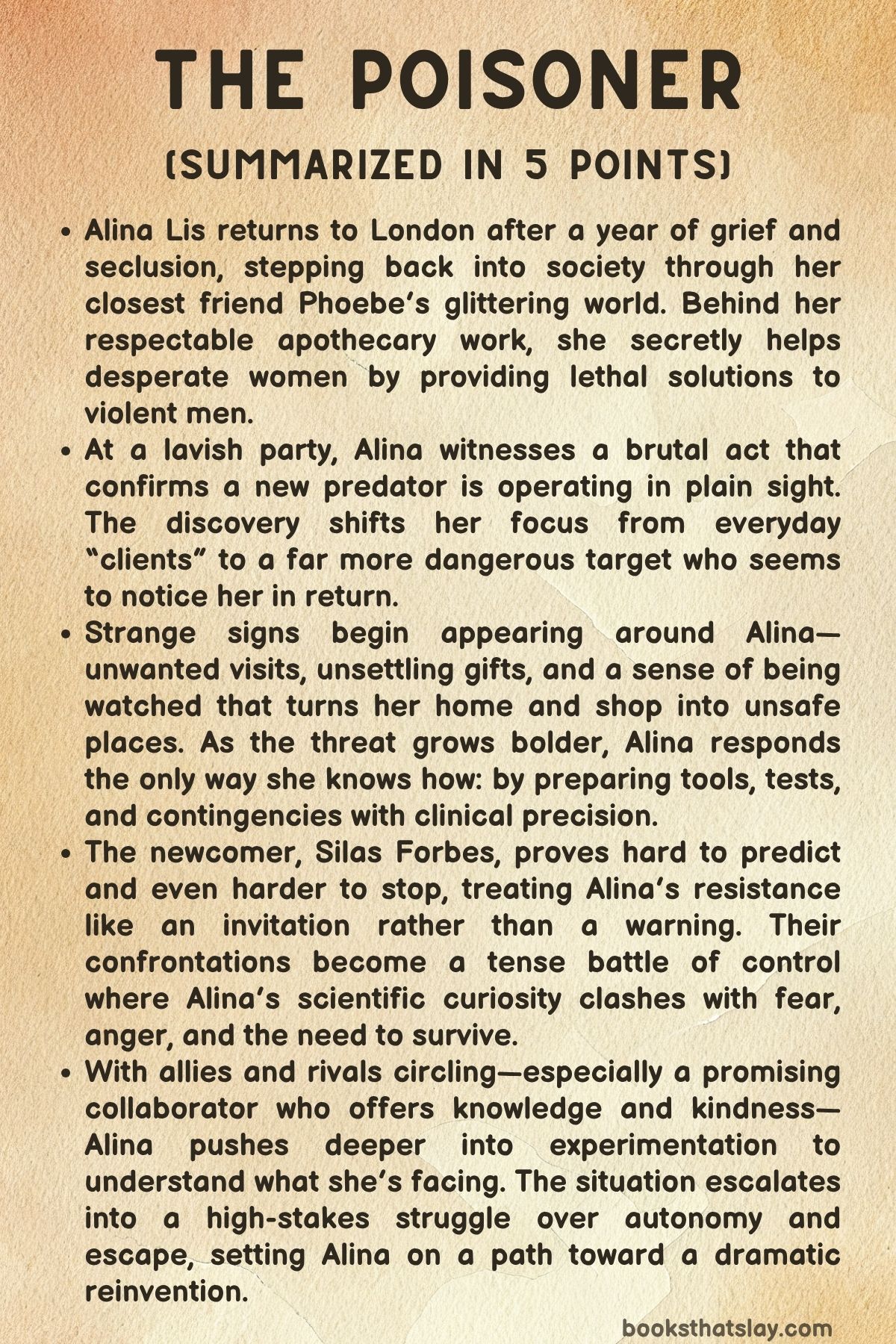
Alina Lis returns to London after spending a year on her country estate, shut away following her father’s death. She steps into the city with grief still heavy on her shoulders and a reputation that sits politely on the surface: she owns an apothecary and writes about the harm caused by beauty products.
Her oldest friend, Phoebe Aston, welcomes her back with a lavish party in a grand townhouse. Alina arrives in mourning black, which Phoebe mocks with affectionate disbelief, but Alina doesn’t correct her.
It’s easier to let people think her darkness is only fashion and grief.
Inside the party, Alina keeps herself guarded. Men approach with smug comments, especially about the white streak at the left side of her hair, as if her appearance exists for their inspection.
She slips away from the crowd and wanders toward a quieter room, wanting silence more than conversation. Instead, she finds a scene that turns her stomach: a blond man in black restrains a woman in a baby-blue dress and feeds from her neck.
He doesn’t hide it. He looks straight at Alina, calm and daring, as if testing what kind of person she is.
Alina freezes. She could scream, run for help, grab a weapon—she does none of it.
She backs away and leaves the woman behind.
By morning, Alina is sick from drink and from what she did not do. When she meets Phoebe for breakfast, she lies and claims she left the party because she felt ill.
A newspaper boy calls out about a body found at the docks. Alina buys a paper and sees the dead woman’s description, then realizes the victim was the same woman in the baby-blue dress.
The attacker didn’t simply feed; he killed openly and discarded the body like refuse. Alina’s guilt hardens into focus.
She has spent years providing poisons to women who need violent men removed. She has called those men “subjects,” treated their deaths as proof of skill, as something controlled.
This killer is uncontrolled, public, and bold. Alina decides he is her next problem.
She goes about her work with practiced calm. She visits Caldwell’s Flora and Botanicals to collect a special order: white snakeroot, prized for its toxin tremetol, a slow, delayed sickness that can hide inside products like perfume.
She brings the crate back to her apothecary—her father’s shop, now hers—and spends the day serving customers who want creams, powders, and harmless tonics. Her public face remains clean and respectable.
Madam Berdot arrives in distress. Berdot runs a brothel and has long relied on Alina’s poisons to eliminate abusive men who threaten her women.
Now she claims the snakeroot poison failed: it made one man sick but didn’t finish him. Alina insists her work should not be inconsistent, but the report rattles her.
She gives Berdot arsenic instead and warns her that speed matters when danger is immediate. Even as Alina reassures Berdot, she can’t shake the feeling that her control is slipping, not only in her craft but in her life.
That evening, strange sounds begin. In the apothecary’s dark back room, Alina hears an unfamiliar clicking, like predatory chattering, then silence when she investigates.
Later, at Phoebe’s townhouse, she hears scratching, finds her bedroom door slightly open, and hears the same clicking behind her—yet sees nothing.
The blond man is not gone. He has begun stalking her.
He watches her sleep, learns her habits, learns her name, and becomes fixated for reasons that go beyond cruelty. He calls her a “Mellifluous Host,” someone whose blood is rare and irresistibly sweet to his kind.
He fights the urge to bite her immediately, not out of mercy but out of hunger sharpened into obsession. He wants her aware.
He wants games.
Alina’s nights fill with nightmares: drowning in blood, a voice at her ear, the sense of being pinned and studied. Then Phoebe brings news that confirms Alina is being targeted.
Two women have been found dead, their faces mutilated—specifically the left side, carved away as if to mock Alina’s own white hair patch. The message is private and personal.
Alina stops pretending this is coincidence. She arms herself with vials, blades, and a syringe.
She hides weapons around her room and threads a needle through a hair stick, coating it with puff adder venom.
Late one night, after drinking and listening to music by the fire, the darkness shifts. Her candle goes out.
A voice speaks from the shadows, taunting her for ignoring him. He proposes a wager: if she can reach her bedroom before he catches her, he will leave her alone for the night.
Alina runs. He catches her almost immediately, grabbing her ankle on the stairs.
She slashes his cheek with the venom needle, but the struggle sends her head into the steps. The world goes black.
She wakes days later with a concussion and bloodstained stairs she cannot fully scrub clean. There is no sign of forced entry.
Worse, signs suggest the intruder tidied up, leaving flowers where a thrown vase had been, as if he wants her to know he can touch her life and arrange it. Alina tells Phoebe she fell while drunk.
She also tells herself the venom must have killed him.
It hasn’t.
The clicking returns, and soon the blond man walks into her apothecary in daylight, calm as a customer. He asks for something to treat snake venom.
He speaks in metaphors about creatures that survive bites and begin to crave what once threatened them. Alina realizes he’s showing off his resistance—and telling her she has failed.
She threatens to destroy him from the inside out. He smiles as if she has flirted.
He leaves as though they have an appointment.
He introduces himself as Silas Forbes of Astor Industrial & Petroleum and makes it clear he knows she wants answers about him. Alina refuses to play along, calls him a pest, and accuses him of cheating in their “wager.” Silas treats her anger as entertainment.
Her disgust is real, but so is her frustration that he survived, and her scientific mind can’t stop turning the problem over: what, exactly, is he?
Silas pushes further. A parcel arrives with a pearl choker.
The note reveals the pearls were strung with Alina’s own hair. The violation makes her vomit.
She decides he isn’t simply dangerous—he is a devil who enjoys proof of access.
That night, Silas returns and forces a new game: Alina must hide until dawn. If she fails, he promises to “eat” her.
When she tries to stab him, he lets the blade sink into his shoulder, eyes darkening, tongue splitting in an animal way, then pulls the knife free as if it’s a nuisance. The chase becomes brutal.
He finds her, drags her out from hiding, pins her, shows retractable fangs, and makes it clear he is not human. He bites and marks her body, mixing threat with possessiveness.
Alina struggles, but something else surfaces too—her clinical curiosity. In the middle of fear, she forces her fingers into his mouth to examine how the fangs fold like a snake’s.
Silas is unsettled by her refusal to react the way prey should. She passes out from exhaustion, and he carries her to bed, leaving her alive, feeding elsewhere yet finding every other victim bland.
He begins to realize his hunger is narrowing to her alone.
Alina tries to reclaim control. She hides bruises under mourning clothes and continues her routines, but Silas keeps appearing—at a dress fitting, at the market, at the florist—always charming in public, always threatening in private.
Phoebe reacts sharply when she sees him, warning Alina away with the intensity of someone who knows more than she admits. Alina notices the crack in Phoebe’s composure but doesn’t yet understand it.
Determined to find a way to kill what poisons can’t touch, Alina escalates her experiments. She gains access to a chemistry lab at King’s College through Dr. Hayes, with strict limits and no permission to store materials.
There she works with Viktor Kaskov, a young man with a Russian accent who admires her scientific writing and treats her with respect. With Viktor, Alina feels something like normality: shared curiosity, careful planning, and attention without cruelty.
She brings dark blood samples and explains her theory that Silas’s body contains a toxic mechanism beyond simple infection. She wants to break it down, measure it, and determine a lethal dose.
Viktor agrees to help.
Silas disrupts even that. At a botanical gardens gathering, Viktor takes Alina into a restricted conservatory filled with poisons and carnivorous plants, and they steal clippings like mischievous students.
When Silas spots Alina afterward, he corners her in a locked nursery. The confrontation turns dangerous when Alina bites his finger and his toxic blood burns her throat, choking her from the inside.
Silas forces a kiss that transfers something that stops the burning and lets her breathe, then uses the moment to control her body and humiliate her. Alina staggers out shaken and grabs Viktor to dance in the crowd, using the public space as a shield.
Back at home, Silas continues his “gifts”: hair wreaths, dissected animals, staged remains meant to assert dominance and test her reactions. Alina refuses to be broken by it.
She feeds the mess to her ravens, treats the hair like nesting material, and keeps working.
In the lab, her rat experiments turn wrong in ways she can’t account for. Results are inconsistent.
Blood cells burst under the microscope. Then she returns one day to find every rat dead—subjects and controls—decomposed grotesquely, as if something contaminated everything at once.
Alina spirals into exhaustion, migraines, nausea, and episodes that feel like waking paralysis. It begins to seem like her body is failing on a schedule she didn’t choose.
Silas becomes both threat and reluctant ally. He offers his saliva as a cure for her migraines, and it dulls the pain, confirming that his biology can alter hers.
Their interactions become increasingly transactional: she offers controlled access, he offers information and relief. He explains his kind are Vipera.
Some are born; others are made when someone dies with venom in their system. He calls Alina a “Host,” and claims she has the latent capacity to become like those born if she dies within hours of being envenomed.
Alina shares her own origin: as a bullied child trying to protect Phoebe, she poisoned tormentors, sickening two and killing one by accident. She became a poisoner not from romance or destiny, but from a lesson learned early—harm is easier to inflict than to undo, and sometimes it is the only language predators understand.
Then the betrayal lands.
Viktor reveals his true name—Luka—and his true nature when he corners Alina, clamps a hand over her mouth, and bites her shoulder. The bite burns instead of numbing.
She loses consciousness and wakes bound and hooded in a moving carriage. Luka drags her into a building saturated with heavy florals meant to hide something fouler.
Inside, she is stripped, washed by maids, collared with gold that bites into her skin when she lowers her head, and locked in a sealed room without her clothes, purse, or mirror. Luka tells her she is in the Nest, where Hosts are kept as controlled blood sources.
He drops the truths Phoebe never gave her: Phoebe is Vipera, Silas is Phoebe’s brother, and Mr. Aston is their father. Alina has been kept close for years because she is valuable.
Phoebe sneaks in and admits she was ordered to keep the secret, terrified Alina would leave if she knew. Alina’s rage is immediate and justified, but survival forces them to cooperate.
Alina demands her purse, especially the poison vials hidden inside. Phoebe recovers only one and says Luka has found others.
They agree Phoebe must map an escape route, because if Alina uses poison inside the Nest, they will have only minutes before retaliation closes every door.
Alina’s captivity becomes structured cruelty. She is moved between rooms on a rigid schedule, still collared, treated like property.
A maid insists most Hosts are voluntary and protected by rules, but Alina’s situation is clearly different. Luka returns with a riding crop and turns “lessons” into punishment and coercive training, leaving Alina injured and shattered.
Silas intervenes after one incident, threatening Luka and fighting him outside, but even Silas cannot fully shield Alina in a place where older Vipera power matters. Luka warns Silas that their father will return soon and that Silas has no loyalists among the Nest’s elders.
Alina realizes she will not be rescued by kindness. She will leave by force.
At a gathering designed to fatten Hosts with food and wine, Alina provokes jealousy between Luka and Silas, pulling their rivalry into the open to create an opening. Luka seizes her in front of Silas, demanding to know whom she would poison first, trying to make her choose and submit.
Alina uses the moment. She breaks the hidden glass vial in her mouth, then bites into Luka’s neck, forcing poison into his blood through the wound.
Luka screams as the toxin burns him from within. Chaos erupts.
Silas crashes into Luka, and the two tear into each other while the Nest fractures into panic.
The glass and poison tighten Alina’s throat; she can barely breathe. But the distraction is enough.
In the aftermath, Alina and Phoebe escape. They reach a ship and secure passage west on a White Star Line route from Liverpool to New York.
On deck, Alina smokes as England recedes into water, grief and rage mixing with something new: purpose reshaped by captivity and survival. With Phoebe beside her, she throws her cigarette into the sea and watches the land disappear, leaving behind the Nest, the games, and the city that tried to keep her as fuel.
Characters
Alina Lis
Alina is a scientist by temperament and a moral absolutist by necessity, someone who translates trauma into method. In The Poisoner, she frames death as a measurable process—hours counted, doses refined—because measurement gives her control over what once felt uncontrollable: her father’s loss, her isolation, and the violent power men wield in her world.
Publicly, she wears the mask of a respectable apothecary and author who speaks politely about “toxicity,” but privately she operates with a colder, more radical ethic: she supplies poisons to women who cannot otherwise remove dangerous men. What makes Alina distinctive is not only the dual life, but the way she refuses sentimental language about it; she calls men “subjects” and treats each killing as an experiment, which signals both her intellect and the emotional armor she has built to survive guilt.
That armor fractures the night she witnesses the feeding in the lounge and retreats—an early moment that exposes a core contradiction: she believes she is a protector, yet she is capable of self-preserving silence when confronted with raw, immediate violence. The story keeps tightening this contradiction until Alina’s defining trait becomes her refusal to behave like expected prey: she pivots from fear into curiosity, even during violations, inspecting fangs and mechanisms like a clinician.
That scientific detachment is not the absence of feeling; it is her way of reclaiming agency. Her arc is driven by a hunger for answers as strong as Silas’s hunger for blood, and her resilience shows in how she keeps reasserting authorship over her own body and fate—hiding weapons, collecting samples, running experiments, and eventually turning the logic of “Host” exploitation back onto her captors.
By the end, when she chooses flight over submission and steps onto the ship westward, Alina is no longer only a poisoner refining craft; she becomes someone redefining purpose, converting survival into a new kind of autonomy rather than merely a reaction to threat.
Silas Forbes
Silas functions as both predator and mirror, a being whose obsession exposes what Alina refuses to admit about herself: that control can become its own appetite. In The Poisoner, he is introduced through predation without shame, feeding openly and daring intervention, which establishes him as a creature who treats morality as entertainment and dominance as flirtation.
His stalking is ritualistic and possessive—watching her sleep, learning her routines, leaving “gifts” made from hair and body parts—acts that are not simply threats but declarations that her boundaries do not exist unless he allows them. Yet Silas is not written as a simple monster because his fixation on Alina destabilizes him; he discovers her blood is rare to him, and once he tastes the idea of her, everything else becomes bland, even nauseating.
This dependence reveals a key vulnerability: his power is compromised by desire, and his predatory certainty collapses into compulsion. The “games” he proposes—races to the bedroom, hide-until-dawn hunts—are a method of forcing participation while pretending consent exists, which frames him as someone who eroticizes control and calls it courtship.
Still, he follows rules of his own making, repeatedly sparing her in ways that suggest he is trying to master himself as much as he is trying to master her, and his moments of explanation about the Vipera and Hosts hint at a conscience buried under appetite and entitlement. His violence and his protectiveness coexist uneasily: he threatens and marks Alina, then becomes furious when Luka breaks her more thoroughly than Silas believes he has.
That tension makes Silas dangerous in a specific way—he is capable of care, but only inside a cage he designs. His jealousy and territorial instincts intensify when Viktor enters the picture, and when Alina’s health deteriorates, Silas’s reaction reveals that he is not indifferent to her suffering, only incapable of imagining love without ownership.
In the Nest, his conflict with Luka also exposes a political reality among the Vipera: Silas may be privileged by bloodline, but he is not secure in loyalty or power, and his attachment to Alina becomes both his weakness and his motive to defy the older order.
Phoebe Aston
Phoebe begins as warmth and social safety, the glittering hostess and lifelong friend who offers Alina an entry back into London life, but she gradually reveals herself as one of the story’s most morally complicated figures. Phoebe’s outward persona is all charm, teasing affection, and protective closeness; she checks on Alina constantly after the staircase incident, hovers at the apothecary, and insists on practical caretaking like washing Alina’s hair when she senses something wrong.
That tenderness is real, but it is also intertwined with concealment. Phoebe’s strongest defining trait is fear—fear of losing Alina, fear of what her family is, fear of being abandoned if the truth becomes visible.
When Silas appears, Phoebe’s reaction is immediate and loaded, implying history and danger long before she admits any connection, and her secrecy becomes a form of betrayal that she justifies as protection. The later revelation that Phoebe is Vipera and Silas’s sister reframes all her earlier behavior: her friendship was not purely spontaneous companionship but also surveillance shaped by a father’s directive and a system that treats Alina as a resource.
Even so, Phoebe is not depicted as purely manipulative; her confession that she let secrecy fester because she loved Alina too much to risk losing her makes her pathetic in the classical sense—tragically human in her selfishness. Inside the Nest, Phoebe becomes the bridge between Alina and escape, recovering at least one poison vial and agreeing to plan routes, which shows she is capable of choosing Alina over the family structure that raised her.
Her bruises also signal the cost of that choice: she is not merely a privileged conspirator but someone who can be harmed within the same hierarchy that benefits her. Ultimately, Phoebe embodies the story’s question about loyalty under coercive systems—whether love that begins inside control can transform into love that helps someone break free.
Viktor Kaskov / Luka
Viktor, later revealed as Luka, is the novel’s most precise instrument of betrayal because he is introduced through the language of respect and intellectual partnership before he reveals coercion as his true mode. Viktor appears as a young admirer of Alina’s scientific work, offering her what Silas never does: recognition of her mind without overt predation.
Their time in the conservatory—stealing clippings, exploring restricted poisons—creates a sense of conspiratorial joy and mutual curiosity, and for Alina it functions as rare emotional oxygen, a respite in which attention feels safe rather than invasive. The reveal that Viktor is Luka weaponizes that safety; the “nice” man becomes the captor who clamps a hand over her mouth, bites her, and drags her into a system designed to discipline Hosts into compliance.
Luka’s cruelty is structured, not impulsive: he imposes collars, controls posture with pain, orchestrates bathing and stripping as rituals of dehumanization, and introduces “lessons” and “training” as if violence is education. Where Silas plays at dominance as a game, Luka institutionalizes dominance as doctrine, embodying the Nest’s ideology that Hosts are assets to be managed.
His floral-saturated environment, meant to conceal blood-stink, becomes symbolic of him: perfumed civility masking rot. Luka also understands politics; he taunts Silas about loyalty, the father’s return, and the power structure among older Vipera, suggesting he is not only a sadist but an ambitious operator positioning himself in a hierarchy.
His relationship to Alina is not obsession like Silas’s but entitlement backed by systems, which makes him a different kind of terrifying—less emotional, more administrative in his harm. Alina’s counterattack—poison delivered through a bite into his neck—turns Luka’s own logic against him, and his burning flesh becomes the narrative’s insistence that even in the most controlled enclosure, a trained victim can become an active agent.
Madam Berdot
Madam Berdot serves as a pragmatic portrait of women’s underground networks and the grim economies created when formal justice fails. She is not sensationalized as merely a brothel owner; she is presented as someone who understands violence intimately and responds with transactional solutions.
Berdot supplies Alina with “test subjects” in the sense that she connects her to abusive men who threaten women, and she treats poison not as taboo but as a necessary tool, which underscores how normalized brutality is in their social landscape. Her panic over the snakeroot poison’s inconsistency is important because it disrupts Alina’s belief in the reliability of her craft; if a poison fails, control fails, and Berdot becomes the messenger of that destabilization.
She also highlights Alina’s limits: Alina can posture as a detached experimenter, but her relationships with women like Berdot reveal she is embedded in a messy, desperate moral ecosystem where outcomes matter more than purity of method. Berdot is therefore both client and mirror—she shows Alina the practical stakes of “craft,” where a delayed toxin can be the difference between survival and retaliation.
Dr. Hayes
Dr. Hayes represents institutional knowledge that pretends neutrality while quietly collaborating with power. He appears first as a gatekeeper who offers Alina access to a prestigious lab with strict rules, framing himself as a professional mentor and protector of protocol.
That early posture makes him seem like an ally to Alina’s intellect, especially when he discusses instruments, schedules, and cautions, because it grants her legitimacy in spaces usually denied to women. The later revelation—that he knew what she was and still allowed her to move toward danger—recasts his mentorship as a controlled allowance rather than real support.
His claim that “other Hosts are there by choice” functions as moral laundering: it transforms coercive systems into voluntary arrangements and blames Alina’s curiosity for her own captivity. This is his defining flaw: he uses the language of consent and order to excuse complicity.
Yet he is not a cartoon villain; his willingness to drink with colleagues, speak of Alina’s father, and participate in experiments suggests a person who can be kind in small interpersonal ways while still serving a larger apparatus. Dr. Hayes illustrates how oppression often persists not only through monsters but through respectable people who keep doors half-open and call it fairness.
Themes
Agency as Survival Under Predation
In The Poisoner, Alina’s sense of agency is not presented as a comforting ideal; it operates like a tool she has to keep sharpening because every environment she enters contains someone who assumes the right to take from her. Her private work supplying poisons to women is built on a clear logic: threats that the legal world refuses to stop still have to be stopped, and she refuses to treat those threats as untouchable.
That same logic becomes more complicated when she meets Silas and later Luka, because the danger she faces is no longer only social power or male entitlement—it is a system that treats her body as a resource. The language around “Host” turns agency into a battleground: her blood becomes a commodity, her movements become negotiable, and her consent is treated as an obstacle rather than a boundary.
What makes the theme sharp is the way Alina keeps trying to reclaim decision-making even when she has almost none. She sets traps, studies anatomy mid-assault, bargains for information, and turns observation into a form of resistance.
The story keeps showing that control is not just physical; it is also about who defines what is happening. Silas frames pursuit as courtship and “games,” Luka frames captivity as “rules” and “training,” and the Nest frames exploitation as protection and tradition.
Alina’s refusal is not only verbal—it’s structural. She tries to turn their strengths into variables she can measure and counter, refusing to accept that fear is the only available response.
Even when her plans fail or get sabotaged, the act of planning becomes its own survival mechanism, because it keeps her identity from being reduced to a “Host” label. By the end, her escape is not only leaving a building; it is the recovery of authorship over her own future, with a deliberate choice to reroute her life rather than remain inside a system designed to manage her.
Poison as Ethics, Power, and Self-Definition
Poison is not merely a weapon; it is Alina’s chosen language for making sense of harm, justice, and control. She publicly writes about the toxicity of beauty products while privately distributing lethal substances, and that split identity is the point: she lives in a world where respectable surfaces often mask rot, so her work mirrors that structure.
Her moral framework is not naïve or accidental. She calls dangerous men “subjects,” which is chilling, but it also signals how she has protected herself psychologically—if she can treat their deaths as experiments, she can keep emotion from paralyzing her.
The theme becomes richer once she confronts beings who are themselves described as poison. Silas doesn’t just resist toxins; his blood and saliva behave like substances with rules Alina cannot predict.
Her expertise stops being a guarantee and becomes a question mark. That shift forces the story to ask what power looks like when your best tool no longer works reliably.
Alina responds by escalating the scientific side of her identity: collecting samples, running titrations, using rats, seeking access to a formal lab, and turning her conflict into research. Yet the experiments repeatedly betray her expectations—results become inconsistent, controls die, and the lab itself begins to feel like an arena where knowledge is being sabotaged or where reality refuses to behave.
That instability pushes the theme beyond “poison as empowerment” into “poison as uncertainty.” It’s also where ethics enters the room more sharply. Alina has always justified her actions by targeting abusers, but now she is dragged into a society where exploitation is bureaucratized and defended as normal.
Poison becomes the only tool that still feels like it belongs to her, even when it threatens her as much as it threatens others. The escape plan hinges on concealing glass and toxin inside her own body, turning herself into the delivery system—an extreme expression of self-definition: if others insist on treating her as a vessel, she will decide what that vessel contains and what it does.
Her final act against Luka is not random violence; it is her reclaiming of expertise and intention in a space designed to strip both away. Poison, then, functions as her argument with the world: harm exists, systems protect it, and she refuses to let politeness be the only permitted response.
Intimacy as Control, Curiosity, and Negotiation
Intimacy is repeatedly staged as a contest over meaning. Silas approaches Alina with dominance and spectacle—stalking, taunting, “wagers,” forced closeness—trying to place her into the role of prey who will eventually comply.
Luka takes that same logic and turns it into institutional captivity, where the collar, the lead, and the enforced routines try to convert her body into property. What makes the theme complex is that the story doesn’t treat intimacy as a single thing.
It shows how proximity can be used as intimidation, how desire can be manufactured by coercion, and how a person can experience physical reactions that do not equal consent. Alina’s internal shifts are central here.
She is terrified, disgusted, furious, and yet she also becomes alert and investigative in the middle of experiences meant to overwhelm her. When she studies Silas’s fangs with her fingers, she performs a refusal to be psychologically scripted.
He expects fear; she responds with analysis. That does not romanticize what is happening—it highlights her strategy: if she can turn the encounter into data, she can keep part of herself outside his control.
The story also uses negotiation to expose uneven power. Alina tries to make transactions—answers for a controlled taste, saliva for migraine relief, samples in exchange for access—and those bargains reveal how limited “choice” becomes when the other party can always ignore the deal.
Silas sometimes honors terms, sometimes breaks them, and often reframes violations as flirtation. Luka treats bargaining as disobedience that requires punishment.
Against that, Alina keeps testing what leverage exists, including jealousy between Silas and Luka, the social visibility of crowds, and the rules the Nest claims to enforce. The theme underlines that intimacy is not only personal; it is political.
Who gets to initiate touch, who gets to refuse, who is believed, and who is protected are all being argued through bodies rather than speeches. Even Phoebe’s friendship becomes part of this theme, because closeness is revealed as surveillance, and affection is tied to a decision to keep secrets “for safety.” By the time Alina leaves England, intimacy has been exposed as something that can be weaponized, but also something that can be renegotiated on her terms—she chooses who stands beside her on the ship, and she chooses distance from the people who tried to define closeness as ownership.
Complicity, Secrecy, and the Violence of “Protection”
Secrecy operates as both a shield and a blade, and the story keeps returning to how “protection” can be used to justify control. Alina hides her poison work behind a respectable public identity, believing secrecy allows her to act where institutions won’t.
Phoebe hides the truth about her family and the Nest, claiming it keeps Alina safe. Dr. Hayes withholds knowledge while granting access and guidance, then later admits he knew what she was and implies her curiosity led her into danger.
Each of these secrets is defended as necessary, but the consequences reveal a pattern: secrecy tends to benefit the person keeping it more than the person supposedly being protected. Phoebe’s version of protection is especially painful because it’s wrapped in friendship.
The betrayal isn’t only that Phoebe withheld information; it’s that the entire friendship is retroactively tainted by the idea that Alina was allowed, managed, and watched. Luka’s revelations reframe Alina’s life in London as curated containment, where even her social circle may have functioned as an invisible fence.
This theme also interrogates complicity as something broader than personal betrayal. The Nest presents itself as elegant, rule-bound, and civilized, yet it is built on using Hosts as controlled blood sources.
The maids’ routines, the “voluntary” framing, the talk of payment and rules against damage—all of it resembles a bureaucracy designed to make exploitation feel ordinary. That normalization is a kind of violence, because it asks Alina to accept her own reduction as reasonable.
Even when some characters express concern, they often act as if the system itself is non-negotiable. The story shows how complicity can come from fear, loyalty, habit, or self-interest, and how difficult it is to fight a structure that many people treat as natural.
Alina’s response is not to argue politely for reform; she treats the system as an enemy mechanism to be escaped. Her break from London is therefore a break from a culture that confuses control with care.
The ending on the ship, with new names and a new direction, isn’t simply a travel choice—it is a refusal to remain inside a web of secrets where her life can be traded among powerful people under the comforting label of safety.