The Re-Do List Summary, Characters and Themes
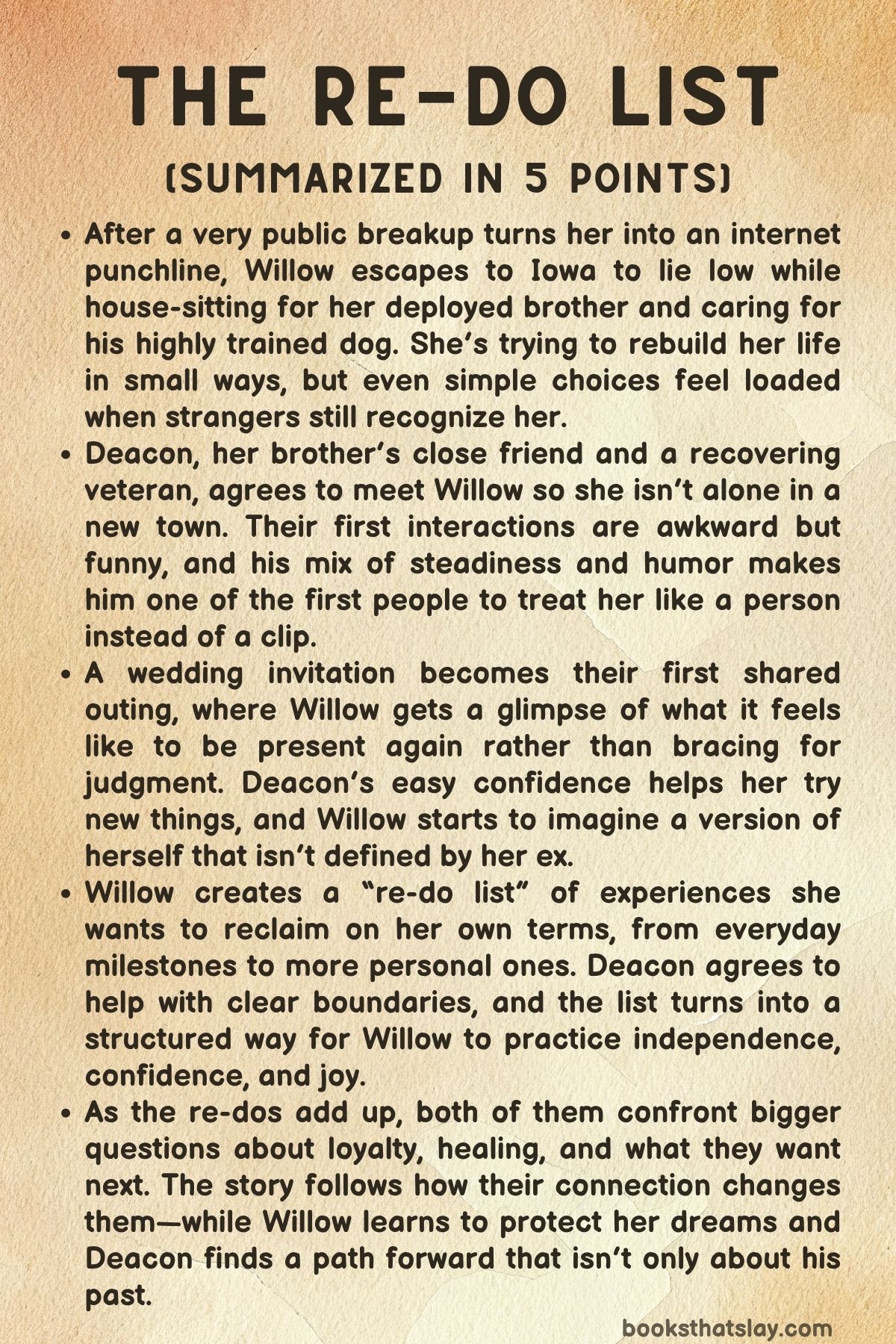
The Re-Do List by Denise Williams is a contemporary romance about starting over when your worst moment becomes public entertainment. Willow is “Drowning Girl,” the woman from a viral breakup clip, and she’s hiding out in Iowa while her brother is deployed.
She expects three quiet months, but meeting Deacon—her brother’s best friend, a recovering serviceman rebuilding his own life—changes the plan. Willow decides to replace the “firsts” she shared with her ex with new ones, on her terms. What begins as a practical reset becomes a messy, funny, and brave push toward self-trust, ambition, and love.
Summary
Willow arrives in Iowa determined to disappear. The internet already knows her as the woman who screamed, grabbed her boyfriend, fell into a fountain, and cried so hard she became a joke.
She’s house-sitting for her brother, Cruz, and caring for his highly trained German shepherd, Gus, while Cruz is overseas. Willow tells herself she can handle three months alone, but even ordering coffee turns into a test she fails: she blurts out the same two-drink order she used to buy for herself and her longtime boyfriend, Spencer.
When strangers recognize her and pressure her for a selfie, Willow caves just to end the attention, then feels sick with shame.
Cruz insists she meet his best friend, Deacon Rakes, so she won’t be isolated. Deacon shows up late to the coffee shop—broad-shouldered, calm, and disarmingly funny.
He doesn’t treat her like a meme. He sees her anxiety, hears what she’s trying not to say, and offers the kind of steady company that doesn’t demand anything from her.
When Willow admits the second coffee was habit—proof she doesn’t know how to be a person without Spencer—Deacon quietly helps her break the ritual by tossing the extra cup. The small gesture cracks her open.
She cries, and he stays. He jokes, but he doesn’t minimize her.
The next day, Willow has to attend a wedding where she’s basically a pity invite. She expects humiliation, but Deacon offers to go with her as her plus-one, insisting he’s great at weddings and that she shouldn’t skip life because she’s afraid.
At the reception, the dim lighting and loud music help Willow relax. The bride awkwardly references the viral video and moves on, and Willow realizes the world doesn’t stop to stare as much as she fears.
Deacon turns out to be the kind of person who can talk to anyone, dance with everyone, and still circle back to make sure she’s okay. During a slow dance, Willow admits she’s only ever danced with Spencer.
Deacon decides that fact needs fixing immediately and turns the dance into a “re-do,” guiding her through steps he learned in physical therapy and making her laugh so hard she forgets to be self-conscious.
After the wedding, they end up drinking in Cruz’s living room, trading teasing nicknames and loosening their guard. Willow’s curiosity about Spencer finally wins, and she asks Deacon to look up Spencer’s Instagram since she’s blocked him.
Deacon warns her it’ll hurt, but he does it anyway. Spencer already has a new girlfriend and a new dog.
Willow is stunned by how quickly her ten-year relationship has been replaced. The grief comes back sharp, and with it the fear that she wasted her youth building a life around someone who could walk away.
Drunk, angry, and desperate for a way to feel like herself again, Willow grabs a notebook and starts listing every “first” tied to Spencer that now feels ruined: dancing, painting, brunch, dates, the park where she was dumped. The list turns frank when she admits she’s never reliably been able to give herself an orgasm—and then braver when she adds sex with someone new.
The point, Willow insists, is to overwrite the old memories with new ones so Spencer doesn’t get to own her story. Deacon writes as she talks, uneasy about where the list leads but unable to ignore how much she needs a plan that’s hers.
He agrees to help over the three months she’s in town.
The next morning brings hangovers and humiliation: Willow wakes on the couch half undressed, her bra and pants on the floor. Deacon swears he looked away, but Willow still wants to crawl out of her skin.
Her best friend, Zoe, reacts with chaos, excitement, and unhelpful enthusiasm about Deacon, then accidentally pepper-sprays herself with microwaved chilies. Willow rewrites the list neatly, adding smaller steps like holding hands, kissing, being on stage, and changing her look—anything that feels like movement.
Deacon is dealing with his own reset. He’s injured, in recovery, and pushing himself through training benchmarks because he wants to return to military service.
He’s also avoiding reminders of what he lost, including the campus Veterans Center, even as another veteran, Kelly, tries to pull him into community. Deacon’s loyalty to Cruz is fierce, and his attraction to Willow is a problem he keeps trying to solve by pretending it isn’t there.
Willow starts with what she can control. She meets her neighbor Hollis, who instantly adopts her, and Hollis’s brother Blaine, a cosmetology student with a big personality.
With their encouragement, Willow chops her hair shorter and adds subtle highlights. The change makes her feel lighter, like she’s not wearing the same version of herself that Spencer knew.
As Willow works through her list, she and Deacon slip into a rhythm: dog playdates with Deacon’s rescue pit bull, Cupcake; teasing chess games with Deacon’s young neighbor Jayden; shared meals; and small moments that build trust. When Willow chooses “painting” as her next re-do, she explains how even the color of their old kitchen became a compromise—her bold red replaced by Spencer’s safe gray.
Now she wants red again. She climbs a ladder, panics, and texts Deacon.
He shows up without making her feel silly, catches her dancing to music in her room, and helps her paint the walls a deep, dramatic color that feels like courage.
Over dinner, the flirtation sharpens. Willow asks how people even start over romantically, how a first kiss with someone new works, and Deacon demonstrates with his hands and body positioning, getting close enough that the air changes.
He stops before they kiss, telling her she’s “very kissable,” then walks away like he hasn’t just set both of them on fire.
The tension finally snaps at brunch when a voice memo from Zoe—explicit and mortifying—plays out loud. Willow tries to recover, Deacon laughs, and they keep talking.
Willow shows Deacon her list. He sees that she’s already crossed off some items—like hand-holding and a first kiss—and when he flips to page two, he discovers Willow’s sexual wish list.
Willow panics, admitting she wrote it as fantasy and that she doesn’t have anyone to do those things with. Deacon calls her his “buddy” in a way that stings, then immediately contradicts himself by taking her hand and suggesting a no-strings setup back home might work.
The conversation turns honest and risky. Deacon lists all the reasons they shouldn’t—Cruz, timing, age, the fact that both of them are leaving eventually.
Willow insists she’s not asking for forever; she wants experiences that are hers, with someone she trusts. Then Willow spills her drink all over herself, and the embarrassment pushes her into tears.
Deacon follows her to the bathroom to check on her, refusing to let her hide. He admits he kissed her because he wanted to, and that he’s tempted to say yes.
He’s scared she’ll get hurt. Willow argues that she’s already hurting and that choosing something for herself is the point.
Deacon finally agrees, setting boundaries: secrecy, going slow, and not starting anything in the diner bathroom.
What follows is a mix of awkward, funny, and intensely intimate exploration. Willow tries touching herself, fails, then ends up on a video call with Deacon where his voice and instructions help her finally orgasm on her own.
It’s a breakthrough that leaves her stunned and proud. They talk about toys and safety, flirt openly, and keep building trust even as the line between “no-strings” and real feelings blurs.
Willow applies herself to the rest of the list too. She tours a vet school and admits her dream of applying, even though her timeline stalled after her mother died and her life narrowed around Spencer.
She weighs a cheap flight home to Colorado to go camping with Zoe, worries about money, and still decides to go because she’s tired of waiting for life to be convenient. Deacon agrees to watch Gus and teaches Willow practical self-defense tips, treating her like someone capable, not fragile.
One of Willow’s biggest re-dos is learning to ride a bike. Deacon coaches her patiently until she can balance on her own.
Then Willow insists Deacon try too, and he wipes out repeatedly. The moment turns serious when he admits his surgery and a tumor affected his balance.
Back at the house, Willow cleans his scrapes, and their care for each other stops being theoretical. It’s real, physical, and tender.
Deacon gives her lube for her toys so she won’t hurt herself, then admits he’d want to watch. Willow hears the possessiveness and doesn’t run from it.
Everything changes when Cruz goes missing on a mission. Willow’s old grief roars back, echoing the loss of her mother.
She decides she won’t shut down this time. She opens her vet school application, reads her personal statement, and tries to hold herself together.
Then she makes a careless mistake: she forgets to clip Gus’s leash, he bolts after cats, and vanishes into worsening weather. Willow spirals into panic.
Deacon arrives immediately, steady and focused, and searches with her through thunder and rain.
Under a gazebo in the storm, the truth finally comes out. Willow confronts Deacon’s obsession with returning to service as a way to protect Cruz.
Deacon breaks, admitting Cruz is his brother in everything but blood and that he feels like he’s failed him—especially by crossing lines with Willow when Cruz asked him to protect her. Willow tells him wanting her doesn’t make him a villain.
Gus returns soaked but safe, and Willow clings to the dog and the hope that Cruz will come back too.
Cruz does call—alive, injured, drugged, and furious that Willow knows he went missing. He talks to Deacon privately, then tells Deacon to take care of Willow until he gets home.
After the call, Willow admits she’s scared Deacon will leave. He promises he won’t.
They kiss again, and Deacon stops fighting what he feels, telling Willow he wants to help her finish the list.
Soon after, Willow comes home from volunteering at a vet clinic, filled with purpose, and she asks Deacon directly for sex. They end up in bed, moving carefully but without pretending anymore.
Deacon prioritizes Willow’s pleasure, and Willow claims the experience as something chosen, not given. Afterward, Deacon tells her he’s in love with her.
Willow doesn’t flinch; she says she’ll have him.
The next moment is chaos: Cruz returns early on crutches, walks in, and punches Deacon. Deacon refuses to hit back.
Cruz throws him out, convinced Deacon used Willow. Willow is furious—at Cruz’s control, at the assumption that she’s a child, at the way her choices are treated like accidents.
Alone with Cruz, Willow pushes back hard. Cruz argues Deacon isn’t good for her, and when Willow admits she almost offered to delay vet school for Deacon, she realizes Cruz is right about one thing: she will not shrink her dream for a man again.
She explains the re-do list and how Deacon helped her rebuild her life piece by piece. Cruz starts to see that what happened wasn’t Deacon taking advantage—it was Willow coming back to herself.
Deacon meets Cruz later, bruised but honest. He apologizes for not telling him, admits he fell in love, and says he wants both Willow and Cruz in his life.
Cruz tells him Willow submitted her vet school application after adding a new paragraph that makes her commitment to her own future clear. That matters.
The friendship holds. They reconcile.
For Willow’s final re-do, she returns to the park and faces the breakup video that made her a meme. This time, she watches it with distance, refusing to let the internet define her.
Deacon shows up and asks her to be his girlfriend for real, telling her he loves her. Willow says she loves him too—and she makes the boundary clear: she’s not putting her plans on hold.
They agree to figure out the future together, not by sacrificing one life for the other, but by building a shared one that can handle ambition and love at the same time.
In the end, Willow starts vet school, stepping into the life she delayed for too long. Deacon stops isolating himself and begins working as a peer mentor at the Veterans Center, choosing connection over avoidance.
Their relationship moves forward with Cruz’s reluctant blessing and plenty of teasing. Deacon shares plans to propose, and when he does, he asks Cruz to be his best man—turning the old fear of betrayal into something like family.
Characters
Willow Lewis
Willow is the emotional and thematic center of The Re-Do List: a woman forced to rebuild her identity after a breakup becomes public spectacle. At the start, she’s living in self-protective shrink mode—choosing anonymity, rehearsing “normal” behaviors in public, and trying to control small things like a coffee order because everything else feels uncontrollable.
The viral “Drowning Girl” label doesn’t just embarrass her; it disrupts her sense of personhood, turning a private rupture into a permanent public identity that strangers feel entitled to use, mock, and monetize. What makes Willow compelling is that she doesn’t simply “get over” Spencer; she recognizes that her relationship wasn’t only love, it was a structure that quietly replaced self-definition.
Her grief is therefore two-layered: she mourns Spencer and the future she assumed, but she also mourns the version of herself that outsourced choices—where compromise became habit and “us” slowly crowded out “me.”
Willow’s re-do list is both a coping mechanism and a reclamation project. On the surface, it’s playful—redo the firsts, reclaim the memories, swap out Spencer’s imprint with new experiences.
Underneath, it reveals a serious psychological need: she’s trying to prove to herself that her life can still generate joy and agency without a partner authorizing it. The list also exposes her vulnerability around desire and pleasure; her admission that she has difficulty orgasming alone isn’t just a spicy detail, it’s another sign of how disconnected she’s been from her own body, preferences, and autonomy.
Over time, her arc becomes less about replacing Spencer and more about choosing herself without apology—applying to vet school, rewriting her personal statement, and refusing to bargain away her future even when she’s in love. By the end, Willow’s growth is visible in how she handles the meme: she can finally look at the breakup video without collapsing into shame, which signals that she has separated her worst moment from her identity and learned to hold compassion for the girl she used to be.
Deacon Rakes
Deacon is introduced as competence wrapped around damage: a disciplined former Pararescue Jumper in recovery, restless in civilian life, and quietly haunted by what he’s lost. He has the outward markers of steadiness—training benchmarks, routines, practical skills, calm under pressure—but his internal conflict is persistent and specific.
He’s grieving service and purpose, resisting spaces like the Veterans Center because they mirror back a life he isn’t sure how to rebuild. His injury recovery and his fixation on returning aren’t just career goals; they’re his way of making meaning out of pain and of staying tethered to Cruz, whose bond with him is forged through extreme shared experiences.
Deacon’s loyalty is almost sacred to him, which is why his attraction to Willow registers as a moral crisis rather than a simple temptation.
What distinguishes Deacon as a romantic lead is how his tenderness expresses itself through action and containment rather than grand declarations—at least at first. He listens when Willow falls apart over something as small as coffee, and instead of minimizing her, he converts the moment into a symbolic reset by throwing away the “habit” drink.
He becomes her partner in re-authoring her life, but he keeps trying to draw boundaries because he genuinely anticipates the cost of crossing them. His “no” is not cruelty; it’s fear of harming her, fear of betraying Cruz, and fear of losing the last relationship that still feels like family.
As their connection intensifies, Deacon’s conflict sharpens: he wants Willow, but he also believes wanting her is evidence of his own failure. That’s why his breakdown during the storm matters—his composure cracks, and the story reveals the depth of his grief and guilt.
By the end, Deacon’s growth mirrors Willow’s: he chooses connection and community rather than isolation, takes a role as a peer mentor, and allows love to coexist with responsibility. His proposal plans signal that he’s no longer living in “pause until I’m fixed,” but in commitment to a future built with, not despite, the people he loves.
Cruz Lewis
Cruz functions as protector, anchor, and catalytic force in the relationship between Willow and Deacon. Even while overseas, his presence shapes the story: he insists Willow not be alone, he selects Deacon as her support system, and he frames Willow as vulnerable in a way that makes Deacon hyperaware of the power imbalance and moral stakes.
Cruz’s protectiveness is rooted in genuine love and trauma—he has seen what the world does to people under stress, and he knows Willow has already been publicly torn apart. That love, however, sometimes slips into control, and his “don’t touch her” warning positions Willow as someone to be guarded rather than someone fully empowered to choose.
When Cruz returns and reacts violently, it’s not simply jealousy; it’s the collision of brotherly protectiveness, battlefield loyalty, and the shock of discovering that the one person he trusted to keep Willow safe is now the person entangled with her most intimately.
Cruz’s arc is subtle but meaningful because he’s forced to recalibrate how he loves. He learns that shielding Willow can inadvertently infantilize her, and that his protective instincts don’t grant him veto power over her autonomy.
At the same time, he’s allowed his own vulnerability—missing on a mission, returning injured and medicated, and joking through pain—so his anger doesn’t read as villainy, but as messy human fear. His eventual acceptance of Willow and Deacon together is a surrender of control in favor of trust, and it signals maturation: he can remain a devoted brother without being the gatekeeper of Willow’s life.
By the epilogue, his willingness to become Deacon’s best man confirms that he has integrated both relationships into a single family structure rather than treating love as a zero-sum betrayal.
Zoe
Zoe is Willow’s long-distance lifeline and comic accelerant, but her deeper role is emotional permission. She speaks the thoughts Willow is scared to admit—about desire, rebound fantasies, and the possibility that a “fresh start” can include pleasure and risk.
Zoe’s humor is often chaotic, and that chaos serves a purpose: it disrupts Willow’s spirals. When Willow is stuck in shame or self-surveillance, Zoe drags her back into the present with jokes, daring advice, and a kind of blunt optimism that refuses to treat Willow as permanently broken by the meme.
Zoe is also a mirror for the reader: she sees the chemistry between Willow and Deacon early and treats it as obvious, which pressures Willow to confront feelings she would rather file under “temporary” and “unsafe.”
At the same time, Zoe’s advice is intentionally imperfect, and that imperfection keeps her from becoming a purely wise best-friend device. Her explicit voice memo and her push toward sexual experimentation create both comedy and discomfort, forcing Willow to navigate embarrassment and boundaries.
Zoe’s presence highlights a key tension in Willow’s healing: empowerment can look like taking control of your sexuality, but it can also look like deciding the terms on which you explore it. Zoe helps Willow move, but Willow still has to choose direction—especially when her re-do list shifts from playful revenge against the past into a blueprint for a self-directed future.
Spencer
Spencer is largely absent in the present action, yet his imprint is everywhere because Willow’s early identity has been built around him since middle school. His breakup line—framed as wistful but final—positions him as someone who has already emotionally exited while Willow is still living inside the relationship’s story.
The fact that he has someone new quickly, complete with curated posts and a new dog, functions as a brutal contrast: Spencer’s life appears to flow forward without consequence, while Willow’s moment of grief becomes permanent public entertainment. This imbalance sharpens the story’s critique of social narratives that punish visible emotion, especially from women, while rewarding the person who leaves cleanly.
Spencer’s deeper function is symbolic: he represents the “default life” Willow thought she was building—predictable milestones, shared routines, a future that seemed prewritten. The re-do list is essentially a method of rewriting the parts of Willow’s life Spencer colonized, not because he is a monster, but because the relationship became the container for her agency.
In that sense, Spencer is less a character being redeemed or condemned and more the embodiment of Willow’s old pattern: choosing partnership as identity rather than partnership as addition.
Hollis
Hollis arrives as an immediate infusion of warmth and momentum—an extroverted neighbor who treats Willow like a person, not a meme, and who offers friendship without making Willow audition for it. Her significance lies in how quickly she normalizes Willow’s presence in the community.
Where public spaces make Willow feel hunted, Hollis makes domestic space feel safe. She also represents a model of confident self-expression; her casual approach to hanging out, pizza-and-beer intimacy, and comfort with change encourages Willow to stop living as if she’s under constant observation.
Hollis is crucial to Willow’s growth because she widens Willow’s support system beyond Deacon. This matters emotionally and structurally: Willow’s healing cannot be reduced to romance, and Hollis helps prove that.
By facilitating the haircut and celebrating reinvention, Hollis becomes part of the “re-do” energy—someone who validates transformation as allowed, not dramatic. She helps Willow practice being a person in community again, which is one of the story’s quiet goals.
Blaine
Blaine is a gentle stabilizer in Willow’s new Iowa orbit, and his role is tied to reinvention through care. As a cosmetology student, he has literal skill in transformation, and that physical transformation becomes a gateway to psychological change for Willow.
His presence during the haircut scene contributes to the feeling of chosen family: a small, safe group making space for Willow to shed an old version of herself without judgment.
Blaine also operates as a boundary marker in Willow’s romantic world. Because he is gay, he becomes a clear non-romantic male presence, which keeps Willow’s emotional landscape from collapsing into “all men equal potential partner.” That distinction matters when Willow is trying to relearn intimacy without substituting another relationship for selfhood.
Blaine’s supportive presence underscores that affection and closeness can exist without romantic stakes, reinforcing Willow’s broader recovery of healthy attachment.
Linda
Linda, the older barista Deacon flirts with, functions as a tonal bridge: she shows that Deacon’s charm isn’t predatory or selective, but woven into how he moves through the world. Her easy rapport with him paints him as socially fluent and fundamentally kind, someone who can banter without cruelty.
In a story where Willow has been publicly mocked, those early signals of Deacon’s social ethics matter—he’s not a man who enjoys humiliating people for entertainment.
Linda also helps establish the community texture of the setting. Her presence makes the coffee shop feel like a real place with relationships and routines, which contrasts with the internet’s faceless cruelty.
In that contrast, Willow’s path forward becomes clearer: her healing happens in embodied community, not in the comment section.
Gus
Gus is more than a pet; he is a behavioral barometer for trust and a living tie between Willow and Cruz. His training and responsiveness highlight both Cruz’s care and Deacon’s competence, and Willow’s learning to handle him parallels her learning to handle her own life again—commands, boundaries, follow-through.
When Willow forgets the leash and Gus disappears, the incident becomes a pressure test of her coping: it triggers the same panic and grief circuits tied to her mother’s death and Cruz’s deployment, showing that Willow’s losses stack and echo.
Gus returning during the storm is emotionally symbolic without feeling purely contrived: it becomes a moment where Willow gets one thing back safely in a period where she fears losing everything. His presence also forces proximity and partnership between Willow and Deacon in high-stress moments, letting their bond reveal itself through action—searching, calming, enduring weather—rather than only through flirtation.
Gus is, in many ways, the story’s quiet reminder that care is a practice, not a feeling.
Cupcake
Cupcake, Deacon’s older rescue pit bull, reflects Deacon’s caretaking instincts and his capacity for softness that doesn’t require explanation. Rescue dogs carry implied histories of damage and recovery, which parallels Deacon’s own situation as someone trying to rebuild after injury and loss of role.
Cupcake’s presence in the backyard scenes expands Deacon beyond “competent soldier archetype” into someone domestic and rooted, capable of creating a safe home space.
Cupcake also helps normalize intimacy for Willow. The dog playdate frames Willow and Deacon’s time together as ordinary and neighborly, which is important for Willow’s nervous system: she’s learning that closeness doesn’t have to be a spectacle.
In a story about reclaiming normalcy after becoming a meme, ordinary moments are a form of repair.
Emi
Emi, as Deacon’s friend and roommate, represents the supportive infrastructure Deacon has even when he resists admitting he needs it. Her act of giving him a rose to bring Willow is small but telling: she sees what’s happening emotionally before Deacon allows himself to name it.
The rose becomes an early symbol of care that is not transactional—an offering meant to soften a moment that could otherwise remain awkward and guarded.
Emi’s presence also suggests that Deacon’s life isn’t empty outside Willow, which matters for the story’s emotional health. Deacon isn’t saved solely by romance; he has friends who notice him, nudge him, and participate in his transition back into civilian belonging.
Sybil
Sybil functions similarly to Emi as part of Deacon’s social scaffolding, reinforcing that he exists within a small chosen-family unit. Her role in helping Deacon get ready for the wedding supports the idea that Deacon’s charm and stability are not performative for Willow; they are grounded in a life where people know him and are invested in him.
This makes his later isolation—avoiding the Veterans Center, fixating on returning to service—stand out as a choice driven by pain rather than lack of options.
Through Sybil, the narrative quietly emphasizes community as medicine. Deacon’s eventual movement toward mentorship and connection feels earned because the story has shown he already has a relational foundation; he simply has to let himself step into it fully.
Jayden
Jayden, the cocky middle-school neighbor Deacon plays chess with, reveals Deacon’s gentleness in a way that dialogue alone can’t. Spending time with a kid who needs company while his mom works shows Deacon as someone who naturally occupies a protector role outside of the military.
That matters because Deacon’s struggle is partly about believing his worth depends on service; Jayden is evidence that his value is transferable—that caretaking, steadiness, and presence still matter in civilian life.
Jayden’s swagger and bluntness also create a contrast that humanizes Deacon. Around Jayden, Deacon isn’t performing competence or trying to be morally perfect; he’s just engaged, patient, and real.
This makes Deacon’s relationship with Willow feel safer because it’s nested within a pattern of non-romantic care.
Kelly
Kelly, the fellow veteran who keeps inviting Deacon to the campus Veterans Center, represents the path Deacon resists but ultimately needs: community with people who understand the loss of identity that comes with leaving service. Kelly’s repeated invitations function like a steady hand at the edge of the frame—an option for reconnection that Deacon keeps refusing because it forces him to face grief instead of outrunning it with training goals.
When Deacon later steps into mentorship, Kelly’s earlier persistence gains meaning: it shows that Deacon didn’t have to climb out alone, and that healing often arrives through the same mundane kindness offered again and again. Kelly embodies one of the quieter ideas running through The Re-Do List: support is not a single dramatic rescue; it’s an open door you eventually choose to walk through.
Dina
Dina, the bride who awkwardly references the meme, illustrates the social reality Willow is navigating: people don’t always intend harm, but their curiosity and discomfort can still reduce Willow to her worst moment. Dina’s greeting is brief, but it captures the particular sting of being “known” for something you didn’t consent to share widely.
Even in a celebratory space, Willow can’t fully escape the shadow of public judgment.
At the same time, Dina and the wedding setting give Willow a corrective experience. The darkness, the music, and the communal joy allow Willow to relax, dance, and laugh without constant hypervigilance.
Dina’s presence therefore contributes to the story’s message that healing often begins with small, imperfect social reentries—showing up, being seen, and realizing you can survive it.
Addy
Addy, the diner server who flirts with Deacon during Willow’s spill-and-cry moment, is a sharp narrative tool: she creates a brief triangle of attention that tests Deacon’s priorities and exposes Willow’s raw insecurity. Addy’s flirtation isn’t portrayed as villainous; it’s casual, opportunistic, and normal.
The point is how Deacon responds—shutting it down, focusing on Willow, protecting her dignity in a moment when she feels ridiculous and messy.
Addy’s presence also underscores the difference between being desired in public versus being cared for in private. Willow has been sexualized by strangers online, but in the diner scene, the story contrasts that objectifying gaze with Deacon’s attentive, practical care—napkins, a clean shirt, a check-in behind a bathroom door.
Addy helps highlight what Willow is actually craving: not performance-based attention, but safe intimacy.
Theo
Theo, the vet Willow dates briefly, represents the “reasonable option” that doesn’t ignite. He is connected to Willow’s career dreams—volunteering, GRE materials, the path toward vet school—which makes him symbolically aligned with her future.
Yet the lack of spark matters because it clarifies that Willow isn’t using dating merely to prove she can; she is learning to trust her own desire signals again. Theo is a contrast figure who shows that kindness and compatibility on paper aren’t enough to override what the story frames as essential chemistry and emotional aliveness.
Theo’s presence also pressures Deacon. Even when Deacon tries to label Willow as a “buddy,” Theo and the possibility of Willow moving on force Deacon to confront his own feelings.
In that sense, Theo’s narrative job isn’t to be a competitor with depth, but to make visible the choice Deacon keeps postponing: distance as protection versus closeness as truth.
Themes
Public humiliation, surveillance, and the loss of narrative control
Willow’s life gets reshaped by a camera angle, a caption, and a comment section that treats her grief like public property. The breakup itself is brutal, but what lingers longer is how strangers decide they understand her from a few seconds of footage: the creator who performs certainty for clicks, the viewers who diagnose her stability, the ones who sexualize her, and the small minority who ask whether it was ethical to share the video at all.
That spread of reactions turns Willow into a label before she can be a person again. She starts making choices around recognition rather than desire—standing in a coffee line calculating risk, denying her own identity, taking a selfie she doesn’t want just to end the pressure, then feeling ashamed that she couldn’t even order a different drink.
The Re-Do List keeps showing how public shaming doesn’t stay online; it changes posture, appetite, confidence, and the meaning of ordinary spaces. Even in a dark wedding reception, Willow enjoys the anonymity not because she loves hiding but because privacy has become relief.
Her fear is not only “being seen,” it’s being interpreted without context, reduced to a punchline with no right of reply. That’s why the later moment of watching the breakup video again matters: Willow isn’t trying to erase what happened, she’s taking her story back from the internet’s version of it.
The theme isn’t just about cruelty; it’s about what it costs to rebuild when your worst moment has an audience that never agreed to stop watching.
Rebuilding identity after a long relationship ends
Willow’s breakup hits like more than heartbreak because the relationship began so early that it became the structure around her sense of self. Her automatic two-drink coffee order shows how deeply “we” has replaced “me”: even alone, her body repeats the routine of caretaking and companionship.
What embarrasses her isn’t just that Spencer left; it’s that she can’t locate the edges of her identity without him. The re-do list becomes a method for separating memory from ownership—taking experiences that were once defined by Spencer and creating new versions that belong to her.
Some items look small from the outside, like learning to dance with someone else or painting a room a color she actually wants, but the point is psychological: Willow is practicing preference. When she chooses a dark red paint after years of compromising into neutral gray, it reads like selfhood returning through decision-making.
The list also reveals how uneven her autonomy has been, especially sexually; she admits she hasn’t been able to give herself an orgasm and has built her ideas of pleasure around someone else’s presence and approval. Her progress comes through repeated moments of choosing what she wants, naming it out loud, and tolerating the vulnerability of wanting something without guarantees.
By the end, the strongest proof that Willow is no longer living inside old patterns is not that she falls in love again, but that she refuses to trade her future plans for romance. Love doesn’t become her identity the second time.
She wants partnership, but she also wants her own life to stay intact.
Care, consent, and trust as a foundation for intimacy
The connection between Willow and Deacon develops through steady acts of care that don’t demand repayment. Deacon listens when she cries in the coffee shop and responds in a way that protects her dignity: he keeps the tone light enough to lower her panic while still treating her pain as real.
Again and again, he notices the places where she feels exposed—being recognized, feeling inexperienced, feeling “behind”—and he meets those moments with patience rather than pressure. That matters even more once their attraction becomes physical, because the emotional safety becomes part of the erotic tension.
Their shift into friends-with-benefits isn’t framed as impulsive chaos; it is negotiated. Willow insists on no-strings experiences, Deacon sets boundaries about secrecy and pace, and both acknowledge the risks—especially the risk that Willow might feel disposable after Spencer.
Even the sexy video call scene is rooted in consent and communication: Willow is guided, checked in with, and treated as someone learning her own body rather than performing for male approval. Deacon also refuses certain moments despite desire, which signals that his self-control isn’t moral superiority; it’s care.
Importantly, Willow’s sexual growth is connected to agency, not to being “fixed” by a man. She asks questions, buys toys, experiments alone, and learns what works for her with Deacon as support rather than the sole source of change.
This theme reaches its emotional peak during the storm while searching for Gus, when Deacon admits his guilt and fear and Willow refuses to punish him for being human. Trust becomes a shared practice: honesty, restraint, reassurance, and the willingness to repair after mistakes.
Duty, loyalty, and choosing a future without self-erasure
Deacon’s desire to return to military service is presented as more than career planning; it’s tied to identity, belonging, and unfinished responsibility. He misses active service and measures himself by physical benchmarks, pushing his body as if performance can restore what injury took.
His loyalty to Cruz runs just as deep, and it’s complicated by the promise to “look out for” Willow. That promise turns into a moral pressure point once he wants her, because loyalty starts to feel like a trap: if he chooses Willow, he believes he betrays Cruz; if he chooses Cruz’s expectations, he betrays his own feelings and maybe Willow’s needs.
The story doesn’t treat this as a simple love-triangle dynamic; it’s a theme about how duty can become identity until personal desire feels like a violation. Willow is caught in a parallel tension.
She has a dream—vet school—and a history of delaying it, first because life drifted with Spencer and later because insecurity makes postponement feel safer than commitment. When she offers to put her application on hold for Deacon, it reveals the old version of her: a woman trained to make love synonymous with sacrifice.
Cruz’s anger is messy, but it forces a hard truth into the open: Willow’s future cannot keep being negotiable. The resolution isn’t that duty disappears; it’s that duty gets rearranged.
Deacon starts connecting with community again and steps into mentoring, redirecting his need for purpose into something grounded. Willow submits her application with a stronger closing paragraph that proves she can choose herself without rejecting love.
Their relationship becomes viable only once both stop treating devotion as self-erasure and start treating it as support for each other’s growth.