The Room in the Attic Summary, Characters and Themes
The Room in the Attic by T. M. Logan is a fast-paced domestic thriller about the kind of fresh start that turns toxic. Adam and Jess move their family into a worn Victorian house in Nottingham, hoping it will be the answer to their money worries and a new chapter for their three kids.
Instead, Adam finds a concealed room in the attic—sealed up, furnished, and filled with locked drawers of strangers’ possessions. What begins as an unsettling curiosity quickly becomes a fight for safety as hidden surveillance, threatening messages, and links to old disappearances close in around them. The house isn’t just run-down; it has a past that refuses to stay buried.
Summary
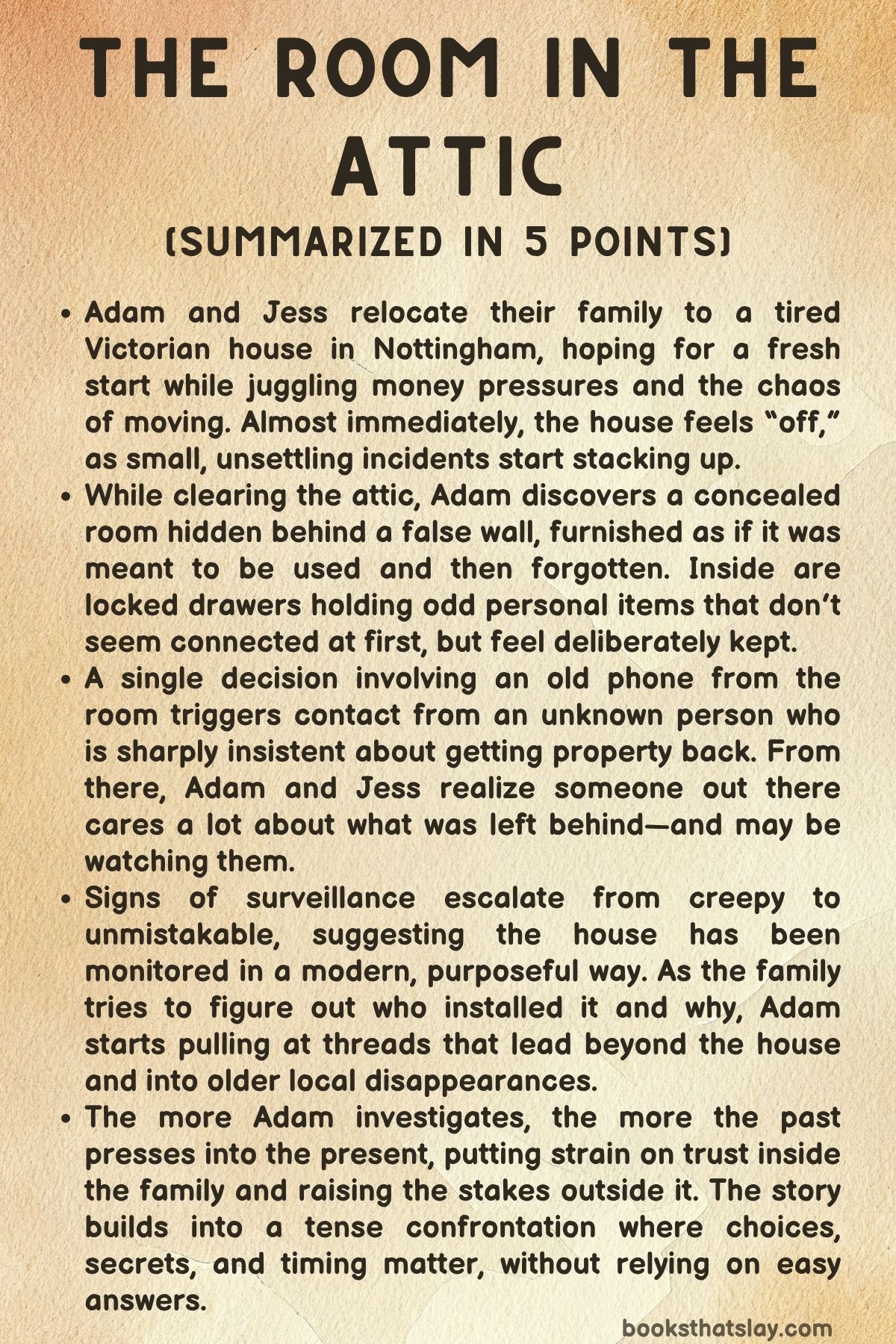
Adam and Jess relocate with their three children—Leah, Callum, and Daisy—into a large Victorian house in The Park area of Nottingham. It’s the kind of place that looks impressive at first glance but shows its age the moment you step inside: neglected rooms, old fittings, and signs that the previous owner let the place quietly decay.
They’re exhausted from moving, cash is tight, and they’re relying on this house to be a long-term home they can restore.
While clearing the top floor late on move-in day, Adam tears away a broken wardrobe in a small attic bedroom and uncovers something that doesn’t match the rest of the space: a wall of dark wood paneling. Under the light of his phone, he spots a seam.
When he presses it, the panel clicks open, revealing a hidden door. Behind it is a cramped, dusty room with no windows, sealed and forgotten.
Inside are a heavy armchair, a side table, and a large Welsh dresser with eight small drawers—most locked. The furniture is too big to have been brought through the narrow opening, which means the room must have been built around it.
The idea sits badly with Adam: the room wasn’t just unused; it was deliberately concealed.
His teenage daughter Leah briefly sees it and finds the whole thing disturbing. After she leaves, Adam shifts the dresser and discovers a carved indentation hiding a small iron key.
He unlocks the drawers and finds an odd set of items that feel like personal “keepsakes” rather than random junk: an old wallet with initials, a purple-checked scarf that still holds a trace of perfume, a dog collar engraved “Woody” with an address, a pair of rings on a keyring shaped like a tennis ball, cracked tortoiseshell glasses, and a Rolex Explorer engraved “EJS 11–29–75.” There’s also an old Motorola flip phone that won’t power up. Adam locks everything away again but takes the phone.
That night, over fish and chips eaten among unpacked boxes, Adam mentions the hidden room. Jess jokes about it, but she’s intrigued when the flip phone powers on.
It appears barely used, yet it contains one blurry photo and a single phonebook entry labeled “USE THIS.” Jess, half amused and half defiant, calls the number. To their surprise, it rings and goes to voicemail.
She leaves a message asking whoever it belongs to to call back.
Their first night in the house is unsettled. Daisy wakes up screaming, convinced someone was in her room.
Callum claims he heard footsteps. Leah finds their hamster on the stairs with the cage open, though no one admits to letting it out.
Jess tries to explain it away as stress and unfamiliar surroundings, but Adam feels the house is already pressing in on them. He’s carrying his own secret too: he’s been made redundant before the move and hasn’t told Jess.
The pressure of money, plus Jess’s plans to buy expensive new furniture, makes him desperate.
The next day, Adam makes a decision he knows is wrong but tells himself is necessary. He takes the Rolex to a jeweler and sells it for £4,000 cash, signing paperwork that it belongs to him.
It’s quick relief, and he uses it to steady their finances, but it binds him to the hidden room’s secrets. He spends the day job-hunting and searching for information about the house and its previous owner, Eric Hopkins, but finds little.
Then another discovery shifts everything from creepy to threatening. In the garden, Adam notices a bird box high in an oak tree.
He climbs up to remove it—partly to stop their cat from getting stuck again—and realizes the “blocked” opening is actually a camera lens. The bird box is a disguised surveillance camera connected to a small solar panel hidden above it.
It’s aimed straight at their drive and front door. He brings it inside, shaken, and Jess insists they call the police.
The response is lukewarm; it could have been left by the previous owner, they’re told.
Adam contacts Jeremy Swann, the estate agent who handled the sale. Jeremy claims there was no mention of CCTV, only an old alarm system, and he casually drops by with a welcome pack and champagne, acting friendly and helpful.
Adam also asks about the hidden attic space not shown in the listing. Jeremy brushes it off as the kind of forgotten quirk old houses have, especially when an elderly owner stopped using the upper floors.
He mentions Eric Hopkins is now in a care home and offers to put Adam in touch with Hopkins’s son, Kevin.
Jess sends photos of the camera to her brother Dom, who works in security. While they’re processing what this might mean, their neighbor Eileen from number 93 returns Callum after he wanders through a gap in the fence chasing a football.
She comments that it’s been a long time since children lived in the house and talks about Eric Hopkins as a recluse after a stroke and dementia. Eileen claims she knows nothing about surveillance.
Soon, Jess receives two unsettling texts—from the number she called using the flip phone. The sender demands the phone and “all other personal items found in house” be returned immediately, providing a PO box.
The tone implies they’ve stolen something. Adam tells Jess not to respond and pretends he’ll handle it, hiding the fact he’s already sold one of the most valuable items.
Adam goes back into the hidden room alone, sitting in the absolute darkness with the door shut. The silence is unnatural, and the lack of windows makes the space feel less like a storage nook and more like a place designed to keep something—or someone—out of sight.
He searches more carefully and finds an ATM receipt from 2000 and focuses on the dog collar engraved with an address: 167 Sumner Street.
The next morning, Dom arrives early to inspect the bird-box camera. But when Adam goes to retrieve it from the garage shelf, it’s gone.
The padlock is unlocked. Someone entered in the night and took the camera back.
Dom identifies the device as a modern covert setup, likely capable of uploading footage when someone nearby connects. He then checks the old motion detectors around the house and discovers something worse: inside the outdated housings are modern hidden cameras.
Multiple rooms are being watched. Suddenly, the theft makes sense—whoever is monitoring them knew exactly where the evidence was stored.
Adam drives to 167 Sumner Street and meets Maxine, who is stunned to see the collar. She explains Woody belonged to her husband, Adrian Parish, who vanished more than twenty years ago after taking the dog for a walk.
Woody returned without the collar. Police eventually assumed Adrian died by suicide when his bank card turned up near coastal cliffs, but Maxine never believed it.
Adrian’s disappearance has haunted her and her son Charlie, who grew up without him. The collar being found in Adam’s attic room makes no sense to her—and that impossibility is what makes Adam certain the hidden room is connected to something criminal.
Adam’s unease spikes again when he believes Leah is followed on the drive home from school by a gray Volvo. He tries to confirm it with a deliberate route change, but the car peels away before he gets a clear view.
Shortly afterward, Charlie messages Adam: he has used AI to enhance the blurry photo from the flip phone. The image becomes horrifyingly clear—two pale wrists bound tightly with a purple-checked scarf.
Adam recognizes the scarf pattern. It matches the scarf in the hidden dresser.
The story of the scarf comes into focus through a separate thread: a girl named Sian, living in fear of a man in her home who assaults her. One freezing January morning, she runs away before dawn, wearing the purple-checked scarf.
She heads toward the road, desperate to reach town and start over. A dark car stops, with a smiley-face sticker in the rear window.
Believing she’s finally found help, Sian approaches.
Back in the present, Adam searches the hidden room again, frantic for anything he missed. A hollow sound under a rug leads him to a hidden cavity beneath the floorboards.
Inside is an old tobacco tin containing matches, a lighter, ash, and a half-burned note. The note is coded, but Leah recognizes it as a simple cipher and decodes it.
The result reads like a checklist split between two names: “barrow” and “parker.” One side lists surveillance-style tasks like tracking access, locations, traffic, and call logs. The other side lists items to buy and use, including cable ties, shoe covers, and spades.
Adam recognizes the names as Bonnie and Clyde references, and the note feels like an operational plan—meant to be destroyed.
Adam’s attempt to get straight answers from Kevin Hopkins goes nowhere. Kevin admits wardrobes were fitted in 2002 after his family bought the house, but he denies knowledge of a hidden room or cameras.
Adam starts building a timeline and digs into the house’s ownership before Hopkins. He finds that the seller was Elizabeth Makepeace, who died in late 2001.
When Adam meets Maxine at Nottingham General Cemetery, she shows him something that makes the case stranger: Elizabeth Makepeace’s grave is near the grave of a younger man, Peter William Flack, who died on the same day as Elizabeth.
The pressure escalates inside the house too. Daisy is found holding the flip phone, saying she was talking to Santa—even though there’s no call record.
Soon after, Adam hears movement at night. The power is cut, and when he goes to the cellar to reset the breaker, he finds it switched off deliberately.
A masked intruder attacks him, kicking him down the steps.
Police involvement stays frustratingly limited. Adam speaks with DC Tanya Rubin and learns the gray Volvo seen near the park was reported stolen—conveniently with an alibi window that could have been staged.
Adrian Parish is technically still a missing person, but the case is cold.
Adam’s marriage begins to crack under stress and secrecy. Jess is furious at his growing obsession and especially angry when he involves a retired detective, Gordon Webber, who claims there were two killers operating together around the early 2000s.
Adam becomes suspicious of Helena, the cleaner Jess hired, and her cousin Tobias, especially after learning a fake WhatsApp account recommended them. When Adam confronts Helena, she admits she used a fake profile to get work in the neighborhood, but she insists she’s not part of anything else.
Tobias escalates it with violence, and Adam leaves with more fear than answers.
Webber proposes a sting operation: Adam should arrange a handover of the items to the blackmailer while police move in. Adam agrees and sets a meeting, but then receives an anonymous envelope revealing Webber’s own disgrace—he was tied to misconduct in a collapsed case.
Adam realizes Webber is unreliable and may be manipulating him.
The blackmailer changes the meeting location to an abandoned RAF site and threatens to burn Adam’s house down if he involves police. Adam goes anyway, but it’s a trap.
He receives messages making it clear the blackmailer never intended to show. Then the threat becomes personal: a video arrives showing Jess unconscious, injured, and gagged.
A live call follows, and Adam recognizes the setting. She’s inside their house.
Adam races home to find the gray Volvo in the drive and the front door open. He runs to the attic and opens the hidden room.
Jess is inside, bound, with a diesel heater pumping fumes. Adam shuts it off and drags her out, trying to call for help—until he’s struck from behind.
When he regains awareness, the truth is finally revealed. Estate agent Jeremy Swann is the one behind the threats and surveillance.
He explains that he and Peter Flack were the killer pair: Flack led, Swann assisted, luring victims and collecting “insurance” souvenirs to keep each other loyal. When Flack became reckless, Swann killed him and Elizabeth Makepeace, staging it via a sabotaged gas fire, then rebuilt his life as an estate agent to keep access to the house and its hidden stash.
The cameras were his way of monitoring the property and anyone who moved in, waiting for the moment he could retrieve what was hidden without interference.
Swann ties Adam and Jess and drags them back into the concealed room, turning the heater on again. He intends to leave them to die and make it look accidental.
But Adam manages to resist, shutting off the heater and realizing the house is being set on fire. With no easy exit, he uses tools left behind to smash through the blocked wall and force a way out.
He carries Jess outside as firefighters and ambulances arrive.
Outside, the situation turns in Adam’s favor through sheer timing and help. Maxine and Charlie, seeing smoke and catching Swann trying to flee, tackle him.
Charlie strikes him with his walking stick. Police arrive and arrest Swann.
Months later, the aftermath becomes clear. Forensics link Swann to multiple victims through DNA and traces on the items from the hidden room.
Swann leads police to a grave in Sherwood Forest containing Adrian Parish’s remains, confirmed through Charlie’s DNA. A task force reopens the connected cases, identifying six victims tied to the pair: Edward Stiles, Adrian Parish, Carys Neill, Dean Fullerton, Sian Stott, and Pamela Roy.
Adam and Jess sell the repaired house and move their family into a new-build, choosing a place without hidden spaces, without leftover secrets, and without the sense that the walls might be watching.
Characters
Adam
Adam is the story’s emotional and investigative engine: a practical, conscientious father whose sense of responsibility curdles into secrecy the moment money gets tight. His discovery of the hidden room in The Room in the Attic doesn’t just unlock a physical space, it exposes his default coping mechanism—control through concealment.
He withholds his redundancy from Jess, sells the Rolex, and then tries to “manage” the escalating threat alone, believing he can keep the family safe by carrying the burden privately. That choice becomes his defining flaw: every protective lie narrows his options and increases everyone’s risk.
Yet Adam is not reckless in a cartoon way; he is methodical, curious, and tenacious, repeatedly returning to the hidden room, building timelines, chasing addresses, and pushing past fear even when his body is injured and his home feels compromised. His arc bends from denial (this is just an odd house quirk) to dawning horror (this room may have held people) to grim clarity (someone is actively hunting the evidence), and finally to survival by sheer will.
In the end, Adam’s heroism is inseparable from his guilt—he fights hard to undo a danger he helped intensify by keeping secrets and underestimating how predatory the situation truly is.
Jess
Jess functions as the family’s stabilizer and the narrative’s reality-check, but she is also a pressure point because her priorities—home, comfort, normality—collide with Adam’s financial fear and growing paranoia. She initially treats the “secret room” as a strange novelty and tries to keep the family grounded through routine, jokes, and domestic plans, which makes her feel like the adult holding the line against spiraling anxiety.
At the same time, she is decisive and action-oriented in a different way than Adam: she calls the number on the phone, wants to involve the police, and tries to use her brother Dom’s expertise, showing that she is not naïve so much as unwilling to live in dread without proof. Her conflicts with Adam reveal the relationship’s fault lines—trust, money, decision-making—especially when she discovers he’s controlling information while criticizing her choices, like hiring Helena and Tobias.
Jess’s ordeal in the hidden room makes the threat intimate and bodily real, transforming her from skeptical partner to direct victim of the house’s secret history. By the end, her survival and the decision to leave underline her core value: she wants a life that isn’t built on hidden spaces, hidden debts, or hidden truths.
Leah
Leah embodies the adolescent perspective—sharp, embarrassed by parental scrutiny, and sensitive to social fallout—yet she also becomes one of the family’s most practically useful members. Her initial reaction to the hidden room is instinctive discomfort; she reads it as “wrong” before the adults fully accept what it implies.
That intuition aligns with her later role in deciphering the burned note, where her recognition of the Atbash cipher becomes a turning point: Leah isn’t just a bystander teen, she is a contributor who helps convert dread into actionable understanding. She also becomes a focal point for Adam’s fear, particularly when he suspects they’re being watched or followed; his overprotective behavior around her school pickup shows how the external threat distorts normal parenting into surveillance and counter-surveillance.
Leah’s anger at being singled out in school assemblies and her frustration with Adam’s secrecy reflect a deeper theme: the family’s attempt to “start fresh” is contaminated by the house’s legacy and by Adam’s choices. Leah’s character balances teenage vulnerability with quick intelligence, and the story uses her to show how danger seeps into identity, reputation, and daily life—not just physical safety.
Callum
Callum represents childhood openness and the way children become accidental sensors for danger. His wandering through a fence gap, the odd noises he reports at night, and the pet-related disturbances around the home create an early atmosphere where the line between imagination and intrusion feels thin.
He doesn’t interpret events with adult suspicion, but his experiences keep reinforcing the sense that the house is permeable and observed. Callum’s presence also intensifies the stakes because he is old enough to move independently but too young to reliably assess risk; that combination makes him vulnerable in a story built around surveillance and predation.
He becomes, in effect, a reason the adults must act quickly even when they are uncertain—because uncertainty is a luxury parents cannot afford when a child is potentially being monitored. By the later stages, Callum is also a measure of the family’s fraying normality: practices like routine pickups and safe play become logistical liabilities in a neighborhood that no longer feels secure.
Daisy
Daisy is the purest expression of fear in the narrative, and her terror is one of the earliest signals that something is wrong beyond coincidence. Her insistence that a “ghost” was behind her door reads like a child’s vocabulary struggling to label an adult threat—an unseen presence, a watched room, a home that doesn’t feel sealed.
Her sleep disruptions and panic force the parents to confront that the danger isn’t abstract; it is already living in their children’s bodies as anxiety. Daisy’s interaction with the old phone, holding it to her ear and claiming she spoke to Santa, deepens the creepiness because it suggests manipulation, monitoring, or at minimum the psychological contamination of the household—technology and secrecy bleeding into childhood fantasy.
Daisy’s role is not to solve the mystery but to externalize its cost: she shows what happens when adults argue, hide information, and chase answers while children absorb the atmosphere. When the family ultimately leaves, Daisy’s need for a “home without secrets” is implicit in the choice, even if she can’t articulate it.
Dom
Dom is the narrative’s technical anchor and the voice that confirms the family is not simply paranoid. His professional knowledge in security gives the discovery of covert cameras a hard edge; once he identifies the equipment as modern and high-end, the story moves from eerie to criminal.
Dom also functions as a protective brother figure for Jess, creating a triangle of trust where Adam’s credibility is weakened by his secrecy while Dom’s expertise feels clean and reliable. Importantly, Dom doesn’t just deliver information—he escalates the response appropriately, urging police involvement and methodical checking of the home, which counters Adam’s tendency to handle things privately.
His presence highlights a recurring irony in the novel: the family has access to sensible help, but the antagonist’s surveillance and Adam’s concealment keep disrupting coordinated action. Dom represents what competent intervention might look like in a rational world, which makes the antagonist’s preparedness and infiltration feel even more violating.
Helena
Helena initially appears as an innocuous continuation of the house’s past—someone who “belongs” to the property through prior employment—and that familiarity is precisely what makes her suspicious later. She moves through private spaces with legitimacy, cleaning bedrooms and speaking about the previous owner with just enough knowledge to sound credible.
Her guardedness when asked about specific names and renovations positions her as a possible gatekeeper of secrets, and the story leverages Adam’s growing paranoia to make her feel like a potential “follower” in a killer partnership. Yet her eventual confession reframes her as morally complicated rather than malicious: she is using deception to survive economically in a neighborhood that prices her out, exploiting a local network with a fake profile, but not orchestrating the violence.
Helena becomes a study in how desperation can mimic criminality—how the same behaviors that signal threat, such as lying, hiding identity, and avoiding questions, can also be the strategies of someone marginalized. Her character also functions as a mirror to Adam: both hide truths for reasons they believe are justified, and both discover that secrecy invites consequences.
Tobias
Tobias intensifies Helena’s storyline by giving her deception a sharper edge and a physical menace. Where Helena’s dishonesty is framed as fearful and pleading, Tobias reacts with aggression when confronted, punching Adam and threatening him, which blurs the moral line around them and sustains the reader’s suspicion.
He embodies the protective volatility that can arise in precarious circumstances: when survival depends on maintaining access to work, exposure feels existential, and intimidation becomes a weapon. Tobias is not positioned as the mastermind antagonist; instead, he functions as a reminder that danger comes in layers—some predatory and orchestrated, others reactive and opportunistic.
His presence complicates Adam’s attempts to sort “real threat” from “perceived threat,” feeding the story’s broader anxiety that anyone near the house might be connected to its secrets.
Jeremy Swann
Jeremy Swann is the most chilling character in The Room in the Attic because he weaponizes normalcy: the friendly estate agent, the helpful visitor, the approachable professional who can enter a home without raising alarms. His villainy is built on patience and access rather than overt brutality; he keeps himself close to the house by choosing an occupation that lets him orbit property transactions and plausible contact.
Swann’s psychology is defined by subordination and resentment—he frames himself as the “follower” to Peter Flack’s charisma, but his later betrayal reveals a deeper hunger for control and self-preservation. The “souvenirs” as mutual insurance show a relationship structured around distrust, and Swann’s decision to kill Flack and Elizabeth signals a man who will eliminate anyone once they become a liability.
His surveillance network reveals meticulous planning: he doesn’t merely watch, he curates power by learning routines, manipulating timing, and stripping the family of privacy until their home becomes a stage he controls. Even his attempt to steer Adam away from Webber with a warning shows strategic thinking—he can play protector if it keeps his secrets safe.
Swann is terrifying because he is adaptable: polite when it suits him, invisible when needed, and violently decisive when cornered.
Peter Flack
Peter Flack exists partly through traces—grave records, old connections, the “insurance” cache, and Swann’s later confession—and that absence makes him feel like a haunting force rather than a fully present character. He is described as charismatic and dominant, the kind of predator who could lure victims through charm and confidence, and this fits the checklist-like planning and the trophy-keeping that suggests ritual as well as pragmatism.
Flack’s relationship with Swann is central: he represents the alpha energy that draws in a subordinate partner, but also the instability that ultimately triggers betrayal. His death at Swann’s hands reframes him as both monster and cautionary example inside the killers’ world—reckless enough to threaten the partnership’s survival.
Even without direct scenes, Flack’s personality is legible through the system he helped build: a secret room, carefully stored items, coded notes, and an implied sense of ownership over victims’ lives and memories. He is the original architect of the horror, the one whose appetites set the pattern that Swann later tries to preserve and control.
Eric Hopkins
Eric Hopkins is a key “absence” character: he owned the house but appears more as a narrative decoy than an agent of events. His illness, limited mobility, and later dementia create plausible explanations for why rooms were forgotten and why odd features might have gone unchallenged.
The story uses Eric to show how evil can hide behind the gaps created by aging, disability, and isolation—whole parts of a home can become unreachable, and the people around may accept that as sad but ordinary. Because Eric kept to himself, neighbors project assumptions onto him, and the house’s neglect becomes background noise rather than a clue.
He matters because he illustrates how the house could carry secrets through a period when scrutiny was minimal; his life circumstances become an unintentional shield for what was concealed upstairs.
Kevin Hopkins
Kevin Hopkins embodies defensiveness, distance, and the convenient blind spot that family members of vulnerable people sometimes occupy. His impatience on the phone, his quick denials, and his limited memory about renovations position him as someone who wants the past closed off, whether from guilt, discomfort, or genuine ignorance.
He is not portrayed as malicious, but his emotional posture—short-tempered, evasive, eager to end calls—creates friction that slows Adam’s attempts to build a clear timeline. Kevin’s role highlights how secrets persist not only because criminals hide them, but because ordinary people avoid looking too closely at uncomfortable histories.
His contribution is partly negative space: what he fails to know or refuses to engage with becomes a barrier Adam must push past.
Elizabeth Makepeace
Elizabeth Makepeace operates as a historical hinge, linking ownership, inheritance, and concealed architecture. Her identity as the seller and her death on the same day as Peter Flack’s create the first hard proof that the house’s story is not just about an eccentric elderly owner but about something entangled and violent.
Elizabeth’s presence in a family plot and her proximity to Flack in death suggest a domestic tie strong enough to protect him and to keep the property connected to his life. Even if she is not depicted as a conscious accomplice in the crimes, the narrative positions her as someone whose household or family structure enabled the secret room to exist and remain hidden.
Her death becomes part of Swann’s self-serving cleanup, making her both collateral damage and a symbol of how criminal secrets often sit inside ordinary family frameworks.
Maxine
Maxine brings the story’s moral weight into focus because she represents the long, unresolved suffering of those left behind by disappearance. She is not driven by thrills or curiosity like Adam at first; she is driven by grief that never got closure and by a conviction that the official narrative did not fit her husband.
Her shock at seeing Woody’s collar again underscores how physical objects can preserve pain across decades, turning “evidence” into something intensely personal. Maxine is also perceptive and purposeful—she moves quickly once the connection to the house emerges, organizes cemetery research, and pushes the investigation forward with a focus that suggests she has carried this case alone for years.
At times, her speed and knowledge create suspicion, which is narratively useful because it mirrors Adam’s growing inability to trust anyone fully. But her ultimate function is clarifying: she reminds both Adam and the reader that the hidden room’s contents are not abstract artifacts but fragments of human lives.
Charlie Parish
Charlie represents the next generation living in the shadow of a vanished parent, and his involvement shifts the investigation from Adam’s private obsession into a shared, intergenerational pursuit of truth. His use of AI upscaling to clarify the photo is a modern counterpoint to the old secrets of the house—new tools dragging the past into sharper focus.
The resulting image of bound wrists is one of the story’s most visceral bridges between then and now, and Charlie becomes the messenger of that horror. He is also physically courageous when it matters, tackling Swann and helping stop him as the house burns, which transforms him from supporting investigator to active protector.
Charlie’s character carries a particular poignancy: he is seeking answers not only for justice but to complete his own identity, to know what happened to the father he never truly had.
Adrian Parish
Adrian Parish is a presence defined by loss and by the way a single vanished evening can fracture a family’s entire future. Though he is absent in the present-day narrative, he becomes vividly real through Maxine’s memories: a man with routines, with a dog he loved, and with a life that didn’t align with the tidy conclusion authorities wanted.
Adrian’s disappearance is the human hook that ties the hidden room’s objects to the wider world; without him, the items might remain eerie curios. He functions as proof that the house’s secret history spilled outward into ordinary streets, parks, and families far from The Park neighborhood.
When his remains are finally found and confirmed, Adrian’s story supplies the closure that crime fiction often promises but rarely earns so emotionally: it ends a long uncertainty, but it also confirms that Maxine’s intuition was right and that the horror was real.
Edward
Edward’s brief early thread serves as a cruel contrast between personal liberation and impending violence. His preparation to tell his parents he is gay frames him at a moment of hope, self-acceptance, and future possibility, and the focus on his expensive watch makes time and memory literal—an object marking a turning point.
By tying his watch to the hidden-room stash, the narrative turns that symbol into a wound: what should have been an emblem of adulthood becomes a trophy in someone else’s private archive. Edward’s character is therefore less about extended development and more about thematic impact: he stands for the lives that were just beginning, interrupted by predation, and reduced to belongings in a drawer.
Sian
Sian is one of the story’s most harrowing viewpoints because her fear is specific, domestic, and immediate before it becomes part of the broader criminal pattern. Her life is shaped by surviving nightly assaults from Colin, and her decision to leave at 4:04 a.m.
is an act of courage that also exposes how vulnerable escape can make a person. The purple-checked scarf she wears is both comfort and identity, which later becomes horrifying when that same pattern appears tied around bound wrists in the enhanced photo.
Sian’s tragedy is layered: she is fleeing one abuser only to be intercepted by another kind of predator, suggesting a bleak ecosystem where vulnerability is exploited at multiple points. Her character makes the novel’s violence feel rooted in real-world dynamics—coercion, flight, risky choices made under desperation—rather than purely sensational mystery.
Colin
Colin represents intimate, domestic cruelty, and his presence broadens the novel’s moral landscape beyond the headline evil of serial killers. He is a predator within the home, using alcohol and power to terrorize Sian, and his behavior explains why she would take the dangerous risk of accepting a stranger’s ride in the dark.
Colin’s function is brutally consequential: he is not the main villain of the central mystery, but he is a catalyst for Sian’s exposure to it. By including him, the story underlines that threat isn’t always hidden behind walls or in surveillance devices; sometimes it sits openly in a household and is endured in silence.
Eileen Evans
Eileen operates as the neighborhood’s human interface with the house’s past and as a quiet counterweight to the story’s mistrust. She is observant, practical, and socially rooted, the kind of person who notices patterns like “it’s been a long time since children lived here.” Her comments about Eric Hopkins and the home’s condition provide context without requiring her to be deeply involved in the conspiracy.
When chaos erupts, Eileen becomes part of the family’s safety net, helping ensure the children are protected, which shows how community can matter even in a narrative dominated by isolation and surveillance. She also symbolizes a more ordinary truth: neighbors often know fragments, not the whole story, and their partial knowledge can still be meaningful.
Mr. Sedgewick
Mr. Sedgewick appears as a supportive neighbor figure whose importance lies in what he represents during the climax: the difference between being alone inside a threatening home and having nearby adults who can act quickly when danger becomes explicit. His presence alongside Eileen during the emergency reinforces the theme that survival is not just about individual bravery but about timely help and social proximity.
In a novel where covert observation creates isolation, Mr. Sedgewick’s role is a small but meaningful reminder that not everyone in the orbit of the house is compromised.
DC Tanya Rubin
DC Tanya Rubin functions as the institutional voice of the present—professional, cautious, and constrained by evidentiary thresholds. She confirms facts that matter, such as the reported theft of the Volvo and the dormant status of Adrian Parish’s case, but her reluctance to fully re-engage without “significant new evidence” illustrates the gap between lived terror and procedural action.
Rubin is not depicted as incompetent; she is realistic about priorities and resources, which is exactly what makes her frustrating for Adam. Her presence emphasizes that official systems often lag behind evolving threats, especially when crimes are old, linkages are hidden, and the victim pool is not yet clearly connected.
Gordon Webber
Gordon Webber is the embodiment of compromised authority: a former detective whose knowledge can illuminate patterns, but whose history makes him dangerously unreliable. He offers Adam a framework—the possibility of a killer pair, dynamics of dominance and lure—that seems to impose order on chaos, and that psychological comfort is part of his power.
Yet his disgrace for misconduct and mishandling undermines his legitimacy, reframing his involvement as potentially self-serving or even manipulative. Webber’s sting plan reveals the seduction of “one decisive move” that bypasses slow procedure, and Adam’s willingness to go along shows how fear can drive people toward dubious allies.
Webber functions as a thematic warning: even help can be contaminated, and the desire for certainty can lead you to trust someone who should not be trusted.
PC James
PC James appears at the story’s sharp end, where the narrative shifts from suspicion and investigation into immediate physical crisis. His tackle and role in Swann’s arrest mark the moment the threat is finally met with effective force, providing a clean puncture to the novel’s atmosphere of helplessness.
He is not developed for complexity, but he serves an important structural purpose: he represents competent intervention arriving at the exact moment when individual effort and civilian bravery alone might not be enough.
Mr. Stay Puft
Mr. Stay Puft, Leah’s hamster, is a small domestic detail that becomes an early signal of disturbance. The cage being open and the hamster appearing on the stairs works like a subtle alarm bell: something in the house is not behaving as expected, and the family’s routines are being interfered with.
As the story escalates, he fades into the background, but his initial role is meaningful because he helps build the uncanny feeling that the home is being penetrated, that boundaries—between rooms, between day and night, between safe and unsafe—are not holding.
Steve
Steve the cat operates as both comic realism and inadvertent foreshadowing. His tree rescue scene reads like ordinary moving-day chaos until it leads Adam to notice the bird box and discover it is actually a covert camera.
Steve’s curiosity and climbing instinct accidentally reveal the story’s central modern threat: surveillance. In that way, Steve becomes a catalyst, turning a mundane pet problem into the uncovering of an invasive system that has likely been watching the family from the start.
Themes
The Cost of Secrecy Inside a Family
In The Room in the Attic, Adam’s first major mistake is not the hidden room—it’s the quiet decisions he makes around it, especially while keeping his redundancy and financial panic from Jess. That secrecy becomes a private engine driving many of his choices: selling the engraved Rolex for cash, downplaying how serious the found items might be, and trying to “handle it” alone once the threatening texts arrive.
The more he hides, the more he corners himself into riskier behavior, because admitting the truth would mean admitting he crossed ethical lines. The tension isn’t just about money; it is about identity and control.
Adam wants to stay the dependable provider, so he chooses concealment over honesty, even when honesty would bring practical help. Jess, meanwhile, is not kept in the dark because she can’t cope—she is kept in the dark because Adam fears what transparency would do to his self-image and to the marriage’s balance of trust.
That gap widens when danger becomes real. Their arguments show how secrecy turns partners into adversaries: Jess sees Adam’s obsession as the problem, Adam sees Jess’s everyday choices—like hiring Helena and Tobias—as a vulnerability, and both are partly right because the marriage has lost the shared map of reality.
The children absorb the fallout in the form of fear, confusion, and overheard conflict. Daisy’s terror at night and Callum’s sense of strange noises aren’t just spooky details; they signal a home where adults are not providing steady emotional safety.
The story keeps returning to one point: secrets rarely stay contained to the person holding them. They leak into tone, timing, defensiveness, and decisions.
By the time Adam is forced to tell Jess key truths, the information arrives as a weapon in arguments rather than a bridge between them, making repair harder. The novel’s pressure comes from watching ordinary concealment snowball into a family-wide crisis, showing how a household can become fragile not only because an outsider is watching, but because the people inside are no longer fully truthful with one another.
Surveillance and the Loss of Private Space
The hidden camera in the bird box shifts the threat from unsettling to intimate. It isn’t simply that someone might know where the family lives; it is that someone has been collecting patterns—arrivals, routines, vulnerable moments—turning domestic life into data.
When Dom identifies covert, modern surveillance disguised inside old motion detectors, the house itself stops feeling like shelter and starts feeling like a stage rigged for an audience. That change rewrites every ordinary action.
A cup of tea at the kitchen table becomes something that might be observed. The front drive is no longer neutral space; it is a monitored threshold.
Even the decision to store the bird box camera on a garage shelf becomes loaded, because the device’s disappearance proves the watcher can physically enter and exit without immediate detection. Surveillance here is not presented as a distant concept; it is a tool that creates obedience through uncertainty.
The family begins to self-censor: Jess wants the camera gone, Adam wants to keep it as evidence, and both impulses reveal how invasive it feels to have an object in the home that might still “report” them. The children’s experiences intensify the theme because they react before they understand.
Daisy believes someone is behind the door. Callum hears footsteps.
Leah finds the hamster on the stairs. These moments underline how being watched doesn’t only threaten adults with harm; it reshapes a child’s sense of what a room means.
A bedroom should be the safest space, but the story repeatedly violates that expectation—especially when Daisy is found holding the flip phone as if a stranger can reach her through it. The fear is not limited to cameras; it extends to the idea that systems can be hidden in familiar shapes.
A bird box, a motion detector, an old alarm keypad—items that should signify safety become masks. This undermines trust in the environment itself, producing a kind of paranoia that is rational because it is repeatedly confirmed.
By the end, the family’s choice to move into a new-build home “without secrets” is not just about escaping a location; it is about escaping a model of life where privacy is conditional and home is no longer a boundary. The theme argues that surveillance is psychologically violent even before any physical violence occurs, because it steals the right to feel unobserved in your own space.
Evidence, Memory, and the Long Shadow of Unfinished Harm
The items locked in the dresser drawers are small, personal, and stubbornly physical—wallet, scarf, dog collar, glasses, rings, a watch engraved with a date. Each object functions like compressed memory, carrying more truth than any official story that tried to close a case.
The dog collar leads Adam to Maxine and to the fact that Adrian Parish’s disappearance was never emotionally resolved; it was administratively tidied up, treated as likely suicide, and then left to fade. The scarf, once connected to the enhanced image of bound wrists, transforms from a quirky find into a piece of possible evidence and a sign of cruelty.
Even the old ATM receipt and the burned cipher note show how harm leaves traces that can survive decades when institutions stop looking. This theme is sharpened by the way official attention has cooled.
DC Rubin is polite but cautious; Adrian’s file exists, but it is inactive. The novel doesn’t suggest the police are indifferent as individuals; it suggests that time and workload push older pain to the margins unless something new forces it back.
That reality makes private citizens the ones who keep memory alive—Maxine through sheer refusal to accept the convenient narrative, and later Charlie through technical skill and persistence. The enhanced photo is important because it represents a modern method of reopening the past.
Technology becomes a way to recover what was once dismissed as too blurry, too uncertain, too easy to ignore. Yet the story also shows the danger of amateur investigation: Adam’s desire to solve it is tangled with guilt over selling the watch, and that guilt distorts his judgment.
The past is not just a puzzle; it is a moral weight that tests the present. When Adam stands in the hidden room and imagines what it might have been used for, the theme becomes a question about what a community chooses to remember and what it allows to be buried—sometimes literally.
The eventual forensic links and the task force reopening cases demonstrate how truth can be reconstructed, but only after someone refuses to let objects stay “just objects.” In this sense, memory is not sentimental; it is procedural. A collar leads to a conversation, a conversation leads to a grave, a grave leads to names, and names lead to justice.
The shadow of unfinished harm stretches across years, shaping lives like Maxine’s and Charlie’s, and the novel insists that closure is not granted by time passing—it is earned by truth being named, documented, and acted on.
Predatory Control Disguised as Normality
The threat in the story is frightening partly because it wears familiar faces. The estate agent Jeremy Swann is helpful, nearby, and socially acceptable; his presence comes with champagne, a welcome pack, and smooth reassurance about quirks in old houses.
That normal presentation is not cosmetic—it is strategic. Predatory control works best when it can move through respectable channels, where questions feel rude and suspicion feels irrational.
Swann’s access to the house’s history, his knowledge of the previous owner’s decline, and his ability to frame oddities as harmless “old house” features are all forms of power. The hidden room itself embodies the theme: a space built to conceal, to isolate, and to deny accountability.
Whoever can create such a room is not only hiding something; they are designing a system where a person can be kept out of sight. The story’s flashback sequence with Sian makes this theme broader than one villain.
Before any abduction, she is already trapped by Colin’s nightly abuse, and her attempt to escape is met by a second predator. The novel draws a line between domestic abuse and stranger violence: both rely on the victim’s limited options and on social invisibility.
Sian walks into the cold morning believing a car stopping might mean help, and the reader understands how hope can be exploited when someone is desperate. In the present timeline, Swann’s coercion escalates through demands for “personal items,” threats to burn the house down, and finally the staged suffocation attempt with the diesel heater.
Each step is about control more than profit. Even the “souvenirs” are described as insurance to enforce loyalty, showing that predators also manage each other through fear and leverage.
The checklist decoded from the burned note reinforces how methodical this control is: it reads like operations planning—access, traffic, call log, supplies—reducing human lives to logistics. The novel also shows how predatory control recruits ordinary doubt.
Adam wonders if he is overreacting. Jess worries he is fixating.
Police initially treat the camera as possibly leftover equipment. These reasonable hesitations create the space predators need.
The theme lands hardest when the danger is revealed to have been inside the family’s support network all along, meaning the family’s trust—the basic currency of community—was used against them. By the end, the family’s desire for a home “without secrets” is also a desire for a social world where friendliness is not a mask and where safety is not dependent on guessing who is lying.