The Scent of Oranges Summary, Characters and Themes
The Scent of Oranges by Kathy George is a reimagining that puts Nancy—usually a side character in the world of Oliver Twist—at the center of the story. It follows her through London’s streets, lodgings, churches, and back rooms, showing what it costs to survive under men like Fagin and Bill Sikes, and what small scraps of tenderness can do to a person who has almost none.
Nancy’s life is split between danger and duty, but also shaped by unexpected chances: a strange, gentle client; a rich aunt’s drawing room; and one hungry boy who makes her remember she still has a choice.
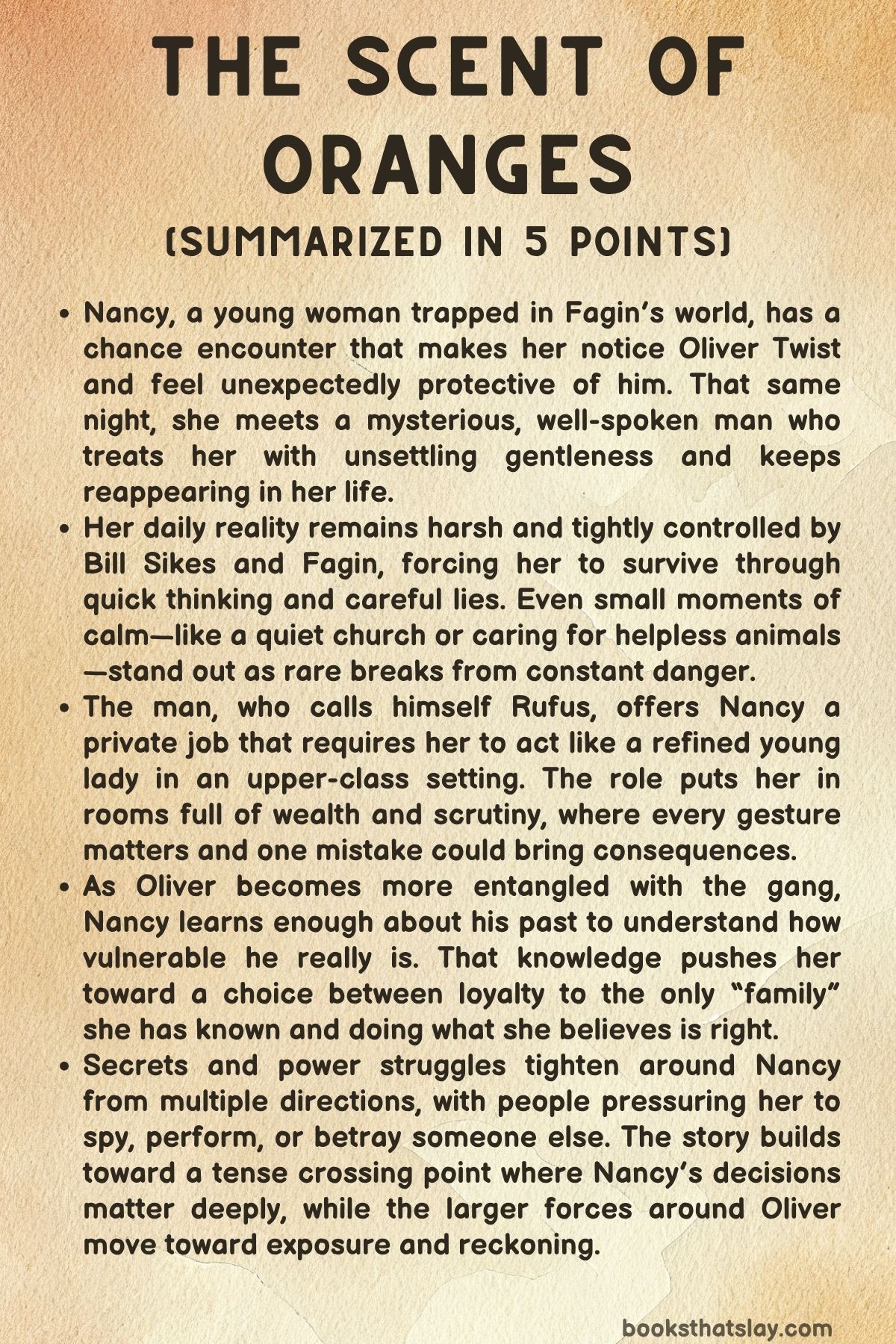
Summary
Nancy works for Fagin and lives under the shadow of Bill Sikes. One foggy night in Saffron Hill she is sent to meet a new client.
On the street she notices the Artful Dodger walking with a clean, angel-faced boy who looks completely wrong for the company he keeps. She later learns the boy is Oliver Twist.
Something in Oliver’s face catches in her chest, an instinctive pull she doesn’t understand, and she carries that feeling with her as she goes on alone.
At the tenement where her client waits, she hears a small movement under a shrub and discovers a cold fox cub, half-moulted and barely alive. She wraps it in her shawl and brings it close for warmth before going inside.
The client is a handsome man with careful speech and an upper-class accent that doesn’t match the shabby room. Nancy expects sex because that is what she is usually paid for, but the night turns oddly quiet.
He holds her as if she is something fragile, refuses her attempts to begin work, and they fall asleep fully clothed in a kind of uneasy peace.
In the morning Nancy remembers the cub and finds it still alive but weak. The man becomes intent on the animal instead of her, dragging her back inside, making her boil water and prepare tea while he reads the paper and watches.
The cub stirs; he startles, then goes outside and returns with more fox cubs and places them by the fire. He sends Nancy out to buy milk so they can be fed, gives her money, and when she insists on her shawl back, lends her his coat.
Nancy queues at a coffee house and returns with milk. The cubs lap from a saucer, and the room grows calm in a way she is not used to.
The man says he has someone who can rear the cubs. Before she leaves, he asks to see her again and hints he may have a private job for her.
He tells her to behave like a lady, jokes she can pass if she keeps her mouth shut, and gives her the name “Rufus,” admitting it may not be real.
Nancy goes back to her room and prepares herself with the blunt practicality of someone who has learned to survive. Later she goes to The Three Cripples to find Bill Sikes.
Bill is violent even when he is not aiming his cruelty at her; his dog Bullseye cowers under his moods. Nancy waits until Bill’s hands are away from his knife and poker before entering.
She gives him her earnings. It is more than usual, and Bill’s jealousy flares.
Fagin appears, smooth and watchful, and takes the money while praising Nancy, steering Bill away from questions. Nancy leaves with Rufus’s gentleness echoing in her mind like a dangerous dream.
Her past surfaces in fragments. As a child she stole to eat until Fagin caught her and threatened exposure, then decided she was useful.
She lived dressed as a boy for years, running errands and learning tricks. Later she wore dresses and earned money in the way men demanded.
She also carries broken memories of being separated from a woman she thinks was her mother, and of trying to care for a smaller child, as if she once had siblings and then lost them.
Bill later confronts Nancy about the extra money. She lies, inventing crude details about a demanding client to soothe Bill’s suspicion.
Bill makes the lie into a punishment, forcing sex while acting out the story she told. Afterward he sleeps.
Nancy lies awake, thinking about names and how Oliver and Rufus have somehow become linked in her thoughts, both of them pulling at something inside her she thought was dead.
She sees Oliver again at Fagin’s, where the boys drink and smoke and Fagin trains Oliver with little games that teach him how to steal. Oliver looks scared and confused, and Nancy’s protective feeling sharpens.
On a rare night off in Soho, Nancy becomes separated from the others and is cornered by a soldier who tries to assault her. She fights, bites, is struck, and pinned against a wall.
Rufus appears out of the dark, shoves the man away, and leads her to safety.
Rufus takes Nancy by cab back to his place, lights a fire, and gives her strong drink. He speaks sharply about a private job he wants done without involving Fagin or Bill.
He admits he wants her but says he should not. He arranges to leave messages for her through Barney at The Three Cripples.
Days later Nancy visits Fagin’s and finds Oliver alone. Oliver tells her, in a rush of misery, about the workhouse hunger, being punished for asking for more food, being apprenticed to an undertaker, sleeping among coffins, being bullied, and running away after defending his dead mother’s honour.
He breaks down and faints in Nancy’s arms. She lays him on a bed and slips out, shaken by how much pain can fit inside such a small body.
A message arrives: “Thursday: 5 o’clock.” Nancy goes, but Bill tries to stop her. She blurts that she is going to help Oliver and escapes.
Rufus rushes her into a carriage in heavy rain and explains the plan. She will bathe and dress in fine clothes, pretend to be mute, and take the name “Miss Titania Richardson.” He supervises her transformation with unsettling intimacy—washing, dressing, lacing her stays, feeding her rich soup—until she looks like a quiet young lady in a pale-blue gown.
Then he takes her to an elegant townhouse where his Aunt Maud waits.
Aunt Maud inspects Nancy with a lorgnette and calls her appearance “uncanny.” Nancy plays the mute role with nods and careful manners. Maud interrogates Rufus about the girl’s parents, money, and living arrangements.
Rufus lies smoothly, inventing dead parents and a respectable companion. Nancy notices valuables in the room, including a small gold baby trinket and a delicate gold-cased clock, and her thief’s eye measures what Fagin or Bill would do for them.
When they leave, Rufus explains the truth: Maud controls money and property but will only increase his allowance if he marries. Nancy has been used as a pretend fiancée.
Rufus also confesses why Maud found her “uncanny.” Nancy resembles his dead mother. He admits he once followed Nancy in Whitechapel, became obsessed with seeing her, and even negotiated with Fagin to get closer.
He asks her to stay the night. Nancy refuses, afraid of Bill.
Rufus kisses her gently, then insists she go home.
At home Bill is waiting and furious. Nancy produces the stolen baby trinket to distract him.
It works—Bill is delighted—but he still punishes her, whipping her legs with his belt. Nancy stays silent to avoid worse, and she tells herself she must endure because Bill’s own past is brutal: he witnessed his father kill his mother, lost siblings, grew up feral and frightened, and sometimes wakes screaming and sobbing, begging Nancy to hold him.
She convinces herself she is the only kindness he has.
Soon Oliver disappears—taken by the police—and Fagin pressures Nancy to find out what happened. Disguised as a respectable girl, she goes to the police office and performs a story about searching for her innocent brother.
She learns Oliver has been released and taken away by a gentleman to a residence in Pentonville. Nancy reports back.
Fagin panics and prepares to move. Over the next days Nancy searches for Oliver and eventually trades sex to a coachman to learn the address: Number Seven, Claremont Court, near gardens in Pentonville.
While watching the house, Nancy realizes she is being followed. Rufus confronts her about the stolen trinket from Maud’s, asking her to return it.
Nancy denies taking it and suggests a servant did. Rufus offers a coach and tries to draw her close; in the enclosed space he holds her on his lap like a child.
Their desire flares, but Nancy abruptly leaves when they reach Hyde Park, jarred by how easily comfort can become another trap.
Not long after, Bill insists on controlling the search. They find Oliver outside a bookshop carrying books.
Nancy seizes him, loudly pretending to be his sister, telling onlookers he ran away to join thieves. A crowd believes her.
Bill strikes Oliver, and the crowd approves the roughness as discipline. Bill drags Oliver through alleyways, using Bullseye as threat, and delivers him back to the gang’s hidden house.
Meanwhile Nancy is pulled deeper into Rufus’s scheme. She returns to Aunt Maud’s alone and is forced to answer questions on a slate.
Her poor handwriting nearly exposes her. Rufus then invites her to stay at his Mayfair house because he cannot afford servants and the house is quiet.
There Nancy faces the truth that she cannot read, and she hides it by cleaning dusty books. Rufus joins her with a bowl of warm water and shares an orange with her while they work.
He leads her into his mother’s preserved bedroom and offers his mother’s dresses. Nancy realizes with shock how much he is trying to recreate his mother through her.
She drags him out, takes control, and they have sex—tender, real, and dangerous because it makes her want to believe in safety.
The next visit to Maud collapses into disaster. Maud gives Nancy a necklace, then fakes a choking fit to force Nancy to speak.
Nancy cries out, revealing her voice. Maud confronts her calmly, listing the signs: bitten nails, the missing companion, the borrowed dress.
Nancy admits her real name and admits the engagement is a lie. Maud decides to proceed anyway to secure Rufus’s inheritance, but orders Nancy to investigate whether Rufus has secret income.
She tells Nancy to return alone next week and report.
Nancy is dragged back to her old life when news arrives that a burglary went wrong and Oliver was shot. Bill disappears.
Fagin rages and orders Nancy to murder Bill if he returns without the boy, because Oliver is worth money. Nancy overhears Fagin meeting Monks, a well-spoken man, and learns they are plotting to ruin Oliver.
Desperate, Nancy travels alone to Chertsey. She finds the house connected to the burglary and learns from servants that Oliver is upstairs and will recover.
Relief hits her so hard it nearly breaks her.
Back in London, Bill returns sick and feverish, drags Nancy to a worse hiding place, and collapses delirious. Nancy struggles to care for him, paying for food with hidden money.
When Bill recovers, his paranoia turns sharp. He demands the return of the baby trinket and threatens her with his belt.
Nancy claims she hid it while he was ill so no one would steal it. Bill orders her to fetch it back and insists he will come so she cannot trick him.
Before dawn Nancy slips out and goes to Aunt Maud’s house. She speaks to Maud honestly—not as a lady but as herself—saying a boy she cares about is in danger and helping him could destroy her.
Maud presses her, then tells her she must do everything possible to save the boy or she will never forgive herself. Nancy leaves with that verdict ringing in her head.
But she also remembers why she truly came: she sneaks into the drawing room and steals back the baby trinket.
Nancy’s world tightens. Bill keeps her close, refusing to let her out on the night she needs to meet Rose Maylie.
For nearly two weeks she cannot reach Rose as planned, and she avoids Rufus, fearing she is being set up. When she does run into Rufus at The Three Cripples, she hides in a stable.
He finds her and holds her gently. He asks if she still means to marry him and offers escape to France.
Nancy tells him dangerous people would kill her and insists no one is safe. She pushes him to tell Aunt Maud the truth about his poverty, believing Maud will not disinherit him.
She refuses to tell him her own past, protecting him by keeping him ignorant.
At last Nancy reaches London Bridge near midnight and meets Rose Maylie and Mr Brownlow. She leads them down to the landing steps by the river to speak privately.
Mr Brownlow says they plan to force the truth from Monks; if that fails, they want Fagin. Nancy refuses to betray Fagin directly, unable to turn informer against those from her own life.
Mr Brownlow offers another route: give them Monks. Nancy agrees and gives details—where he can be found, when he visits The Three Cripples, and what he looks like, including a red mark on his throat.
Mr Brownlow reacts as if he recognizes the description. They offer Nancy immediate escape abroad before dawn.
Nancy refuses, saying she is chained to her world. Rose gives her a small gift instead: a lace handkerchief.
The next morning Bill bursts in, wild with fury. He has learned Nancy was watched and that her words were overheard.
He attacks her, choking and dragging her by the hair. Nancy begs him to remember she once spared him and tries to offer the new life she was offered, even for both of them.
Bill beats her with a pistol, then kills her with a heavy club. Nancy dies clutching Rose’s white handkerchief.
After death, Nancy’s narration continues as her spirit hovers. Bill is horrified, covering and uncovering her body, unable to shut her staring eyes.
He burns the club and bloody scraps, drags Bullseye away, and wanders through fields and streets, haunted and frantic. Nancy is drawn to a church where Rufus waits in wedding clothes with Foxley and a priest.
Aunt Maud watches from a wheelchair. Nancy never comes.
Rufus leaves in tears, taking one orange from a bowl where flowers should be.
Nancy is then pulled to the rooftop near Folly Ditch where a crowd has cornered Bill. Mr Brownlow offers money to take him alive.
Bill tries to escape with a rope, but he sees Nancy’s ghost, screams about her eyes, loses balance, and hangs as the noose tightens. Bullseye leaps after him and falls too.
In the aftermath, Mr Brownlow and the Maylies confront Monks and force him to confess that he is Oliver’s half-brother. Oliver’s father left a will and a letter meant to protect Agnes Fleming and Oliver, but Monks’s mother destroyed them, and Monks swore to ruin Oliver.
Mr Brownlow compels Monks to repay what is owed and leave the country. It is also revealed that Rose Maylie is Agnes Fleming’s younger sister, adopted and renamed long ago.
The Artful Dodger is arrested and sentenced to transportation. Nancy’s murder helps unravel Fagin’s gang and exposes the larger plot around Oliver.
Finally, Nancy is drawn to Newgate where Fagin has been condemned. Mr Brownlow visits to obtain papers Monks left with Fagin.
Oliver comes too. Fagin, terrified and raving, tells them where the papers are hidden.
In his delirium he reveals one last truth: the Artful Dodger is Nancy’s brother, a fact he concealed for years by inventing a story about finding her in the street. As dawn comes and the scaffold is prepared, Nancy’s spirit lifts its gaze toward the sky, as if the last thread binding her to London has finally loosened.
Characters
Nancy
Nancy is the emotional and moral center of The Scent of Oranges—a young woman shaped by poverty, coercion, and survival, yet still capable of fierce tenderness. She moves through London as both participant in and victim of Fagin’s world, forced into sex work and petty crime while carrying a deep, private hunger for safety, belonging, and dignity.
What makes her character so charged is the constant contradiction she lives inside: she can steal to placate Bill, lie fluently to protect herself, and perform whatever role the men around her demand, yet she also responds instinctively to vulnerability—Oliver’s innocence, the fox cubs’ helplessness, even Bill’s brokenness. Her attachment to names and identity—Nancy, “Miss Titania Richardson,” the idea of “behaving like a lady”—reveals how badly she wants to be seen as more than a tool.
Across the story she oscillates between resignation and rebellion, but her arc tilts toward moral courage: she risks everything to help Oliver, refuses easy rescue because she believes she is “chained” to her world, and ultimately pays with her life for choosing compassion over self-preservation. Even after death, her continued narration underscores that her story is about witnessing—she becomes a presence who sees consequences unfold, including truths that were hidden from her in life, which gives her tragedy an almost sacred clarity.
Mr Rufus Redfern
Mr Rufus Redfern is a man split between gentility and ruin, desire and restraint, performance and desperation. He appears first as a client who confounds expectations—seeking closeness rather than sex—and his tenderness toward Nancy and the fox cubs sets him apart from the violence of her usual world.
Yet his kindness is never uncomplicated; it’s braided with control, secrecy, and need. His scheme to present Nancy as a mute, refined fiancée exposes his dependence on social illusion and inheritance, and his insistence that she “behave like a lady” shows both his class bias and his wish to remake her into something that can pass in his world.
The most unsettling truth about him is psychological: Nancy resembles his dead mother, and he is drawn to Nancy with a grief-charged obsession that blurs romantic longing with a desire to resurrect what he lost. His mother’s preserved room and his offering of her dresses make that substitution explicit, and the story allows him tenderness without absolution—he protects Nancy from assault, pays her, imagines marriage and escape, but also uses her body and identity as a solution to his financial and emotional emptiness.
By the end, his waiting at church in wedding clothes—and leaving with a single orange—shows that his feelings became real even if the arrangement began as a ruse, turning him into a figure of mournful “almost,” someone who reaches toward redemption but is too late to save what he loves.
Bill Sikes
Bill Sikes embodies brutality born from trauma, a man who turns survival into domination and love into possession. His violence is not episodic—it is structural to how he relates to the world: he threatens, interrogates, punishes, and controls, even extending cruelty to Bullseye.
At the same time, the narrative refuses to make him a simple monster; his childhood history—witnessing familial murder, losing siblings, growing up feral with grief—explains how fear and rage fused inside him. Bill’s relationship with Nancy is a cage he maintains through intimidation and sexual violence, but it is also, in his warped way, dependency; he collapses into need when sick or terrified, demanding she hold him, treating her as the only balm he trusts.
Nancy misreads this as a duty to “be the one to give him kindness,” and that belief becomes one of the story’s cruelest engines: her compassion keeps her tethered to the person most likely to kill her. When he finally murders her, it is not just jealousy or betrayal—it is the collapse of his fragile control under the pressure of exposure.
His end, haunted by Nancy’s eyes and driven to a public death, reads as both punishment and psychological inevitability: a man who made terror his language is finally destroyed by terror turned inward.
Fagin
Fagin is the architect of predation in Nancy’s world: a strategist who profits by turning children and vulnerable people into instruments. He recruits Nancy by threatening her, then cultivates her usefulness—first as a thief, later as a money-earner—while keeping her emotionally and socially trapped.
What makes him particularly dangerous is his ability to appear pragmatic and even approving while operating with cold, transactional cruelty; he praises Nancy when she brings money, dodges Bill’s suspicions when it benefits him, and shifts plans instantly when Oliver becomes valuable. He understands leverage—secrets, dependencies, fear—and uses them with the ease of habit.
Yet his character also carries the rot of paranoia: he hoards valuables on his person, moves hideouts, listens for betrayal everywhere, and tries to pull Nancy toward “revenge” when he senses her slipping away, revealing how he manipulates not only bodies but emotions. In the end, his frantic, condemned state strips away control and exposes the one thing he has always had in abundance: information.
His final revelation about Nancy’s true family tie is devastating because it shows that even her origin story—her sense of being found and owned—was curated by him, making him not just a criminal leader but a thief of identity.
Oliver Twist
Oliver Twist is presented as innocence under siege, and his function in the story is not naïve simplicity but moral contrast that intensifies everyone else’s choices. He enters Nancy’s awareness as “angelic-looking,” out of place beside the Artful Dodger, and from that first sight he becomes a trigger for her buried protectiveness.
His recounting of the workhouse, hunger, punishment, and flight is rendered with such helpless honesty that it breaks through Nancy’s practiced hardness, culminating in his collapse in her arms—an image that seals their bond as something closer to guardianship than acquaintance. Oliver’s vulnerability also exposes how society collaborates in cruelty: bystanders believe Nancy’s false “sister” performance and approve Bill striking a child, showing how easily public morality becomes mob cruelty when guided by confident narrative.
Even when Oliver is injured and nearly discarded after the failed burglary, his survival keeps the story’s moral question alive—whether anyone trapped in corruption can still choose goodness. He becomes the reason Nancy finally gambles everything, and his eventual safety and restored identity throw Nancy’s fate into sharper tragedy: he is saved, in part, because she is not.
The Artful Dodger
The Artful Dodger is street intelligence made charismatic, a boy who survives through performance, speed, and belonging to Fagin’s system. Early on he is contrasted with Oliver: where Oliver is conspicuously gentle and lost, Dodger is fluent in the city’s codes, carrying himself with a practiced swagger that makes danger look like play.
He is not portrayed primarily as cruel but as adapted—someone for whom theft is normalized and loyalty to the gang is the nearest thing to family. His brief, significant role as messenger and observer—passing information to Nancy, moving between rooms of men, watching shifts in power—shows how children in this world become the nervous system of adult crime.
The revelation that he is Nancy’s brother reframes him as part of her stolen history, a living proof that Fagin didn’t merely recruit her—he rearranged her life and separated truths to keep her controllable. His eventual arrest and transportation underline the story’s bleak realism: charm and youth do not protect you when the system decides to sweep you away, and his fate echoes Nancy’s in a different key—both are casualties of a world that made them useful before it made them disposable.
Charley Bates
Charley Bates appears as part of the gang’s youthful ecosystem—another boy shaped by Fagin’s tutelage, drinking, smoking, and treating crime as routine. His presence reinforces how normalized exploitation has become inside the group: he is not singled out for a deep personal arc in the summary, but his very ordinariness is the point.
Charley’s role helps show that Oliver’s suffering is not exceptional; many boys are being trained into the same pipeline, and their personalities blur into the collective life of the den. That blurring is itself a kind of tragedy: childhood becomes a background detail in an adult criminal enterprise.
Barney
Barney functions as a quiet hinge between worlds, the kind of intermediary who enables secrets to move without becoming the center of them. He delivers messages for Rufus to Nancy through The Three Cripples, making him a practical facilitator of covert arrangements.
His significance lies in how ordinary the mechanism is: in this London, clandestine communications run through pubs and doormen and familiar faces, and Barney represents the infrastructure of the underworld—people who may not wield overt violence but keep networks alive through small, deniable actions.
Bullseye
Bullseye is more than Bill’s dog; he is Bill’s violence made animal, a constant extension of threat. The way Bill treats him—harshly, domineeringly—mirrors how Bill treats Nancy, suggesting that for Bill, companionship exists only under control.
Bullseye’s role in menacing Oliver amplifies the terror Bill generates without requiring more words: the dog becomes a living weapon that can enforce silence and obedience. His final leap after Bill, falling as Bill hangs, reads as grim symmetry—loyalty twisted into doom—showing how brutality drags even the innocent or uncomprehending down with it.
Betsy
Betsy appears as another woman in Fagin’s orbit, a reminder that Nancy is not alone in being used, threatened, and commanded. Her presence offers a glimpse of how women in this world form thin companionships—standing beside each other, moving together, surviving together—without necessarily having the power to change anything.
Betsy’s function in the narrative is partly to prevent Nancy from becoming an isolated “special case”; Nancy’s suffering is personal, but it is also representative.
Aunt Maud
Aunt Maud is social power hardened into vigilance, a woman who guards property, lineage, and reputation with icy precision. She immediately senses something “uncanny” in Nancy’s appearance, and her interrogations show the instincts of someone trained to detect fraud in the language of manners: she questions parents, money, companions, and the exact shape of respectability.
Yet she is not merely a villain of class; she is capable of a blunt moral clarity when Nancy finally comes to her honestly about the boy in danger. Her decision to proceed with the marriage plan anyway—while also ordering Nancy to spy on Rufus’s finances—reveals a pragmatic, controlling ethics: she will do what benefits her family, but she also wants the truth and will use whatever tools she has to secure it.
The fake collapse that exposes Nancy’s voice is a defining moment for Maud: theatrical, ruthless, and effective. She is a manipulator, but unlike Fagin she manipulates from a position of legitimacy, showing that coercion exists in drawing rooms as well as slums—just in cleaner gloves.
Foxley
Foxley, the butler, represents the disciplined surface of the upper-class household and the quiet complicity that keeps it functioning. He admits Nancy and Rufus, observes oddities, and becomes a gatekeeper whose permission determines access to Maud’s space.
His surprise at Nancy’s early arrival and plain dress suggests he notices more than he says, and his dozing in the kitchen while Nancy restores order hints at how fragile “proper” households can be behind their rituals. Foxley is not portrayed as cruel; he is a functionary of hierarchy, and his main power is that he can open doors—or keep them closed.
Rose Maylie
Rose Maylie functions as a moral counterpart to Nancy: a young woman associated with safety, compassion, and the possibility of a clean future. Her midnight meeting at London Bridge is an act of courage and empathy, and her presence gives Nancy a glimpse of an alternative life that is real, not imagined.
Rose’s offer of money, and Nancy’s refusal of it in favor of a small lace handkerchief, highlights the difference between charity and recognition: Nancy doesn’t want to be paid off; she wants a human token that says she mattered. The later revelation that Rose is Agnes Fleming’s younger sister ties her intimately to Oliver’s true story and makes her, symbolically, a bridge between broken past and restored identity—exactly the bridge Nancy stands on when she chooses sacrifice.
Mr Brownlow
Mr Brownlow represents lawful authority guided by conscience rather than cruelty. He listens to Nancy, takes her information seriously, and offers a plan that aims to protect Oliver while minimizing collateral harm, even giving Nancy an option that does not require betraying everyone in her world.
His recognition of Monks’s identifying mark suggests he already carries pieces of the larger truth, and Nancy’s trust in his pledge shows how persuasive decency can be when someone has lived under constant threat. Brownlow’s offer of immediate escape for Nancy is one of the story’s sharpest moments of tragic possibility: the door opens, and she cannot step through, not because she lacks desire, but because fear, loyalty, and learned bondage have rewritten what “possible” feels like.
Monks
Monks is the shadow antagonist whose obsession with ruining Oliver gives the criminal plot its deeper motive. Unlike Bill’s impulsive brutality or Fagin’s opportunistic exploitation, Monks is driven by inheritance, resentment, and the need to erase Oliver’s legitimacy.
His conversations with Fagin show calculated malice: he wants Oliver not merely harmed but morally destroyed—turned into a thief so that birthright becomes shame. The eventual exposure that he is Oliver’s half-brother frames his cruelty as a family war fought through a child, and his fate—compelled repayment and exile—feels like a cold legal resolution compared to the blood cost paid by Nancy.
Monks is dangerous because he weaponizes respectability and paperwork as effectively as Fagin weaponizes hunger, proving that villainy in this story wears both rags and clean collars.
Agnes Fleming
Agnes Fleming is mostly absent in body but intensely present in consequence, the missing center around which Oliver’s identity turns. She is invoked through Oliver’s fierce defense of his mother’s honor and through the revelations about Edwin Leeford’s letter and intentions.
Agnes becomes a symbol of wronged motherhood and stolen legitimacy, and her erasure—her letter never reaching her, the will destroyed—mirrors Nancy’s erasure in a different register: both women are deprived of the lives they should have had by forces more powerful than their voices.
Edwin Leeford
Edwin Leeford exists in the narrative as the origin of the inheritance conflict and the moral complication behind Oliver’s birth. His letter and will, meant to protect Oliver and provide for Agnes, represent a private attempt at responsibility that collapses under manipulation and secrecy.
He is a figure whose intentions become irrelevant once others seize control of the documents, showing how easily a child’s fate can be rewritten by whoever holds the paper.
Mrs Maylie
Mrs Maylie appears as part of Oliver’s eventual safe household and stands for stable, protective domesticity—the kind of enduring care Nancy never had. Her presence in the aftermath scenes reinforces that Oliver’s rescue is not merely removal from danger but placement into consistent affection and guardianship.
She is part of the living proof that goodness can be ordinary, structured, and lasting, not only dramatic sacrifice.
Mrs Bedwin
Mrs Bedwin represents the steady, nurturing everydayness of Brownlow’s home—a caretaker figure whose role is to sustain safety once it has been secured. In a story filled with schemes, threats, and performances, she embodies the quieter labor of kindness: keeping a household humane, making recovery possible, and giving Oliver a sense that being cared for can be normal.
Mr Losberne
Mr Losberne operates as practical compassion—someone who helps manage crisis, healing, and the logistics of saving a child. He belongs to the network that can turn Nancy’s information and Oliver’s survival into real protection rather than temporary rescue.
His presence reinforces that salvation in the story is not only moral intention; it requires action, resources, and people who know how to intervene.
Sowerberry
Sowerberry is part of Oliver’s early history of institutional cruelty and neglect. His role, connected to Oliver sleeping among coffins and being treated as less than human, underscores how suffering is normalized long before Oliver meets criminals.
The undertaker’s household is an intermediate hell: not the workhouse, not the streets, but a place where death hangs over childhood and where a boy’s grief is treated as inconvenience.
Noah Claypole
Noah Claypole represents petty cruelty empowered by social permission—the kind of bullying that flourishes when adults model contempt. His provocation about Oliver’s mother is what finally ignites Oliver’s self-defense and flight, making Noah a catalyst for the story’s turning point.
He matters because he shows that the violence done to Oliver is not only physical hunger and beatings; it is also the slow humiliation of being told your dead mother deserves scorn.
Brittles
Brittles appears briefly but meaningfully as a servant whose loose speech confirms Oliver’s survival after the burglary. In a narrative where information is often guarded or traded for exploitation, Brittles’s chatter becomes an accidental mercy.
His moment suggests that not all gatekeepers are as controlled as Foxley; sometimes the machinery of households leaks truth in ways that change outcomes.
Mr Giles
Mr Giles functions as the rigid protector of household boundaries, shutting the door on Nancy and trying to keep danger outside. He represents the reflex of respectable society to close itself off from the desperate—an instinct that can feel like safety to those inside and like erasure to those outside.
His refusal contrasts with Brittles’s openness, showing how class can manifest as both silence and speech, both of which have consequences.
Toby Crackit
Toby Crackit appears as a voice of criminal aftermath, the source of the account that Oliver was shot and abandoned. He represents the casual disposability that hardens within gangs: when risk rises, the child becomes cargo to drop.
His information accelerates Nancy’s panic and her decision to act alone, making him a narrative trigger for her most dangerous choices.
Mother Hubbard
Mother Hubbard represents the informal survival economy around the margins—people who will provide food or shelter for money without asking too many questions. Her role underscores Nancy’s isolation when Bill is ill: when the gang disappears and formal society is closed, Nancy must purchase scraps of stability through whatever channels exist.
She’s a reminder that in this world, “help” is rarely free, but it can still exist in transactional, nonjudgmental forms.
The Priest
The priest who orders Nancy away from church embodies institutional moral failure: the place that should offer refuge instead offers rejection. His recognition of what Nancy is, and his harshness in naming and shooing her away, shows how respectability polices compassion—especially toward women marked by poverty and sex work.
This moment deepens Nancy’s tragedy because it proves that even when she seeks grace, she is denied it by the very structures that claim to dispense it.
The Soldier
The soldier who assaults Nancy in Soho represents predation wearing authority. His attack demonstrates that danger to Nancy is not limited to criminals; it is also embedded in the broader male power of the city.
Rufus’s intervention saves her physically, but the incident functions narratively to show how little protection Nancy has anywhere—her body is treated as available by men across class and uniform, and survival often depends on chance interruption rather than justice.
Juliet Walker Redfern
Juliet Walker Redfern, Rufus’s mother, shapes The Scent of Oranges as an absence that dominates the living. Her death is not merely backstory; it is the gravitational force behind Rufus’s obsession with Nancy, his preserved bedroom, and his inability to disentangle desire from mourning.
Learning her name at the burial ground anchors Rufus’s “uncanny” fixation in a specific loss, and it exposes how grief can become exploitative when it searches for substitutes. Juliet’s presence, indirectly, also intensifies Nancy’s discomfort: she realizes she is being invited not just into Rufus’s future but into a haunted past that wants to wear her like a mask.
Themes
Identity, Performance, and the Violence of Being Renamed
Nancy’s life is shaped by the constant requirement to perform a version of herself that keeps her alive, and that performance is never neutral. She has learned that identity in her world is something assigned, traded, or forced into place by people with more power: Fagin renames and repurposes her, Bill claims her through domination, and Rufus tries to recast her into a respectable “lady” because it serves his inheritance.
Even when Nancy chooses a role—disguising herself as a respectable sister to retrieve Oliver, playing “Miss Titania Richardson,” or rehearsing a convincing story at the police office—those choices are made inside a cage built by necessity. The theme becomes sharper because the “lady” act is not presented as liberation.
It is a costume that requires silence, illiteracy hidden behind poise, and constant fear of being exposed. Aunt Maud’s tests show how quickly the upper-class gaze turns suspicious when it detects anything it cannot categorize, and her satisfaction at unmasking Nancy reveals that respectability can function as a trap rather than a refuge.
Nancy’s inability to read deepens this theme: in a society where documents, handwriting, and polished speech signal legitimacy, she is forced to fake competence while knowing that one written word could undo her. The requirement that she pretend to be mute is especially cruel because it literalizes what men already demand of her: be present, be pleasing, and do not speak in a way that asserts personhood.
When she finally breaks silence—calling out during Aunt Maud’s staged collapse—the moment is both human and catastrophic, because it confirms how fragile her safety is when it depends on appearing unreal. Her shifting names and roles show identity as a battlefield where survival depends on adaptability, but the cost is that Nancy is rarely allowed to exist as simply herself.
The tragedy is not that she changes; it is that she is punished whenever her true self pushes through the mask, whether by the church’s rejection, the crowd’s willingness to believe her staged “sister” story, or Bill’s final violence when her private act of moral agency becomes public betrayal.
Coercion, Dependency, and the Economics of Intimacy
Sex and tenderness operate in the same marketplace throughout The Scent of Oranges, but the book refuses to treat them as opposites. Nancy’s body is a site of transaction, and the narrative keeps returning to the grim arithmetic of what she must give to obtain shelter, information, or temporary safety.
Even her precaution—using a pessary—signals a life where intimacy is planned around risk management rather than desire. The coercion is not always overtly physical, though it often becomes that with Bill; it also appears as leverage, surveillance, and the constant expectation of payment.
The coachman demanding sex in exchange for Oliver’s address shows the broader system at work: institutions that should protect the vulnerable instead create conditions where exploitation becomes routine and socially invisible. What makes this theme unsettling is that dependency is not portrayed as a simple chain with one captor.
Nancy is bound to Bill by fear and habit, but also by her belief that she is the only tenderness he has ever known. She explains his past trauma and persuades herself that staying is an act of mercy, which reveals how abuse can recruit empathy and turn it into a tool of control.
Bill’s violence is therefore not only personal brutality; it is the enforcement mechanism of a relationship where he believes ownership is the only form of stability. Fagin’s coercion is colder and more managerial: he applies threats, secrets, and the promise of belonging, reminding Nancy that her “family” is conditional on obedience.
Rufus appears as a contrast because he offers warmth, clothing, and a softer kind of attention, yet he also participates in the same economy—paying her, arranging meetings through Barney, and using her as a strategy to unlock Aunt Maud’s money. His tenderness is genuine at points, but it does not erase the fact that he first approaches Nancy through negotiation with Fagin and later tries to restrict her contact with other men by offering “extra pay.” In that sense, even kindness risks becoming another contract.
The theme reaches its cruel peak when Nancy tries to act morally—protecting Oliver and refusing to betray her entire world—and is killed for it. Her death is not presented as random cruelty; it is the predictable endpoint of a system where intimacy is regulated by men who use force, money, or status to decide what a woman is allowed to be.
The story’s power lies in showing how coercion can wear different faces—jealous “love,” businesslike control, aristocratic judgment—while producing the same result: Nancy’s choices narrowed until her only freedom is the one she seizes briefly, and pays for completely.
Class, Respectability, and the Social Appetite for Cruelty
The story exposes class not as background scenery but as an engine that decides whose suffering counts and whose pain is entertainment. Nancy crosses between worlds—Saffron Hill, taverns, tenements, Mayfair drawing rooms, police offices, churches—and each space comes with rules that are enforced less by law than by collective agreement about who is “real” and who is disposable.
The “Miss Titania Richardson” charade reveals that upper-class respectability depends on performance and policing: Aunt Maud’s suspicious delight, the emphasis on handwriting, lineage, inheritance, and the constant evaluation of manners show that the wealthy treat identity as a credential system. But the narrative is equally harsh toward the crowd and the everyday public.
When Nancy and Bill seize Oliver outside the bookshop, bystanders accept the story that he is a wicked boy because it matches what they want to believe about poverty and childhood. The two women who scold him, and the crowd that approves Bill’s strike, demonstrate how easily ordinary people become agents of violence when it is socially sanctioned.
That moment matters because it reveals that cruelty is not limited to criminals; it is a communal habit, especially when directed downward. The police office scene reinforces this: Nancy succeeds because the system rewards a rehearsed narrative of “innocence” and punishes the actual vulnerable.
Oliver is released not because the world suddenly becomes just, but because a gentleman’s intervention outweighs the boy’s own voice. Churches, too, become instruments of class discipline.
Nancy’s repeated attempts to find peace in religious spaces are met with exclusion and contempt, including the priest who recognizes what she is and orders her out. The message is not simply that institutions fail; it is that they protect their own sense of purity by rejecting those who most need shelter.
Aunt Maud embodies a more refined form of the same cruelty. She is capable of advising Nancy to save Oliver, even capable of approving the marriage scheme for Rufus’s benefit, yet she still treats Nancy’s deception as sport—engineering a fake collapse to force confession and maintaining the appearance of normality by returning to cards.
Her morality is managerial, concerned with outcomes and appearances rather than the human cost of the game. In this landscape, respectability becomes a kind of weapon: it allows Maud to control others without getting her hands dirty, allows the crowd to endorse abuse, and allows society to treat Oliver as a problem to be contained rather than a child to be protected.
Nancy’s tragedy is intensified because she understands these class mechanisms. She knows how to speak the right story at the right desk, how to dress for the right doorway, and how to perform “family” in public.
Yet the same society that rewards her skill will never grant her full humanity. The theme insists that class cruelty is not only structural; it is emotional, enacted daily through suspicion, gossip, laughter, and the pleasure of seeing someone put back in their place.
Memory, Grief, and the Search for a Different Kind of Home
The emotional core of the story rests on the way memory acts like a second life—sometimes sustaining Nancy, sometimes imprisoning her, always shaping what she believes she deserves. Nancy carries fragments of early childhood: being separated from a woman she thinks was her mother, memories of caring for a smaller child, and the long period of survival that began before she had language for it.
These broken recollections explain why she clings to the few connections she has, even when they are harmful. Bill’s history—witnessing family murder, losing siblings, living with terror—becomes part of Nancy’s memory too, because she absorbs it as a justification for staying.
She repeats it to herself as proof that her endurance is meaningful, almost sacred, as if suffering can be redeemed by loyalty. That belief is a form of grief: she mourns the childhood she never had and tries to manufacture purpose by becoming someone else’s shelter.
Rufus represents another branch of grief. His fixation on Nancy’s resemblance to his dead mother turns desire into mourning disguised as romance.
The preserved bedroom, the untouched dresses, the graveyard visit, and his emotional collapse at the church where he waits in wedding clothes show a man living inside loss, attempting to replace what cannot be replaced. Nancy senses the wrongness of being treated as a substitute, and her discomfort highlights a crucial point: grief can distort love into possession, even when the touch is gentle.
The orange becomes important within this theme because it functions as a small, sensory form of belonging—something warm, bright, and shareable in a life dominated by cold rooms and guarded transactions. When Rufus peels and shares the orange with Nancy while they clean books, the scene offers a fleeting model of home that is not purchased through sex or enforced through fear.
It is domestic intimacy without immediate threat. Yet even that moment sits beside anxiety: Nancy worries the orange is a test, a trap connected to theft and punishment, showing how her past has trained her to suspect kindness.
The fox cubs early in the story establish the same emotional pattern. Nancy’s instinct to warm and protect the vulnerable is real, but it also foreshadows how she is drawn to rescue even when rescue endangers her.
Oliver becomes the clearest object of that rescuing instinct because he triggers something older in her—possibly a memory of the child she once protected, certainly a memory of herself as a hungry, frightened child. Her decision to help Oliver is therefore not a sudden moral awakening; it is an act of self-recognition.
The haunting after her death continues the theme by turning memory into presence. Nancy’s spirit witnesses consequences she cannot control, and Bill’s terror at “the eyes” suggests that guilt is memory made unbearable.
The ending’s disclosures—about family ties and hidden truths—underline how desperate Nancy has been for roots, for a story that explains her life. Even when she learns that the Artful Dodger is her brother, it arrives too late to give her a living home.
What remains is the sense that Nancy’s deepest longing was never for wealth or status, but for a place where tenderness did not come attached to a price, a threat, or an absence.