Alice’s Adventures In Wonderland Summary, Characters and Themes
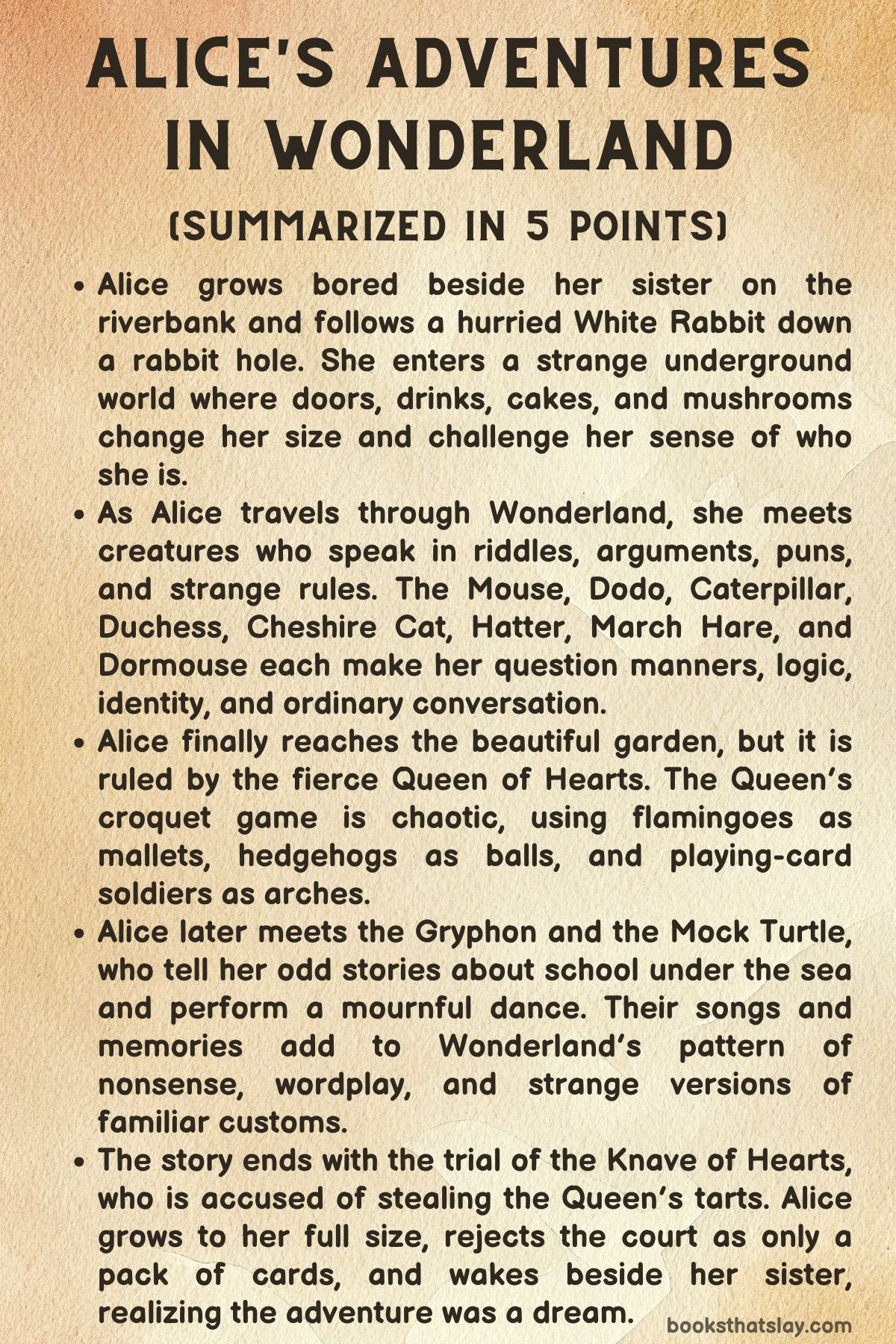
Alice’s Adventures In Wonderland by Lewis Carroll is a classic work of literary nonsense that turns childhood curiosity into a strange, funny, and unpredictable dream adventure. The book follows Alice, a bright and questioning young girl, after she follows a hurried White Rabbit into a world where size, language, rules, and manners keep changing.
Wonderland is filled with talking animals, odd arguments, strange logic, and comic authority figures who often make less sense than the child among them. Beneath its playful surface, Alice’s Adventures In Wonderland explores imagination, identity, growing up, and the confusion of trying to make sense of adult rules. It’s the 1st book in the Alice’s Adventures in Wonderland series.
Summary
The book begins with a short framing poem that explains how the story came to be told. Lewis Carroll recalls a boat trip on a warm afternoon with three young girls who ask him to invent a tale.
They keep urging him on, interrupting, and shaping the mood of the story as he speaks. One of those girls is Alice, and the finished story is later offered to her as a keepsake of childhood, imagination, and shared delight.
The main story begins with Alice sitting beside her sister on a riverbank. Her sister is reading a book, but Alice finds it dull because it has no pictures or conversation.
She is bored, sleepy, and thinking about making a daisy chain when she suddenly sees a White Rabbit run past. At first, this is only mildly surprising, but then the Rabbit speaks anxiously about being late and pulls a watch from its waistcoat pocket.
Alice follows him without hesitation and tumbles down a rabbit hole.
The fall is long and strange. Alice passes shelves, cupboards, maps, and pictures as though the tunnel were part of a house.
She wonders where she will land and whether she might fall through the earth to the other side of the world. At last, she reaches the bottom and follows the White Rabbit into a hall lined with locked doors.
She finds a tiny door leading to a beautiful garden, but she is too large to pass through it. After drinking from a bottle marked “Drink me,” she shrinks until she is small enough for the door, only to realize she has left the key on a table she can no longer reach.
She then eats a cake marked “Eat me,” hoping it will solve the problem.
Instead, Alice grows enormously. Upset by her repeated changes and still unable to enter the garden, she cries until her tears form a large pool.
When the White Rabbit reappears carrying gloves and a fan, he drops them in fright. Alice picks them up and soon begins shrinking again, apparently because of the fan.
She finds herself swimming in the pool of tears she made while she was giant. Other creatures, including a Mouse and several birds, are also caught in the water.
They swim to shore together, where everyone tries to get dry.
The group attempts a very strange race in which everyone runs in no clear order and stops whenever they please. The Dodo declares that all have won, and Alice gives out sweets as prizes.
The Mouse tries to tell Alice a sad story, but she misunderstands and offends it. When Alice mentions her cat Dinah, who is good at catching mice and birds, the animals become frightened and leave.
Alice is left alone again, wishing she had been more careful.
The White Rabbit soon returns, still searching for his gloves and fan. Mistaking Alice for his servant, he orders her to fetch replacements from his house.
Alice obeys and enters the Rabbit’s home, where she finds another bottle and drinks from it. She grows so large that she fills the house, trapping herself inside.
The Rabbit and his helpers try to remove her, even sending a lizard named Bill down the chimney. Alice kicks Bill out, and the Rabbit’s group begins throwing stones at her.
The stones turn into small cakes, which Alice eats. They make her shrink, allowing her to escape.
Now very small, Alice meets a large puppy and is frightened because, from her new size, even play feels dangerous. She escapes and looks for a way to return to a sensible height.
She finds a Caterpillar sitting on a mushroom and smoking a hookah. The Caterpillar asks who she is, but Alice cannot give a confident answer because she has changed so many times.
He questions her, asks her to recite a poem, and treats her confusion with calm superiority. Before leaving, he tells her that one side of the mushroom will make her grow and the other side will make her shrink.
Alice tests the mushroom pieces and grows so tall that her neck rises above the trees. A Pigeon mistakes her for a serpent and accuses her of wanting eggs.
Alice insists she is a little girl, though the Pigeon is not convinced. By carefully nibbling from the mushroom, Alice eventually returns to a more manageable size and continues her search for the garden.
She comes upon a small house and makes herself smaller so she can approach it safely.
Outside the house, Alice sees a Fish-Footman deliver an invitation to a Frog-Footman for the Duchess to play croquet with the Queen. Inside, the house is chaotic.
The Duchess is nursing a baby in a kitchen full of pepper, while a cook throws dishes and stirs soup. A large Cheshire Cat sits nearby, grinning.
The Duchess sings roughly to the baby and then hands it to Alice before leaving for croquet. Alice takes the baby outside, only to discover that it is turning into a pig.
When it runs away, she is relieved.
The Cheshire Cat appears again and speaks to Alice from a tree. She asks where she should go, and the Cat tells her that one way leads to the Hatter and the other to the March Hare.
He says both are mad, and that everyone in Wonderland is mad, including Alice. The Cat disappears and reappears in pieces, leaving Alice unsettled but curious.
She chooses to visit the March Hare.
At the March Hare’s house, Alice finds a tea party with the March Hare, the Hatter, and the Dormouse. Although the table has plenty of space, they claim there is no room.
Their conversation is rude, circular, and full of word games. The Hatter asks why a raven is like a writing desk, but no real answer is given.
They argue about meaning, manners, time, and language. Alice grows annoyed as the discussion keeps turning away from sense.
The Dormouse tells a strange story, but the others interrupt constantly. Finally, Alice leaves in frustration.
She finds a door in a tree, enters it, and returns to the hall of doors. This time, using the key and the mushroom pieces properly, she finally reaches the garden.
In the garden, Alice finds three gardeners shaped like playing cards. They are painting white roses red because they accidentally planted the wrong rosebush and fear the Queen’s anger.
Soon the Queen of Hearts arrives with her court, including the King, the White Rabbit, and the Knave of Hearts. The Queen is quick-tempered and repeatedly orders people to be beheaded.
Alice is invited to play croquet, but the game is absurd. Hedgehogs serve as balls, flamingoes as mallets, and soldiers bend themselves into arches.
Nothing stays still, and no one follows clear rules.
The Cheshire Cat appears during the game, and Alice complains about the Queen’s behavior. The King dislikes the Cat and wants it removed, but this causes a problem because the Cat has appeared only as a head.
The executioner, King, and Queen argue over whether something without a body can be beheaded. By the time they finish arguing, the Cat has vanished.
Alice then meets the Duchess again, who is suddenly friendly. The Duchess keeps turning every remark into a strange moral, which Alice finds tiresome.
The Queen sends the Duchess away and takes Alice to a Gryphon, ordering it to introduce her to the Mock Turtle. The Mock Turtle is mournful and says he was once a real turtle.
He and the Gryphon tell Alice about their school under the sea, filling their memories with puns, odd lessons, and comic misunderstandings. They also describe a dance called the Lobster Quadrille and sing melancholy songs.
Their talk is interrupted by the announcement that a trial is beginning.
Alice returns to the Queen’s court, where the Knave of Hearts is accused of stealing the Queen’s tarts. The King serves as judge, the Queen watches impatiently, and the jury is made up of animals writing nonsense on slates.
The Hatter is called as a witness, but his testimony is confused and useless. The Duchess’s cook is also called, but she refuses to provide helpful evidence.
Meanwhile, Alice begins growing again.
At last, Alice herself is called as a witness. Because she is now large, she accidentally knocks over the jury box and has to put the jurors back.
She says she knows nothing about the tarts. The court then examines a set of verses that the King treats as important evidence, even though they prove nothing clearly.
The Queen demands punishment before a verdict is reached. Alice objects to the unfairness and absurdity of the proceedings.
When the Queen orders Alice’s execution, Alice has grown back to full size and is no longer afraid. She declares that the whole court is nothing but a pack of cards.
The cards fly at her, and Alice wakes to find herself back on the riverbank with her head in her sister’s lap. The attack was only dead leaves falling on her face.
Alice tells her sister about her strange dream and then runs home for tea. Her sister remains by the river, imagining the dream’s characters in the ordinary sounds around her.
She thinks of Alice as one day grown up, perhaps telling children stories of her own and remembering the wonder of childhood through them.
Characters
Alice
Alice is the central character of Alice’s Adventures In Wonderland, and nearly every event is shaped by her curiosity, impatience, confusion, and courage. She begins as a bored child sitting beside her sister, but her decision to follow the White Rabbit shows that she is drawn to the unusual and unwilling to remain passive when something strange captures her attention.
Throughout her journey, Alice keeps trying to understand the world around her using the rules she has learned from school, manners, and common sense. Wonderland constantly defeats those rules, yet Alice does not stop questioning it.
Her repeated changes in size mirror her unstable sense of identity. At times she wonders whether she is still herself or whether she has become someone else entirely.
This makes her more than a simple observer; she is a child trying to define herself in a world where nothing remains steady.
Alice is also notable for her strong moral instincts. She may be confused by Wonderland, but she often recognizes unfairness, rudeness, and nonsense when she sees them.
She objects to the behavior at the tea party, worries about the baby in the Duchess’s kitchen, and challenges the Queen’s unjust courtroom procedure. Even when she is frightened, she is rarely submissive for long.
By the end, she has grown both literally and emotionally. Her final rejection of the Queen and the court shows that she has learned to resist empty authority.
Alice’s innocence remains intact, but it is no longer helpless. She represents childhood imagination, but also the child’s growing ability to question adults, rules, and social customs that make no sense.
The White Rabbit
The White Rabbit is the figure who draws Alice into Wonderland and sets the story in motion. His most striking quality is anxiety.
He is always hurried, worried about time, and afraid of being late. His waistcoat, gloves, watch, and formal behavior make him seem like a parody of a nervous adult servant or court official.
He is not powerful in the way the Queen is powerful, but he is tied to the world of rules, schedules, and social rank. His panic suggests a life controlled by obligation rather than freedom.
To Alice, the White Rabbit is fascinating because he brings together the ordinary and the impossible. A rabbit is familiar, but a rabbit with a watch and a social appointment is absurd.
He gives Alice a reason to enter Wonderland, but he never becomes a guide. In fact, he often misunderstands her, as when he mistakes her for his maid and orders her about.
Later, he appears in the royal court, where he acts as an official figure in the trial. This connects him to Wonderland’s strange systems of authority.
He is not especially cruel, but he is weak, nervous, and eager to obey the structures around him. As a character, he represents the adult world’s obsession with time, duty, and status, all made ridiculous through Carroll’s comic imagination.
The Mouse
The Mouse is one of the first creatures Alice meets after her size begins to change, and it reflects the difficulty of communication in Wonderland. At first, Alice tries to speak politely to it, but she repeatedly offends it by mentioning cats and dogs.
The Mouse is sensitive, formal, and easily wounded. Its reactions show how hard it is for Alice to understand the fears and values of others in this strange world.
What seems harmless to her sounds threatening to the Mouse.
The Mouse also introduces one of the book’s recurring comic habits: turning language into a joke. Its attempt to dry everyone through a “dry” historical lecture makes sense only as a pun, not as practical advice.
Its “long tale” becomes both a story and a visual joke about a tail. The Mouse’s seriousness makes the scene funnier because it treats its own absurd logic as perfectly reasonable.
Yet the Mouse is not merely comic. It also shows how quickly social situations in Wonderland collapse.
Alice wants companionship, but her honest remarks drive others away. The Mouse’s departure leaves her isolated again, reminding the reader that Wonderland’s conversations often create misunderstanding rather than connection.
The Dodo
The Dodo appears during the gathering of wet animals and is best remembered for organizing the caucus race. The character is comic, solemn, and oddly authoritative.
He proposes a race in which everyone runs around without a clear start, finish, direction, or winner. When it ends, he declares that everyone has won and that all must receive prizes.
The race is one of the clearest examples of Carroll’s satire of public procedures that appear organized but are actually meaningless.
The Dodo’s authority comes not from wisdom but from confidence. He speaks as though his decisions are official, and the others accept them.
This reflects how easily groups can treat nonsense as order when someone presents it formally enough. The Dodo may also be read as a playful self-reference to Carroll, whose real name, Charles Dodgson, has often been associated with the character.
Whether or not one focuses on that connection, the Dodo remains important because he shows how Wonderland imitates adult institutions in childish, circular, and comic forms. His race has the language of fairness and competition, but none of the structure that would make those ideas meaningful.
The Caterpillar
The Caterpillar is calm, detached, and difficult. He sits on a mushroom smoking a hookah and questions Alice in a slow, superior manner.
His first question, asking who she is, goes directly to one of Alice’s deepest anxieties. She cannot answer confidently because her body and sense of self have changed repeatedly.
The Caterpillar does not comfort her. Instead, he demands clarity from a child who is already struggling with confusion.
His manner can seem rude, but he also forces Alice to confront the question of identity more directly than any other character.
He is important because he gives Alice practical knowledge, even though he does so without warmth. His explanation that one side of the mushroom makes her grow and the other makes her shrink gives Alice a tool she can use to manage Wonderland.
Until then, changes happen to her; after meeting him, she gains some control over them. The Caterpillar therefore represents a strange kind of teacher.
He is not nurturing, and he does not explain more than necessary, but he gives Alice knowledge through challenge. His presence also suggests transformation, since caterpillars naturally become butterflies.
In Alice’s case, the transformation is psychological rather than physical: she becomes more capable of navigating uncertainty.
The Pigeon
The Pigeon appears when Alice’s neck has grown so long that she rises above the trees. It mistakes her for a serpent and accuses her of being a threat to eggs.
The scene is comic because Alice insists she is a little girl, while the Pigeon judges her only by appearance and behavior. From the Pigeon’s point of view, a long-necked creature near eggs must be dangerous, no matter what it claims to be.
The Pigeon’s role is brief but meaningful. It shows how identity can be determined by others, especially when outward appearance changes.
Alice knows who she is, or at least who she is trying to remain, but the Pigeon refuses to accept her self-description. This deepens Alice’s confusion about what makes a person themselves.
Is she still Alice if she looks like a serpent? The Pigeon also represents defensive fear.
It is not villainous; it is protecting its eggs. Yet its fear makes it unreasonable.
Through this encounter, Carroll turns a simple comic misunderstanding into a reflection on appearance, selfhood, and judgment.
The Duchess
The Duchess is one of Wonderland’s most unsettling adult figures. When Alice first meets her, she is harsh, careless, and surrounded by chaos.
Her kitchen is filled with pepper, the cook throws objects around the room, the baby cries and sneezes, and the Duchess sings a rough lullaby while treating the child with little tenderness. She seems to belong to a world where domestic order has broken down completely.
Alice, by contrast, is alarmed by the danger to the baby and tries to act responsibly.
Later, the Duchess appears in a very different mood, speaking affectionately to Alice and turning nearly every statement into a moral. This shift makes her seem unstable and artificial.
Her moralizing is not wise; it is mechanical and often absurd. She represents a kind of adult habit in which people attach lessons to everything whether or not those lessons make sense.
The Duchess is therefore both comic and disturbing. She exposes the failure of adult care, the emptiness of forced moral instruction, and the unpredictability of authority.
In a world where grown-up figures should provide guidance, she provides only noise, danger, and strange sayings.
The Cook
The Cook is a chaotic figure who turns the Duchess’s kitchen into a place of violence and discomfort. She stands over a soup pot in a room full of pepper and throws dishes and utensils with no concern for whom she might hit.
Her behavior is extreme, but she is treated by the others as part of the household’s normal atmosphere. This makes the scene more absurd and more unsettling.
The Cook suggests a world where aggression has become routine.
Her later appearance as a witness in the trial continues this pattern of unhelpfulness. She refuses to give meaningful testimony and offers only a strange remark about tarts and pepper.
Like many characters in Wonderland, she occupies an official role for a moment but does not fulfill it in any sensible way. The Cook’s obsession with pepper also connects her to irritability and disorder.
Pepper makes everyone sneeze and contributes to the Duchess’s bad temper, creating an environment where discomfort shapes behavior. As a character, the Cook embodies domestic chaos, blunt refusal, and the breakdown of ordinary responsibility.
The Cheshire Cat
The Cheshire Cat is one of the most memorable figures in Alice’s Adventures In Wonderland because of his grin, his calm intelligence, and his ability to appear and disappear at will. Unlike many Wonderland characters, he does not seem trapped by the world’s absurdity.
He understands it and comments on it with amused detachment. When Alice asks for directions, he tells her that it does not matter where she goes if she has no particular destination.
This is both nonsense and sense at the same time, which makes him one of the book’s sharpest voices.
The Cat also introduces the idea that everyone in Wonderland is mad, including Alice. His madness is different from the frantic behavior of the Rabbit or the rude logic of the tea party.
He is controlled, witty, and almost philosophical. His disappearing body, especially when only his head remains, turns identity into a visual joke.
The argument over whether a head without a body can be beheaded shows how Wonderland’s authorities become helpless when faced with a problem their rules cannot handle. The Cheshire Cat often acts as a guide, but he is not comforting.
He gives Alice insight without giving her safety. His role is to expose the strange logic of Wonderland while remaining free from its consequences.
The March Hare
The March Hare is one of the hosts of the mad tea party, and his behavior is marked by rudeness, contradiction, and restless absurdity. He invites Alice into a social setting that should be welcoming, yet immediately joins the others in claiming there is no room at a mostly empty table.
This contradiction sets the tone for the entire tea party. The March Hare appears to understand hospitality only as a form without substance.
He offers wine when there is none and participates in conversations that move in circles rather than toward meaning.
His madness is social and conversational. He does not threaten Alice physically, but he helps create an atmosphere where ordinary politeness is constantly overturned.
He argues over words, time, and etiquette, making Alice feel both excluded and provoked. The March Hare represents a version of adult company in which rules of manners exist but are used badly.
Instead of making people comfortable, they become tools for teasing, contradiction, and confusion. His character helps turn the tea party into a comic version of social life where conversation has energy but no generosity.
The Hatter
The Hatter is clever, rude, and trapped in a broken relationship with Time. He is one of the most famous characters in the story because his speech turns logic into a game.
His riddle about the raven and the writing desk has no clear answer, and that lack of resolution is central to his character. He enjoys questions and distinctions, but not in order to find truth.
For him, language is a toy, an obstacle, and sometimes a weapon.
The Hatter’s conflict with Time explains why the tea party never moves beyond six o’clock. This detail gives his comic madness a sadder edge.
He is stuck in endless teatime, repeating the same rituals without progress. The table is long, but the characters only move around it instead of leaving it behind.
His later appearance at the trial shows that he remains anxious and disordered outside the tea party as well. As a witness, he cannot provide useful evidence and seems more concerned with his tea than justice.
The Hatter represents the collapse of rational conversation and the absurdity of rituals that continue after their meaning has disappeared.
The Dormouse
The Dormouse is sleepy, passive, and frequently mistreated by the March Hare and the Hatter. At the tea party, he is squeezed between them, interrupted while speaking, and sometimes used almost like an object.
His drowsiness makes him seem less aggressive than the others, but his stories are just as strange. He contributes to the atmosphere of nonsense through his tale of three sisters living in a treacle well, a story that grows more absurd as Alice questions it.
The Dormouse’s role is important because he shows how Wonderland’s characters often accept absurd conditions without resistance. He is half-awake, which gives the tea party a dreamlike quality.
He speaks, sleeps, wakes, and speaks again, as though conversation itself does not require full consciousness. His treatment also reveals the casual cruelty of the Hatter and March Hare, who interrupt and handle him without concern.
The Dormouse is comic, but he is also a sign of exhaustion and passivity. In a world full of noise, he is the character most associated with drifting through events rather than shaping them.
The Queen of Hearts
The Queen of Hearts is the loudest and most openly tyrannical authority figure in Wonderland. Her favorite command is execution, and she orders beheadings for the smallest offenses.
Yet her violence is often more performative than effective. Many characters are sentenced, but the actual carrying out of punishment is uncertain or avoided.
This makes her both frightening and ridiculous. She has the language of absolute power, but her world is too unstable for that power to function properly.
The Queen represents arbitrary authority. She does not judge based on fairness, reason, or evidence.
She reacts instantly, loudly, and angrily. Her croquet game reflects her rule: the equipment is alive, the rules are unclear, and everyone is afraid.
The game cannot be played properly because the Queen’s presence turns order into panic. In the trial, she demands sentencing before the verdict, showing complete contempt for justice.
Alice’s final rejection of the Queen is one of the story’s most important moments. Once Alice recognizes the Queen and her court as merely a pack of cards, their power collapses.
The Queen is intimidating only while Alice accepts the illusion of her authority.
The King of Hearts
The King of Hearts is a weaker and more foolish counterpart to the Queen. He holds official positions, especially during the trial, but he lacks true command.
While the Queen shouts for executions, the King often tries to soften matters or apply rules, though he does so clumsily. He represents legal and royal authority stripped of wisdom.
His judgments are shallow, and his attempts at interpretation often make the situation more absurd.
In the trial, the King presides as judge, but his handling of evidence is laughably poor. He treats vague verses as proof and tries to make sense of them in whatever way supports a convenient conclusion.
His authority depends on titles and ceremonies rather than intelligence. Compared with the Queen, he is less terrifying, but he is still part of the same unjust system.
His weakness does not make him harmless, because foolish authority can still support unfair outcomes. The King shows that institutions can be absurd not only when they are cruel, but also when they are incompetent.
The Knave of Hearts
The Knave of Hearts is the accused figure in the trial over the stolen tarts. He is less developed than many other characters, but his role is important because he becomes the center of Wonderland’s parody of justice.
The court treats his guilt as something to be assumed rather than proven. The evidence against him is weak, the witnesses are useless, and the Queen wants punishment before a verdict.
The Knave’s relative silence makes him seem less like an individual criminal and more like a symbol of anyone caught inside an unfair system.
Because the Knave does not dominate the scene, attention shifts to the absurdity of the court itself. His function is to reveal how little Wonderland cares about truth.
The trial is filled with ceremony, but its procedures are empty. The Knave’s denial that he wrote the verses matters less to the King and Queen than their desire to force meaning onto them.
Through him, Carroll shows that justice can become nonsense when authority decides the result before reason has any part in the process.
The Gryphon
The Gryphon is energetic, practical, and somewhat impatient. As a mythical creature, he belongs naturally to Wonderland’s impossible world, but he often seems less foolish than the characters around him.
He takes Alice to the Mock Turtle and helps explain the Mock Turtle’s sorrow, saying that it is imaginary. This makes the Gryphon a kind of interpreter, though not always a gentle one.
He is brisk rather than sentimental.
The Gryphon’s main role is to guide Alice through the Mock Turtle’s stories and the Lobster Quadrille. He participates in the nonsense, but he also keeps events moving.
His attitude toward the Mock Turtle suggests that he sees through exaggerated emotion and theatrical sadness. Yet he still joins in the songs, dances, and memories, which means he is not outside Wonderland’s absurdity.
He accepts its strangeness as normal. The Gryphon is important because he bridges movement and explanation.
He leads Alice from one situation to another while showing that even the more sensible figures in Wonderland remain part of its comic disorder.
The Mock Turtle
The Mock Turtle is melancholy, theatrical, and deeply attached to his own strange memories. He claims to be sad because he was once a real turtle, a statement that is absurd but treated with great seriousness.
His sorrow is exaggerated, and the Gryphon suggests that it is not based on real suffering. Still, the Mock Turtle speaks with such heavy emotion that he becomes a parody of sentimental storytelling.
His memories of school under the sea are filled with puns, distorted subjects, and comic versions of education. Lessons “lessen,” and ordinary school topics become strange underwater jokes.
Through him, Carroll mocks rigid education, especially the way lessons can become more about words than understanding. The Mock Turtle’s sadness also adds variety to Wonderland’s madness.
Unlike the Queen’s anger or the Hatter’s argumentative energy, his defining quality is self-pity. Yet his grief is so stylized that it becomes comic rather than tragic.
He represents the absurd side of nostalgia, especially when memory turns the past into a performance.
Bill the Lizard
Bill the Lizard is a minor character, but he appears at key comic moments. He is first sent down the chimney to remove Alice from the White Rabbit’s house after she has grown too large.
Alice kicks him out, and he flies into the air, becoming part of the scene’s slapstick humor. Later, he appears as one of the jurors at the trial and is accidentally knocked over when Alice grows.
Bill’s importance lies in his vulnerability. He is pushed into danger by others and seems to have little control over what happens to him.
In the Rabbit’s house, he is used as a tool by stronger personalities. In the courtroom, he becomes part of the official jury, but he is no wiser or more effective than anyone else.
Bill represents the small, ordinary participant caught in systems of chaos. He is not powerful enough to direct events, but he is repeatedly affected by them.
His presence adds humor while also showing how Wonderland’s absurdity often falls hardest on the least assertive characters.
Alice’s Sister
Alice’s sister frames the story from the ordinary world. At the beginning, she sits reading beside Alice, representing the calm, adult-adjacent world from which Alice’s dream departs.
Her book seems dull to Alice because it lacks pictures and conversation, which helps establish the difference between conventional reading and Alice’s imaginative experience. The sister is not part of Wonderland, but she is essential to the story’s closing mood.
After Alice wakes and runs home, her sister remains by the river and reflects on the dream. She imagines the sounds of Wonderland returning to ordinary rural noises and thinks of Alice as an adult who may one day tell stories to children.
Through her, the ending becomes more reflective. She understands the value of Alice’s imagination and sees childhood as something precious that memory can preserve.
Alice’s sister represents the adult awareness that childhood wonder cannot last unchanged, but can be remembered, retold, and cherished.
Dinah
Dinah, Alice’s cat, never appears directly in Wonderland, but she has a strong presence in Alice’s thoughts and conversation. Alice misses her and speaks of her with affection, but these comments often frighten the animals she meets.
To Alice, Dinah is a beloved pet; to mice and birds, she is a predator. This difference creates several misunderstandings and shows Alice’s limited awareness of other creatures’ perspectives.
Dinah’s role is important because she connects Alice to home. Mentioning Dinah reminds readers that Alice comes from an ordinary world of pets, lessons, manners, and family.
At the same time, Dinah becomes dangerous in Wonderland through reputation alone. Alice’s innocent affection sounds threatening in a place populated by animals who might become Dinah’s prey.
Dinah therefore reveals one of Alice’s recurring challenges: learning that her own viewpoint is not universal. Even love and pride can sound careless when spoken without attention to the listener.
Themes
Identity and Change
Alice’s changing size is the clearest outward sign of her inner uncertainty. She grows, shrinks, stretches, and returns to different proportions so often that she begins to question whether she is still herself.
This is not only a fantasy device; it reflects the unstable experience of childhood, when the body, mind, and social role of a child are constantly shifting. Alice tries to prove her identity through memory and recitation, but even familiar school lessons come out wrong.
The failure of memorized knowledge makes her feel less secure, because she has been taught to understand herself partly through what she knows and can repeat. Wonderland challenges that foundation at every turn.
The question “Who are you?” becomes difficult because Alice cannot rely on fixed facts. Her body does not stay the same, her knowledge becomes unreliable, and other creatures misidentify her.
The Pigeon sees her as a serpent, the White Rabbit sees her as a servant, and the court sees her as a witness before she understands what is happening. Yet Alice slowly learns that identity is not only a matter of size, label, or outside judgment.
By the end of Alice’s Adventures In Wonderland, she speaks with more confidence because she has begun to trust her own perception. Her growth is not simply physical; it is the development of self-possession in a world that keeps trying to define her incorrectly.
Language, Logic, and Nonsense
Language in the story often follows grammar while abandoning sense. Characters speak in complete sentences, ask questions, recite poems, and offer explanations, yet their words frequently lead nowhere.
This creates a comic world where language looks orderly on the surface but fails as a tool for clear understanding. The Hatter’s riddle, the Mouse’s tale, the Duchess’s morals, and the courtroom verses all show how words can be arranged into forms that suggest meaning without actually providing it.
Carroll uses this pattern to make readers laugh, but he also draws attention to how fragile communication can be.
Alice often assumes that words should behave properly. If someone asks a riddle, she expects an answer.
If a witness gives evidence, she expects it to matter. If a moral is offered, she expects it to teach something.
Wonderland repeatedly frustrates these expectations. Conversations become arguments over phrasing, and small differences in wording become more important than truth.
The tea party is especially important because it treats language as a set of traps. Saying what one means is not the same as meaning what one says, and ordinary expressions are pulled apart until they seem strange.
This theme shows Carroll’s fascination with the gap between words and meaning. It also shows Alice learning that not every statement deserves respect simply because it sounds formal, clever, or authoritative.
Authority, Rules, and Absurd Power
Wonderland is full of authority figures, but very few of them deserve authority. The White Rabbit gives orders because he mistakes Alice for a servant.
The Caterpillar questions Alice with calm superiority but offers little sympathy. The Duchess moralizes without wisdom.
The Queen threatens executions for almost everything. The King presides over a trial without understanding justice.
These figures imitate adult power, but Carroll strips that power of dignity by showing how often it depends on noise, habit, costume, or title rather than reason.
The croquet game and the trial are the strongest examples of rules that have lost their purpose. A game should have structure, but the Queen’s croquet match cannot function because the equipment is alive, the players are frightened, and the Queen’s temper overwhelms everything.
A trial should seek truth, but the Knave’s trial treats evidence as an afterthought and punishment as a foregone conclusion. In both cases, public order becomes performance.
People act as though rules exist, but the rules do not protect fairness or create meaning.
Alice’s development can be measured by how she responds to authority. Early in the story, she obeys or worries about offending others.
Later, she questions bad manners, unfair commands, and false logic. Her final dismissal of the court shows that power can collapse once it is recognized as empty.
The theme is not that all rules are bad, but that rules without sense or justice are only a costume for absurdity.
Childhood, Imagination, and the Adult World
The story presents childhood imagination as free, bold, and strange, but it does not make childhood simple. Alice’s dream is playful, yet it is also filled with anxiety, frustration, and loneliness.
She wants to explore, but she also wants order. She enjoys curiosity, but she dislikes being insulted, confused, or treated unfairly.
This balance makes the story’s vision of childhood unusually rich. Imagination is not shown as an escape into pure comfort.
It is a place where fears, lessons, social rules, and desires are rearranged into surprising forms.
Many parts of Wonderland seem like distorted versions of adult life. There are formal invitations, lessons, games, trials, servants, royalty, etiquette, and moral instruction, but nearly all of them are absurd.
From Alice’s point of view, the adult world may already seem full of rules that are difficult to understand. Wonderland exaggerates that experience until manners become rudeness, education becomes wordplay, justice becomes nonsense, and authority becomes shouting.
In this way, the dream allows the reader to see adult customs through a child’s skeptical eyes.
The ending gives the theme a gentle frame. Alice wakes and returns to ordinary life, but her sister recognizes the beauty of the dream and imagines Alice preserving such stories into adulthood.
Childhood imagination may pass, but storytelling can keep its energy alive. The book treats imagination as one of childhood’s great powers: a way to question the world before accepting it.