All My Rage Summary, Characters and Themes
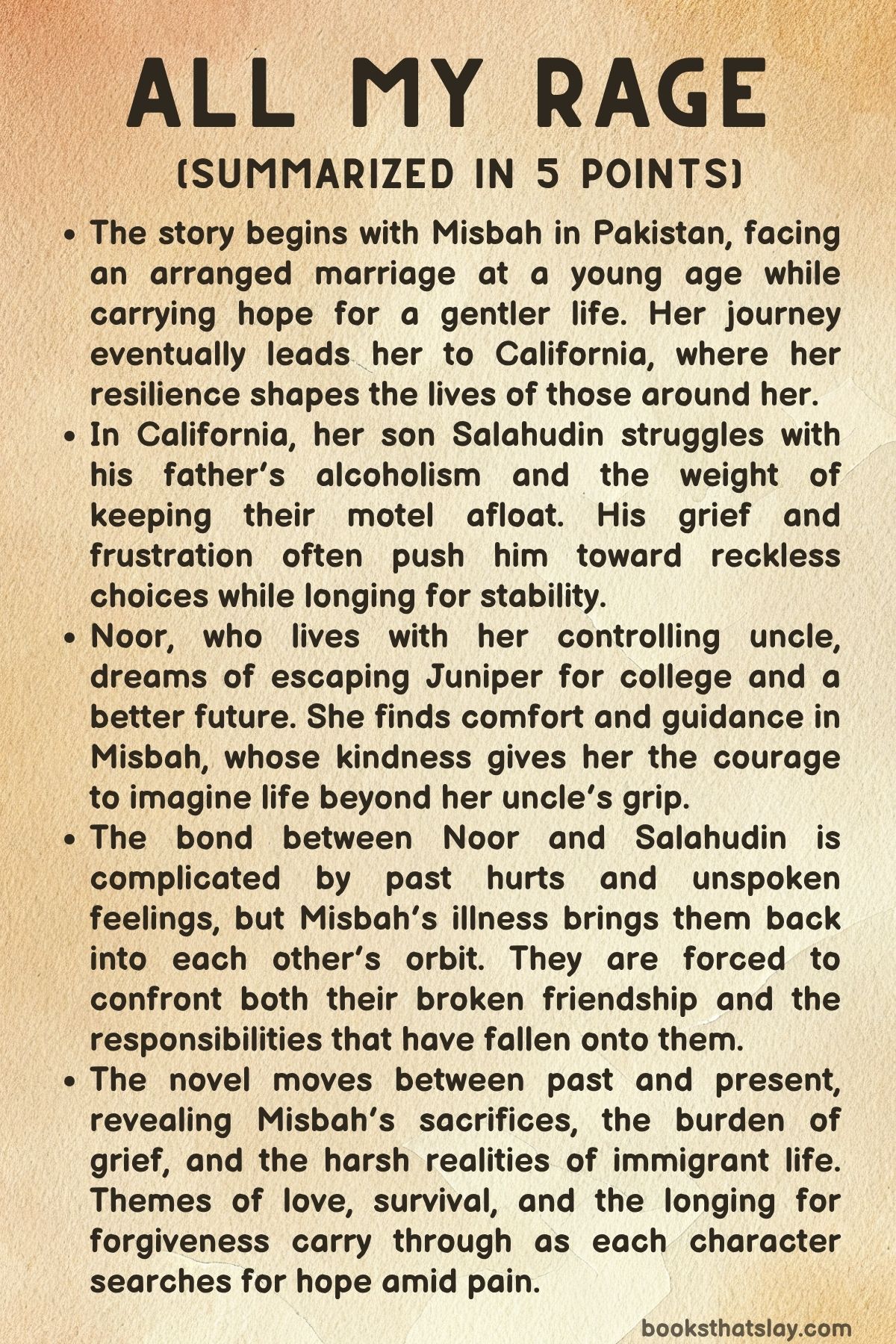
All My Rage by Sabaa Tahir is a powerful contemporary novel that spans continents and generations. It tells the story of Misbah, a woman forced into an arranged marriage in Lahore, who dreams of building a new life with her husband in America.
Years later, her son Salahudin and his best friend Noor struggle with grief, identity, and survival in the small desert town of Juniper, California. The book explores themes of love, forgiveness, and resilience against overwhelming odds, as the characters grapple with illness, abuse, addiction, and the weight of expectations. Ultimately, it is a story of brokenness and the healing power of connection.
Summary
The novel begins in Lahore, where Misbah, a young woman on the cusp of marriage, faces uncertainty and fear. Encouraged by her father, she agrees to marry Toufiq, a man who is kind yet carries unspoken sorrow.
Her hopes for a gentle life carry her far away from Pakistan to California, where she and Toufiq run a rundown motel called Clouds’ Rest. Though the work is hard and Toufiq eventually falls into alcoholism, Misbah devotes herself to her family and becomes a guiding light for both her son Salahudin and Noor, the orphaned niece of Toufiq’s brother.
In the present, Salahudin, known as Sal, struggles under the weight of his mother’s failing health and his father’s unreliability. His father, Toufiq, drinks heavily, neglects responsibilities, and lashes out in moments of weakness.
Sal feels trapped, desperate to keep the motel afloat and care for his mother. His childhood bond with Noor has fractured after a painful falling-out, leaving him isolated.
Noor, meanwhile, lives under the control of her uncle, Chachu, who saved her during an earthquake in Pakistan but now dominates her life with cruelty and suspicion. She dreams of escaping Juniper through college, secretly applying to universities despite his attempts to hold her back.
When Misbah collapses due to kidney failure, Noor rushes to her side, showing her enduring bond with the woman who treated her like a daughter. Misbah’s death devastates both Sal and Noor, drawing them reluctantly back into each other’s lives.
Sal is left with the crushing burden of the motel’s debt and a father who drinks away their resources. Noor grieves while hiding her dreams from her uncle, whose anger erupts when he learns about her applications.
Despite the abuse she endures, she clings to Misbah’s words urging her to seek more than the confines of Juniper.
Sal and Noor rekindle their connection in the aftermath of loss, supporting one another through grief and hardship. Sal, desperate for money to save the motel, turns to dealing drugs, a decision that weighs heavily on him when one of his classmates overdoses.
Noor faces humiliation at school when a classmate exposes her immigration status and mocks her heritage, leading to a violent confrontation that results in her suspension. Both teenagers find themselves cornered by circumstances they cannot fully control, yet their renewed friendship offers moments of solace and strength.
Their struggles escalate as Noor suffers brutal abuse from her uncle, finally fighting back and escaping. Sal takes her away for a brief moment of freedom, where they share food, stories, and a fragile intimacy that offers hope amid despair.
But danger looms when the police stop them, and Sal, panicking, hides drugs in Noor’s possession. This act leads to devastating consequences when both face legal charges.
Noor, already traumatized, must defend herself in court while Sal faces the truth of his actions.
Throughout the trial, Noor shows quiet resilience, refusing to name her abuser but standing firm against accusations. In a moment of selflessness, Sal takes full responsibility, confessing to dealing and to implicating Noor without her knowledge.
His honesty clears her name but seals his own fate. He is sentenced to prison, where he begins a slow process of reflection and healing.
Noor, freed from charges, starts a new life at UCLA, though her uncle continues to cast a shadow with his violence. She seeks therapy and finds strength in her independence, all while quietly sending Sal books in prison, a silent act of connection.
In prison, Sal begins to read, write, and confront his past, slowly piecing together meaning from the fragments of his family’s story. Noor, though trying to move forward, cannot let go of him.
Both continue to grow apart yet remain bound by love, pain, and the memory of Misbah’s care. When Sal is released early for good behavior, he visits his mother’s grave, where Noor finds him.
They reconcile, acknowledging the mistakes, love, and forgiveness that shaped their journey.
The novel closes with the echo of Misbah’s presence, her blessing lingering over Sal and Noor as they choose each other again. It is a story of young people carrying the weight of trauma, yet still reaching for light.
Across continents and generations, All My Rage reveals how forgiveness, resilience, and the bonds of chosen family can bring healing, even in the aftermath of loss.
Characters
Misbah
Misbah is the emotional core of All My Rage, representing resilience, sacrifice, and love in the face of unrelenting hardship. From her early days in Lahore, she is depicted as fearful yet hopeful, seeking a gentle life despite the constraints of an arranged marriage.
Her compassion and sense of duty define her, whether in comforting a desperate mother at her motel or nurturing Noor like her own daughter. Misbah’s strength lies in her ability to give endlessly, even when she herself is fragile and sick.
However, her life is marked by constant self-sacrifice—skipping her dialysis to save money, carrying her husband’s failings, and always prioritizing others over her own needs. The fortune teller’s prediction that she would “fail” her children haunts her, but her final word, “forgive,” reflects her lifelong desire for reconciliation and healing.
Misbah is both tragic and inspiring, embodying maternal love that transcends death and continues to guide Noor and Salahudin.
Salahudin (Sal)
Sal is a deeply conflicted character, burdened by grief, guilt, and overwhelming responsibility. As Misbah’s son, he shoulders adult responsibilities prematurely—paying bills, managing the motel, and covering for his father’s alcoholism.
His relationship with Toufiq is fractured, characterized by resentment and protectiveness in equal measure. Sal’s choices reflect his desperation; his descent into drug dealing is not out of malice but a misguided attempt to save Clouds’ Rest and preserve his mother’s dream.
His guilt over Ashlee’s overdose, his estrangement from Noor, and his hidden childhood trauma leave him broken yet yearning for redemption. Prison, paradoxically, becomes a place of clarity for him—an opportunity to accept his mistakes, reconnect with his mother’s memory, and find peace in Noor’s steadfast support.
Ultimately, Sal is a character defined by survival, but also by his gradual understanding that forgiveness and love are more sustaining than self-destruction.
Noor
Noor is portrayed as ambitious, intelligent, and quietly fierce, but also deeply wounded by her circumstances. Orphaned after the Pakistan earthquake and raised by her abusive uncle, she grows up under constant control and suppression.
Her uncle denies her opportunities, isolates her, and inflicts physical and emotional abuse, yet Noor clings to the hope of escape through education. Misbah becomes her mother figure, nurturing her dreams and giving her the love her uncle withholds.
Noor’s journey is one of resilience against systemic oppression—racial prejudice at school, misogyny and cruelty at home, and financial insecurity. Her relationship with Sal is central to her growth: once betrayed by him, she gradually finds her way back into trust and love, though not without conflict.
Her decision to resist the plea deal and fight for her future reflects her courage. By the end, Noor emerges as someone scarred yet unbroken, learning to embrace therapy, healing, and the possibility of a future shaped by her own choices.
Toufiq (Abu)
Toufiq is one of the most complex and tragic figures in the novel. Once gentle and full of dreams, his life becomes consumed by grief, guilt, and alcoholism.
His inability to cope with past traumas—including the assault on young Salahudin and Misbah’s illness—pushes him into cycles of self-destruction. For much of the story, he is absent as a father, leaving Sal to carry responsibilities that should have been his.
Yet beneath his failures lies a man still capable of tenderness; his small acts, like comforting Misbah after the theft at the motel, reveal his heart. His attempt at sobriety, with the help of Imam Shafiq and Janice, highlights his struggle to rebuild some semblance of dignity.
Toufiq’s character is not about redemption in a grand sense but about small, broken steps toward accountability and remembrance. His grief for Misbah is endless, but his later willingness to sell the motel and reconnect with Sal hints at a man trying, however imperfectly, to heal.
Riaz (Chachu)
Riaz, Noor’s uncle, embodies control, hypocrisy, and violence. He saved Noor from the earthquake, but his “rescue” becomes a lifelong justification for abuse and domination.
His liquor store becomes both Noor’s prison and a symbol of his authority. Riaz’s cruelty is not limited to emotional suppression; he inflicts physical abuse and deliberately sabotages Noor’s future by attempting to block her college applications.
His manipulation extends to religious and cultural shaming, weaponizing faith and family honor to silence her. Unlike Toufiq, whose failures are tied to grief and weakness, Riaz is driven by malice and a desire for control.
His eventual exposure and arrest for hurting Brooke reveal his hypocrisy, though the justice he faces is incomplete. He stands as the clearest antagonist in Noor’s life, a figure who represents the suffocating forces of patriarchy and abuse that she must escape to reclaim her agency.
Ashlee
Ashlee is a minor yet significant character, serving as both a reflection of Sal’s mistakes and a mirror to his internal struggles. Their relationship is shallow, rooted in distraction rather than true connection, and her overdose becomes a turning point for Sal.
Ashlee represents the dangers of Sal’s choices—his involvement in drug dealing is no longer abstract when her life is endangered. Though she survives, the incident shatters Sal, making him confront the moral weight of his actions.
Her presence in the novel underscores themes of denial, fragility, and the ripple effects of desperation.
Brooke
Brooke, Riaz’s wife, is a quiet but crucial presence in Noor’s life. Though initially distant, she becomes a subtle ally, offering Noor small acts of kindness and cover when she is punished or suspended.
Brooke herself lives under Riaz’s control, embodying the silent suffering of women in abusive households. Yet her eventual act of reporting Riaz for violence reveals her strength.
Brooke’s role highlights the quiet, often overlooked forms of resistance and solidarity among women trapped in oppressive circumstances.
Jamie Jensen
Jamie serves as Noor’s foil, embodying privilege, entitlement, and casual cruelty. Her repeated mispronunciation of Noor’s name and racial taunts reflect the everyday racism Noor faces.
Jamie’s exposure of Noor’s expired green card and public humiliation of her are acts of violence cloaked in elitism. Yet her downfall, through a viral video that costs her Princeton acceptance, reveals the fragility of her supposed superiority.
Jamie is important not for her depth but for the way she represents systemic inequities and the prejudices Noor must confront in her journey.
Themes
Family and Generational Struggles
The story of All My Rage highlights the ways in which families carry both love and pain across generations. Misbah’s arranged marriage in Pakistan sets the stage for a life where duty and sacrifice outweigh personal choice, yet her nurturing presence in California provides the foundation for Noor and Sal to survive their hardships.
The fragility of family bonds is evident in Toufiq’s descent into alcoholism after trauma, which isolates him from both his wife and his son. Sal is forced into adulthood prematurely, becoming the caretaker in a home where the parent fails him, while Noor lives in a household ruled by her uncle’s oppressive authority.
Family becomes both a source of strength and a source of deep wounds, as traditions and expectations weigh heavily on young lives. At the same time, the story suggests that chosen families—like Noor’s bond with Misbah—can be more healing than blood ties, showing that resilience often grows from love that transcends obligation.
The novel critiques the silence and shame that can fracture families, while also illuminating the possibility of reconciliation and forgiveness even when the past cannot be erased.
Grief and Loss
The death of Misbah shatters the central characters, yet it also binds them more tightly to one another. Grief in All My Rage is not portrayed as a single moment of mourning but as an ongoing, suffocating presence that shapes choices and identities.
Sal is haunted by his inability to save his mother and channels his despair into reckless decisions like drug dealing, convincing himself that sacrificing his own integrity might keep her dream of the motel alive. Noor finds her grief compounded by isolation, as Misbah’s death leaves her without the maternal figure who protected her against the cruelty of her uncle.
The text portrays grief as layered—there is grief for what is lost, grief for what could have been, and grief for the parts of oneself that die along with loved ones. Yet grief is not solely destructive; it becomes a force that reorients the characters toward their deepest desires and moral reckoning.
By the end, grief has transformed into a quiet form of acceptance, one that does not erase pain but instead integrates it into the act of survival and remembrance.
Identity, Belonging, and Cultural Displacement
For both Noor and Sal, the question of identity is a constant struggle, rooted in being Pakistani Muslim teenagers in a small American town. Their cultural heritage is a source of pride but also a source of alienation when classmates mock their names or question their legitimacy as Americans.
Noor’s undocumented status becomes a weapon used against her by peers and even her uncle, placing her in constant fear of exposure and exclusion. Sal, meanwhile, wrestles with carrying the dual weight of being his parents’ son while also navigating the expectations of American adolescence.
Misbah’s memories of Lahore remind readers that immigration is not just a shift in geography but also a loss of familiarity, culture, and community. The motel becomes a symbol of both displacement and belonging, a place where immigrant stories intersect, where survival is negotiated day after day.
Ultimately, the novel presents identity as something fractured yet resilient, a negotiation between the past and the present, between the pressure to assimilate and the longing to remain connected to one’s roots.
Abuse, Silence, and the Struggle for Voice
The violence Noor endures at the hands of her uncle underscores how abuse thrives in secrecy and silence. Misbah suspects Noor is suffering but feels powerless to act, a hesitation that later weighs heavily on her conscience.
Noor herself internalizes the cycle of silence, believing that speaking out would make her vulnerable to losing the little security she has. The novel shows how abusive systems rely not only on physical power but on cultural, social, and economic dynamics that keep victims trapped.
Sal, too, carries the buried trauma of childhood assault, a memory so repressed that it lingers as an absence in his psyche. Both characters reflect the long shadow abuse casts over identity and self-worth, yet their eventual acts of resistance—Noor leaving her uncle’s house, Sal confessing in court—reclaim their voices and mark turning points in their journeys.
All My Rage insists that while silence allows abuse to fester, breaking it is both liberating and profoundly difficult, requiring courage that comes at immense cost.
Hope, Forgiveness, and the Possibility of Renewal
Even in its darkest moments, the novel is laced with threads of hope that keep its characters moving forward. Misbah’s last word—“forgive”—acts as both a burden and a gift, pushing Noor and Sal to confront not only the wrongs done to them but also the wrongs they have done to others.
Forgiveness here is not presented as easy or immediate; it is a process of wrestling with betrayal, resentment, and grief before finally reaching a place where compassion can break through. Noor’s eventual freedom to attend UCLA, and Sal’s acceptance of responsibility even at the cost of imprisonment, represent acts of renewal where their futures are no longer dictated by the failures of the past.
Forgiveness becomes the soil where hope can grow, allowing love to reemerge between Noor and Sal, and even between Sal and his father as they begin to rebuild what was broken. The story closes not with perfection but with possibility—the chance for healing, for a shared future, and for the lives of two young people to finally unfold on their own terms.