All Things Bright and Beautiful Summary and Analysis
All Things Bright and Beautiful is James Herriot’s warm, comic, and observant account of life as a country veterinarian in the Yorkshire Dales. Told through the eyes of Jim Herriot, the book follows his early married life with Helen, his demanding work with farm animals and pets, and his friendships with the unpredictable Farnon brothers.
Rather than a single dramatic storyline, it offers a series of vivid episodes filled with difficult births, odd clients, loyal animals, professional doubts, and quiet gratitude. The book is about work, love, community, and the daily surprises that make an ordinary life feel rich.
Summary
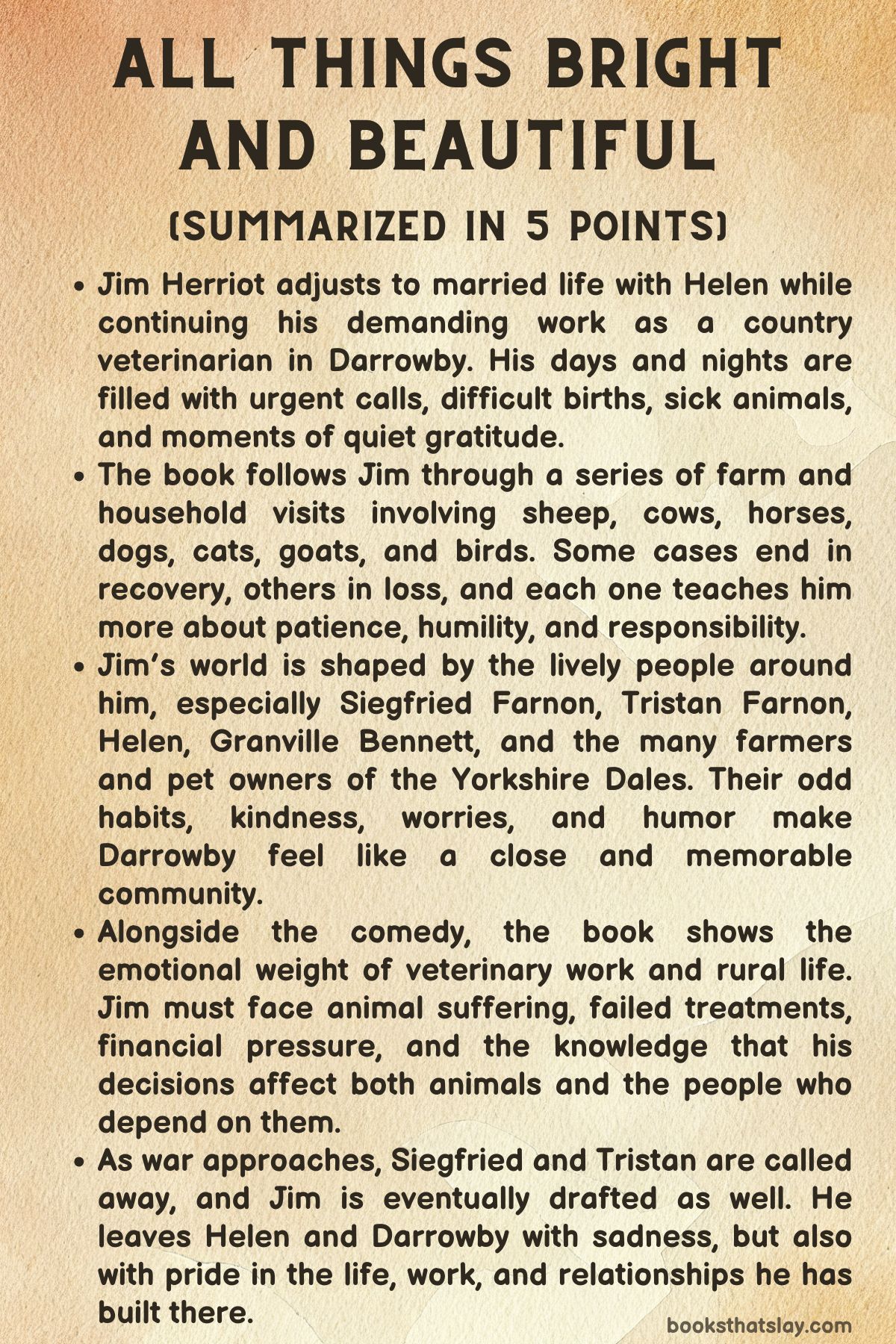
All Things Bright and Beautiful follows James “Jim” Herriot as he settles into married life with Helen while continuing his demanding work as a country vet in Darrowby, a town in the Yorkshire Dales. The book opens with Jim feeling grateful for his warm bed, his wife, and the home they now share at Skeldale House.
That comfort is quickly interrupted by the realities of his profession when a late-night call sends him into the freezing dark to help a farmer with a difficult lambing. The farmer is drunk and noisy, and Jim is tired and annoyed, but the successful delivery of the lambs restores his sense of purpose.
Jim and Helen live above the veterinary surgery, thanks to Siegfried Farnon, Jim’s employer, and Siegfried’s younger brother Tristan. Jim is thankful for the arrangement and for the beauty of the Dales outside his window.
Much of the book moves through his calls to farms and homes, showing how veterinary work is never just medical. Each visit brings him into the lives, habits, worries, and oddities of the people who depend on him.
His farm cases often combine practical problem-solving with humor. He treats injured foals, assists with lambing, diagnoses cattle ailments, and works with farmers whose pride or habits make treatment difficult.
One farmer’s cows suffer because of rough milking, but Jim must find a tactful way to suggest the truth. Another family struggles with sick cattle, and Jim first fears he has failed them before finally realizing the animals have a copper deficiency.
These successes matter deeply to him because he knows that a farmer’s livelihood can rest on the health of a few animals.
The book also shows Jim’s affection for individual animals. He remembers Jock, a sheepdog who loves racing beside his car, and Herbert, a rejected runt lamb who gains a new mother after a clever bit of farm improvisation.
He treats dogs, cats, horses, cows, bulls, goats, birds, and many other animals, each with its own temperament and story. Some animals seem grateful, others hold grudges, and some simply behave in ways no vet can fully explain.
Darrowby’s people are just as memorable. Joe Mulligan worries endlessly over his growling dog Clancy, though the dog appears healthy.
Old Mrs. Donovan, a nosy but energetic town fixture, first irritates Jim by criticizing his veterinary work, then reveals her kindness when she adopts an abused and starving dog named Roy. Under her care, Roy recovers and becomes beloved throughout the town.
Mrs. Bond, who cares for many cats, earns Jim’s respect because she loves animals that others often ignore. Colonel Bosworth wants his injured cat Maudie put down, but Jim takes her to Granville Bennett, a skilled small-animal surgeon, and Maudie is saved.
Granville Bennett becomes one of the book’s great comic figures. Jim admires his surgical ability, especially when Granville operates on dogs and cats that Jim cannot treat alone.
Yet visits to Granville often become ordeals because Granville insists on heavy drinking, rich food, and late social calls. Jim repeatedly finds himself drunk, sick, and embarrassed in front of Granville’s elegant wife Zoe.
These episodes are comic, but they also show Jim’s insecurity and his awareness that he is more comfortable in muddy barns than in polished social settings.
The Farnon brothers remain central to Jim’s life. Siegfried is brilliant, generous, erratic, and often hypocritical.
He scolds Jim and Tristan for misplacing tools, only for Jim to learn that Siegfried himself leaves equipment behind on almost every visit. Tristan is playful, charming, unreliable, and frequently ridiculous.
In one episode, he pretends to be a ghost haunting Darrowby, only to end up hiding for hours in a cold drain pipe when someone tries to catch him. Despite their flaws, both brothers are dear to Jim, and their bond with Helen makes Skeldale House feel like a lively family home.
Jim often looks back on his courtship with Helen. He remembers feeling awkward around her father and fearing that every meeting with her would go wrong.
At one early visit to her family home, he is called to treat a cow and the animal dies almost immediately after his injection, leaving him convinced he has ruined his chances with Helen. At the Darrowby Show, he grows jealous when he sees Helen with Richard Edmundson and becomes overwhelmed by complaints about his decisions as a judge.
Later, at the Daffodil Ball, he again thinks Helen may be with Richard. A veterinary call gives him the chance to leave, but Helen joins him, and after they share a kiss, he introduces her as his girlfriend.
These memories show how uncertain and human their romance was before it became the steady marriage he now treasures.
Marriage gives Jim comfort, but it also brings new responsibilities. He appreciates Helen’s care for him, her patience with his mistakes, and her ability to understand the demands of his work.
When he tries to furnish their home, he buys a musty set of geography books instead of something useful, and Helen tolerates the failure with kindness. Later, when she becomes pregnant, Jim worries about money and their future.
Siegfried, who is about to leave for service in the Air Force, quietly gives Jim money he is owed, though Jim realizes only slowly that Siegfried is trying to help him.
The shadow of war grows stronger near the end of the book. Siegfried is called up first, then Tristan is drafted, and finally Jim receives his own notice on his birthday.
These departures change the mood of the story. The comic rhythm of calls, mishaps, diagnoses, and dinners gives way to uncertainty.
Jim knows he must leave the Dales, Helen, and the life he has built, but he also knows that this life has shaped him.
Before his departure, Jim continues taking calls, racing against time, treating animals, and navigating farmers’ expectations. He helps with cows, bulls, dogs, and other creatures, still finding wonder in recoveries that seem almost magical.
Some cases end well; others end in loss, such as the death of a beloved draught horse or the failure to save a farmer’s cattle and livelihood. Jim does not present veterinary work as clean or easy.
It is tiring, muddy, uncertain, and often painful. Yet it gives him a place in the community and a sense that his work matters.
At the end of All Things Bright and Beautiful, Jim leaves Darrowby for London, saying goodbye to Helen through tears. As he travels away, he thinks about the land, the people, the animals, and the future ahead of him.
He does not yet understand that leaving is not only an ending, but also the start of another stage in his life. The book closes with sadness, gratitude, and the quiet faith that the life he loves will remain part of him wherever he goes.
Key People
James “Jim” Herriot
Jim Herriot is the narrator, central consciousness, and emotional anchor of All Things Bright and Beautiful. He is a young country veterinarian trying to build a meaningful life in the Yorkshire Dales while adjusting to marriage, responsibility, professional uncertainty, and the looming disruption of war.
Jim is competent, observant, and deeply committed to his work, but he is not presented as flawless or heroic in a grand way. Much of his appeal comes from his humility.
He often doubts himself, worries about failed treatments, feels embarrassed in social situations, and sometimes loses patience when exhaustion or frustration gets the better of him. These weaknesses make him believable and human.
Jim’s relationship with animals reveals his compassion and curiosity. He treats cows, dogs, cats, horses, sheep, goats, and birds not as mere cases but as living beings with distinct personalities.
He remembers them individually, notices their habits, and often reflects on the emotional bond between people and their animals. At the same time, he is practical.
He knows that farm animals are tied to livelihood and survival, and that not every case can end happily. His work teaches him to accept both recovery and death without becoming cold.
His marriage to Helen gives him emotional steadiness. Through her, Jim discovers domestic warmth, loyalty, and the quiet pleasures of being cared for.
Yet marriage also heightens his awareness of money, responsibility, and the future. When Helen becomes pregnant, Jim’s joy is mixed with anxiety because he knows their life is financially fragile.
His final departure for service marks a turning point: he leaves Darrowby sorrowfully, but with a deep sense that his life there has given him identity, purpose, and belonging.
Helen Herriot
Helen Herriot is Jim’s wife and one of the calmest, most grounding figures in the story. She is not defined by dramatic speeches or grand gestures, but by steadiness, patience, and emotional intelligence.
Her presence gives Jim’s life a sense of home. Before their marriage, Jim is anxious around her, often convinced that he is making a poor impression, especially when veterinary emergencies interrupt their time together.
Helen, however, sees through his awkwardness and recognizes his sincerity.
After marriage, Helen becomes a source of comfort for Jim in a life that is physically exhausting and emotionally unpredictable. She understands that his work will often pull him away at inconvenient times, including nights, holidays, meals, and social occasions.
She rarely responds with resentment. Instead, she accepts the demands of his profession as part of their shared life.
This does not make her passive; rather, it shows her strength. She is capable of caring for her family, returning home to help her father and aunt during illness, and adapting to the difficult rhythms of rural life.
Helen’s love is expressed through practical care. Jim notices how carefully she attends to his preferences and needs, much as she once cared for her father.
Her patience with his failed attempts to furnish their rooms also shows her generosity. When she becomes pregnant, her role expands from wife to future mother, and her presence gives Jim’s worries greater emotional weight.
She represents warmth, loyalty, and the domestic life Jim fears losing when war calls him away.
Siegfried Farnon
Siegfried Farnon is Jim’s employer, mentor, friend, and one of the most comic personalities in the book. He is intelligent, capable, generous, and energetic, but also inconsistent, impulsive, and frequently unaware of his own contradictions.
He lectures Jim and Tristan about professional discipline, misplaced tools, and proper standards, yet he often commits the same mistakes himself. This contradiction is central to his charm.
Siegfried can be exasperating, but his flaws never erase his warmth.
As a veterinarian, Siegfried represents experience and authority. Jim respects his knowledge and often depends on him.
Yet Siegfried’s authority is softened by his unpredictability. He may scold others harshly one moment and act with great kindness the next.
His treatment of Jim reveals genuine affection beneath his bluster. This is especially clear when he gives Jim money before leaving for the Air Force.
Jim first sees the payment as a simple financial matter, but the gesture carries emotional depth. Siegfried understands Jim’s situation and helps him without making the kindness humiliating.
Siegfried also contributes to the feeling of Skeldale House as a lively, unconventional home. His friendship with Helen and Tristan’s presence make Jim’s married life feel connected to a larger chosen family.
When Siegfried leaves for military service, his absence signals that the familiar world of Darrowby is changing. He is both a comic force and a deeply important emotional presence in Jim’s life.
Tristan Farnon
Tristan Farnon is Siegfried’s younger brother, and his character brings mischief, humor, and youthful disorder into the story. He is charming, careless, playful, and often irresponsible, but he is rarely malicious.
His behavior can irritate Jim and Siegfried, yet his good nature makes him difficult to dislike. Tristan’s pranks, evasions, and odd working habits create many comic episodes, including his attempt to frighten the village by pretending to be a ghost.
The prank is funny because it reveals both his theatrical imagination and his lack of foresight.
Tristan’s approach to veterinary work is very different from Jim’s. He is less disciplined and less serious, but he has an instinctive ease with people and situations.
Jim sometimes finds him frustrating, yet he also recognizes Tristan’s charm and individuality. Their friendship is built on shared work, shared embarrassment, and mutual affection.
Tristan’s presence helps balance the heavier parts of Jim’s life, especially the cases involving suffering, failed treatments, and financial worry.
His closeness with Helen also matters. Jim appreciates that Helen, Siegfried, and Tristan get along well, because it makes Skeldale House feel less like a workplace and more like a family.
When Tristan is drafted, Jim feels the loss strongly. His departure is not only the loss of a colleague but the loss of a familiar rhythm.
Tristan represents youth, laughter, and the untidy happiness of daily companionship before war begins to scatter everyone.
Granville Bennett
Granville Bennett is a skilled small-animal veterinarian whose professional talent impresses Jim. He is confident, sociable, physically imposing, and highly capable in surgery.
Jim looks up to him because Granville can perform operations that Jim cannot manage in his rural practice. When animals such as Dinah, Maudie, and Toby need advanced treatment, Granville becomes the person Jim trusts.
Through him, the book contrasts specialized veterinary skill with the broader, rougher world of country practice.
Yet Granville is also a comic burden for Jim. His hospitality is overwhelming.
He drinks heavily, eats heartily, and expects Jim to keep up with him. Jim repeatedly ends up intoxicated, sick, embarrassed, and unable to behave naturally in front of Granville’s wife Zoe.
Granville never seems affected in the same way, which makes Jim’s discomfort even funnier. These episodes reveal Jim’s insecurity outside his usual environment.
In a barn or field, Jim can usually manage himself; in Granville’s social world, he becomes awkward and exposed.
Granville’s character is not simply comic excess, though. He represents a path Jim might once have wanted: a more specialized, urban, technically advanced veterinary career.
Watching him work reminds Jim of earlier ambitions. Still, Jim realizes that he would not trade his country practice for Granville’s world.
Granville helps Jim understand the value of the life he has chosen.
Zoe Bennett
Zoe Bennett, Granville’s wife, appears less often than many other characters, but she plays an important role in Jim’s comic humiliation. She is graceful, attractive, composed, and socially confident.
Jim badly wants to appear respectable in front of her, but almost every visit to Granville’s house leaves him in a terrible state. He is drunk, uncomfortable, overfed, burping, and barely able to speak.
Zoe’s elegance makes Jim feel even more clumsy.
Zoe’s function is partly comic, but she also reveals something about Jim. He is deeply aware of how others see him, especially in settings where he feels out of place.
Around farmers, animals, mud, and late-night calls, Jim may be tired or uncertain, but he belongs. Around Zoe, he becomes painfully self-conscious.
He imagines that she sees him as weak, foolish, or too fond of drink, even though the situation is usually Granville’s doing.
Zoe also helps define Granville’s world as different from Jim’s. Her home, manners, and social ease contrast with Jim’s rural life of cold yards, sick animals, and unpredictable calls.
Through her, Jim’s attachment to Darrowby becomes clearer. He may admire Granville’s skill and enjoy his company in some ways, but he does not truly fit into Granville’s polished domestic sphere.
Old Mrs. Donovan
Old Mrs. Donovan is one of Darrowby’s most memorable local figures. At first, she seems interfering, sharp-tongued, and almost impossible to avoid.
She wanders through town, inserts herself into other people’s affairs, and confidently comments on matters she does not fully understand. Her accusation that Jim’s surgery on a cat looks like student work irritates him and makes her appear meddlesome.
Her deeper character emerges through her response to suffering. When her own dog dies after being hit by a car, her grief is intense and sincere.
Later, when Jim is called to deal with an abandoned, starving, badly neglected dog, Mrs. Donovan unexpectedly offers to take him. This decision transforms how she is seen.
She may be nosy, but she is also compassionate, determined, and capable of giving neglected life a second chance.
Her relationship with Roy, the rescued dog, becomes one of the most touching human-animal bonds in the book. Under her care, Roy recovers and becomes a familiar, loved presence in the town.
Mrs. Donovan’s character shows that people who seem irritating on the surface may possess great reserves of kindness. She also reflects the wider community’s capacity to absorb and cherish damaged creatures once someone chooses to care.
Roy
Roy, the abandoned dog rescued by Mrs. Donovan, represents resilience and the power of care. When Jim first sees him, Roy is in terrible condition: starving, sore, neglected, and close to being put down.
What moves Jim is not only the dog’s suffering but his trusting nature. Despite mistreatment, Roy still responds with gentleness.
This makes Jim hesitate before ending his life.
Roy’s recovery under Mrs. Donovan’s care is one of the clearest examples of healing in the book. His body improves, but more importantly, he gains a place in the community.
He becomes inseparable from Mrs. Donovan and affectionate toward Jim whenever they meet. The whole town eventually knows and loves him.
His transformation from abused animal to beloved companion shows how attention, patience, and affection can restore dignity.
Roy also changes how readers understand Mrs. Donovan. Through him, her kindness becomes visible.
Their bond gives both of them renewed purpose: Roy receives safety and love, while Mrs. Donovan receives companionship after loss. Roy is not just a rescued animal; he is a sign of how mercy can alter the emotional life of an entire community.
Mrs. Dalby
Mrs. Dalby is a widowed farmer who carries grief, responsibility, and endurance with quiet strength. Since her husband’s death, she has run the farm and raised her children on her own.
Jim respects her because she does not dramatize her hardships, yet the difficulty of her life is always present. Her cattle are not merely animals; they are tied to the survival of her household.
Jim’s first attempt to help her sick cattle does not fully succeed, and his failure weighs on him. This shows how Mrs. Dalby’s situation affects him emotionally.
He knows that veterinary uncertainty has real consequences for people like her. When he later diagnoses a copper deficiency and the cattle improve, the success feels deeply meaningful because it offers relief to someone who has already endured much loss.
Her invitation to tea and her quiet mention of her wedding anniversary reveal the emotional depth beneath her practical exterior. She still carries love for her late husband but does not dwell on self-pity.
Mrs. Dalby represents rural resilience: the ability to continue working, caring, and surviving even when life has become lonely and hard.
Mrs. Bond
Mrs. Bond is defined by her devotion to cats. Jim values her because cats are often overlooked, mistreated, or treated as less important than dogs and farm animals.
Mrs. Bond’s home is a place where cats are noticed, named, and loved. Her care gives dignity to animals that might otherwise be ignored.
Her character also reveals Jim’s own sensitivity. He enjoys visiting her not because the cases are grand or profitable, but because he respects her affection for vulnerable creatures.
Whether he is treating a cat with something in its eye, removing a bone caught in a mouth, or helping retrieve a lost animal, he sees that Mrs. Bond’s concern is real.
Her rejection of Tristan is comic but revealing. She has clear standards and strong preferences.
She welcomes Jim because she trusts his manner with her animals, but she does not extend that trust automatically. Mrs. Bond’s role is small but meaningful: she represents private, persistent kindness toward creatures that depend entirely on human attention.
Harold Ingledew
Harold Ingledew is one of the farmers who introduces the reader to the demanding rhythm of Jim’s life. His late-night call forces Jim out of bed and into the bitter cold to assist a ewe in trouble.
Harold is drunk, loud, and singing throughout the visit, which tests Jim’s patience. Yet he is not portrayed simply as a nuisance.
He belongs to the rough, unpredictable world Jim serves.
Harold’s scene shows how veterinary work requires more than medical knowledge. Jim must manage animals, weather, exhaustion, and human behavior all at once.
Harold’s drunken cheer contrasts with Jim’s irritation and fatigue, but the successful delivery of the lambs restores balance. Through Harold, the book shows the comic inconvenience of country practice and the satisfaction that can come even from the most unwelcome call.
Robert Corner
Robert Corner is important mainly through his connection with Jock, his sheepdog. As a farmer, he belongs to the community of practical rural people Jim serves, but his dog gives his household personality and warmth.
The scenes involving Robert’s farm show how working animals are both tools and companions in farm life.
Robert’s decision to bring in puppies changes Jock’s world, creating a comic rivalry in which the older dog tries to compete with younger animals. Jock’s exhaustion and later relief after the puppies are sold allow Jim to imagine the emotional life of a dog who wants to remain important.
Robert’s character supports one of the book’s recurring ideas: farm animals and working dogs may have practical roles, but they also live within emotional relationships shaped by pride, habit, loyalty, and attention.
Jock
Jock is Robert Corner’s sheepdog, and he stands out because of his energy and pride. He loves running beside Jim’s car and seems happiest when he can show his speed and vitality.
Jim sees in him not just a working dog but a personality with desires, habits, and a sense of status.
When puppies arrive at Robert’s farm, Jock tries to compete with them. This effort wears him out, suggesting a dog who feels challenged by younger rivals.
After the puppies leave, Jock returns to himself, and Jim imagines his relief at being the top dog again. Jock’s story is comic and affectionate, showing Jim’s gift for reading animal behavior in humanly recognizable terms without making it sentimental.
Rob Benson
Rob Benson is a farmer whose lambing case shows the mixture of practicality and tenderness in rural life. When a ewe loses her lambs and another lamb is rejected by its mother, Rob works with Jim to solve both problems at once.
The solution of placing the dead lamb’s skin on Herbert may seem harsh, but it is also an act of rescue. It saves the orphaned lamb and gives the grieving ewe a living young one to nurse.
Rob’s naming of the runt lamb Herbert, after his own son, gives the scene humor and personality. He is practical, but not emotionally blank.
His farm knowledge and Jim’s veterinary skill work together. Through Rob, the book shows that country life often requires unsentimental methods in the service of compassionate ends.
Herbert
Herbert is a runt lamb rejected by his mother, and his survival becomes one of the book’s most satisfying small victories. He begins as vulnerable and unwanted, searching for milk and likely to die without intervention.
Jim and Rob’s solution gives him a new mother, and the ewe accepts him.
Herbert’s story captures the book’s respect for chance, ingenuity, and the strange tenderness of farm life. The method used to save him is practical rather than pretty, but the result is deeply moving.
When Jim later sees Herbert and the ewe inseparable, the episode becomes a reminder that life can continue after loss in unexpected ways.
Joe Mulligan
Joe Mulligan is an anxious owner whose concern for his dog Clancy becomes both comic and troublesome. He repeatedly asks Jim and Tristan about Clancy’s health, convinced something is wrong despite their inability to find a serious problem.
His worry reflects the intensity with which people can attach themselves to their pets.
Joe’s role also exposes the limitations and pressures of veterinary authority. Jim, Tristan, and Siegfried all have to deal not only with Clancy’s symptoms but with Joe’s persistence.
The humor increases when Siegfried criticizes Jim and Tristan for not examining Clancy thoroughly enough, only to conduct a very brief inspection himself because Clancy’s growling intimidates him. Joe’s concern may be excessive, but it is rooted in affection.
Clancy
Clancy is Joe Mulligan’s dog, memorable less for illness than for menace. His vomiting causes concern, but what truly shapes the episode is his growling.
He unnerves Jim, Tristan, and Siegfried alike, undermining their professional confidence. Clancy shows that animals can control a room even when humans are supposedly in charge.
As a character, Clancy adds humor by exposing the gap between veterinary authority and physical reality. A vet may know what should be done, but a growling dog can make even experienced professionals cautious.
He also reveals the comic side of pet care: sometimes the animal’s temperament becomes the main obstacle to treatment.
Mr. Pickersgill
Mr. Pickersgill is a stubborn farmer whose pride makes Jim’s work difficult. His cows suffer from swollen teats and poor milk quality, and Jim suspects that the problem comes from Pickersgill’s aggressive milking technique.
The challenge is that Pickersgill does not respond well to criticism. Jim must therefore solve the problem without directly accusing him.
This episode reveals both Pickersgill’s flaws and Jim’s tact. Pickersgill is opinionated and self-assured, but not unreachable.
When he complains of back pain, Jim uses that opening to suggest a rest from milking, allowing Olive to take over. The cows improve, and Pickersgill’s back improves too.
Pickersgill’s character shows how pride can block practical solutions, while also showing that diplomacy can succeed where bluntness would fail.
Olive Pickersgill
Olive Pickersgill plays a small but important role as the gentler alternative to her father’s rough habits. She does not need to argue or prove herself; her milking technique quietly solves the problem that Jim cannot openly name.
Through Olive, the book suggests that competence is not always loud or self-declared.
Her role also highlights the often unnoticed labor of women in rural households. While Mr. Pickersgill dominates the conversation, Olive’s practical care produces the improvement.
She represents quiet effectiveness, patience, and the value of skill that does not announce itself.
Mr. Alderson
Mr. Alderson is Helen’s father, and Jim’s anxiety around him comes from Jim’s desire to be accepted into Helen’s family. Mr. Alderson is not cruel or hostile, but his presence makes Jim nervous because he represents judgment, adulthood, and the seriousness of Jim’s relationship with Helen.
During Jim’s early visit to Heston Grange, the awkwardness of conversation only increases Jim’s fear that he will fail to impress him.
The death of Mr. Alderson’s cow after Jim’s treatment becomes a major emotional test for Jim. Jim is devastated because he believes the incident has destroyed his chances with Helen.
Mr. Alderson, however, does not react as harshly as Jim expects. His steadiness reflects the practical realism of a farmer who knows animals sometimes die despite human effort.
He is a figure of quiet authority, and his acceptance matters deeply to Jim.
Albert Crump
Albert Crump is a farmer whose homemade wine leads Jim into one of his comic misadventures. He is hospitable, talkative, and generous in a way that becomes dangerous for Jim’s professional composure.
Jim enjoys the wine too much and then has to answer another call while drunk.
Albert’s role shows how social life and veterinary work often overlap in Darrowby. A farm visit may become a drink, a conversation, or an unexpected test of endurance.
Albert means well, but his hospitality creates trouble. Through him, the book finds comedy in the blurred boundary between professional duty and rural sociability.
The Bamfords
The Bamfords are memorable because Jim has to help them deliver a calf while intoxicated from Albert Crump’s wine. They are strict Methodists and strongly opposed to alcohol, which makes Jim’s condition especially embarrassing.
Although Jim manages the veterinary task, he later realizes that they almost certainly knew he was drunk.
Their role is comic, but it also reveals Jim’s vulnerability. He wants to be seen as competent and trustworthy, yet circumstances sometimes make him look foolish.
The Bamfords represent the moral seriousness of part of the rural community, and Jim’s discomfort around them adds humor to the clash between professional success and personal embarrassment.
Colonel Bosworth
Colonel Bosworth is the owner of Maudie, a cat injured by a car. His first instinct is to have her put down, which suggests a practical, perhaps emotionally restrained attitude.
He does not initially believe she can be saved. Jim, however, sees another possibility and takes Maudie to Granville.
Bosworth’s role shows how owners sometimes need the vet not only to treat animals but to imagine hope for them. He is not uncaring; he simply assumes the injury is beyond repair.
Maudie’s successful surgery challenges that assumption. Bosworth helps highlight Jim’s willingness to seek help rather than accept defeat too quickly.
Maudie
Maudie is Colonel Bosworth’s injured cat, and her case shows the importance of skilled intervention. Her dislocated jaw seems severe enough that her owner expects euthanasia, but Jim believes she has a chance.
Granville’s operation saves her, proving that an animal’s fate can change when someone refuses the easiest conclusion.
Maudie’s role also deepens Jim’s admiration for Granville. Through her, Jim sees the possibilities of small-animal surgery and the value of specialized skill.
She is a reminder that even in a book full of farm calls and practical rural medicine, pets matter profoundly too.
Roland Partridge
Roland Partridge is a bachelor artist whose devotion to his dog Percy is tender, anxious, and somewhat comic. He worries that surgery will upset Percy emotionally, and Jim struggles to understand this hesitation.
Roland’s concern may seem excessive from a medical point of view, but it comes from genuine love.
His artistic identity sets him apart from the farmers and practical villagers who fill much of the book. He approaches Percy less as a working animal or patient and more as an intimate companion.
Through Roland, the book explores the emotional complexity of pet ownership. Love can lead to care, but it can also lead to avoidance when the owner fears causing distress.
Percy
Percy is Roland Partridge’s dog, whose unusual medical condition creates both worry and comedy. His enlarged testicle first requires surgery, and later his other testicle becomes inflamed.
The treatment produces the strange result of attracting male dogs from the neighborhood, creating an absurd situation that Jim cannot fully explain.
Percy’s story is funny, but it also shows the limits of veterinary certainty. Jim can treat symptoms and make practical decisions, yet animal bodies sometimes respond in baffling ways.
Percy’s eventual improvement brings relief to Roland and confirms the bond between them. He is one of the book’s examples of how medical oddity and affection often exist side by side.
Richard Carmody
Richard Carmody is a veterinary student who shadows Jim and quickly unsettles him with his intelligence. He diagnoses cases with impressive skill, making Jim feel embarrassed and professionally threatened.
Carmody’s presence forces Jim to confront his own insecurity, especially when younger or more academically gifted people appear to know more than he does.
Yet Carmody is not arrogant in a simple way. He is serious, capable, and eager for responsibility.
When he asks to do more, Jim responds by giving him some of the less pleasant tasks of country practice. This becomes a quiet lesson: veterinary work is not only about knowledge but also about physical effort, inconvenience, and patience.
Carmody later becomes highly accomplished, and Jim follows his career with interest. He represents intellectual promise, but also the gap between theory and the messy reality of fieldwork.
Mr. Kitson
Mr. Kitson is a farmer involved in one of Jim’s most memorable lessons about nature and recovery. When one of his ewes appears close to death, Jim anesthetizes her so she can die without pain.
Instead, she sleeps for two days and wakes restored. Kitson’s simple explanation of what happened leaves Jim astonished.
Kitson’s role is to place Jim in contact with mystery. The case challenges the assumption that professional judgment can always predict outcomes.
Jim does not become careless because of it; rather, he learns humility. Kitson’s ewe becomes a living argument for patience and for allowing the body time to heal when there is still a chance.
Penny
Penny, the Flaxtons’ poodle, becomes the second major example of unexpected recovery through rest. She suffers from vomiting and diarrhea, and her owners are so distressed that they ask Jim to put her down.
Remembering Kitson’s ewe, Jim chooses anesthesia and rest instead. Like the ewe, Penny sleeps and recovers.
Penny’s case shows how experience changes Jim’s practice. He does not simply repeat textbook methods; he learns from one case and applies that lesson to another.
Penny also represents the emotional panic of pet owners who cannot bear to watch suffering and may ask for an ending before all hope is gone. Her recovery rewards Jim’s patience.
Sam
Sam is Helen’s dog who gradually becomes Jim’s own beloved companion. His importance lies in the way he changes Jim’s understanding of pet ownership.
As a veterinarian, Jim sees many people’s attachments to animals, but through Sam he feels that attachment personally. Sam loves riding with Jim on calls, becoming part of his daily routine.
Sam gives Jim firsthand knowledge of companionship that is not based on usefulness alone. He helps Jim understand why people worry so intensely over dogs, cats, and even small birds.
Through Sam, Jim’s professional compassion becomes more personal. He is not only a vet treating other people’s animals; he is also a man who knows what it means to love one.
Mrs. Tompkin
Mrs. Tompkin is an elderly woman devoted to her budgie Peter. Her attachment to the bird makes Jim’s accidental crisis especially painful.
When Peter dies in Jim’s hand, Jim fears telling her the truth because he understands how much the bird means to her. His decision to replace Peter with another budgie is ethically questionable but emotionally understandable.
Mrs. Tompkin’s character shows how companionship can take many forms. A small bird may seem insignificant to others, but to her he is precious.
Her later comment that Peter has changed adds gentle comedy while preserving the sadness beneath the episode. She represents the loneliness and tenderness often hidden inside ordinary pet ownership.
Peter
Peter the budgie is important less as an active character than as the focus of Mrs. Tompkin’s affection and Jim’s moral discomfort. His sudden death shocks Jim because it happens during a routine visit and because Jim knows the emotional damage the truth could cause.
The replacement bird creates a comic deception, but it also raises questions about kindness, honesty, and protection.
Peter’s role shows that even the smallest animals carry emotional weight. To a lonely owner, a budgie can be a companion, routine, and source of joy.
His death reminds Jim that veterinary work involves human grief as much as animal bodies.
Mrs. Cook
Mrs. Cook is a demanding dog owner who is convinced that her pregnant dog Cindy needs an injection to induce labor. Jim repeatedly resists because he does not believe Cindy is ready.
Mrs. Cook’s insistence creates tension between owner confidence and veterinary judgment. When Siegfried finally gives the injection and Cindy delivers her puppies, Mrs. Cook feels vindicated and scolds Jim.
Her role shows the frustration vets face when clients are certain they know what should be done. Mrs. Cook is not uncaring; she is anxious and forceful because she wants a result.
Yet her pressure makes Jim’s work harder. She represents a type of client whose certainty can make professional caution look like incompetence.
Cindy
Cindy, Mrs. Cook’s pregnant dog, is at the center of a conflict between patience and intervention. Jim believes she should be allowed more time, while Mrs. Cook demands action.
When the injection is finally given and the puppies arrive, Cindy becomes proof, at least in Mrs. Cook’s eyes, that the owner was right.
Cindy’s case is important because it shows that veterinary decisions are often judged by outcomes rather than reasoning. Jim may have been medically cautious, but the final result makes him appear wrong.
Through Cindy, the book captures the uncomfortable reality that professional judgment can be undermined by timing, chance, and client perception.
Mr. Wilkins
Mr. Wilkins is the owner of the sheepdogs Gyp and Sweep. He takes pride in them, and Jim recognizes the strong bond between man and dogs.
Wilkins’s decision to give Sweep away surprises Jim because the two dogs seem so happy together. Yet farm life often involves practical decisions that may not fully align with emotional attachment.
His later encounter with both dogs at a show leads to Gyp barking for the first and only time. Mr. Wilkins helps frame this moment as extraordinary.
His character reflects the quiet emotional lives of farmers who may not speak sentimentally but still feel deep attachment to their animals.
Gyp
Gyp is one of the most mysterious animals in the book. He has epilepsy, and Jim cannot offer a cure, but he seems content with his brother Sweep.
His most striking trait is that he never barks. This silence makes his later reaction to seeing Sweep at a dog show deeply memorable.
When Gyp barks upon recognizing Sweep, the moment suggests emotional intensity that cannot be medically explained. Years later, Jim learns that Gyp never barked again.
Gyp represents the unknowable inner lives of animals. His silence and single bark imply loyalty, memory, and feeling beyond human measurement.
Sweep
Sweep is Gyp’s brother and companion. Though less individually developed than Gyp, his importance lies in the bond between the two dogs.
When he is given away, his absence changes the emotional meaning of Gyp’s silence. Their reunion produces the only bark anyone hears from Gyp.
Sweep’s character shows how animals form attachments that humans may underestimate. To Mr. Wilkins, giving him away may be a practical choice, but to Gyp it appears to carry great emotional significance.
Sweep is the absent presence that reveals the depth of Gyp’s feeling.
Frank Metcalfe
Frank Metcalfe is one of the saddest human figures in the book. He gives up factory work to reclaim his family’s old farm, full of hope that he can build a better life.
His dream is fragile, and when his cows become sick, Jim knows the stakes are enormous. Despite Jim’s efforts, the cows die, and Frank is forced to sell the farm.
Frank’s story shows the harshness of rural life. Not every hardworking person succeeds, and not every dream can be saved by effort or skill.
Jim’s inability to help Frank stays with him, proving that professional failure is not only technical but emotional. Frank represents the people who disappear from the community after misfortune, leaving behind regret in those who tried to help.
Cliff Tyreman
Cliff Tyreman is a horseman deeply attached to his draught horse. His grief when the horse dies seems likely to break him, at least from Jim’s perspective.
The horse is not merely equipment; he is part of Cliff’s identity and working life. Jim fears that the loss will be devastating.
Cliff’s later move to using a tractor surprises Jim and reflects a broader change in farming. His character stands at the boundary between older rural traditions and modern machinery.
He shows that people can mourn what they lose and still adapt. Through Cliff, the book captures the quiet passing of an older agricultural world.
Duke Skelton
Marmaduke “Duke” Skelton is an amateur veterinarian whose confidence far exceeds his skill. Because unlicensed animal treatment is still possible in this world, Duke appears as a rival and irritation to trained professionals like Jim.
He acts knowledgeable, dismisses proper methods, and positions himself as an authority even when his understanding is limited.
Duke’s presence highlights the value of professional training without making Jim seem arrogant. Jim is often uncertain, but his uncertainty is tied to responsibility.
Duke’s certainty, by contrast, can be dangerous because it lacks knowledge. He brings comedy, but he also represents the risks of ego in animal care.
Mr. Kirby
Mr. Kirby owns the goat Dorothy and becomes part of Jim’s Christmas experience. Jim is initially annoyed at being called out again on a holiday, especially after an earlier frustrating visit.
The case turns comic when Jim discovers that Dorothy has swallowed Kirby’s old long johns.
Mr. Kirby’s hospitality after the treatment changes Jim’s mood. The invitation to tea restores the warmth of Christmas and reminds Jim why he values the people he serves.
Mr. Kirby represents the kindness that can appear after inconvenience, turning irritation into gratitude.
Dorothy
Dorothy the goat provides one of the book’s comic animal emergencies. Her problem is bizarre rather than tragic: she has something caught in her throat, which turns out to be old long johns.
The absurdity of the case lightens Jim’s Christmas frustration.
Dorothy’s episode shows how veterinary work can move suddenly from annoyance to laughter. Animals create problems no one could invent, and Jim’s job requires him to meet each one seriously, no matter how ridiculous it seems.
Dorothy helps return Jim to a sense of festive goodwill.
Walt Barnett
Walt Barnett is a farmer whose interaction with Siegfried over payment creates comic tension. Siegfried is determined to charge him far more than the usual fee for castrating horses, and Walt hesitates before paying.
The humor grows when Siegfried later loses the check.
Walt’s role is small but effective. He helps expose Siegfried’s mixture of boldness and absurdity.
The scene also reflects the constant negotiation around money in rural veterinary work, where fees, pride, and personal relationships all influence professional dealings.
Mr. Summergill
Mr. Summergill is connected to Jim’s final call before leaving Darrowby for service. His dog becomes the last animal Jim treats before his departure, giving the visit emotional importance beyond the case itself.
The ordinary nature of the call contrasts with the major change about to happen in Jim’s life.
Mr. Summergill represents the continuity of Darrowby. Even as war pulls Jim away, the people and animals of the Dales continue to need care.
His presence at the end reminds readers that Jim is leaving not an abstract place, but a living community of familiar calls, roads, farms, and households.
Themes
The Meaning of Work
Veterinary work in All Things Bright and Beautiful is shown as tiring, unpredictable, dirty, and emotionally demanding, but also deeply meaningful. Jim’s life is governed by calls that arrive at inconvenient hours, often pulling him from bed, meals, holidays, or private time with Helen.
The work rarely allows him to feel fully in control. Animals may not respond as expected, farmers may resist advice, and a diagnosis may remain unclear until the last possible moment.
Yet the very difficulty of the work gives it value. Jim is not performing abstract labor; he is protecting livelihoods, easing suffering, and helping people preserve relationships with animals they depend on or love.
The book makes clear that work is meaningful not because it is always successful, but because it asks for commitment. Jim cannot save every animal.
He loses cases, misjudges situations, and carries guilt when farmers suffer losses. Still, he returns to the next call because the role itself matters.
His profession places him inside a community, giving him intimate knowledge of people’s homes, farms, worries, and habits. Work becomes a form of belonging.
By the end, when Jim prepares to leave Darrowby, what he mourns is not comfort or status but the daily pattern of service that has shaped his identity.
Human Beings and Animals
The relationships between people and animals are never treated as simple. Animals in the book are companions, workers, sources of income, emotional anchors, mysteries, and sometimes comic agents of chaos.
A cow’s illness can threaten a family’s survival, while a dog’s suffering can devastate an owner. A budgie, a cat, a poodle, a sheepdog, or a bull may hold a place in human life that outsiders cannot fully measure.
Jim’s work teaches him to respect these bonds even when they seem excessive or strange.
The book also gives animals individuality. Jock has pride, Roy has trust, Gyp has mysterious emotional depth, Sam has companionship, and Percy has a comic medical history that resists easy explanation.
Jim often interprets animals with humor, but he does not reduce them to jokes. Their behavior reminds him that animals have inner lives humans can only partly understand.
This humility is important. Jim’s medical knowledge gives him authority, but animals repeatedly surprise him.
Some recover when they seem doomed; others die despite his best efforts. Through these encounters, the book argues that care begins with attention.
To treat animals well, one must notice them as particular beings, not as interchangeable cases. That attention also reveals human character, because the way people treat animals often exposes their kindness, fear, loneliness, pride, or cruelty.
Community, Eccentricity, and Belonging
Darrowby is filled with odd, stubborn, generous, anxious, and comic people, and the book’s sense of community depends on this variety. Farmers, widows, pet owners, amateur healers, social drinkers, strict Methodists, artists, and town gossips all form Jim’s world.
Many of them are difficult. Some talk too much, refuse advice, underpay, over-worry, or call at terrible hours.
Yet the book does not mock them from a distance. Instead, it shows how their eccentricities are part of the texture of belonging.
To live in Darrowby is to know people’s habits, forgive their oddness, and recognize their hidden decency.
Jim’s place in this community grows through repeated contact. He is not accepted because of a single heroic act, but because he keeps showing up.
He comes in bad weather, during holidays, while tired, embarrassed, or uncertain. He learns how to speak tactfully to proud farmers, how to comfort grieving owners, and how to laugh at absurd situations.
Characters such as Mrs. Donovan show that first impressions can be incomplete; the interfering gossip becomes the rescuer of an abused dog. This theme gives the book much of its warmth.
Community is not idealized as perfect harmony. It is a daily practice of patience, memory, humor, and mutual dependence.
Uncertainty, Humility, and Wonder
Jim’s professional life constantly teaches him that knowledge has limits. He is trained and capable, but animals do not always follow textbook patterns.
A bull’s strange symptoms turn out to be caused by a hairball. A dying ewe sleeps for two days and wakes healed.
A sick poodle recovers after rest when her owners had nearly given up. A silent dog barks once upon seeing his lost companion and never barks again.
These moments do not make Jim abandon science; rather, they deepen his humility. He learns that skill and uncertainty often exist together.
This humility shapes the book’s moral outlook. Jim is most admirable when he admits what he does not know, seeks help from someone like Granville, or waits before taking irreversible action.
His mistakes and doubts make him a better observer. Wonder appears not as a dramatic revelation, but as a quiet response to ordinary mysteries: an animal’s recovery, a landscape after a difficult call, a farmer’s endurance, or the loyalty of a pet.
The natural world can be beautiful, but it can also be indifferent and harsh. Jim’s maturity comes from accepting both truths.
He finds meaning not by mastering everything, but by remaining attentive, grateful, and willing to learn from each case.