All Thirteen Summary and Analysis
All Thirteen: The Incredible Cave Rescue of the Thai Boys’ Soccer Team by Christina Soontornvat is a nonfiction account of the 2018 Tham Luang cave rescue in Thailand, when twelve young soccer players and their assistant coach were trapped underground by sudden flooding. The book explains not only what happened inside the cave, but also how culture, science, weather, teamwork, courage, and careful problem-solving shaped the rescue.
Soontornvat writes with clarity and respect, showing the boys as more than victims and the rescuers as people facing impossible choices. The book is both a survival story and a tribute to a worldwide effort that saved thirteen lives.
Summary
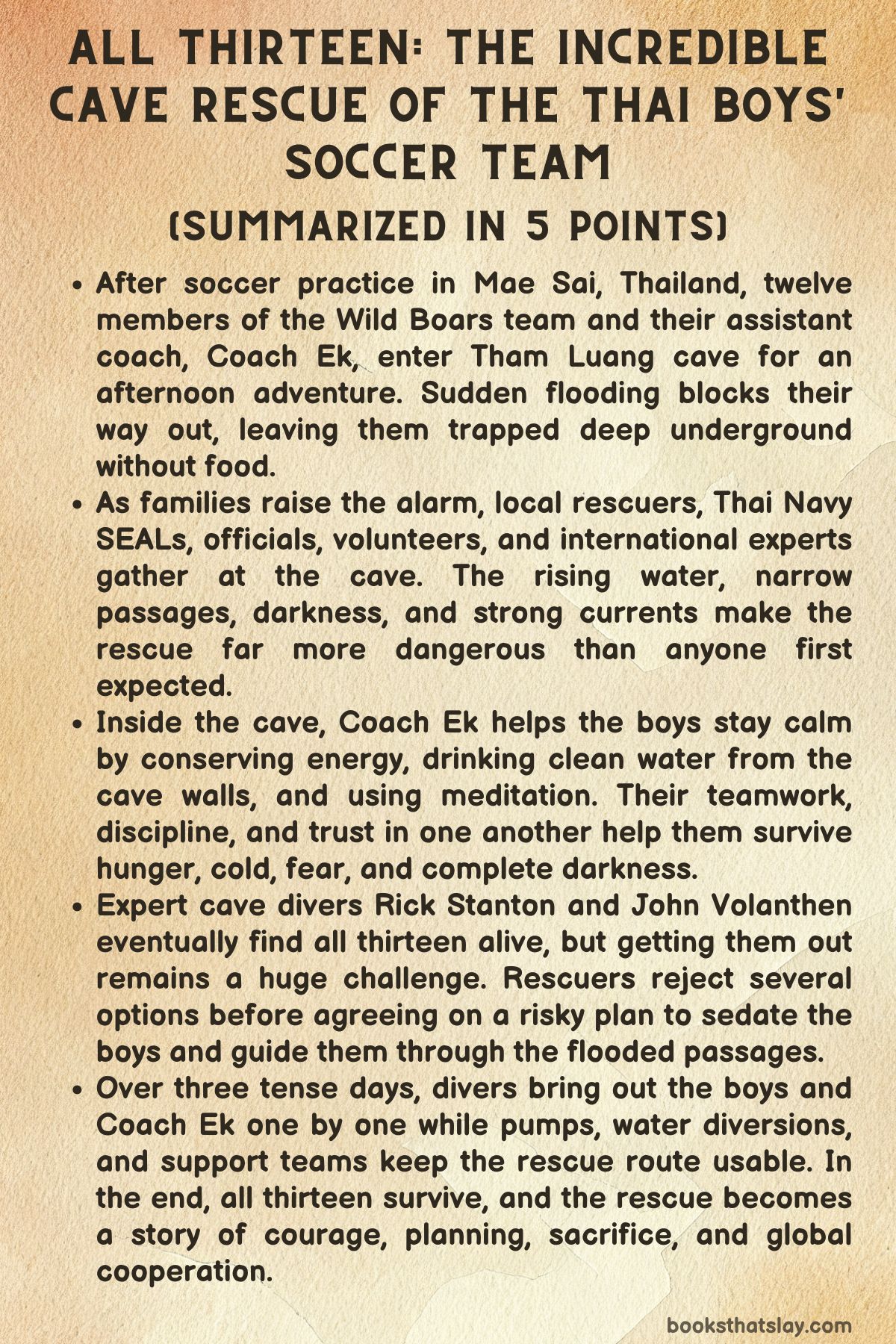
All Thirteen tells the true story of the Wild Boars, a youth soccer team from Mae Sai, Thailand, and their assistant coach, Ekkapol Chantawong, known as Coach Ek. On June 23, 2018, after a regular Saturday soccer practice, the boys decided to explore Tham Luang, a local cave system.
They planned to be out by evening so one of the boys, Night, could attend his birthday party. The cave was familiar to many locals, and though signs warned visitors about flooding during the rainy season, the boys did not expect serious danger.
The heaviest rains were usually still weeks away.
The team entered the cave after leaving their bikes outside. They bowed at a shrine to the spirit of the Sleeping Lady, connected to a local legend, and continued into the dark passages.
At first, the trip felt like an adventure. They moved through tight spaces, crawled over rocks, and followed the passage deeper inside.
At a junction, they left their shoes and packs and went farther in. As time passed, they realized they had stayed much longer than planned.
When they finally turned back, they found that water had flooded the route they had used to enter. Their way out was blocked.
Outside the cave, Night’s parents became worried when he did not arrive for his party. Soon, families learned that the team might have gone to Tham Luang.
Rescue workers arrived and discovered the boys’ belongings inside, proving that they were trapped somewhere beyond the floodwater. Local rescuers, Thai officials, and later the Royal Thai Navy SEALs began trying to reach them.
At first, many people did not understand how dangerous the cave had become. The water was muddy, fast, cold, and rising.
The passages were narrow, and even trained open-water divers struggled.
Inside the cave, Coach Ek tried to keep the boys calm. He attempted to find a way through the flooded passage using a rope tied to his waist, but the current and darkness made it impossible.
The group realized they would have to wait. They moved farther into the cave and found a raised, sandy place where they could stay above the water.
They had no food, but they could drink clean water dripping from the cave walls. Hunger, cold, darkness, and fear became their daily reality.
Coach Ek encouraged them to save energy, stay close for warmth, and use meditation to quiet their minds.
The cave itself made the rescue especially difficult. Tham Luang is formed from karst limestone, a porous rock that allows water to move through the mountain.
Heavy rain had soaked the ground, and more rain forced water into the cave through hidden routes. Pumps were installed, but the water kept rising.
Vern Unsworth, a British cave explorer who knew Tham Luang well, understood that ordinary rescue methods would not be enough. He urged officials to bring in expert cave divers who had experience with narrow, flooded, muddy passages.
As the crisis grew, people from Thailand and around the world came to help. The US Air Force joined the planning effort.
Engineers considered drilling into the mountain, searching for another entrance, or lowering the water enough to walk or swim in. Volunteers searched the forest for openings, but none led to the trapped team.
Thanet Natisri, a groundwater expert, focused on stopping water from entering the cave. With the help of farmers, engineers, soldiers, and local people, he worked to pump water from nearby areas and divert streams away from sinkholes feeding the cave.
The rescue camp outside Tham Luang became a huge operation. Thousands of people helped in any way they could.
Some cooked meals, washed clothes, carried equipment, cleared roads, gave supplies, or supported the families. Thai culture and Buddhist belief shaped the atmosphere around the cave.
Families prayed, made offerings, and hoped the spirit of the Sleeping Lady would allow the boys to return. A respected monk visited and gave the families comfort, telling them the boys would come out.
After days of failed attempts and rising fear, two British cave divers, Rick Stanton and John Volanthen, made a difficult dive deeper into the cave. They laid guideline through the flooded passages and pushed farther than anyone had gone.
After passing the area where Vern thought the boys might be, they continued and finally surfaced in a chamber where they smelled human waste. Then they saw the boys.
The Wild Boars were alive. One boy, Adul, spoke enough English to communicate with the divers.
The boys asked if they could leave immediately and whether the divers had food. The answer to both questions was no, but Rick and John promised help would come.
The news that all thirteen were alive spread quickly. Families celebrated, and the world reacted with relief.
Yet the hardest part was still ahead. The boys were deep inside the cave, and getting them out seemed almost impossible.
Waiting until the rainy season ended could take months. That option was dangerous because oxygen levels in the chamber were falling, more adults had joined the boys, and supply dives through the flooded cave would put rescuers at constant risk.
The death of Saman Gunan, a former Thai Navy SEAL who died while helping place air tanks in the cave, showed how deadly the conditions were.
The rescue leaders faced a terrible decision. Some believed diving the boys out was too risky because none of them had diving experience.
Panic underwater could kill them and their rescuers. Others believed waiting would lead to an even worse outcome.
Major Charles Hodges and Sergeant Derek Anderson of the US Air Force helped create a detailed rescue plan. Thanet explained that the water had been lowered only temporarily and that rain was coming.
Thai leaders were told that the dive rescue could cost lives, but doing nothing could mean losing everyone. Finally, officials approved the plan.
The plan required the boys to be sedated and carried through the flooded passages by expert cave divers. Dr. Richard Harris, an Australian anesthesiologist and cave diver, was brought in to handle the sedation.
The boys would wear full-face masks so they could breathe underwater, and divers would guide them through the sumps one by one. Other divers would wait in dry chambers to carry them across rocky sections.
The Thai SEALs and US Air Force teams would help move them from the deeper chambers toward the cave entrance. Everyone rehearsed the process, knowing they had little time before the rain returned.
The first rescue day began on July 8. The boys accepted the plan with remarkable calm.
The first boy was given medicine to reduce anxiety, then sedated. A diver checked that his mask sealed properly and that he could breathe before beginning the long route out.
The passage was dark, narrow, and difficult. Divers had to protect each boy’s mask, monitor breathing, manage sedation, avoid rocks, and follow the guideline through muddy water.
The first boy reached the rescue team safely, then was carried by stretcher through the remaining distance. By the end of the day, four boys were out.
The next day, four more boys were rescued. The process went more smoothly because the team had learned from the first day.
Still, everyone was exhausted, and the weather remained a threat. On the final day, the remaining four boys and Coach Ek had to be brought out.
Rain had begun again, and water was moving faster inside the cave. Problems arose, including a mask that did not fit one boy properly and a diver who lost the guideline and had to recover his way.
Even so, the team adapted. One by one, the last boys and Coach Ek were carried through the cave.
After all the Wild Boars were out, the remaining Thai SEALs and Dr. Pak still had to escape. Just as the last rescuers left, a pump failed and water began rising quickly again.
The cave filled behind them, making the timing of the rescue seem almost unbelievable. All thirteen members of the team survived after eighteen days underground.
The boys recovered in the hospital and were soon reunited with their families. They thanked the people who had helped save them and later spent time as novice monks to show gratitude.
Coach Ek and the stateless boys on the team were granted Thai citizenship, bringing attention to the struggles of stateless people in Thailand. All Thirteen ends by showing that the rescue succeeded because of many kinds of strength: the boys’ patience, Coach Ek’s calm leadership, the divers’ skill, the planners’ honesty, the volunteers’ generosity, and the willingness of people from many countries to work together when thirteen lives depended on them.
Key People
The Wild Boars Soccer Team
The Wild Boars are the emotional center of All Thirteen. They are not presented as a single faceless group, but as young boys with strong bonds, local customs, fears, humor, discipline, and loyalty to one another.
Their shared identity as a soccer team matters because it shapes how they survive inside Tham Luang. They are used to listening to a coach, working as a unit, trusting each other, and staying focused even when circumstances are against them.
Their time in the cave tests these qualities in a far more serious way than any soccer match ever could. Hunger, darkness, cold, and uncertainty could easily have broken their spirits, yet the boys manage to remain calm for long stretches because they rely on familiar habits: teamwork, patience, and respect for Coach Ek’s guidance.
Their survival is not only physical but mental. They endure by conserving energy, staying together, drinking clean water from the cave walls, and accepting that panic would only make their situation worse.
Their youth makes their ordeal especially frightening, but it also highlights their resilience. They are children placed in a situation that even trained adults would struggle to handle, yet they respond with trust, discipline, and surprising emotional strength.
Coach Ek
Coach Ek is one of the most important figures in the story because his behavior inside the cave helps keep the boys alive. As the assistant coach, he feels responsible for the team, and that responsibility shapes nearly every choice he makes after the flood traps them.
His past as a novice monk gives him habits that become essential in the cave: patience, fasting, meditation, emotional control, and the ability to endure discomfort. Rather than letting fear spread, he encourages the boys to conserve energy, stay calm, and meditate.
He understands that survival depends not only on finding food or shelter, but also on keeping the boys from losing hope. His leadership is quiet rather than dramatic.
He does not pretend the situation is safe, but he avoids adding to the boys’ fear. His background also adds depth to his character.
Losing his family at a young age, living in a temple, and facing statelessness have made him familiar with hardship. These experiences allow him to guide the boys through a crisis with humility and steadiness.
Coach Ek is not shown as flawless; the trip into the cave becomes a dangerous mistake. Yet his response after that mistake reveals compassion, maturity, and a deep commitment to the children in his care.
Adul
Adul stands out because he becomes the main bridge between the trapped boys and the British divers when the team is found. His ability to speak English allows him to communicate clearly in a moment when even a few words matter greatly.
Through Adul, the boys can ask whether they are leaving immediately, whether food has arrived, and what will happen next. His role shows how survival sometimes depends on unexpected skills.
In ordinary life, his English might simply be part of his education and identity, but inside Tham Luang, it becomes a lifeline. Adul is also one of the boys affected by statelessness, which adds social and political weight to his character.
His situation reminds readers that some of the boys were already facing serious limits before the cave crisis made them famous. The rescue brings attention to these problems, and Adul’s presence helps readers see that the story is not only about one emergency, but also about larger questions of belonging, citizenship, and opportunity.
He is brave not because he gives speeches or takes command, but because he remains calm enough to speak for the group when help finally arrives.
Night
Night is important because his missed birthday party is one of the first signs that something has gone terribly wrong. The boys had planned to leave the cave in time for his celebration, so his absence alerts his family and begins the chain of concern that leads rescuers to Tham Luang.
In this way, Night’s role is closely tied to the outside world and to the families waiting in fear. His birthday also adds emotional contrast to the story.
A day that should have been filled with happiness becomes the beginning of a national emergency. Night represents the ordinary childhood that the cave suddenly interrupts.
He is a boy with friends, family, a birthday party, and plans, but within hours he becomes part of a survival crisis watched around the world. During the rescue, his difficulty breathing under sedation creates one of the tense moments in the extraction process.
This reminds readers that even after the plan is approved, every child’s rescue is uncertain and fragile. Night’s character helps connect the public rescue mission to a very personal human story: a family waiting for a son who was supposed to come home for a celebration.
Thi
Thi is shown as one of the older boys who takes practical action during the cave exploration. When the team reaches water inside the cave, he tests its depth before the others cross, which shows responsibility and courage.
He also checks his watch, helping the group realize how long they have been inside and that they need to return. Later, his watch becomes a tool for measuring time in the darkness, allowing the boys to keep some sense of morning and night.
Thi’s character reflects the importance of small acts of leadership within a group. He is not the adult in charge, but he contributes to the team’s survival by paying attention, helping make decisions, and offering a sense of order.
In a place where natural light disappears and normal routines collapse, even a watch can become a source of structure. Thi shows how the older boys support Coach Ek and help the younger ones manage fear.
His role may seem quiet, but it is meaningful because survival inside the cave depends on shared responsibility, not just one person’s leadership.
Note
Note becomes especially important during the rescue because he is the first boy taken out of the cave. His extraction carries enormous emotional and practical weight.
Until he reaches safety, no one can be certain that the plan will work. He is sedated, fitted with a mask, and guided through dangerous flooded passages by expert divers.
His rescue proves that the nearly impossible plan can succeed. Note’s role is powerful because he becomes the test case for everyone’s hope.
For the divers, medical team, military personnel, and families, his safe arrival changes the atmosphere from fear to cautious belief. As a character, Note represents trust.
He must allow adults he barely knows to prepare him for a rescue he cannot fully control. Because he is unconscious during the journey, his life rests entirely in the hands of others.
His successful rescue shows how much cooperation, planning, skill, and faith in strangers are required to save the boys.
Mark
Mark’s rescue highlights the unpredictable nature of the mission. On the final day, the team needs a fifth mask, and the mask chosen for him turns out to be too large.
This creates a serious problem because a poor seal could allow water into the mask and put his life at risk. The diver’s quick improvisation with a backup mask allows Mark to continue safely.
Mark’s character is important because his situation shows that no rescue plan, however detailed, can account for everything. The rescuers have rehearsed, planned, and prepared, but a single piece of equipment can still threaten the whole operation.
Through Mark, the story shows the vulnerability of the boys and the pressure placed on the divers. He also represents the final stretch of the rescue, when exhaustion, rain, and rising water make every decision more urgent.
His safe exit is not simply another success; it is part of the closing movement of a mission that has tested everyone involved.
Pong
Pong’s rescue becomes memorable because of a dangerous moment involving the guideline between chambers. When Chris Jewell loses the line and becomes disoriented, the situation shows how easily even an expert diver can be thrown off inside Tham Luang.
Pong’s safety depends on the rescuers’ ability to adapt quickly. Dr. Harris helps carry him through the remaining section, preventing the problem from becoming a disaster.
Pong’s role emphasizes the extreme danger of cave diving, especially when the person being rescued is sedated and completely dependent on the diver. He cannot help himself, correct a mistake, or respond to danger.
His character therefore represents the trust and helplessness of all the boys during extraction. Through Pong, the story reminds readers that the rescue did not become easy after the first day.
Even near the end, one wrong turn, one lost guideline, or one delayed decision could have changed everything.
Rick Stanton
Rick Stanton is one of the expert cave divers whose specialized skills become essential to the rescue. He is experienced, direct, and deeply aware of the dangers of cave diving.
His refusal to enter the cave when conditions are too unsafe is not cowardice; it is discipline. Rick understands that bravery without preparation can kill people, especially inside a flooded cave where darkness, current, narrow passages, and low visibility leave no room for pride.
His character contrasts with approaches based mainly on courage or rank. He follows the rules of cave diving because he knows those rules are written in life-and-death terms.
Rick also plays a crucial role in finding the boys. When he and John Volanthen finally reach them, his skill turns global hope into reality.
Yet even after finding them alive, he knows the rescue problem is far from solved. Rick’s character shows the value of expertise, emotional control, and honesty.
He may seem blunt at times, but his realism helps prevent reckless choices and makes the final rescue possible.
John Volanthen
John Volanthen works closely with Rick Stanton and shares many of his strengths: technical skill, patience, calm judgment, and respect for cave diving’s dangers. He is part of the pair that first reaches the boys, and his role in that discovery is one of the most important in the story.
John’s character is marked by quiet determination. He does not rely on dramatic gestures, but on careful movement through dangerous spaces.
Earlier, when he and Rick rescue trapped workers from the cave, John demonstrates quick thinking and compassion under pressure. That unplanned rescue foreshadows the larger mission to come.
John also represents the kind of person whose talents may not fit ordinary public ideas of heroism. He is not a soldier or official leader, but his experience in cold, narrow, muddy cave systems gives him knowledge that few people in the world possess.
In All Thirteen, John’s importance lies in the way he combines technical mastery with calm humanity.
Vern Unsworth
Vern Unsworth is the local cave expert whose knowledge of Tham Luang helps guide the entire rescue effort. He understands the cave’s layout, its dangerous passages, its likely routes, and the kind of divers needed for the mission.
Because he has spent years exploring and mapping the cave, his judgment becomes valuable at a time when many officials and rescuers are trying to understand an unfamiliar underground world. Vern correctly suspects the route the boys may have taken and pushes for expert cave divers when others still hope ordinary diving methods might work.
His role shows the importance of local knowledge and long experience. He is not at the center of the public spotlight in the same way as some rescuers, but without his understanding of the cave, the rescue could have lost crucial time.
Vern also acts as a connector between Thai authorities and the international cave-diving community. He knows who has the skill to enter Tham Luang and argues for their involvement when the situation grows desperate.
Thanet Natisri
Thanet Natisri is one of the most important problem-solvers outside the cave. His expertise in groundwater helps shift the rescue from desperate pumping to a more strategic effort to control where the water goes.
Thanet understands that simply pumping water from the cave entrance is not enough if new water continues to pour in through the mountain. He studies the land, listens to local knowledge, works with farmers and engineers, and organizes efforts to divert streams away from sinkholes feeding the cave.
His character is defined by persistence and practical intelligence. He has no official rank in the rescue hierarchy, yet his work becomes vital.
Thanet also shows how effective leadership can come from action rather than title. He sees what needs to be done and gathers people who can help.
His long hours, physical exhaustion, and refusal to give up make him a key figure in creating the short window that allows the dive rescue to happen.
Major Charles Hodges
Major Charles Hodges represents disciplined leadership under emotional pressure. As part of the US Air Force team, he approaches the crisis with strategic thinking and a clear understanding that emotions, while natural, can cloud decision-making.
His role becomes especially important when Thai leaders must decide whether to approve the dangerous dive rescue. Hodges does not minimize the risks.
Instead, he explains them honestly and compares them against the even greater risk of waiting. This honesty is difficult but necessary.
His leadership depends on communication as much as planning. He must respect Thai officials, acknowledge their emotional burden, and still make the case that the least terrible option is the only viable one.
Hodges’s character shows that rescue work is not only physical. It also requires moral courage, diplomacy, and the ability to make decisions when every choice carries the possibility of loss.
Sergeant Derek Anderson
Sergeant Derek Anderson is a planner whose attention to detail helps transform a frightening idea into an organized rescue operation. He works on the practical structure of the dive plan, thinking through the stages, the transfer points, the divers’ roles, and the movement of the boys through the cave.
His character represents preparation. The rescue cannot depend on hope alone; it needs rehearsals, backup plans, equipment, timing, and clear coordination among people from different countries and organizations.
Anderson’s work in setting up practice runs shows his understanding that a plan must be tested before lives are placed in its hands. He is also important because he helps bring order to a chaotic situation.
With thousands of people at base camp and many competing ideas, the rescue needs a clear method. Anderson’s character shows how calm organization can make an impossible task manageable.
Dr. Richard Harris
Dr. Richard Harris plays one of the most unusual and difficult roles in the rescue. As both an anesthesiologist and cave diver, he has the rare combination of skills needed for the plan to sedate the boys and bring them out underwater.
His responsibility is enormous because the boys must remain unconscious enough not to panic, yet stable enough to keep breathing through their masks. Every dosage matters.
Every child’s condition matters. Harris must make medical decisions in an environment where normal hospital controls do not exist.
His character shows the burden of specialized responsibility. He knows that the plan is risky and that failure could happen despite everyone’s best efforts.
Yet he accepts the task because there may be no other way. His calm, careful approach allows the divers to carry out the rescue.
Harris represents the point where medicine, trust, and courage meet.
Jason Mallinson
Jason Mallinson is one of the expert divers who helps carry the boys out, and his rescue of Note shows the intense personal pressure placed on each diver. While moving through flooded passages, he must watch the boy’s mask, protect his face, check for breathing, manage the line, avoid obstacles, and administer more sedation when needed.
Jason’s character is defined by focus and adaptability. When he realizes that support divers are waiting in the wrong place, he carries Note across a chamber alone and continues.
Later, when Mark’s mask does not fit, Jason improvises with a backup mask. These moments show that the rescue depends not only on the plan but also on the judgment of individuals inside the cave.
Jason must make decisions without delay and without full outside support. His character reveals the quiet intensity of rescue work, where success depends on staying calm while another person’s life is literally in one’s hands.
Dr. Pak
Dr. Pak, the Thai army doctor who stays with the boys inside the cave, brings medical care and emotional support when they badly need both. His presence reassures the boys and their families because it means the team is no longer completely alone.
He remains in Chamber 9 with the boys, along with the Thai SEALs, providing care, monitoring their condition, and helping maintain morale. His role is important because survival is not only about extraction; it is also about keeping the boys healthy enough to be rescued.
Dr. Pak’s willingness to stay underground shows great commitment. He accepts the same danger as the trapped team and later must make his own dangerous exit.
His character reflects service, compassion, and the quiet bravery of those who support others without seeking attention.
Saman Gunan
Saman Gunan is a former Thai Navy SEAL whose death changes the emotional and practical stakes of the rescue. He volunteers to help place air tanks in the cave, a task meant to make the route safer for others.
His death is a devastating reminder that Tham Luang is dangerous even for trained rescuers. Saman’s character represents sacrifice, duty, and the real cost of the mission.
Before his death, the rescue may still seem to some people like a difficult but manageable operation. Afterward, no one can ignore the possibility that more people may die.
His loss affects different groups in different ways. For some, it proves that waiting inside the cave and continuing supply dives for months is too dangerous.
For others, it shows that bringing inexperienced children out through the same route may be impossible. Saman’s death deepens the seriousness of the rescue and honors the risks taken by those who tried to save the boys.
Themes
Teamwork and Collective Responsibility
The rescue succeeds because many people accept responsibility for a problem no single person can solve. Inside the cave, the Wild Boars survive by acting like a team.
They share fear, hunger, darkness, and uncertainty, but they also share discipline and trust. Coach Ek’s guidance matters, yet the boys’ willingness to listen and support one another is just as important.
Outside the cave, teamwork expands into a global effort. Local rescuers, Thai Navy SEALs, British cave divers, US Air Force personnel, Australian medical experts, groundwater engineers, farmers, cooks, drivers, monks, journalists, and volunteers all become part of the mission.
Many of these people do not know each other, and some come from very different professional and cultural backgrounds. Disagreement and tension arise, especially when people have different ideas about risk, authority, and communication.
Yet the rescue moves forward because people keep returning to the same goal: getting the boys and Coach Ek out alive. All Thirteen shows teamwork not as simple cooperation, but as a difficult process that requires humility.
Experts must listen to local knowledge. Officials must trust outsiders.
Volunteers must do unglamorous work. The trapped boys must trust adults they cannot see.
The final success belongs to everyone because each contribution, large or small, helps create the conditions for survival.
The Power of Calm Under Pressure
Calmness becomes one of the most important survival tools in the story. The cave is terrifying because it removes nearly everything familiar: light, food, warmth, space, time, and contact with family.
In such conditions, panic could spread quickly and weaken the boys’ chances of survival. Coach Ek’s background as a novice monk helps him understand how to manage fear through stillness, meditation, and energy conservation.
His calm does not erase the danger, but it gives the boys a way to endure it. The same theme appears among the rescuers.
Cave divers must control their breathing, movement, and thoughts while navigating dark flooded passages where a single mistake can be fatal. Rick Stanton, John Volanthen, Jason Mallinson, Dr. Harris, and others survive because they can slow their minds and focus on each task.
Even the planning teams must remain calm as they consider options that all carry serious risks. Calmness in the book is not passivity.
It is active discipline. It allows people to think clearly, preserve strength, solve problems, and avoid making fear-based decisions.
The story suggests that courage is not always loud or visibly dramatic. Sometimes courage looks like breathing steadily in the dark, waiting without giving up, and doing the next necessary thing.
Respect for Nature’s Power
Tham Luang is not presented as an enemy, but it is never harmless. The cave follows the laws of weather, geology, water, and time, not human wishes.
The boys enter when the cave appears safe, but hidden conditions have already changed. Rain has saturated the mountain, and water begins moving through limestone channels that no one can fully control.
This creates one of the story’s strongest lessons: nature can shift faster than human plans. The rescue teams try to pump water out, divert streams, block sinkholes, study rainfall, and read the cave’s behavior, but they never truly command it.
They only create a temporary chance. The rising water, cold currents, tight passages, and low oxygen levels remind everyone that the cave sets the limits.
Even advanced equipment and expert knowledge must adapt to natural conditions. This theme also connects to Thai cultural beliefs about caves as sacred places.
The legend of the Sleeping Lady gives the mountain a spiritual presence, while the science of limestone and monsoon rain explains its physical danger. Together, these views create a fuller respect for the place.
The rescue depends on understanding that human beings survive not by conquering nature, but by studying it, respecting it, and acting within the brief openings it allows.
Risk, Sacrifice, and Moral Choice
The rescue forces people to make decisions in situations where there is no safe option. Keeping the boys inside the cave could protect them from the immediate danger of a dive, but it could also expose them to falling oxygen, illness, more flooding, and months of dangerous supply runs.
Diving them out could save them quickly, but panic, mask failure, sedation problems, or diver error could kill them. The death of Saman Gunan makes these risks painfully real.
His sacrifice shows that rescuers are not protected by skill alone. Every trip into the cave carries danger, and every decision has consequences.
The moral difficulty of the rescue lies in choosing action while knowing that action may lead to loss. Major Hodges, Sergeant Anderson, Thai officials, Dr. Harris, and the cave divers must weigh fear against urgency.
Their decision to proceed is not based on certainty. It is based on the belief that the chosen plan gives the boys the best chance among terrible alternatives.
This theme gives the story its seriousness. Heroism is not shown as reckless confidence.
It is shown as the willingness to face risk honestly, prepare as carefully as possible, and act because delay may be even more dangerous.