All the Broken Places Summary, Characters and Themes
All the Broken Places by John Boyne is a dark literary novel about guilt, memory, and the long reach of history. It follows Gretel Fernsby, the elderly sister of Bruno from The Boy in the Striped Pajamas, as she lives quietly in London while hiding the truth of her childhood near Auschwitz.
Across decades, the novel shows how Gretel tries to escape her family’s crimes, first in France, then Australia, and finally England. In old age, a new neighbor’s violence forces her to face a question she has avoided all her life: whether silence makes a person guilty.
Summary
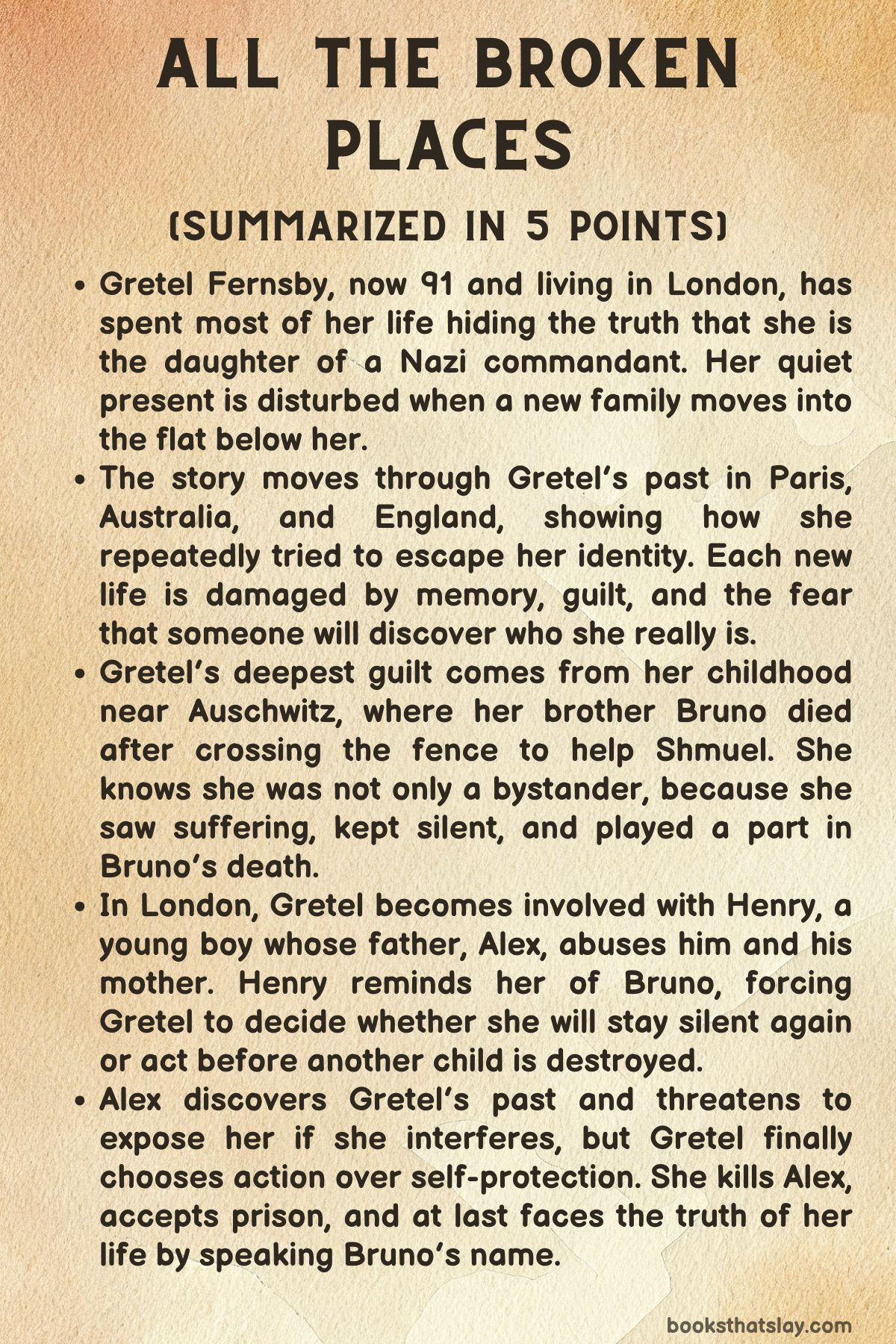
Gretel Fernsby is 91 years old in 2022 and lives in Winterville Court, an expensive apartment building in Mayfair, London. She has spent more than 60 years there, guarded, private, and determined not to leave.
Her husband, Edgar, is dead, and her son, Caden, wants her to sell the flat, partly because he needs money. Gretel refuses.
She prefers the habits and boundaries of her present life, though her mind is full of memories she has tried to bury.
When the flat below hers is sold, Gretel worries about the new residents. She hopes they will be quiet and childless.
Her life has long been shaped by an aversion to children, especially boys, because they remind her of her younger brother, Bruno, who died when they were both children. Gretel has hidden much of her past from nearly everyone, including Caden.
She was born in Germany, and her father was the commandant of Auschwitz. As a girl, she lived beside the camp and witnessed enough to know that something terrible was happening, even if she later tried to tell herself she had been only a child.
The story moves between Gretel’s old age and her earlier life. In 1946, she and her mother are living in Paris under false names after fleeing Germany.
Her father has been executed, and her brother is dead. Gretel’s mother, now calling herself Nathalie, drinks heavily and clings to denial.
She insists they were not responsible for the crimes of Gretel’s father or the Nazi regime. Gretel is less certain.
She knows she saw things, understood some things, and still said nothing.
In Paris, Gretel becomes interested in Émile, a young man who works in his father’s haberdashery shop. She is lonely, guilty, and eager to separate herself from her family’s past.
Émile’s brother was killed by the Nazis after joining the Resistance, and Émile speaks bitterly about German soldiers and the camps. Gretel lies to him about her background, pretending her father died long ago and that she has no siblings.
Their relationship becomes sexual, but it does not bring her the freedom she hoped for.
At the same time, Gretel’s mother becomes involved with Rémy Toussaint, a Frenchman who appears charming but has his own motives. Eventually, Gretel and her mother are lured into a warehouse by people who know who they really are.
They are publicly humiliated and punished by former Resistance members and grieving survivors. Toussaint calls Gretel the devil’s daughter.
The group does not kill them, but they cut off their hair and force them to confront their connection to Nazi crimes. This event scars Gretel and pushes her mother deeper into hatred and denial.
Years later, after her mother dies, Gretel leaves France for Australia. In Sydney, she befriends Cait, an Irish woman with her own painful history.
Cait is direct, independent, and protective, and for a time Gretel has a chance at a new life. She works in a clothing shop and begins to settle into ordinary routines.
But then she sees a man in a bar whom she recognizes from her childhood: Kurt Kotler, a former SS officer and her first crush. He now lives under the name Kurt Kozel, with an Australian wife and young son.
Gretel follows him and confirms his identity. Kurt knows who she is too.
Their meeting drags her back into the world she has tried to escape. She briefly kidnaps Kurt’s son, Hugo, intending to kill the boy and herself as a form of revenge or justice.
But she cannot do it. Instead, she confronts Kurt.
He does not truly repent. He speaks openly about the power he enjoyed during the Nazi years and dares Gretel to expose him, reminding her that doing so would also expose her identity as the daughter of a notorious commandant.
Gretel leaves Australia without reporting him, haunted by her failure to act.
In England, Gretel builds another life. She works at Harrods and meets David Rotheram, a Jewish man whose family was murdered at Treblinka.
She also becomes close to Edgar, a thoughtful man interested in history. Gretel and David begin a relationship, but after watching a documentary that includes footage of her family and her father, Gretel suffers a breakdown and throws herself in front of a bus.
She survives. When she later tells David the truth about her past, he is horrified and rejects her.
Edgar, however, cannot bring himself to hate her. He marries her, and they have a son, Caden.
Gretel’s relationship with motherhood is troubled. She feels distant from Caden and is terrified when, as a child, he crawls under a fence at Winterville Court, echoing the way Bruno crossed the fence at Auschwitz to help Shmuel, a Jewish boy he had befriended.
Gretel had once met Shmuel and knew her brother was visiting him. Out of jealousy and childish cruelty, she had encouraged Bruno to go under the fence.
Bruno died in the gas chamber with Shmuel. Gretel’s guilt over this truth becomes one of the deepest wounds of her life.
In 2022, the new residents of the downstairs flat arrive: Madelyn Darcy-Witt, her wealthy and powerful husband Alex, and their nine-year-old son Henry. Gretel first dislikes the idea of having a child nearby, but Henry quickly affects her.
He is polite, bookish, small for his age, and fond of adventure stories. He reminds her painfully of Bruno.
Gretel soon realizes that something is wrong in the Darcy-Witt household. Madelyn is fragile and isolated.
Alex controls her, humiliates her, and prevents her from having friends or pursuing acting work. Henry appears with injuries and makes excuses for them.
Gretel hears shouting at night and sees signs of violence. She gradually understands that Alex is abusing both his wife and son.
Gretel’s moral crisis returns in a new form. In the past, she watched harm happen and did nothing.
Now she has a chance to act. She confides in Eleanor, Caden’s fiancée, a heart surgeon who listens without judging too quickly.
Together they go to the police, but Alex is rich, influential, and skilled at protecting himself. He also discovers Gretel’s past.
Using old records and the documentary about the Holocaust, he learns that she is the commandant’s daughter. He threatens to expose her if she interferes in his family.
Gretel agrees to stay silent, but the decision torments her.
Alex’s abuse continues. Henry remains trapped, and Madelyn seems broken.
Gretel sees that Alex will not stop. She also knows that official channels may fail.
The old question becomes unbearable: will she again protect herself while a child suffers?
On the night before Caden and Eleanor’s wedding, Gretel invites Alex to her flat. She speaks with him calmly and draws out his beliefs.
Alex sees Madelyn as his possession and Henry as a boy who must be made strong through fear. He believes he has power over Gretel because of her past.
Gretel reflects on Bruno, Shmuel, her father, Kurt, and all the times she failed to help. Then she takes a box cutter and kills Alex, cutting his throat.
Afterward, Gretel attends Caden and Eleanor’s wedding without telling them the full truth. She is later arrested.
The newspapers portray her as a confused old woman who lost control, but Gretel refuses that version. She wants people to know that she acted deliberately.
She is sent to a low-security prison, which she compares bitterly to the retirement village she always refused to enter.
In prison, Gretel is visited by Caden, Eleanor, Heidi, and Oberon. She does not regret killing Alex, because she believes she saved Henry.
But she is sorry for the rest of her life: for silence, cowardice, denial, and the harm caused by inaction. At last, she opens an old jewelry box she has kept for decades.
Inside is a photograph of her family. For the first time, she allows herself to say her brother’s name: Bruno.
Characters
Gretel Fernsby
Gretel Fernsby is the central figure of All the Broken Places, and her character is built around the tension between guilt, survival, denial, and late moral action. At 91, she appears controlled, sharp, private, and even cold.
She lives in an expensive London flat and has spent decades shaping a life around secrecy. Her past as the daughter of a Nazi commandant has made her suspicious of intimacy and terrified of exposure.
Gretel often tells herself that she was only a child when the atrocities happened, but her own memories challenge that excuse. She saw the camp, met Shmuel, knew Bruno was visiting him, and encouraged Bruno to cross the fence.
Her guilt is therefore both historical and personal. She is not simply haunted by what her father did; she is haunted by what she failed to do and by the small act of cruelty that helped lead to her brother’s death.
Gretel is also morally complicated because she can be selfish, judgmental, and emotionally distant, yet she is not incapable of care. Her relationship with Caden is strained partly because motherhood forces her to confront Bruno’s memory.
She cannot love her son freely because every young boy recalls the child she lost and betrayed. Her later bond with Henry is therefore crucial.
Henry gives her a chance to face a situation where a vulnerable child is in danger and where silence would again mean complicity. Gretel’s decision to kill Alex is not presented as pure heroism.
It is also an act shaped by rage, guilt, and desperation. Yet it marks the first time she fully chooses action over self-protection.
By the end, Gretel has not cleansed herself of the past, but she has stopped hiding behind innocence. Her final ability to say Bruno’s name shows that she has accepted the truth she spent a lifetime avoiding.
Bruno
Bruno is Gretel’s younger brother and the emotional center of her guilt. Although he is dead for most of the story, his presence shapes nearly every part of Gretel’s life.
He is remembered as curious, innocent, bookish, and eager to explore. His fascination with the world beyond boundaries becomes fatal when he befriends Shmuel, a Jewish boy imprisoned on the other side of the fence.
Bruno does not understand the full horror of the camp, which makes his death especially devastating. He represents childhood innocence destroyed by adult hatred, but he also represents the moral clarity that Gretel lacked.
While Gretel absorbs fear, secrecy, and self-protection from the adults around her, Bruno reaches toward another child with trust.
For Gretel, Bruno is not only a lost brother but also a permanent accusation. She knows that she encouraged him to cross the fence, partly from jealousy and partly from childish spite.
That action becomes the wound around which her adult life forms. She avoids children, especially young boys, because they remind her of him.
Caden’s childhood terrifies her, Henry’s bookishness unsettles her, and every image of a small boy near danger reopens the memory of Bruno. His name becomes so painful that she cannot speak it for decades.
When she finally says his name in prison, it marks a moment of emotional surrender. Bruno is no longer only a ghost she runs from; he becomes a truth she can acknowledge.
Shmuel
Shmuel is the Jewish boy Bruno befriends at Auschwitz, and his brief presence carries enormous moral weight. He is a child trapped inside a system designed to erase him.
When Gretel meets him, he is hiding, hungry, frightened, and already aware that he will probably die. His small body and quiet fear expose the lie Gretel has been told about the people beyond the fence.
He is not an enemy, a threat, or a nameless prisoner. He is a nine-year-old boy who needs help.
Shmuel matters because he destroys Gretel’s ability to claim total ignorance. She may not understand every mechanism of the camp, but after meeting him she knows that children are suffering there.
Her promise not to reveal his hiding place is one small act of decency, yet it is not enough. She does not use her position to help him.
Later, when she remembers him, his name becomes connected to her deepest guilt. Shmuel also reflects Bruno’s innocence.
Both boys are small, vulnerable, and drawn together by loneliness. Their deaths show the terrible consequence of a world where children are placed inside adult systems of cruelty.
Through Shmuel, the story makes clear that silence is not neutral when a person has seen suffering and chooses safety.
Gretel’s Father
Gretel’s father is the commandant of Auschwitz and the source of the family’s lasting disgrace. To the outside world, he is a figure of historical evil.
To Gretel, he is more difficult to process because he was also her father. This contradiction shapes her psychological conflict.
She tries to separate him into two people: the father she knew at home and the man who oversaw mass murder. Yet the story refuses to let that separation remain comfortable.
His domestic authority and his public brutality come from the same belief in hierarchy, obedience, and dehumanization.
His most chilling quality is the ease with which he treats murder as work. When he shows Gretel the camp, he exposes her to the machinery of atrocity without moral hesitation.
His explanation that the people beyond the fence are not really people reveals the central lie that allows violence to continue. He teaches Gretel, directly and indirectly, that some lives can be dismissed.
Even after his execution, his influence remains. Gretel spends her life trying to escape his name, but she cannot escape what being his daughter means.
Alex later uses her father’s identity as a weapon against her, proving that the father’s crimes continue to shape her life long after his death.
Gretel’s Mother
Gretel’s mother, who later uses the name Nathalie, is a figure of denial, bitterness, and collapse. After the war, she insists that she and Gretel are not responsible for anything that happened.
She presents herself as an obedient wife and Gretel as a child who had no power. Her argument contains some truth, but it is also self-protection.
She does not want to examine what she knew, what she ignored, or how she benefited from her husband’s position. Her drinking and decline show a woman unable to live honestly with the past.
After she and Gretel are punished in Paris, her denial hardens into resentment. Rather than develop remorse, she turns toward antisemitic explanations and self-pity.
She sees herself as a victim of postwar hatred, not as someone connected to a system that murdered millions. This makes her a warning figure for Gretel.
Gretel inherits her mother’s instinct for concealment but not her total refusal of guilt. Their relationship is tense because Gretel wants truth, even when she fears it, while her mother wants survival without confession.
Nathalie’s death frees Gretel physically, but not morally. The silence and false identity her mother imposed continue to shape Gretel’s choices for decades.
Kurt Kotler
Kurt Kotler is one of the most disturbing characters because he combines charm, vanity, cowardice, and cruelty. As a young SS officer, he is Gretel’s first crush, which adds discomfort to her memories.
She remembers his attractiveness and the excitement she felt around him, but she also remembers his violence, including his brutal treatment of Pavel. Kurt represents the seduction of power.
He is not portrayed as a mindless follower; he enjoys authority and admits later that power mattered to him.
When Gretel finds him in Australia living under the name Kurt Kozel, he has reinvented himself as a respectable husband and father. Yet the disguise has not changed his inner nature.
He lies to his wife, hides his past, and responds to Gretel’s confrontation with manipulation rather than remorse. His possession of Hitler’s glasses shows his attachment to the symbolic power of the regime.
He understands guilt as leverage, not as a moral burden. By reminding Gretel that exposing him would also expose her, he traps her in the same silence that has governed her life.
Kurt is important because he shows what happens when a guilty person feels no real need for redemption. He survives by adapting, not by changing.
Émile Vannier
Émile Vannier is Gretel’s first serious romantic attachment after the war, and he represents both youthful desire and postwar rage. He has lost his brother Louis to Nazi violence, so his hatred of Germans is personal and intense.
Gretel is drawn to him partly because he resembles Kurt and partly because she wants to become someone separate from her family. Through Émile, she imagines that love or sex might allow her to begin again.
This hope proves false.
Émile is not simply a romantic figure. He is also part of the group that exposes and punishes Gretel and her mother.
His sense of justice has been shaped by grief, but it becomes cruel. He participates in humiliating Gretel, cutting away the false identity she has tried to build.
His betrayal is painful because Gretel believed she was moving toward intimacy with him, while he was moving toward revenge. Still, Émile’s anger does not come from nowhere.
His brother was tortured and killed, and his family was damaged by occupation. He reflects a postwar world in which victims and survivors are desperate to identify the guilty, even when justice becomes public degradation.
Rémy Toussaint
Rémy Toussaint is charming, theatrical, and dangerous. He enters Gretel’s Paris life as her mother’s suitor, but his real purpose is revenge.
His polished appearance, red car, and romantic manners hide a calculated plan to expose Gretel and Nathalie. He has suffered under Nazi violence, and the murder of his brother gives him a personal reason to hate anyone connected to the regime.
His charm is therefore a mask, just as Gretel and her mother’s false names are masks.
Toussaint’s importance lies in the way he forces Gretel to confront identity. He calls her the devil’s daughter, reducing her to her father’s crimes.
This is both unfair and understandable. Gretel is a teenage girl, but she is also someone who lived beside Auschwitz and benefited from her father’s position.
Toussaint’s punishment of her and her mother is brutal, especially because it targets their bodies and dignity. He does not offer moral justice so much as revenge performed before an audience.
Through him, the story asks whether suffering gives people the right to harm others, and whether inherited guilt can ever be judged cleanly.
Edgar Fernsby
Edgar is Gretel’s husband and one of the few people who responds to her past with compassion rather than rejection. He is a historian, thoughtful and serious, and his interest in World War II becomes professionally significant.
His relationship with Gretel begins in the shadow of David, but he gradually becomes the person who can remain when others leave. When Gretel tells him the truth, he does not excuse everything, but he refuses to see her as identical to her father.
Edgar’s love is not blind. His silence about taking Caden to Auschwitz suggests that he also carries private judgments and unresolved questions.
He knows Gretel’s history and perhaps understands that Caden has a right to face part of it. Yet he stays with her and builds a life with her.
For Gretel, Edgar represents stability, but also a kind of mercy she is not sure she deserves. His death leaves her emotionally isolated, and his absence is felt in her strained old age.
Through Edgar, the story explores whether love can survive knowledge of another person’s worst truths.
Caden Fernsby
Caden is Gretel and Edgar’s son, and his character reveals the long-term effects of Gretel’s emotional distance. As an adult, he is financially troubled, physically unhealthy, and dependent on his mother’s money.
He has been married several times and is about to marry Eleanor. Gretel often judges him sharply, but the novel suggests that some of his instability may come from being raised by a mother who could not fully embrace motherhood.
Caden is not portrayed as cruel. He can be self-interested, especially when he pressures Gretel to sell her flat, but he is also capable of warmth.
His relationship with Eleanor shows his better qualities: kindness, humor, and genuine interest in another person’s life. Gretel’s fear that she failed him as a mother is not baseless, yet Eleanor helps her see that Caden is not ruined.
He has decency, even if he also has weakness. Caden’s existence forces Gretel to face the cost of trauma passed into the next generation.
He did not inherit Nazi guilt directly, but he inherited the emotional consequences of Gretel’s secrecy and grief.
Eleanor
Eleanor is Caden’s fiancée and later wife, and she becomes one of Gretel’s most important confidants. As a heart surgeon, she understands responsibility, failure, and guilt in a practical and serious way.
Her profession makes her familiar with life-and-death decisions, but she does not present herself as morally superior. When she loses a patient, she feels personal responsibility, even when the outcome may not be her fault.
This gives her a meaningful connection to Gretel’s burden, though their situations are very different.
Eleanor is intelligent, direct, and emotionally steady. She listens when Gretel confesses painful truths, including the attempted murder-suicide involving Hugo.
Rather than react with shock alone, she asks what happened and tries to understand why Gretel is telling her. She also pushes Gretel to report Alex, showing that her compassion does not make her passive.
Eleanor functions as a moral witness. She does not erase Gretel’s guilt, but she gives Gretel space to speak honestly.
Her pregnancy also raises the stakes of Alex’s threat, because Gretel realizes that exposure could harm Caden, Eleanor, and their unborn child.
Madelyn Darcy-Witt
Madelyn is Alex’s wife and Henry’s mother. At first, she appears glamorous, wealthy, and somewhat scattered, but her behavior soon reveals the effects of coercive abuse.
She is isolated, controlled, and made to feel stupid by her husband. Her past as an actress matters because it suggests she once had ambition, talent, and a public identity.
Alex has reduced that identity until she doubts her worth and accepts his judgments as reality.
Madelyn’s weakness is not simple passivity. She is trapped in a system of fear.
Alex controls her friendships, her work, her body, and her speech. Her drinking, forgetfulness, and emotional instability are signs of damage rather than moral failure.
She sometimes fails Henry, especially when she cannot protect him or when she repeats Alex’s claims about discipline. Yet she is also a victim of the same household terror.
Her statement that she hopes Alex will kill her shows the depth of her despair. Madelyn’s character shows how abuse can make escape feel impossible, especially when the abuser is rich, admired, and skilled at public charm.
Alex Darcy-Witt
Alex Darcy-Witt is the main antagonist in Gretel’s old age. He is a successful film producer with wealth, charm, and social power, but inside his home he is violent and controlling.
He abuses Madelyn and Henry while maintaining the public image of a polished, important man. His cruelty is not impulsive alone; it is ideological.
He believes his wife belongs to him and that his son must be hardened through fear. Like Gretel’s father, he uses authority to dehumanize those under his control.
Alex is also dangerous because he understands hypocrisy. When he discovers Gretel’s past, he weaponizes it brilliantly.
He argues that she has no right to judge him because she protected herself after the Holocaust. His comparison is morally manipulative, but it is effective because it touches Gretel’s deepest fear.
He forces her to confront the fact that she has often chosen silence. Yet Alex uses truth only to protect his own violence.
He has no moral concern for the victims of history; he only wants power over Gretel. His death at Gretel’s hands is the result of his belief that shame will keep her obedient.
He misunderstands that guilt can eventually push a person toward action rather than silence.
Henry Darcy-Witt
Henry is the child who awakens Gretel’s buried conscience in the present. He is polite, intelligent, small for his age, and devoted to books.
His love of adventure stories links him closely to Bruno, making him emotionally difficult for Gretel to face. At first, she resists him because he represents the kind of child she has spent decades avoiding.
But Henry’s vulnerability slowly breaks through her defenses.
Henry is trapped between an abusive father and a damaged mother. He tries to manage adult pain in a child’s body, caring for Madelyn and hiding his injuries.
His excuses about bruises and burns show how abuse trains children to protect the abuser. Yet he still has imagination and tenderness.
His reading matters because books give him an inner life beyond fear, just as Bruno’s curiosity once carried him beyond the fence. For Gretel, saving Henry becomes a chance to answer the past differently.
He is not a replacement for Bruno, but he becomes the child she refuses to abandon.
Heidi Hargrave
Heidi Hargrave is Gretel’s elderly neighbor and one of the few people connected to Gretel’s daily life. She is talkative, affectionate, and increasingly confused because of cognitive decline.
Her memories slip, and she sometimes mistakes the dead for the living, especially when she speaks of Edgar. Yet she is not foolish.
She has emotional intelligence and a long history in Winterville Court, making her part of the building’s moral and social fabric.
Heidi also has a hidden connection to Gretel, because she is the child Gretel gave up for adoption. This fact adds quiet sadness to their relationship.
Gretel has lived near her without claiming her, which reflects both her fear and her inability to mother openly. Heidi’s vulnerability to Oberon’s financial pressure parallels Gretel’s own conflict with Caden.
Older women in the novel are often treated as assets by younger relatives who want property or money. Heidi’s presence softens Gretel’s life, but it also reminds readers of Gretel’s long habit of keeping love at a distance.
Oberon
Oberon is Heidi’s grandson, and he represents a more ordinary form of selfishness than the novel’s larger crimes. He wants Heidi to move to Australia or use her property in a way that benefits him financially.
He insists he is not exploiting her, but Gretel sees his motives clearly. His plan to turn Heidi’s flat into a source of money echoes Caden’s pressure on Gretel, though Oberon’s behavior feels more opportunistic.
Still, Oberon is not drawn as purely villainous. By the end, when his move to Australia falls through, he seems less predatory and more embarrassed by his failed ambition.
His character helps show how age can make people vulnerable, especially when property is involved. He also gives Gretel a chance to act protectively in a smaller way, defending Heidi’s right to remain where she belongs.
Cait
Cait is Gretel’s friend in Australia and one of the liveliest figures in Gretel’s younger life. She is Irish, bold, wounded, and independent.
Her father’s violence caused the loss of her pregnancy, so she understands what it means to leave a painful past behind. Unlike Gretel, however, Cait is more open in her anger and less controlled by secrecy.
She sees through people quickly, including Kurt, whom she recognizes as dangerous before knowing his history.
Cait’s sexuality is treated as one of the private truths she carries, though Gretel does not judge her harshly for it. This matters because their friendship briefly becomes a space where both women might exist outside social expectations.
Cait could have been a lasting source of honesty for Gretel, but Gretel’s encounter with Kurt destroys that possibility. When Gretel leaves Australia, she abandons Cait with only an apology.
Cait therefore represents one of Gretel’s lost chances at friendship, trust, and a more truthful life.
David Rotheram
David is Gretel’s Jewish lover in London and one of the clearest moral judges in her life. He is charming, sexually open, and lively, but beneath that energy is the trauma of family murder.
His parents and sister died at Treblinka, and he is haunted by images of their final moments. His grief is personal, not abstract, which makes Gretel’s confession devastating to him.
When Gretel tells David who she is, he rejects her completely. His response is harsh, but it comes from a place of profound injury.
To him, Gretel’s childhood does not absolve her because she saw enough to know right from wrong. David’s judgment forces Gretel to face the possibility that her excuses are insufficient.
He also serves as a contrast to Edgar. Where Edgar chooses compassion, David chooses condemnation.
Neither response is presented as simple. David’s inability to forgive is understandable, and his departure becomes another defining loss in Gretel’s life.
Pavel
Pavel is a Jewish prisoner forced to work in Gretel’s family home during her childhood. He is a quiet but important reminder that the violence of the camp entered domestic life.
He is not only behind the fence; he is inside the house, serving the family that benefits from his imprisonment. His presence makes Gretel’s later claims of ignorance harder to accept.
Kurt’s brutal treatment of Pavel becomes one of Gretel’s key memories of Nazi cruelty. Pavel’s suffering shows how normalized violence had become around her.
The adults and officers treat him as disposable, and Gretel witnesses this without intervening. Pavel’s character may have limited space in the narrative, but he represents the victims whose humanity was visible to Gretel even when she lacked the courage or maturity to defend it.
Maria
Maria is the domestic worker from Gretel’s childhood, remembered especially through ordinary details such as preparing food. Her role is small, but she belongs to the lost world of Gretel’s early life before and during the family’s move to Poland.
She represents domestic routine existing beside monstrous violence. Through Maria, the story shows how normal family life continued for those connected to the Nazi system while others were being starved, enslaved, and murdered nearby.
Gretel’s uncertainty about what happened to Maria also reflects the fragmentary nature of memory. Some people from the past remain vivid, while others fade into unanswered questions.
Maria’s presence reminds readers that Gretel’s childhood was not only made of ideology and horror; it was also made of meals, servants, books, rooms, and family habits. That ordinary setting makes the surrounding evil more unsettling.
Monsieur Vannier
Monsieur Vannier is Émile’s father and the owner of the haberdashery shop in Paris. He is stern, damaged by war, and protective of his son.
His treatment of Émile can be harsh, but it comes from a life marked by loss and bitterness. He does not want Gretel near Émile because he senses danger in romantic distraction, but also because the postwar atmosphere has made trust difficult.
His family’s suffering explains his role in Gretel and Nathalie’s public punishment. Like Émile and Toussaint, he has been shaped by violence.
He is not a central emotional figure, but he adds to the portrait of postwar France as a place where grief has become social anger. Through him, the novel shows how families of the Resistance carry wounds that do not end with liberation.
Alison Small
Alison Small is the interior designer hired to prepare the downstairs flat for Madelyn and Alex. Her role is brief, but she helps introduce the world of wealth, secrecy, and appearances surrounding the Darcy-Witt family.
She is professional and discreet, refusing to give Gretel the details she wants about the new residents. This discretion irritates Gretel, who is used to observing and controlling her environment.
Alison’s work also reflects one of the novel’s contrasts: beautiful surfaces can hide discomfort and danger. The decorated flat looks expensive and carefully arranged, but it becomes the setting of abuse.
Alison does not know this, yet her presence helps establish the difference between what a home appears to be and what happens inside it.
Themes
Guilt and Complicity
Guilt in All the Broken Places is not limited to direct action. Gretel’s life is shaped by the more difficult question of what it means to see harm and do nothing.
She did not design the camp, command the soldiers, or create Nazi ideology, but she lived beside Auschwitz, benefited from her father’s position, met Shmuel, and understood more than she later wants to admit. Her guilt becomes even more personal because she encouraged Bruno to cross the fence, an act that helped lead to his death.
The novel treats guilt as something that can be denied, displaced, buried, or rationalized, but not destroyed. Gretel’s mother chooses denial and insists that obedience and ignorance absolve them.
Kurt chooses deflection and survival, using the guilt of others to protect himself. Gretel spends decades between these positions, never fully innocent and never fully honest.
Her final decision to kill Alex comes from this unresolved burden. She cannot undo her childhood silence, but she can refuse to repeat it when Henry is in danger.
The theme is powerful because it does not offer clean redemption. Gretel’s action saves a child, but it does not erase the past.
The novel suggests that complicity begins not only in cruelty, but also in comfort, fear, and the decision to remain safe while others suffer.
The Burden of Memory
Memory functions like a second life running beneath Gretel’s present. In old age, she appears settled in Mayfair, but the past constantly breaks into ordinary moments.
A child reading an adventure story, a Polish accent, a school hallway, a fence, a bruise, or a photograph can return her to Auschwitz, Paris, Sydney, or the hospital. These memories are not gentle reflections; they are accusations.
Gretel has tried to organize her life around avoidance. She keeps few photographs on display, refuses to speak openly about her family, and avoids history books about her childhood period.
Yet the mind does not obey these boundaries. What she refuses to name still shapes her reactions, relationships, and fears.
Bruno’s memory is especially powerful because it combines love, grief, and self-blame. She cannot remember him only as a lost brother; she must remember the part she played in his death.
The old jewelry box becomes a symbol of sealed memory. It holds the family photograph she cannot face, just as her mind holds truths she has hidden.
When she finally opens it in prison and says Bruno’s name, memory changes from a force of evasion into a form of acknowledgement. The past remains painful, but it is no longer completely unspeakable.
Abuse, Power, and Control
Alex’s household shows how power can operate behind polished surfaces. From the outside, he is wealthy, successful, charming, and respectable.
Inside the home, he controls Madelyn’s movements, friendships, career, speech, and self-worth. He also terrorizes Henry, using violence and threats while framing cruelty as discipline.
This private abuse echoes larger systems of domination in the novel. Alex is not a Nazi, and the story does not equate domestic abuse with the Holocaust, but it does show similar patterns of dehumanizing thought.
Alex believes other people belong beneath him. He thinks Madelyn is his possession and Henry is material to be shaped through fear.
His charm is part of his power because it makes outsiders less likely to believe the victims. Madelyn’s condition shows how abuse can weaken a person’s ability to act.
She drinks, forgets, submits, and even repeats Alex’s language because she has been trained to doubt herself. Henry, too, hides his injuries and protects the household secret.
Gretel recognizes the danger because she has seen what happens when people look away from cruelty. Her conflict is sharpened by Alex’s ability to expose her past.
He tries to use shame to force her silence, proving that power often survives by making witnesses afraid to speak.
Identity, Inheritance, and Moral Choice
The novel repeatedly asks whether people are trapped by where they come from. Gretel is the daughter of a commandant, Alex is the son of an abusive father, and Caden is the son of a mother damaged by secrecy and guilt.
Madelyn believes people cannot be different from their parents, while Gretel insists that they can. This disagreement becomes one of the story’s central moral questions.
Gretel cannot change her father’s identity or erase the privileges and horrors attached to her childhood. Alex also cannot change the fact that he was shaped by a violent father.
But the novel distinguishes inheritance from choice. Gretel’s father’s crimes mark her life, yet they do not force every later decision she makes.
Alex’s upbringing may explain his cruelty, but it does not excuse it. He chooses domination and calls it nature.
Gretel, by contrast, spends much of her life failing to choose bravely, but her final act comes from the belief that a person can break from inherited patterns. This theme also applies to Caden.
Gretel fears that her failures as a mother have damaged him beyond repair, but Eleanor sees kindness in him. The novel therefore rejects easy ideas of purity or permanent corruption.
People inherit wounds, names, fears, and histories, but they are still responsible for what they do with them.