Another Brooklyn Summary, Characters and Themes
Another Brooklyn by Jacqueline Woodson is a lyrical coming-of-age novel about memory, girlhood, grief, and survival in 1970s Brooklyn. Told through August’s adult reflections, the book follows four Black girls whose friendship gives them beauty and shelter in a city marked by poverty, racism, male violence, and family loss.
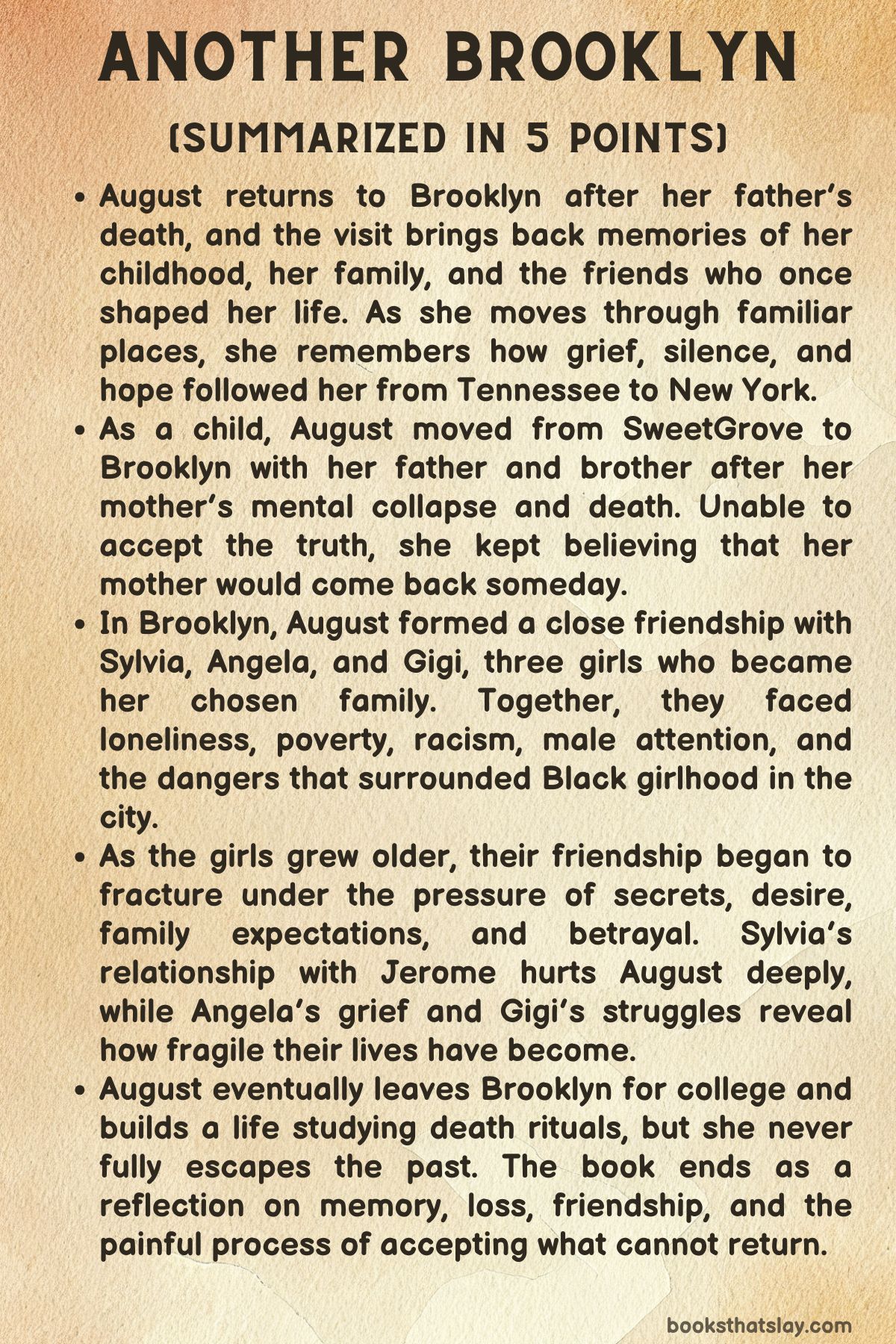
August returns to Brooklyn after her father’s death, and the visit brings back the friends, streets, secrets, and wounds that shaped her. The novel is less a straight timeline than a remembered life, moving between childhood hope and adult understanding.
Summary
The book follows August, an anthropologist who returns to Brooklyn after the death of her father. As an adult, she has built a life around studying death rituals in other cultures, perhaps because death and loss have shaped her own life from childhood.
Her father’s funeral does not break her as much as the return to Brooklyn itself. The streets, trains, buildings, and familiar faces bring back memories she has spent years carrying at a distance.
One of those faces is Sylvia, a girl who once belonged to August’s closest circle of friends. Seeing Sylvia again brings back the story of four girls: August, Sylvia, Angela, and Gigi.
August’s childhood begins far from Brooklyn, in SweetGrove, Tennessee. She lives there with her parents, her younger brother, and the shadow of family history.
Her mother’s family once had land, but debt, failed crops, taxes, and hardship weaken their hold on it. The death of August’s uncle Clyde in the war leaves her mother deeply shaken.
After that, her mother begins to hear Clyde’s voice. August’s father eventually takes August and her brother away to Brooklyn, leaving their mother behind.
August is very young, and she does not understand this separation as final. She believes her mother is coming soon.
That belief becomes one of the central lies she tells herself in order to survive.
In Brooklyn, August and her brother spend much of their early time watching the world from the apartment window. The city is strange, loud, and full of movement.
Black residents fill the streets in the style and energy of the 1970s, while many white families leave the neighborhood. August’s father tries to protect his children from poverty and danger, but his protection also leaves them isolated.
The children wait for their mother. August holds onto the idea that she will arrive any day.
When her brother breaks through the sealed apartment window and injures himself, August begins to feel the first serious crack in that belief. If her mother were really coming, August thinks, surely she would have come then.
After her brother’s injury, August is allowed more freedom. She begins school and becomes aware of three girls who seem almost magical to her: Sylvia, Angela, and Gigi.
They are always together, beautiful and confident in a way August longs to understand. Sylvia eventually notices August watching them and asks whether she is motherless.
August denies it, but Sylvia seems to understand something deeper. She tells August that she belongs to them now.
From that moment, the girls become August’s chosen home.
Each girl carries her own burden. Sylvia is from a family of Martinican immigrants.
Her father is educated and ambitious, and her parents expect her to become a lawyer. She is intelligent, polished, and admired by the others.
Her home has books, piano lessons, French language, and strict expectations. Yet that world also judges August, Angela, and Gigi, making them feel poor, rough, and unwanted.
Gigi comes from South Carolina and dreams of becoming an actress. Her mother encourages her beauty and talent but also warns her about the darkness of her skin, telling her to stay out of the sun.
Gigi does not accept the shame others attach to her complexion. She sees herself as beautiful, and her friends support her.
Angela is a gifted dancer, but she is guarded about her past. She claims she has no history, and when the girls ask about her mother, she breaks down.
Her silence hides pain that the others can sense but cannot fully reach.
August’s own family life is marked by absence. Her father tries to provide, taking the children to Coney Island and making sure they eat, but the loss of her mother shapes every room of the apartment.
A woman named Jennie moves into the building, and August and her brother imagine that her presence means their mother’s return is near. Instead, Jennie brings more evidence of adult sadness and neglect.
Her children appear hungry and frightened, and August hears their crying through the building. She turns up the radio rather than face what is happening.
As the girls grow older, Brooklyn becomes both playground and threat. Men begin to notice their changing bodies.
The girls learn early that the streets are not safe for them. They hear stories about men who prey on girls, teachers who cross boundaries, and young women who are harmed or disappear.
When Gigi is assaulted by a veteran who lives under her building, the friends respond with rage and helpless devotion. They want to protect her and even imagine revenge, but they are still children.
Their friendship becomes their defense against a world that treats Black girls as vulnerable and disposable.
August’s father joins the Nation of Islam, influenced first by men in the neighborhood and later by Sister Loretta. The family’s home changes.
Pork and certain foods are rejected, prayers become part of daily life, and Sister Loretta teaches August discipline, cleaning, and faith. August becomes attached to her, but she never fully surrenders her old self.
She refuses to wear a hijab and continues to long for her mother. Her father’s faith gives him a structure for grief, but August finds more comfort in her friendships than in religion.
During adolescence, the bond between the four girls becomes intense and complicated. They tell each other secrets, share the news of their periods, practice kissing, whisper love, and imagine futures.
Their closeness is emotional, physical, protective, and sometimes confusing. August especially admires Sylvia and wants to see the world as Sylvia sees it.
Sylvia represents a future that looks more secure than August’s own. Yet class differences and family expectations begin to strain the group.
Sylvia’s father increasingly sees the other girls as bad influences. Gigi is accepted into a performing arts high school in Manhattan.
Sylvia attends a private school. The girls are still connected, but the world is already pulling them in different directions.
August also begins a relationship with Jerome. Their attraction grows in parks and hidden places, even as August remembers religious lessons about treating her body as sacred.
Like the other girls, she is curious, excited, and afraid. Stories of pregnancy and punishment follow them.
The girls test the limits of desire while knowing that one mistake could change everything.
A major turning point comes when Angela’s mother is found dead on the roof of a housing project. August realizes that a woman she had seen before, a drug-addicted woman on the street, was Angela’s mother.
Angela cannot deny the death the way August has denied her own mother’s absence. Soon after, August is forced to face the truth she has avoided for years.
Her father tells her that her mother will not return until the resurrection. August finally remembers what happened: her mother drowned herself.
The urn in the apartment, which August had repeatedly asked about, contains her mother’s ashes. The fact she has pushed away becomes impossible to escape.
The friendship begins to break. Sylvia and Jerome start seeing each other after August refuses to have sex with him.
For August, the betrayal is devastating. Sylvia had been her closest friend, almost an ideal, and Jerome had been her first serious desire.
Their relationship makes August withdraw. She throws herself into school and prepares to leave Brooklyn.
When she sees Sylvia again months later, Sylvia is pregnant. The circle that once felt unbreakable is now damaged beyond repair.
Gigi also suffers a terrible fall. She invites the girls to see her in a drama club production, but August, Sylvia, and Angela do not attend.
During the performance, Gigi’s voice cracks, and the audience laughs at her. Later, at a cast party at the Chelsea Hotel, Gigi jumps from the roof and dies.
August carries guilt over not being there. Gigi’s death becomes another loss that August cannot fully settle inside herself.
August eventually leaves Brooklyn for Brown University, where she reinvents herself as Auggie. She sleeps with men, listens to jazz, and begins to understand that music can hold sorrow in a way ordinary speech cannot.
Jazz gives her a language for the pain she and her friends lived through. She later travels widely and studies other cultures, but emotional distance follows her.
Lovers accuse her of being closed off. She has left Brooklyn, but she has not left behind the girl she was there.
The novel also returns to SweetGrove, where August’s father takes her and her brother when she is sixteen. The family home is gone, replaced by weeds and absence.
At the water, August understands more fully that her mother is dead and that the past cannot be restored. SweetGrove is no longer home.
Brooklyn, too, has become memory.
In the present, after her father’s funeral, August speaks with her brother. He asks why she always said their mother was coming back.
August answers simply that she believed it. That belief was not only denial; it was a child’s way of staying alive.
She also remembers seeing Angela on television during her freshman year at Brown and realizing that Angela had made it out in her own way.
Another Brooklyn ends as a meditation on memory, friendship, and the cost of survival. August looks back on the girls they were: beautiful, lonely, endangered, and briefly held together by love.
Their friendship could not save them from every harm, but it gave them a home when their families, neighborhoods, and futures were uncertain. The book shows how childhood does not disappear.
It becomes part of the adult self, returning in flashes, voices, songs, streets, and faces from long ago.
Characters
August
August is the central consciousness of Another Brooklyn, and the book presents her as both a remembering adult and a wounded girl. As a child, she is shaped by displacement, silence, and the unfinished grief surrounding her mother’s absence.
Her move from SweetGrove, Tennessee, to Brooklyn removes her from a rural family history and places her in a city where she feels both fascinated and unsafe. August’s most defining trait is her need to believe in return.
For years, she tells herself that her mother is coming back, even when the adults around her know that this is impossible. This belief is not simple innocence; it is a survival method.
By refusing the truth, she protects herself from a loss too large for a child to hold.
As she grows, August becomes observant, hungry for attachment, and deeply dependent on friendship. Sylvia, Angela, and Gigi become the family she chooses when her own home feels hollow.
Through them, she learns beauty, loyalty, fear, desire, and betrayal. Yet August is also emotionally guarded.
Even in adulthood, after becoming an anthropologist who studies death rituals, she remains someone who understands grief intellectually more easily than she can face it personally. Her adult life suggests escape, but not healing.
She leaves Brooklyn, studies, travels, and takes lovers, yet her memories remain powerful. August is a character built out of absence: an absent mother, an emotionally distant father, lost friends, and a vanished home.
Her journey is not about forgetting pain, but about finally naming it.
Sylvia
Sylvia is one of the most magnetic figures in the book. To August, she represents elegance, intelligence, confidence, and possibility.
Sylvia comes from a Martinican family that values education, refinement, and professional ambition. Her father expects her to become a lawyer, and her home life appears more stable and cultured than the lives of her friends.
She reads advanced books, speaks French, takes lessons, and moves through the world with a sense of promise that August envies. Because of this, Sylvia becomes more than a friend to August; she becomes a symbol of the future August wishes she could enter.
Yet Sylvia is not only privileged or idealized. She is also trapped by expectation.
Her family’s ambition creates distance between her and the other girls, especially when her father begins to see them as unsuitable companions. Sylvia’s social position gives her opportunities, but it also separates her from the shared vulnerability that first bound the group together.
Her betrayal of August through Jerome marks a painful shift in the friendship. It shows that the girls’ bond, however intense, cannot remain untouched by jealousy, sexuality, class pressure, and growing independence.
Sylvia’s pregnancy later becomes a sign of how quickly girlhood can be interrupted. In Another Brooklyn, Sylvia is both dream and disappointment, someone August loves deeply but cannot keep unchanged.
Angela
Angela is the most secretive of the four girls, and her silence gives her character a haunting quality. She is talented, especially as a dancer, and she carries herself with beauty and grace.
Yet beneath that grace is a history she refuses to explain. When her friends ask about her mother, Angela breaks down, suggesting that her pain is too raw or shameful for language.
Her statement that she has no history is one of the clearest signs of how trauma can make a person feel cut off from origin, family, and identity.
Angela’s relationship with her mother becomes one of the saddest parts of her character. The discovery that her mother is a drug-addicted woman whom August had seen on the street forces the girls to confront a reality they had only partly understood.
Angela cannot protect herself with fantasy the way August does. When her mother dies, Angela must face loss directly.
Her grief exposes the difference between denial and knowledge: August can keep imagining her mother’s return, but Angela is given proof that her mother is gone. Still, Angela is not defined only by suffering.
Her later success on television suggests resilience and escape. She becomes a figure of survival, showing that even a girl marked by secrecy and family pain can move toward a larger life.
Gigi
Gigi is vivid, ambitious, and full of performance. She wants to be an actress, and that dream gives her character both brightness and fragility.
She comes from South Carolina and brings with her a sense of self that resists the colorism imposed by others. Her mother warns her not to let her skin get darker, but Gigi sees beauty in herself, and her friends affirm that beauty.
This makes her an important figure in the book’s treatment of Black girlhood: she is aware of judgment, but she also possesses a strong desire to be seen, admired, and celebrated.
Gigi’s life also reveals how cruel the world can be to girls who dream publicly. Her assault by the veteran under her building shows the danger surrounding the girls even before they fully understand it.
Later, her acceptance into a performing arts school seems like a step toward escape, but it also moves her away from the protective circle of friendship. Her final crisis after being laughed at during a performance is devastating because it strikes at the core of who she wants to become.
Gigi longs for recognition, but humiliation destroys the space where she feels most alive. Her death becomes one of the book’s deepest wounds.
She represents talent, beauty, vulnerability, and the terrible cost of being unsupported at the moment one most needs love.
August’s Father
August’s father is a complicated figure because he is both protector and source of emotional damage. He takes August and her brother away from Tennessee after their mother’s mental collapse, and his decision is partly an act of survival.
In Brooklyn, he feeds his children, takes them to Coney Island, and tries to maintain a sense of order despite poverty and grief. He is not careless in a simple way; he is a man struggling to hold a family together after a tragedy he does not know how to explain.
At the same time, his silence harms August. By refusing to tell her plainly what happened to her mother, he leaves her trapped in false hope.
His anger when she asks about the urn shows his own inability to face grief openly. He turns to the Nation of Islam and finds structure, discipline, and spiritual meaning there.
Faith helps him rebuild his life, but it does not fully bridge the emotional distance between him and his daughter. His character reflects the limits of parental protection.
He can remove his children from one danger, but he cannot save them from confusion, loneliness, or the pain caused by hidden truths.
August’s Mother
August’s mother is physically absent for most of the story, but she shapes nearly everything August feels and remembers. Her death is the central loss around which August’s childhood is organized.
Before Brooklyn, she is connected to SweetGrove, land, family history, work, and the burden of survival. She carries the collapse of that family world heavily, especially after Clyde’s death.
Her mental distress, including hearing Clyde’s voice, reveals a woman overwhelmed by grief, poverty, and the destruction of the life she knew.
For August, her mother becomes less a complete person than a promise. The idea that she is “coming tomorrow” allows August to avoid accepting death.
Her mother’s warning that women cannot be trusted also echoes throughout August’s friendships. The warning is challenged by the love August finds with Sylvia, Angela, and Gigi, but it also returns when those friendships fracture.
In this way, August’s mother influences both August’s longing and her fear. She represents love, loss, inheritance, mental suffering, and the painful way children preserve parents through memory even when they do not fully understand them.
August’s Brother
August’s brother is important because he shares the same family wound but responds to it differently. As children, he and August wait together, watch Brooklyn together, and try to understand their mother’s absence from inside the same apartment.
His injury after breaking through the sealed window becomes a turning point. It is as if the trapped life inside the apartment finally breaks into physical harm.
For August, that moment begins to weaken her belief that their mother will return.
As he grows older, August’s brother becomes more closely aligned with their father’s religious faith. Unlike August, who becomes an anthropologist and seeks meaning through study, he remains devout.
This difference shows how siblings can inherit the same grief but build different lives from it. His adult conversation with August after their father’s death is especially important because it forces her to explain why she kept saying their mother would come back.
His question carries the weight of shared childhood confusion. He is not as central as August, but he serves as a mirror to her.
Through him, the book shows another possible response to loss: faith, family continuity, and a more direct acceptance of the life their father chose.
Sister Loretta
Sister Loretta enters the family’s life as a force of discipline, faith, and change. She represents the Nation of Islam’s promise of order in a home unsettled by grief.
When she arrives, she does not simply offer comfort; she changes habits, food, prayer, cleanliness, and daily structure. She teaches August how to clean and how to participate in a new religious order.
For August’s father, Sister Loretta helps mark the beginning of a transformed life.
For August, Sister Loretta is more complicated. She becomes attached to her and finds some comfort in her presence, but she does not fully accept everything Sister Loretta represents.
August’s refusal to wear a hijab suggests resistance to being remade entirely. Sister Loretta gives August a form of maternal guidance, but she cannot replace August’s mother.
Her care is real, yet it exists inside a religious framework August does not completely trust. Sister Loretta’s character matters because she shows how communities attempt to repair broken families.
She brings structure where there has been emotional disorder, but structure alone cannot answer every grief.
Sister Sonja
Sister Sonja appears as someone meant to guide August through emotional and spiritual trouble. August’s father sends her to Sister Sonja when he senses that she needs help, especially as adolescence and pain become harder to manage.
Sister Sonja represents formal counsel, religious authority, and the adult world’s attempt to intervene. Yet August makes it clear that her true comfort comes less from Sister Sonja than from her friendships.
This does not make Sister Sonja unimportant. Her presence shows that August’s father is not entirely blind to his daughter’s suffering.
He knows she needs someone to speak with, even if he cannot be that person himself. Sister Sonja also becomes part of August’s later memory of recognition, especially when August connects her return to Tennessee with the realization that her mother is truly dead.
Sister Sonja’s role is quiet, but she helps reveal the distance between adult solutions and a child’s emotional needs. Guidance is offered, but August’s deepest wounds remain tied to memory, friendship, and the truth about her mother.
Jerome
Jerome represents August’s early experience of desire, romance, and betrayal. He is her first boyfriend, and her relationship with him opens a new part of adolescence.
With Jerome, August begins to test the boundaries between religious teaching, bodily desire, and personal choice. She wants closeness but also holds back, aware of the risks surrounding sex, pregnancy, and reputation.
Her hesitation is not weakness; it shows her attempt to protect a self that already feels fragile.
Jerome’s importance grows when he becomes involved with Sylvia. This betrayal is devastating because it wounds August in two places at once: her romantic life and her closest friendship.
Jerome is not developed with the same depth as the four girls, but his role is crucial. He helps expose the instability of the friendship circle once sexuality enters it.
He also shows how young men can move through the girls’ lives in ways that leave emotional damage behind. In Another Brooklyn, Jerome is less a great love than a catalyst for August’s disillusionment.
Jennie
Jennie is a secondary character, but she adds an important layer to the book’s picture of Brooklyn life. When she moves into August’s building, August and her brother attach hope to her presence, imagining that she somehow signals their mother’s return.
That hope says more about the children than about Jennie. They are so desperate for a maternal figure that any woman entering their space becomes part of their fantasy.
Jennie’s actual life is troubling. She brings men home, leaves her children in August’s care, and returns looking unwell and exhausted.
Her children’s hunger and crying expose another version of neglect inside the building. August hears their suffering but turns up the radio, a small action that reveals how children sometimes learn to survive by blocking out pain they cannot fix.
Jennie is not presented simply as a villain. She appears as another woman worn down by poverty, desire, and instability.
Through her, the book shows that adult womanhood in August’s world can look frightening, tired, and unsafe, especially to a girl already grieving her mother.
Clyde
Clyde, August’s uncle, is mostly remembered through his effect on August’s mother. His death in war becomes one of the events that breaks the family’s earlier life.
After he dies, August’s mother begins hearing his voice, and the family’s connection to SweetGrove continues to weaken. Clyde is connected to land, inheritance, and the history that August loses when her father takes the children to Brooklyn.
Although Clyde does not appear as an active character in August’s Brooklyn life, his absence matters. He represents the way historical forces enter private families.
War, economic hardship, and the loss of land are not background events; they shape August’s mother’s mind and August’s childhood. Clyde’s death contributes to the grief that eventually leads to August’s mother’s suicide.
His character reminds readers that August’s story does not begin in Brooklyn alone. It begins with older losses, family burdens, and a Southern past that continues to echo after the family leaves it behind.
Themes
Memory and the Shape of the Past
Memory in Another Brooklyn does not move in a neat line. It returns in fragments, images, voices, and sudden recognitions.
August’s adult self remembers childhood not as a complete record but as a series of emotionally charged moments: watching from the window, seeing the girls outside, hearing sounds through apartment walls, touching the urn, and meeting Sylvia years later. This structure reflects the way trauma often works.
The past is not gone simply because time has passed. It remains stored in the body and mind, waiting for a place, face, or death to bring it forward again.
August’s profession as an anthropologist gives her intellectual language for death and ritual, but her own memories resist easy explanation. She can study how other cultures mourn, yet still struggle to understand how she survived her own losses.
The book treats memory as both painful and necessary. Without memory, August might be spared suffering, but she would also lose the girls, her mother, SweetGrove, and the child she once was.
Remembering becomes a form of truth-telling, even when the truth arrives late.
Girlhood, Friendship, and Chosen Family
The friendship among August, Sylvia, Angela, and Gigi is one of the book’s emotional centers. Their bond gives each girl a form of shelter that her family or neighborhood cannot fully provide.
They recognize one another’s beauty, protect one another from male attention, share secrets, and create a private language of loyalty. For August especially, the group becomes a replacement for the mother and home she has lost.
Sylvia’s declaration that August belongs to them gives her a new identity at a time when she feels rootless. Yet the book does not romanticize friendship as something pure or permanent.
The girls love one another deeply, but they are also pressured by class differences, ambition, sexuality, family expectations, and personal pain. Sylvia’s betrayal, Gigi’s isolation, and Angela’s guarded grief show that friendship can comfort without being able to save everyone.
Their bond is powerful because it is temporary and real. It gives the girls a way to survive childhood, even though adulthood, loss, and betrayal eventually pull them apart.
Grief, Denial, and Survival
August’s belief that her mother is coming back is one of the clearest examples of denial in the story. As a child, she cannot accept the finality of death, so she builds a version of reality in which her mother’s return is always near.
This denial protects her, but it also delays her understanding of herself and her family. Her father’s silence deepens the problem.
By refusing to explain the truth clearly, he leaves August alone with imagination, confusion, and false hope. Grief appears in many forms throughout the book.
Angela faces the death of her mother with a terrible directness. Gigi’s death leaves August with guilt and sorrow.
August’s father turns toward religion. August turns toward study, travel, and emotional distance.
These different responses show that survival is not the same as peace. People continue living, but they carry what happened to them in hidden ways.
The book suggests that grief must eventually be named, even if naming it does not remove the pain.
Race, Gender, and Vulnerability in the City
Brooklyn is not only a setting; it is a force that shapes the girls’ lives. The city offers movement, style, music, friendship, and possibility, but it also exposes Black girls to danger.
August and her friends grow up knowing that their bodies attract attention before they are ready for it. Men call to them, teachers and strangers behave threateningly, and stories of assaulted or murdered girls become part of their understanding of the world.
Their linked arms are not just signs of affection; they are acts of defense. Race and gender also shape how the girls see themselves.
Gigi faces colorism, Sylvia’s family distances itself from Black American poverty, and August watches white families leave the neighborhood as Brooklyn changes. The girls’ beauty does not protect them.
In some ways, it makes them more visible and more vulnerable. The book presents girlhood as a state of wonder and danger at the same time.
To grow up Black and female in this Brooklyn is to learn early that freedom must be guarded, and that safety is never guaranteed.