America’s First Daughter Summary, Characters and Themes
America’s First Daughter is a historical novel by Stephanie Dray and Laura Kamoie about Martha “Patsy” Jefferson Randolph, the eldest daughter of Thomas Jefferson. The book follows Patsy from childhood through old age as she protects her father’s reputation, manages family crises, and tries to define herself beyond duty.
Set against the American Revolution, the French Revolution, the early republic, and the long shadow of slavery, the novel presents public history through a private life. It is a story about loyalty, silence, sacrifice, love, ambition, and the cost of preserving a famous man’s legacy.
Summary
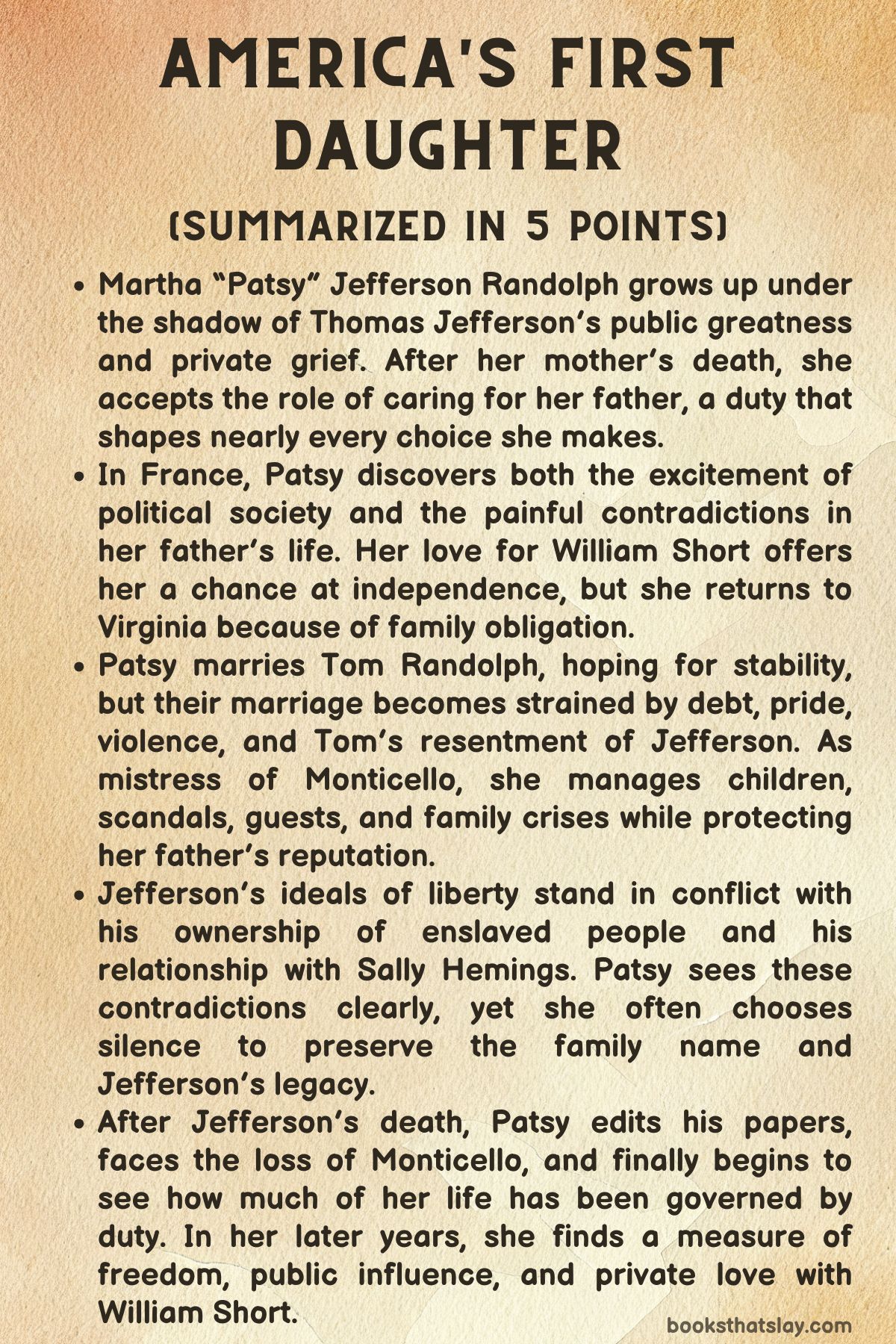
America’s First Daughter begins at the end of Thomas Jefferson’s life, when his daughter Patsy sorts through his papers after his death. She understands that letters can shape how a person is remembered, and she takes on the heavy task of protecting her father’s name.
In doing so, she also hides truths that could damage his image, especially the long relationship between Jefferson and Sally Hemings, the enslaved half-sister of Patsy’s late mother. From the start, Patsy knows that daughters of powerful men are often asked to give up parts of themselves so that history can remember those men kindly.
The story then turns back to Patsy’s childhood during the American Revolution. Her family is forced to flee when British soldiers threaten to capture Jefferson.
This early fear teaches Patsy that silence and even lies can sometimes protect those she loves. Soon after, her mother dies after childbirth, leaving Patsy with a command that shapes the rest of her life: she must watch over her father.
Jefferson nearly breaks under grief, and Patsy, still a child, becomes his emotional support. She learns to hide her own pain because she believes her father’s suffering matters more.
Jefferson eventually accepts a diplomatic post in France and takes Patsy with him. Paris opens a new world to her.
She studies in a convent school, meets Abigail Adams, and begins to see the power of education, manners, and political society. Yet France also exposes her to disappointment.
Jefferson becomes attached to Maria Cosway, a married woman, and Patsy feels that he has betrayed her mother’s memory. Her feelings grow more complicated when her younger sister Polly arrives in Paris with Sally Hemings.
Patsy soon discovers Jefferson’s sexual relationship with Sally, who is enslaved, young, and closely connected to Patsy’s mother. Patsy is shocked by the moral contradiction between her father’s ideals of liberty and his private conduct.
During this time, Patsy falls in love with William Short, Jefferson’s secretary. William is intelligent, principled, and opposed to slavery, and he offers Patsy a future based on shared ideals.
For a time, she imagines choosing love and independence. But Jefferson depends on her deeply, and he steers her away from William, preferring that she marry into Virginia’s landed class.
Patsy nearly chooses life as a nun, then abandons that idea after realizing she loves William. Still, when the French Revolution turns Paris dangerous and the family returns to Virginia, she leaves William behind.
She believes she must help settle her father and family at Monticello, but William warns that Jefferson will never truly release her from duty.
Back in Virginia, Patsy marries Thomas Randolph Jr., known as Tom. At first, she sees the marriage as practical.
Jefferson’s finances are unstable, and Tom offers social standing and property. Their relationship grows into affection, but Tom is troubled by family wounds, money problems, pride, and a violent temper.
Patsy becomes mistress of Monticello, managing the household, raising children, and protecting both Jefferson and Tom from scandal. Her life becomes a constant balance between public reputation and private distress.
The Randolph family brings new scandals and sorrows. Tom’s sister Nancy is accused in a shocking case involving seduction, abortion, and the death of an infant.
Patsy lies in court to protect Nancy and the family name. Tom is later disinherited by his father, a blow that damages his confidence and deepens his resentment.
Meanwhile, Jefferson returns to national politics, eventually becoming president. Patsy becomes not only the daughter of a president but also the wife of a congressman, expected to serve the family’s ambitions while managing endless pregnancies and household duties.
As Jefferson’s presidency rises, so do attacks against him. Newspapers accuse him of keeping Sally Hemings as his concubine.
Patsy urges him to answer the charge, but Jefferson refuses, trusting silence to protect him. Patsy goes to Washington to support him and becomes skilled at political society.
With help from Dolley Madison, she learns that dinners, visits, and social grace can influence public affairs as much as speeches. She becomes her father’s defender in drawing rooms, using her presence to steady his reputation.
Private grief continues. Polly dies after childbirth, repeating the pattern of their mother’s death and leaving Patsy devastated.
Tom’s temper worsens. He strikes Patsy more than once, then shows shame, but the damage remains.
Their marriage becomes marked by love, anger, fear, and dependence. Their children grow up amid the pressure of Monticello, debt, and public duty.
Patsy’s daughter Ann marries Charles Bankhead, a violent drunk who abuses her and later nearly kills members of the family. Patsy increasingly sees that women are expected to endure pain for the sake of family honor, even when that endurance destroys them.
After Jefferson retires, Monticello becomes crowded with relatives, visitors, debts, and memories. Patsy’s body is worn down by repeated childbirth.
Tom seeks political success and becomes governor of Virginia, even speaking of ending slavery in the state, but his hopes are damaged by money troubles and instability. Jefferson continues to free some of Sally’s children as they reach adulthood, fulfilling promises made long ago, but the reality is painful for Sally, who must watch them leave in order to live freely.
As the family’s debts grow, land and enslaved people must be sold. Tom resents Jefferson’s dominance in Patsy’s life and feels trapped in the older man’s shadow.
Patsy grows afraid that Tom’s anger has become madness. William Short returns, and Patsy realizes that their love has endured.
Tom’s jealousy drives William away, and Patsy again chooses duty over escape. Even when General Lafayette visits Monticello and challenges Jefferson over slavery, the house remains a place of contradiction: liberty is praised, while enslaved people still carry the burden of that world.
Jefferson’s final years are marked by financial ruin. He tries to save Monticello through a lottery, but the plan fails.
He dies on July 4, the same day as John Adams, and Patsy must again hold herself together in public. After his death, she edits and prepares his letters, shaping his legacy just as she always has.
Monticello is eventually lost, its property and enslaved people sold. Sally is freed and leaves with her remaining children.
Tom, ill and broken, reconciles with Patsy before his death and asks to be buried near Jefferson, still beneath his shadow.
At last, Patsy finishes her father’s papers. William returns and tells her that Monticello is no longer a home but a chain.
For the first time, Patsy allows herself to break down. She sees how much of her life has been spent serving others: father, husband, children, family reputation, and national myth.
Leaving Monticello becomes an act of release.
In the final stage of her life, Patsy lives in Washington with her daughter’s family. President Andrew Jackson asks for her help in managing political society because he lacks a wife to fill that role.
Patsy once again becomes a powerful female presence in public life. She keeps a private romantic bond with William, honoring a promise not to remarry while still claiming love for herself.
The novel closes with Patsy riding a railway train, moved by the promise of movement and change. After a lifetime shaped by duty, she finally turns toward possibility.
Characters
Martha “Patsy” Jefferson Randolph
Patsy is the center of America’s First Daughter, and her character is defined by a lifelong struggle between duty and selfhood. As a child, she is forced into emotional adulthood after her mother dies and leaves her with the charge of caring for Thomas Jefferson.
That promise becomes the foundation of her identity. She learns to silence her own needs, hide her pain, and act as the stabilizing force for the men around her.
Patsy’s loyalty is sincere, but it also traps her. She protects Jefferson’s reputation, manages Monticello, supports his political life, and later shapes his written legacy.
Her intelligence is clear in the way she understands politics, family honor, social influence, and public perception. Yet she often uses that intelligence in service of others rather than herself.
Her love for William Short represents the life she might have chosen, while her marriage to Tom Randolph represents the compromises demanded by class, family, and duty. By the end, Patsy’s tears and departure from Monticello mark a delayed but powerful act of self-recognition.
She has spent most of her life preserving other people’s stories, and only late in life does she begin to claim her own.
Thomas Jefferson
Thomas Jefferson appears as both a great public figure and a deeply flawed private man. He is brilliant, charming, learned, politically gifted, and capable of inspiring fierce devotion.
To Patsy, he is not only a father but also a cause. His grief after his wife’s death makes him dependent on his daughter in ways that shape her entire life.
Jefferson’s ideals about liberty stand in painful contrast to his role as a slaveholder and to his relationship with Sally Hemings. He speaks and writes about freedom, yet he avoids fully confronting the bondage within his own household.
His emotional needs often override Patsy’s independence. He discourages her relationship with William, draws her back into his life whenever he feels abandoned, and relies on her to defend his reputation.
The novel does not reduce him to a villain; instead, it presents him as a man of extraordinary intellect, deep contradictions, and moral evasions. His greatness is real, but so is the cost paid by the people around him, especially Patsy and Sally.
His legacy is not simply inherited; it is edited, protected, and partly concealed by his daughter.
Sally Hemings
Sally Hemings is one of the most important and morally revealing characters in the story. She is enslaved, yet she possesses a quiet strength that challenges the power structures surrounding her.
Her relationship with Jefferson exposes the painful contradiction at the heart of the household: a man celebrated for liberty keeps intimate power over an enslaved woman. Sally is not portrayed as merely passive.
She understands the limits of her world and negotiates within them to secure freedom for her children. Her decision to return from France to Virginia shows the complex pressures placed on her, especially because France offers a possibility of freedom that Virginia does not.
Sally’s motherhood becomes central to her character. Her deepest concern is not public reputation but the future of her children.
Her grief when they must leave in order to live freely reveals the cruel bargain forced upon enslaved families. To Patsy, Sally is at once a reminder of family ties, slavery, betrayal, and hidden truth.
Sally’s presence forces the reader to see what polite society tries to hide.
William Short
William Short represents the path Patsy might have taken if love, principle, and independence had mattered more than family duty. He is thoughtful, principled, and intellectually compatible with Patsy.
Unlike many Virginia men in the novel, he openly questions slavery and imagines a more equal society. His love for Patsy is steady, but it is also marked by frustration because he recognizes how fully Jefferson controls her life.
William sees that Patsy’s devotion to her father will prevent her from becoming fully free unless she chooses to break away. His warning that she cannot be both Jefferson’s devoted daughter and a wife with an independent life proves painfully accurate.
Over the years, William becomes a symbol of emotional truth. When he returns later in life, he sees Patsy not as a political daughter, wife, or household manager, but as a woman who has been bound by duty for too long.
His final role is not simply romantic; he helps Patsy understand that Monticello has become a chain rather than a home. Through William, the novel gives Patsy a mirror in which she can finally see her own lost desires.
Thomas “Tom” Randolph Jr.
Tom Randolph is a tragic and troubling figure whose charm gradually gives way to anger, insecurity, and violence. At first, he offers Patsy a socially acceptable marriage and a connection to Virginia’s landed world.
Their relationship grows into genuine tenderness, and for a time Patsy sees in him a man who understands family duty better than William does. Yet Tom is deeply damaged by his father’s rejection and by the weight of comparison with Jefferson.
His disinheritance wounds his pride and feeds a lifelong sense of inadequacy. He wants to be respected as a planter, politician, husband, and father, but repeated failures make him bitter.
His violence toward Patsy reveals the danger beneath his wounded pride. He is not simply cruel; he is also weak, ashamed, jealous, and increasingly unstable.
His desire to step out of Jefferson’s shadow becomes impossible because he has married a woman whose life is tied to that shadow. Tom’s final wish to be buried near Jefferson shows the sadness of his character.
Even in death, he remains defined by the man he resented.
Polly Jefferson
Polly Jefferson serves as a gentler and more vulnerable contrast to Patsy. Separated from her father and sister for years, she arrives in France emotionally distant from them and more attached to Sally, who has cared for her during the journey.
This distance wounds Patsy, who has long imagined reuniting the family as a way of fulfilling her mother’s dying wish. Polly’s life shows another version of womanhood shaped by marriage, childbirth, and limited choices.
She does not carry the same public burden that Patsy does, but she is still subject to the physical dangers and social expectations of her time. Her death after childbirth echoes the death of her mother and deepens the novel’s repeated connection between female sacrifice and family continuity.
Polly’s loss also leaves Patsy more alone. With her sister gone, Patsy has fewer emotional equals and becomes even more responsible for holding the family together.
Polly’s character may be quieter than Patsy’s, but her life and death sharpen the novel’s attention to the dangers women faced in private domestic spaces.
Martha Wayles Jefferson
Martha Wayles Jefferson, Patsy’s mother, appears only briefly in the living action of the story, but her influence is enormous. Her dying request that Patsy care for Jefferson becomes the moral command that governs Patsy’s life.
Martha’s absence is almost as powerful as her presence. She becomes an idealized figure in Patsy’s mind, a symbol of family love, female suffering, and unfinished duty.
Jefferson’s grief over her death nearly destroys him, and Patsy responds by becoming the emotional substitute who keeps him alive. Martha also matters because of her connection to Sally Hemings, her enslaved half-sister.
This family relationship makes Jefferson’s later relationship with Sally even more disturbing to Patsy. Martha’s death creates the vacancy that both Patsy and Sally are forced, in different ways, to occupy.
Through Martha, the novel shows how the dead can continue to command the living. Patsy’s devotion to her mother’s memory is noble, but it also becomes one of the reasons she denies herself freedom for so long.
Ann Randolph Bankhead
Ann Randolph Bankhead, Patsy’s daughter, reflects the generational consequences of women being taught to endure suffering for the sake of family reputation. Her marriage to Charles Bankhead becomes a brutal warning about the dangers of dependence and social silence.
Ann is trapped with a violent, drunken husband, and even Jefferson’s disapproval does not translate into a clear declaration that she has the right to leave. Her suffering shows how deeply social rules protect male authority, even when that authority becomes abusive.
Patsy’s fierce defense of Ann reveals a change in her own character. After years of accepting that men should handle public matters, Patsy becomes more willing to intervene directly when her children are in danger.
Ann’s death is one of the most devastating losses in the story because it confirms Patsy’s fear that female obedience can be deadly. Ann’s life also forces Patsy to confront the limits of the values she inherited.
Duty without self-protection can become a form of destruction.
Charles Bankhead
Charles Bankhead is one of the clearest examples of unchecked male violence in the novel. He enters the family through marriage to Ann, but rather than becoming a source of stability, he brings fear, shame, and danger.
His drunkenness and brutality threaten not only Ann but also the wider Jefferson-Randolph household. He nearly kills Patsy when denied liquor, beats Ann, and later wounds Jeff in a tavern quarrel.
Charles represents the social failure to restrain abusive men when family reputation and public appearance matter more than women’s safety. He is not given the complexity of Tom or Jefferson; his function is sharper and more direct.
He shows what happens when patriarchal privilege is joined with addiction, rage, and impunity. Patsy’s decision to speak sweetly to him after Ann’s death in order to gain control of the children reveals how skilled she has become at surviving male power.
With Charles, persuasion is not a matter of grace; it is a weapon used for protection.
Jefferson “Jeff” Randolph
Jeff Randolph, Patsy’s son, grows into a practical and responsible figure amid the family’s financial collapse. Unlike Tom, Jeff appears more capable of confronting economic reality, even when that reality is painful.
His decision to assume debts and sell property shows a hardheaded willingness to do what older generations have avoided. Yet he is also caught in the moral and material system he inherits.
Selling land and enslaved people becomes part of saving what remains of the family, and this places him inside the same contradictions that shaped Jefferson’s life. Jeff’s injury at Charles Bankhead’s hands also becomes a turning point for Patsy.
Seeing her son nearly dead changes her willingness to stand aside while men decide matters of justice and revenge. Jeff represents the next generation’s burden: he must manage the wreckage left by fathers and grandfathers, including debt, violence, slavery, and a famous name that cannot pay its own bills.
Ellen Randolph Coolidge
Ellen Randolph Coolidge is one of the characters through whom Patsy begins to rethink the meaning of duty. Ellen is devoted to her mother and grandfather, and she risks repeating Patsy’s pattern of self-denial.
Patsy recognizes this danger because she sees in Ellen the same loyalty that once bound her to Jefferson. Rather than encouraging Ellen to sacrifice herself, Patsy urges her toward happiness.
This is an important development in Patsy’s character. She cannot fully recover the freedom she lost in youth, but she can try to prevent her daughter from losing the same thing.
Ellen’s marriage offers a more hopeful vision of womanhood, one based not solely on family obligation but on choice. Her life suggests that change may occur through daughters who are taught differently.
In this sense, Ellen is not only a beloved child but also a sign of Patsy’s late wisdom.
Nancy Randolph
Nancy Randolph’s character reveals the cruelty of scandal in a society that judges women harshly while protecting male power. Accused in a sensational case involving sexual misconduct, pregnancy, and the death of a child, Nancy becomes an object of public suspicion and family shame.
Patsy initially views her situation through rumor and fear, but later learns that Nancy’s suffering is more complex than she understood. Nancy has been manipulated, trapped, and damaged by the actions of others.
Her plea to stay with Patsy after Polly’s death shows both vulnerability and a desire for belonging. Nancy’s presence forces Patsy to confront the gap between public stories and private truths.
Like several women in the novel, Nancy survives by enduring what society refuses to understand. Her character also reinforces the idea that reputation can become a prison, especially for women whose lives are judged by men’s versions of events.
Dolley Madison
Dolley Madison represents social intelligence as political power. She teaches Patsy that influence in the capital does not depend only on speeches, offices, or written arguments.
It also depends on hospitality, conversation, clothing, introductions, and the careful management of rooms. Dolley understands that women, though excluded from formal office, can still shape political outcomes through social life.
Her guidance helps Patsy become effective in Washington, where she defends Jefferson’s reputation and manages delicate political tensions. Dolley’s character broadens the novel’s view of power.
She shows that domestic and public spheres are not truly separate; the parlor can become an arena of statecraft. For Patsy, Dolley offers a model of womanly influence that is strategic rather than merely obedient.
She does not free Patsy from duty, but she gives her tools to turn duty into authority.
Abigail Adams
Abigail Adams appears as a maternal and instructive presence during Patsy’s early life in Paris. She quickly notices Patsy’s need for guidance and helps her adjust to diplomatic society.
Her care fills part of the emotional gap left by Patsy’s mother’s death. Abigail’s attention to clothing, manners, and public presentation is not superficial; it teaches Patsy that appearance carries political meaning, especially for women attached to powerful men.
Abigail also represents a different kind of female strength: practical, opinionated, intelligent, and socially aware. Her presence early in the novel helps Patsy understand that women can influence public life while still working within the expectations placed on them.
Though Abigail does not remain central throughout the story, her impact is lasting. She helps prepare Patsy for the role she will later play in Washington society.
Maria Cosway
Maria Cosway is important because she changes Patsy’s understanding of Jefferson. Before Maria, Patsy’s father remains almost sacred in her eyes, a grieving widower devoted to the memory of her mother.
His infatuation with Maria damages that image. Patsy sees him as a man capable of romantic vanity, secrecy, and emotional foolishness.
Maria herself is elegant, fascinating, and unreliable. She enjoys Jefferson’s attention but does not offer the permanence or emotional seriousness that he seems to desire.
To Patsy, Maria becomes a symbol of betrayal, not because she alone is at fault, but because Jefferson’s conduct forces Patsy to see him as flawed in ways she does not want to admit. Maria’s role prepares Patsy for the even more difficult discovery of Jefferson’s relationship with Sally.
Through Maria, the novel begins to separate Jefferson the idealized father from Jefferson the imperfect man.
James Hemings
James Hemings, Sally’s brother, represents enslaved talent constrained by ownership. In France, he becomes a skilled chef and sees a chance to claim freedom.
His demand for liberty challenges Jefferson directly and exposes the weakness of the idea that enslaved people can be “free in all but name.” James understands that skill, trust, and good treatment do not equal freedom. His negotiation with Jefferson shows both courage and practicality.
He must bargain for what should already be his by right. His situation also reveals how Jefferson’s household benefits from the labor and genius of enslaved people while delaying their independence.
James’s character adds weight to the novel’s treatment of slavery because he is not defined only by suffering. He has ambition, craft, and a clear understanding of his own worth.
General Lafayette
General Lafayette appears late in the story as a living reminder of revolutionary ideals. To Jefferson and Patsy, he belongs to the heroic world of their youth, a time when liberty seemed like a grand and noble cause.
Yet Lafayette’s visit also brings judgment. He challenges Jefferson over the continued existence of slavery in America, pointing out the failure of the nation to live up to its own promises.
His role is brief but meaningful because he speaks a truth that many others avoid. Lafayette’s presence contrasts memory with reality.
The men who helped change the world have grown old, but the work they claimed to begin remains unfinished. For Patsy, seeing Lafayette and Jefferson together is emotionally powerful, yet it also underscores the distance between revolutionary glory and moral completion.
Andrew Jackson
Andrew Jackson appears in the epilogue as a sign that Patsy’s public usefulness continues beyond Jefferson’s life. As a widower president, he needs a woman who can manage the social and political demands of Washington, and Patsy is uniquely suited to that role.
His request acknowledges her authority, experience, and reputation. By this stage, Patsy is no longer only Jefferson’s daughter.
She has become a political figure in her own right, respected for her ability to guide social life at the highest levels of government. Jackson’s presence also shows that Patsy’s life does not end with Monticello.
After decades of serving her father’s legacy, she still has a place in public affairs. In America’s First Daughter, this late recognition gives her a measure of independence, even though her life remains shaped by old promises and private secrets.
Themes
Duty and the Loss of Self
Patsy’s life is shaped by a promise made beside her mother’s deathbed, and that promise becomes both her moral purpose and her burden. She is taught early that loving her father means protecting him from grief, scandal, loneliness, and historical judgment.
This duty gives her strength, discipline, and influence, but it also limits her ability to ask what she wants. She gives up William, manages Jefferson’s household, defends his reputation in Washington, edits his papers, and stands between him and the consequences of his choices.
The tragedy is that Patsy’s sacrifices are often praised as virtue, even when they erase her individuality. Her silence becomes a family tool.
Her composure becomes public armor. Her intelligence is directed toward preserving male legacies rather than building her own.
Yet the novel does not treat duty as worthless. Patsy’s devotion is real, and her love for her family is sincere.
The problem is excess: duty becomes destructive when it allows no room for personal happiness. Her final departure from Monticello matters because it shows her recognizing that loyalty should not require lifelong captivity.
Public Legacy and Private Truth
Reputation is treated as something made, guarded, edited, and sometimes falsified. Jefferson believes letters preserve the truest record of a life, but Patsy knows that records can be shaped by what is saved and what is destroyed.
Her work after his death reveals one of the central tensions of America’s First Daughter: history often depends on the people willing to hide its most uncomfortable facts. Jefferson’s public image as a philosopher of liberty conflicts with private realities involving slavery, debt, emotional dependence, and sexual secrecy.
Patsy understands the gap between the man celebrated by the nation and the man known inside Monticello. Her decision to protect him is not simple dishonesty; it comes from love, fear, family loyalty, and an awareness that public memory can be merciless.
Still, the cost is severe. Sally’s story, Patsy’s suffering, Tom’s resentment, and the family’s moral contradictions are all pushed beneath the official version.
The theme asks whether legacy built on silence can ever be complete. It also shows that preserving a hero can mean sacrificing the truth of everyone around him.
Slavery and the Contradictions of Liberty
The novel repeatedly places the language of freedom beside the reality of enslavement. Jefferson writes about liberty, helps found a nation, and speaks as a champion of human rights, yet his own household depends on enslaved labor.
This contradiction is not treated as background; it shapes the emotional and moral structure of the story. Sally Hemings, James Hemings, Beverly, and the other enslaved people at Monticello reveal the human cost of ideals left unfinished.
France becomes especially important because slavery is not legal there, making freedom seem close enough to touch. James demands his liberty, and Sally negotiates for her children’s future, showing that enslaved people are not passive symbols but active moral agents.
Patsy sees the contradiction clearly at moments, but she often chooses family preservation over justice. Her discomfort does not become full resistance, which makes her morally complex.
The sale of enslaved people during the family’s financial collapse further exposes how slavery turns human lives into assets. The theme insists that the American promise of freedom is incomplete when built on bondage.
Women, Power, and Survival
Women in the novel live within systems that deny them formal authority while demanding constant sacrifice. Patsy, Sally, Polly, Ann, Nancy, Dolley Madison, and Abigail Adams all show different forms of female survival.
Some survive through silence, some through social intelligence, some through negotiation, and some through endurance. Patsy’s power grows from her ability to manage households, reputations, political gatherings, and emotional crises, but that power is often unpaid, unofficial, and unrecognized.
Dolley Madison teaches her that social spaces can influence national politics, turning dinners and visits into instruments of power. Sally uses the limited leverage available to her to secure freedom for her children.
Nancy’s life shows how easily women can be ruined by scandal, while Ann’s fate shows the deadly consequences of marital abuse in a society reluctant to defend wives against husbands. The novel presents women’s strength without romanticizing their suffering.
Their resilience is impressive, but it is required because the world around them is unjust. Female power exists, but it often works through indirect means because direct freedom is denied.