All We Ever Wanted Summary, Characters and Themes
All We Ever Wanted by Emily Giffin is a contemporary social novel about privilege, family loyalty, race, class, and moral responsibility. Set in Nashville, it follows three central voices: Nina Browning, a wealthy mother questioning the values of her marriage; Tom Volpe, a single father trying to protect his daughter; and Lyla, a teenager caught in a painful scandal after a private photo of her is shared.
The book examines what people choose to defend, excuse, or confront when reputation is at stake. At its core, All We Ever Wanted is about truth, accountability, and the cost of doing the right thing.
Summary
Nina Browning appears to have a successful life. She is married to Kirk, a wealthy and powerful businessman, and their son Finch has just been accepted to Princeton.
Nina lives in a beautiful Nashville home and belongs to an elite social circle connected to Windsor, the prestigious private school Finch attends. Yet she often feels uneasy about the wealth surrounding her.
She grew up middle-class, and although she has adapted to Kirk’s world, she has never fully felt at home in it.
One night, Nina and Kirk attend a gala for a mental health foundation. They are proud of Finch and pleased with their public image.
While they are celebrating, Finch is at a party across town at the home of Beau, one of his friends. That night, a photograph is taken of Lyla Volpe, a scholarship student at Windsor, while she is drunk, asleep, and partly undressed.
The image is shared on Snapchat with a racist caption about her getting a green card. Someone saves the photo, and it quickly spreads through the Windsor community.
Tom Volpe, Lyla’s father, senses that something is wrong before he fully understands what has happened. He is a single father and works hard as a carpenter while also driving for Uber.
After Lyla goes out with friends, Tom later receives a call that she is drunk and unresponsive. He brings her home and cares for her.
When he checks her phone, he learns that the photo circulating at school is of his daughter. He is horrified and angry, but Lyla begs him not to report it.
She fears that she will be punished for drinking and that the whole school will turn against her.
At the Browning house, Nina is disturbed not only by the photo but also by the way Kirk and Finch respond to it. Finch does not seem to understand the seriousness of what happened.
Kirk focuses mainly on protecting Finch’s future. He worries about Princeton, the school’s honor board, and the family name.
Nina, however, cannot stop thinking about Lyla and how violated she must feel. This begins to expose the moral distance between Nina and her husband.
When the school becomes involved, Kirk tries to control the situation. In a meeting with Walter, the headmaster, Kirk lies and presents Finch as remorseful.
Finch follows his father’s lead, acting sincere while avoiding real accountability. Nina sees how easily her husband and son perform concern for others when their real goal is to protect themselves.
She begins to question what kind of man Finch is becoming and what kind of mother she has been.
Tom meets Kirk, hoping to discuss what happened to Lyla. Instead, Kirk talks down to him and tries to make the issue disappear.
He offers Tom money for Lyla’s distress, clearly expecting that Tom’s financial situation will make him accept it. Tom takes the money but does not see it as a true settlement.
The meeting confirms his belief that Kirk cares more about power and reputation than justice.
Nina later reaches out to Tom herself. Unlike Kirk, she apologizes sincerely and asks about Lyla’s well-being.
Tom is surprised by her honesty and kindness. Nina admits that she feels partly responsible because Finch is her son.
As the two talk, Nina becomes more determined that the matter should be handled properly. Her empathy for Lyla is shaped by her own past.
In college, Nina was sexually assaulted and chose not to report it. She remembers the shame and fear she felt then, and she begins to connect Lyla’s pain with her own.
Lyla, meanwhile, struggles with confusion and embarrassment. She has had a crush on Finch for a long time and wants to believe the best about him.
She remembers being nervous at Beau’s party and drinking more than she should have. After Finch visits her with Nina, he tells Lyla that he did not take or post the photo.
He claims Polly, his girlfriend, took the picture from his phone and shared it. Lyla wants to believe him, especially because he shows interest in her.
Finch even asks Tom if he can take Lyla out, though Tom remains suspicious and angry.
The situation becomes more complicated when Finch and Lyla spend more time together. They go to a concert with friends, and Lyla starts to hope that Finch truly cares about her.
But Grace, Lyla’s friend, warns her that Finch may still be involved with Polly and may be lying. Lyla later goes to Finch’s house while his parents are away, and they have sex.
Polly arrives unexpectedly and insults Lyla, calling her degrading names and accusing her of trying to trap Finch. Lyla leaves feeling humiliated and ashamed.
The next morning, someone spray-paints the same kind of insult across Tom and Lyla’s porch. Tom is furious and goes to the school.
Finch then claims again that Polly is responsible for the original photo and the later harassment. But doubts continue to grow.
Nina, already shaken by Kirk’s behavior, discovers that Kirk secretly paid for the concert tickets as part of a plan to smooth things over with Lyla and Finch. Finch lies to Nina about the tickets, which makes her realize that Kirk is teaching their son to manipulate the truth.
Nina’s marriage begins to collapse. She overhears Kirk with another woman and realizes he may be having an affair.
She visits her hometown and confides in her childhood friend Julie, who is a lawyer. Julie has long disliked Kirk and supports Nina’s decision to leave him.
Nina also reconnects with Teddy, her old boyfriend, and tells him about the assault she suffered in college. This conversation helps her understand how much of her life has been shaped by shame, silence, and the belief that she had to accept less than she deserved.
The truth about Finch becomes harder to avoid. Polly contacts Lyla and says she did not take the original photo.
She sends Lyla another disturbing image from Finch’s phone, showing Lyla while she was asleep and vulnerable. Polly reveals that Finch and Beau have taken similar explicit photos of other girls.
She also says Finch has sexual videos of her, which is why she has been afraid to expose him. Lyla realizes that Finch has been lying and that the problem is much larger than one photo.
Lyla calls Nina for help because she is afraid Polly might harm herself. Nina picks Lyla up, and they go to Polly’s house.
At first, Polly’s parents refuse to listen, but when Nina says Polly may be in danger, they check on her and discover she has overdosed on pills and alcohol. Emergency services are called, and Polly is taken away for treatment.
Lyla’s quick action likely saves her life.
At the hospital and afterward, Nina tells Lyla that she must report what Finch has done. Nina also shares that she herself experienced sexual assault.
Lyla admires Nina’s honesty and her willingness to stand with the truth, even when it means facing her own son’s wrongdoing. Nina understands that loving Finch does not mean protecting him from consequences.
She tells him he must confess because other people’s pain matters. Finch cries and begs her not to leave him, but Nina leaves Kirk and begins staying separately.
In the years that follow, Finch is not punished by the school because there is not enough evidence for the honor board to act. Tom and Lyla consider legal action but decide against it.
Lyla works through the trauma with help from Bonnie, an older therapist who had also supported Tom. Nina divorces Kirk and writes letters to Finch while he is at Princeton, though he rarely responds at first.
Over time, he begins to reconnect with her.
Ten years later, Lyla has become a defense attorney in New York. Nina and Tom have built a successful design business together, combining his carpentry with her decorating skills.
Though they call themselves best friends, Lyla believes their bond is deeper. At an award ceremony for Nina and Tom’s work, Lyla sees Finch again.
He has written her a letter of apology, and although she is grateful for it, she is more moved by the fact that he has come to support Nina.
As Nina and Tom receive their award, Finch silently apologizes to Nina and begins to cry. Lyla reflects that Nina saved her by choosing truth over comfort, and she hopes Finch understands that Nina saved him too.
The novel closes on the idea that real love is not blind loyalty. It is the courage to tell the truth, demand better, and refuse to protect wrongdoing simply because it belongs to someone close.
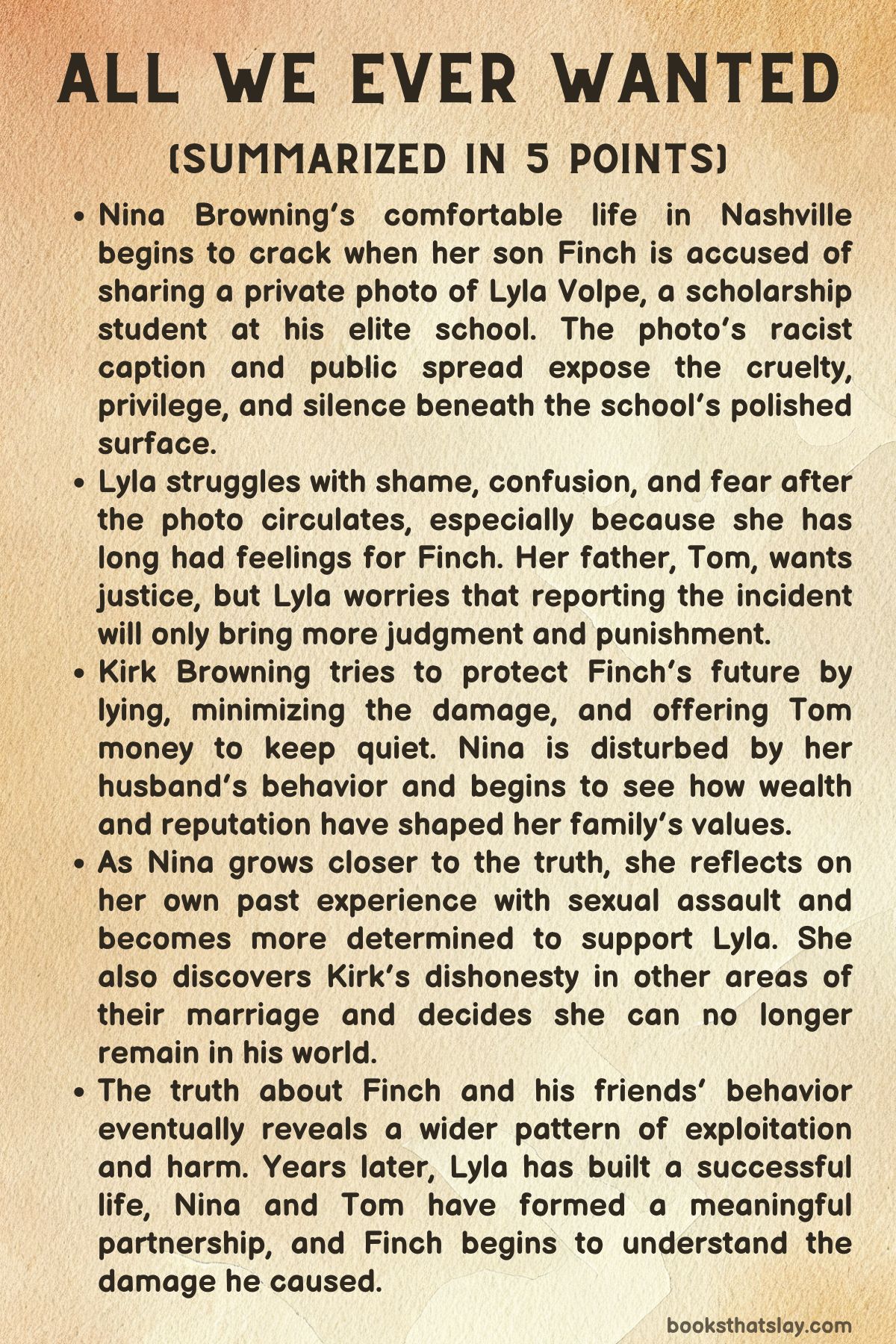
Characters
Nina Browning
Nina Browning is the moral center of All We Ever Wanted, though she does not begin the story with complete clarity about herself or her family. At first, she appears to be a woman who has benefited from wealth while still feeling uneasy about it.
She enjoys the comforts of her life with Kirk, but she also recognizes the artificiality, waste, and status anxiety that surround their social world. Her discomfort becomes sharper after Finch’s actions come to light.
What begins as a crisis about her son soon becomes a larger reckoning with her marriage, her parenting, her social circle, and her own past. Nina’s response to Lyla is shaped by empathy rather than reputation.
Unlike Kirk, she cannot reduce the photo to a public relations problem or a threat to Finch’s future. She imagines Lyla’s fear and humiliation, partly because Nina herself carries the memory of a sexual assault she never reported.
This private wound gives her a deeper understanding of silence, shame, and the damage caused when victims are made to feel responsible for what happened to them.
Nina’s character arc is built around the painful movement from denial to truth. She slowly admits that Kirk is not merely flawed but morally corrupt in ways she has excused for years.
She also admits that Finch is not simply a good boy who made one careless mistake. Her love for Finch remains strong, but it changes shape.
She learns that real maternal love cannot mean protecting him from accountability. By leaving Kirk, confronting Finch, supporting Lyla, and refusing to defend lies, Nina breaks from the values of the world she married into.
Her courage is not loud or simple; it comes through hesitation, guilt, fear, and grief. This makes her transformation believable.
She is not presented as perfect, but as someone who finally chooses integrity over comfort.
Tom Volpe
Tom Volpe is a devoted father whose life is defined by work, responsibility, and protective love for Lyla. As a single parent, he has built his identity around keeping his daughter safe, especially after Beatriz left their family.
He is practical, emotionally guarded, and proud, but beneath that toughness is deep vulnerability. When the photo of Lyla spreads, Tom’s anger is immediate and justified.
He sees not only the cruelty of the act but also the class imbalance that shapes the response to it. The Browning family has money, status, school influence, and social connections, while Tom has little more than his own voice and his determination to defend his daughter.
This makes his interactions with Kirk especially tense. Kirk’s attempt to pay him off insults Tom because it treats Lyla’s suffering as a problem that can be priced and dismissed.
Tom’s protectiveness, however, is not always easy for Lyla to accept. He sometimes acts before listening to her, and his fear can become controlling.
His decision to check her phone, confront the school, and pull her out of class comes from love, but it also shows how difficult it is for him to let Lyla have agency in her own life. His visits with Bonnie help reveal another side of him: a man who is lonely, overwhelmed, and still trying to understand his emotional life.
His growing respect for Nina also softens him. He sees that not everyone from privilege is the same, and Nina sees in him a steadiness and honesty missing from her marriage.
Tom’s character represents the fierce desire to protect a child in a world where institutions often protect the powerful first.
Lyla Volpe
Lyla Volpe is one of the most complex characters because she is both a victim of exploitation and a teenager still trying to understand her own desires, insecurities, and choices. She is not written as a symbol of innocence alone.
She drinks too much at the party, lies to her father, wants Finch’s attention, and makes decisions that place her in emotionally risky situations. Yet none of these choices justify what happens to her.
Her vulnerability comes from being young, socially uncertain, and eager to belong at Windsor, a school where wealth and popularity shape status. Her crush on Finch makes the situation even more painful because the person connected to her humiliation is also someone she wants to trust.
Lyla’s internal conflict is powerful because she wants the situation to disappear, but she also knows she has been harmed. She worries about being judged, punished, mocked, or seen differently.
Her reluctance to report Finch is not weakness; it reflects the pressure placed on victims to protect themselves from further public shame. Her relationship with Tom is loving but strained, because she wants him to trust her while he wants to shield her from everything.
Her later choice to call Nina and act when Polly is in danger shows her growth. Even while carrying her own hurt, she recognizes another girl’s crisis and responds with urgency.
As an adult, Lyla becomes a defense attorney, suggesting that she has transformed her experience with judgment, evidence, and power into a career. She survives the scandal without being defined by it, and that survival is central to her character.
Finch Browning
Finch Browning is a privileged teenager whose charm and promise hide serious moral failures. At the beginning, he is the golden child: accepted to Princeton, admired by his parents, and protected by his school’s social hierarchy.
His name, his wealth, and his popularity all work in his favor. When the photo scandal begins, Finch’s first response is not true remorse but self-protection.
He minimizes the harm, follows Kirk’s lies, and worries about consequences for his future rather than the damage done to Lyla. His behavior reveals how privilege can train a young person to expect rescue rather than accountability.
Finch becomes more troubling as the truth emerges. His claim that Polly took the photo allows him to shift blame, manipulate Lyla’s feelings, and present himself as misunderstood.
His romantic pursuit of Lyla after the incident is especially disturbing because it blurs apology, attraction, and control. By drawing Lyla closer, he makes it harder for her to see him clearly.
The later evidence that he and Beau have taken other explicit photos of girls shows that the original incident was not isolated. Finch is not simply careless; he has participated in a pattern of objectifying and humiliating girls.
Still, the ending leaves room for the possibility of change. His later apology and emotional response to Nina suggest that shame and accountability may finally have reached him.
The novel does not fully absolve him, but it suggests that Nina’s refusal to excuse him may be the first real act of love that gives him a chance to become better.
Kirk Browning
Kirk Browning represents wealth without moral responsibility. He is polished, successful, and socially powerful, but his behavior reveals a man who values control above truth.
From the start, he treats Finch’s scandal as a threat to be managed rather than a wrong to be confronted. He lies to the headmaster, coaches Finch into a false version of remorse, tries to bribe Tom, and hides information from Nina.
His actions are not impulsive mistakes; they are part of a consistent worldview. For Kirk, rules matter only when they protect his own interests.
When rules threaten his son, his reputation, or his comfort, he treats them as obstacles to be removed.
Kirk’s marriage to Nina also exposes his selfishness. He appears to see her partly as an extension of his status, a beautiful wife who fits the image he wants to maintain.
His possible affair and his decision to shut off her credit cards after she leaves show his instinct to punish and control. He is not interested in emotional repair because he does not truly believe he has done anything wrong.
His influence on Finch is one of the most damaging forces in the story. He teaches his son that wealth can soften consequences, that appearances matter more than harm, and that lying is acceptable if done smoothly.
Kirk is important because he shows how private moral failure becomes generational when it is modeled, rewarded, and protected.
Polly
Polly is first presented through the lens of jealousy, rivalry, and cruelty, but her role becomes more tragic as the story progresses. She insults Lyla, humiliates her, and appears at first to be another privileged girl attacking someone more vulnerable.
Her language toward Lyla is cruel and revealing, shaped by insecurity, possessiveness, and social prejudice. Yet Polly is also trapped by Finch’s power over her.
The revelation that Finch has sexual videos of her changes the reader’s understanding of her behavior. Her willingness to accept blame for the photo is not simple loyalty; it is fear.
She believes that exposure would destroy her in the eyes of her parents and community.
Polly’s overdose shows the emotional danger of shame and coercion. Like Lyla, she is a teenage girl living in a world where male behavior is excused and female sexuality is judged harshly.
Her cruelty toward Lyla does not disappear, but it becomes part of a larger pattern of pain. Polly is both harmful and harmed.
This complexity prevents her from being reduced to a villain. She shows how girls can be turned against one another while the boys responsible for their humiliation remain protected.
Her crisis forces Nina and Lyla to act together and brings the hidden truth closer to the surface.
Beau
Beau is a secondary character, but his presence is important because he represents the peer culture that enables Finch. The party takes place at his house, and the social environment around him is casual about drinking, sex, privacy, and cruelty.
Beau is connected to the larger pattern of photos taken of girls, which places him within the same culture of entitlement as Finch. He does not need as much narrative attention as Finch to matter; his role shows that Finch’s behavior is not happening in isolation.
There is a group dynamic at work, one in which boys encourage one another, hide one another’s actions, and treat girls as material for jokes, images, and status.
Beau also matters because of his family connection to Melanie. His mother’s reaction to the scandal is defensive and class-conscious, suggesting that Beau has grown up in a world where reputation is protected aggressively.
Even when he is not directly speaking, his social position shapes the events. He is part of the privileged circle that can make Lyla feel like an outsider and can make accountability difficult.
Through Beau, the story shows how wrongdoing becomes normalized when a group treats it as entertainment rather than harm.
Melanie
Melanie is Nina’s friend, but her behavior reveals the limits of that friendship. She is deeply invested in the Windsor social order and reacts to the scandal by protecting her own family and status.
Her comments about Lyla are cruel, racist, and classist, exposing the prejudice beneath the polished surface of the elite community. She does not see Lyla as a girl who has been violated; she sees her as a threat to Beau, Finch, and the families who belong to her social world.
This makes Melanie a key figure in showing how social circles maintain injustice. Harm is minimized when the victim is considered less valuable.
Melanie’s conflict with Nina also marks Nina’s separation from the world she has been living in. When Nina begins to defend Lyla and question Finch, Melanie sees her as irrational or disloyal.
To Melanie, friendship means protecting the group. To Nina, friendship and morality begin to mean telling the truth.
Their relationship breaks down because they no longer share the same values. Melanie is not simply a gossip; she is a representative of a community that uses gossip, money, and prejudice to control narratives.
Julie
Julie is Nina’s childhood best friend and one of the few people connected to Nina’s original self before wealth and marriage changed her life. Julie’s perspective is blunt, grounded, and morally clear.
She immediately understands the seriousness of what happened to Lyla and does not soften the truth just to comfort Nina. Her reaction matters because it gives Nina an outside view, away from Kirk’s manipulation and the Windsor community’s defensiveness.
Julie helps Nina see what she already suspects: that Finch’s actions are serious, that Kirk is dangerous in his moral emptiness, and that Nina has been excusing too much.
Julie also has a long memory. Her dislike of Kirk goes back years, and her honesty helps Nina face the reality of her marriage.
As a lawyer and friend, Julie represents practical support as well as emotional loyalty. She does not flatter Nina or protect her from hard truths.
Instead, she gives Nina the kind of friendship that makes change possible. In All We Ever Wanted, Julie’s role may be smaller than Nina’s or Lyla’s, but she is crucial because she helps Nina return to her own conscience.
Beatriz
Beatriz, Lyla’s mother, is mostly present through memory and emotional absence. Her departure shaped both Tom and Lyla in lasting ways.
To Tom, Beatriz represents instability, disappointment, and the pain of being left to carry the full burden of parenthood. Their marriage was passionate at first but became strained, especially around drinking, responsibility, and trust.
When she leaves, Tom becomes even more protective of Lyla, partly because he feels he is the only dependable parent she has.
For Lyla, Beatriz is more complicated. She is absent, but she is still a figure Lyla wants to know and claim.
Their communication gives Lyla a sense of independence from Tom, though it also creates tension. Beatriz’s willingness to help Lyla with birth control suggests that she can offer a kind of openness Tom struggles with, but her history also makes her unreliable.
She is not drawn as purely bad or purely sympathetic. Instead, she represents the unresolved family wound that shapes Lyla’s longing, secrecy, and desire to make her own decisions.
Bonnie
Bonnie serves as a wise and calming presence for Tom and Lyla. As a retired therapist, she has the emotional language that Tom often lacks.
She helps him see that his protectiveness, while loving, can become overwhelming for Lyla. She also gives Lyla space to speak without being immediately corrected or controlled.
Her home, especially the treehouse Tom built, becomes a place where father and daughter can step outside the panic of the scandal and speak more honestly.
Bonnie’s importance lies in her ability to slow down conflict. The other adults in the story often react through fear, denial, money, gossip, or anger.
Bonnie listens. She encourages both Tom and Lyla to recognize each other’s pain without forcing either one to surrender their perspective.
She also helps reveal Tom’s loneliness and need for connection. Her role is quiet but necessary because she provides the emotional steadiness that the school, the wealthy families, and even Tom himself cannot always offer.
Teddy
Teddy represents the life Nina might have had if shame and fear had not changed her path. He is connected to her youth, her family, and her old sense of self.
When Nina sees him again, the encounter is not only romantic or nostalgic; it forces her to confront the choices she made after being assaulted in college. She once believed Teddy would no longer love her if he knew what had happened.
His reaction proves that this fear was tragically misplaced. He would have supported her, and this realization deepens Nina’s grief over the years she spent hiding her pain.
Teddy’s role is not to rescue Nina but to show her that tenderness and respect were always possible. He contrasts sharply with Kirk.
Where Kirk is controlling and image-driven, Teddy is gentle and emotionally present. His reappearance helps Nina understand that she has built much of her adult life around silence, compromise, and self-blame.
Through Teddy, she sees that her past still matters, not because she can change it, but because she can finally stop letting it define what she accepts.
Themes
Privilege and the Protection of Reputation
Privilege shapes nearly every response to the scandal. Finch’s actions are not judged in a neutral environment; they are filtered through his family name, wealth, school history, and Princeton acceptance.
Kirk immediately understands the situation as a threat to status. His first instinct is not to ask what Lyla has suffered, but to calculate how the event might affect Finch’s future.
This response reveals how privilege often works quietly through access and influence rather than open force. Kirk can request meetings, shape narratives, offer money, and expect people to consider his son’s promise more important than a girl’s pain.
The school environment also reflects this imbalance. Lyla is warned that she may face consequences for drinking, while Finch’s behavior is discussed in terms of potential, reputation, and fairness to him.
This double standard exposes a world where the powerful are given context and sympathy, while the less powerful are judged by rules. Tom sees this clearly because he stands outside that world.
Nina gradually sees it too, and her awakening requires her to reject the protection that privilege offers her family. In All We Ever Wanted, reputation becomes a form of currency, and the central moral question is whether truth can survive in a community trained to protect its own.
Accountability and Parental Love
The story presents parental love as a force that can either protect truth or bury it. Kirk and Nina both love Finch, but they express that love in opposite ways.
Kirk believes love means shielding his son from consequences. He lies, bribes, manipulates, and teaches Finch that survival depends on controlling the story.
His version of fatherhood is deeply damaging because it confuses protection with permission. Nina’s love is more painful because it requires her to admit that Finch has done something wrong.
She wants to believe in his goodness, yet she comes to understand that defending him blindly would harm Lyla, Polly, and Finch himself. Her decision to confront him is an act of moral courage.
She refuses to abandon him, but she also refuses to excuse him. Tom’s love for Lyla is equally intense, though it creates different problems.
His need to protect her sometimes limits her voice, and he must learn that support also means listening. The novel shows that good parenting is not measured by how completely a parent can control an outcome.
It is measured by whether a parent can guide a child toward truth, responsibility, and self-respect, even when doing so is painful.
Shame, Silence, and Sexual Harm
Sexual harm in the novel is surrounded by silence, fear, and misplaced shame. Lyla’s photo is a violation not only because of what is shown, but because she has no control over how her body is seen, discussed, and judged.
Her first instinct is not to seek justice but to make the situation disappear. This reaction reflects a larger social pattern in which girls and women often fear that reporting harm will expose them to more humiliation.
Nina’s past assault deepens this theme. As a young woman, she chose silence because she feared judgment and rejection.
Years later, she recognizes the same emotional trap closing around Lyla. Polly’s situation adds another layer.
She is cruel to Lyla, but she is also being controlled by the threat of sexual exposure. Her fear of her parents seeing private videos shows how shame can be weaponized.
The boys’ behavior depends on that shame. They take photos and videos because they expect girls to be too embarrassed or afraid to speak.
The story argues that silence protects perpetrators more than victims. Nina’s honesty with Lyla becomes powerful because it breaks that pattern.
By speaking openly, she helps Lyla see that the shame belongs to those who caused the harm.
Class, Race, and Belonging
Lyla’s experience at Windsor is shaped by more than one act of cruelty. She is already vulnerable because she does not fully belong to the wealthy world around her.
She attends an elite school, but her home, family background, and financial reality separate her from students like Finch, Beau, and Polly. The racist caption on the photo makes this outsider status explicit.
It reduces Lyla to a stereotype and turns her identity into a joke for privileged students. The cruelty continues through the reactions of adults like Melanie, whose comments expose the prejudice beneath polite society.
Class and race work together to determine whose pain is taken seriously. Lyla is treated as someone who can be discussed, doubted, mocked, or dismissed.
Tom’s anger is tied to this imbalance. He knows that his daughter is being judged by people who assume their own children are worth more.
Nina’s growing sympathy for Tom and Lyla requires her to see the ugliness of the world she has been living in. Belonging, in this context, is not just about friendship or school status.
It is about whose dignity is protected. The novel shows that elite communities often maintain their comfort by deciding who counts and who can be sacrificed.