Amadeus Summary, Characters and Themes
Amadeus is Peter Shaffer’s dramatic study of envy, faith, art, and self-deception. The play imagines Antonio Salieri looking back on his life in Vienna and accusing himself of destroying Wolfgang Amadeus Mozart.
Salieri is not presented as a simple villain, but as a man tortured by the gap between his ambition and his talent. Mozart, in contrast, appears vulgar, reckless, immature, and touched by genius. Through their rivalry, Amadeus asks whether artistic greatness is earned, granted, or cruelly assigned by a silent God.
Summary
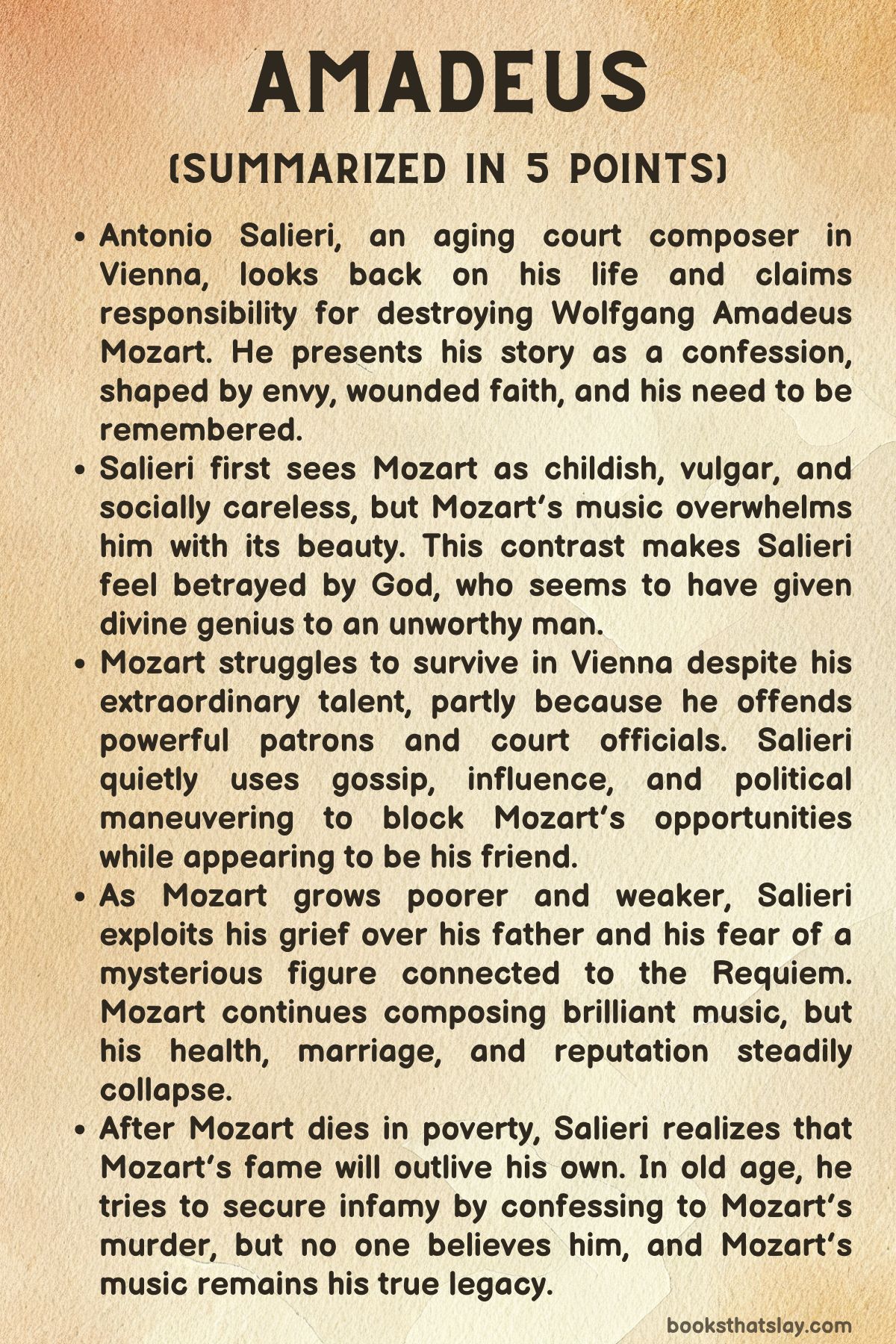
Amadeus begins in Vienna, many years after Wolfgang Amadeus Mozart’s death. Antonio Salieri is an old, isolated man, surrounded by rumors that he poisoned Mozart.
The citizens of Vienna whisper his name, linking him to scandal, guilt, and madness. Salieri, near the end of his life, addresses the audience as if speaking to people from the future.
He prepares to confess, not in search of forgiveness, but in the hope that his story will survive.
Salieri recalls his younger self in 1781. At that time, he is a respected composer at the Hapsburg court, with a comfortable home, a proper wife named Teresa, and a reputation for discipline.
He has made a vow to God: if God grants him musical success, Salieri will live virtuously and serve Him through music. He believes he has kept his side of the bargain.
He is admired, employed, and considered one of Vienna’s most successful musicians. Yet his ordered life changes when Mozart arrives.
Before meeting Mozart, Salieri hears constant praise of the young composer’s genius. Mozart had been famous since childhood, and his reputation unsettles Salieri.
Salieri wants to see whether the praise is deserved. At a gathering in the home of Baroness Waldstädten, he first observes Mozart not as a noble genius, but as a childish, vulgar young man chasing and teasing Constanze Weber.
Mozart behaves with shocking silliness and sexual humor. Then Salieri hears Mozart’s music from the next room and is shaken.
The music seems to him like the voice of God, yet it has come from someone he finds crude and obscene. This contradiction wounds him deeply.
At first, Salieri tries to contain his fear. He works harder, prays more, and studies Mozart’s other compositions, hoping to prove that the music he heard was an exception.
He reassures himself that Mozart is not always so extraordinary and decides to welcome him to Vienna. At court, Mozart is introduced to Emperor Joseph and the senior officials.
Salieri plays a march he has composed in Mozart’s honor. Mozart hears it once, plays it back from memory, and casually improves it.
Salieri is humiliated. Mozart does not even realize the pain he causes; his genius appears effortless.
Mozart is commissioned to write a German comic opera, and his manner offends the court. He speaks bluntly, mocks Italian traditions, and insists that opera should express real human feeling, especially love.
His first major success in Vienna brings applause, but also criticism from the emperor and the court officials. Salieri praises Mozart politely while privately resenting him.
He becomes convinced that Mozart has slept with Katherina Cavalieri, Salieri’s prized pupil and secret object of desire. This intensifies his jealousy and sense of betrayal.
Mozart soon marries Constanze against his father’s wishes. The couple lives beyond their means, and Mozart struggles to find steady work because he is tactless and insulting.
He criticizes court musicians, mocks officials, and openly declares himself better than everyone else in Vienna. His talent is undeniable, but his behavior makes him enemies.
Salieri begins to see that Mozart’s weakness may be useful.
Constanze later asks Salieri to help Mozart secure the position of music teacher to Princess Elizabeth. She is desperate because the couple is poor and Mozart has few students.
Salieri tells her to visit him privately. When she comes, she brings Mozart’s original manuscripts.
Salieri tries to use his influence to seduce her, suggesting that help for Mozart will require payment. Constanze resists and insults him.
Humiliated, Salieri turns cold and pretends he will examine the music to judge Mozart’s fitness.
When Salieri looks at the manuscripts, he is stunned. They are first drafts with no corrections.
He realizes that Mozart is not laboring like ordinary composers; he hears entire works in his mind and merely writes them down. The music confirms that the divine sound Salieri heard earlier was no accident.
Mozart truly possesses a gift beyond Salieri’s reach. Salieri feels betrayed by God.
He has lived obediently, worked hard, and sacrificed pleasure, yet God has given supreme genius to a vulgar child. Salieri declares war on God by targeting God’s chosen creature, Mozart.
Salieri’s first major act of revenge is to block Mozart from teaching Princess Elizabeth. He implies to the emperor that Mozart cannot be trusted around a young woman, and another man is chosen for the post.
Meanwhile, Salieri’s own career flourishes. He becomes more celebrated, more powerful, and more corrupt.
He takes Katherina as his mistress and abandons charitable committees. He notices that God does not punish him.
In fact, Salieri rises while Mozart struggles.
Mozart continues to create remarkable work, but court politics limit his success. When Mozart writes an Italian opera based on The Marriage of Figaro, the court objects to its social boldness and its source material.
Mozart defends the opera as a work about real people, arguing that music can express many thoughts and emotions at once in a way spoken drama cannot. Salieri recognizes the brilliance of the work but joins efforts to damage it.
Court officials remove a dance scene, claiming that the emperor has banned ballet in opera. Mozart is furious.
Although the emperor eventually restores the music, the opera’s run is cut short. Salieri knows the piece is magnificent, but he is pleased when the emperor yawns and the court fails to fully honor it.
Mozart’s father dies, leaving Mozart shaken by guilt. Salieri takes advantage of this emotional wound, presenting himself as a comforting father figure.
Mozart, vulnerable and grieving, calls him “Papa.” Salieri understands how deeply Mozart’s father haunts him and resolves to push him further into poverty and despair. When a court position becomes available, Salieri advises that Mozart be given the title but paid far less than the previous holder.
Mozart is insulted, then grateful when he believes Salieri helped him. Salieri secretly enjoys the damage he has done.
As Salieri becomes Kapellmeister, Mozart’s health and finances worsen. Mozart begs the Masons for money and accepts small jobs.
Salieri encourages him to write a popular stage work inspired by Masonic ideas, knowing that revealing the order’s rituals will anger powerful supporters. Mozart writes The Magic Flute, a work Salieri recognizes as extraordinary.
But when Masonic figures see their secrets represented, they reject Mozart. He loses support and receives little financial reward.
At home, Mozart and Constanze live in cold and poverty. Constanze, resentful of Mozart’s father, burns his letters for warmth.
Mozart is horrified. He is also increasingly frightened by visions of a dark figure who seems to command him to write a Requiem Mass.
Constanze leaves him for a time, believing he is losing his mind. Mozart writes obsessively, sick and terrified.
Salieri then carries out his cruelest deception. He dresses as the dark figure from Mozart’s fears and appears near his window, counting down the days left to finish the Requiem.
On the final night, Mozart invites the figure inside, begging for more time. Salieri reveals himself.
Mozart is devastated. Salieri tells him that God does not love him and urges him to die.
Mozart, broken and childlike, again calls him “Papa.” When Constanze returns, Mozart tells her Salieri has killed him. She tries to comfort him, insisting no one has harmed him, but Mozart dies as the Requiem plays unfinished.
Mozart receives a poor burial, and Salieri feels both relief and pity. Later, he learns that the mysterious figure who commissioned the Requiem was real: Count Walsegg had hired Mozart to compose it so he could claim it as his own.
Salieri eventually conducts the work under Walsegg’s name. Years pass.
Mozart’s fame grows, while Salieri’s fades. Salieri sees this as God’s final punishment: he lives long enough to watch Mozart become immortal.
In old age, Salieri decides that if he cannot be remembered as a great composer, he will be remembered as Mozart’s murderer. He falsely confesses to poisoning Mozart and cuts his own throat, but he survives, and no one believes him.
His attempt to secure infamy fails. At the end, Mozart’s music fills the theatre, enduring beyond gossip, jealousy, and Salieri’s ruined ambition.
Characters
Antonio Salieri
Antonio Salieri is the central consciousness of Amadeus, and the play is shaped by his memory, jealousy, confession, and self-dramatization. He begins as a successful court composer who believes his life is built on a sacred agreement with God: he will live with discipline, moral restraint, and devotion, and in return God will allow him to achieve musical greatness.
This belief gives Salieri a sense of dignity, but it also makes him fragile. When he hears Mozart’s music, he does not simply feel professional envy; he experiences a spiritual crisis.
To him, Mozart’s genius proves that God has rejected human effort, virtue, and sacrifice. Salieri’s tragedy lies in his awareness.
He is intelligent enough to recognize Mozart’s greatness, but not generous enough to accept it. He understands beauty deeply, yet cannot create it at the same level.
This makes him both villain and victim: he destroys Mozart socially and emotionally, but he is also destroyed by the knowledge of his own mediocrity. His evil is not impulsive; it is patient, polite, and socially respectable.
He uses influence, gossip, court politics, and religious language as weapons. By the end, his desire changes from fame to infamy.
If he cannot be remembered as a great composer, he wants to be remembered as the man who killed one. His final failure is that even his confession is not believed, leaving him trapped in the very obscurity he feared.
Wolfgang Amadeus Mozart
Wolfgang Amadeus Mozart is presented as a contradiction: childish in behavior, careless in speech, vulgar in humor, and almost superhuman in musical ability. He unsettles everyone because his genius does not match their expectations of dignity.
He jokes obscenely, offends officials, insults other musicians, and often behaves without social awareness. Yet when he composes, he reveals an artistic command that no one around him can equal.
This contrast is central to his character. Mozart is not written as a polished saint of music, but as a flawed, needy, impulsive man whose gift seems independent of his personality.
His greatest weakness is his inability to survive within systems of power. He needs patrons, positions, students, and court approval, but he repeatedly alienates the people who control those opportunities.
He believes in the truth of his own talent and says what others are too cautious to say, but honesty without strategy makes him vulnerable. His relationship with Constanze shows his immaturity and tenderness at once; he can be selfish, jealous, and foolish, but he also depends on love and comfort like a frightened child.
His grief over his father’s death reveals a deep emotional wound, and Salieri exploits that wound cruelly. Mozart’s decline is not only physical but social and psychological.
He is surrounded by people who admire his music while refusing to protect the man who creates it. His death leaves behind the central irony of the play: the society that failed him during his life later turns him into an immortal symbol.
Constanze Mozart
Constanze Mozart is often underestimated by the men around her, but she is one of the most human figures in the play. She is playful, sensual, direct, and practical in ways that Mozart is not.
Her relationship with Mozart is filled with childish language, teasing, jealousy, and affection, showing a marriage that is emotionally intense but unstable. Constanze understands their poverty more clearly than Mozart does, and she is forced to face the practical consequences of his pride, bad judgment, and lack of steady income.
Her visit to Salieri shows both her courage and her desperation. She is willing to humble herself for her husband’s career, but she is not passive.
When Salieri tries to turn her need into sexual bargaining, she resists and wounds his pride. Her rejection becomes one of the moments that hardens Salieri’s cruelty.
Constanze also represents the domestic cost of genius. Mozart’s music may be divine to Salieri, but Constanze lives with the cold rooms, unpaid bills, illness, and emotional chaos that surround its creation.
Her burning of Leopold’s letters is harsh, but it also reveals her anger at the judgment and control that Mozart’s father continued to exert over their marriage. At Mozart’s death, she tries to deny the terror consuming him, not because she is unfeeling, but because she cannot defeat it.
Afterward, she becomes one of the keepers of Mozart’s memory, suggesting that survival may require reshaping pain into reverence.
Emperor Joseph II
Emperor Joseph II is not malicious, but his limitations have serious consequences. He presents himself as a patron of art and enjoys appearing reasonable, cultured, and enlightened.
However, his judgment is shallow and easily influenced by the officials around him. He wants German opera, supports new artistic ventures in principle, and welcomes Mozart politely, yet he lacks the depth to fully understand what Mozart is creating.
His famous complaint that Mozart’s work has “too many notes” captures his character perfectly: he senses that he is expected to have an opinion, but he cannot articulate a serious artistic criticism. The emperor’s power makes his mediocrity dangerous.
A mild comment from him can damage a career, and his uncertainty allows men like Salieri, Orsini-Rosenberg, and Van Swieten to shape outcomes behind the scenes. He likes order, decorum, and moderation, while Mozart’s art is excessive, bold, and emotionally alive.
Because Joseph values art without truly seeing its highest form, he becomes part of the system that praises genius in theory and restricts it in practice. His character also reflects the distance between official culture and real creativity.
He has the authority to reward Mozart, but not the vision to recognize what that reward should be.
The Venticelli
The Venticelli function as gossip, public opinion, rumor, and social movement given human form. They are not deeply individualized characters in the usual sense; instead, they represent the speed with which information moves through Vienna.
They carry news of Mozart’s reputation, Salieri’s suspicions, court politics, financial distress, scandal, illness, and death. Their presence gives the play energy, but it also shows how reputations are made and damaged.
They rarely create events directly, yet they feed the atmosphere in which those events gain meaning. Salieri uses the same world they represent: a world where suggestion can be more powerful than proof, and where a whisper can quietly close doors.
The Venticelli also blur the line between fact and rumor. They tell the audience things that may be true, exaggerated, incomplete, or socially convenient.
In this way, they support one of the play’s central concerns: history itself is shaped by gossip, memory, and performance. Their role becomes especially important at the end, when Salieri tries to turn rumor into legacy by confessing to Mozart’s murder.
The Venticelli show that public memory cannot be fully controlled, even by someone as calculating as Salieri.
Baron Van Swieten
Baron Van Swieten represents moral seriousness, cultural authority, and artistic conservatism. He cares about music and believes it should elevate society, but his idea of elevation is narrow.
He wants art to be noble, disciplined, and proper. Mozart’s desire to write about ordinary people, desire, social tension, and comic disorder disturbs him because it challenges his belief that opera should refine its audience.
Van Swieten is not merely ignorant; he has taste, education, and influence. That makes his opposition more complex.
He respects music as an institution but is threatened by music as a living force. His reaction to Mozart’s use of Masonic material shows the limits of his tolerance.
He supports Mozart when the music can fit into his values, but withdraws when Mozart exposes sacred or private forms to public performance. Van Swieten’s character shows how patrons and intellectuals can admire genius while still trying to control it.
He is not as personally vindictive as Salieri, but his rigidity helps create the conditions in which Mozart is isolated. He stands for the respectable world that wants art to serve ideals, not disturb them.
Count Orsini-Rosenberg
Count Orsini-Rosenberg is one of the clearest representatives of bureaucratic obstruction in Amadeus. He does not need to match Mozart’s talent because he has something more useful in court society: authority.
His power lies in rules, procedure, etiquette, and access. He can damage a work not by disproving its worth, but by removing pages, enforcing regulations, or whispering objections in the right room.
His conflict with Mozart over the dance in Figaro shows his method. He frames censorship as obedience to the emperor’s command, even when the result harms the artistic structure of the opera.
Orsini-Rosenberg is also offended by Mozart’s lack of respect. Mozart laughs at him, insults his appearance, and treats court hierarchy as absurd.
In response, Orsini-Rosenberg becomes one of the forces that makes Mozart pay for his social carelessness. He is not consumed by spiritual envy like Salieri, but he is still dangerous because he turns pettiness into policy.
Through him, the play shows that genius can be weakened not only by hatred but by administrative power in the hands of small-minded people.
Johann Killian Von Strack
Von Strack is a court official who values discipline, manners, and national cultural ambition. He supports the emperor’s interest in German opera and often appears more practical than deeply artistic.
His irritation with Mozart grows from Mozart’s refusal to behave with respect toward the structures that employ him. Von Strack is offended by Mozart’s drunken insults, his criticism of foreign musicians, and his inability to separate private opinion from public speech.
Unlike Salieri, Von Strack does not appear to understand Mozart’s genius at a profound level, so his judgment is based more on conduct than art. This makes him important to the social world of the play.
Mozart’s career does not depend only on whether his music is brilliant; it also depends on whether officials find him manageable. Von Strack sees Mozart as disruptive, immature, and politically inconvenient.
He helps reveal the practical tragedy of Mozart’s position: a composer with extraordinary gifts must still please people who care more about order than originality.
Katherina Cavalieri
Katherina Cavalieri is mostly silent, but she has strong dramatic importance because of what she represents to Salieri. She is his prized pupil and the woman he secretly desires while maintaining the outward image of marital virtue.
Salieri’s attraction to her exposes the tension between his public morality and private appetite. He claims to have remained faithful because of his vow to God, but his restraint is not pure; it is part of a bargain through which he expects reward.
When Mozart chooses Katherina for a major role and Salieri suspects they have been lovers, Salieri experiences this as both sexual humiliation and artistic theft. Katherina becomes another sign that Mozart receives effortlessly what Salieri denies himself.
Her singing also reminds Salieri that music is tied to bodies, desire, and performance, not only to prayer and discipline. Though she is not given a full independent inner life in the play, her presence helps reveal Salieri’s possessiveness, hypocrisy, and resentment.
Later, when Salieri takes her as his mistress, it marks his rejection of the moral identity he once used to define himself.
Teresa Salieri
Teresa Salieri, Salieri’s wife, is a muted presence, and that silence is meaningful. She represents the respectable domestic life Salieri has built: proper marriage, social stability, and public virtue.
Salieri mentions her as part of the orderly world he once believed proved his goodness. Yet she is not emotionally central to him.
His real passions are directed toward music, God, Katherina, and Mozart. Teresa’s silence reflects the emptiness of Salieri’s moral performance.
He has a wife, but the marriage is treated less as an intimate relationship than as evidence of respectability. She helps define Salieri’s public image as a disciplined and honorable man, but the audience sees how thin that image becomes once his envy takes control.
Her limited role also shows the gendered structure of the society around Salieri: women often appear as wives, pupils, lovers, or bargaining figures within male ambition. Teresa’s quietness makes Salieri’s confessions feel even more self-centered.
He narrates his life as a grand spiritual conflict, but his marriage seems almost incidental to him.
Leopold Mozart
Leopold Mozart does not need to appear constantly to dominate Mozart’s emotional life. He represents authority, judgment, discipline, and paternal expectation.
Mozart’s marriage to Constanze takes place against Leopold’s wishes, and that disapproval continues to haunt him. Mozart wants independence, but he also wants approval, and this conflict leaves him vulnerable.
After Leopold’s death, Mozart is overwhelmed by guilt, especially because he had spoken bitterly about him. Salieri recognizes this wound and exploits it by offering himself as a substitute father.
This is one of the cruelest parts of Salieri’s manipulation because he understands that Mozart’s need for paternal acceptance is stronger than his pride. Leopold’s influence also appears through Mozart’s art, especially in the image of the commanding father figure.
He becomes less a normal parent than a psychological force. For Mozart, the father is love, fear, duty, shame, and judgment combined.
His memory helps explain why Mozart can be arrogant in public yet childlike in private. He has escaped his father geographically, but not emotionally.
Count Walsegg
Count Walsegg appears late in the story, but his role changes the meaning of the Requiem. Salieri believes that Mozart’s fear of a dark messenger can be used as part of his revenge, but he later learns that the mysterious commission had a real source.
Walsegg wanted Mozart to write a Requiem that he could claim as his own. He is a smaller figure than Salieri, but he mirrors Salieri in an important way.
Both men want to possess genius they do not have. Salieri wants to defeat Mozart and gain meaning through his destruction; Walsegg wants to steal Mozart’s work and attach his own name to it.
Walsegg’s deception shows that Mozart is surrounded by people who feed on his gift. Some exploit him socially, some financially, and some artistically.
His success in passing off the Requiem under his own name also reinforces the play’s bitter view of recognition. Authorship, fame, and honor can be distorted by money and status, at least for a time.
Yet the music ultimately outlives the fraud.
Themes
Genius and Mediocrity
The conflict between genius and mediocrity drives the emotional force of Amadeus. Salieri is not talentless; he is skilled, respected, and successful by ordinary standards.
His suffering comes from knowing the difference between competence and greatness. He can understand Mozart’s genius with painful clarity, but he cannot equal it.
This makes his envy unusually intense. A person with no musical understanding might dismiss Mozart, but Salieri hears exactly what makes him extraordinary.
Mozart’s manuscripts, without corrections, become proof of a mind working beyond normal labor. For Salieri, this destroys the comforting idea that hard work always leads to greatness.
He has practiced, prayed, studied, and behaved properly, yet Mozart creates music that seems to arrive whole. The theme is not simply that genius is superior to mediocrity; it is that recognizing genius can become unbearable when one’s own limitations are exposed.
Salieri’s tragedy is that he would rather damage greatness than live honestly beside it. The play presents mediocrity not as lack of ability, but as a spiritual condition that becomes dangerous when mixed with ambition, resentment, and power.
Salieri’s deepest pain is not that Mozart exists, but that Mozart proves what Salieri is not.
Faith, Bargaining, and Anger at God
Salieri’s relationship with God is built less on love than negotiation. He believes that virtue should be rewarded, and he treats his religious devotion almost like a contract.
He gives up indulgence, remains outwardly disciplined, and dedicates himself to music, expecting divine favor in return. Mozart’s genius shatters this belief.
To Salieri, God has chosen the wrong vessel: a vulgar, immature, irresponsible man who seems unworthy of such beauty. This creates a crisis that is theological as much as personal.
Salieri does not merely envy Mozart; he feels insulted by heaven. His war against Mozart becomes a war against the God who gave Mozart his gift.
The disturbing part is that Salieri continues to believe in God even as he rebels. He does not become an atheist; he becomes an enemy.
This gives his actions a dark religious intensity. Every attack on Mozart is, in Salieri’s mind, an attack on divine injustice.
The theme questions whether faith based on reward can survive disappointment. Salieri’s goodness collapses because it was never entirely selfless.
Once he feels cheated, his morality turns into rage, proving that his devotion depended on getting what he wanted.
Art, Power, and Social Approval
The play repeatedly shows that artistic greatness does not guarantee worldly success. Mozart creates music of lasting brilliance, but he depends on patrons, officials, audiences, students, and social reputation.
These systems are controlled by people who may admire art in theory while resisting it in practice. The emperor enjoys culture but lacks deep judgment.
Court officials enforce rules, protect hierarchy, and punish disrespect. Patrons want art that confirms their values, not art that unsettles them.
Mozart’s problem is not only poverty or illness; it is his inability to operate within this network. He speaks too freely, insults the wrong people, and trusts the value of his music to defend him.
Salieri understands the system far better. He knows when to flatter, when to suggest, when to remain silent, and when to let others act.
This makes him powerful despite being artistically inferior. The theme reveals a painful gap between art and recognition.
Great work may need social permission to be performed, funded, and remembered during the artist’s lifetime. Mozart’s music survives in the long run, but while he is alive, committees, gossip, class expectations, and political taste can still starve him.
Jealousy, Reputation, and the Desire to Be Remembered
Salieri’s jealousy begins with Mozart’s talent, but it grows into an obsession with memory. He wants more than comfort, money, or status; he wants immortality.
At first, he hopes to achieve it through music. When he realizes that his compositions will not last beside Mozart’s, he seeks another path.
His final confession is an attempt to attach his name permanently to Mozart’s. If he cannot be remembered for beauty, he will be remembered for destruction.
This makes reputation one of the play’s central concerns. The public world is filled with rumors, whispers, half-truths, and performances of identity.
Salieri spends his life appearing respectable while acting cruelly in secret. Mozart appears foolish and offensive, yet his music reveals greatness.
The difference between appearance and truth is unstable throughout the story. Salieri tries to control the story after Mozart’s death by presenting himself as the murderer, but even this fails because no one believes him.
His punishment is not legal justice but historical smallness. He wanted to defeat Mozart, yet Mozart’s music fills the future while Salieri’s name survives mainly through envy.
The desire to be remembered becomes more destructive than the desire to succeed.