Always Running Summary and Analysis | Luis J. Rodriguez
Always Running by Luis J. Rodriguez is a memoir about growing up Mexican American in Los Angeles amid poverty, racism, family instability, police violence, and gang warfare. Rodriguez writes from the perspective of a man looking back at the “crazy life” he survived and the young people he lost along the way.
The book is also a father’s warning: he begins by watching his own son move toward the same dangers that once nearly destroyed him. In clear, urgent language, Rodriguez shows how gangs become a substitute for belonging when society offers neglect, fear, and blocked futures.
Summary
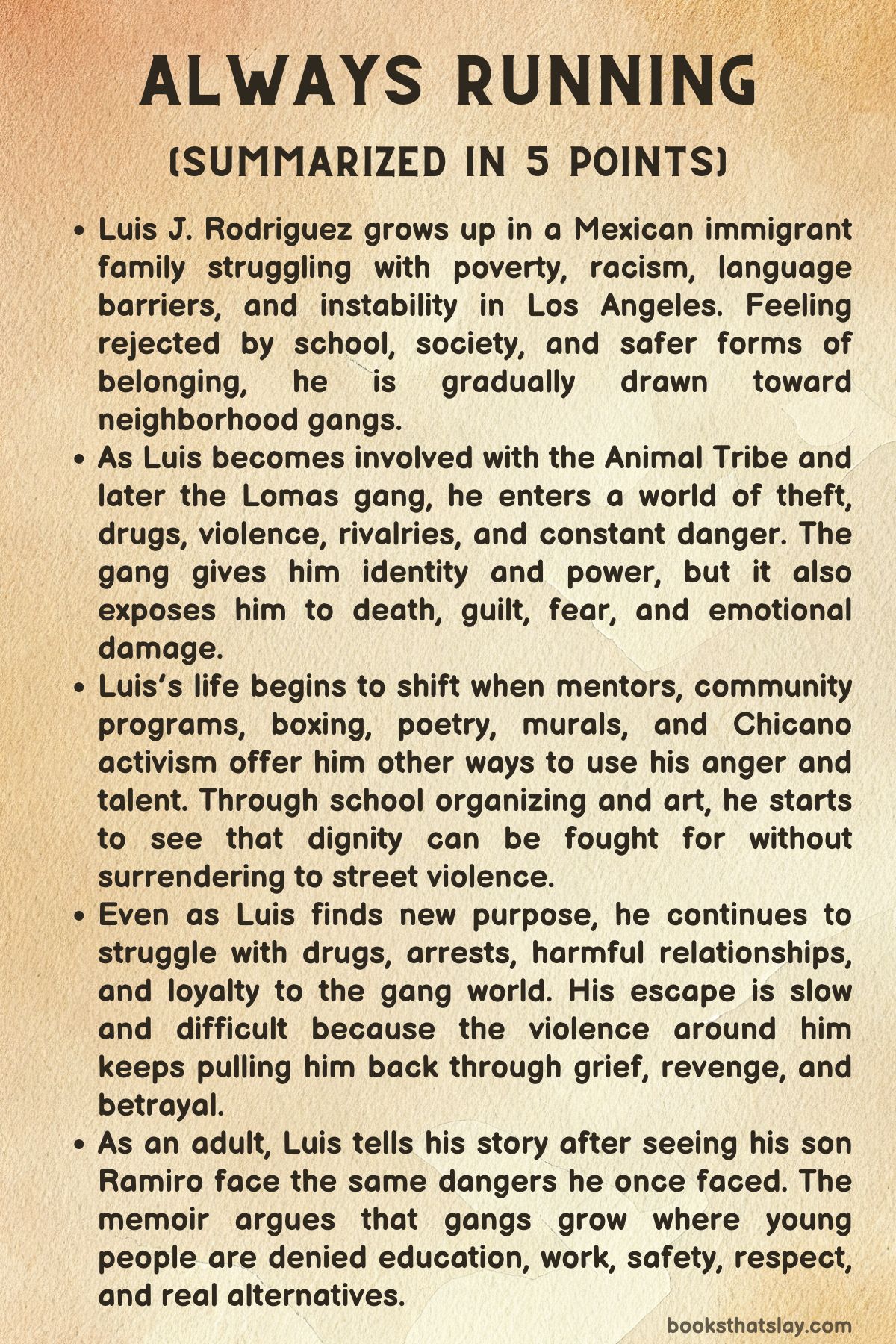
Always Running begins with Luis J. Rodriguez as an adult father living in Chicago, far from the Los Angeles streets that shaped his youth. Yet the past returns through his teenage son, Ramiro, who is becoming involved in gang life.
After a fierce argument, Ramiro runs away, leaving Luis terrified that his son may be lost to the same violence Luis once escaped. This crisis pushes Luis to tell his own story, not simply as confession, but as a warning about what happens when young people are denied safety, respect, education, and hope.
Luis grows up in a Mexican immigrant family marked by tension, poverty, and displacement. His father, Alfonso, had once been an educated school principal in Mexico, but after being accused of stealing school funds, he leaves the country with his wife, Maria, and their children.
The family settles in Los Angeles, but they do not find the stability they hoped for. They struggle with money, housing, language, and the feeling of being unwanted.
Luis and his siblings experience racism early. When Luis and his brother wander into a white neighborhood, they are beaten by local boys.
At school, Luis is neglected because he cannot speak English, and teachers treat him as a problem rather than a child who needs help.
For a short time, Alfonso gets a teaching job and moves the family into a better neighborhood. The family enjoys small signs of comfort: furniture, appliances, and the belief that they might finally belong in America.
But Alfonso loses the job because his accent is considered difficult for white students to understand. The family’s fragile progress collapses.
Maria decides to take the children back to Mexico, but at the last moment she changes her mind. They remain in Los Angeles, caught between a country they left and a country that refuses to fully accept them.
The family eventually moves to the San Gabriel Valley, into a poor and isolated barrio known as Las Lomas. The neighborhood lacks transportation, organized activities, and safe spaces for young people.
Luis and his friends create their own group, a small clique that gives them identity and protection. Luis is shy and afraid, but he wants power.
He wants to stop feeling weak. This desire leads him toward gang life.
By junior high, Luis is slipping further from school and family. He falls in love, gets a homemade tattoo, causes trouble, and joins a gang called the Animal Tribe.
His brother Joe moves in the opposite direction, finding purpose in school, sports, and theater. Luis, however, finds belonging among boys who are angry, reckless, and ready to fight.
The gang world exposes him to violence, sexual cruelty, theft, drugs, and the idea that respect must be defended through fear.
The Animal Tribe clashes with rival gangs, especially the Sangra Diablos. Luis sees friends injured, arrested, and hardened.
He begins to view the police as another gang, one with uniforms and legal power. His group steals, fights, and carries weapons.
During one robbery at a drive-in movie theater, Luis is given a gun and nearly gets shot. The experience frightens him, but he remains tied to the life because it gives him status and a sense of belonging he cannot find elsewhere.
High school brings more crisis. Luis has attempted suicide and is partly cast out by his mother, who is exhausted from jail calls and fear that he will end up dead.
He sleeps in the family garage, without comfort or dignity. At school, Mexican students are treated as if they are not meant for academic success.
Wealthier white and Asian students are placed in advanced classes and school activities, while students from Las Lomas are pushed into technical tracks.
Luis briefly finds hope in music. He takes up the saxophone and practices with devotion.
The instrument becomes a way to imagine another life. But after a fight with Joe, his brother crushes the saxophone, destroying one of Luis’s few sources of beauty and discipline.
Luis returns to the streets with deeper anger.
Luis also experiences love and desire amid gang conflict. At a festival, he meets Viviana, a girl connected to the rival Sangra gang through her brothers.
Their brief connection gives him a glimpse of tenderness, but it cannot remove him from the violence around him. Soon after, a racially charged fight between white and Mexican students grows into a larger riot.
Luis is expelled and begins working in a restaurant, where he is treated with condescension by white customers. His resentment grows, and he responds with small acts of revenge.
Drugs become another escape. Luis sniffs paint, uses other substances, and begins harming himself.
His relationship with Payasa, a fellow drug user, reflects the damage surrounding him. She attempts suicide, and Luis sinks further into despair.
As the Animal Tribe fades, Luis becomes part of the larger Lomas gang. His initiation involves being beaten by older members.
Soon afterward, he participates in a random attack on innocent lowriders and stabs a man with a screwdriver. The act marks a frightening change: Luis is no longer only witnessing violence; he is committing it.
A turning point begins when Luis meets Chente Ramirez at a community center. Chente is a former barrio resident who went to college and returned to help young Chicanos.
He sees potential in Luis and pushes him toward school, discipline, and community work. Luis also joins a boxing program, where he learns that real strength requires balance, control, and training.
Through Chente, Luis is introduced to political ideas, social justice, and Chicano identity. He begins to understand that his anger has roots in racism, poverty, and exclusion.
Still, Luis remains divided between activism and gang loyalty. He attends an antiwar protest in East Los Angeles, where police violence turns the march into a riot.
He is arrested and held in jail. Later, he reconnects with Viviana, who introduces him to poetry.
Words begin to reach parts of Luis that violence never could. At school, he helps form ToHMAS, a group dedicated to improving conditions for Mexican American students.
The group fights for dignity, better classes, representation, and Chicano studies. Luis becomes a school mascot through a traditional Aztec dance, writes and performs plays, and helps organize protests.
Art also becomes important. Luis paints murals with barrio images and earns a summer job supervising other young artists.
For the first time, he sees a future built on creativity rather than destruction. Yet the streets keep pulling him back.
He is arrested after a shooting involving white bikers. He tries to support a gang truce, but rival leaders and even members of his own gang resist peace.
Violence continues to claim lives. Friends are killed by police or rival gangs.
Others are imprisoned or destroyed by drugs.
Luis grows into a young man with talent and opportunity. He graduates from high school, receives a scholarship to California State University, Los Angeles, sends out poems, and earns chances to paint murals.
But he is still careless and harmful in his relationships with women. He begins dating Camila, who will become his wife, but he also has sex with vulnerable girls.
When one girl, Terry, says she is pregnant, Luis pressures her to get an abortion, and she disappears from his life. His moral growth is incomplete; he is escaping gang life, but not yet free from its damage.
Luis is later arrested after intervening when police beat a woman named Licha. He loses important opportunities and serves time in county jail.
Afterward, financial pressure and legal trouble make college difficult. Chente urges him to leave Los Angeles and build a life beyond the neighborhood.
Luis tries once more to stop gang violence, but members of his own gang shoot at him and warn him not to interfere. This betrayal wounds him deeply.
He realizes that the gang he once would have died for may kill him if he chooses peace.
Luis finally leaves the barrio. Before going, he visits the cemetery where many friends and enemies are buried.
The place stands as a record of wasted lives and endless retaliation. Over the years, the neighborhood changes.
Drugs, especially PCP, devastate many people. Development and demographic shifts alter the area, leaving remaining Mexican residents feeling pushed aside.
Luis marries Camila in 1974, and they have a child.
Near the end, Luis meets Chava, a former Sangra leader who had been brutally attacked by Lomas members and left badly scarred. Chava believes Luis was part of the attack and confronts him with years of pain and rage.
Luis tells him that killing him will not heal anything. Chava breaks down, and Luis holds him as he cries.
This moment becomes a release. Luis feels the old life finally loosen its hold on him.
The memoir closes by returning to Ramiro and the next generation. Luis argues that gang violence is not just a personal failure but a social crisis.
Young people join gangs when schools fail them, jobs are unavailable, neighborhoods are abandoned, and police respond with force rather than solutions. He believes gangs can be defeated only when youth have real alternatives: education, work, recreation, art, and respect.
Ramiro begins to move away from gangs, finding ways to express himself and stop running. Always Running ends as both a remembrance of the dead and a call to protect the living.
Key People
Luis J. Rodriguez
Luis J. Rodriguez is the central figure and narrator of Always Running, and his character is built around conflict: fear and rage, damage and intelligence, loyalty and self-preservation, violence and artistic hunger. As a child, Luis experiences poverty, racism, displacement, and emotional neglect, all of which shape his early sense that the world has already rejected him.
His silence in school, his confusion in an English-speaking classroom, and his humiliation at the hands of white boys create a deep need for power. Gang life gives him that power, but it also trains him to accept cruelty as normal.
Luis is not presented as simply a victim; he steals, fights, uses drugs, hurts others, and participates in violence. What makes him complex is his growing awareness that the life he has chosen is destroying him.
His love of music, poetry, murals, boxing, and activism reveals that he has always contained other possibilities. His transformation is slow and uneven, not a clean moral awakening.
He repeatedly returns to destructive behavior even after discovering art and political purpose. By the end, Luis becomes a survivor who understands that escape is not only physical but emotional and spiritual.
His story is about learning to stop running from pain and begin turning it into witness, art, and responsibility.
Ramiro Rodriguez
Ramiro represents the painful return of the past. As Luis’s teenage son, he is not developed as fully as Luis, but his role is essential because he gives the memoir its reason for being.
Ramiro’s drift toward gang life terrifies Luis because it forces him to see that survival alone is not enough; the conditions that shaped him still exist for another generation. Ramiro is angry, restless, and vulnerable to the same hunger for belonging that once pulled his father into the streets.
His running away from home becomes more than a family crisis. It shows how difficult it is for a parent to protect a child from social forces larger than the household.
Through Ramiro, Luis sees that love, warning, and personal experience cannot always prevent a young person from seeking identity in dangerous places. Still, Ramiro also represents hope.
His gradual movement away from gangs suggests that young people can change when they receive support, care, and real alternatives. He is the emotional center of the memoir’s adult frame, reminding readers that the book is not only about memory but prevention.
Alfonso Rodriguez
Alfonso, Luis’s father, is a proud, educated man whose life is marked by disappointment and displacement. In Mexico, he had status as a school principal, but after being accused of theft, even though he is cleared, his dignity is damaged.
His decision to leave Mexico is tied to pride as much as survival. In the United States, Alfonso tries to rebuild the family’s life, but racism and economic instability undercut him.
His teaching job at a wealthy white school briefly gives him confidence, and his spending on furniture and appliances shows his desire to claim American success. Yet when he loses that job because of his accent, his dream of belonging collapses.
Alfonso is not an openly tender father, and his distance contributes to Luis’s loneliness. He “states the way things are,” which suggests authority, but not emotional warmth.
Still, Alfonso is not careless. He tries to place Luis in better schools and wants education to save his son.
His tragedy is that his belief in education and respectability cannot protect his family from poverty, racism, or the streets. He stands for the immigrant parent whose sacrifices are real, but whose power inside the new country is painfully limited.
Maria Rodriguez
Maria, Luis’s mother, is volatile, outspoken, exhausted, and deeply burdened by the instability surrounding her family. She is often harsh with Luis, especially when his gang involvement, arrests, drug use, and self-destructive behavior become too much for her to handle.
Her decision to make him sleep in the garage shows the severity of their family crisis, but it also reveals her fear. She is a mother who has reached the edge of what she can endure.
Maria’s anger often comes from powerlessness: she cannot control poverty, her husband’s failures, racism, police harassment, or the violence that threatens her children. Her desire to return to Mexico shows how alienated she feels in the United States.
Yet she repeatedly remains, caught between two painful options. Maria is not written as a gentle maternal figure; she is sharp, emotional, and sometimes damaging.
But her harshness comes from desperation rather than indifference. Her character shows how families living under constant pressure can wound one another even while trying to survive.
Joe Rodriguez
Joe, originally known as Rano, serves as Luis’s contrast within the family. While Luis moves toward gangs, drugs, and violence, Joe finds direction through school, sports, and theater.
His decision to change his name reflects his attempt to adapt, succeed, and separate himself from the limitations placed on Mexican American youth. Joe’s path suggests that the same family and neighborhood pressures do not affect every child in the same way.
He is not simply the “good brother,” however. His fight with Luis, especially when he crushes Luis’s saxophone, shows resentment, rivalry, and frustration.
That moment is especially painful because the saxophone represents one of Luis’s few healthy attachments. Joe’s destruction of it becomes a symbolic blow to Luis’s fragile hope.
Joe’s character reveals the emotional distance between siblings who respond differently to hardship. He survives by discipline and assimilation, while Luis seeks power and belonging through rebellion.
Their conflict shows how poverty and family stress can turn brothers into rivals instead of allies.
Chente Ramirez
Chente Ramirez is one of the most important positive influences in Luis’s life. As a former barrio resident who has gone to college and returned to help young people, Chente represents a model of escape that does not require abandoning the community.
He sees Luis not as a lost cause but as a young man with intelligence, energy, and creative potential. Chente’s guidance is practical rather than sentimental.
He pushes Luis toward school, community work, political awareness, and sobriety. He also understands that young people involved in gangs cannot simply be told to behave; they need purpose, structure, dignity, and opportunity.
Chente’s role is powerful because he offers Luis a different version of masculinity. Instead of proving strength through violence, Chente shows strength through service, discipline, and leadership.
He does not rescue Luis completely, because Luis must make his own choices, but he becomes a steady force at moments when Luis might otherwise sink deeper into the streets. Chente represents mentorship as a form of intervention, especially for youth who have been failed by schools, police, and family systems.
Miguel
Miguel is one of Luis’s early companions and helps lead him toward the first stages of gang identity. As the leader of the childhood clique, he gives structure and a name to the boys’ need for belonging.
At first, this group may seem like ordinary boyhood friendship, but in the isolation of Las Lomas it becomes a step toward gang life. Miguel matters because he shows how gangs do not always begin with hardened criminal intent.
They can begin as groups of children trying to protect themselves, entertain themselves, and create identity in neighborhoods with few resources. Later, Miguel’s rejection of gang life and his death after being shot by police add another layer to his character.
He becomes a reminder that leaving the gang does not guarantee safety. His death shows the wider violence surrounding Luis’s world, where young men can be harmed not only by rivals but by the authorities who claim to protect the public.
Miguel’s life and death expose the narrowness of the choices available to young men in the barrio.
Clavo
Clavo is one of Luis’s close friends during his time in the Animal Tribe, and his injury becomes a key sign of how quickly gang life consumes its members. When Clavo is shot and loses an eye, the violence that may have once seemed like a test of courage becomes permanent and bodily.
His decision to quit gang life after the attack shows that he understands the cost. Clavo’s character demonstrates that fear and wisdom can emerge from trauma, but also that such wisdom often arrives too late.
His injury sparks further conflict between gangs, turning personal suffering into collective retaliation. In this way, Clavo becomes part of the cycle even as he tries to step away from it.
He is important because his damaged body represents the future awaiting many of the boys around Luis: survival without wholeness, escape without peace, and memory marked by injury.
Yuk Yuk
Yuk Yuk represents the escalation of Luis’s criminal life. After replacing Clavo in Luis’s close circle, he introduces Luis to larger thefts and more dangerous robberies.
Yuk Yuk is bold, reckless, and persuasive, pushing the group toward crimes involving weapons. His character shows how peer influence can normalize increasingly risky behavior.
Luis sometimes feels uncomfortable with the danger, but Yuk Yuk’s confidence and insistence keep him involved. Through Yuk Yuk, the memoir shows that gang life is not only about loyalty and defense; it also becomes a training ground for theft, aggression, and numbness.
Yuk Yuk’s importance lies in how he pulls Luis further from hesitation. He helps turn fear into action, and action into habit.
He is one of the figures who make violence seem like a practical tool rather than a moral crisis.
Viviana
Viviana is one of the most important romantic figures in Luis’s youth because she represents beauty, tenderness, poetry, and the possibility of emotional awakening. She is connected to the rival Sangra gang through her brothers, which makes her relationship with Luis dangerous from the beginning.
Yet Luis is drawn to her because she offers something different from the rough codes of the street. Her interest in poetry opens a new inner space for him, helping him recognize language as a way to reach pain and desire.
Viviana is not simply a romantic ideal, however. Her emotional distance after intimacy with Luis suggests her own vulnerability, confusion, or hurt.
Luis cannot fully understand her because he is still immature and shaped by a world that has not taught him how to handle tenderness responsibly. Viviana’s character reveals how love appears in Luis’s life as both possibility and loss.
She helps him sense another kind of self, but he is not yet ready to live as that person.
Payasa
Payasa is a painful reflection of the drug-damaged world Luis inhabits. Her nickname, meaning “clown,” contrasts sharply with the sadness and emptiness surrounding her.
As Luis’s girlfriend and fellow drug user, she represents the way addiction can become a shared escape for young people who see no future. Her deterioration frightens Luis because he recognizes in her the same deadened state that threatens him.
Her suicide attempt makes visible the despair that many characters carry silently. Payasa is not given the same depth as Luis, but her presence is important because she shows the emotional cost of the barrio’s neglect.
She is not merely a warning sign for Luis; she is a young person consumed by pain, drugs, and hopelessness. Through her, the narrative shows that gang culture and drug culture do not only produce public violence.
They also create private collapse.
Roberta
Roberta is another figure who exposes Luis to the harsh realities faced by vulnerable young women in his environment. Luis is drawn to her, but he is devastated when he learns that she is a prostitute.
His reaction is emotional and self-centered, showing both his attachment to her and his inability to fully understand the conditions that may have led her there. Roberta’s life points to the gendered forms of exploitation surrounding poverty and street life.
While boys are often pulled into gangs through violence and loyalty, girls and young women may be pushed into sexual vulnerability, survival arrangements, and abuse. Luis’s pain over Roberta’s situation sends him further into drugs, which shows his limited ability to respond constructively.
Roberta is important because she broadens the memoir’s view of damage. She reminds readers that the barrio’s violence is not only fought with fists, guns, and knives; it is also present in the ways young women’s bodies and choices are constrained.
Daniel Fuentes
Daniel Fuentes, the boxing coach, represents discipline, physical control, and a healthier form of strength. When Luis enters boxing, he assumes that fighting in the street has prepared him, but Fuentes’s training proves otherwise.
Boxing teaches Luis that real fighting requires balance, patience, focus, and respect for technique. This is a major contrast to gang violence, which is often chaotic, impulsive, and fueled by rage.
Fuentes helps Luis understand his body differently. Instead of using it only as a weapon or shield, Luis begins to see it as something that can be trained and directed.
Fuentes’s role is not as emotionally central as Chente’s, but he contributes to Luis’s gradual transformation by offering structure. His character shows how organized activities can redirect young people who might otherwise seek challenge and recognition in dangerous places.
Ms. Baez
Ms. Baez is an important adult ally in Luis’s school life. As an advisor to the student advocacy group, she recognizes the racism and cultural disrespect embedded in school traditions.
Her encouragement of Luis and Esme to become school mascots through an Aztec dance is a meaningful act because it challenges the casual appropriation of Mexican and Indigenous identity by white students. Ms. Baez helps Luis understand that dignity can be fought for through organized action, cultural pride, and performance rather than violence.
She gives legitimacy to student protest and helps create space for Mexican American students to see themselves as worthy of representation. Her character shows the importance of teachers who do more than manage students.
She listens, guides, and takes their concerns seriously. For Luis, that respect matters deeply because so many earlier teachers ignored or dismissed him.
Esme
Esme appears most significantly in connection with Luis’s effort to challenge the school mascot tradition. Her role as Luis’s partner in performing an Aztec dance gives her symbolic importance.
She represents the young Chicana students who also seek cultural visibility and respect in a school system that has marginalized them. Although she is not developed at length, Esme’s presence matters because the struggle for dignity is not only male and not only gang-related.
She participates in reclaiming cultural identity in a public school setting, helping shift Luis’s energy from street reputation to community representation. Esme’s character shows how performance, tradition, and student activism can become tools for resistance.
Delfina
Delfina is one of Luis’s romantic interests during a period when his life is moving between activism, art, and lingering immaturity. She is younger and attractive to him, and their relationship reveals his continuing confusion about intimacy and responsibility.
Even as Luis becomes more politically aware and creatively engaged, his treatment of girls and young women often remains careless. Delfina’s importance lies less in her individual development and more in what she reveals about Luis.
He is learning to fight for dignity in schools and neighborhoods, yet he has not fully learned how to honor the dignity of the women around him. Her character helps expose the gap between public growth and private maturity.
Camila
Camila, who later becomes Luis’s wife, represents a possible future beyond the instability of adolescence. Luis meets her while speaking at a local school, and their relationship eventually leads to marriage and family.
Yet Camila’s presence also reveals Luis’s flaws. Even while dating her, he remains involved with other women and behaves irresponsibly.
This makes their relationship part of his transition rather than a simple rescue from his past. Camila stands near the life Luis is trying to build: adulthood, family, continuity, and distance from the gang world.
However, the memoir does not present domestic life as an instant cure. Luis must still confront the damage he carries.
Camila’s importance lies in her connection to the future Luis eventually chooses, especially the family that frames his later concern for Ramiro.
Terry
Terry is one of the most troubling figures in Luis’s personal life because her interaction with him reveals his capacity to harm others even while he is beginning to change. She is young and vulnerable, and when she tells Luis she is pregnant, he pressures her to get an abortion.
His response is not guided by care for her emotional state but by fear, convenience, and immaturity. Terry disappears from his life, leaving behind a sense of unresolved guilt.
Her character is important because she prevents readers from seeing Luis’s growth too simply. He may be moving away from gang violence, but he still carries selfishness and emotional recklessness.
Terry’s pain becomes part of the moral weight of his past. She reminds readers that survival does not erase responsibility.
Licha
Licha enters Luis’s life when he intervenes in police violence against her and is arrested. Her presence connects Luis’s personal rebellion against police brutality with his impulsive and unstable emotional life.
Meeting her in the justice system highlights the way marginalized people are caught together in cycles of policing, jail, and vulnerability. Luis’s later sexual encounter with her, just before serving his sentence, shows his tendency to seek intensity when his life is under pressure.
Licha is significant because she appears at a moment when Luis’s opportunities are collapsing: he loses artistic and literary chances, leaves college behind, and faces jail as an adult. Through her, the memoir shows how easily moments of compassion, desire, and crisis can blur in Luis’s life.
Chava
Chava is first presented as a feared Sangra leader and enemy of the Lomas gang. For much of the memoir, he exists as a symbol of rivalry, retaliation, and danger.
The attack that leaves him badly scarred turns him into one of the clearest examples of what gang violence does to the human body and spirit. His later confrontation with Luis is one of the most emotionally important moments in Always Running.
Chava wants someone to answer for his suffering, and Luis becomes the person he confronts, even though Luis was not part of the attack. Their encounter moves beyond gang identity.
Chava is no longer simply an enemy; he is a broken man carrying years of pain. When he cries, the hatred that once defined him gives way to grief.
His character shows that enemies are often victims of the same system of violence. His breakdown allows Luis to release one of the final emotional ties to the life he has left behind.
Puppet
Puppet represents the older, hardened leadership within the gang world. He carries authority because of his reputation and history of violence.
When younger members look to him, they are not looking for wisdom but permission to continue the cycle. His insistence on revenge after the deaths of Lomas members shows how gang leadership often depends on maintaining pride through retaliation, even when the truth is uncertain.
When Luis questions the plan and suggests that police may be responsible, Puppet silences him with force. This moment reveals the limits of dissent inside the gang.
Loyalty is demanded, and peace is treated as weakness. Puppet’s character shows why gang culture is so difficult to escape from within: those who challenge revenge risk becoming targets themselves.
Rudy
Rudy is a smaller but meaningful figure because he triggers one of the violent episodes involving the bikers. When he reports being attacked, Luis and others respond according to the code of retaliation.
Rudy’s role shows how quickly a single incident can escalate when young men are trained to defend group honor through violence. Whether Rudy intends it or not, his injury or humiliation becomes a call to collective action.
His character represents the way gang identity transforms personal conflict into group warfare. In Luis’s world, no insult or attack remains isolated.
Everything becomes part of a larger demand for revenge.
Mr. Rothro
Mr. Rothro, Luis’s former elementary school principal, represents an adult who still sees value in him despite his failures and reputation. When Maria invites him to speak with Luis, his encouragement to return to school suggests that some educators can remember the child beneath the troubled adolescent.
His role is brief but important because it reminds Luis that he has not been entirely abandoned by the educational world. Unlike the teachers who ignored Luis when he could not speak English, Mr. Rothro approaches him with concern.
He is one of several adult figures who help create small openings toward change. His character shows that intervention does not always have to be dramatic; sometimes it begins with a person willing to say that a young man still has a future.
Mr. Humes
Mr. Humes represents the arrogance and disrespect that Chicano students face within school institutions. When he insults a female student, Luis reacts with anger and turns the incident into a larger confrontation.
Mr. Humes’s character is important less as an individual than as a symbol of the authority figures who demean students while expecting obedience. At the same time, Luis’s response to him reveals Luis’s own immaturity.
Instead of relying only on organized advocacy, Luis spreads the story in a way that leads to vandalism and violence. The conflict shows how legitimate anger can be mishandled when students have little trust in official systems.
Mr. Humes therefore helps expose both institutional disrespect and the difficulty of turning rage into effective action.
Themes
Gang Life as a Search for Belonging and Power
Gang life in Always Running begins not as a simple attraction to crime, but as a response to fear, isolation, and humiliation. Luis grows up feeling unwanted in school, unsafe in white neighborhoods, and invisible within the larger society.
In Las Lomas, young boys lack organized recreation, reliable transportation, and institutions that make them feel valued. Their cliques and gangs become replacements for the support systems missing from their lives.
Through them, Luis gains a name, a group, a territory, and a code. These things matter deeply to a child who has been made to feel powerless.
The tragedy is that the same structure that gives him belonging also demands violence. Loyalty becomes tied to retaliation, masculinity becomes tied to fearlessness, and respect becomes something won through intimidation.
The gang offers protection, but it also creates new dangers. It gives Luis identity, but that identity narrows his life until death, jail, addiction, or betrayal seem almost inevitable.
The memoir shows that gangs cannot be understood only as criminal organizations. They are also social responses to abandonment.
When young people are not given meaningful ways to belong, they may accept destructive forms of belonging instead.
Racism, Exclusion, and Institutional Failure
Luis’s life is shaped by institutions that repeatedly fail him and other Mexican American youth. Schools ignore him when he cannot speak English, place Chicano students in lower academic tracks, and reserve leadership, advanced classes, and recognition for wealthier white and Asian students.
These patterns teach Luis that the system has already decided who matters. Racism is not only shown through open insults or violence; it appears in placement decisions, teacher expectations, police behavior, and the daily message that Mexican American students should expect less from life.
The police intensify this alienation. Instead of protecting Luis’s community, they often appear as aggressors, treating young Chicanos as threats before seeing them as people.
This creates a dangerous feedback loop. Young people who feel rejected by schools and targeted by police become more likely to seek pride and safety in gangs, which then gives institutions more reason to punish them.
The memoir’s critique is not that individuals bear no responsibility, but that responsibility cannot be separated from conditions. Luis makes harmful choices, yet those choices are shaped by systems that deny him dignity long before he becomes violent.
His activism later emerges from recognizing that personal rage has political causes.
Art, Education, and Activism as Paths Toward Self-Respect
Art and education become lifelines for Luis because they offer ways to transform anger into expression. Music first gives him a private sense of beauty and discipline through the saxophone.
Later, poetry allows him to name feelings that gang language cannot hold. Murals give him a public voice, turning barrio images into visible statements of identity and pride.
These creative outlets do not instantly save him, but they open doors that violence keeps closed. Education functions in a similar way.
Traditional schooling often fails Luis, but alternative forms of learning change him: Chente’s political discussions, the student group’s organizing, boxing discipline, Chicano studies, and public performance all teach him to see himself and his community differently. Activism becomes especially important because it gives Luis a way to fight without simply destroying.
Through student organizing, protests, theater, and cultural work, he begins to understand that dignity can be demanded through collective action. This theme shows that young people need more than warnings against bad choices.
They need tools for self-definition. When Luis finds language, art, history, and political purpose, he begins to imagine a life beyond survival.
Cycles of Violence and the Possibility of Breaking Them
Violence in the memoir moves in cycles: one attack demands another, one death creates another funeral, one humiliation becomes a reason for revenge. Gang members inherit old conflicts and continue them even when they no longer understand their origins.
Luis participates in this cycle, but he also grows tired of it. He sees friends injured, killed, imprisoned, addicted, and emotionally ruined.
He learns that revenge does not repair grief; it only spreads it. The attack on Chava and the later meeting between Chava and Luis make this theme especially clear.
Chava’s scars show that violence remains long after the fight ends. His desire for someone to pay is understandable, but Luis recognizes that another death would not heal him.
The moment when Chava breaks down reveals the grief beneath hatred. Breaking the cycle requires more than physical escape from the barrio.
It requires Luis to reject the emotional logic of retaliation. The same pattern appears in his relationship with Ramiro.
Luis fears that his son will inherit the running, anger, and danger of his generation. The possibility of change comes through truth-telling, support, opportunity, and the courage to stop treating pain as a debt that must be paid in blood.