American Fantasy Summary, Characters and Themes | Emma Straub
American Fantasy by Emma Straub is a comic and observant novel about fandom, fame, nostalgia, and the lives people carry with them into adulthood. Set on a cruise ship devoted to Boy Talk, a reunited boy band past its prime, the book follows fans, performers, and staff as they move through one strange, emotional weekend at sea.
At its center are Annie, a divorced woman trying to rediscover herself, and Keith, a weary pop star trapped by old roles and family pressure. American Fantasy looks at the gap between fantasy and real life with warmth, humor, and sharp human insight.
Summary
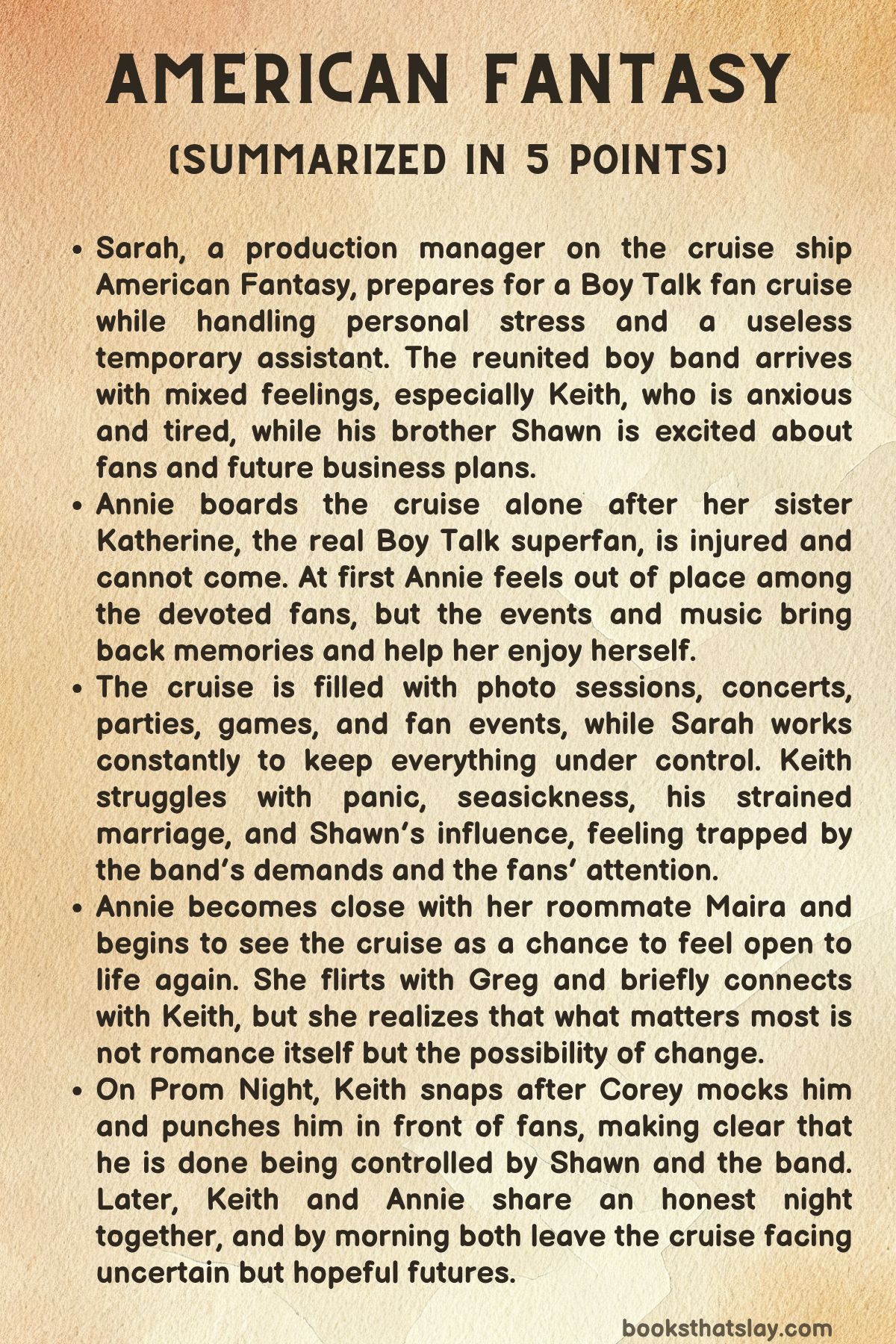
American Fantasy begins aboard the cruise ship that gives the novel its name, where Sarah, a production manager for JackRabbit, is trying to prepare for a fan cruise centered on Boy Talk. The band was once a global sensation, and although its members are now middle-aged, their loyal fans still treat them like icons.
The event is meant to be cheerful, profitable, and tightly managed, but Sarah already knows it will be difficult. She is dealing with her own recent breakup, trying to stay professional, and struggling with Tyler, a temporary assistant who is careless, unhelpful, and clearly not suited to the job.
Boy Talk arrives with its own problems. Keith Fiore, one of the band’s core members, boards the ship feeling anxious, reluctant, and emotionally drained.
He is not excited by the cruise in the way some of the others are. His older brother Shawn, however, is eager and energized.
Shawn sees the fans, the nostalgia, and the reunion as a chance to keep building business opportunities. He brings Jonathan, a strange adviser who presents himself as a coach and wellness guide, though his presence makes Bobby, the band’s longtime manager, deeply uneasy.
From the start, there is tension between old loyalties, new schemes, and the question of who really controls Boy Talk.
Among the passengers is Annie, who boards alone after her sister Katherine breaks her leg and cannot come. Katherine is the true Boy Talk devotee, and Annie feels awkward taking her place.
Annie is newly divorced, unhappy at work after a demotion, and unsure how to act among the excited fans around her. She is assigned a roommate named Maira, an experienced Talker who understands every part of the cruise: where to stand, which events matter, what gossip matters, and how to enjoy the weekend without embarrassment.
At first, Annie feels separate from the costumed fans and their intense enthusiasm. Yet when the sail-away party begins and Boy Talk appears in front of her, the past comes rushing back.
The songs, the faces, and the shared energy of the crowd remind her that she once loved the band too. Slowly, she gives herself permission to enjoy what is happening.
The cruise becomes a blur of fan events. There are photo sessions, trivia games, deck parties, concerts, themed gatherings, and constant chances for the Talkers to see the band up close.
Sarah keeps moving from one problem to the next, responsible for the smooth running of the weekend while managing the band’s emotions, the fans’ expectations, and mistakes made by the crew. Corey West, the most famous and scandal-prone member of Boy Talk, arrives late, but the fans welcome him with devotion.
His recent public trouble does little to lessen their excitement. To them, he remains Corey, the star they have loved for years.
Keith, meanwhile, struggles more and more. He is seasick, anxious, exhausted, and unhappy in his marriage to Steffani.
He feels trapped by the ship, by the band, and by the role fans still want him to play. He is grateful for their love, but that love also makes him feel confined.
He depends on Shawn’s approval and resents that dependence. Shawn keeps pushing future plans, including a trip to Japan, while Jonathan tries to involve himself more deeply in the band’s decisions.
Keith feels ignored, handled, and used. He watches Corey move through the weekend with a freedom Keith does not feel he has, and this increases his resentment.
Corey can behave badly, disappear, return late, and still be adored. Keith feels he must obey, smile, and keep going.
Annie’s experience grows more complicated as the weekend continues. Through Maira, she learns how the Talkers think and how much meaning the cruise holds for them.
She attends parties, poses for photos, watches performances, drinks more than she expected, and begins to feel less like an outsider. Her old crush on Keith returns, but it changes into something more adult.
She starts to notice not just the star she once admired, but the tired, nervous man standing behind the image. During a late-night smoking break, Annie and Maira unexpectedly meet Keith, and Annie has a brief conversation with him.
The moment is small, but it stays with her.
On American Cay, during the beach games, Annie meets Greg, a single man on the cruise. He is friendly, available, and interested in her.
Annie flirts with him and kisses him on the tender, but the kiss does not become what she imagined it might. Instead of feeling swept away by Greg himself, Annie realizes she is drawn to the possibility of being desired again.
The moment matters because it reminds her that her life has not closed down after divorce. She can still move toward new experiences, even if she does not yet know what she wants.
As the cruise nears its end, the emotional pressure inside Boy Talk grows sharper. Shawn continues to push Keith toward future commitments.
Jonathan’s influence becomes more irritating and suspicious. Corey’s behavior adds to the strain.
Keith feels that Shawn protects Corey in ways he does not protect him, and that Corey is allowed choices Keith is denied. Sarah, still trying to hold the event together, has to manage the band’s chaos while keeping the fans from seeing too much of it.
Everything breaks open on Prom Night, the final major event of the cruise. Corey makes a suggestive pass at Sarah.
When Keith learns about it in the elevator, Corey mocks him. Keith finally loses control.
As the elevator opens near waiting Talkers, Keith tackles Corey and punches him. Maira records the fight, which gets her punished by being locked in her cabin.
Annie is left without a place to sleep. Keith, shaken but also newly clear, tells Shawn that he is finished: finished with the cruise, finished with Japan, and finished taking orders.
Sarah decides to contain the damage as best she can. She sends the other members to perform and allows Keith to bring Annie into the private Sanctuary area.
Away from the fans, the noise, and the expectations, Keith and Annie spend the night talking. They eat, rest, and speak honestly.
Keith admits that he cannot continue living under Shawn’s control. Annie reflects on her divorce, her career, her shame, and her desire to stop judging herself so harshly.
Their connection is quiet and real. It is not the fantasy Annie might once have imagined as a young fan.
It is two tired adults recognizing something true in each other.
Keith gives Annie an empty cabin where she can sleep. Before they part, they kiss.
The kiss matters not because it fulfills a celebrity dream, but because it feels like a beginning. Annie understands that Keith is not simply the figure she once adored from afar.
He is a person carrying fear, guilt, and longing, just as she is. Keith, too, seems to feel the importance of being seen outside the machinery of Boy Talk.
By morning, the cruise is ending. Sarah discovers Tyler’s involvement with Jonathan and fires him, then turns her attention to getting the ship ready for debarkation.
Annie reunites with Maira, who remains loyal to the cruise and to the Talkers despite everything that has happened. Keith leaves early, pausing to hug fans as he goes.
He seems to accept that Boy Talk may be over for him, or at least that he cannot keep living inside it in the same way.
Annie leaves the ship changed, though not magically fixed. Her life is still uncertain.
Her job, her divorce, and her future remain unresolved. Yet she carries a new sense of motion.
The weekend has reminded her that memory is powerful but not final, that timing can shift a life, and that the future may still hold surprise. American Fantasy ends with Annie stepping back into the world, no longer only looking backward, but open to whatever comes next.
Characters
The characters in American Fantasy are shaped by nostalgia, disappointment, reinvention, and the strange emotional intensity of a fan cruise. Each major figure in the book carries some form of longing, whether it is for youth, success, love, control, recognition, freedom, or a future that feels less painful than the past.
Sarah
Sarah is one of the most grounded and capable characters in the book, serving as the person responsible for keeping the cruise functioning while nearly everyone around her is distracted by fantasy, fame, anxiety, or emotion. As the production manager for JackRabbit, she understands that the cruise is not just entertainment but a complex machine built from schedules, personalities, fan expectations, and constant problem-solving.
Her competence makes her stand apart from many of the other characters because she is rarely allowed to lose herself in the dreamlike atmosphere of the ship. Instead, she must manage it from behind the scenes.
At the same time, Sarah is not emotionally detached. Her recent breakup gives her a private vulnerability that runs beneath her professional control.
She is surrounded by people performing happiness, nostalgia, desire, and devotion, while she herself is trying to stay composed after personal hurt. This contrast makes her character especially interesting because she is both an organizer of fantasy and someone who cannot fully escape her own disappointment.
Her frustration with Tyler also reveals her impatience with incompetence and her need for order in an environment that constantly threatens to become chaotic.
Sarah’s interactions with the band show that she is practical, observant, and often more emotionally mature than the famous people she is managing. She sees the cracks in Boy Talk more clearly than many of the fans do, especially the tensions between Keith, Shawn, and Corey.
When Corey makes a suggestive pass at her, Sarah becomes part of the emotional breaking point of the story, not because she seeks drama, but because she has been placed too close to the band’s dysfunction. By the end, her decision to fire Tyler and keep the ship moving reinforces her role as a survivor of chaos.
She is not transformed in a dramatic romantic or sentimental way, but she emerges as someone who understands that professionalism sometimes means cleaning up after other people’s fantasies collapse.
Annie
Annie is the emotional center of the book because her journey captures the painful but hopeful process of beginning again. Recently divorced and newly demoted at work, she arrives on the cruise with a sense of embarrassment and personal failure.
She is not the original superfan who planned the trip; that role belongs to her sister Katherine. Because Annie boards alone, she begins the weekend feeling displaced, as if she has accidentally entered a world where everyone else knows the rules except her.
This feeling mirrors her larger life, where divorce and career disappointment have left her unsure of who she is supposed to be.
As the cruise continues, Annie gradually allows herself to participate in the joy, absurdity, and emotional excess around her. Her renewed interest in Boy Talk is not only about celebrity worship or childhood nostalgia.
It becomes a way for her to reconnect with an earlier version of herself, before shame, marriage, divorce, and adult disappointment narrowed her sense of possibility. Her friendship with Maira helps her enter the Talker world without judgment, and through that friendship Annie becomes more open, playful, and willing to experience the weekend instead of standing apart from it.
Annie’s attraction to Keith is important because it changes from fan fantasy into recognition of another wounded adult. At first, Keith is connected to her old memories and former crushes, but when they finally spend real time together, she sees his exhaustion, fear, resentment, and loneliness.
Their connection matters because it is quiet rather than spectacular. It is not presented as a magical solution to either of their lives.
Instead, it gives Annie a moment of genuine intimacy at a time when she needs to believe that tenderness and surprise are still possible. By the end, Annie’s future remains uncertain, but she leaves with a stronger sense that uncertainty can be movement rather than failure.
Keith Fiore
Keith Fiore is one of the most conflicted and emotionally burdened figures in the book. As a member of Boy Talk, he is adored by fans and tied to a past that still has commercial power, but he does not experience that adoration as simple happiness.
He arrives on the cruise anxious, reluctant, seasick, and emotionally trapped. His fame, which might look glamorous from the outside, feels to him like a cage built from old obligations, fan expectations, family pressure, and his own inability to say no.
Keith’s relationship with Shawn is central to his character. Although they are brothers, Shawn also functions as a controlling force in Keith’s professional life.
Keith depends on Shawn’s approval but resents the way Shawn pushes him into plans he does not want, including future performances and business opportunities. This creates a painful contradiction in Keith: he wants freedom, but he has spent so long accepting Shawn’s authority that rebellion feels almost impossible.
His panic and exhaustion are not isolated weaknesses; they are signs of a life in which his public identity has overtaken his private needs.
His resentment toward Corey also reveals Keith’s deeper insecurity. Corey is scandal-prone and unreliable, yet he seems to possess a freedom Keith lacks.
Corey can arrive late, behave badly, and still be adored. Keith, by contrast, feels responsible, controlled, and emotionally trapped.
When Corey mocks him after making a pass at Sarah, Keith’s violence becomes the eruption of years of frustration. The fight is not just about Corey; it is Keith finally rejecting the roles that have suffocated him.
His night with Annie shows a softer and more honest version of him. With her, he is not a nostalgic celebrity or Shawn’s younger brother, but a tired man trying to reclaim his own life.
Shawn Fiore
Shawn Fiore is energetic, ambitious, and deeply invested in turning nostalgia into opportunity. Unlike Keith, Shawn seems energized by the cruise, the fans, and the possibility of future business.
He views Boy Talk not only as a band but as a continuing brand, one that can be extended through more events, trips, and carefully managed fan experiences. His confidence makes him appear competent and forward-moving, but it also makes him controlling.
He often treats the people around him, especially Keith, as pieces in a larger plan.
Shawn’s relationship with Keith reveals both affection and domination. He may believe that he is guiding the band wisely, but his leadership leaves little room for Keith’s fear or exhaustion.
Shawn assumes forward motion is the answer to everything: more plans, more appearances, more markets, more ways to profit from the past. This makes him a sharp contrast to Keith, who experiences the same opportunities as pressure.
Shawn’s inability or unwillingness to truly hear Keith shows how ambition can become emotional blindness.
His openness to Jonathan also suggests that Shawn is vulnerable to people who flatter his desire for reinvention and expansion. Jonathan’s vague executive-coach energy appeals to Shawn because it promises transformation without requiring real emotional honesty.
Shawn wants the band to evolve, but he does not necessarily want to confront the pain within it. By the end, when Keith refuses Japan and rejects Shawn’s control, Shawn’s authority is shaken.
He represents the part of the story that wants to keep packaging the past, even when the people inside that package are beginning to break.
Corey West
Corey West is the band’s most famous and scandal-prone member, and his character embodies charisma without responsibility. He arrives late, carries public trouble with him, and still receives intense love from the fans.
This makes him both magnetic and frustrating. Corey understands, perhaps better than anyone, that charm can excuse a great deal, especially in a world built around nostalgia.
Fans do not simply see who he is now; they see who he once was, who they imagined him to be, and what he represented in their younger lives.
Corey’s power comes from his ability to remain slightly outside the rules. While Keith feels trapped by obligation, Corey appears able to drift in and out of the band’s world on his own terms.
That freedom makes him fascinating to fans and deeply irritating to Keith. Corey does not carry the same visible guilt about disappointing others.
His carelessness, however, has consequences. His suggestive pass at Sarah shows his entitlement, and his mocking of Keith reveals his cruelty.
He knows how to provoke, and he seems to enjoy exposing other people’s vulnerabilities.
Yet Corey is not simply a villain. He is a portrait of a celebrity who has learned that attention can survive bad behavior.
The fan cruise setting allows him to remain adored even when he is unreliable or inappropriate. His solo show and continued popularity show how fame can protect a person from accountability.
In the book, Corey functions as the spark that ignites Keith’s collapse, but he also represents a broader problem: the way nostalgia can soften judgment and allow old idols to remain powerful even when they behave badly.
Maira
Maira is Annie’s guide into the Talker world and one of the most vivid representations of devoted fandom in the book. Unlike Annie, who arrives uncertain and self-conscious, Maira knows the rhythms, rituals, gossip, and strategies of the cruise.
She understands where to stand, what to attend, how to interpret band behavior, and how to participate fully in the shared emotional language of the fans. Her confidence makes her both comic and important because she shows that fandom is not random hysteria; it has its own culture, knowledge, and forms of expertise.
Maira’s enthusiasm helps Annie loosen her defenses. Through Maira, Annie learns that the cruise can be ridiculous and meaningful at the same time.
Maira does not treat fan devotion as something to be ashamed of. Instead, she embraces it as a source of pleasure, community, and identity.
This matters because Annie begins the trip carrying shame from her divorce, her demotion, and her uncertainty. Maira’s presence gives Annie permission to enjoy something without constantly measuring whether it is sensible or respectable.
Her decision to film Keith and Corey’s fight shows both her instinct as a fan and her lack of awareness about consequences in the moment. For Maira, capturing the drama is part of being close to the action, but the punishment of being locked in her cabin reminds readers that the cruise has rules beneath its festive surface.
Even after the chaos, Maira still loves the experience, which reveals the resilience and intensity of her fandom. She may be punished, inconvenienced, and surrounded by scandal, but her emotional connection to the Talker world remains intact.
Katherine
Katherine is physically absent from the cruise, but her influence is essential because she is the reason Annie is there. As the true Boy Talk superfan, Katherine represents a more direct and confident relationship to fandom than Annie initially has.
Her broken leg removes her from the trip, but it also creates the opening for Annie’s unexpected journey. Without Katherine’s absence, Annie might never have entered the cruise world alone or been forced to confront her own memories and desires.
Katherine also functions as a contrast to Annie. Where Katherine seems to know what she loves, Annie is less certain.
Katherine’s fandom is active and intentional, while Annie’s connection to Boy Talk begins as something half-remembered and secondhand. This contrast highlights Annie’s emotional state at the beginning of the book: she is someone who has become unsure of her own wants.
Katherine’s absence therefore becomes strangely productive. It gives Annie the space to discover that the trip can belong to her, even if it was not originally meant for her.
Although Katherine does not participate directly in the cruise events, her role should not be underestimated. She represents family connection, shared girlhood memory, and the way enthusiasm can be passed between people.
Annie’s experience is shaped by the fact that she is partly taking Katherine’s place, but by the end, Annie is no longer merely a substitute. Katherine’s absence allows Annie to become the main participant in her own emotional renewal.
Tyler
Tyler is Sarah’s incompetent temporary assistant, and his character adds frustration, comic disorder, and practical difficulty to Sarah’s already demanding job. He is not simply bad at tasks; he represents the kind of workplace burden that falls on competent people when they are expected to manage both the job and the failures of those assigned to help them.
For Sarah, Tyler is a constant reminder that she cannot fully rely on the support system around her.
His incompetence also helps reveal Sarah’s standards. Because Sarah is organized and responsible, Tyler’s mistakes become more than minor annoyances.
They threaten the smooth operation of an event where timing, access, celebrity management, and fan satisfaction all matter. In a setting as emotionally charged as the cruise, even small failures can grow into major problems.
Tyler therefore functions as a pressure point in Sarah’s professional life.
By the end, Sarah’s decision to fire Tyler is satisfying because it shows her reclaiming control in at least one area. After dealing with band drama, fan chaos, Corey’s behavior, Keith’s breakdown, and Jonathan’s interference, Tyler becomes a problem she can actually solve.
His involvement with Jonathan also connects him to the larger theme of foolishness disguised as opportunity. Tyler’s role may be secondary, but he helps expose the exhaustion of being the responsible person in a world full of unserious ones.
Jonathan
Jonathan is one of the strangest and most unsettling characters in the book. As Shawn’s holistic adviser and executive-coach figure, he brings a vague language of wellness, transformation, and strategy into the band’s already unstable environment.
He alarms Bobby because his role is unclear and because he seems to be inserting himself into spaces where he may not belong. Jonathan’s presence suggests opportunism disguised as guidance.
His appeal to Shawn is important. Shawn wants growth, reinvention, and future plans, and Jonathan appears to offer a framework for all of that.
However, Jonathan’s advice seems less grounded in the band’s real emotional needs than in fashionable language and self-importance. He represents the kind of outsider who attaches himself to fame and business ambition by promising clarity while actually increasing confusion.
His presence makes the band’s management situation feel more unstable.
Jonathan also adds to the book’s satire of celebrity-adjacent culture. Around famous people, there are often managers, advisers, coaches, assistants, and hangers-on, all trying to influence decisions or gain access.
Jonathan belongs to this world of blurry authority. His connection with Tyler near the end reinforces the sense that he is not a trustworthy stabilizing force.
Instead, he is part of the absurd machinery surrounding Boy Talk, a person who complicates rather than heals.
Bobby
Bobby, the band’s longtime manager, represents old loyalty, professional experience, and traditional control. His alarm at Jonathan’s presence shows that he understands the danger of unclear authority around a band that is already emotionally fragile.
Unlike Jonathan, Bobby has history with Boy Talk. He knows the personalities, the tensions, and the business.
This makes him protective not only of the band’s brand but also of the structure that has kept the group functioning.
Bobby’s role is significant because he belongs to the older system of celebrity management. He is not necessarily sentimental, but he understands that a group like Boy Talk survives through careful handling.
His concern about Jonathan suggests that he can recognize when someone is trying to interfere without earning trust. In this way, Bobby acts as a stabilizing presence, even if he cannot fully prevent the band from unraveling.
He is also limited. The fact that Keith reaches a breaking point shows that management cannot solve everything, especially when the real problems are emotional, familial, and personal.
Bobby may understand logistics and reputation, but he cannot force Keith to keep accepting a life he no longer wants. His character shows the limits of professional management when the performers themselves are exhausted by the roles they are paid to repeat.
Steffani
Steffani, Keith’s strained wife, is important because she represents the life Keith has beyond the cruise and beyond Boy Talk. Even though she is not at the center of the shipboard action, her presence in Keith’s mind reveals that his personal world is troubled.
His marriage is another area where he feels pressure, distance, and emotional failure. The strain with Steffani deepens the sense that Keith’s crisis is not only professional but also intimate.
Steffani’s role also prevents Keith from being seen only as a trapped celebrity. He is a husband as well as a performer, and his unhappiness has consequences beyond the stage.
His connection with Annie gains emotional complexity because it occurs against the background of a troubled marriage. The kiss between Keith and Annie is meaningful, but it is not simple.
Steffani’s existence reminds readers that moments of renewal can also be morally complicated.
As a character, Steffani functions mostly through absence and tension. She is part of the reality waiting outside the fantasy environment of the cruise.
While fans see Keith as an object of devotion and Annie sees him as a vulnerable man, Steffani likely knows another version of him: the husband shaped by anxiety, avoidance, and exhaustion. Her role expands Keith’s character by showing that his problems cannot be left behind on land.
Greg
Greg is a single man Annie meets during the cruise, and his main importance lies in what he reveals about Annie’s changing emotional state. Their flirtation and kiss on the tender give Annie a chance to feel desired and spontaneous after divorce.
Greg is not presented as her great romantic destiny. Instead, he becomes part of her rediscovery of possibility.
Through him, Annie tests what it feels like to be open to someone new.
The kiss with Greg matters because Annie realizes that her interest is less about him specifically and more about the sensation of being alive to the future. This distinction shows her growing self-awareness.
Earlier in the book, Annie is burdened by shame and uncertainty, but with Greg she begins to understand that desire does not have to immediately become commitment or meaning. It can simply indicate that she is no longer frozen.
Greg also serves as a contrast to Keith. With Greg, Annie experiences ordinary flirtation within the playful atmosphere of the cruise.
With Keith, she experiences a more intimate and emotionally revealing connection. Greg therefore helps clarify what Annie wants and does not want.
He is a transitional figure, someone who opens a door but does not become the destination.
The Talkers
The Talkers, the devoted Boy Talk fans, function almost like a collective character. They create the emotional atmosphere of the cruise through costumes, screaming, rituals, loyalty, gossip, and shared memory.
Their devotion transforms the ship into a floating world where adolescence, adulthood, fantasy, and disappointment all exist together. They are often funny and excessive, but they are not treated as meaningless.
Their love for the band is sincere, and that sincerity gives the cruise its power.
The Talkers also reveal the double nature of fandom. On one hand, their enthusiasm gives Boy Talk continued relevance and financial value.
On the other hand, their devotion can feel overwhelming to the band members, especially Keith. The fans’ love is both gift and burden.
They preserve the band’s past, but they also make it harder for the performers to escape that past. This tension is central to the book’s emotional world.
As a group, the Talkers show how nostalgia can become community. Many of them are not simply chasing celebrities; they are reconnecting with youth, friendship, identity, and joy.
For Annie, entering their world helps her move beyond self-consciousness. For Keith, being surrounded by them intensifies his sense of entrapment.
This contrast makes the Talkers essential to the story. They are not background decoration but the force that keeps the fantasy alive, even as the people inside it begin to question whether they can continue.
Boy Talk
Boy Talk as a group functions as more than a band; it is a symbol of packaged memory, aging celebrity, and the emotional afterlife of pop culture. Once hugely successful, the members are now middle-aged and reunited for profitable nostalgia events.
Their performances allow fans to return to an earlier emotional era, but the band members themselves cannot return so easily. They must perform youth while living with adult exhaustion, scandal, resentment, and disappointment.
The group’s internal tensions reveal how difficult it is to turn the past into a business without damaging the people involved. Shawn sees opportunity, Keith feels trapped, Corey behaves as if rules do not fully apply to him, and Bobby tries to maintain order.
The band’s public unity hides private fractures. This makes Boy Talk one of the book’s most important character systems: each member reflects a different response to fame after its peak.
By the end, Boy Talk appears fragile, perhaps even finished in its current form. Keith’s refusal to continue with the cruise plans and Japan trip signals that the fantasy cannot be endlessly extended without cost.
The band has survived because fans still love what it represents, but the people inside the band are no longer young images on posters. They are adults with limits.
In American Fantasy, Boy Talk represents the central conflict between the comfort of nostalgia and the need to stop performing a version of the self that no longer feels livable.
Themes
Nostalgia and the Emotional Power of the Past
Nostalgia shapes the emotional world of American Fantasy by showing how the past can feel comforting, embarrassing, painful, and powerful all at once. The Boy Talk cruise is built on memory: fans return to songs, costumes, dances, and crushes that once gave them joy and identity.
For Annie, the cruise begins as something connected to her sister’s fandom, but it soon becomes a way of meeting her own younger self again. The music and performances bring back feelings she had buried under divorce, disappointment, and adult self-consciousness.
Yet the novel does not treat nostalgia as simple escape. The band members are also trapped by the past because their current value depends on who they used to be.
Keith, especially, feels the weight of being loved for an older version of himself. Nostalgia becomes both a gift and a burden: it allows people to remember who they were, but it also forces them to ask whether they can become someone new.
Fame, Performance, and the Loss of Personal Freedom
The cruise reveals fame as a life of constant performance, where public affection can become another form of pressure. Boy Talk is adored by fans, but that adoration leaves little room for privacy, weakness, or change.
Keith’s anxiety shows how exhausting it is to keep playing a role that no longer feels natural. He is expected to smile, pose, sing, charm fans, and follow Shawn’s plans, even when he feels physically and emotionally overwhelmed.
Corey’s public image also shows how fame can excuse bad behavior, because fans continue to admire him despite scandal and selfishness. Sarah’s role as production manager exposes the machinery behind celebrity events: every magical fan experience depends on schedules, damage control, emotional labor, and hidden stress.
The cruise may look like celebration from the outside, but behind the scenes it is filled with control, fear, and compromise. Fame gives the band attention and money, but it also limits their ability to be honest human beings.
Reinvention After Disappointment
Annie’s journey centers on the possibility of beginning again after personal failure, shame, and unwanted change. She boards the ship newly divorced, professionally diminished, and unsure of how to understand herself outside the life she expected to have.
At first, she feels awkward among the fans because their confidence and excitement make her aware of her own hesitation. Gradually, the cruise gives her a strange but useful space where normal rules are suspended.
She can drink, dance, flirt, make friends, remember old desires, and imagine a future that is not defined only by loss. Her brief connection with Greg matters less as romance than as proof that she can still attract attention and feel curiosity.
Her later connection with Keith is more meaningful because it is based on mutual honesty rather than fantasy alone. Annie does not leave with a fully solved life, but she leaves with movement.
Her reinvention begins when she stops treating disappointment as final.
Control, Brotherhood, and the Need for Self-Ownership
Keith’s conflict with Shawn highlights the damage caused when love, loyalty, and control become difficult to separate. Shawn acts like a brother, business partner, leader, and manager all at once, which makes it hard for Keith to resist him without feeling guilty.
Keith has spent years accepting Shawn’s decisions because it is easier than facing conflict, but the cruise makes that pattern unbearable. Shawn’s enthusiasm for future opportunities, especially new performances and business plans, ignores Keith’s exhaustion and fear.
Jonathan’s presence makes the situation worse because it suggests that Shawn is willing to replace genuine care with empty coaching language and manipulation. Keith’s fight with Corey is not only about Corey’s behavior; it is the moment when Keith’s buried anger finally breaks through.
By rejecting Shawn’s plans and choosing a quiet night of honesty with Annie, Keith begins to claim ownership over his life. The theme shows that freedom often requires disappointing the people who expect obedience.