American War Summary, Characters and Themes
American War by Omar El Akkad is a dystopian novel set in a future United States broken by climate disaster, political extremism, and a second civil war. The story follows Sarat Chestnut, a young girl from Louisiana whose life is reshaped by loss, displacement, radicalization, imprisonment, and revenge.
Through her journey, the book examines how violence creates more violence, how nations rewrite their own suffering, and how children can become weapons when adults feed them grief and anger. American War is bleak, political, and intimate, using one family’s ruin to show the human cost of endless conflict.
Summary
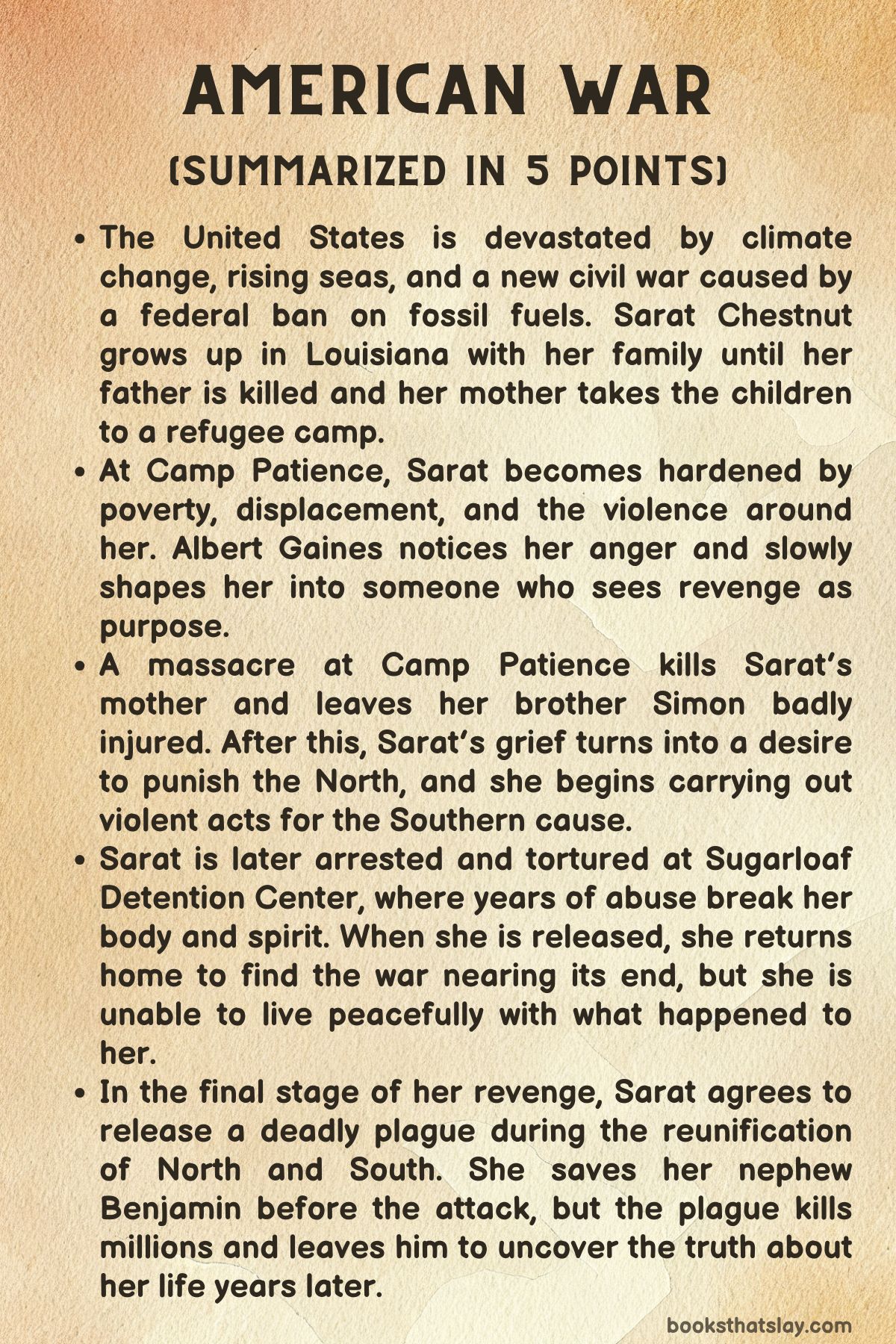
American War begins in a future America damaged by climate change and divided by politics. Rising seas have swallowed large parts of the country, including Florida and much of Louisiana, and many coastal cities have been abandoned.
The capital has moved from Washington, DC to Columbus, Ohio. The federal government has passed a law banning fossil fuels, but several Southern states see this as an attack on their way of life and secede.
This starts the Second American Civil War, a long and devastating conflict between the North and the South.
The story is framed by Benjamin Chestnut, a man born during the war who survives because he is sent away from the worst of its aftermath. As an old man and historian, Benjamin decides to reveal the hidden story of his aunt, Sarat Chestnut, whose life became tied to one of the worst acts in American history.
Sarat is born Sara T. Chestnut and grows up in St. James, Louisiana, near the new mouth of the Mississippi. She lives with her mother Martina, her father Benjamin, her older brother Simon, and her twin sister Dana.
Their home is a converted shipping container, and their life is already shaped by poverty, instability, and the distant sounds of war. Louisiana is not officially part of the seceded South, but many people there sympathize with the Southern cause.
Martina wants a safer life for the family, so Sarat’s father travels to Baton Rouge to apply for permission to work in the North.
He never returns. A rebel bomber attacks the federal building where he has gone, and he is killed.
Martina cannot bring herself to tell the children the truth at first. She tries to find a place where the family can survive, but the options are limited.
As fighting moves closer, she takes the children away from their home and joins other displaced Southerners heading to Camp Patience, a refugee camp in Mississippi.
Camp Patience becomes Sarat’s childhood home. It is crowded, poor, and dangerous, but it is also where she grows into a fierce and restless girl.
Her brother Simon becomes drawn to the rebel cause, while Dana learns how to use her beauty and charm to earn money from visiting journalists. Martina spends her days helping other refugees write letters and petitions.
Sarat, meanwhile, spends her time wandering the camp, testing limits, and watching the war from the edges.
At the camp, Sarat meets Albert Gaines, a refined and secretive man who notices her anger and strength. Gaines begins giving her small tasks, then lessons.
He teaches her history, geography, music, and, most importantly, a version of the war that focuses on Northern cruelty and Southern suffering. Sarat is young, grieving, and hungry for purpose.
Gaines sees that and slowly shapes her. He convinces her that her pain is part of a larger injustice and that she is one of the rare people strong enough to act on it.
The turning point comes when Camp Patience is attacked. Northern militiamen storm the camp and kill large numbers of refugees.
Sarat manages to save Dana by hiding with her in Gaines’s office, but she cannot save Martina. Simon survives, but he suffers a severe head injury that leaves him permanently damaged.
After the massacre, Sarat finds bodies, blood, and fire everywhere. She kills one of the attackers with a knife.
By morning, the girl she once was has largely vanished. When Gaines speaks to her afterward, Sarat no longer wants lessons or explanations.
She wants revenge.
The surviving Chestnuts are later moved to a charity house in Georgia. Simon lives with serious brain damage and is cared for by Karina Chowdhury, who eventually becomes part of the family.
Dana tries to live beyond the war, but Sarat sinks further into militancy. Gaines trains her to shoot, and with help from foreign supporters of the Southern cause, she becomes a weapon.
She assassinates General Joseph Weiland, the North’s top military commander, with a sniper rifle. This killing changes the course of the war.
Instead of weakening the North, it hardens Northern public opinion and leads to harsher military action against the South.
Sarat continues moving through the rebel world, meeting leaders, informants, and fighters. She reconnects with Marcus, a childhood friend from Camp Patience who has become a Northern soldier.
Their relationship is complicated by history and guilt, but he still gives her information. Sarat also has moments of intimacy and escape, including time with Layla, Jr., yet she remains driven by rage.
When Dana is killed in a drone strike, Sarat’s last close tie to her old life is broken. Soon after, federal forces arrest her.
Sarat is taken to Sugarloaf Detention Center, a prison on what used to be high ground before the seas rose. There she is caged, isolated, interrogated, and tortured.
The authorities do not appear to know the full truth of what she has done, but they treat her as a terrorist. She refuses to confess for years, repeating that she did nothing.
The prison strips away her body, pride, and resistance. After long periods of sensory torture, solitary confinement, hunger strikes, force-feeding, and waterboarding, she finally breaks and confesses to crimes she did not commit.
When the war nears its end, officials decide the intelligence used to arrest her was unreliable, and she is released.
By the time Sarat returns home, she is physically and emotionally transformed. The war is nearly over, and the South has agreed to reunification with the North.
Simon has become more stable, Karina has married him, and they have a young son named Benjamin. The family now runs a successful greenhouse estate, helped by Karina’s unexpected rise as a trusted local banker.
Sarat cannot fully rejoin their life. She sleeps in a woodshed instead of the room prepared for her, partly because the room faces water and her torture has left her terrified of it.
Young Benjamin becomes the one person who draws Sarat back toward ordinary feeling. She spends time with him, protects him, and begins to experience brief moments of peace.
She even enters the river with him, facing one of her deepest fears. But the past keeps returning.
Adam Bragg, Jr., one of the remaining rebel leaders, brings Sarat the prison guard Bud Baker, the man who helped torture her. Sarat murders Bud, but she spares his wife and children after realizing the children are twins, like she and Dana once were.
Even in revenge, a trace of her old self remains.
Then Joe, a foreign agent who has long supported the Southern insurgency, returns with a final offer. He tells Sarat that Gaines betrayed her by giving her name to federal authorities.
He also offers her a way to punish everyone: the Quick, a deadly virus created during failed experiments connected to the South Carolina quarantine. Sarat agrees to release it during the reunification process.
By this point, she no longer believes in the South as a noble cause. Her revenge has grown beyond politics.
She wants to wound the entire country that made and destroyed her.
Before carrying out the plan, Sarat sends Benjamin away to safety in Alaska. She gives him a letter and makes sure he will escape the coming disaster.
Then she travels north disguised as a medical patient and crosses the heavily guarded border. Soon afterward, the plague is released in Columbus during Reunification Day.
It spreads across the country and kills 110 million people, Northerners and Southerners alike.
Benjamin grows up in New Anchorage, far from the worst of the plague. Only later does he understand the numbers Sarat left in her letter: they are coordinates.
They lead him back to Georgia, where he meets Layla, Jr., who had survived because Sarat warned her. Layla gives Benjamin Sarat’s writings, which reveal the truth of her life and her role in the plague.
Horrified that Sarat caused the deaths of millions, including his parents, Benjamin burns most of the pages. He keeps only the first page, where Sarat remembers a time before war, when she lived with her family by the Mississippi and was happy.
American War ends with that painful contrast: a child who once knew happiness becomes an instrument of mass death. The novel shows how war does not only kill people; it reshapes memory, identity, and morality until victims can become perpetrators.
Sarat’s life is not presented as an excuse for her final act, but as a warning about what happens when a society feeds children nothing but fear, loss, and revenge.
Characters
Sarat Chestnut
Sarat Chestnut is the central figure of American War, and her character is built around the slow destruction of childhood by violence, grief, and political manipulation. She begins life as Sara T. Chestnut, a bold, restless, physically strong girl who does not fit the gentle role expected of her.
Her toughness is not evil at first; it is a survival instinct. She grows up in poverty, then loses her father, her home, and later her mother, brother’s wholeness, and sister.
Each loss narrows her emotional world. Albert Gaines recognizes her anger before she fully understands it and turns that anger into a political weapon.
Sarat’s transformation is disturbing because it feels gradual and human. She is not born cruel.
She is trained to believe that pain needs a target. Even after becoming a killer, she still shows flashes of tenderness, especially toward Dana, Benjamin, and later Bud Baker’s twin children.
Her final act is monstrous, but the novel makes clear that Sarat is both responsible for what she does and also a product of a nation that taught her revenge before mercy.
Benjamin Chestnut
Benjamin Chestnut, Sarat’s nephew and the narrator of much of the larger story, represents memory, inheritance, and moral judgment. He survives because Sarat sends him away before the plague, but survival becomes its own burden.
He grows up far from the South, in Alaska, detached from the direct history of his family yet still shaped by it. His later career as a historian is important because he tries to understand the past through records, testimony, and evidence, but Sarat’s story forces him to face something more personal than history.
His anger at Sarat is not abstract; she caused the death of his parents and millions of others. When he burns her writings, he tries to punish a dead woman by destroying the version of herself she left behind.
Yet he preserves the first page, where she remembers happiness. That choice reveals Benjamin’s conflict.
He condemns Sarat, but he cannot reduce her only to a mass murderer. He becomes the keeper of a terrible truth: that history is made not only by governments and armies, but by wounded people.
Martina Chestnut
Martina Chestnut is the emotional center of the Chestnut family before war tears it apart. As a mother, she is practical, protective, and exhausted by the demands of survival.
She wants to move her family away from danger, not because she is a coward, but because she understands that ordinary people rarely win anything from political conflict. Her grief after Benjamin’s death is private and overwhelming, but she still has to keep functioning for her children.
At Camp Patience, she becomes useful to other refugees by writing letters for them, showing that even in displacement she tries to preserve dignity and order. Martina’s tragedy is that every decision she makes to protect her children places them in new danger.
Leaving Louisiana seems sensible, but it leads the family into the camp massacre. Her death becomes one of the defining wounds in Sarat’s life.
Martina stands for the civilian cost of war: parents who do not control politics, yet pay for them with their homes, bodies, and children.
Benjamin Chestnut Sr.
Sarat’s father, Benjamin Chestnut Sr., appears briefly but his death shapes the entire family’s future. He is a man trying to find a path out of hardship by applying for work in the North.
His choice shows that he is not driven by ideology as much as by responsibility. He wants stability for Martina and the children, and his willingness to seek opportunity outside the South separates him from those who see compromise as betrayal.
His death in a rebel bombing carries bitter irony because he is killed by the side that later claims to speak for people like his family. For Sarat, however, the politics of his death become blurred by the larger violence around her.
His absence creates the first great hollow space in the Chestnut household. Martina loses her partner, the children lose their father, and the family loses the possibility of escape before the war fully claims them.
He is less a developed presence than a lost future.
Dana Chestnut
Dana Chestnut, Sarat’s twin sister, functions as Sarat’s emotional opposite and closest mirror. Where Sarat is hard, physical, and combative, Dana is beautiful, socially aware, and more able to move through the world by charm.
In Camp Patience, Dana learns to pose for journalists and turn outside attention into small financial advantage, which shows both her adaptability and the way refugee suffering becomes a spectacle for others. Dana is not shallow; she is a child learning how to survive in the limited ways available to her.
Her bond with Sarat is one of the few relationships that keeps Sarat connected to love. During the camp massacre, Sarat’s decision to hide with Dana instead of searching immediately for Martina becomes one of her lasting emotional scars.
Dana’s later death in a drone strike destroys one of Sarat’s final attachments to innocence and family. Dana represents the life Sarat might have protected if the war had not kept taking from them.
Simon Chestnut
Simon Chestnut’s life is one of the clearest examples of war’s damage to the body and mind. As a teenager, he is drawn to the rebel cause, partly because war offers young men a story of purpose, courage, and belonging.
Before he can become the heroic fighter he imagines, the massacre leaves him with severe brain damage. Afterward, he becomes the “Miracle Boy” to strangers, a symbol onto which they project faith, hope, and superstition.
This public image contrasts sharply with his private condition: he needs care, struggles with connection, and lives with the lasting effects of violence. Sarat’s feelings toward him become painfully complicated.
She loves him, but she also resents his survival because he becomes neither martyr nor fully restored brother. Simon’s later marriage to Karina and fatherhood to Benjamin show that damaged people can still form families, but the shadow of the massacre never leaves him.
His character reveals how survival can be mistaken for healing.
Albert Gaines
Albert Gaines is one of the most dangerous characters because he understands how to turn suffering into ideology. He is educated, calm, cultured, and persuasive, which makes his manipulation of Sarat especially effective.
He does not recruit her through crude slogans alone. He teaches her, listens to her, praises her, and gives structure to her anger.
Gaines knows that Sarat wants to be seen as strong and special, so he offers her that identity. His betrayal later exposes the selfishness beneath his political devotion.
When he gives names to federal authorities to protect his own family, the cause he preached becomes secondary to personal survival. This does not make his earlier influence harmless; it makes it more corrupt.
Gaines uses Sarat’s pain while keeping enough distance to preserve himself. By the time she sees him again, he is physically broken and mentally diminished.
Sarat chooses not to kill him because his guilt has already made him a ruin.
Yousef Bin Rashid, Known as Joe
Joe, whose real name is Yousef Bin Rashid, represents foreign interference and the global politics behind the civil war. He presents himself as an ally of the Southern cause, but his motives are not rooted in love for the South.
He belongs to an outside power that benefits from America’s division and decline. His friendship with Gaines gives him access to Sarat, and he becomes part of the network that supports her transformation from angry refugee to trained assassin.
Joe is patient, strategic, and emotionally controlled. He understands that Sarat’s revenge can be directed toward a much larger purpose.
His final offer of the Quick virus reveals the full scale of his manipulation. He gives Sarat a way to hurt everyone, but he also serves the geopolitical interest of weakening the United States beyond repair.
Joe’s danger lies in the fact that he does not need to create Sarat’s rage; he only needs to wait until it becomes useful.
Karina Chowdhury
Karina Chowdhury is a stabilizing force in the later part of the story. As Simon’s caretaker and later wife, she represents care, patience, and practical intelligence in a world dominated by vengeance.
She is not attached to the Southern cause in the way Sarat is, and this makes Sarat suspicious of her. Yet Karina proves her loyalty through action rather than ideology.
She looks after Simon, builds a family with him, raises Benjamin, and creates economic security through the trust people place in her. Her rise as a banker is unusual but meaningful.
In a society shattered by institutions, people trust her because she protects what they give her. Karina’s protectiveness toward Benjamin, including her fear of the river, shows both love and anxiety.
She knows the world is dangerous and tries to control what she can. Her presence offers an alternative to Sarat’s path: survival through care, labor, and rebuilding rather than revenge.
Marcus Exum
Marcus Exum is Sarat’s childhood friend and later a Northern soldier, making him one of the clearest examples of how war divides people who once shared the same suffering. In Camp Patience, he is a companion who understands Sarat’s world because he lives inside it too.
His family’s desire to move North reflects a longing for safety rather than betrayal. When he later appears in uniform, Sarat’s reaction shows how deeply identity has hardened around sides and symbols.
Yet Marcus does not become a simple enemy. He feels guilt about what happened to Sarat and understands that wearing the uniform connects him to the system that tortured her, even if he personally did not commit those acts.
His role as an informant suggests that personal loyalty can survive political separation, but only in damaged form. Marcus is important because he complicates Sarat’s belief that people can be sorted cleanly into guilty and innocent groups.
Adam Bragg Sr.
Adam Bragg Sr. represents the hardline rebel leadership that keeps war alive even when formal political structures move toward compromise. As leader of the United Rebels, he stands apart from Southern officials willing to negotiate reunification.
He feeds on the mythology of resistance and depends on people like Sarat, whose personal losses can be converted into military action. Bragg’s power comes not from moral clarity, but from his ability to give angry people a banner.
He understands the symbolic value of violence and treats assassins and fighters as tools in a larger story of defiance. His movement reflects the way wars continue after governments become tired of them, because militias, revenge networks, and political myths remain active.
Bragg is less intimate than Gaines, but he is part of the same machinery. He helps create a world in which Sarat’s pain is praised only when it is useful.
Adam Bragg Jr.
Adam Bragg Jr. is connected to the rebel elite through his father, and he moves through the Southern militant world with a sense of inherited status. He is fascinated by Sarat, partly because he recognizes or suspects her role in General Weiland’s assassination.
His invitation to the violent fighting event reveals the culture around him: pain, spectacle, masculinity, and death are treated as entertainment. Later, he becomes one of the remaining figures of the rebel cause after most of the movement has collapsed.
His role in bringing Bud Baker to Sarat shows how the remnants of rebellion operate through revenge rather than strategy. Bragg Jr. also helps Sarat reach the North for her final mission, proving that even a failing movement can still enable catastrophic violence.
He is not the origin of Sarat’s rage, but he gives it access, transportation, and approval.
Bud Baker
Bud Baker is the face of Sarat’s imprisonment and torture. As a guard at Sugarloaf, he has power over people who have been stripped of nearly every defense.
His cruelty is personal, repeated, and intimate, making him one of the figures Sarat most directly associates with her suffering. Bud is important because he brings the machinery of state violence down to the level of one human body hurting another.
He is not a distant policy maker or general; he is the person who enforces pain. When Sarat later kills him, the scene is not framed as justice in any clean sense.
It is revenge, and it brings her close to killing innocent children as well. Her decision to spare them shows that Bud’s cruelty has not completely erased her capacity for recognition.
His sons later play an ironic role when one moment of mercy allows Sarat’s medical transport to pass, showing how revenge and kindness can exist in the same damaged family line.
General Joseph Weiland Sr.
General Joseph Weiland Sr. represents Northern military authority and the cold logic of wartime responsibility. He is committed to victory and rejects gestures that might imply federal guilt for civilian suffering caused by military action.
His attitude suggests that war requires not only weapons but also narratives that protect one side from moral accountability. By refusing to compensate victims of drone strikes, he treats acknowledgment itself as a strategic danger.
Sarat’s assassination of him becomes a turning point because it changes Northern public feeling and strengthens support for harsher action against the South. In that sense, his death proves how political violence often produces the opposite of what it seeks.
Weiland Sr. is not explored as a private person in great depth, but his public role matters greatly. He embodies the state’s refusal to appear weak, sympathetic, or guilty, even when civilians suffer.
Joseph Weiland Jr.
Joseph Weiland Jr. begins as a more conflicted figure than his father. His work with compensation claims suggests that he sees Southern civilian suffering and understands that the federal government’s image matters.
Yet his father teaches him that sympathy has limits in war, especially when the enemy’s perception cannot be easily changed. After his father’s assassination, Weiland Jr. becomes part of a harsher system.
As head of the War Office, he defends brutal interrogation methods and frames them as necessary for reducing insurgent attacks. His development shows how personal loss can harden even those who once seemed capable of nuance.
In this way, he mirrors Sarat from the opposite side. Both are shaped by grief, both become less merciful, and both justify violence through the language of necessity.
He represents how institutions absorb private pain and turn it into policy.
Layla Jr.
Layla Jr. offers Sarat one of her few spaces of intimacy outside war, family, and revenge. Her relationship with Sarat shows that Sarat is not only a fighter or symbol; she is also a person with desire, vulnerability, and need.
Layla Jr. survives because Sarat warns her before the plague, which reveals that Sarat’s final revenge is not entirely indiscriminate on a personal level. She is willing to kill millions, but she still chooses to save someone she once loved.
Later, Layla Jr. becomes the keeper of Sarat’s writings and passes them to Benjamin. Her role is quiet but essential because she preserves the human record Sarat left behind.
Through Layla Jr., the story suggests that private love can survive inside a life ruined by public violence, though it cannot undo the harm that life causes.
Prince Wendell
Prince Wendell is a minor but memorable figure because his offshore coffee shop becomes a rare neutral space where Northerners and Southerners can coexist peacefully. His refusal to abandon his business after the sea consumes his town gives him a strange dignity.
He lives amid the ruins of climate disaster, yet maintains a place where ordinary exchange is still possible. In a story dominated by borders, camps, prisons, and military zones, his coffee shop feels almost unreal because it is one of the few places not fully controlled by war.
Prince Wendell’s role is small, but symbolically important. He shows that coexistence is possible, though fragile and isolated.
The fact that such peace exists only on an abandoned oil platform also carries irony, since fossil fuel politics helped ignite the conflict.
Themes
War as a Machine That Recreates Itself
In American War, violence does not end with a battle, a massacre, or a peace agreement; it keeps reproducing itself through memory, revenge, and political storytelling. Sarat’s life shows how war recruits people long before they pick up weapons.
Her father’s death, displacement, life in Camp Patience, the massacre, Dana’s death, and torture at Sugarloaf all become stages in a process that turns personal grief into mass violence. The same pattern appears on the Northern side.
The assassination of General Weiland does not weaken the North’s will; it strengthens support for harsher military action. Joseph Weiland Jr. becomes more severe after his father’s death, just as Sarat becomes more destructive after losing her family.
The novel presents war as a system that feeds on injury. Each side points to its own dead as proof of righteousness while ignoring the people it has harmed.
This is why formal reunification cannot truly heal the country. The political agreement may end the war on paper, but Sarat’s final act proves that private wounds can outlive public settlements.
Peace fails when no one has learned how to stop needing revenge.
Radicalization and the Theft of Childhood
Sarat’s transformation is one of the clearest studies of radicalization in the novel. She is not recruited because she is empty of feeling; she is recruited because she feels too much and has no safe way to process it.
Albert Gaines understands that Sarat’s anger needs recognition. He gives her attention, education, secrecy, praise, and a sense of destiny.
This makes his influence more powerful than open coercion. He does not simply command her; he teaches her to see herself as chosen.
The tragedy is that Sarat’s natural courage and intelligence could have become something constructive in another life. Instead, those qualities are trained toward killing.
Camp Patience is central to this theme because it is filled with children who are supposed to be protected but are instead surrounded by propaganda, poverty, humiliation, and danger. Simon is drawn toward militancy; Sarat is shaped into a weapon; Dana learns to perform refugee suffering for money.
Childhood becomes a resource that adults exploit. The novel shows that radicalization is not only about belief.
It is also about loneliness, grief, pride, and the desperate need to make suffering mean something.
Climate Collapse and National Breakdown
The future America of the novel is already broken before the civil war begins. Rising seas have erased states, moved populations, and changed the map so severely that the country’s old identity no longer matches its physical reality.
The relocation of the capital, the loss of Florida, the ruined Louisiana coastline, and the Mississippi’s transformed landscape all show that climate change is not background setting; it is one of the forces that makes political collapse possible. Scarcity and displacement make people more vulnerable to fear, resentment, and regional identity.
The fossil fuel ban becomes the direct political trigger for secession, but the deeper conflict is about a society unable to adapt without turning adaptation into humiliation. For the South, the ban feels like cultural erasure and economic punishment.
For the federal government, it is a necessary response to environmental disaster. The tragedy is that both the climate crisis and the war punish ordinary people most.
Families like the Chestnuts do not shape national energy policy, yet they lose their home, safety, and future because of it. The novel suggests that environmental collapse does not only destroy land; it destabilizes memory, belonging, and political trust.
History, Memory, and the Stories Nations Tell
The novel is deeply concerned with who gets to tell history and what those stories hide. Benjamin’s role as narrator matters because he is not only recounting family history; he is challenging official versions of the war.
The inserted records, testimonies, letters, and public documents show that history is always assembled from fragments, many of them biased, incomplete, or self-protective. Governments use language to soften guilt.
Rebels use heroic wording to make brutality sound noble. Peace negotiators argue over how the war should be described because they understand that future power depends on future memory.
The line between truth and propaganda becomes especially important in Sarat’s life. Gaines radicalizes her by telling true stories of Northern cruelty while placing them inside a larger lie that violence will restore justice.
Later, Benjamin burns Sarat’s diaries because he wants to hurt her memory, yet he saves the page that remembers happiness. That act captures the novel’s moral difficulty.
Sarat is guilty of an unforgivable crime, but erasing her humanity would also create a false history. The past must be judged, but it must also be understood clearly enough that its violence is not repeated.