American Wolf Summary and Analysis
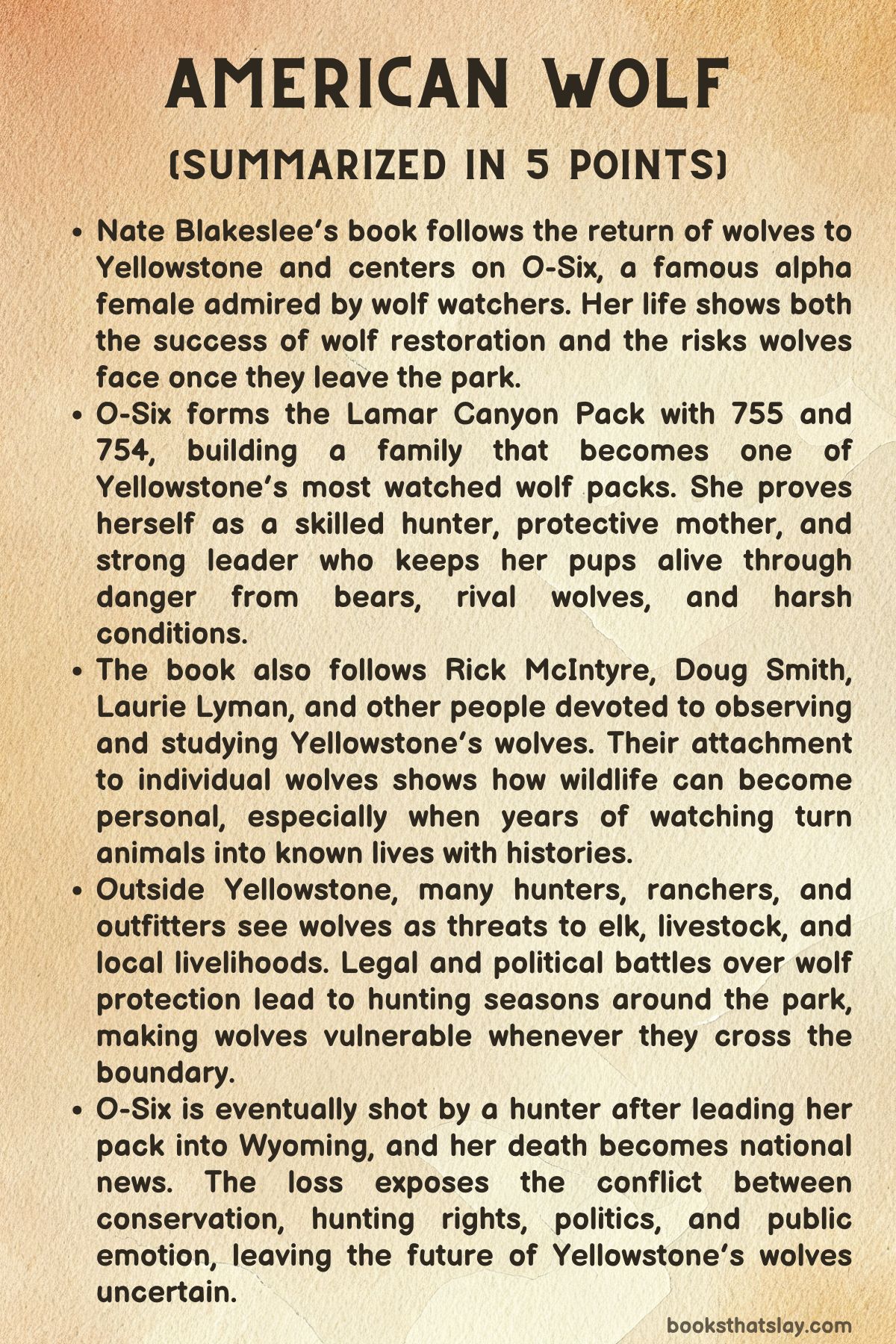
American Wolf: A True Story of Survival and Obsession in the West by Nate Blakeslee is a nonfiction account of Yellowstone’s restored wolf population, centered on the famous alpha female O-Six and the people who followed, studied, loved, feared, or hunted wolves. The book follows the return of wolves to Yellowstone after decades of absence and shows how one animal became a symbol in a larger fight over conservation, politics, hunting, ranching, and public land.
Through O-Six, Rick McIntyre, Doug Smith, local hunters, and lawmakers, the book explores what happens when wild animals cross human boundaries, both physical and emotional.
Summary
American Wolf tells the story of Yellowstone’s wolves after their reintroduction to the park in the mid-1990s, with special focus on a remarkable female wolf known as O-Six. The book opens with a hunter in Wyoming watching two wolves in his rifle sights.
He can kill only one, and the moment sets up the central conflict of the book: to some people, wolves are treasured wild animals and signs of ecological renewal; to others, they are predators that threaten hunting, livestock, and a way of life.
The story then moves into Yellowstone, where Rick McIntyre, a park ranger and devoted wolf watcher, spends his days searching for wolves through spotting scopes. Rick has watched Yellowstone’s wolves for years and keeps detailed records of their behavior.
Among all the wolves he observes, O-Six becomes one of his favorites. She is beautiful, intelligent, strong, and unusually independent.
She has left her birth pack and spent years looking for a mate and a territory of her own. For a wolf, that is a dangerous path.
Lone wolves often die young, but O-Six survives by skill, caution, and force of will.
The book explains that O-Six is part of a much larger history. Wolves once lived across much of North America, but humans nearly wiped them out in the continental United States.
In Yellowstone, officials once believed wolves should be removed to protect elk and other large animals. Their disappearance, however, damaged the balance of the ecosystem.
Without wolves, elk overgrazed, and the park lost an important predator. Decades later, biologists brought wolves from Canada back into Yellowstone, beginning one of the most important wildlife restoration projects in American history.
Early reintroduced packs, especially the Druids, become legendary in the park. The Druids take over the Lamar Valley and grow into a powerful family.
Rick watches their rise, their battles, their internal conflicts, and their eventual decline. Their story shows that wolf life is complex and often brutal.
Wolves fight rival packs, compete for mates, protect pups, and form deep family bonds. The Druids’ leaders, especially the male 21 and his mate 42, leave a strong mark on Rick and other watchers.
Their lives become part of the park’s shared memory.
O-Six emerges after the Druids weaken. She draws two young males away from them, brothers later known as 755 and 754.
The younger brother, 755, becomes her mate, while 754 remains loyal to the family as a helper. Together they claim territory and become the Lamar Canyon Pack.
O-Six proves to be the pack’s central force. She is the best hunter, the main protector, and the wolf who gives the family its identity.
When O-Six gives birth to pups, her fame grows. Visitors gather with scopes to watch her family from a distance.
Rick, Laurie Lyman, Doug McLaughlin, and other wolf watchers follow the pups’ growth and learn their traits. O-Six defends her young from bears, moves them to safer places, and teaches them the first lessons of hunting.
To the watchers, she is not just a research subject. She has a personality, a family, and a story.
Outside the park, however, the mood is very different. In towns such as Crandall, Wyoming, many hunters and outfitters blame wolves for falling elk numbers and weaker hunting businesses.
Louie Cary, an outfitter, represents people who feel that wolves have damaged the local economy. Steven Turnbull, a local hunter, also sees wolves as competitors.
For people like him, wolves are not symbols of wilderness recovery. They are animals that kill elk and should be hunted.
The book shows how this conflict moves from the woods into courts and politics. The question of whether wolves should remain protected under federal law becomes a national debate.
Conservation lawyers argue that the wolf population is still vulnerable and that state plans may not protect the animals enough. Opponents argue that wolves have recovered and that states should be free to manage them, including through hunting seasons.
In Montana, Idaho, and Wyoming, wolves become part of a broader political struggle over federal power, rural identity, and resentment toward outside control.
For a time, legal rulings protect wolves from new hunting seasons. But political pressure changes the outcome.
A budget deal in Washington removes federal protection for wolves in parts of the Northern Rockies. Montana and Idaho open hunting seasons, and Wyoming eventually receives approval for one as well.
From that point on, Yellowstone’s wolves are safe only inside park boundaries. Once they cross into surrounding land, they can be legally killed.
Meanwhile, O-Six’s pack faces natural dangers too. The Mollie Pack, a large and aggressive group of wolves, moves into the Lamar Valley and threatens the Lamars.
O-Six must protect her pups from a pack much larger than her own. In one dramatic confrontation, the Mollies find her den while she is nursing newborn pups.
O-Six escapes down a dangerous cliffside, using terrain that her attackers cannot follow. Her pack survives, though one of her young wolves dies.
Later, the Lamars strike back and kill one of the Mollies involved in the attacks. These scenes show O-Six as both mother and fighter, willing to risk everything for her family.
As the Lamar Canyon Pack grows, O-Six travels farther in search of elk. That movement worries Rick because it brings the wolves close to the park boundary and into hunting country.
His fear soon comes true. During Wyoming’s first wolf-hunting season, the pack moves into Crandall.
A hunter kills 754, the loyal brother who helped O-Six and 755 raise their young. The loss deeply affects the wolf-watching community.
Rick, Laurie, and Doug McLaughlin mourn him as a known individual, not an anonymous animal.
Soon after, O-Six herself leads her pack out of the park again. Steven Turnbull sees a gray wolf and a black wolf in the snow.
He fires and kills the gray one. When he approaches, the black wolf returns and howls, and other wolves appear from the willows.
Turnbull realizes he has likely killed the leader of the pack. Later, officials confirm that the dead wolf is O-Six.
Her death becomes national news. Newspapers, radio, and television report that one of the world’s most famous wolves has been killed outside Yellowstone.
Many people are angry and confused that a wolf loved by thousands of visitors could be legally shot just beyond the park border. Donors question the value of radio collars if hunters can kill collared animals.
The Wolf Project faces public pressure, and Doug Smith must answer difficult questions while also grieving.
After O-Six dies, the Lamar Canyon Pack falls apart. Some members return to the park, but the family is no longer whole.
755 struggles to hold territory and later loses his place to his own daughters and their new mates. He leaves the Lamar Valley, the home he built with O-Six.
For Rick and the other watchers, this loss is painful because they have followed these wolves through births, battles, hunts, and family changes.
The final part of the book shows that O-Six’s death has lasting effects. It brings wider public attention to wolf hunting and strengthens calls for better protection around Yellowstone.
Legal fights continue, and some rulings restore protections in certain areas. Yet hunting also continues in much of the Northern Rockies, where thousands of wolves are killed over several years.
The book ends with Rick still devoted to the wolves, though changed by loss. He is honored by the wolf-watching community for his years of work.
He tells stories of earlier wolves, including 21 and 42, and reflects on whether wolves feel joy, grief, loyalty, and longing. His answer is yes.
Through Rick’s eyes, the book suggests that wolves are not just data points or political symbols. They are living beings with families, memories, and places they try to return to.
American Wolf closes as both a story of one extraordinary wolf and a larger account of America’s uneasy relationship with wildness.
Key People
O-Six
O-Six is the central wolf figure and the emotional core of the narrative. She is presented as unusually capable, cautious, and independent, a wolf who survives long odds after leaving her birth pack and searching for territory and a mate.
Her strength is not only physical; it lies in her judgment. She knows when to fight, when to avoid danger, and when to move her pups to safer ground.
Her role as mother defines much of her character, but she is not reduced to motherhood alone. She is also a hunter, a leader, a strategist, and a symbol of Yellowstone’s restored wildness.
Her ability to feed and protect her family makes her admired by watchers and feared by rivals. In American Wolf, O-Six becomes important because she is both an individual animal with recognizable behavior and a public symbol caught in human conflict.
Her death outside the park exposes how fragile protection can be when a wild animal crosses an invisible boundary.
Rick McIntyre
Rick McIntyre is one of the most important human figures in the book because he acts as witness, recorder, interpreter, and emotional guardian of Yellowstone’s wolves. His life is organized around watching them.
His daily routine, his notebooks, and his deep attention to wolf behavior show a man whose purpose has become tied to observation. Rick does not simply collect data; he sees stories, relationships, grief, loyalty, and courage in the wolves he follows.
This makes him vulnerable to criticism from scientists who avoid human language when describing animals, yet it also makes him powerful as a storyteller. Rick’s devotion is inspiring but also isolating.
His obsession leaves little room for ordinary relationships, and his need to see wolves every day shapes nearly every decision he makes. Through him, the book explores the difference between watching nature from a distance and forming lasting emotional bonds with individual animals.
755
755 is O-Six’s mate and the founding male of the Lamar Canyon Pack. At first, he appears less impressive than O-Six because she is the stronger hunter and the more commanding presence.
Yet his importance grows through his loyalty, steadiness, and commitment to family life. He helps raise pups, assists in defending them, and remains a constant partner to O-Six.
His character becomes especially moving after her death. Without her, he struggles to hold the pack together and eventually loses the home they built.
His later reappearance with a new mate and pups gives his story a measure of renewal. 755 represents endurance after loss.
He is not the heroic leader in the same way O-Six is, but his survival shows another kind of strength: the ability to continue after family, territory, and status have been taken away.
754
754, the brother of 755, is defined by loyalty. Although he is not the dominant male, his role in the Lamar Canyon Pack is essential.
He remains with his brother and O-Six, helps hunt, assists with pups, and supports the family structure. His presence shows that wolf packs are not only built around alpha pairs but also around helpers whose work allows pups to survive.
754’s broken leg keeps him close to the pack when he might otherwise have left in search of his own mate, deepening his image as a family member tied to the Lamars’ survival. His death during the Wyoming hunting season is one of the book’s major emotional blows.
To hunters, he is a legal kill; to watchers, he is a known life with history and value. His death prepares readers for the greater loss of O-Six.
Doug Smith
Doug Smith represents the scientific side of wolf restoration. As a biologist with the Wolf Project, he studies wolf populations, collars animals, tracks movements, and tries to balance research with public responsibility.
He must speak carefully because he works within a government institution, and this often places him in a difficult position. He understands the emotional importance of wolves like O-Six, but he also has to maintain professional restraint.
His grief after O-Six’s death reveals that his scientific role does not shield him from attachment. Doug is important because he stands between worlds: the world of data and management, the world of public anger, and the world of personal sorrow.
His character shows how conservation work is not only about numbers and policy. It is also about the emotional burden of caring for animals whose lives cannot always be protected.
Laurie Lyman
Laurie Lyman is part of the wolf-watching community and one of the people who helps turn observation into shared memory. She writes about the wolves, gives them names, and helps others understand their behavior.
Her naming of O-Six is especially significant because it gives the wolf an identity that visitors and readers can hold onto. Laurie is sensitive, observant, and deeply invested in the fate of the Lamar Canyon Pack.
She also helps balance Rick’s intensity, making her important not only as a watcher but as a stabilizing presence in the human community around the wolves. Through Laurie, the book shows how ordinary citizens can become central to conservation culture.
She is not a scientist or policymaker, yet her writing and care help shape how others see Yellowstone’s wolves.
Doug McLaughlin
Doug McLaughlin is another devoted wolf watcher, but his character carries a sharper edge than Rick or Laurie. He is skilled at spotting wolves and becomes part of the informal network that follows the park’s packs.
His bond with the Lamars is strong, and after O-Six’s death he reacts with anger and direct action. His attempt to frustrate hunters through noise emitters and signal-jamming equipment shows how grief can become resistance.
Doug’s character reflects the frustration of people who feel official systems have failed the wolves. He is not content with mourning from a distance.
He wants to intervene, even if his methods are unofficial and extreme. Through him, the book examines what happens when love for wildlife turns into distrust of human institutions.
Steven Turnbull
Steven Turnbull is the hunter who kills O-Six, and the book treats him as more than a simple villain. He is a devoted hunter from Wyoming who sees wolves through the lens of elk loss, local resentment, and hunting tradition.
He believes he acted legally and does not express regret in the way wolf advocates might want. His view of O-Six is fundamentally different from Rick’s or Laurie’s.
To him, she is a wolf in hunting country, not a celebrity or a cherished individual. This contrast makes him one of the most important human figures in the narrative.
He forces readers to confront the gap between legal action and moral reaction. His refusal to feel shame may seem cold, but it also reveals the cultural divide at the heart of American Wolf.
Louie Cary
Louie Cary represents the local outfitter and hunting economy affected by the return of wolves. His business depends on elk, hunters, and access to public land.
As elk become harder to find and hunting permits decline, he sees wolves as a direct threat to his livelihood. Cary’s resentment is shaped by economics as much as ideology.
He belongs to a community that feels ignored or judged by outsiders, especially tourists and federal officials who celebrate wolves without living with the consequences. His character helps explain why anti-wolf feeling remains so strong outside Yellowstone.
He shows that the conflict is not only about animals; it is also about money, pride, rural identity, and fear of losing control over land that locals consider part of their way of life.
Doug Honnold
Doug Honnold represents the legal fight to protect wolves. As a lawyer, he argues that wolf recovery cannot be judged only by political compromises or minimum population numbers.
His concern with genetic connectivity and state management plans shows that conservation law depends on details that are easy for the public to overlook. Honnold’s role is important because he fights in court while others fight in newspapers, hunting fields, and park pullouts.
He receives threats, which shows how emotionally charged the wolf issue has become. His character demonstrates the risks faced by people who defend unpopular environmental positions in hostile regions.
He also shows that the fate of wild animals often depends on legal language, agency decisions, and political pressure as much as biology.
John Tester
John Tester is important because he shows how political survival can shape environmental policy. As a Democratic senator in a difficult reelection fight, he supports action that removes federal protection from wolves in parts of the Northern Rockies.
His decision is not presented as an act of personal hatred toward wolves but as a political calculation. That makes his role especially revealing.
He shows how conservation can be sacrificed when elected officials fear losing rural voters or Senate control. Tester’s character stands for the compromises of power.
Through him, the book shows that wolves become bargaining chips in national politics, even though the consequences are felt by real animals in specific places.
Denny Rehberg
Denny Rehberg functions as a political voice for anti-wolf sentiment. His opposition to wolves fits into a wider campaign identity based on resistance to federal control and resentment of policies associated with Washington.
He uses strong language that presents wolves as dangerous and excessive, helping turn them into a symbol in a larger cultural fight. Rehberg matters because he shows how public fear can be sharpened for political gain.
He is less central as an individual than as a representative of a political mood. Through him, the debate over wolves becomes part of a larger argument about government, land, rural life, and who gets to decide what belongs in the West.
The Druid Pack
The Druid Pack is almost a collective character. Its rise, dominance, decline, and legacy shape the world into which O-Six steps.
The Druids show the power and instability of wolf society. They claim territory, raise large numbers of pups, fight internal battles, and lose leaders to rival packs.
Their history gives the Lamar Valley emotional weight because later wolves inherit not only the land but also the stories attached to it. The Druids also teach Rick and other watchers how complex pack life can be.
Through them, the book shows that wolves are neither gentle icons nor mindless killers. They are social predators living under pressure, capable of cooperation, violence, loyalty, and loss.
The Mollie Pack
The Mollie Pack represents the danger that wolves pose to one another. Their attacks on other packs and their threat to O-Six’s den remind readers that the wild is not safe even without human hunters.
The Mollies are large, aggressive, and destabilizing, especially after losing clear leadership. Their movement into the Lamar Valley creates some of the book’s most tense wolf-on-wolf conflict.
Yet they are not evil. They are acting according to the pressures of territory, food, breeding, and survival.
Their presence complicates any simple view of wolves as innocent victims. They show that Yellowstone’s restored ecosystem includes violence within nature as well as violence from human society.
Themes
Wildness and Human Boundaries
Wild animals do not understand the borders humans draw on maps. A wolf inside Yellowstone is protected, studied, photographed, and admired; the same wolf outside the park may become a legal target.
This boundary problem sits at the center of the narrative. O-Six and her pack move according to elk, territory, family needs, and seasonal patterns, not according to park regulations.
Their natural movements bring them into conflict with human systems that divide land into protected zones, hunting zones, predator zones, and private holdings. The tragedy is that the wolves are punished for crossing lines they cannot see.
This theme also raises a larger question about conservation: protecting animals in one place may not be enough if their lives require movement beyond that place. The park becomes both sanctuary and trap.
It offers safety, but only as long as the animals remain within its limits. American Wolf shows that wildness cannot be fully contained by human categories, even when those categories are created with good intentions.
Science, Storytelling, and Emotional Truth
The book places scientific observation beside emotional storytelling and asks whether one must cancel out the other. Doug Smith and the Wolf Project study wolves through collars, population counts, behavior records, and management reports.
Rick, Laurie, and other watchers also observe closely, but they give the wolves names, histories, and personalities. Scientists may worry that this kind of language makes animals seem too human, yet the watchers see emotional meaning in repeated behavior, family bonds, grief, play, and loyalty.
The theme is not that science is cold or that emotion is automatically correct. Instead, the book suggests that both forms of attention reveal something important.
Scientific language can explain population recovery, hunting effects, and ecological balance, while storytelling can make the public care about an individual life. O-Six becomes famous because people know her story, not because she is only one data point among many.
The book argues through its structure that facts matter, but facts often need narrative before they can move people.
Politics and the Fate of Nature
The wolves’ future is repeatedly shaped by decisions made far from Yellowstone. Courts, federal agencies, state wildlife departments, senators, and budget negotiations all affect whether wolves live under protection or become available to hunters.
This theme shows how nature is never separate from politics, especially when animals are controversial. Wolf recovery begins as a scientific and ecological project, but it quickly becomes tied to elections, rural anger, federal authority, and party strategy.
Politicians respond not only to evidence but also to pressure from voters who feel that wolves represent outside interference. The result is a painful gap between biological reality and political action.
Even when research suggests wolves are part of a healthier ecosystem, political leaders may treat them as liabilities. The book presents this process as frustrating because animals like O-Six pay the price for decisions made through compromise and public fear.
The wolves become symbols in arguments about power, but they also remain living creatures whose deaths are immediate and irreversible.
The Conflict Between Local Livelihood and Conservation
The opposition to wolves is not shown as pure hatred without cause. Hunters, ranchers, and outfitters often believe the return of wolves has damaged their lives.
Elk become harder to hunt, businesses weaken, livestock owners fear losses, and locals feel that outsiders celebrate wolves without understanding the costs. This theme gives the book much of its moral tension.
Wolf advocates see restoration, beauty, ecological repair, and individual animal lives. Many locals see reduced opportunity, federal control, and a predator placed above human needs.
The conflict becomes harder because both sides speak from real experience. Rick watches wolves raise pups, grieve, and struggle to survive.
Louie Cary and Steven Turnbull live in a region where hunting has economic and cultural value. The book does not make these perspectives equal in emotional force, but it does show why the debate remains so bitter.
Conservation succeeds only partly if it restores animals while deepening resentment among nearby communities. The unresolved problem is how to protect wild creatures while also facing the fears and losses of people who live beside them.