An American Sickness Summary and Analysis
An American Sickness: How Healthcare Became Big Business and How You Can Take It Back by Elisabeth Rosenthal is a nonfiction investigation into how the United States healthcare system became so expensive, confusing, and difficult for ordinary patients to use. Rosenthal, a physician and journalist, explains how hospitals, insurers, drug companies, device makers, billing contractors, and even some doctors learned to treat illness as a business opportunity.
The book is not only a critique; it is also a guide for patients who want to understand bills, question prices, avoid traps, and push for a more transparent, fair, patient-centered system.
Summary
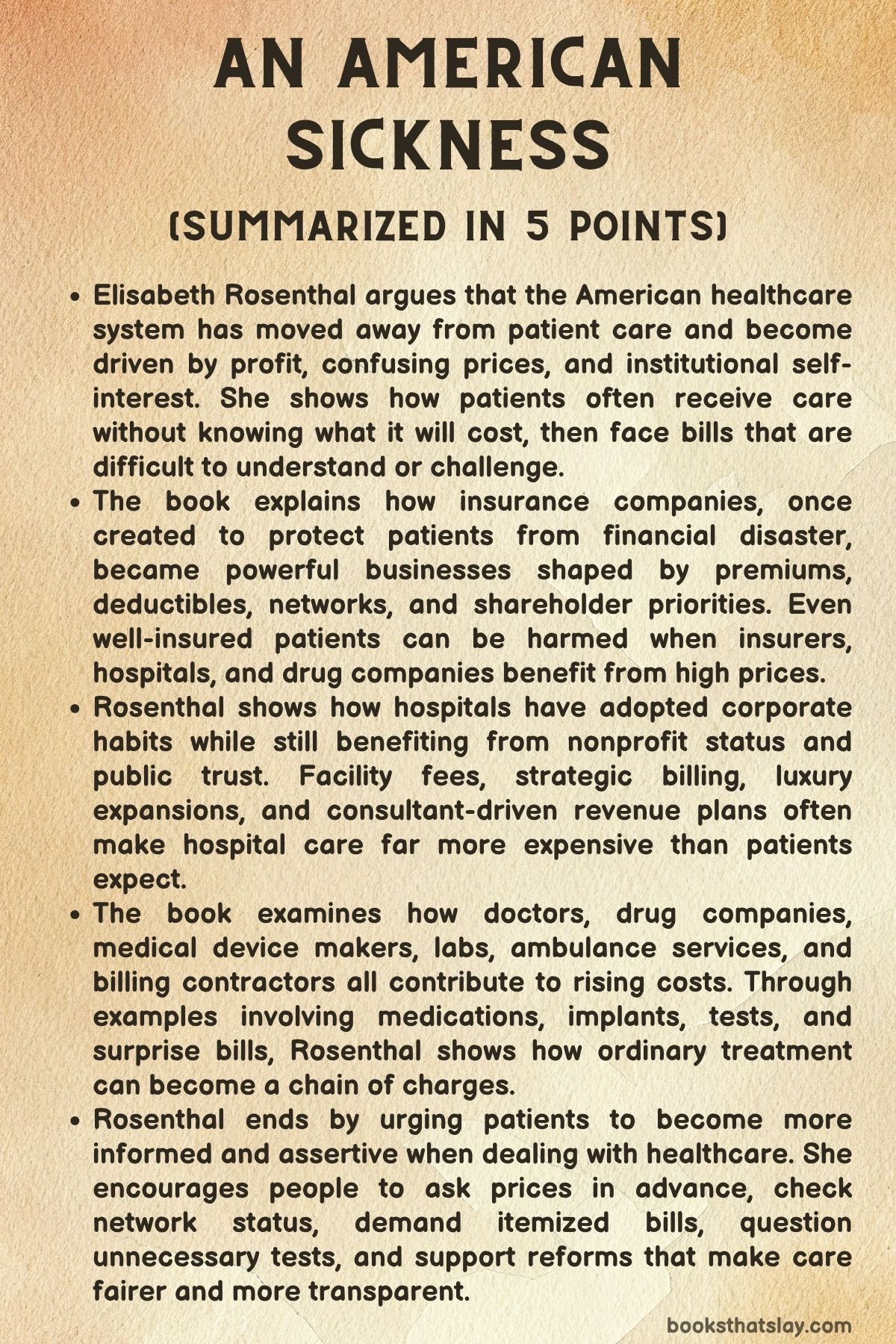
An American Sickness argues that American healthcare has shifted away from care and toward profit. Rosenthal begins with the central complaint: Americans pay more for healthcare than people in other developed countries, yet they often receive worse access, confusing bills, and unpredictable costs.
The system has become so complex that patients rarely know the price of a treatment before receiving it, and even insured patients can be left with crushing bills. Rosenthal presents healthcare as a “medical-industrial complex” in which every sector has found ways to make money from fear, illness, and the lack of price transparency.
The book first examines health insurance. Insurance began as a protective, nonprofit idea meant to keep hospitals stable and shield patients from financial disaster.
Early plans were simple and charitable in spirit. Over time, however, insurance became a major business.
Companies learned to design plans around profit, premiums, deductibles, and market advantage. Rosenthal uses the case of Jeffrey Kivi, whose arthritis treatment became wildly more expensive after his care moved to a major medical center.
His medicine did not change, but the billing structure did. The case shows how hospitals, insurers, and pharmaceutical interests can all benefit while the patient becomes trapped in a system he cannot control.
Hospitals are another major focus. Rosenthal explains how many hospitals began as religious or charitable institutions but gradually adopted corporate habits.
They hired consultants, expanded administrative departments, added luxury features, and developed billing strategies that increased revenue. Nonprofit status did not always mean charitable behavior.
Some hospitals used their tax advantages while spending relatively little on charity care. Patients were charged facility fees, room fees, and vague “miscellaneous” charges that were hard to challenge.
A routine or short visit could result in a bill of tens of thousands of dollars. Hospitals also learned to focus on profitable departments, such as orthopedics, cardiac care, and cancer services, while reducing or neglecting less profitable but necessary areas like emergency care, dialysis, addiction treatment, and clinics for low-income patients.
Rosenthal then turns to doctors. She explains that physicians face high educational costs and long training periods, but the modern system has also created incentives for some doctors to maximize income through billing codes, ownership stakes, ancillary services, and procedural medicine.
Payment systems often reward procedures more than judgment, time, or careful diagnosis. Specialists who patients do not choose directly, such as anesthesiologists or emergency physicians, can bill separately and sometimes remain outside insurance networks even when the hospital is in-network.
This creates surprise bills. Rosenthal also describes how doctors can profit from surgery centers, office-administered drugs, medical upgrades, and work done by assistants or technicians under their supervision.
The pharmaceutical industry receives close attention. Rosenthal traces how drug regulation developed around safety and effectiveness but often failed to address cost.
Pharmaceutical companies learned to use patents, legal delays, marketing, and product changes to extend monopolies and keep prices high. Drugs that are old or only slightly changed can be reintroduced at much higher prices.
Companies may combine cheap generic ingredients into expensive branded drugs, shift products from prescription to over-the-counter status to block generic competition, or use “pay-for-delay” agreements to slow cheaper alternatives. Patient assistance programs may appear generous, but they can also help companies preserve high prices by making the patient’s share manageable while insurers and public programs pay the larger cost.
Medical devices form another profitable sector. Patients often do not know which device is being implanted in their body, what it costs, or whether the doctor has a financial relationship with the manufacturer.
Devices such as hip implants, heart valves, and surgical mesh can pass through approval pathways that require limited proof if they are considered similar to existing devices. This can allow flawed products to reach patients.
Rosenthal shows how manufacturers, distributors, sales representatives, hospitals, and physicians can all profit from devices. Some doctors may even earn royalties from products they use, raising serious concerns about conflicts of interest.
Testing and ancillary services also add costs. Blood tests, MRIs, biopsies, ambulance rides, and preoperative screenings can be billed at wildly different prices depending on where they are performed.
Hospitals and doctors may order more tests because testing brings revenue and is easier to bill than careful conversation or observation. Patients often assume tests are necessary because they are recommended by medical professionals, but Rosenthal shows that financial motives can influence what gets ordered.
Elderly patients are especially vulnerable to excessive testing and procedures, especially when Medicare or Medicare Advantage payment systems reward more diagnoses.
The book also explains the role of coding, billing, contractors, and debt collection. Medical bills are filled with codes that ordinary patients cannot understand.
A small change in coding language can greatly increase the amount charged. Hospitals may outsource billing and collections to third parties whose goal is to recover as much money as possible.
Uninsured patients can be charged far more than insured patients, and even people recovering from serious illness may face liens, payment plans, lawsuits, or threats from collectors. Rosenthal presents billing as a separate industry that profits from confusion.
The Affordable Care Act appears in the book as an important but incomplete reform. It expanded insurance access and protected many people from denial based on preexisting conditions, but it did not fully control prices.
Insurers could still offer high-deductible plans, narrow networks, and confusing coverage rules. Hospitals and doctors could still exploit uncertain definitions such as “covered,” “preventive,” or “no cost.” Rosenthal argues that insurance coverage alone cannot fix healthcare if the prices underneath remain uncontrolled.
In the second half, An American Sickness becomes more practical. Rosenthal urges patients to stop being passive consumers.
She recommends asking for prices in advance, checking whether every doctor involved is in-network, questioning unnecessary tests, demanding itemized bills, appealing unfair charges, and comparing costs when possible. She also calls for broader reforms: national fee schedules, stronger transparency, limits on surprise billing, better regulation of drug prices and patents, more accountable nonprofit hospitals, and greater patient ownership of medical data.
The book closes with a call for a return to affordable, evidence-based, patient-centered care. Rosenthal does not claim that doctors and nurses are villains; many entered medicine to help people.
But she argues that good intentions are not enough when the structure of the system rewards overcharging, confusion, and waste. Her final message is that knowledge gives patients power.
By understanding how the system works, Americans can protect themselves and demand a healthcare model that treats medical care as a public need rather than a marketplace designed to extract money from illness.
Key People
Elisabeth Rosenthal
Elisabeth Rosenthal functions as the central guiding voice of An American Sickness. She is not a character in the fictional sense, but she is the controlling presence who shapes the reader’s understanding of the American healthcare system.
Her authority comes from her dual background as a physician and journalist, which allows her to explain medical details while also investigating financial motives, institutional behavior, and patient experiences. She writes with controlled anger rather than emotional exaggeration, and her role is to make a deliberately confusing system legible.
Rosenthal’s strongest quality is her ability to connect individual suffering to larger systems. A single bill, drug price, hospital policy, or insurance decision becomes evidence of a broader pattern.
She is also important because she does not let patients remain only victims; she pushes them, and the reader, toward knowledge, questioning, and resistance.
Dr. Jeffrey Kivi
Dr. Jeffrey Kivi is one of the clearest examples of how even well-insured patients can become vulnerable inside the healthcare market. He is a high school chemistry teacher with debilitating psoriatic arthritis, and his access to Remicade gives him back the physical ability to work, stand, and live with far less pain.
His case is powerful because he is not uninsured, careless, or medically uninformed. He has a strong insurance plan and a legitimate medical need.
Yet he still becomes trapped when the same treatment begins costing far more after his doctor moves to a different medical center. Kivi represents the patient who has done everything “right” but is still punished by a system whose prices have little connection to ordinary logic.
His story also exposes how hidden financial relationships affect care. The fact that NYU Langone has a financial stake connected to Remicade makes Kivi’s treatment both a medical matter and a revenue opportunity.
His eventual move to a less effective drug shows the human cost of pricing structures that look rational only to institutions.
Dr. Paula Rackoff
Dr. Paula Rackoff appears as Kivi’s rheumatologist and represents the kind of doctor whose medical judgment can improve a patient’s life while still operating inside a system that distorts care. Her recommendation that Kivi participate in the Remicade trial is medically beneficial, and the treatment gives him meaningful relief.
She is not presented as a villain; rather, her role shows how individual doctors can make sound clinical decisions that later become entangled in institutional pricing. When her practice moves to NYU Langone, the treatment setting changes, and with it the billing scale changes dramatically.
Rackoff’s presence helps Rosenthal show that the healthcare crisis is not simply a matter of bad doctors or bad patients. A doctor may act in good faith, a patient may benefit, and yet the surrounding business structure can still transform care into an expensive financial event.
Heather Pearce Campbell
Heather Pearce Campbell represents the patient who faces a medical emergency and then has to fight a billing system that refuses to explain itself. Her ectopic pregnancy requires urgent surgery, but the aftermath becomes a second ordeal when she receives a large hospital bill that classifies the entire stay under a vague label.
Campbell’s importance lies in her insistence on clarity. She asks for an itemized bill, questions the hospital’s refusal, and files a complaint accusing the institution of deceptive and obstructive billing practices.
Her story reveals how even a short hospital stay can become financially overwhelming when hospitals hide behind internal procedures and opaque billing categories. Campbell is also significant because her case touches on religious hospital systems and reproductive care.
Her procedure’s vague classification suggests that institutional ideology and billing practice may overlap in ways that leave patients confused, exposed, and powerless.
Dr. Frank McCullar
Dr. Frank McCullar serves as a witness to the transformation of hospitals from community-minded medical institutions into revenue-driven organizations. When he joins Providence, he is drawn to its charitable identity and its connection to respected medical work.
Over time, he sees administrators gain influence, doctors become pressured to consider revenue, and the hospital invest in expensive amenities while poor patients feel increasingly out of place. McCullar’s character is valuable because he gives the reader a long view of institutional change.
He remembers a different model of medicine, one shaped more by service and less by financial performance. His discomfort shows that the shift toward profit is not abstract; it changes the atmosphere of care, the relationship between doctors and administrators, and the moral identity of the hospital.
His embarrassment at seeing poor patients enter such a costly environment captures the emotional burden carried by medical professionals who recognize that their workplace no longer fully matches their ethical ideals.
Patricia Kaufman
Patricia Kaufman represents patients who receive medically successful treatment but are still harmed by the financial structure around that treatment. Her upper back surgeries help her, and she is pleased with the clinical results and hospital experience.
Yet the billing around her care changes dramatically, including an additional charge tied to who closed her wound. Kaufman’s case is important because it separates medical outcome from financial fairness.
A patient can be grateful for care and still be exploited by strategic billing. Her experience shows how hospitals and consultants can identify ordinary parts of a procedure and turn them into opportunities for extra revenue.
Kaufman is not portrayed as medically neglected; instead, she is financially manipulated after treatment. That distinction makes her case especially revealing, because it shows that the system’s harm does not always come from bad medicine.
Sometimes it comes from converting routine medical steps into billable advantages.
Olga Baker
Olga Baker stands for the patient’s family member who lacks insider medical knowledge and is forced to trust urgent hospital instructions. Her daughter’s brain cancer diagnosis creates terror, and the hospital’s insistence that surgery must happen immediately leaves little room for independent review.
Baker’s story is contrasted with Rosenthal’s own experience with her daughter, where professional knowledge and medical contacts allow Rosenthal to seek more opinions and make a more informed decision. Baker does not have that privilege.
Her daughter is treated by an out-of-network subcontractor who has an exclusive hospital arrangement but no special expertise in brain tumors. Baker’s role exposes one of the book’s sharpest inequalities: patients with medical knowledge, connections, and confidence can resist pressure, while others may be rushed into procedures with enormous consequences.
She shows how fear becomes a tool that can be used to sell urgency, even when the situation deserves more careful evaluation.
Barbara Bennion
Barbara Bennion represents older patients who are offered costly medical “upgrades” under the language of safety, convenience, or better quality of life. Her cataract surgery consultation becomes a sales encounter, with options presented in a way that pressures her toward a laser-based procedure costing far more than Medicare covers.
Bennion’s role is important because her case shows how medical innovation can be marketed beyond necessity. New technology may genuinely help in some cases, but the patient is often not given a clear, neutral explanation of whether the added cost is medically justified.
Bennion is not rejecting care; she is trying to make a reasonable choice in a setting where the doctor’s recommendation carries enormous authority. Her experience shows how vulnerable patients can be when medicine adopts the logic of premium consumer products.
The problem is not technology itself, but the way technology becomes an upsell.
Hope Marcus
Hope Marcus represents the patient whose life depends on access to an old, effective drug that becomes expensive because of patent and marketing strategies. Her need for mesalamine is not experimental or luxurious; it is necessary for managing a serious bowel condition.
Yet the drug’s ownership and packaging changes place her in a position where affordability becomes uncertain. Marcus’s decision to buy generic medicine from India shows both desperation and resourcefulness.
She becomes a symbol of patients forced outside the normal American healthcare channels because those channels are too expensive. Her story also exposes the moral problem of treating long-established medicines as profit opportunities.
When a drug has existed for decades and still becomes financially unreachable, the issue is not scientific scarcity but market control. Marcus’s role in the book is to show how pharmaceutical pricing can turn ordinary survival into a search for loopholes.
Mary Chapman
Mary Chapman’s experience with multiple sclerosis shows how chronic illness makes patients financially captive. Unlike a one-time procedure, her condition requires continuing treatment, which means she cannot simply avoid the system after one bad bill.
Her dependence on expensive medication places her at the mercy of insurance design, copays, assistance programs, and charitable funds that may themselves be connected to pharmaceutical interests. Chapman’s story is especially significant because it shows how disability and illness can reduce a person’s income at the same time that medical costs rise.
She cuts back work, spends savings, and searches for aid, but the system keeps demanding more. Her later move from California to South Carolina, along with continued travel for treatment, shows how healthcare costs can shape where people live and how they organize their entire lives.
She represents the long-term patient who is not only sick but financially rearranged by illness.
Barbara Baxter
Barbara Baxter is one of the strongest examples of how medical devices can harm patients after being marketed as solutions. Her hip replacement is supposed to restore mobility and quality of life, but the Rejuvenate implant becomes a source of fractures, monitoring costs, surgeries, anxiety, and financial strain.
Baxter’s importance lies in the way her body becomes the site of regulatory failure. She later learns that the implant has been recalled, but she still bears the burden of testing, follow-up care, and out-of-pocket expenses.
Her case shows how device makers benefit from approval systems that may not require enough safety evidence before products reach patients. Baxter also represents a deeper loss of trust.
A patient who accepts an implant must believe that doctors, manufacturers, hospitals, and regulators have done their jobs. When that trust fails, the consequences are physical, emotional, and financial.
Antonitsa Vlahoulis
Antonitsa Vlahoulis reveals the dangers of conflicts of interest in medical device use. During heart surgery, she receives a valve invented by her surgeon, and later suffers serious complications that require further intervention.
Her case raises troubling questions about experimentation, consent, royalties, and professional accountability. Vlahoulis is important because she shows what can happen when a doctor’s role as healer overlaps with the role of inventor or financial beneficiary.
Even if a device is presented as medically appropriate, the patient may not fully understand the financial relationship behind it. Her experience also shows how approval categories and lobbying can lower the level of scrutiny applied to devices that carry serious risks.
Vlahoulis’s story is not only about one failed heart valve; it is about the weakness of safeguards when professional prestige, innovation, and money sit too close together.
Jerri Solomon
Jerri Solomon represents the patient who encounters the wild inconsistency of medical testing prices. Her lab bill after a colonoscopy reveals that a Vitamin D test can cost hundreds of dollars in one setting while being available for a tiny fraction of that price elsewhere.
Her role in the book is to expose the absurdity of a system where the same basic test can have radically different prices depending on the lab, hospital, or billing arrangement. Solomon’s experience is important because testing often feels routine and harmless to patients.
People rarely ask whether a blood test is necessary, where it will be processed, or what it will cost. Her case shows how ancillary services turn that trust into income.
She stands for patients who believe they are simply following medical instructions, only to learn later that the hidden price of compliance is far higher than expected.
Dr. Spencer Hansen
Dr. Spencer Hansen represents the medical professional who notices that institutional priorities are shaping clinical behavior. As a radiology resident, he becomes concerned about the growing number of MRIs being ordered and the financial burden these tests may place on patients.
His decision to contact the billing department shows a moral curiosity that many patients are not in a position to exercise. Hansen’s importance lies in his awareness that overtesting can appear medically cautious while also serving a hospital’s financial recovery plan.
He is not against imaging as a tool; rather, he questions its use when volume becomes a revenue strategy. His character shows that resistance can also come from inside medicine.
Doctors and trainees can see when care is being bent toward profit, but their ability to challenge it depends on institutional culture and personal courage.
Dr. Jeffrey Crespin
Dr. Jeffrey Crespin is another figure who exposes the gap between medical practice and billing knowledge. As a gastroenterologist, he notices that his patients are receiving unusually high biopsy bills and investigates the pathology center involved.
His reaction shows that doctors may not always know what their patients are being charged, even when they are the ones ordering the service. Crespin’s importance comes from his refusal to accept inflated prices as normal once he becomes aware of them.
He identifies the charges as unfair and recognizes that patients are being harmed by a financial arrangement hidden from both doctor and patient. His role complicates any simple blame placed on physicians.
Some doctors are part of the problem, but others are also kept in the dark by billing systems that operate around their work.
Wanda Wickizer
Wanda Wickizer represents the devastating position of an uninsured patient facing a sudden medical emergency. Her burst brain vessel requires urgent surgery and a long recovery, but survival is followed by an enormous hospital bill and aggressive collection pressure.
Wickizer’s case is one of the most severe examples of how medical debt can threaten a person’s home, savings, and future. She is not negotiating from comfort; she is recovering from a life-threatening event while being asked to enter an impossible payment plan.
Her story also exposes the power of medical coding and legal paperwork. Even when she is barely capable of understanding what she signs, those forms become binding proof that she has accepted financial responsibility.
Wickizer’s character shows how the system can turn rescue into debt and how hospitals that claim charitable missions may still use harsh methods against vulnerable patients.
Hospitals
Hospitals act almost like collective characters in An American Sickness because they have motives, habits, and institutional personalities. They begin in the book as places historically tied to charity, religion, and community service, but many become large business entities that use nonprofit status, consultants, facility fees, and strategic billing to increase revenue.
Hospitals are portrayed as powerful because patients enter them in moments of fear, pain, or urgency. That emotional dependence gives hospitals unusual control.
They can determine where care happens, who participates, how services are coded, and what bills appear afterward. Their character is therefore double-sided: they contain skilled workers and lifesaving technology, yet they also operate through administrative systems that often treat patients as sources of payment.
Rosenthal’s analysis makes hospitals symbols of the larger American healthcare contradiction: places built to heal can also become engines of financial harm.
Insurance Companies
Insurance companies are presented as institutions that began with a protective purpose but gradually became profit-oriented gatekeepers. Their character is defined by distance.
They are involved in nearly every medical decision, but they rarely appear at the bedside. They negotiate, approve, deny, classify, and shift costs while patients struggle to understand what is covered.
The early nonprofit ideal of insurance was to protect savings and support hospitals, but modern insurers often serve shareholders, executives, and market strategy. They can appear to negotiate discounts while still leaving patients with large bills.
They may also lack strong incentives to lower prices if higher medical spending can be passed into higher premiums. In the book’s moral structure, insurers are not the only cause of the crisis, but they are essential to its continuation because they make the system look managed while often failing to make it fair.
Pharmaceutical Companies
Pharmaceutical companies are characterized by their ability to turn medical need into market control. They use patents, product changes, assistance programs, advertising, and legal delays to keep prices high and competition limited.
Their role is especially troubling because patients often depend on drugs for survival or basic functioning. A person with a chronic illness cannot simply walk away from treatment when prices rise.
These companies are not portrayed as lacking scientific value; many medicines are genuinely important. The criticism is that the business model often rewards strategic ownership more than public benefit.
Old drugs can be repackaged, generics can become expensive, and patient assistance can preserve a high-price system rather than solve it. Pharmaceutical companies therefore represent the conversion of medical discovery into financial leverage.
Medical Device Companies
Medical device companies are shown as less visible than drug companies but equally important. Patients often know the name of a medication, but they may not know the brand, safety record, or cost of a device implanted in their body.
This gives device companies unusual freedom. They can use sales representatives, hospital relationships, doctor preferences, approval shortcuts, and distribution networks to place expensive products into operating rooms.
Their character is built around opacity. The patient often sees only the surgery, not the chain of brokers, markups, incentives, and regulatory gaps behind the implant.
Device companies represent a world where innovation is praised, but safety and price may not be questioned enough before the patient carries the consequences inside the body.
Consultants, Coders, and Billing Contractors
Consultants, coders, and billing contractors form the hidden workforce of healthcare profit. They are not usually part of the patient’s idea of medical care, but they strongly influence what care costs.
Consultants help hospitals identify profitable departments, adjust charges, and rethink services as revenue streams. Coders translate illness into billable categories, where small wording changes can raise the price dramatically.
Billing contractors and collection agencies pursue payment after the medical encounter ends, often with little concern for the patient’s condition or ability to pay. This group is important because it shows that modern healthcare is not only doctors, nurses, and patients.
It is also spreadsheets, codes, negotiations, and collection strategies. Their role proves that the financial life of medicine can become almost separate from the healing life of medicine.
Themes
Profit Replacing Care
Rosenthal presents American healthcare as a system in which the purpose of medicine has been steadily redirected from service toward revenue. The problem is not that medical workers should never be paid or that hospitals should operate without resources.
The problem is that financial incentives often determine what kind of care is offered, how it is priced, where it is delivered, and how aggressively payment is collected. Hospitals add facility fees, consultants identify profitable departments, doctors may gain from procedures or devices, pharmaceutical companies extend patents, and insurers design plans that protect their own margins.
These decisions do not always appear cruel at the individual level, but together they create a system in which illness becomes a business opening. The patient’s vulnerability is central to this theme.
A person in pain, fear, or medical uncertainty cannot bargain like an ordinary consumer. That imbalance allows institutions to charge high prices, hide costs, and justify practices that would seem unacceptable in many other industries.
The book’s critique is strongest when it shows how profit does not merely sit beside care; it changes care itself. It affects what services survive, what treatments are promoted, and whose suffering becomes financially useful.
The Power of Confusion
Confusion is not presented as an accident; it is one of the system’s most effective tools. Patients struggle to understand networks, deductibles, copays, facility fees, drug formularies, billing codes, itemized statements, and negotiated rates.
This complexity protects the institutions that benefit from it. When a patient cannot understand a bill, compare prices, or identify who is responsible for a charge, it becomes harder to object.
Rosenthal repeatedly shows patients asking reasonable questions and receiving unclear answers. A hospital stay may be labeled vaguely, a test may cost hundreds of dollars more in one location than another, or a surgeon may be in-network while an anesthesiologist is not.
The result is a healthcare experience in which patients are expected to consent before they know the price and pay after they no longer have the power to refuse. Confusion also weakens accountability.
Each actor can point elsewhere: the hospital blames the insurer, the insurer blames the provider, the doctor blames the lab, and the billing contractor simply demands payment. In this way, the system’s complexity becomes a shield.
The patient is left not only sick or recovering, but also forced to become an investigator.
Inequality of Knowledge and Access
Medical knowledge creates a major divide between those who can protect themselves and those who cannot. Rosenthal’s comparison between her own experience with her daughter and Olga Baker’s experience with her daughter makes this theme especially clear.
Rosenthal’s background as a physician gives her access to professional contacts, second opinions, and the confidence to question urgency. Baker, lacking that background, must rely on what hospital doctors tell her during a terrifying moment.
The contrast shows that healthcare inequality is not only about money or insurance. It is also about information, confidence, language, networks, and the ability to challenge authority.
Patients who know what questions to ask can slow down decisions, check credentials, compare options, or refuse unnecessary procedures. Patients without that knowledge may be rushed into choices they do not fully understand.
This inequality becomes even sharper when the system behaves like a marketplace while patients are expected to act like consumers. A true consumer can compare prices and decline a purchase; a frightened patient often cannot.
The theme reveals the unfairness of asking ordinary people to navigate a system designed by specialists, lawyers, administrators, insurers, and billing experts. Knowledge becomes a form of protection, and lack of knowledge becomes a financial and medical risk.
Patient Resistance and Reform
The book does not stop at exposing abuse; it argues that patients must become active participants in changing healthcare. This theme is practical rather than sentimental.
Rosenthal encourages patients to ask for prices, demand itemized bills, check network status, question tests, appeal charges, and keep ownership of medical records. These actions may seem small compared with the size of the healthcare industry, but they matter because they challenge the silence on which the system depends.
Patient resistance also includes political and regulatory pressure. Individual questioning can reduce personal harm, but broader reform is needed to control prices, prevent surprise billing, regulate patents, monitor nonprofit hospitals, and make medical data more accessible.
In An American Sickness, resistance begins with refusing to accept confusion as normal. A patient who asks why a test costs hundreds of dollars more than it should, or why a bill includes unexplained charges, is pushing against the system’s preferred imbalance.
Rosenthal’s final argument is that knowledge can become collective power. When patients understand that their private billing nightmares are part of a shared national structure, they can move from isolated frustration toward organized demand for fairness, transparency, and care centered on human need.