An American Tragedy Summary, Characters and Themes
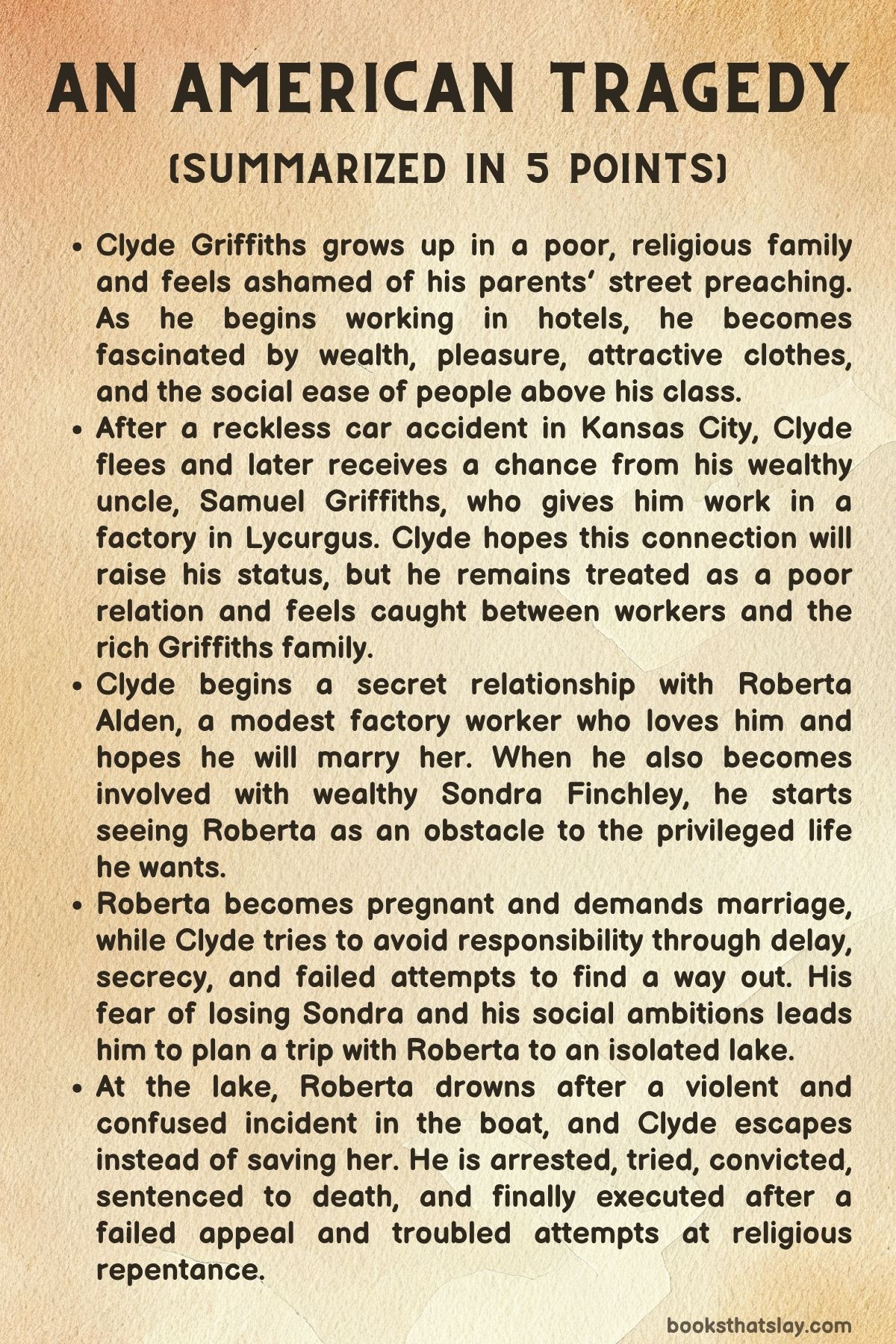
An American Tragedy by Theodore Dreiser is a social novel about ambition, class pressure, desire, and moral weakness in early 20th-century America. The book follows Clyde Griffiths, a poor young man who longs for status, comfort, and admiration.
Raised by strict street-preaching parents, Clyde grows ashamed of poverty and becomes obsessed with the rich world he sees from the outside. His wish to rise in society leads him through work, romance, deception, and crime. Dreiser presents Clyde not as a simple villain, but as a weak person shaped by poverty, vanity, social inequality, and his own choices.
Summary
An American Tragedy begins with Clyde Griffiths as a boy growing up in a poor, religious family in Kansas City. His parents, Asa and Elvira Griffiths, preach on the streets with their children, forcing them into public displays of faith that embarrass Clyde deeply.
His sister Esta sings hymns, while his mother plays the organ with stern devotion. The family’s life is unstable, joyless, and marked by poverty.
Clyde receives little education and grows increasingly resentful of the shabby rooms, religious slogans, and constant moral warnings that surround him.
Clyde wants a life of ease, attractive clothes, money, and admiration. He finds work first in a drugstore and then as a bellhop at the Green-Davidson Hotel.
The hotel opens his eyes to a world of wealth, pleasure, drinking, flirting, and sexual freedom. He learns that appearance, charm, and flattery can bring tips and attention.
He lies to his parents about his wages and uses his money to buy clothes and spend time with other young hotel workers. Away from his parents’ control, he begins drinking and visits a brothel, feeling both guilt and excitement.
His desire for pleasure grows stronger when he meets Hortense Briggs, a vain and manipulative young woman. Clyde is drawn to her beauty and flirtation, though she mainly wants his money.
He spends more than he can afford on her, even while his mother asks him to help Esta, who has returned pregnant after being abandoned by a man who promised to marry her. Clyde feels some pity for Esta, but he also resents anything that threatens his own hopes.
His selfishness becomes clearer as he gives money to Hortense instead of helping his family.
Clyde’s life in Kansas City ends after a reckless outing with other bellhops. They take a car that does not belong to them, and one of the boys hits and kills a little girl while speeding.
The group crashes while trying to escape. Clyde hides from the police and eventually flees to Chicago under a false name.
There, he works small jobs and later becomes a bellhop at an exclusive men’s club. He tries to appear respectable and controlled, but his old hunger for status remains.
A chance meeting changes his future. Clyde encounters his wealthy uncle, Samuel Griffiths, a successful shirt-collar manufacturer from Lycurgus, New York.
Samuel decides to give Clyde a job in his factory. Clyde hopes this will be his entry into the world of wealth and social position.
When he arrives in Lycurgus, however, he is given hard, dirty work in the factory basement. His cousin Gilbert treats him coldly and wants him kept in his place.
Clyde is a Griffiths by name, but not by status, and he feels trapped between poor workers and the rich family that refuses to fully accept him.
Samuel eventually promotes Clyde to supervise the stamping room, where many young women work. Clyde is warned not to become involved with any of them.
Still, he notices Roberta Alden, a pretty, modest factory girl from a poor farming family. Roberta is careful, religious, and aware of the risk of being seen with her supervisor.
Clyde’s name and manner attract her, and Clyde finds comfort in her admiration. They begin meeting secretly.
Their relationship grows from romantic outings to private visits in Roberta’s room, and eventually they have sex. Roberta feels guilty but hopes Clyde may marry her.
Clyde enjoys the relationship, but he does not see it as his future.
His ambitions rise sharply when Sondra Finchley, a wealthy young socialite, takes an interest in him. Sondra is amused by Clyde, partly because he looks like a more appealing version of Gilbert and partly because he flatters her.
She begins helping him enter her social circle. Clyde attends parties, dances with rich young people, and dreams of marrying Sondra.
Through her, he imagines wealth, approval, and revenge against those who looked down on him. As Sondra becomes more important to him, Roberta becomes an obstacle.
Roberta discovers she is pregnant. Clyde panics.
He does not want to marry her because doing so would ruin his chance with Sondra and damage his position with the Griffiths family. He tries to find abortion pills and then a doctor, but his efforts fail.
Roberta grows desperate and demands marriage. Clyde delays, lies, and offers weak alternatives, such as sending her away to have the child while he stays in Lycurgus.
Roberta sees his selfishness more clearly but remains trapped by shame, pregnancy, and hope.
Clyde’s thoughts darken when he reads a newspaper story about a couple drowning during a boating trip. The man’s body is missing, suggesting he may have escaped.
Clyde begins imagining a similar accident involving Roberta. He is horrified by the idea at first, but the thought keeps returning.
He plans a trip with Roberta under the pretense that they will marry. He arranges false names, buys an extra hat, and chooses an isolated lake.
Roberta, believing Clyde may finally do the right thing, travels with him hopefully.
At Big Bittern Lake, Clyde rows out with Roberta. He has planned to kill her, but when he sees her happiness and innocence, he hesitates.
The exact moment becomes confused: Clyde strikes or pushes toward her, the camera hits her face, the boat capsizes, and Roberta is injured in the water. She calls for help, but Clyde swims away and lets her drown.
He hides evidence, abandons the scene, and makes his way toward Sondra and the wealthy friends who represent the life he still wants.
The authorities quickly become suspicious. Roberta’s body, her letters, the false hotel names, and witness accounts point toward Clyde.
District Attorney Orville Mason sees the case as a path to political advancement. He builds a murder case around Clyde’s motive: Roberta threatened his future with a rich young woman.
The newspapers turn the case into a national sensation. Roberta is portrayed as a betrayed innocent, while Clyde becomes the ambitious seducer who killed her to escape responsibility.
Sondra’s identity is protected because of her family’s influence.
Clyde is arrested while with Sondra’s circle. Under questioning, he admits suspicious details but claims Roberta’s death was an accident.
His wealthy uncle helps pay for defense lawyers, though the Griffiths family keeps its distance. The lawyers understand that Clyde is probably guilty in a moral sense, but they craft a defense: Clyde planned to abandon Roberta, then changed his mind and meant to marry her; the boat overturned accidentally; he failed to save her because of cowardice and shock.
At trial, Mason presents letters, witness testimony, physical evidence, and a dramatic version of Clyde’s actions. The defense argues that Clyde was weak and frightened, not a deliberate murderer.
Clyde testifies, but Mason exposes contradictions in his story. The public mood is against him, and the jury finds him guilty.
He is sentenced to death.
In prison, Clyde’s mother tries to raise money and save him through faith, publicity, and appeals. A minister, Duncan McMillan, visits Clyde and urges him to repent.
Clyde eventually admits that he intended to kill Roberta but says he changed his mind before her death. His appeal fails, and the governor refuses to commute his sentence.
Clyde writes a final religious statement, though his faith remains uncertain and troubled. He is executed.
The ending returns to the Griffiths family preaching on the street, now with Esta’s young son present. The scene echoes Clyde’s childhood, suggesting that the same poverty, repression, shame, and desire may shape another generation.
An American Tragedy closes with a bleak sense that personal weakness and social pressure together can destroy lives.
Characters
Clyde Griffiths
Clyde Griffiths is the central figure in An American Tragedy, and his character is built around longing, shame, weakness, and ambition. He grows up poor, embarrassed by his parents’ street preaching and the religious life forced upon him.
From an early age, he associates happiness with money, appearance, social ease, and sexual freedom. Clyde is not naturally powerful or disciplined; he is impressionable, vain, and easily led by whatever world appears more attractive than the one he comes from.
At the hotel in Kansas City, he quickly absorbs the values of pleasure and display. In Lycurgus, he becomes even more consumed by the desire to rise socially.
His tragedy lies not only in his ambition but in his inability to accept responsibility when ambition conflicts with morality. He wants Roberta’s love when it comforts him, Sondra’s world when it flatters him, and freedom from consequences when his choices trap him.
Clyde is not presented as a fearless criminal; he is weak, evasive, and morally unstable. His crime grows out of cowardice as much as desire.
He repeatedly chooses the easier lie over the harder truth until he reaches a point where even another person’s life seems less important than preserving his imagined future.
Roberta Alden
Roberta Alden is one of the most sympathetic characters in the novel because she is honest, loving, vulnerable, and socially powerless. She comes from a poor farming family and works in the factory to help herself and her relatives.
Her upbringing has taught her modesty and religious morality, but she also wants romance, affection, and a life beyond poverty. Clyde attracts her because he appears refined, gentle, and connected to a better social world.
At first, she tries to protect her reputation and resist secrecy, but her emotional dependence on Clyde grows. Once she gives herself to him, she becomes trapped by the unequal terms of their relationship.
Clyde controls her work life, has greater social standing, and can abandon her more easily than she can recover from scandal. Her pregnancy exposes how fragile her position is.
Roberta’s demands for marriage are not manipulative; they are desperate attempts to survive in a society that would punish her far more harshly than Clyde. Her trust, patience, and hope make Clyde’s betrayal especially cruel.
She represents the young working woman whose moral reputation is treated as her only protection, even though that protection fails her when she most needs help.
Sondra Finchley
Sondra Finchley represents the glamorous upper-class life Clyde desperately wants to enter. She is wealthy, pretty, socially secure, and used to admiration.
Unlike Roberta, Sondra does not need Clyde; she enjoys him. Her attraction to him begins partly as curiosity and partly as rebellion against Gilbert and the social expectations around her.
Clyde flatters her, looks attractive, and seems less ordinary than the men in her circle. Yet Sondra’s affection is protected by privilege.
She can flirt, encourage, withdraw, and remain safe because her family name shields her. Clyde, however, treats her attention as a possible escape from every humiliation he has known.
Sondra is not cruel in the same direct way Clyde becomes cruel, but she is careless because her world allows her to be. She does not understand the scale of Clyde’s desperation or the danger created by his fantasy of marrying her.
Her babyish romantic language and guarded intimacy keep Clyde emotionally excited without giving him real security. To Clyde, she becomes less a person than a doorway into wealth, status, and social revenge.
Elvira Griffiths
Elvira Griffiths is Clyde’s mother, and she is defined by religious conviction, endurance, and a limited understanding of the world her children inhabit. She believes deeply in sin, salvation, prayer, and moral discipline.
Her street preaching embarrasses Clyde, but to her it is a sacred duty. Elvira’s faith gives her strength, yet it also narrows her judgment.
She does not fully understand Clyde’s social hunger, Esta’s vulnerability, or the practical dangers her children face. When Esta becomes pregnant, Elvira responds through secrecy and moral anxiety rather than open emotional support.
When Clyde is convicted, she becomes fiercely devoted to saving him, raising money and seeking religious redemption for him. Her love is real, but it is shaped by doctrine.
She can see Clyde as a sinner who needs salvation, yet she struggles to see how his upbringing, poverty, and emotional deprivation contributed to his weakness. The ending, where she continues the same public preaching with Esta’s son present, suggests that Elvira may repeat the conditions that helped produce Clyde’s shame and rebellion.
Asa Griffiths
Asa Griffiths is Clyde’s father, a weak and passive religious man who depends on faith more than practical action. He speaks often of God providing and hopes that his wealthy brother Samuel may someday help the family.
Unlike Elvira, Asa does not appear forceful or commanding; he drifts through poverty with resignation. His failure as a provider shapes Clyde’s resentment.
Clyde sees in Asa the life he most fears: poor, powerless, dependent, and publicly humiliated. Asa’s religious work may be sincere, but it offers his children little stability, education, or emotional security.
He is not malicious, yet his passivity has serious consequences. He cannot guide Clyde into adulthood, protect Esta, or create a home that feels safe and dignified.
Asa represents a kind of spiritual optimism that becomes irresponsible when it ignores material reality.
Esta Griffiths
Esta Griffiths is Clyde’s sister, and her story foreshadows Roberta’s. She is raised in the same strict religious environment as Clyde, but that morality does not protect her when a man promises marriage and financial security.
She runs away, becomes pregnant, and is abandoned. Her return exposes the gap between moral teaching and real-world vulnerability.
Esta’s situation briefly invites Clyde’s sympathy, but he soon sees her as a burden and a source of shame. Through Esta, the novel shows how young women suffer when desire, poverty, and false promises collide.
She also reflects the hypocrisy of social judgment: her mistake stains her reputation, while the man who abandoned her disappears from view. In the ending, her son appears beside Elvira in a scene that echoes Clyde’s childhood, suggesting that the family’s cycle of poverty and public religious performance may continue.
Samuel Griffiths
Samuel Griffiths is Clyde’s wealthy uncle and the owner of the Lycurgus factory. He is not heartless in a simple sense; he does offer Clyde a job and later pays for his defense.
Yet his kindness is limited by class assumptions. He sees Clyde as a poor relation who may deserve a chance, but not full equality.
Samuel believes in hierarchy, discipline, and the idea that low wages and hard work can test a person’s character. His help comes slowly and cautiously, and he allows Gilbert to treat Clyde with contempt.
Samuel’s moral failure is one of distance. He feels some responsibility after Clyde’s arrest, but by then his earlier neglect has already helped deepen Clyde’s resentment and isolation.
Samuel wants to appear fair and respectable without risking the comfort or reputation of his own family. He represents the wealthy relative who can offer opportunity but not belonging.
Gilbert Griffiths
Gilbert Griffiths is Clyde’s cousin and one of the clearest examples of class arrogance in An American Tragedy. He recognizes Clyde as a threat not because Clyde has real power, but because Clyde looks like him and shares the Griffiths name.
Gilbert responds with coldness, suspicion, and humiliation. He wants Clyde kept in the lowest place possible and resents any improvement in his status.
Gilbert’s cruelty is not loud or dramatic; it is administrative, social, and constant. He uses workplace hierarchy to remind Clyde that family connection does not make him equal.
To Clyde, Gilbert represents everything he wants and hates: confidence, wealth, authority, and social legitimacy. Gilbert’s contempt helps intensify Clyde’s hunger to prove himself through Sondra’s world.
He is a privileged man who believes his own position is natural and deserved, and that belief blinds him to his own pettiness.
Elizabeth Griffiths
Elizabeth Griffiths, Samuel’s wife, is socially cautious and emotionally restrained. She notices Clyde’s resemblance to Gilbert and senses something incomplete in him, which she attributes to his poor upbringing.
Her attitude toward Clyde is not openly hostile, but it is shaped by class distance. She is more concerned with social propriety than with understanding him.
Her discomfort with newer wealthy families also shows that class pride operates even within the upper class itself. Elizabeth’s role is quiet but important because she helps define the social atmosphere Clyde longs to enter: polished, judgmental, controlled, and difficult for outsiders to penetrate.
She can pity Clyde, but she does not truly embrace him.
Bella Griffiths
Bella Griffiths is Samuel’s younger daughter and a member of the social world Clyde wants to join. She is more active and socially open than her mother would prefer, moving among wealthy young people such as the Cranstons and Finchleys.
Bella’s presence matters because she gives Clyde glimpses of the parties, friendships, clothes, and freedom that wealth provides. She is not developed as deeply as Clyde, Roberta, or Sondra, but she helps connect the Griffiths family to the fashionable circle that later attracts Clyde.
Her casual access to privilege contrasts sharply with Clyde’s anxious desire to earn or imitate it.
Myra Griffiths
Myra Griffiths is Samuel’s older daughter and is described as more studious than Bella. She remains a background figure, but her position within the family helps show the stability and refinement of the Lycurgus Griffithses.
Unlike Clyde, Myra does not need to invent herself or fight for recognition. Her life is already secured by family wealth and social standing.
Her limited role emphasizes how little Clyde belongs in the household. He observes this family from the edge, aware that even the quieter members possess a certainty he lacks.
Hortense Briggs
Hortense Briggs is Clyde’s first major romantic obsession, and she reveals how easily he confuses beauty and flirtation with love. She is vain, calculating, and highly aware of her effect on men.
Clyde thinks she is refined and desirable, but Hortense mostly sees him as a source of money and attention. Her interest rises when other girls notice him and fades when he expects emotional loyalty.
The fur coat episode shows her materialism and Clyde’s weakness. He understands that she is using him, yet he cannot break away because her approval feeds his vanity.
Hortense prepares the reader for Clyde’s later relationships by showing how desire can make him irrational and submissive. She also teaches him a damaging lesson: affection, money, status, and sexual hope can become a kind of transaction.
Ratterer
Ratterer is one of Clyde’s fellow bellhops and an important influence during Clyde’s Kansas City years. He introduces Clyde to a freer, more pleasure-seeking world and later helps him in Chicago by giving him a reference.
Ratterer is more socially experienced than Clyde and understands the habits of young men trying to enjoy life beyond strict moral rules. He also senses Clyde’s lack of inner strength.
Unlike Clyde, Ratterer appears more practical and less consumed by fantasy. He helps Clyde enter new social spaces, but he also exposes him to temptations Clyde is not mature enough to handle.
His role is partly that of a guide into urban pleasure and partly that of someone who sees Clyde’s weakness before Clyde can admit it.
Sparser
Sparser is the reckless bellhop whose actions lead to the car accident in Kansas City. He represents the danger of youthful thrill-seeking without responsibility.
By driving a car that does not belong to him and speeding to avoid trouble, he causes the death of a little girl. The accident becomes a turning point for Clyde, forcing him to flee and begin another life under fear and concealment.
Sparser is not central for long, but his carelessness helps establish one of the novel’s repeating patterns: young men act selfishly, others suffer, and Clyde’s first instinct is to protect himself.
Walter Dillard
Walter Dillard is Clyde’s neighbor in Lycurgus and one of the first people there to offer him companionship. He is ambitious and enjoys using Clyde’s Griffiths name to improve his own social standing.
Walter invites Clyde to parties and social events involving alcohol and women, tempting Clyde back toward habits he claims he wants to avoid. His friendship shows how Clyde’s name gives him value even when he personally lacks power.
Walter is not deeply malicious, but he is opportunistic. Through him, Clyde sees again how social life can be used for advancement, display, and desire.
Grace Marr
Grace Marr is Roberta’s friend and housemate, and she acts as a witness to Roberta’s changing behavior. Her suspicions about Roberta and Clyde’s secret relationship show how closely women’s reputations are watched.
Grace is not merely nosy; she belongs to a social world where secrecy, dating, and moral judgment can have serious consequences for a young working woman. Her presence increases Roberta’s anxiety and helps push Roberta into more private living arrangements, which then makes the relationship with Clyde more dangerous.
Grace represents the social surveillance that surrounds women like Roberta.
The Newtons
The Newtons are Roberta’s landlords during part of her time in Lycurgus. Their home offers respectability and moral structure, but also close supervision.
Roberta’s decision to leave their house marks a significant step away from protection and into secrecy. The Newtons are not villains; they reflect the conventional moral expectations of their class and religious background.
Yet their watchfulness contributes to Roberta’s isolation because she cannot speak openly about her feelings or choices. Their role shows how social respectability can protect young women in one sense while also trapping them in silence.
Titus Alden
Titus Alden, Roberta’s father, is a poor farmer whose life deeply affects both Roberta and Clyde. To Roberta, he represents family duty, hardship, and the plain life she both loves and wants to rise above.
To Clyde, Titus is a terrifying image of what poverty can do to a man. When Clyde sees the Alden home and Titus’s worn body, clothes, and surroundings, he becomes even more determined not to marry Roberta and enter that world.
Titus is not responsible for Roberta’s suffering, but his poverty becomes part of Clyde’s selfish reasoning. Clyde does not see him as a human being with dignity; he sees him as a warning.
Mrs. Alden
Mrs. Alden is Roberta’s mother, and she is emotionally central to the aftermath of Roberta’s death. Before the tragedy, she senses that Roberta is unhappy and physically troubled, but she does not know the full truth.
After Roberta dies, her grief becomes part of the public case against Clyde. Her sorrow is genuine, but newspapers and officials use it to heighten public emotion.
Mrs. Alden represents the family left behind after Clyde’s choices destroy Roberta. She also shows the pain of parents who teach moral rules but cannot shield their children from exploitation, secrecy, and social danger.
Dr. Glenn
Dr. Glenn is the doctor Roberta approaches when she is pregnant and desperate. He refuses to help her, partly from fear of legal consequences and partly from moral judgment.
His response reveals the hypocrisy of social and medical authority. He has helped women from respectable affluent families in the past, but Roberta, poor and unmarried, receives condemnation instead of care.
Dr. Glenn’s refusal leaves Roberta with fewer choices and pushes her more completely into Clyde’s power. He is an important figure because he shows how institutions that claim morality often protect the privileged while abandoning the vulnerable.
Orville Mason
Orville Mason is the district attorney who prosecutes Clyde. He is intelligent, ambitious, theatrical, and politically motivated.
Mason does seem moved by Mrs. Alden’s grief, but he also recognizes that the case can advance his career. He shapes the evidence into a public drama of seduction, betrayal, and murder.
His pursuit of Clyde is not baseless, since Clyde is morally responsible for Roberta’s death, but Mason’s methods are far from pure. He withholds information, plays to public emotion, and benefits from newspaper attention.
Mason’s character complicates the idea of justice. He seeks punishment for a real wrong, yet he also uses that wrong to strengthen his own power.
Fred Heit
Fred Heit, the coroner, is one of the first officials to recognize the political usefulness of Roberta’s death. He notices the suspicious evidence, including false names, wounds, and Roberta’s letter, and quickly treats the case as murder.
Heit is practical and self-interested. His decision to involve newspapers and manage information shows how the legal process is shaped by publicity from the beginning.
He is not simply investigating a death; he is helping create a public event. His role shows how ambition and job security can influence the handling of truth.
Burton Burleigh
Burton Burleigh is Mason’s legal assistant, and he represents the colder machinery of prosecution. He is focused on building the strongest possible case.
His most troubling action is planting Roberta’s hair on the camera, creating evidence that strengthens the murder theory. Burleigh’s conduct shows that the case against Clyde, though morally persuasive in many ways, is also legally compromised.
He believes in securing conviction more than preserving clean procedure. Through him, the novel questions whether justice can remain just when officials manipulate facts to reach a desired result.
Belknap
Belknap is one of Clyde’s defense lawyers. He takes the case partly for political reasons, but his own past gives him a private understanding of Clyde’s situation.
Like Clyde, he once got a poor young woman pregnant, but money allowed him to escape ruin and marry within his own class. This makes Belknap both cynical and somewhat sympathetic.
He knows Clyde is probably guilty in a serious moral sense, yet he works to create a defense that may save him from execution. Belknap understands how class determines consequences.
His character shows that the line between respectable man and condemned criminal can depend less on virtue than on resources, timing, and social protection.
Ruben Jephson
Ruben Jephson is the sharper and more calculating of Clyde’s defense lawyers. He has risen from a difficult background and understands ambition, class resentment, and survival.
He sees Clyde as weak, but he also recognizes the social forces that helped form him. Jephson’s legal strategy is practical rather than sentimental.
He is willing to shape Clyde’s story into the most useful version, even when truth becomes secondary. Jephson’s sympathy has limits: he wants to win, or at least reduce the penalty, and he judges Clyde partly by whether he can perform convincingly in court.
He represents the hard intelligence of the defense system, where saving a client may require replacing moral truth with a usable narrative.
Duncan McMillan
Duncan McMillan is the minister who visits Clyde on death row. He enters the story as a religious guide, sent through Elvira’s efforts, but his role becomes more morally complex.
He urges Clyde toward confession and repentance, and Clyde gradually admits that he intended to kill Roberta before losing his nerve. McMillan believes in spiritual accountability, but he also becomes troubled by the death penalty.
He cannot fully claim that Clyde deserves execution, yet he cannot deny Clyde’s guilt. His uncertainty near the end gives the novel one of its deepest moral tensions.
McMillan helps Clyde face his actions, but he also sees that legal punishment and spiritual justice are not the same thing.
Oscar
Oscar is an experienced bellhop who teaches Clyde the practical rules of hotel work. His advice shows Clyde how service, tips, speed, performance, and imitation function in a commercial world.
Oscar is a minor character, but he matters because he helps Clyde understand that appearances can be managed and that success often depends on reading people. This lesson stays with Clyde.
He learns to flatter guests, hide parts of himself, and act as though he belongs. Oscar therefore contributes to Clyde’s early education in social performance.
Jill Trumbull
Jill Trumbull helps bring Clyde into Sondra’s social circle by extending a party invitation. Her role is small but important because she becomes one of the social bridges between Clyde and the wealthy young people of Lycurgus.
Through Jill, Clyde gains access to the parties that change his sense of possibility. She does not understand the danger of what this access means to him.
To her, he is an interesting guest; to him, her world becomes proof that he might escape his past.
Bertine Cranston
Bertine Cranston is one of the wealthy young women associated with Bella and Sondra. Her early indifference to Clyde shows how quickly the upper class sorts people by status.
Once Clyde is identified as a poor relation, he becomes less visible to people like Bertine. She represents the casual cruelty of social ranking.
Her role is limited, but she helps create the atmosphere in which Clyde feels both tempted and humiliated.
The Cranstons and Finchleys
The Cranstons and Finchleys represent the secure upper-class world that excites Clyde’s imagination. Their homes, parties, cars, summer retreats, and social habits create the life Clyde wants to claim.
They are not shown as deeply reflective people; their privilege allows them to treat pleasure as ordinary. When Clyde’s crime threatens scandal, their priority becomes protecting reputation, especially Sondra’s anonymity.
These families show how wealth can control public exposure. Roberta’s letters and name become public, while Sondra is shielded.
This contrast is one of the clearest signs of class inequality in the story.
Themes
Ambition and the Illusion of Success
Clyde’s ambition is not rooted in a clear talent, vocation, or ethical goal. It is built on images: fine clothes, hotel guests, wealthy young men, beautiful women, cars, parties, and the ease of people who never seem humiliated by poverty.
He wants success because he believes it will erase the shame of his childhood. This makes his ambition unstable and dangerous.
He does not build a strong self; he tries to borrow one from each social world he enters. At the hotel, he imitates the bellhops and guests.
In Lycurgus, he imitates refinement. Around Sondra, he invents a version of himself worthy of the upper class.
The problem is that Clyde wants the rewards of success without the discipline, honesty, or courage required to deserve them. His ambition becomes a form of escape rather than growth.
Roberta’s pregnancy threatens him because it would force him into an ordinary, poor, responsible life. Sondra represents the opposite: fantasy, elevation, and social victory.
In An American Tragedy, ambition becomes destructive when it is guided by shame and envy rather than moral purpose.
Class Inequality and Social Judgment
Class shapes nearly every important relationship in the novel. Clyde’s poverty makes him ashamed before he has even done anything wrong.
His wealthy relatives treat him as someone who may be helped but not fully accepted. Gilbert sees him as a threat because Clyde shares the family name without belonging to the family’s social rank.
Roberta’s class position makes her vulnerable in a different way. As a working woman, she cannot survive scandal as easily as Clyde can hope to.
When she becomes pregnant, the social cost falls mainly on her body, reputation, and family. Sondra, by contrast, can flirt with danger while remaining protected by money and family influence.
The trial makes this inequality even clearer. Roberta’s private letters are exposed to the public, while Sondra’s identity is carefully hidden.
Clyde is both a victim of class shame and a participant in class cruelty. He suffers from being excluded by the rich, but he also looks down on poorer workers and fears being tied to Roberta’s farming family.
The novel shows class not only as money, but as visibility, protection, opportunity, and the right to be treated with dignity.
Desire, Responsibility, and Moral Cowardice
Clyde’s desires are intense, but his sense of responsibility is weak. He wants pleasure with Hortense, comfort with Roberta, and status with Sondra, yet he avoids the obligations attached to each relationship.
This pattern matters because the novel does not present desire itself as the only problem. The deeper issue is Clyde’s refusal to face the consequences of desire.
Roberta’s pregnancy becomes a moral test, and Clyde fails it repeatedly before the final crime occurs. He delays, lies, searches for secret solutions, and imagines ways to keep his future untouched.
Even when he knows Roberta is frightened and dependent on him, he treats her as an obstacle. His cowardice is not sudden; it develops through many smaller evasions.
He hides his wages from his parents, flees after the car accident, conceals his relationship with Roberta, lies to Sondra’s circle, and then lies to the law. By the time Roberta is in the lake, Clyde’s failure to save her is the physical form of a habit he has practiced for years: escaping responsibility when another person needs courage from him.
Religion, Guilt, and Justice
Religion surrounds Clyde from childhood, but it does not give him a stable moral life. His parents’ faith is public, strict, and repetitive, yet Clyde experiences it as humiliation rather than guidance.
Elvira believes in sin and salvation, but her moral world often lacks practical understanding. She can condemn sexual wrongdoing, but she cannot fully address the social and emotional causes that lead Esta, Clyde, and Roberta into danger.
After Clyde’s conviction, religion returns through Elvira and Duncan McMillan. On death row, Clyde begins to think seriously about sin, confession, and the afterlife, but his faith remains troubled.
He wants comfort and forgiveness, yet he also fears death and struggles to understand his own guilt. The legal system claims to deliver justice, but it is compromised by politics, publicity, planted evidence, and class protection.
Mason prosecutes a real wrong, but he also uses the case for advancement. McMillan’s doubts near the end are crucial because they separate moral accountability from state execution.
Clyde is guilty, but the novel asks whether killing him truly repairs anything. Religion and law both seek judgment, yet neither fully resolves the suffering left behind.