An Economic Theory of Democracy Summary and Analysis
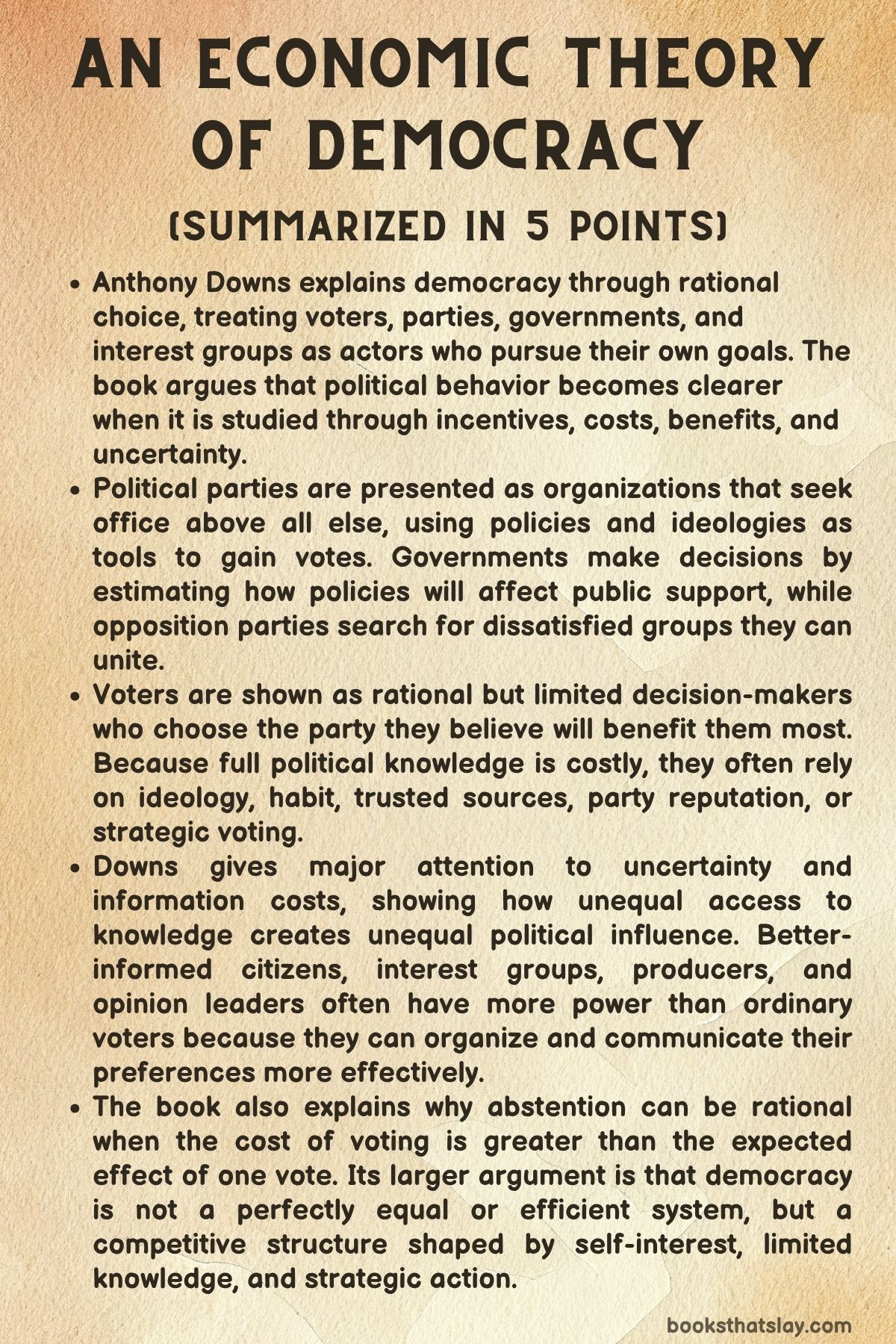
An Economic Theory of Democracy by Anthony Downs is a foundational work in political economy that applies economic reasoning to democratic politics. The book argues that parties, voters, governments, and interest groups can be studied as rational actors who pursue their own goals under conditions of uncertainty.
Downs does not present democracy as an ideal moral system, but as a competitive structure in which parties seek votes, citizens weigh costs and benefits, and information is often incomplete or costly. The book’s central claim is that democratic behavior becomes more understandable when politics is analyzed through incentives, self-interest, and strategic choice.
Summary
An Economic Theory of Democracy develops a model of democratic politics based on rational choice. Downs begins from the idea that economic theory usually assumes individuals and firms act rationally to achieve their goals, yet it has not applied the same discipline to governments and political parties.
He argues that political actors can also be studied as rational agents. A rational person does not need perfect knowledge or perfect judgment; they need only to choose means that seem best suited to their goals, given what they know.
In this model, citizens seek benefits from government, while democratic governments seek public support, especially votes.
The book defines democracy as a system in which governments are chosen through regular elections, more than one party competes legally for office, and citizens have broad voting rights. A political party is treated as a unified group that seeks control of government.
Downs makes a strong simplifying assumption: parties do not mainly seek office in order to carry out policies; rather, they choose policies in order to win and keep office. This does not mean real politicians never care about values or public welfare, but the model focuses on the incentive that matters most in electoral competition: gaining votes.
From this starting point, Downs explains voting as a calculation of expected benefit. A rational voter supports the party they believe will give them the greatest utility.
Voters compare the current government’s record with what they think the opposition would have done and may also consider future performance. In a two-party system, this comparison may be relatively direct.
In a multiparty system, voters face more complex choices. They may vote strategically for a party that is not their first preference if their favorite party has little chance of winning, or they may vote for a small party to help it gain strength in future elections.
Government decision-making follows the same logic. A governing party chooses policies by estimating how those policies will affect votes.
It tries to provide benefits that will attract support while avoiding costs that could alienate enough citizens to lose an election. The opposition watches for dissatisfied groups and tries to gather them into a winning coalition.
This creates an ongoing cycle: governments act in response to voters, voters react to government performance, and opposition parties shape their offers around both. Democratic politics is therefore not a simple expression of the common good, but a competitive process shaped by expected electoral rewards.
A major part of the book concerns uncertainty. Citizens often lack full knowledge of policies, consequences, party intentions, and other voters’ preferences.
Parties also face uncertainty about the economy, voter reactions, and opposition strategy. Because people cannot know everything, information becomes politically important.
Some citizens are better informed than others, and those with more information can influence those with less. Interest groups, political leaders, media sources, and experts become intermediaries between government and voters.
This creates inequality within democracy because those who can gather, process, and distribute information gain more influence.
Downs then explains why ideology matters. Since voters cannot study every policy in detail, ideology gives them a shortcut.
It helps parties present a general image of what they stand for and helps voters make decisions with limited information. But ideology is also strategic.
Parties use it to attract voters, distinguish themselves from rivals, and build coalitions. A party must appear reliable and responsible, meaning its statements and actions must show some continuity over time.
If it changes positions too often, voters may stop trusting it. Still, parties may adjust their ideologies when electoral conditions change.
The book also examines how party systems shape ideology. In a two-party system, parties tend to move toward the political center because each wants to attract the median voter.
However, they must avoid losing their more extreme supporters, who may punish them for becoming too moderate. In multiparty systems, parties usually occupy narrower ideological positions because voters have more options.
Electoral rules matter as well. Winner-take-all systems encourage two large parties, while proportional representation allows more parties to survive.
The ideological distribution of voters is therefore central to understanding party behavior.
Coalition governments create further problems for rational voting. When no party wins a majority, parties must form alliances after the election.
This makes it harder for voters to know what they are really choosing. A citizen may vote for one party, only to see it compromise with parties that hold different views.
Rational voting requires knowledge not only of each party’s platform, but also of possible coalitions and likely compromises. Because this is difficult, voters in coalition systems may end up using elections more to express preferences than to strategically select a government.
Downs connects democratic politics to economic efficiency by asking whether vote-maximizing governments can produce an ideal economic outcome. He argues that democracy is unlikely to achieve a Pareto optimum, where no one can be made better off without making someone else worse off.
Government policies usually benefit some citizens at the expense of others through taxation, spending, regulation, and public goods. Unlike firms, governments cannot simply buy and sell assets to maximize profit; their key measure of success is electoral support.
Since votes cannot legally be bought and sold, political decision-making cannot mirror market exchange. This makes complete economic efficiency impossible under democratic conditions without destroying political equality.
The later sections focus on information costs. To vote rationally, citizens need to know their goals, available choices, and likely consequences.
But acquiring information takes time, effort, and sometimes money. Most voters therefore seek shortcuts.
They rely on free information, trusted experts, friends, media, parties, interest groups, and past experience. This is rational because the cost of becoming fully informed may exceed the expected value of a single vote.
Downs argues that the ideal of a fully informed electorate is attractive but unrealistic. In large democracies, many citizens rationally choose limited political knowledge.
This leads to the idea of rational abstention. If voting has costs and a single vote is unlikely to affect the outcome, it may be rational for some citizens not to vote.
Abstention is especially likely among people for whom voting costs are higher, including lower-income citizens who may face greater burdens in time, travel, or lost wages. Some citizens still vote because they value democracy itself and want the system to continue.
Others vote out of strong party preference or because issues affect them directly. Even so, turnout is shaped by unequal costs, unequal information, and unequal motivation.
The book closes by contrasting Downs’s theory with earlier economic views of government. He criticizes economists for treating government as either an outside interference in markets or a benevolent servant of social welfare.
Instead, he argues that government officials should be analyzed much like private actors: as people pursuing goals under constraints. His final propositions are testable claims about parties, voters, ideologies, abstention, information, and interest groups.
The result is a clear model of democracy as a system of rational but imperfect calculation. An Economic Theory of Democracy shows that democratic outcomes are not only shaped by ideals, institutions, or public spirit, but also by incentives, uncertainty, and the uneven distribution of information and influence.
Key Figures
The Rational Voter
The rational voter is the central human figure in An Economic Theory of Democracy, even though the book is not a novel with fictional characters. This figure represents the citizen who approaches politics as a matter of personal benefit, expected outcomes, and limited information.
The voter does not need to be perfectly informed or morally selfish in every sense; rather, the voter is assumed to choose the party that seems most likely to increase personal utility. What makes this figure important is the constant tension between rational choice and practical limitation.
To vote with complete rationality, the citizen would need to know party policies, government records, likely future actions, personal consequences, and the behavior of other voters. Since that level of knowledge is costly and often impossible, the rational voter becomes a symbol of democratic imperfection.
This figure may vote sincerely, vote strategically, abstain, rely on ideology, or follow trusted information sources. The voter shows that democracy depends not only on rights and institutions, but also on how ordinary citizens manage uncertainty, effort, and self-interest.
The Governing Party
The governing party functions as one of the most powerful actors in the book because it controls policy while constantly thinking about elections. Downs presents it as a rational organization whose primary goal is to remain in power.
Its policies are not treated as expressions of pure principle, but as tools for winning public support. This makes the governing party highly strategic.
It spends, taxes, reforms, and preserves existing arrangements by calculating how each decision may affect votes. The governing party must also judge how strongly citizens care about different issues.
A policy that pleases many voters mildly may be less useful than one that strongly pleases a smaller but more decisive group. Its strength lies in having actual control over government, but its weakness lies in exposure.
Every action creates winners and losers, giving the opposition material to use against it. In An Economic Theory of Democracy, the governing party therefore appears as both dominant and vulnerable: dominant because it can act, vulnerable because each action risks producing a coalition of dissatisfied voters.
The Opposition Party
The opposition party is defined by reaction, opportunity, and strategic contrast. Unlike the governing party, it does not carry the burden of current policy outcomes.
Its advantage comes from being able to observe public dissatisfaction and shape itself around the government’s weaknesses. Downs presents the opposition as a rational competitor seeking the same prize as the ruling party: office.
It studies the electorate, identifies groups unhappy with existing policies, and tries to unite them into a majority. This does not mean the opposition must offer a fully coherent alternative in moral or philosophical terms.
Its goal is to gather enough support to win. The opposition is especially important because it reveals the instability built into democratic politics.
A government that has ruled long enough will usually have disappointed enough people to give its rivals a chance. The opposition is therefore not merely a critic; it is an engine of rotation, pressure, and adjustment within democracy.
It forces the governing party to anticipate attacks, defend decisions, and remain sensitive to changing public preferences.
Political Parties
Political parties in the book are collective actors treated as if they have unified goals. This is a deliberate simplification, since real parties contain factions, personalities, disagreements, and competing ambitions.
Downs uses this simplified version to explain how parties behave when their main purpose is to win elections. Parties create policies, ideologies, promises, and public images in order to maximize votes.
Their role is not limited to representing existing public opinion; they also shape how voters understand political choices. In a two-party system, they tend to move toward the center because that is where they can capture the largest number of voters.
In a multiparty system, they can occupy narrower ideological spaces and appeal to more specific groups. Parties are also constrained by reputation.
If they change positions too often, voters may view them as unreliable. If they remain too rigid, they may lose support when public opinion shifts.
This makes the political party one of the most adaptive and calculating figures in the book.
The Government
The government is broader than any single party, but Downs treats democratic government as an institution shaped by electoral incentives. It has the power to make binding decisions, enforce rules, collect taxes, provide services, and settle disputes.
Yet its behavior is not explained through moral duty alone. The government acts under pressure from parties, voters, interest groups, and uncertainty.
Its choices distribute benefits and costs across society, often helping some citizens while harming others. This means the government cannot easily serve every citizen equally, even when operating legally and democratically.
Its coercive power also separates it from private economic actors. A firm must usually persuade people to buy or sell, while the government can require payment through taxation and enforce collective decisions.
In An Economic Theory of Democracy, the government is therefore a practical institution rather than an idealized guardian of social welfare. It is necessary, powerful, and imperfect, shaped by the same rational calculations that govern other actors.
Interest Groups
Interest groups appear as organized forces that seek to influence policy without necessarily trying to hold office themselves. They are important because they show how democracy does not operate only through elections.
Some citizens and organizations care strongly about particular issues and are willing to spend time, money, and effort to affect government decisions. These groups often have advantages over ordinary voters because they possess specialized knowledge, clearer preferences, and stronger incentives to act.
Producers, for example, may understand the direct consequences of economic policy better than consumers and may be better positioned to communicate with government officials. Interest groups expose an inequality within democratic practice: influence tends to follow organization, information, and resources.
Even when each citizen has one vote, not every citizen has equal practical power. Downs’s treatment of interest groups shows that policy often reflects the voices of those most able and motivated to speak, rather than the silent preferences of the numerical majority.
Influencers and Opinion Leaders
Influencers and opinion leaders are the informed citizens who affect the choices of others. They matter because uncertainty creates dependence.
When voters lack knowledge or confidence, they may turn to people who seem better informed. These figures may be journalists, experts, activists, community leaders, friends, or politically attentive citizens.
Downs assumes they do not necessarily lie, but they may select, emphasize, or withhold information in ways that support their own goals. Their influence comes from reducing the information costs of others.
A voter who does not have time to study every issue may rely on someone whose judgment seems trustworthy. This gives opinion leaders a special place in democratic politics.
They are not formal rulers, but they help shape the flow of political knowledge. Their presence complicates the ideal of equal citizenship because citizens with more information can guide the decisions of those with less.
They make politics more efficient for some voters, but also less equal in terms of influence.
Favor-Buyers
Favor-buyers are among the more transactional figures in the book. They do not simply support a party because of ideology or general policy agreement.
Instead, they help a party gain votes in exchange for specific benefits. Their role demonstrates the bargaining logic that can emerge under democratic uncertainty.
If a government or party believes a particular person or group can influence many voters, it may be more efficient to satisfy that intermediary than to appeal directly to every citizen. Favor-buyers therefore convert influence into political value.
They also reveal the distance between democratic equality as a principle and democracy as practiced. Formally, each voter may count the same at the ballot box, but actors who can deliver support, organize groups, or shape opinion may receive greater attention from parties.
Favor-buyers show that political influence is not distributed evenly; it is often concentrated in those who can make themselves useful to office-seeking parties.
The Well-Informed Citizen
The well-informed citizen represents the person who has invested in political knowledge and can make decisions with greater confidence. This figure is important because Downs treats information as costly.
A citizen who knows more has usually paid some cost in time, education, attention, or resources. The well-informed citizen may vote more strategically, influence others, join interest groups, or communicate preferences more effectively to the government.
Yet this figure is not automatically more public-spirited. Greater information may serve private goals just as easily as civic ones.
The well-informed citizen also exposes a class dimension in politics. People with more education, leisure, money, or professional access often find it easier to acquire political knowledge.
As a result, they may have more practical influence than less-informed citizens. Downs uses this type of figure to challenge the assumption that democracy naturally produces equal participation.
Knowledge becomes a political resource, and those who possess it can affect outcomes beyond their single vote.
The Rational Abstainer
The rational abstainer is one of Downs’s most striking figures because this person challenges the belief that good citizens must always vote. Abstention is not presented simply as laziness or ignorance.
It can be rational when the cost of voting exceeds the expected benefit of casting a ballot. In a large electorate, one vote is unlikely to change the result.
If voting requires time, travel, lost wages, or effort to understand the issues, a citizen may reasonably decide not to participate. This figure is especially important because abstention is not evenly distributed.
Lower-income citizens may face greater costs and therefore may be more likely to stay home. The rational abstainer reveals a difficult truth about democracy: equal voting rights do not guarantee equal participation.
At the same time, Downs acknowledges that some people vote not because their ballot will decide the election, but because they value the survival of democracy. The abstainer therefore helps define the boundary between personal calculation and civic commitment.
The Ideological Voter
The ideological voter uses broad political beliefs as a shortcut for decision-making. This figure does not examine every policy in isolation, but relies on a party’s general image, philosophy, or position on an ideological scale.
Downs treats this behavior as rational under conditions of uncertainty, as long as ideology provides a useful guide to likely policy. The ideological voter shows why parties cannot survive on isolated promises alone.
They need recognizable identities that allow citizens to predict future behavior. However, this voter is also vulnerable to manipulation.
Parties may keep their ideologies vague enough to appeal to many groups while hiding policy overlap or internal inconsistency. The ideological voter therefore occupies a complicated place in the book.
Ideology helps reduce confusion and information costs, but it can also blur the specific consequences of political choice. This figure shows how democracy depends on simplified symbols and labels, even when real policy is far more complex.
Producers
Producers represent businesses, industries, employers, and organized economic actors affected directly by public policy. Downs gives them special importance because they often have stronger incentives and better information than ordinary consumers.
A regulation, tax, subsidy, or spending decision may have direct and measurable effects on producers. Because of this, they are more likely to organize, lobby, and communicate their preferences clearly to government officials.
Producers also tend to possess resources that help them influence politics: money, expertise, access, and organization. Their role complicates the democratic assumption that policy follows majority preference.
Consumers may greatly outnumber producers, but each consumer may feel only a small effect from a given policy, while producers feel concentrated effects. This imbalance gives producers greater practical power.
In the book, they represent the way economic structure shapes political influence, making democracy more responsive to organized intensity than to passive numerical majority.
Consumers
Consumers are the broad mass of citizens affected by economic policy in scattered and often less visible ways. They may benefit from lower prices, better services, public goods, or protections, but they often lack the organization and information needed to influence government effectively.
Downs contrasts them with producers to show why majority interests do not always dominate democratic decision-making. A consumer may be harmed slightly by a policy that greatly benefits a small producer group, yet the harm may be too small for each individual consumer to justify political action.
This makes consumers politically weak despite their numbers. Their character in the book is defined by diffusion.
They are many, but their interests are spread out; they are affected, but often indirectly; they may care, but not enough to bear high information or organization costs. Through consumers, Downs shows how democracy can produce unequal influence without formally denying anyone political rights.
Themes
Rational Choice and Political Self-Interest
Downs builds his theory around the idea that political behavior can be understood through rational choice. Voters, parties, governments, interest groups, and influencers are not treated as purely moral or purely emotional actors.
They are presented as people and organizations trying to achieve goals under constraints. Parties seek office, voters seek utility, interest groups seek favorable policy, and governments seek support.
This approach changes the way democracy is understood. Instead of assuming that parties exist mainly to serve the public good, Downs argues that they often use policy as a means of gaining votes.
Instead of assuming that citizens vote out of duty alone, he shows that they weigh benefits, costs, expectations, and uncertainty. The theme is powerful because it removes sentimentality from democratic politics.
It does not claim that ideals never matter, but it insists that incentives must be taken seriously. An Economic Theory of Democracy presents democracy as a competitive system where public outcomes emerge from private calculations, strategic behavior, and the pursuit of advantage within institutional rules.
Uncertainty and the Limits of Democratic Decision-Making
Uncertainty shapes nearly every political decision in the book. Voters do not know exactly what parties will do, how policies will affect them, how the economy will change, or how other citizens will vote.
Parties do not know exactly what voters want, how their policies will be received, or what their opponents will propose. This lack of knowledge makes politics more complex than a simple exchange between promises and votes.
Because uncertainty exists, citizens rely on shortcuts such as ideology, habit, party reputation, expert opinion, and trusted information sources. Governments rely on interest groups, public signals, influential citizens, and visible expressions of preference.
This creates distortions. The people who speak most clearly or possess the best information may receive more attention than those who are silent, confused, or politically inactive.
Uncertainty therefore weakens the ideal of equal democratic influence. It also explains why mistakes can occur even when actors behave rationally.
A voter may choose poorly, not because they are irrational, but because the available information is limited, costly, or misleadingly selected.
Information Costs and Unequal Political Power
Information is treated as a resource, and like other resources, it is unequally distributed. To make a fully rational political decision, a citizen would need to understand personal interests, public issues, policy alternatives, party records, likely consequences, and electoral possibilities.
Gathering this information requires effort. Some information is free in money terms but costly in time and attention.
Other information depends on education, social position, professional access, or expert interpretation. As a result, citizens do not participate on equal terms.
Better-informed citizens can vote with greater confidence, influence others, and communicate more effectively with government. Less-informed citizens may depend on shortcuts or abstain altogether.
This theme is especially important because it challenges the idea that one person, one vote creates complete political equality. Formal equality remains, but practical influence varies sharply.
Organized groups, producers, media owners, specialists, and wealthy citizens can often bear information costs more easily than ordinary voters. Downs shows that democracy’s outcomes are shaped not only by preferences, but by whose preferences are visible, organized, and informed.
Voting, Abstention, and the Fragility of Democratic Participation
Voting is presented not as an automatic civic act, but as a choice shaped by costs and expected benefits. A citizen may care about politics yet still decide that voting is not worth the effort if one ballot is unlikely to affect the outcome.
This argument makes abstention one of the book’s most important democratic problems. Downs does not treat nonvoters simply as careless citizens.
Some abstain rationally because the personal cost of voting, learning, traveling, or losing work time outweighs the expected impact of their vote. This has serious consequences because voting costs are not equal for everyone.
Lower-income citizens may face greater barriers, which reduces their political power and makes government more responsive to those who participate. At the same time, Downs recognizes that some citizens vote because they value democracy itself.
They may believe participation helps preserve the system, even when their individual vote is unlikely to decide the result. The theme reveals both the strength and weakness of democracy: it depends on voluntary participation, but rational calculation can lead many citizens away from the ballot box.