An Edible History of Humanity Summary and Analysis
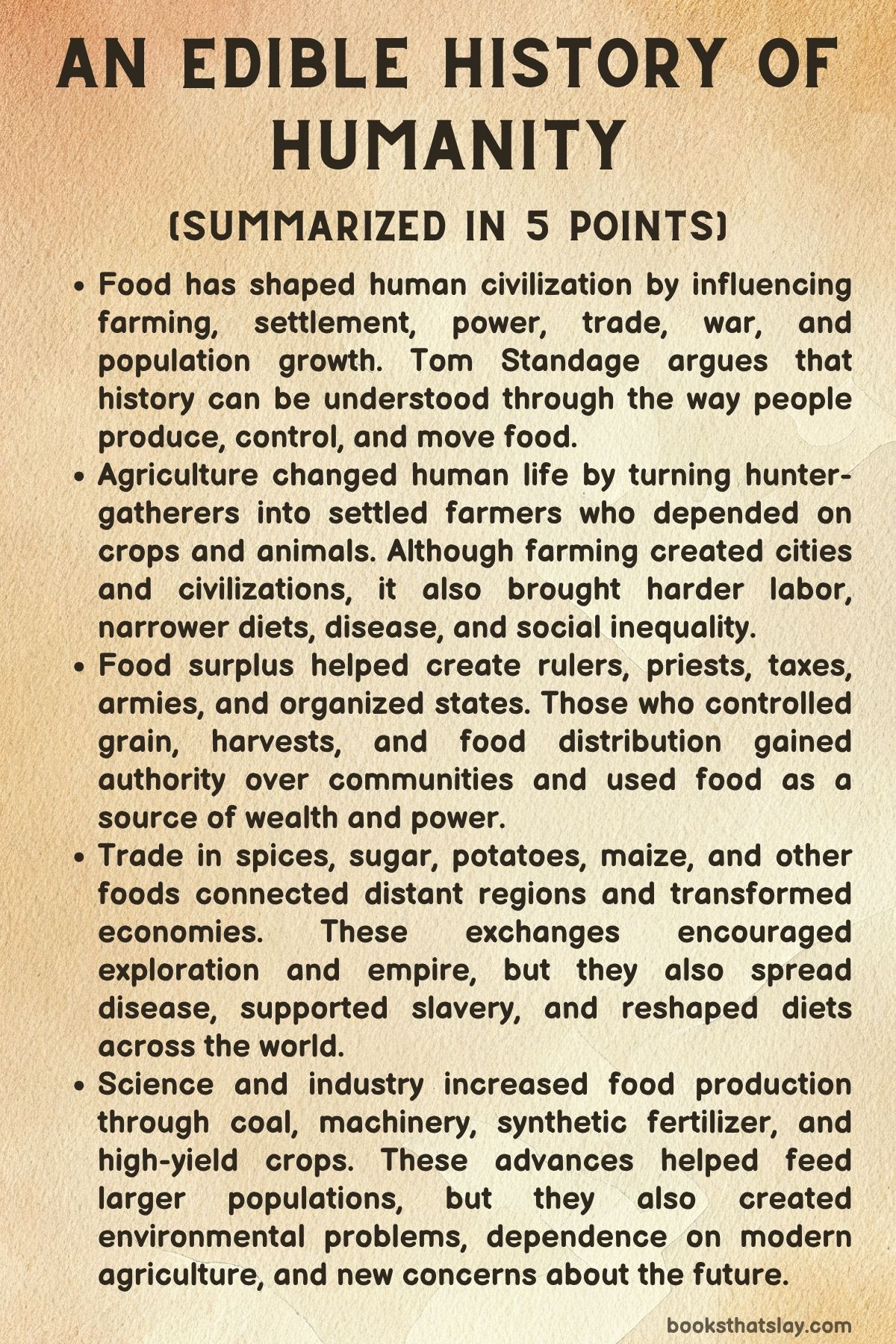
An Edible History of Humanity by Tom Standage is a nonfiction history book about how food has shaped human civilization. Rather than treating food as only culture or cuisine, Standage presents it as a force behind farming, cities, social classes, empire, trade, war, industry, science, population growth, and climate concerns.
The book argues that people changed plants and animals through agriculture, but food also changed people by shaping how they lived, worked, governed, fought, and traded. It is a broad historical account of humanity told through crops, spices, sugar, potatoes, fertilizer, famine, and food politics.
Summary
An Edible History of Humanity begins with the idea that food is not a side detail in history but one of its central engines. Standage presents food as wealth, power, fuel, technology, and political tool.
He argues that the story of civilization can be understood through the ways humans have produced, controlled, moved, and fought over food.
The book first examines the rise of farming. For most of human existence, people lived as hunter-gatherers.
Farming appeared only recently in human history, yet it transformed almost everything. Crops such as maize, wheat, and rice were not simply discovered in their modern forms; they were created through long processes of selection.
Humans favored plants with traits that made them easier to harvest, store, and eat. Maize, for example, came from teosinte, a wild grass that looked very different from modern corn.
Over generations, people selected plants with larger kernels and more useful structures until maize became dependent on human cultivation.
Standage stresses that agriculture was not an obvious improvement. Early farmers often worked harder than hunter-gatherers, ate less varied diets, and suffered more disease and nutritional stress.
Farming may have spread because settled life encouraged population growth, because climate conditions became more favorable, and because people gradually became more dependent on cultivated crops. Once farming took hold, it changed human society so deeply that returning to older ways became difficult.
By producing more calories in one place, agriculture allowed populations to rise and settlements to grow.
As farming expanded, it reshaped social structure. Hunter-gatherer groups often had fewer possessions and more flexible forms of authority, while agricultural societies created surplus.
Surplus food made it possible for some people to stop producing food directly and take on other roles as priests, rulers, soldiers, builders, artisans, or administrators. Those who controlled stored food gained influence.
Leaders emerged by organizing labor, managing irrigation, directing storage, and redistributing grain. Over time, villages developed into chiefdoms, cities, and states.
Food also became tied to religion and political legitimacy. Many societies linked harvests with divine favor and royal authority.
Rulers performed rituals to guarantee fertility, while sacrifices and offerings reinforced the belief that food production depended on relationships between humans, gods, and rulers. In places such as Egypt, food became a form of tax or rent.
Farmers gave a share of their harvest to the state or elite. The control of food therefore supported temples, armies, monuments, and ruling classes.
Even today, language preserves these links: people speak of “breadwinners” and “dough,” showing how food remains associated with wealth.
The book then turns to trade, especially the spice trade. Spices such as pepper, cinnamon, and frankincense became luxury goods because they were rare, distant, and surrounded by mystery.
Arab traders protected their sources and spread stories about dangerous origins, which helped maintain high prices. Spices encouraged long-distance commerce and helped connect regions across Asia, Africa, Europe, and the Mediterranean.
Along these routes moved not only foods but also religions, languages, ideas, and diseases. The Black Death, for instance, spread through trade networks that tied distant societies together.
European desire for spices helped drive overseas exploration. Traders wanted direct access to Asian markets without depending on Muslim-controlled routes.
Christopher Columbus sailed west hoping to reach Asia, but instead reached the Americas. Though he misunderstood where he was, his voyage connected the Americas with Europe, Africa, and Asia in a new way.
Portuguese sailors later rounded Africa and entered the Indian Ocean, where they tried to dominate trade through force. Their efforts showed how food, commerce, religion, and military power became linked in the age of empire.
The movement of crops across the world after European contact with the Americas transformed diets and economies. This global exchange spread maize, potatoes, sweet potatoes, sugar, rice, and other foods to new regions.
Some crops became vital because they grew well in unfamiliar environments. The potato, first cultivated in South America, eventually became an essential European food because it was nutritious and productive, though many Europeans initially distrusted it.
Maize also spread widely because it resembled familiar grains and produced high yields.
Sugar had especially severe consequences. Its production required intensive labor, and European demand helped expand slavery in the Americas.
As sugar became cheaper, it entered ordinary households and created a mass market built on exploitation. Standage uses sugar to show how one food could reshape economies, labor systems, and moral history.
Industrialization changed the food system again. Britain became the first country to rely heavily on imported food while exporting manufactured goods.
Coal replaced wood as a major energy source and powered factories, mining, and steam engines. This shift helped Britain escape older limits on land and agricultural output, but it created new environmental costs.
The book connects these changes to the warnings of Thomas Malthus, who argued that population growth could outrun food supply. Industrial economies avoided immediate collapse by using fossil fuels and global trade, but Standage suggests they exchanged one crisis for another: pressure on land gave way to pressure on the atmosphere.
Food also played a major role in warfare. Armies needed enormous supplies, and military success often depended on feeding soldiers.
Ancient and early modern armies had to carry food, rely on supply routes, or take food from local populations. Alexander the Great improved mobility by limiting baggage and making soldiers carry supplies.
Roman armies used food demands to weaken enemy territory. During the American Revolutionary War, British forces struggled because they depended too much on ports and unreliable loyalist support.
Napoleon understood food logistics well, but his invasion of Russia failed partly because Russian forces destroyed supplies and left little for his army.
New technologies altered military food supply. Canning made it easier to store and transport food.
Railways allowed armies to move provisions at greater scale. By the modern era, food was not only a practical military concern but also an ideological weapon.
The Berlin Blockade showed this clearly when the Soviet Union tried to cut off West Berlin from supplies. The United States and its allies responded with an airlift that delivered food and coal, turning food supply into a symbol of political resistance.
Standage also discusses communist attempts to control food production. Stalin’s collectivization in the Soviet Union and Mao’s similar policies in China both produced disastrous results.
State control of farms reduced productivity and contributed to famine. These examples support the argument that food can be used to enforce ideology, but that such control can also expose the weakness of political systems.
Standage cites the idea that democracies with free press are less likely to experience famine because leaders must respond to public pressure.
The final sections focus on science, population, and development. Feeding the modern world required advances in chemistry and plant breeding.
Scientists learned that nitrogen was essential to plant growth and eventually developed synthetic ammonia, which made large-scale fertilizer production possible. This helped free farmers from older limits such as crop rotation and natural fertilizer supplies.
Later, the green revolution produced high-yield crop varieties, especially wheat and maize, that increased food production in many poorer countries.
These innovations helped support a huge rise in population during the twentieth century, but they also created new problems. Fertilizers caused pollution and runoff, pesticides increased environmental risks, and high-yield crops sometimes displaced local varieties.
Agricultural productivity became closely tied to economic development, helping some countries industrialize while others remained poor. Standage notes that rising wealth often leads to lower birth rates, creating new challenges such as aging populations.
The book ends by looking toward the future through the image of the Svalbard Global Seed Vault, a storage site designed to preserve crop diversity against disasters such as climate change, war, and disease. Seeds kept there may one day help restore lost crops or create new varieties resistant to future threats.
Standage’s final message is that food has always shaped human destiny, and humanity’s future will depend on how wisely it manages agriculture, science, trade, population, and the planet’s limits.
Key Figures
Tom Standage
Tom Standage is the guiding presence of An Edible History of Humanity. As the author and narrator, he shapes the book through a wide historical lens, showing food as a force behind civilization rather than as a simple matter of taste or survival.
His role is analytical and argumentative. He repeatedly challenges familiar assumptions, such as the idea that farming was an obvious improvement over hunting and gathering or that industrial progress fully freed humanity from scarcity.
Standage’s voice is curious, direct, and often skeptical of easy progress narratives. He treats food as a form of power, a technology, a political tool, and a source of human dependence.
Through him, the book becomes less about meals and more about the systems that meals reveal.
Early Farmers
Early farmers are among the most important human figures in the book because they represent the beginning of settled civilization. They are shown not as people who simply discovered farming and improved their lives overnight, but as communities slowly drawn into a demanding new way of living.
Their work changed wild grasses into dependable crops, but it also made them dependent on those crops. The book presents them as innovators, though not always as people who understood the full consequences of what they were doing.
By selecting seeds, tending fields, domesticating animals, and organizing labor around harvests, early farmers helped create the foundations of villages, cities, social classes, and political rule. Their importance lies in the fact that they changed nature while also being changed by it.
Hunter-Gatherers
Hunter-gatherers function as a major contrast to farming societies. They are not romanticized as perfectly peaceful or superior, but they do reveal how much agriculture changed human life.
In the book, they often appear as people with more varied diets, fewer possessions, and less rigid social hierarchy than later agricultural communities. Their mobility limited the accumulation of wealth and made sharing more necessary.
This way of life challenges the assumption that farming automatically gave people more leisure, health, or security. Hunter-gatherers help the reader see that civilization came with costs as well as benefits.
Their presence in the book reminds us that the human story did not naturally or inevitably move toward farms, cities, states, and empires. That path was gradual, complex, and full of trade-offs.
The Big Men and Early Rulers
The Big Men and early rulers represent the rise of power through food surplus. They are central to the book’s explanation of how agricultural societies became unequal.
These figures gained influence by controlling, redistributing, or displaying food. Their authority did not always begin as harsh domination; in many cases, they organized labor, managed irrigation, hosted feasts, or protected communities.
Yet their position also created social debt and dependence. The more food they controlled, the more they could command loyalty, labor, and status.
In An Edible History of Humanity, these leaders show how food became political before money became the main measure of wealth. Their development marks a major turning point: the movement from small farming communities to structured societies with elites, workers, soldiers, priests, and rulers.
Priests and Religious Authorities
Priests and religious authorities appear as figures who connect food production with divine order. In many ancient societies, successful harvests were not seen as purely practical results of labor and climate.
They were understood through ritual, sacrifice, and the favor of gods. Religious figures gained influence because they interpreted these relationships and gave sacred meaning to planting, harvesting, fertility, and abundance.
Their role helped strengthen political power as well, since rulers often depended on religious ceremonies to present themselves as necessary to agricultural success. In the book, priests and ritual leaders show how food moved beyond the field and entered the symbolic life of civilization.
Grain, maize, sacrifice, and seasonal rites became ways to explain power and make hierarchy seem natural or divinely approved.
Arab Traders
Arab traders are important because they controlled valuable spice routes and shaped the mystery surrounding luxury foods. The book presents them as skilled commercial figures who understood the value of secrecy.
By hiding the true sources of spices and allowing strange origin stories to spread, they helped increase the prestige and price of goods such as cinnamon, pepper, and frankincense. Their influence was not limited to commerce.
Their trade networks connected distant regions and helped move languages, religions, technologies, and diseases across continents. Arab traders also became a driving force behind European attempts to find alternate routes to Asia.
Their control of trade made spices more than seasonings; spices became objects of desire, wealth, rivalry, and imperial ambition.
Christopher Columbus
Christopher Columbus is presented as a figure whose mistakes changed history. He set out to reach Asia by sailing west, hoping to find a direct path to the spice trade.
Instead, he reached the Americas while believing he had arrived near Asia. In the book, Columbus is not treated mainly as a heroic explorer but as a man driven by commercial ambition, religious purpose, and geographical misunderstanding.
His inability to identify the land he had reached did not prevent his voyage from transforming the world. By connecting the Americas more directly with Europe, Africa, and Asia, he helped initiate a massive movement of crops, diseases, people, animals, and wealth.
His role shows how food desire, especially the search for spices, helped create global empire.
Portuguese and Dutch Traders
Portuguese and Dutch traders represent the militarization of food commerce. They were not satisfied with participating in existing trade networks; they wanted control.
The Portuguese entered the Indian Ocean and used armed ships to challenge Muslim traders who had long operated within a more peaceful commercial system. Their actions show how European trade often relied on violence, intimidation, and religious justification.
Later, the Dutch became powerful players in eastern trade, showing that empire was built not only by conquering land but also by controlling routes, ports, commodities, and prices. These traders help explain how food and spices became foundations of global capitalism.
Their role in the book reveals that trade was rarely neutral; it often carried coercion, war, and exploitation.
King Charles II
King Charles II appears through the image of the pineapple, a fruit that symbolized wealth, power, and global reach. His role in the book is less about personal psychology and more about what monarchy wanted food to represent.
The pineapple presented to him was not just a rare fruit; it was proof of imperial connection, botanical knowledge, and elite privilege. Through Charles, the book shows how rulers used exotic foods to display status and command admiration.
His gardens and interest in plants reflect the competitive spirit of European monarchies, which wanted to collect, classify, and cultivate the world’s resources. He represents a period when botany, empire, luxury, and political prestige became closely linked.
Enslaved Laborers
Enslaved laborers are among the most important and tragic human presences in the book. Their suffering is tied especially to the history of sugar.
As European demand for sugar grew, plantations in the Americas required enormous labor, and enslaved Africans were forced into brutal systems of production. The book shows that sugar’s spread into ordinary European households was built on violence and human exploitation.
Enslaved laborers reveal the moral cost hidden behind a food that became common, pleasurable, and profitable. They are not treated as background figures but as central to understanding how global food economies worked.
Their labor made possible the wealth of planters, merchants, and empires, while exposing how appetite and profit could normalize cruelty on a massive scale.
Thomas Malthus
Thomas Malthus is a major intellectual figure in An Edible History of Humanity because his ideas frame the relationship between food supply and population growth. He warned that population could grow faster than agricultural production, leading to famine, poverty, and social collapse.
Although many of his predictions did not come true in the exact way he expected, the book treats his concerns as historically important. Malthus helps explain the recurring pattern in which humanity solves one food problem only to create another.
Industrialization, imported food, fossil fuels, fertilizer, and high-yield crops all helped avoid the crisis he feared, but they introduced environmental and social problems of their own. His role is to keep the question of limits at the center of the book.
Napoleon Bonaparte
Napoleon Bonaparte is presented as a military leader who understood that armies march on food. His success depended partly on his ability to organize supplies, use foraging, and move troops efficiently.
In this sense, he recognized food as a strategic resource, not merely a support system. Yet his invasion of Russia exposed the limits of his methods.
Russian forces destroyed or removed local supplies, leaving his army unable to feed itself. Napoleon’s failure shows that military genius could be undone by food logistics.
In the book, he represents the larger truth that war is shaped as much by supply lines, storage, transport, and hunger as by weapons or battlefield tactics.
Nicolas Appert
Nicolas Appert is important as the inventor associated with canned food, a development that changed both military and civilian life. His work made it possible to preserve food for long periods, transport it more safely, and feed soldiers with greater reliability.
In the book, Appert represents the technological side of food history. His innovation shows how solving a practical problem can alter the scale and style of war.
Canned food reduced dependence on immediate local supplies and helped armies operate with greater flexibility. Appert’s role may seem smaller than that of kings, generals, or traders, but his contribution reveals how food technology can reshape history quietly and permanently.
Joseph Stalin
Joseph Stalin appears as a ruler who used food as a tool of state control and ideology. His collectivization policies forced farmers into a centralized system intended to accelerate industrial development.
Instead of producing abundance, these policies caused reduced productivity, fear, and famine. Stalin’s role in the book shows how political power can turn food production into a weapon against its own people.
His refusal to acknowledge policy failure made suffering worse, especially in regions such as Ukraine. Through Stalin, the book examines the danger of separating agricultural policy from human reality.
Food under his rule became a measure of obedience, punishment, and state ambition.
Mao Zedong
Mao Zedong is presented in relation to similar attempts to control agriculture through collectivization and state planning. Like Stalin, Mao believed that centralized control could transform the country and support rapid industrialization.
His grain monopoly and farm policies led to falling production and widespread hunger. Mao’s role in the book highlights the disastrous consequences of ideology overriding local knowledge and practical farming needs.
His eventual decision to allow farmers more control over their own fields shows that the system had failed, even if he did not fully admit it. Mao’s place in the book reinforces one of its central lessons: food systems cannot be successfully governed by theory alone when they ignore incentives, conditions, and human survival.
Amartya Sen
Amartya Sen appears as an economist whose ideas help interpret famine and political responsibility. His argument that famines do not occur in functioning democracies with a free press gives the book a powerful political conclusion.
Sen shifts the discussion away from food supply alone and toward accountability, information, and public pressure. In his view, famine is not simply a natural disaster caused by crop failure; it is often the result of political failure.
His presence in the book helps explain why systems that silence criticism are more likely to let hunger become catastrophe. Sen’s contribution deepens the book’s argument that food is always tied to power, governance, and rights.
Norman Borlaug
Norman Borlaug is one of the key scientific figures in the book because of his connection to the green revolution. He promoted high-yield crop varieties that helped increase food production in countries facing hunger and poverty.
His work represents the promise of agricultural science: the possibility of feeding millions through improved seeds, fertilizers, and farming techniques. Yet the book also shows that such breakthroughs bring complications.
High-yield crops often require chemical inputs, irrigation, and changes to local agriculture. Borlaug’s role is therefore both hopeful and complex.
He stands for human ingenuity in the face of hunger, while also raising questions about environmental cost, crop diversity, and dependence on modern agricultural systems.
Scientists, Botanists, and Agronomists
Scientists, botanists, and agronomists form a collective group of major figures in the book. They appear across history as people who classify plants, improve crops, study nitrogen, develop fertilizers, and search for higher yields.
Their work helped turn agriculture from a practice based mainly on tradition into a field shaped by chemistry, genetics, and experimentation. They contributed to population growth by making more food available, but their achievements also created new problems such as pollution, pesticide use, and reduced biodiversity.
These figures show that food history is also a history of knowledge. Their discoveries changed the relationship between humans and the natural world, making food production more powerful but also more fragile.
Farmers in the Modern World
Modern farmers carry forward the oldest role in the book while facing newer pressures. They are no longer simply growers of food for local communities; they operate within global markets, government policies, fertilizer systems, fuel prices, climate risks, and technological demands.
The book presents agriculture as a field shaped by economics and politics as much as weather and soil. Modern farmers inherit the achievements of past agricultural revolutions but also the burdens: environmental damage, dependence on chemical inputs, price instability, and the pressure to produce more for a growing population.
Their role connects ancient farming to present-day food challenges, showing that humanity remains deeply dependent on those who cultivate crops and manage land.
Themes
Food as Power
Food in An Edible History of Humanity is repeatedly shown as a foundation of authority. Before money became the dominant measure of value, stored grain, livestock, and harvests could determine who held influence.
Agricultural surplus allowed certain people to move away from direct food production and become rulers, priests, soldiers, or administrators. Those who controlled food controlled labor, loyalty, taxation, and survival.
This connection can be seen in early farming communities, ancient states, religious ceremonies, and imperial trade. Food also created social hierarchy because surplus made wealth visible and transferable.
A ruler who could organize irrigation, collect grain, distribute supplies, and perform rituals tied to fertility appeared necessary to the survival of the community. The book shows that political systems did not emerge apart from agriculture; they grew from the management of food.
Even modern language preserves this relationship through terms such as “breadwinner” and “dough.” Food remains tied to power because it is not optional. Whoever controls access to it can shape behavior, reward loyalty, punish resistance, and define the structure of society.
Agriculture and the Cost of Civilization
Agriculture is often treated as the beginning of progress, but the book complicates that belief. Farming made settled life, population growth, cities, and states possible, yet it also brought harder labor, narrower diets, disease, inequality, and dependence on a few crops.
Early farmers did not simply choose an easier life; they gradually entered a system that demanded constant work and created new vulnerabilities. Once communities depended on planted fields and stored harvests, they became tied to seasons, land, property, and authority.
Farming also altered human bodies and social relations. Nutritional stress increased because grain-based diets lacked the variety of many hunter-gatherer diets.
Settled communities were more exposed to waste, crowding, and disease. At the same time, surplus food created the conditions for social ranking, organized religion, taxation, and warfare.
The theme is powerful because it refuses to present civilization as a clean victory. Human beings gained cities, writing, trade, and political organization, but they also accepted toil, control, and new forms of suffering.
Agriculture appears as both achievement and burden.
Trade, Empire, and the Global Movement of Food
The movement of food across regions changed the scale of human history. Spices, sugar, potatoes, maize, rice, and other crops did not merely enter new diets; they redirected trade routes, motivated exploration, supported empires, and reshaped economies.
The desire for spices encouraged Europeans to search for direct routes to Asia, helping launch voyages that connected continents in new and often violent ways. The Columbian exchange then moved crops, animals, diseases, and people across oceans at a speed never seen before.
Some foods, such as the potato and maize, helped support population growth in new regions. Others, especially sugar, became tied to slavery, plantation economies, and imperial profit.
Food trade also carried religion, language, disease, and military conflict. This theme shows that globalization did not begin with modern corporations or digital networks; it has deep roots in hunger, luxury, profit, and conquest.
The book makes clear that the global food system was not built peacefully or evenly. It was shaped by curiosity, greed, violence, adaptation, and the human desire to possess what was rare or useful.
Science, Survival, and Unintended Consequences
Scientific advances in agriculture helped humanity avoid mass starvation, but they also created new risks. The discovery of nitrogen’s role in plant growth, the development of synthetic fertilizer, and the creation of high-yield crops allowed food production to rise dramatically.
These breakthroughs supported enormous population growth and helped many countries improve agricultural productivity. The green revolution, in particular, showed how science could answer urgent human needs by increasing yields and making famine less likely in some regions.
Yet the book also emphasizes that solutions in food history rarely end problems completely. Synthetic fertilizer contributes to pollution and nitrogen runoff.
High-yield crops can reduce biodiversity and increase dependence on chemicals, irrigation, and global supply chains. Industrialization helped countries escape older limits on land, but fossil fuels produced climate consequences.
Even population growth, once supported by better food supplies, later created concerns about resources, aging societies, and environmental strain. This theme presents human ingenuity as real and necessary, but never simple.
Each solution changes the conditions of survival and produces new questions for the future.