An Elephant in the Garden Summary, Characters and Themes
An Elephant in the Garden by Michael Morpurgo is a historical novel about war, memory, survival, and unlikely friendship. Set mainly during the final months of World War II, it follows Lizzie, who remembers fleeing the bombing of Dresden with her mother, brother, a young Canadian airman, and Marlene, an elephant rescued from the zoo.
The story is told years later in a nursing home, where Lizzie shares her past with a nurse and the nurse’s son. In my view, the book is about how compassion can survive even when the world around people has become cruel and broken.
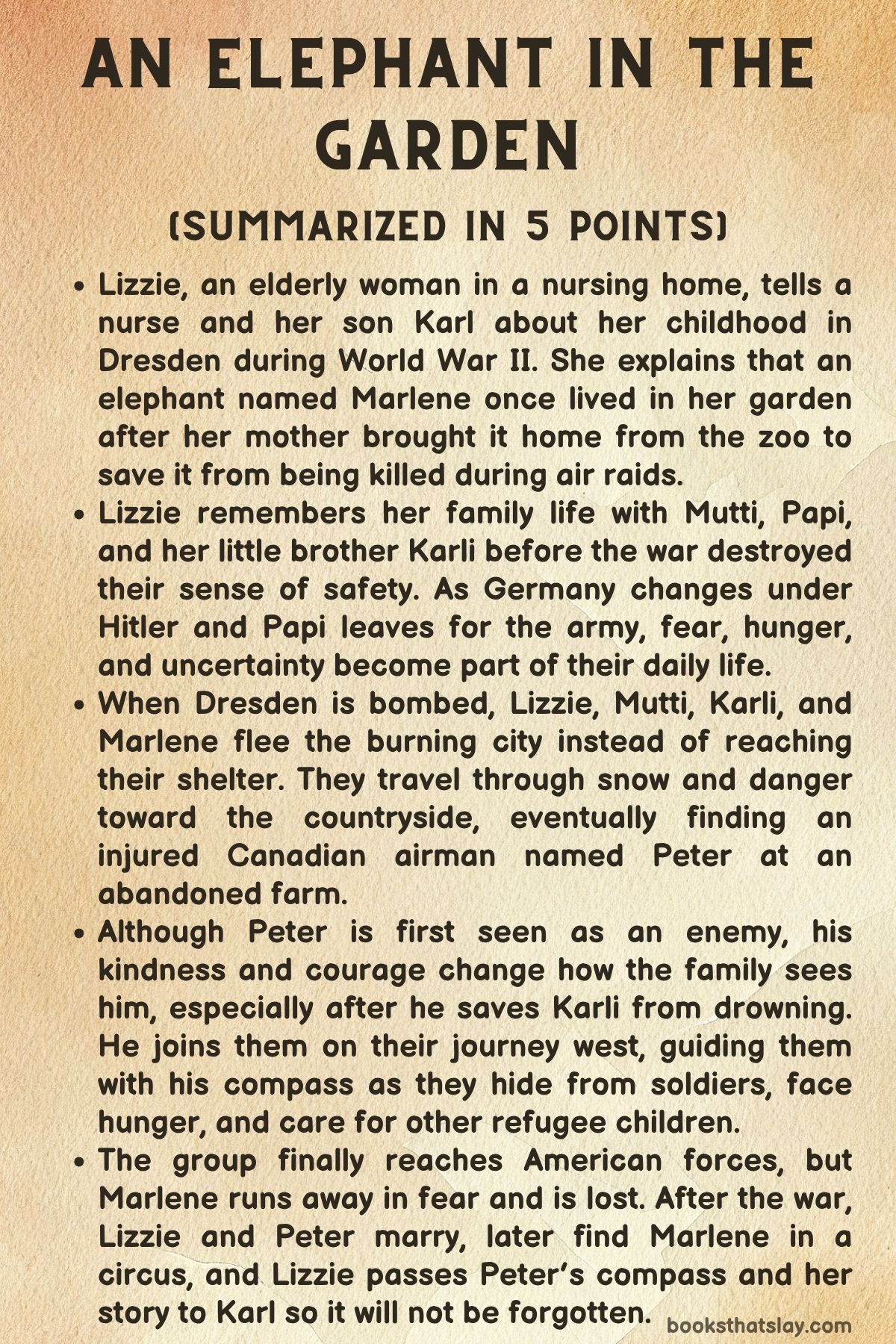
Summary
Lizzie is an elderly woman living in a nursing home. She is frail, private, and unhappy there, though she likes the nurse who cares for her.
The nurse knows very little about Lizzie’s past. One day, the nurse’s young son Karl visits Lizzie’s room, and the two quickly form a connection.
Karl reminds Lizzie of someone from her childhood: her little brother, Karli. When Lizzie tells Karl that an elephant once lived in her garden, his mother assumes she is confused, but Karl believes her.
This gives Lizzie the chance to tell the story she has carried for most of her life.
Lizzie begins by remembering her childhood in Dresden, Germany. She lived with her mother, whom she called Mutti, her father, whom she called Papi, and her little brother Karli.
Before the war darkened everything, their lives had warmth and happiness. They visited relatives on a farm, listened to music, and lived in a house with a garden that opened onto a park.
But Germany was changing under Hitler. Lizzie saw cruelty toward Jewish people, though her family avoided speaking openly because it was dangerous to say too much.
A quarrel between Mutti and relatives who supported Hitler marked the end of the old family closeness.
When war came, Papi joined the German army and left for France. Mutti found work at the Dresden zoo, where she became attached to a young elephant named Marlene.
As the war dragged on, food became scarce, refugees arrived in Dresden, and the family feared the city would be bombed. Lizzie, now a teenager, felt angry and lonely.
She resented Mutti’s love for Marlene, thinking her mother cared more for the elephant than for her own children. After an emotional conversation, Mutti explained that the zoo animals would be shot if bombing began, so they would not escape into the city.
Mutti could not bear the thought of Marlene being killed.
Soon after Lizzie’s sixteenth birthday, Mutti revealed her secret plan. The zoo director had allowed her to bring Marlene home each night to keep her safe.
When Lizzie and Karli returned from school, they found an elephant standing in the garden. At first Lizzie was nervous around Marlene, but she soon saw gentleness in her and began to love her.
Marlene became part of the family, and her presence brought wonder to the neighborhood. Children came to see her, and Lizzie and Karli became famous at school because of the elephant in their garden.
This fragile happiness ended on the night of February 13, 1945. A hostile dog began tormenting Marlene at the garden gate.
During a walk in the park, the dog appeared again, and Marlene chased it. Mutti, Lizzie, and Karli ran after her.
Then the air-raid sirens sounded. Mutti wanted to get home to the shelter, but Karli refused to leave Marlene.
As the bombs began falling on Dresden, the family was forced away from the city instead of back toward their house. They watched the sky fill with planes and explosions.
The city burned behind them, and they heard the zoo animals being shot. Marlene found them again, and Mutti decided they must walk to her sister’s farm for safety.
The journey was cold and exhausting. They joined crowds of refugees fleeing Dresden, then left the road to travel through the woods.
Karli grew too tired to walk, so he rode on Marlene’s back. After a long struggle, they reached the farm, only to find it deserted.
In the barn, Lizzie discovered a wounded young man in a blue uniform. He was Peter Kamm, a Canadian serving in the RAF, and his plane had been shot down after the bombing of Dresden.
Mutti, filled with rage and grief, nearly attacked him with a pitchfork, but Lizzie stopped her. Peter spoke German and said he had not known the bombing would destroy the city.
He hated what war made people do to one another.
At first Mutti treated Peter as an enemy and planned to hand him over. Lizzie and Karli, however, were drawn to him.
Peter was gentle, and he had once wanted to be an actor. He showed Karli his compass, a treasured object that could guide him home.
Mutti took the compass so Peter could not run away. Lizzie soon realized she was falling in love with him, even though he wore the enemy’s uniform.
Everything changed when Karli fell through the ice into a lake. Peter risked his own life to save him.
He pulled Karli from the freezing water and worked desperately until the boy began breathing again. Mutti saw then that Peter was not simply an enemy.
When German soldiers came searching for a missing British airman, Mutti lied to protect him, claiming he was her older son. Karli helped by saying Peter had asthma and therefore was not in the army.
After the soldiers left, Mutti returned Peter’s compass and told him he was now part of the family.
Together, Mutti, Lizzie, Karli, Peter, and Marlene set off west, hoping to reach American forces. They traveled by night and hid by day in barns and huts.
They avoided roads, shared shelter with other refugees, and relied on Peter’s compass to guide them. Marlene’s presence often softened people’s suspicion, especially children.
Karli entertained others with juggling, while Mutti kept everyone going with songs and strength. Lizzie and Peter grew closer during the journey, finding quiet moments together away from the fear of war.
When food ran out, Peter hunted, fished, or stole from farms so the group could survive. Then Karli became seriously ill, coughing and burning with fever.
Desperate, the family went to a country estate and asked for help. A countess took them in, called a doctor, and allowed them to stay while Karli recovered.
Her house was already full of refugees. For a short time, the family found warmth, food, and rest.
But danger returned when Karli juggled Peter’s compass in front of others. A servant named Hans noticed English writing on it and became suspicious.
Mutti invented a story that Papi had taken the compass from a British airman in France, but Hans did not believe her. The countess warned the family that Hans planned to call the police.
She also asked them to take a group of orphaned schoolchildren with them, since their choirmaster had died. The countess revealed that her own husband had been executed for trying to kill Hitler.
She opposed the evil Germany had followed and wanted to help them escape.
Before the family could leave, German soldiers arrived with Major Klug. The countess used courage, persuasion, and a bribe to prevent him from arresting Peter.
After this close escape, the group continued west with the schoolchildren. Their journey became harder as supplies dwindled, the weather worsened, and the fighting drew closer.
Yet the children sang, and the music helped them face their fear.
At last, American tanks appeared through the mist. The refugees had reached safety.
But the noise terrified Marlene, and she ran away. The soldiers would not let anyone search for her.
At the very moment the family survived, they lost the elephant who had protected and comforted them for so long.
After the war, Peter returned to the RAF, while Lizzie, Mutti, Karli, and the children were sent to a displaced persons camp. Peter gave Lizzie his compass and promised to come back.
They wrote to each other, but later his letters stopped arriving. Lizzie believed she had lost him.
Eventually, the family moved to Heidelberg. Papi, who had been captured by the Russians, returned home after four years.
Then one day Peter appeared on Lizzie’s doorstep. Her letters had only reached him much later, and once he knew where she was, he came to find her.
Peter and Lizzie married in Heidelberg and moved to Canada. Years later, they saw Marlene performing in a circus.
They recognized her at once, and she remembered them too. Lizzie and Peter were able to spend time with her before the circus moved on.
Peter and Lizzie remained married for almost sixty years.
Back in the nursing home, Lizzie gives Peter’s compass to Karl and asks him to look after her story. The next day, Karl and his mother bring Lizzie’s photograph album.
On the last page, they see proof: a picture of Lizzie with Marlene at the circus. Karl says he always believed her.
His mother admits she almost always did.
Characters
Lizzie
Lizzie is the central voice of An Elephant in the Garden, and her character is shaped by memory, loss, guilt, love, and the need to be believed. As an old woman in a nursing home, she appears fragile, lonely, and somewhat mysterious, but her storytelling reveals a life marked by extraordinary courage.
She is not presented as a simple heroine from the beginning. As a teenager, she is angry, frightened, and sometimes unfair to her mother, especially when she thinks Mutti cares more about Marlene than about her own children.
This makes Lizzie feel human and believable. Her emotional growth comes through suffering: the bombing of Dresden, the dangerous journey west, her bond with Marlene, and her love for Peter all force her to see the world with greater compassion.
Lizzie’s strongest quality is her moral instinct. Even when Peter is identified as an enemy airman, she recognizes his humanity and stops Mutti from harming him.
In old age, her need to tell the story is not just nostalgia; it is an act of preservation. By giving Karl Peter’s compass, she passes on both memory and responsibility.
Mutti
Mutti is one of the strongest characters in the book because she combines tenderness with fierce practical courage. She is a mother, a zoo worker, a protector, and a moral guide, but she is also a woman under unbearable pressure.
Her decision to bring Marlene home from the zoo shows her deep compassion. She cannot save the whole world from war, but she can save one living creature placed in her care.
At times, Mutti is severe, especially toward Peter after she learns he flew with the forces that bombed Dresden. Her anger is understandable because she has lost her home, her city, and perhaps her husband.
Yet her character does not remain trapped in hatred. When Peter saves Karli, Mutti is forced to reconsider what it means to call someone an enemy.
Her choice to protect Peter from the German soldiers is a turning point, showing that her moral courage is stronger than her bitterness. She becomes the emotional center of the travelling group, keeping the children alive through discipline, songs, hope, and determination.
Karli
Karli brings innocence, humor, and emotional warmth to the story. He has physical difficulties, including asthma and one leg shorter than the other, but he is never defined only by weakness.
He is lively, playful, and theatrical, often using performance to lift the spirits of those around him. His love for Marlene is immediate and pure, and his refusal to abandon her during the air raid shows both childish stubbornness and genuine loyalty.
Karli’s presence often changes the behavior of adults. He helps Lizzie open herself to tenderness, gives Peter a reason to show kindness, and softens Mutti’s fear during moments of crisis.
His near-drowning is one of the most important events in the novel because it forces Mutti to see Peter not as a faceless enemy but as the man who saves her son. Karli also represents the children whose lives are shaped by war before they can fully understand it.
By the end, hardship has made him more mature, but his spirit remains connected to laughter, music, and trust.
Marlene
Marlene, the elephant at the heart of An Elephant in the Garden, is more than an unusual companion. She represents gentleness surviving in a violent world.
At first, Lizzie resents Marlene because Mutti seems so devoted to her, but the elephant gradually becomes a source of comfort and unity for the family. Marlene is large and powerful, yet her nature is affectionate, patient, and sensitive.
She senses fear, responds to kindness, and offers a quiet form of companionship that words cannot provide. During the family’s escape from Dresden, Marlene becomes both a protector and a symbol of hope.
Karli rides on her back when he cannot walk, refugees are comforted by her presence, and children are drawn to her. She also reveals the cruelty of war by showing how innocent creatures are placed in danger by human conflict.
Her disappearance near the American lines is painful because survival comes at the cost of losing a beloved family member. Her later reappearance in the circus gives the story a sense of emotional healing.
Peter Kamm
Peter Kamm is one of the most morally important figures in the book because he challenges the idea that people can be reduced to uniforms, nations, or sides in a war. When Lizzie first sees him, he is an enemy airman, connected to the destruction of Dresden.
Yet his words and actions reveal a frightened, wounded young man who hates the violence he has been part of. Peter’s character is marked by remorse, intelligence, gentleness, and courage.
He does not defend the bombing; instead, he apologizes and admits the horror of what war does to people. His rescue of Karli proves his bravery in the most direct way.
He risks himself for a German child even though the child’s mother wants to hand him over. Peter’s compass becomes a symbol of direction, survival, and promise.
His love for Lizzie grows quietly during the journey, not through grand speeches but through shared danger and trust. His return after the war confirms his loyalty and turns survival into a future.
Karl
Karl, the nurse’s son in the present-day frame of the novel, plays a small but essential role. He is the person who believes Lizzie before others do.
His trust allows Lizzie to speak freely and gives her story a listener who receives it without cynicism. Karl’s resemblance to Karli gives Lizzie an emotional bridge between past and present, making it easier for her to return to memories that are painful but precious.
He also represents a younger generation that did not experience the war but can still inherit its lessons. His belief in Lizzie’s elephant is important because the story depends on faith in memory, especially when memory sounds impossible.
By accepting Peter’s compass at the end, Karl becomes the keeper of Lizzie’s story. He is not merely a child visiting a nursing home; he becomes the link through which the past can continue to matter.
Karl’s Mother
Karl’s mother, the nurse, is practical, caring, and initially skeptical. She sees Lizzie first as a patient: elderly, frail, and possibly confused.
Her early disbelief about the elephant is understandable because the claim seems impossible. However, her character changes as she listens.
She becomes more than a nurse performing a duty; she becomes a witness. Her role is important because she stands between ordinary reality and Lizzie’s extraordinary past.
Through her, the reader experiences the gradual movement from doubt to belief. She also reflects the everyday compassion of caregiving.
She brings Karl to work when necessary, cares for Lizzie, and eventually helps recover the photograph album that proves Lizzie’s story. Her final admission that she almost always believed Lizzie is gentle and honest.
She does not pretend she had faith from the beginning, but she learns to respect the truth carried by memory.
Papi
Papi is mostly absent from the action, but his presence strongly shapes Lizzie’s family. He represents the many fathers and husbands pulled into war, leaving families to survive without certainty.
Through his letters, he remains emotionally present in the household. Mutti’s ritual of reading his letters and placing them behind his picture shows how deeply the family depends on the idea of his return.
Papi is also important because he is associated with music, tenderness, and moral values. Lizzie remembers that her parents taught her killing was wrong, and this belief helps her stop Mutti from attacking Peter.
Though Papi serves in the German army, the book does not present him as cruel or fanatical. Instead, he is shown as another person caught in history’s machinery.
His eventual return after being captured by the Russians brings relief, but it also reminds readers that survival after war is slow and uncertain.
Aunt Lotti and Uncle Manfred
Aunt Lotti and Uncle Manfred represent the damage politics and ideology can do within families. Their farm once stands for happiness, childhood freedom, and family closeness, but that changes after the argument about Hitler.
Uncle Manfred’s support for Hitler and his antisemitic views create a permanent rupture with Mutti. He shows how resentment after World War I and national humiliation could be twisted into hatred.
Aunt Lotti is less clearly developed, but as part of that household, she belongs to the lost world Lizzie can no longer safely return to. When Mutti, Lizzie, Karli, and Marlene reach the farm after Dresden is destroyed, it is deserted.
This emptiness is symbolic. The place that once represented family refuge has become another sign of collapse.
Their absence also forces the characters into a more complex situation because instead of finding relatives, they find Peter, the supposed enemy who will become family.
The Countess
The countess is a figure of moral courage, dignity, and resistance. She shelters refugees even though doing so is difficult and dangerous.
Her home becomes a temporary refuge in a country breaking apart. Unlike characters who protect only their own, the countess acts out of a wider sense of human responsibility.
She helps Karli by calling a doctor, gives the family time to recover, and later warns them when Hans becomes suspicious of Peter. Her backstory adds depth to her character: her husband was executed for trying to assassinate Hitler, which places her among those Germans who opposed the Nazi regime at great personal cost.
She is brave but also intelligent. When Major Klug arrives, she uses influence, emotional force, and strategy to protect the family.
Her character shows that courage is not always physical; sometimes it is the ability to speak calmly in a room full of armed men and still choose what is right.
Hans
Hans is a minor character, but he creates real danger. He is suspicious, watchful, and hostile from the moment the family arrives at the countess’s home.
His reaction to the English writing on Peter’s compass shows how fear and loyalty to authority can make ordinary people dangerous. Hans does not need to be a major villain to threaten the characters; in wartime, one suspicious person can expose everyone.
He represents the atmosphere of distrust that surrounds the journey. People are hungry, displaced, frightened, and alert to anything that might bring punishment or reward.
Hans’s suspicion forces the family to leave the countess’s house before they are ready, increasing their hardship. His role in the story is to show how survival depends not only on avoiding armies and bombs but also on navigating human suspicion.
Major Klug
Major Klug appears briefly, but his presence raises the threat level sharply. As a German officer, he has the power to arrest Peter and punish those protecting him.
Yet he is not presented as a simple monster. The countess is able to reach him through their shared connection to her dead husband, through bribery, and perhaps through his own exhaustion with the war.
His decision to leave without arresting the family shows the collapsing moral and political order near the war’s end. Authority still exists, rifles are still pointed, and people can still be killed, but certainty has weakened.
Major Klug’s scene also shows the countess’s strength. He matters less as a fully developed character than as a test of her courage and the family’s fragile safety.
The German Soldiers
The German soldiers who search the farm create one of the book’s most tense moments. They are hunting for the surviving airman and speak of killing him if they find him.
Their presence shows the danger Peter brings to the family and the risk Mutti takes by protecting him. The soldiers also reveal the emotional ruin inside Germany itself.
One of them says there is no Dresden anymore, a statement that carries shock, bitterness, and despair. They are still agents of military power, but they are also men standing inside a defeated and devastated country.
Their scene forces Mutti to act quickly and convincingly. By claiming Peter as her son and trusting Karli’s improvised explanation, she crosses a moral line away from national loyalty and toward human loyalty.
The Schoolchildren
The schoolchildren taken from the countess’s house represent the many children displaced by war, separated from protection, and forced to depend on strangers. Their choir background gives them a special role in the story because music becomes a means of survival.
Their singing does not erase hunger, cold, or fear, but it gives the travelling group moments of unity and courage. They also enlarge Mutti and Peter’s responsibility.
The journey is no longer only about one family and an elephant; it becomes a small community trying to move through danger together. The children’s presence emphasizes the cost of war on the innocent.
They have lost their choirmaster and their stable lives, yet they still carry beauty with them through song.
The Refugees
The refugees form the human background of the novel, but they are important because they show the scale of suffering beyond Lizzie’s family. They are cold, hungry, frightened, suspicious, and exhausted.
Some share shelters with the family, and many tell their own stories of escape from Dresden. Through them, the book avoids making the bombing only a private tragedy.
Lizzie’s family is one part of a much larger movement of people driven from their homes. The refugees also show how war changes social behavior.
People may be wary of each other at first, but Marlene often breaks through that silence and creates a moment of shared wonder. Their presence reminds readers that survival in wartime is both personal and collective.
Themes
Compassion in a World Shaped by Violence
Compassion survives in the story not as a soft feeling but as a difficult moral choice. Mutti saves Marlene even when Dresden is under threat, and that decision reveals her belief that innocent life matters, whether human or animal.
Lizzie’s choice to stop Mutti from harming Peter is another powerful example. Peter belongs to the forces that bombed Dresden, so hatred would be easy, even expected.
Yet Lizzie sees his fear and sorrow before she sees his uniform. This act of recognition changes the direction of the story.
Later, Mutti herself must make the same moral journey when Peter saves Karli’s life. By protecting Peter from German soldiers, she chooses gratitude and justice over revenge.
The countess also lives by compassion when she shelters refugees and helps the family escape danger. In An Elephant in the Garden, kindness is never shown as simple or risk-free.
It often requires people to go against fear, anger, law, and public expectation. The book suggests that compassion is most meaningful when it is hardest to practice, especially when people are pressured to see others only as enemies.
War and the Destruction of Innocence
War in the novel is shown through its effect on ordinary lives rather than through battle scenes alone. Lizzie’s childhood begins with family visits, music, picnics, and a sense of safety, but that world gradually disappears.
Hitler’s rise changes how adults speak, what families can say openly, and whom people are taught to hate. The bombing of Dresden makes the destruction immediate and physical.
Lizzie loses her home, her city, and the life she knew in a single night. Karli’s innocence is also damaged.
He remains playful and loving, yet he is forced to flee through snow, hunger, illness, and danger. Even Marlene, an animal with no understanding of politics, is threatened because humans have created a war around her.
Peter’s character shows that innocence is damaged on both sides. He is a young man who wanted to act, not kill, but war makes him part of a bombing he deeply regrets.
The novel presents war as a force that reaches everyone: children, parents, soldiers, animals, refugees, and those who try to stay morally decent. It does not allow anyone to remain untouched.
Family Beyond Blood
Family in the story begins with Lizzie, Mutti, Karli, and the absent Papi, but the meaning of family expands as danger grows. Marlene becomes part of the household before the bombing and remains part of the family during the escape.
Mutti’s insistence that Marlene cannot be left behind shows that love is not limited by species or convenience. Peter’s movement into the family is even more complex.
At first he is the enemy, someone Mutti wants to hand over to the authorities. Yet through his actions, especially his rescue of Karli, he earns trust.
When Mutti tells him he is one of them, family becomes a moral bond rather than a biological fact. The schoolchildren also become part of this wider circle when the countess asks Mutti and Peter to take responsibility for them.
In this way, the story shows that crisis can break families apart, but it can also create new forms of belonging. Family becomes the group of people who protect one another, share hunger and fear, keep walking together, and refuse to abandon the vulnerable.
Memory, Storytelling, and the Need to Be Believed
Lizzie’s story is framed through old age, and this makes memory one of the book’s deepest concerns. At the nursing home, Lizzie seems at first like a lonely elderly woman whose strange claim about an elephant might be dismissed.
The nurse’s doubt reflects a common problem: older people’s memories, especially unusual ones, are sometimes treated as confusion. Karl’s belief gives Lizzie dignity.
He listens not because he has proof, but because he trusts the emotional truth of what she says. Storytelling becomes Lizzie’s way of keeping the past alive.
She does not tell the story simply to entertain Karl; she wants someone to know what happened, to remember Marlene, Peter, Mutti, Karli, Dresden, and the journey west. The compass and photograph album turn memory into inheritance.
The compass carries Peter’s love and survival, while the photograph confirms the reality of Marlene. By giving the compass to Karl, Lizzie asks him to become responsible for the story after she is gone.
The novel suggests that memory needs listeners, and belief can be an act of care.