An Octoroon Summary, Characters and Themes
An Octoroon by Branden Jacobs-Jenkins is a sharp, self-aware play that reworks Dion Boucicault’s 19th-century melodrama The Octoroon for a modern stage. It examines race, theater, slavery, performance, and the uneasy history of representation in American drama.
The play does not simply retell an old story; it exposes the assumptions behind it, showing how racism is built into both the original plot and the theatrical traditions that shaped it. Through masks, direct address, satire, and emotional shock, the author asks what audiences expect from stories about Black suffering and who gets to control those stories.
Summary
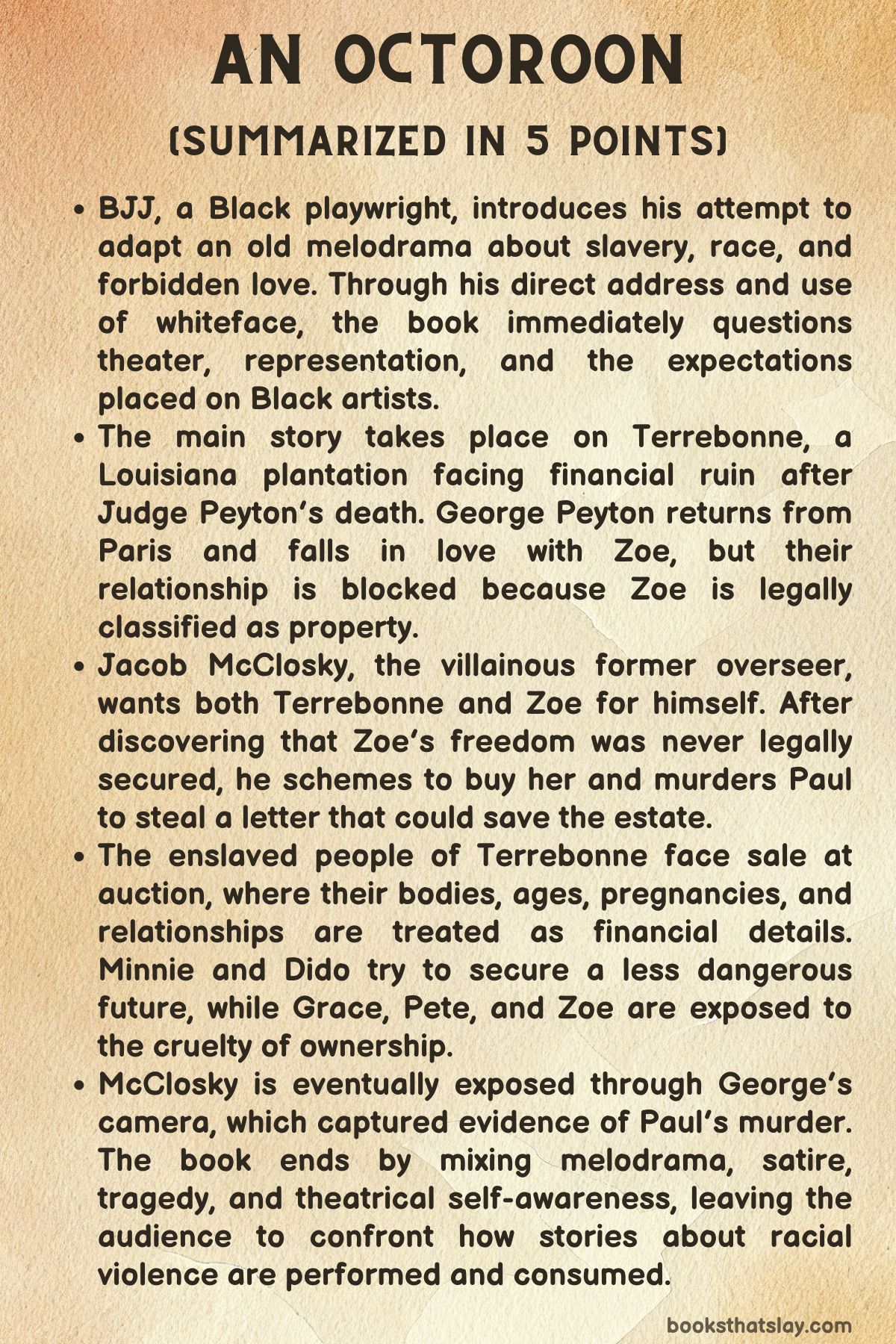
An Octoroon begins in an empty theater, where a playwright named BJJ speaks directly to the audience. He introduces himself as a Black playwright while questioning what that label is supposed to mean.
He describes a conversation with a therapist about depression, art, and the kinds of work that make him feel alive. In that invented conversation, he names Dion Boucicault, a once-famous 19th-century playwright known for melodrama and spectacle.
The therapist suggests that BJJ adapt Boucicault’s The Octoroon, a play centered on race, slavery, inheritance, and forbidden love.
BJJ explains that he did attempt the adaptation, but the white actors he hired left the project because they were uncomfortable playing plainly racist characters. Their discomfort frustrates him because Black performers have long been asked to play degrading roles without the same concern.
His imagined therapist suggests that BJJ perform the white characters himself. BJJ begins putting on whiteface makeup, drinks heavily, and prepares to enter the world of the play.
He admits that the therapist is not real, but the fictional conversation continues because it helps him express the pressure he feels as a Black artist. No matter what he writes, people read his work as a statement on race, oppression, and identity.
A version of Boucicault, called the Playwright, appears almost naked and confused. He is arrogant, comic, and wounded by the fact that his once-celebrated work has faded from cultural memory.
He recalls the grand theaters, elaborate effects, and fame that defined his career. Now he is reduced to sharing the stage with BJJ and an assistant who is asked to play multiple roles.
Their exchange sets the frame for the play’s larger project: a collision between old melodrama and contemporary theater, between racist history and modern critique, between performance and exposure.
The story then moves to Terrebonne, a Louisiana plantation on the Mississippi River. Minnie and Dido, two enslaved women, sit outside and gossip.
Their speech is modern because the play refuses to pretend that contemporary audiences can know exactly how enslaved people spoke. They discuss the death of Judge Peyton, the plantation’s former owner, and the illness of his grieving widow.
Their talk is casual but disturbing, as they speak openly about sexual violence on the plantation and wonder whether the new master, George Peyton, will behave the same way.
Grace, another enslaved woman, briefly appears. Minnie and Dido treat her with false politeness, then mock her interest in escape.
They see running away as unrealistic and dangerous, believing there is only swamp and death beyond the plantation. Pete, an older enslaved man, enters and shifts into a stereotypical performance when white characters arrive.
Around Minnie and Dido, he speaks more naturally; around George, he adopts the exaggerated behavior expected of an enslaved servant.
George Peyton has returned from Paris, where he tried to become an artist and photographer. He is charming, idealistic, and financially helpless.
Dora, a wealthy young woman from a nearby plantation, flirts with him and hopes to marry him. She explains that Terrebonne is in serious financial trouble.
The villain, Jacob McClosky, once the plantation overseer, has taken advantage of Judge Peyton’s debts and now controls part of the estate. The rest may soon be sold.
George is drawn not to Dora but to Zoe, a refined young woman raised in the Peyton household. Zoe is the daughter of Judge Peyton and an enslaved woman.
Though she has been educated and treated as a lady, she remains vulnerable because her legal status is uncertain. McClosky wants Zoe and proposes that she become his mistress when he takes control of Terrebonne.
She refuses him. He then discovers that Judge Peyton’s attempt to free her was invalid because of a lien on the property.
This means Zoe can be sold with the estate. McClosky decides that if she will not accept him willingly, he will buy her.
George’s interest in photography becomes important when he sets up a camera using a self-developing chemical process. Paul, a young enslaved boy favored by the Peytons, watches with fascination.
Paul has the mail, which includes a crucial letter that may save the plantation from sale. Wahnotee, an Indigenous man who cares deeply for Paul, is nearby.
Paul wants his picture taken and persuades Wahnotee to help him operate the camera. While Paul poses, McClosky appears, seeking the letter.
He sees an opportunity, kills Paul with Wahnotee’s tomahawk, steals the letter, and leaves Wahnotee to be blamed. The camera, however, has captured the truth.
Meanwhile, George confesses his love to Zoe. Zoe assumes he means Dora, but he makes clear that he wants to marry her.
Zoe tells him that marriage between them would be illegal because she is classified as an “octoroon,” meaning she is considered one-eighth Black under the racial categories of the time. George’s romantic hope collides with the brutal legal and social structure around them.
Zoe urges him to marry Dora instead because Dora’s wealth could save Terrebonne and the enslaved people from being sold.
In the Peyton house, the estate is prepared for auction. Lafouche, the auctioneer, organizes the sale.
Paul is missing, and many assume Wahnotee killed him. Pete believes Paul must be dead because no one would run from Terrebonne.
Captain Ratts, a steamboat captain, is expected at the auction, and he may buy some of the enslaved people. George decides to marry Dora in order to save the estate, but this plan collapses when Dora learns that George loves Zoe.
Hurt and humiliated, Dora leaves.
Lafouche then reveals that Zoe must also be sold because her freedom was never legally secured. George is horrified but has little power.
Zoe accepts her fate with painful restraint, saying that the kindness she received from the Peytons was already more than she deserved. The line reveals how deeply she has been trained to measure her worth through the limited mercy of the people who owned or controlled her.
Pete gathers Minnie, Dido, and Grace and tells them that George tried to sacrifice his happiness to protect them. He urges them to behave cheerfully at the auction so they will bring a good price.
Grace reveals that most of the other enslaved people have already escaped. Minnie and Dido are upset that they were not included in the plan, partly because others saw them as favored house slaves.
Rather than accept being bought by McClosky, Minnie and Dido decide to attract Captain Ratts’s attention. They imagine that life on a boat might at least offer movement, food, and men they find appealing.
The auction itself is grotesque, comic, and cruel. Pete is offered first, but no one wants to buy him because he is old and disabled.
George buys him cheaply. Minnie and Dido ask to be sold together, and Ratts eventually wins them.
Grace, pregnant and holding a baby, is sold to McClosky when Ratts cannot afford her. Finally, Zoe is auctioned.
George and McClosky bid against each other, but McClosky has more money. George loses, and Zoe is sold to the man who wants to possess her.
The play then pauses its staged action. BJJ, the Playwright, and the Assistant address the audience and explain that they cannot fully stage the next major sequence because the original melodrama requires too many effects, people, and resources.
Instead, they describe what happens. Ratts and his men are loading cotton onto a ship filled with dangerous materials.
McClosky points out that a spark could destroy the boat. Wahnotee is captured and nearly lynched for Paul’s murder, but George persuades the crowd to hold a quick trial.
The broken camera is brought forward, and the photograph reveals McClosky standing over Paul’s body. The characters discuss the camera as evidence, noting how astonishing this technology would have seemed in the 19th century.
The play also comments on how melodrama relied on spectacle to make audiences feel. Rather than recreate that sensation in the expected way, BJJ confronts the audience with the historical reality of racial violence.
McClosky is exposed as the murderer and thief. The crowd turns against him, but George stops them from killing him immediately.
McClosky is taken to the boat, where he causes a fire and escapes. Wahnotee finds him, fights him, and kills him.
The boat explodes.
Late that night, Zoe searches for Dido. She calls Dido “Mammy,” a term that unsettles Dido because they are close in age and do not have that relationship.
Zoe asks for a sleeping potion and wants to know if drinking all of it would kill her without pain. She has heard George say he would rather see her dead than owned by McClosky.
Dido realizes Zoe intends to die and refuses to help, but Zoe grabs the potion and runs away.
Dido tells Minnie what happened. She is disturbed not only by Zoe’s plan but also by the way Zoe imagined her as a comforting maternal figure.
Minnie advises Dido not to get trapped in other people’s ideas of who she should be. Minnie wants them to focus on their own future, especially their coming departure with Ratts.
The two women talk about survival, self-preservation, and the need to live for themselves in a world that keeps turning them into symbols for other people’s stories.
In the end, An Octoroon leaves the audience with several unresolved tensions. It follows the melodramatic structure of Boucicault’s original play, with villains, secrets, murder, mistaken guilt, evidence, punishment, and tragic love.
At the same time, it breaks that structure apart by showing how artificial and racist many of its assumptions are. BJJ’s adaptation asks the audience to notice the machinery of theater: makeup, casting, dialect, spectacle, sentiment, and audience expectation.
The play is about Terrebonne, Zoe, George, Minnie, Dido, Paul, Wahnotee, and McClosky, but it is also about the act of watching them. It forces the audience to confront how easily entertainment can turn suffering into a scene, and how history continues to shape the stage long after the curtain should have fallen.
Characters
BJJ
BJJ is the self-conscious creative center of An Octoroon, a playwright who stands both inside and outside the story. He is not simply a narrator; he is a figure struggling with what it means to adapt a racist theatrical tradition while being constantly identified as a Black playwright before anything else.
His opening address reveals exhaustion, irony, anger, and anxiety. He jokes about therapy, admits to inventing the therapist because he cannot afford one, and uses that imaginary conversation to expose the pressures placed on Black artists.
BJJ’s whiteface performance becomes one of the play’s most important theatrical gestures. By playing white characters himself, he turns racial performance into something visible, awkward, and impossible to ignore.
He is also emotionally unstable in a controlled, theatrical way: he drinks, rants, mocks himself, and argues with the ghostly figure of the Playwright. Through BJJ, the play questions who gets to tell stories about slavery, who is asked to carry racial history, and why audiences often expect Black writers to explain oppression rather than simply create art.
The Playwright
The Playwright represents Dion Boucicault, the 19th-century dramatist whose original work is being adapted and challenged. He is comic, vain, insecure, and desperate for recognition.
His complaints about being forgotten reveal a man who once believed theater belonged to him and now finds himself displaced by time, politics, and changing artistic values. He is fascinated by spectacle, stage effects, fame, and melodramatic structure, and he often treats human suffering as material for performance.
Yet he is not presented only as a villain. He is also a relic of a theatrical past that the play refuses to discard completely.
His presence shows that modern drama is still haunted by older forms, even when it tries to reject them. The Playwright’s exchanges with BJJ create a battle between artistic inheritance and artistic resistance.
He wants his old conventions honored, while BJJ wants to expose their racial violence. Their conflict turns adaptation into an argument rather than a simple retelling.
The Assistant
The Assistant is a practical and comic figure who helps hold the performance together while also revealing how unstable that performance is. He is asked to fill gaps, change roles, manage transitions, and step into identities that the production cannot fully supply.
His presence makes the audience aware of theatrical limitation: there are not enough actors, not enough resources, and not enough clean boundaries between one role and another. The Assistant’s casting as an Indigenous figure also highlights the play’s concern with racial substitution and stage convention.
He becomes part of the problem the play is examining, since his body is used to represent identities that are filtered through theatrical cliché. At the same time, he is one of the figures who helps explain the mechanics of the plot when the spectacle cannot be staged.
He is a reminder that theater is always made out of compromise, labor, costume, and bodies forced into symbolic roles.
George Peyton
George Peyton is the romantic hero of the plantation plot, but the play treats his heroism with sharp skepticism. He returns from Paris educated, artistic, and seemingly more refined than the men around him.
He is interested in photography, and his invention becomes crucial to exposing McClosky’s crime. Yet George’s goodness is limited by the world he accepts.
He expresses love for Zoe and seems horrified by the idea that she can be sold, but he still belongs to the class that benefits from slavery. His moral sensitivity does not free the people around him.
He wants to rescue Terrebonne and preserve the household, but the household itself is built on ownership, racial hierarchy, and violence. His love for Zoe is sincere, but it is also powerless against the law.
George becomes a critique of sentimental white heroism: he feels deeply, suffers visibly, and tries to act nobly, but the system protecting him remains intact until it destroys others.
Zoe
Zoe is one of the most tragic and revealing figures in the play. She has been raised as a lady by the Peyton family, educated and treated with affection, yet the law reduces her to property because of her racial ancestry.
Her position exposes the cruelty of a society obsessed with blood, classification, and ownership. Zoe’s refinement does not protect her.
Her manners, education, beauty, and emotional dignity only make the injustice surrounding her more visible. She loves George but knows that their marriage is forbidden, and she urges him toward Dora because she understands the financial and racial limits that he does not fully grasp.
Zoe has internalized many of the values of the family that controlled her life, even describing their kindness as more than she deserved. This makes her tragedy especially painful.
She is not only threatened by McClosky’s desire to own her; she is also trapped inside a worldview that has taught her to see herself as dependent on white mercy. In An Octoroon, Zoe shows how racial categories can turn a human being into a legal problem, a romantic obstacle, and a commodity all at once.
Jacob McClosky
Jacob McClosky is the play’s clearest melodramatic villain, but his role is more than simple evil. He is resentful, predatory, violent, and obsessed with possession.
His hatred of the Peytons comes partly from class resentment, since he feels they have treated him as beneath them. However, the play never allows that resentment to become an excuse.
McClosky’s desire for Zoe is rooted in domination, not love. When she refuses him, he turns to the law and the marketplace, using her uncertain legal status as a way to claim her body.
His murder of Paul shows his willingness to destroy the innocent to secure power. He also manipulates racial violence by allowing Wahnotee to be blamed, knowing that the crowd will quickly accept an Indigenous man as a convenient target.
McClosky represents the brutal logic of ownership: if he cannot persuade, he will buy; if he cannot buy safely, he will steal; if he is exposed, he will burn everything down.
Minnie
Minnie is one of the play’s most vivid voices of survival. She speaks with humor, sharpness, and practical intelligence, often cutting through the sentimental language surrounding plantation life.
Unlike characters who speak in grand moral terms, Minnie is focused on staying alive and finding whatever pleasure or advantage she can in a violent world. Her conversations with Dido show a private life that exists beyond the gaze of white characters.
She jokes, gossips, judges, complains, and imagines possible futures. Her refusal to romanticize escape early in the story may seem cautious, but it reflects her clear awareness of danger.
Later, when she and Dido decide to be bought by Ratts rather than McClosky, Minnie shows adaptability rather than passivity. She does not control the system, but she reads it quickly and tries to move within it.
Minnie also resists being turned into a symbol of pure suffering. Her wit and self-interest make her fully human.
Dido
Dido is Minnie’s close companion and conversational partner, but she has her own emotional and moral texture. She is observant, wary, and more troubled than Minnie by certain moments of cruelty or misunderstanding.
Her reaction to Zoe calling her “Mammy” is especially important. Dido recognizes the false role being placed on her: Zoe wants comfort from her, but the term reduces Dido to a stereotype and ignores her actual age, identity, and inner life.
Dido’s discomfort shows how racial fantasy harms not only those who are idealized but also those forced to perform emotional labor. She is not simply a caretaker figure; she is a woman trying to survive.
Her concern about Zoe’s suicide shows compassion, but Minnie’s advice pushes her to consider the limits of responsibility in a world where enslaved people are constantly made to carry other people’s pain. Dido’s character gives the play one of its strongest critiques of sentimental plantation myths.
Pete
Pete is an older enslaved man whose character is built around performance, accommodation, and exhaustion. Around Minnie and Dido, he can speak with relative directness, but when white characters arrive, he adopts a stereotyped dialect and manner.
This shift reveals how survival under slavery often requires acting. Pete has learned what white people expect from him, and he performs that role even when it humiliates him.
His loyalty to the Peytons is complicated. He appears emotionally attached to the household and believes in George’s goodness, but that attachment also shows how slavery distorts loyalty by forcing dependence on enslavers.
During the auction, Pete’s song-and-dance moment exposes the cruelty of treating human beings as marketable entertainment. His statement that he is tired of being enslaved is quickly undercut by a joke, creating an uncomfortable mixture of truth and performance.
Pete is funny, sad, compromised, and deeply revealing.
Dora Sunnyside
Dora is wealthy, flirtatious, vain, and comic, but she is not empty. She represents the kind of white femininity that melodrama often places at the center of romance and inheritance.
She expects to be admired and assumes that her fortune gives her importance in the future of Terrebonne. Her interest in George is partly romantic and partly shaped by social expectation.
When she discovers that George loves Zoe, her humiliation is real, but it also reveals the racial assumptions beneath her confidence. She can imagine herself as the natural romantic choice because the society around her has trained her to occupy that place.
Dora’s wealth could save the plantation, yet the play makes that possibility morally uneasy. Saving Terrebonne would also mean preserving a world built on enslavement.
Dora is therefore both a comic rival and a symbol of the social order that presents itself as charming while depending on violence.
Paul
Paul is a young enslaved boy whose innocence makes his murder one of the story’s most disturbing events. He is curious, playful, and fascinated by George’s camera.
His desire to have his photograph taken is simple and childlike, but it becomes central to the exposure of McClosky’s crime. Paul’s death shows how little protection innocence offers in the world of the play.
He is favored by the Peytons and loved by Wahnotee, but neither affection nor special treatment saves him. His body becomes part of the machinery of melodrama: the murdered child, the false accusation, the hidden evidence, the eventual revelation.
Yet the play also asks the audience to feel the horror beneath that structure. Paul is not only a plot device.
He is a child destroyed because an adult wants money, control, and ownership.
Wahnotee
Wahnotee is one of the play’s most complicated figures because he is shaped through racist theatrical convention while also carrying real emotional force. His speech is presented as a jumble that others cannot understand, and his appearance draws on stage stereotypes of Indigenous identity.
This makes him a figure through whom the play exposes the crude representational habits of older melodrama. At the same time, his love for Paul is sincere and devastating.
When Paul is killed, Wahnotee’s grief breaks through the absurdity of the role assigned to him. He becomes the falsely accused outsider, the man the crowd is ready to lynch without evidence, and finally the person who kills McClosky.
His character shows how racialized theater can flatten people into signs, yet pain and rage can still exceed the stereotype. In An Octoroon, Wahnotee embodies both the damage done by representation and the emotional truth that representation fails to contain.
Grace
Grace appears less often than Minnie and Dido, but she is important because she represents a different attitude toward bondage and escape. She is associated with the possibility of running away, and the others mock her for acting superior or imagining freedom beyond Terrebonne.
Her pregnancy adds another layer to her vulnerability. At the auction, she is not only sold as herself but also valued through reproduction, as her unborn child becomes part of the logic of property.
This makes her one of the clearest examples of how slavery treats Black women’s bodies as economic assets. Grace’s fate is especially harsh because McClosky buys her, linking her future to the most openly violent man in the play.
She is not given the comic flexibility of Minnie and Dido or the tragic centrality of Zoe, but her presence deepens the play’s portrait of enslaved women facing different forms of danger.
Lafouche
Lafouche, the auctioneer, is a chilling figure because he turns human suffering into procedure. He is not as openly villainous as McClosky, but his role is essential to the system’s operation.
He organizes names, prices, lists, and sales with bureaucratic calm. His language reduces people to property, and his irritation often comes from disorder rather than injustice.
This makes him frightening in a quieter way. Lafouche shows that slavery does not depend only on violent men with knives and whips; it also depends on clerks, auctioneers, laws, documents, and professionals who make cruelty appear normal.
His presence in the auction scene forces the audience to witness how the marketplace converts identity, age, pregnancy, disability, and beauty into financial value. Lafouche is the voice of commerce inside the story’s moral catastrophe.
Captain Ratts
Captain Ratts is a coarse but important secondary figure. He enters as a buyer, a steamboat captain, and a man connected to the movement of goods and enslaved people along the river.
Compared with McClosky, he may seem like a preferable option for Minnie and Dido, but the play never lets the audience forget that he is still participating in the purchase of human beings. Minnie and Dido’s hope that life with him might be better shows the limited choices available to them.
Ratts also belongs to the world of masculine spectacle: boats, crews, public arguments, danger, and violence. His ship becomes the site of the sensational explosion described later in the play.
Ratts represents mobility without freedom. His boat moves, but the system it serves remains brutal.
Br’er Rabbit
Br’er Rabbit appears in strange, quiet intervals, wandering in and out of the action. He does not function like a conventional character with a clear plotline.
Instead, he feels like a symbolic presence drawn from Black folklore, trickster tradition, and survival storytelling. His repeated appearances interrupt the plantation melodrama without fully explaining themselves.
This makes him important because he suggests that there are other traditions of storytelling present besides white melodrama. Br’er Rabbit’s movement across scenes hints at evasion, endurance, and the ability to exist outside the rules imposed by the main plot.
By the end, when he appears with objects associated with judgment and violence, he seems to gather fragments of the story’s legal, racial, and theatrical conflicts. He is elusive, but that elusiveness is part of his meaning.
Judge Peyton
Judge Peyton is dead before much of the main action unfolds, but his influence shapes the entire story. He is remembered as the former owner of Terrebonne, the father of Zoe, and the man whose financial carelessness helped endanger the estate.
His attempt to free Zoe suggests affection or guilt, but it is not enough to protect her because it was legally flawed. He also represents the false gentility of the plantation order.
The household may remember him with loyalty, but Minnie and Dido’s conversations reveal a darker reality, including sexual exploitation. Judge Peyton’s absence is therefore powerful.
He does not need to appear onstage to remain responsible for the conditions others inherit. His debts, desires, and failures continue to determine the fates of the living.
Mrs. Peyton
Mrs. Peyton is mostly defined through absence, illness, and grief, yet she represents the sentimental image of plantation family life. She loved and raised Zoe as her own, which complicates the household’s racial structure without undoing it.
Her affection gives Zoe education and refinement, but it does not free Zoe from the legal violence of slavery. Mrs. Peyton’s decline after her husband’s death also adds to the atmosphere of a collapsing household.
She belongs to a world that sees itself as kind, noble, and wounded, even while depending on the ownership of others. Her love may be real, but the play shows that private kindness cannot repair public injustice.
Like Judge Peyton, she leaves behind emotional bonds that are unequal, unstable, and unable to save the people most at risk.
Themes
Race as Performance and Social Control
Race in An Octoroon is not treated only as identity; it is shown as something staged, enforced, read, misread, and violently policed. The use of whiteface, racialized casting, exaggerated dialect, and theatrical disguise makes racial performance visible rather than natural.
BJJ applying whiteface forces the audience to confront the artificiality of race onstage, while also recalling the long history of racist performance traditions. Pete’s shift in speech around white characters shows another kind of performance: the behavior enslaved people are pressured to adopt in order to survive.
Zoe’s identity is also controlled by racial classification. Her education, manners, and upbringing do not matter once the law defines her through ancestry and property status.
Wahnotee’s characterization exposes another form of racial staging, as Indigenous identity is filtered through crude theatrical signs. The play shows that race is not merely personal; it is a system of roles assigned by law, theater, language, and power.
These roles decide who is seen as human, who is seen as property, who is believed, and who can be killed without consequence.
The Violence Hidden Inside Sentiment
The story repeatedly places tender emotions beside brutal realities, making it impossible to accept sentimental feeling as morally pure. George loves Zoe, Mrs. Peyton raised her with care, Pete feels loyalty toward the Peytons, and Dora experiences genuine heartbreak.
Yet these emotions exist inside a world where people are bought, sold, raped, whipped, and legally trapped. The play exposes how sentiment can soften the appearance of cruelty without changing its structure.
George’s love for Zoe does not give him the power or clarity to free her. The Peyton family’s kindness does not prevent Zoe from being auctioned.
Pete’s loyalty does not protect him from being sold. Even the audience’s expected pity becomes suspect because melodrama often turns suffering into emotional satisfaction for spectators.
The play asks whether feeling bad about injustice is enough when the conditions producing that injustice remain untouched. Sentiment may reveal humanity, but it can also distract from responsibility.
The characters’ tears, declarations, and sacrifices matter emotionally, yet they cannot erase the violence beneath the social order.
Theater, Spectacle, and Audience Responsibility
The play constantly reminds readers that they are encountering a performance built from old conventions, limited resources, masks, bodies, and deliberate artifice. BJJ and the Playwright argue over what theater should do: entertain, shock, preserve, revise, accuse, or make people feel.
The original melodramatic structure depends on spectacle, including murder, evidence, trial, fire, and explosion. Yet the adaptation interrupts these effects and explains them rather than simply staging them.
This choice changes the audience’s role. Instead of passively consuming sensation, the audience must think about why such scenes are exciting and what kind of suffering is being used to produce that excitement.
The discussion of photography also connects spectacle with technology, since the camera becomes both a theatrical device and a moral witness. When the play cannot reproduce the original sensation, it turns attention toward historical racial violence and the ethics of looking.
Theater becomes a space where entertainment and responsibility collide. The audience is not allowed to forget that watching is itself an action.
Ownership, Law, and the Illusion of Freedom
The play presents slavery not only as physical bondage but also as a legal and economic system that reaches into every relationship. Zoe’s situation makes this especially clear.
She has been treated like a free woman in daily life, but a technical legal failure makes her property again. Her identity can be changed by documents, liens, debts, and claims made by men.
The auction scene expands this theme by showing how the law turns people into units of value. Pete’s age, Grace’s pregnancy, Zoe’s beauty, and Minnie and Dido’s labor all become factors in pricing human beings.
McClosky understands this system and uses it with terrifying precision. He does not need Zoe’s consent if he can purchase her.
Lafouche’s professional calm shows how ordinary the machinery of ownership has become. Even George, who appears sympathetic, is caught inside this legal order and tries to solve moral disaster through marriage, inheritance, and money.
The play makes clear that freedom cannot depend on kindness, paperwork, or proximity to powerful people. A life treated as property remains unsafe until the system itself is destroyed.