Annihilation of Caste Summary and Analysis
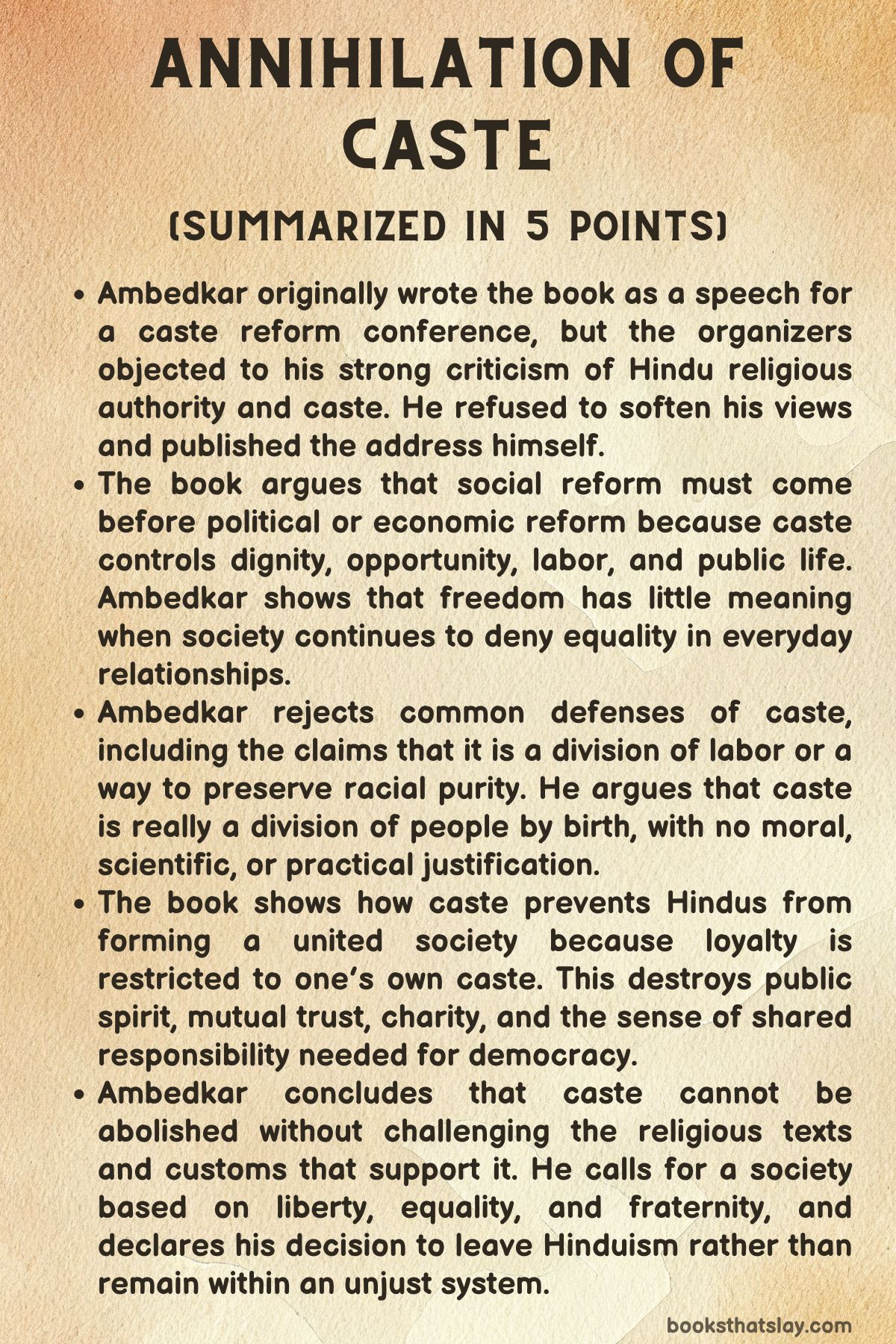
Annihilation of Caste is B. R. Ambedkar’s critique of caste as a social, religious, and moral system. Originally written as a speech for a reform conference, it was never delivered because the organizers objected to Ambedkar’s uncompromising arguments.
The work challenges the idea that caste can be repaired through minor reforms, arguing instead that it must be destroyed at its religious and social roots. Ambedkar examines how caste damages liberty, equality, public life, labor, reform, and human dignity, while calling for a society built on justice, reason, and fellowship.
Summary
Annihilation of Caste begins with the story of how the text came into being. Ambedkar had been invited by the Jat-Pat-Todak Mandal, a group concerned with caste reform, to preside over a conference.
He accepted the invitation and prepared a speech. When the organizers read it, they found parts of it too severe and asked him to soften his criticism, especially his statements about Hindu religious authority and his decision to leave Hinduism.
Ambedkar refused to revise his position. For him, truth and conviction mattered more than the honor of presiding over a conference.
Since the speech could not be delivered, he printed and circulated it himself.
Ambedkar opens by acknowledging that he is an unusual choice to lead such a conference. He belongs to a community treated as untouchable, and many caste Hindus dislike him because of his public criticism of Hindu society.
Yet he accepts the role because the cause of social reform matters deeply to him. His aim is not to flatter his audience but to speak honestly about why caste cannot be tolerated and why Hindu society must face the roots of its own disorder.
A central argument of Annihilation of Caste is that social reform must come before political reform. Ambedkar challenges those who believe that political freedom alone can solve India’s problems.
He argues that a society divided by caste cannot become a healthy political community. If people are denied dignity, mobility, and equal treatment in everyday life, political rights will remain incomplete.
He shows that the treatment of oppressed communities is governed by humiliating restrictions that reach into clothing, movement, occupation, and social contact. Such a society cannot become free merely by changing its political structure.
Ambedkar also argues that economic reform cannot succeed without social reform. Some reformers focus on property, capital, and class, but Ambedkar insists that power in India does not come only from wealth.
It also comes from status, ritual rank, and social privilege. Caste determines who is respected, who is excluded, who may learn, who may work, and who may rise.
A person who joins a movement for economic change must trust that the new society will treat them as an equal. If caste remains intact, that trust is impossible.
Therefore, the destruction of caste is necessary for any true social, political, or economic revolution.
He then rejects the common defense that caste is simply a division of labor. According to Ambedkar, caste is not a practical arrangement for organizing work; it is a division of workers.
It fixes people into inherited roles, regardless of talent, interest, or ability. A person’s occupation becomes tied to birth rather than choice.
This harms both the individual and society. It produces resentment, inefficiency, and unemployment because people refuse work associated with lower status, while others are trapped in work they did not choose.
Ambedkar also attacks the claim that caste preserves racial purity. He argues that no human group is racially pure and that caste has no scientific basis.
People from different castes living in the same region may share more in common than members of the same caste living far apart. In any case, all castes are made up of human beings.
Attempts to defend caste through biology or eugenics are both false and impractical. Caste survives not because it is natural, but because it is protected by social and religious belief.
Another major point is that caste prevents Hindus from forming a real society. Ambedkar states that Hindu society is only a collection of castes.
Each caste looks after itself, celebrates separately, marries within itself, and guards its status against others. Even when people share festivals or religious practices, caste divisions remain stronger than common bonds.
This weakens public life and prevents a sense of shared responsibility. Instead of building unity, caste produces suspicion, contempt, and distance.
He describes caste as creating an anti-social spirit. Each caste is encouraged to preserve its own pride and often to treat other castes as inferior.
Old conflicts, myths, and claims of noble or low origin keep hostility alive. These divisions do not reflect the real relationships among living people; they are inherited prejudices passed down through custom.
Because caste loyalty is placed above human fellowship, society loses the ability to act together.
Ambedkar extends this criticism to the treatment of Indigenous communities and oppressed groups. He argues that caste Hindus have failed to include and uplift communities outside the caste order because caste teaches people to guard their own boundaries.
Rather than share knowledge, resources, and social inheritance, upper castes have often tried to keep others down. If lower castes imitate the manners, dress, or practices of higher castes, they may be punished or humiliated.
Ambedkar contrasts this with missionary religions, which at least seek new members, while caste-bound Hinduism resists inclusion because it cannot decide where a convert would belong.
The text argues that caste destroys mutual help. Members of other religious communities may expect support from fellow believers, but caste prevents Hindus from trusting one another across caste lines.
A Hindu’s loyalty is often limited to caste members, not to society as a whole. This breeds indifference, which Ambedkar sees as one of the worst social diseases.
Public spirit, public charity, and public opinion cannot grow where people care only for their caste.
Ambedkar then presents his ideal society: one based on liberty, equality, and fraternity. Liberty allows people to develop their abilities and choose their paths.
Equality is necessary as a practical moral principle, even if people differ in ability or circumstance. Fraternity is the foundation of democracy because it creates respect and fellow-feeling among people.
These values directly oppose caste, which denies freedom, ranks people by birth, and prevents social brotherhood.
He also examines reform proposals that seek to replace thousands of castes with a fourfold social order. Ambedkar rejects this as unworkable and dangerous.
It would preserve old labels, revive old hierarchies, and fail to classify real human beings, who are too complex to be sorted into fixed categories. It would also raise difficult questions about women’s status and marriage.
Most importantly, it would leave the lowest group vulnerable to domination by the others. For Ambedkar, such a system is not a solution but a return to an old failure.
Ambedkar distinguishes Hindu caste from social groupings in other societies. Every society has groups based on interest, profession, class, or belief.
But caste is different because it is closed, hereditary, and religiously sanctioned. It does not allow free movement or natural association.
It makes caste identity the primary bond and blocks wider social connection. This is why caste cannot be treated as merely another form of social grouping.
The most important solution Ambedkar offers is the rejection of the religious authority that supports caste. He argues that sub-caste reform and inter-caste dining are insufficient.
Inter-caste marriage is more powerful because it creates real family bonds across caste lines. Yet even this cannot succeed fully unless people stop treating the Shastras as sacred authorities for social conduct.
Since caste is rooted in religious belief, reformers must challenge those beliefs directly.
Ambedkar is doubtful that caste can be reformed from within Hinduism. He explains that some reforms adjust secular practices, some return to basic religious principles, and others oppose the foundations of a religion.
Destroying caste belongs to the last category because caste has been treated as divinely sanctioned. The intellectual class, especially Brahmins, has little reason to support a movement that would end its own privilege.
Without the support of those who shape religious and social thought, reform becomes extremely difficult.
He also argues that appeals to reason have failed because Hindu religious practice often discourages rational criticism of scripture. Reform requires reason and morality, but caste society weakens both.
Ambedkar distinguishes between rules and principles: rules are fixed instructions, while principles help people judge wisely in changing circumstances. He believes religion should be based on principles, not rigid rules.
Hinduism, as shaped by caste and scripture, has become too much like a legal code that restricts conscience.
Ambedkar does not call for the end of religion altogether. He believes religion can serve society if it is ethical, rational, and open to reform.
He proposes regulating priesthood, ending hereditary priestly privilege, and making religious authority subject to qualification and public oversight. If other professions require training and regulation, he sees no reason why priests should be exempt.
Near the end of Annihilation of Caste, Ambedkar urges Hindu society to decide what parts of tradition deserve preservation and what must be abandoned. A culture cannot survive by worshipping the past without judgment.
It must test its beliefs, habits, and morals by asking whether they help human beings live well. Since life changes, social standards must also change.
The work closes with Ambedkar’s declaration that he will not remain within the Hindu fold. He has offered his analysis and his challenge, but the struggle now belongs to those who choose to remain and reform Hindu society.
He states that Hindu society can become strong only when caste is completely abolished. Until then, he separates himself from it while continuing to support the cause of justice in his own way.
Key Figures
B. R. Ambedkar
B. R. Ambedkar is the central voice and intellectual force of the book. Since the work is not a novel but a social and political argument, Ambedkar functions as a speaker, critic, reformer, and moral witness of the book.
He appears as someone who refuses comfort, praise, or public honor when these things require him to soften the truth. His decision not to revise the address after the organizers object to it shows his deep commitment to principle.
Ambedkar’s personality comes through as precise, unsentimental, and fearless. He does not attack caste only as a personal grievance, though his own experience as a member of an oppressed caste gives moral urgency to his words.
Instead, he builds a larger argument: caste damages all of society, including politics, economics, religion, public spirit, and human fellowship. In Annihilation of Caste, Ambedkar emerges as a thinker who believes reform must go to the root of the problem.
He does not accept partial solutions, symbolic gestures, or polite compromise when the structure itself is unjust.
The Jat-Pat-Todak Mandal
The Jat-Pat-Todak Mandal plays an important role in the book because it represents the limits of cautious reform. The group invites Ambedkar to preside over its conference because it claims to support caste reform, but its reaction to his prepared speech reveals a hesitation to confront caste fully.
The Mandal is willing to discuss reform, but only within boundaries that do not offend established religious and social assumptions too much. This makes the group a useful contrast to Ambedkar.
Where he insists that caste must be attacked at its foundations, the Mandal appears more concerned with tone, public acceptability, and the reaction of its audience. Its request that Ambedkar revise his speech shows how reform movements can become trapped by respectability.
The Mandal is not shown as openly cruel, but it is shown as limited by fear and caution. In the book, it becomes an example of reform that wants change without the discomfort required to achieve it.
Caste Hindus
Caste Hindus are presented not as one individual character but as a collective social body shaped by inherited rank, custom, and religious obedience. Ambedkar criticizes them for allowing caste to define duty, loyalty, marriage, work, and public conduct.
Their world is organized around separation: each caste protects itself, looks after its own members, and often refuses meaningful contact with others. This creates a society that is only a society in name, because common feeling is replaced by caste loyalty.
Caste Hindus are also shown as people trapped by the very system they defend. Even when they share festivals, rituals, and religious identity, they lack the deeper bonds needed for social unity.
Their failure is not merely personal prejudice but participation in a structure that teaches indifference. In Annihilation of Caste, caste Hindus represent the social majority that must change if justice is to become possible.
Brahmins
Brahmins occupy a major place in Ambedkar’s argument because they represent intellectual and religious authority within caste society. Ambedkar presents them as the class with the power to influence thought, interpret tradition, and guide public opinion.
This makes their role especially important. If they supported the destruction of caste, reform might gain force; yet Ambedkar argues that they are unlikely to support a movement that would weaken their own inherited privilege.
The book does not treat Brahmins only as individuals but as a social class whose authority has been protected by religious belief. Their position makes caste appear sacred rather than political or social.
Because they are treated as custodians of knowledge and religion, their resistance becomes a serious obstacle to reform. Ambedkar’s criticism of Brahmins is therefore tied to his larger criticism of hereditary power: no class should possess permanent authority simply because of birth.
The Antyaja
The Antyaja, the community to which Ambedkar refers when speaking of his own social position, represents those placed outside the dignity and protections granted to caste Hindus. Their presence in the book gives Ambedkar’s argument direct human weight.
They are not discussed as passive sufferers alone; rather, they expose the cruelty and contradiction of a society that claims moral or religious order while denying basic respect to some of its own people. The Antyaja show how caste works at the level of daily life, through exclusion, humiliation, and the denial of equal participation.
Ambedkar’s own identity as a member of an untouchable caste makes his role as invited president deeply significant. His presence challenges the audience before he even begins speaking.
In the book, the Antyaja stand for the people whose humanity caste society refuses to recognize fully, and whose condition proves that reform cannot remain abstract.
The Balais
The Balais are used by Ambedkar as a concrete example of how caste oppression controls the smallest details of life. Their experience shows that caste is not merely a belief system or a matter of social preference; it is a system of discipline imposed through rules, restrictions, and punishment.
The Balais are expected to remember their assigned place and obey customs designed to keep them away from upper castes. Through them, Ambedkar shows that political reform is insufficient when people continue to suffer social degradation.
Their treatment makes clear that caste operates as a complete social order, shaping behavior, movement, clothing, labor, and dignity. The Balais are important because they prevent the reader from treating caste as an abstract theory.
They reveal the lived reality of oppression and show why social reform must come before claims of national progress or political freedom.
Shudras
The Shudras are central to Ambedkar’s rejection of the fourfold social order proposed by some reformers. In his analysis, any system that preserves ranked groups will leave the Shudras vulnerable to domination by those placed above them.
The Shudras represent the danger of reform that merely renames hierarchy instead of abolishing it. Ambedkar argues that a society divided into fixed classes cannot protect those at the bottom unless it gives them real power, education, dignity, and freedom of movement.
The Shudras are also connected to the question of dependence. If one group is denied knowledge, arms, wealth, or authority, it must rely on others who may fail or exploit it.
Their position in the book therefore shows the cruelty of structural dependence. They are not simply one group within the caste order; they represent the human cost of any system that denies equal capacity and equal rights by birth.
Adivasis
Adivasis appear in the book as communities whom caste Hindu society has failed to include, uplift, or treat as equal participants in shared life. Ambedkar uses their exclusion to show that caste does not only divide those already inside the caste order; it also blocks wider social incorporation.
Because caste encourages people to guard their boundaries and fear loss of status, caste Hindus do not freely share social, intellectual, or religious inheritance with communities outside their ranks. Adivasis therefore reveal the anti-social character of caste in another form.
The problem is not only contempt for lower castes but also refusal to build a broader human community. Their treatment exposes the narrowness of a society that values purity and separation over cooperation.
In this way, Adivasis help Ambedkar show that caste prevents moral expansion and social unity.
Arya Samajists
The Arya Samajists appear as reformers whose proposed solution remains inadequate in Ambedkar’s view. Their idea of replacing many castes with four broad social divisions may seem simpler than the existing caste system, but Ambedkar argues that it would preserve the logic of hierarchy.
In the book, they represent reform that changes the arrangement without changing the foundation. Their proposal fails because old labels, old habits, and old ideas of superiority would remain active.
Ambedkar treats their position seriously but rejects it firmly, showing that a reduced caste system is still a caste system. The Arya Samajists are important because they allow Ambedkar to distinguish between genuine abolition and cosmetic reform.
In Annihilation of Caste, they stand for those who recognize a problem but cannot imagine a solution radical enough to end it.
Themes
The Destruction of Caste as a Moral Necessity
Caste is presented as a system that cannot be corrected through small adjustments because its damage reaches every part of life. It determines occupation, marriage, status, education, social contact, and public responsibility.
Ambedkar refuses to treat caste as a harmless tradition or a cultural habit. For him, it is a structure that teaches people to rank one another from birth and to accept inequality as sacred.
This makes it morally destructive even when it is defended in polite language. The book argues that caste does not merely harm oppressed communities; it also corrupts the moral imagination of those who benefit from it.
It trains people to care only for their own caste, to ignore suffering outside their group, and to confuse inherited privilege with virtue. This is why Ambedkar insists that caste must be destroyed rather than managed.
A system built on graded inequality cannot produce justice, brotherhood, democracy, or genuine reform. Its abolition becomes the first condition for rebuilding society on ethical grounds.
Social Reform Before Political and Economic Reform
Ambedkar challenges the belief that political freedom or economic restructuring can succeed while caste remains untouched. A society may change rulers, institutions, or property arrangements, but if people continue to see one another through caste rank, equality will remain hollow.
Social power in India is not limited to money or office. It also comes from ritual status, inherited prestige, access to knowledge, and recognition from others.
This means that a person may be politically free in theory and still socially imprisoned in daily life. Ambedkar argues that no revolution can attract the oppressed unless they know they will be treated as equals after the revolution.
Without that assurance, calls for unity become empty. Social reform must therefore come first because it creates the human foundation on which political and economic change can stand.
The book’s argument is especially sharp because it refuses to separate public institutions from social habits. Democracy cannot be built only through laws; it requires a society that is willing to recognize equal human worth.
Religion, Authority, and the Need for Reason
Religious authority becomes one of the central problems in Ambedkar’s critique because caste survives not only through custom but through sacred approval. When inequality is treated as divinely sanctioned, ordinary reform becomes much harder.
People may accept injustice not because they have examined it rationally, but because they have been taught to obey inherited texts, rituals, and priestly authority. Ambedkar does not reject religion as such.
His objection is to religion reduced to rigid rules that prevent conscience, reason, and moral judgment. He distinguishes between rules and principles because rules can become mechanical and oppressive, while principles allow people to think ethically in changing circumstances.
A living religion, in his view, should help people judge what is right; it should not imprison them in commands that deny human dignity. This theme gives the book much of its force.
Reform cannot succeed if people are forbidden to question the sources of injustice. Reason and morality must be restored as tools of public life, even when they challenge revered traditions.
Liberty, Equality, and Fraternity as the Basis of Society
Ambedkar’s ideal society rests on liberty, equality, and fraternity, not as decorative ideals but as practical conditions for human life. Liberty matters because people must be free to choose work, develop ability, form relationships, and act according to conscience.
Caste denies this by assigning identity and duty at birth. Equality matters because public life cannot function justly if some people are treated as naturally superior and others as permanently inferior.
Ambedkar understands that people differ in talent, strength, education, and circumstance, but he argues that society must treat equality as a guiding rule because it is the fairest basis for common life. Fraternity is equally necessary because law alone cannot create democracy.
People must feel respect and responsibility toward one another. Without that shared feeling, society becomes a set of hostile groups competing for status.
Annihilation of Caste presents these ideals as the direct opposite of caste. Where caste creates separation, fraternity creates fellowship; where caste fixes rank, equality challenges it; where caste traps people in inherited roles, liberty opens the possibility of a fuller human life.