Anathema by Keri Lake Summary, Characters and Themes
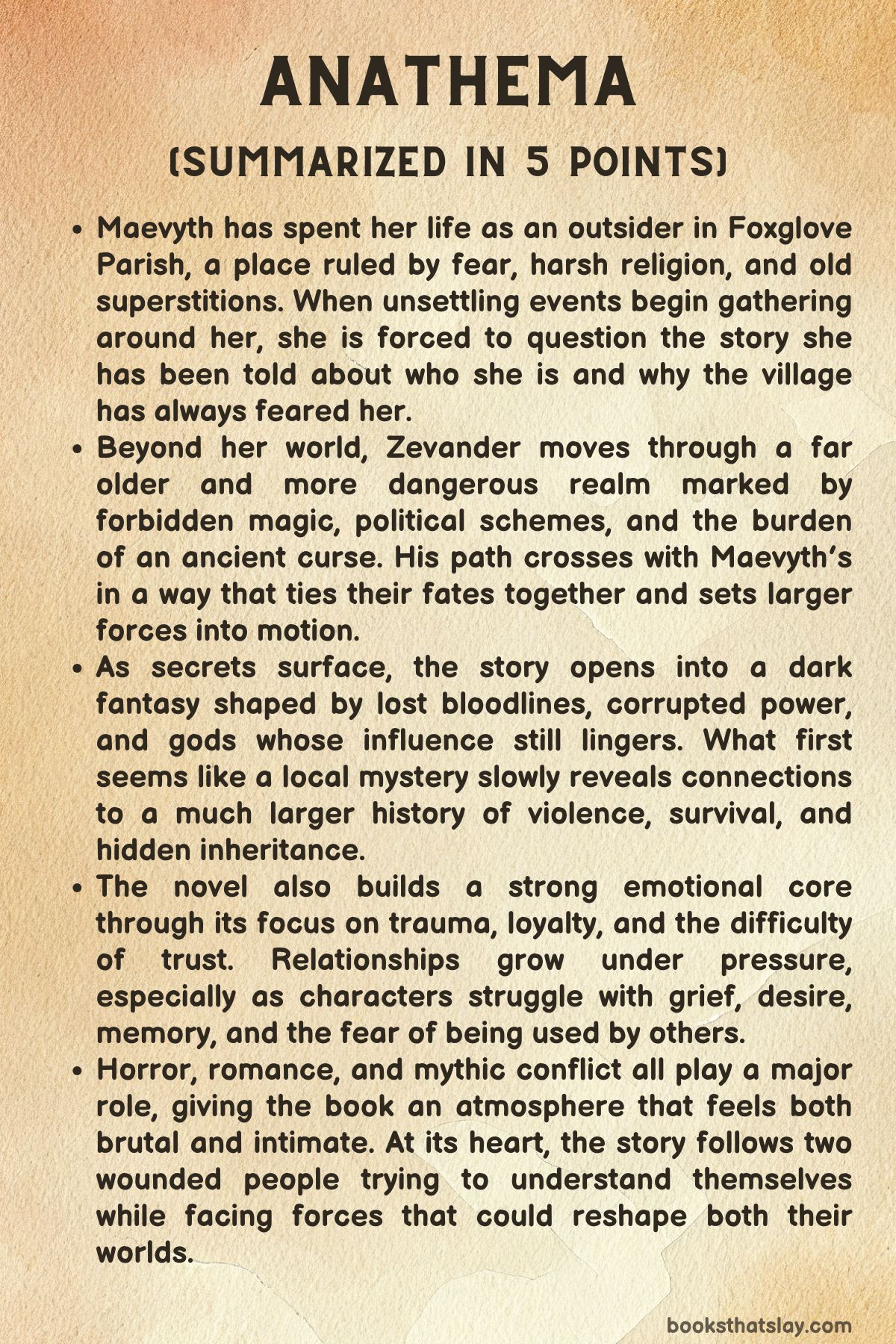
Anathema by Keri Lake is the first book in The Eating Woods Duology, a gothic dark fantasy novel that takes us into a world of forbidden magic, curses, and a slow-burn romance. At its center is Maevyth, a feared young woman from a harsh village where religion is used as control, and Zevander, a scarred immortal assassin carrying a curse that has ruled his life for centuries.
Their story joins horror, myth, and desire with questions of identity, power, survival, and belonging. The novel builds a brutal atmosphere, but it is also about two damaged people finding trust in each other while forces far older and larger than them close in.
Summary
Maevyth grows up in Foxglove Parish, a bleak village beside the Witch Knell, a forbidden forest where no one returns alive. She was found there as a baby and raised by the Bronwick family, but she has never truly belonged.
The villagers see her as cursed, blame her for past misfortunes, and treat her as an omen of ruin. After the death of her adoptive father, her future narrows to marriage or a terrible religious life under the Red God.
Her only real comfort is her bond with her sister Aleysia, who is lively, reckless, and determined to protect her.
Strange things begin to gather around Maevyth. At the forest archway, blood, bone, smoke, and whispers answer her presence.
A dying raven leads to a mysterious exchange that marks her body with silver changes. During a public Banishing, when sinners are thrown toward the forest as sacrifice, a condemned man grips her and says, “God is Death,” connecting her to a truth that the village religion tries to bury.
Soon after, she begins hearing the voices of the dead and sensing that something in her is waking.
At the same time, in the immortal world of Aethyria, Zevander lives under the shadow of a curse inflicted in infancy by Cadavros, a fallen magelord tied to sablefyre, a divine and corrupting black flame. Zevander works as a royal assassin, gathering bloodstones from powerful bloodlines in hopes of breaking his curse.
His body and mind are shaped by old violence, including years of slavery and sexual abuse. He keeps himself hidden behind a mask and harsh control, fearing what the sablefyre may one day turn him into.
His brother Branimir has already been transformed into a monstrous creature, and Zevander believes the same fate waits for him if he fails.
When Maevyth’s wound and blood reveal that she carries the final bloodline Zevander needs, he crosses into Mortasia intending to kill her. But when he stands over her bed, his magic fails against her.
Her scent, her silver-marked blood, and the force around her unsettle him. He retreats, unable to finish the task.
Soon after, Maevyth’s own life collapses. Her grandmother sells her into marriage to Moros, a wealthy and cruel man obsessed with collecting bodies and creating living horrors.
Aleysia is condemned after her affair with Riftyn is exposed, and at the Banishing both sisters are driven into the forest.
Inside the woods, the truth behind the village’s rituals appears in a more terrible form. Moros has dealings with a creature tied to Cadavros, and the forest is full of predatory magic.
Maevyth and Aleysia are separated at a shining boundary between worlds. Maevyth is taken into Aethyria, where soldiers imprison her, but Zevander rescues her with the help of his scorpions and brings her to his castle, Eidolon.
There, Maevyth enters a world larger and older than anything she knew. She meets Rykaia, Zevander’s sharp, wounded sister; Dolion, an aged seer and mage; and later Allura, a scholar who studies ancient bone lore.
They reveal that Maevyth belongs to the lost Corvikae bloodline, a people once favored by Morsana, the Goddess of Death. Her blood can unlock old Corvikae magic, command bones, and possibly resist the Black Pestilence that threatens Aethyria.
She also shares a bond with a Corvugon, a rare dragon-like creature she hatched from the silver egg that appeared after her encounter with the raven.
Maevyth begins training in magic under Zevander and the others. She learns glyphs, defensive spells, and the unsettling truth that her power is tied to death, memory, and the remains of the ancient world.
She opens a puzzle book linked to her bloodline and uncovers pieces of the forgotten history of the gods, the fall of the Corvikae, and the role of sablefyre in their destruction. She is also drawn into Caligorya, a shadowed inner realm where magic users confront the darker sides of themselves.
Through these lessons, she grows from an isolated village outcast into someone capable of fighting back.
As Maevyth changes, so does her relationship with Zevander. Their connection is immediate, physical, and difficult for both of them to resist.
Yet it is also shaped by fear, because Zevander’s trauma and curse make intimacy dangerous terrain. He tries to keep her at a distance, telling himself she is only a means to an end.
But Maevyth brings warmth into Eidolon, earns Rykaia’s affection, calms Branimir with her singing, and starts to become part of the broken household Zevander has built around himself. The more time they spend together, the more he sees her as something he wants to protect rather than use.
Their growing closeness is threatened by larger political forces. King Sagaerin, the Magestroli, and various nobles are maneuvering around Cadavros, the pestilence, and the rare power in Maevyth’s blood.
During the festivities around Princess Calisza’s Becoming, tensions break open into violence. Maevyth is seized by mages who try to use her blood and sablefyre for their own survival.
Instead, she survives the flame, turns it back on them, and proves that her connection to death and divine power is unlike anything they expected. Melantha then manipulates her with a promise involving Aleysia, claiming Zevander was sent to kill her and offering a path back to Mortasia.
Back in Foxglove, Maevyth discovers that time has moved differently. Months have passed.
The village is ruined, and many people have been transformed into monstrous versions of themselves after black spiders spread corruption through the parish. She fights mutated forms of Felix and Agatha and is saved by Zevander, who follows her across worlds.
They seek help from the Crone Witch, Elowen, who reveals key truths: Maevyth was hidden and protected as the last hope of the Corvikae line, Cadavros has been building strength in the woods, and the disaster in both worlds is tied to very old divine betrayals.
With the truth stripping away the last of her old life, Maevyth and Zevander finally stop denying what exists between them. In the midst of danger, they share tenderness, desire, and honest vulnerability.
Maevyth sees the scars Zevander carries and responds not with fear, but with care. He begins to believe he is more than the weapon others made of him.
Their bond deepens into something possessive, protective, and transformative for both of them.
Even then, Cadavros keeps pressing at the edges. He invades Zevander’s mind, tempts him, and tries to force his obedience through the very curse that has defined his life.
Maevyth, meanwhile, faces the cost of her own rising power when she is forced to kill Elowen after the older woman becomes infected. The event leaves Maevyth shaken but confirms that her magic can act with devastating force when needed.
By the end, Maevyth and Zevander choose each other openly. He tells her that he would let the world burn before surrendering her, and she accepts the depth of their connection.
Yet their future remains uncertain. Aethyria is still under threat, Cadavros is still alive, political betrayal still surrounds them, and Aleysia’s fate remains central to Maevyth’s heart.
The final turn brings a fragile note of hope: while searching Elowen’s house, Maevyth discovers a hidden space and finds Aleysia alive, setting up the next stage of the story.
Characters
Maevyth
In Anathema, Maevyth stands at the center of the story as a young woman raised under rejection, suspicion, and control, yet she carries within her a rare spiritual and magical inheritance. At the beginning, she appears more powerless than dangerous.
Foxglove has trained her to think of herself as unwanted, cursed, and expendable, and this social cruelty has shaped her into someone guarded, observant, and emotionally restrained. What makes her compelling is that her strength does not begin as confidence.
It begins as endurance. She survives shame, threat, forced marriage, religious oppression, and the fear of losing the only person she truly loves, her sister.
Her growth comes from moving out of a life defined by what others say she is and toward an understanding of what she actually carries within herself.
A major part of Maevyth’s characterization lies in the contrast between how others see her and who she really is. In Foxglove, she is treated as an omen, a scandal, and a problem to be managed.
Yet her actions repeatedly show compassion, intelligence, and moral instinct. She worries about widows left helpless by cruel laws, feels horror at the abuse of servants, and is deeply shaken by violence even when she herself must answer it with force.
She is not drawn toward cruelty. Instead, she is pulled into power because power becomes necessary for survival.
This matters because it keeps her from becoming a simple chosen-one figure. She does not enjoy domination.
She learns to fight because the world gives her no safe alternative.
Her bond with death is central to her identity. She hears the dead, sees what others cannot, and comes to exist at the edge between life and death after the exchange at the forest archway.
This gives her a haunting quality, but it also gives her a special emotional depth. She is not merely using dark power; she is burdened by intimacy with suffering.
Danyra’s voice, visions, dead presences, and ancestral memory all press on her. That pressure makes her journey both mystical and psychological.
She must learn not only what magic she can use, but also how to remain herself while touching forces older and darker than ordinary human life.
Maevyth’s emotional world is shaped most deeply by love and loss. Her attachment to Aleysia is one of the clearest truths in her life, and much of her action is driven by the refusal to abandon her sister.
Even after entering a new world, finding allies, and awakening immense power, she remains emotionally anchored by that need. This prevents her from becoming swallowed by destiny.
She is still personal, intimate, and human. Her emerging relationship with Zevander broadens this emotional life.
With him, she moves from fear and curiosity into trust, desire, and a growing sense of mutual belonging. Yet even in romance, she remains distinct.
She is not simply softened by love. She becomes more fully herself through being seen, wanted, and respected after a lifetime of being condemned.
By the later parts of the story, Maevyth becomes a figure of transformation. She is no longer the village outcast waiting to be traded, judged, or sacrificed.
She becomes someone who learns, chooses, protects, and acts. Her power over bones, sablefyre, and inherited magic makes her important to the fate of kingdoms, but the real force of her character lies in her emotional resilience.
She proves that gentleness and terror can coexist in one person, and that surviving degradation does not erase the capacity for loyalty, wonder, desire, and courage.
Zevander
Zevander is one of the most layered figures in the novel, written as a man shaped by monstrosity, violence, longing, and deep emotional fracture. He first appears as a lethal and almost demonic presence, masked, feared, and controlled by survival instincts sharpened over centuries.
His role as an assassin suits the image he presents to the world: efficient, cold, and removed. Yet the deeper narrative reveals that this hardness is not his core nature but the armor built around profound suffering.
He is a man who has been used, altered, enslaved, and cursed from infancy onward, and nearly every part of his life reflects the struggle to keep that history from consuming him.
His curse defines much of his outward behavior. The sablefyre within him is both weapon and threat, giving him frightening power while constantly reminding him that he may become something fully corrupted.
This fear is sharpened by Branimir’s condition, because Zevander can see in his brother the future he dreads for himself. That fear creates much of his need for control.
He gathers bloodstones, manages his body through pain and poison, keeps emotional distance, and treats relationships as risks. He believes that if he loses control, he will lose whatever remains of his humanity.
That belief makes him severe, but it also makes him tragic, because the very methods he uses to survive isolate him further.
His past trauma is essential to understanding him. The abuse he endured under the Solassions, especially under General Loyce, has left scars that affect not only his body but his entire relation to touch, desire, and self-worth.
The novel does not present him as emotionally unavailable by temperament alone. It shows that intimacy has been contaminated for him by coercion, humiliation, and pain.
This is why his attraction to Maevyth is not simple relief or easy possession. It terrifies him.
She awakens hunger, tenderness, jealousy, protectiveness, and hope, all of which place pressure on the defensive system by which he has stayed alive. He wants her with a depth that unsettles him because wanting also means vulnerability.
Zevander’s moral complexity is also one of his strongest features. He kills, threatens, manipulates, and often works inside corrupt systems, but he is not morally empty.
He carries disgust toward cruelty, especially cruelty toward children, the powerless, and the sexually exploited. His rescue of Maevyth, his care for Rykaia even when frustrated by her, and his desperate loyalty to Branimir all reveal a man whose conscience has been battered but not destroyed.
The tension in his character comes from the gap between what he has been made into and what he still cannot stop feeling. He is brutal when needed, but the narrative continually shows that brutality as damage management rather than simple appetite.
His relationship with Maevyth is transformative because she sees him without accepting the lies that formed him. She does not deny his darkness, but she does not reduce him to it.
Through her, Zevander becomes capable of imagining belonging rather than mere endurance. His tenderness with her matters precisely because it emerges from such damaged ground.
He is possessive, protective, and often overwhelmed by desire, yet his deeper movement is toward trust. He begins as someone trying to use her for a cure and ends as someone willing to let kingdoms fall rather than sacrifice her.
That shift reveals the emotional truth beneath his violent exterior. He is, at heart, a man starving for a form of love untouched by abuse, and his arc is powerful because he slowly allows himself to believe he might receive it.
Aleysia
Aleysia serves as both emotional anchor and painful contrast within the story. Where Maevyth is dark, inward, and marked by restraint, Aleysia is bright, impulsive, and rebellious in a more visibly social way.
She carries charm, boldness, and warmth, but beneath that energy is a young woman trapped in the same oppressive world as her sister. She is not shallowly carefree.
Her wit and defiance are part of how she survives a society that treats women as property. Her attachment to Riftyn, however reckless, reflects her hunger for agency and intimacy in a world that offers women almost nothing freely.
Her bond with Maevyth is one of the strongest emotional structures in the narrative. Aleysia believes in Maevyth when almost no one else does, and she refuses to see her as cursed or lesser.
At the same time, the relationship is not idealized into sameness. Aleysia can be naïve, romantic, and frustratingly hopeful where Maevyth is wary and practical.
This difference creates tension but also realism. Aleysia wants to believe escape is possible through love or running away, while Maevyth sees more clearly how violent the social order really is.
Their closeness therefore includes both devotion and mismatch, which makes the later separation more painful.
Aleysia also represents the specific vulnerability of women under patriarchal and religious control. Her pregnancy becomes a crisis not because of personal failure but because the culture around her is built to punish female sexuality far more harshly than male desire.
Once exposed, she becomes disposable in the eyes of the village. Her suffering is personal, but it also exposes the system’s cruelty.
In this sense, she is not only Maevyth’s beloved sister but a mirror of what could happen to any woman in Foxglove who steps outside the rules.
Even when absent for long stretches, Aleysia remains powerful in the narrative because she lives inside Maevyth’s motivations. She becomes a symbol of unfinished duty, grief, hope, and sisterhood.
The uncertainty around her fate drives Maevyth forward again and again. Her later survival matters not simply as a plot turn but as the preservation of Maevyth’s original emotional world.
Aleysia keeps the story tied to the love that existed before prophecy, destiny, and ancient bloodlines entered the foreground.
Rykaia
Rykaia is one of the most vivid supporting characters because she combines wit, damage, sensuality, loyalty, and emotional intelligence in unpredictable ways. She initially appears mischievous and chaotic, someone who defies restraint, disappears into dangerous places, and speaks with a sharp edge that unsettles others.
Yet beneath that restless energy is a woman marked by trauma and loss. As a Pain Eater, she is already a character built around the idea of carrying suffering, and the novel uses that ability in both literal and emotional ways.
She absorbs pain, but she is also someone who has inherited and endured unbearable pain of her own.
Her relationship with Zevander reveals a great deal about both of them. They frustrate each other, but the bond between them is deep and protective.
Zevander’s fierce need to keep her safe comes from genuine love, not only obligation, and Rykaia understands him in ways others do not. She sees his moods, his buried feelings, and his limits.
At the same time, she resists being controlled, which keeps her from becoming a passive dependent. She is wounded, but she is never reduced to weakness.
Her defiance is a form of survival.
Rykaia’s importance to Maevyth’s development is enormous. She is among the first in Aethyria to treat Maevyth with warmth rather than suspicion.
Through conversation, teasing, clothing, bathing, dancing, and emotional honesty, she opens parts of life Maevyth had never been allowed to imagine. She offers a living alternative to Foxglove’s repression.
In her presence, Maevyth sees a culture where women can own property, where sexuality is not automatically shameful, and where identity is larger than rigid social law. Rykaia thus becomes both friend and guide, not in an academic sense like Dolion or Allura, but in an embodied, intimate one.
Her backstory deepens her sharply. The revelation about her mother’s assault and murder explains the instability, dependency, and sadness beneath her humor.
She is not merely hedonistic or reckless. She is someone trying to remain alive inside memory.
This makes her one of the novel’s clearest examples of how trauma can produce both vulnerability and charisma. She can be funny, seductive, petty, and tender in the same scene, which makes her feel fully alive.
She also introduces a compassionate reading of pain, especially when she sees what Maevyth does not yet understand about herself. Rykaia is often the emotional bridge between brutality and intimacy.
Dolion
Dolion functions as prophet, scholar, guide, and destabilizing truth-teller. He is old, damaged, brilliant, and morally difficult to pin down.
At first glance, he seems like a fallen sage, someone whose gifts have been eroded by addiction and time, yet he remains one of the most important interpreters of the world’s deeper structures. He understands bloodlines, curses, visions, and ancient history better than almost anyone around him.
Through him, the narrative gains its mythic scale. He sees beyond immediate survival and keeps pointing toward the larger stakes even when others resist him.
What makes Dolion strong as a character is that he is not a purely noble mentor. He is compromised, secretive, and at times manipulative.
He withholds, redirects, and works toward outcomes others may not fully understand. This ambiguity prevents him from becoming a convenient wise elder.
He is invested in Maevyth and Zevander, but he also views them within prophecy, which means he sometimes treats people as pieces inside a larger pattern. That creates tension, especially with Zevander, who needs him yet distrusts the extent of his control.
His relationship with Zevander is especially rich because it rests on dependency and conflict at the same time. Zevander needs Dolion’s knowledge to break the curse, while Dolion increasingly insists that Zevander’s fate is tied to a greater purpose than self-preservation.
Their exchanges often show two different survival philosophies: Zevander is focused on immediate bodily and emotional need, while Dolion is focused on historical consequence and divine design. Both men are partly right, which is why neither can fully dismiss the other.
With Maevyth, Dolion acts as a translator of identity. He helps her understand her bloodline, her power, and the meaning of what is awakening in her.
Yet even here, he is not gentle in a soft sense. He reveals truths that burden her, and he does so because he believes knowledge is necessary, not because it is comforting.
In that way, Dolion represents the harsh side of wisdom. He is valuable because he brings light into mystery, but the light he brings often carries fear.
Branimir
Branimir is one of the most tragic figures in the novel because he embodies what the curse can do when it is allowed to fully consume a person. As Zevander’s brother, he is both warning and remnant, a living piece of family love twisted into monstrous form.
His body has become horrific, spider-like, starved, dangerous, and alien, yet the story repeatedly suggests that a suffering self still remains within him. This tension between monstrosity and buried personhood gives his scenes unusual emotional force.
He serves an important symbolic role in relation to Zevander. Where Zevander lives in dread of becoming unrecognizable to himself, Branimir already exists in that condition.
He is the future Zevander fears, but he is also a brother who still inspires guilt, pity, protectiveness, and sorrow. Zevander cannot simply kill or abandon him because Branimir is evidence that the family’s destruction was not accidental or abstract.
It happened inside their own bodies. This makes Branimir a constant emotional wound.
At the same time, Branimir is not reduced to being a symbol. His reactions to Maevyth, especially to her singing, reveal an unexpectedly tender dimension.
For a moment, the monstrous shape falls back, and something peaceful emerges. Those scenes matter because they suggest that gentleness can reach even what violence has nearly erased.
Maevyth’s ability to soothe him also deepens her place in the household. She does not only attract Zevander; she enters the family’s deepest suffering and touches it without revulsion.
Branimir also sharpens the novel’s themes of cursed inheritance and dehumanization. He is horrifying, yes, but he is also pitiful in the deepest sense.
He does not choose what he became. He lives in confinement because there is no safe place for him in the ordinary world.
Through him, the novel insists that the monstrous body is not always the same as a monstrous soul.
Cadavros
Cadavros is the novel’s most direct embodiment of corruption, appetite, and ancient ruin. He is not only a villain in the ordinary sense but a force that touches blood, power, disease, and identity itself.
His role begins in the distant past with the sablefyre ritual inflicted on Zevander and Branimir, and from there he becomes a shadow stretching over generations. He warps bodies, burns out inherited gifts, and leaves marks that are physical, magical, and psychological.
He does not merely kill. He remakes.
What makes him frightening is his layered nature. He is at once sorcerer, parasite, manipulator, and almost godlike corruption.
He can wear disguises, move through the forest, speak into minds, and exploit weakness through desire, fear, and unfinished pain. His power is not only forceful but invasive.
He enters thoughts, bodies, and systems. In this way, he represents a threat that cannot be handled by weapons alone.
He is disease in both literal and symbolic terms, spreading through bloodlines, politics, belief, and flesh.
Cadavros is especially important in relation to Zevander because he functions almost like an abusive creator. He cursed him, shaped the terms of his life, and still claims access to him through that curse.
This gives their relationship a deeply violating structure. Zevander’s struggle is not simply to defeat an enemy but to escape an imposed identity.
Cadavros wants obedience, continuation, and possession. He offers power, but only as another form of enslavement.
In relation to Maevyth, Cadavros is the force that threatens to consume what she represents. She carries renewal, lost lineage, and divine inheritance, while he carries contamination and distortion.
Their conflict therefore feels larger than personal enmity. It becomes a contest between what survives destruction and what feeds on it.
Cadavros’s presence keeps the novel’s dread active because he is never merely absent. Even when offstage, he is in the curse, in the mutations, in the spiders, and in the fear that the past is not over.
Moros
Moros represents a very human kind of horror, the horror of entitlement, cruelty, and aestheticized abuse. Unlike supernatural monsters, he is terrifying because he is socially respected.
He is wealthy, influential, and treated as legitimate, even while he brutalizes the powerless and turns living beings into objects for his fascination. His basement of mutilated bodies and manufactured oddities exposes the logic already present in the world around him: if certain people are seen as lesser, then cruelty becomes entertainment, research, or status.
His character is built around objectification. He does not see women, servants, or the marginalized as full people.
He sees them as surfaces, commodities, and materials. This makes him a useful counterpoint to the village’s outward piety.
Foxglove and its surrounding order claim moral and religious purpose, yet men like Moros thrive inside that very structure. The novel uses him to show how social respectability can hide monstrous appetites.
He is not outside the system. He is one of its products.
Moros also sharpens Maevyth’s resistance. Her horror at his treatment of Danyra and the women he mutilates clarifies her moral line.
He is among the first figures who makes visible to her just how far male power can go when unchecked by empathy or consequence. He is a grotesque foreshadowing of what marriage to him would have meant: not security, but captivity and annihilation.
His connection to the greater supernatural threat also matters. He becomes a bridge between ordinary cruelty and larger corruption.
Through his dealings, the novel suggests that evil does not always begin with demonic power. Sometimes it begins with desire stripped of conscience, then grows toward something worse.
Agatha
Agatha is a domestic tyrant whose cruelty is grounded less in spectacle than in daily control. She is one of the earliest forces shaping Maevyth’s misery, and she represents the internal policing of oppressive systems.
She may not wield state power or divine magic, but within the household she acts as judge, broker, and disciplinarian. She turns the home into a place of fear, bargaining away the futures of girls under her care while pretending to uphold propriety and order.
What makes Agatha effective as a character is that her cruelty is practical. She is not dramatic in the way Cadavros or Moros are.
Instead, she is petty, transactional, and cold. She accepts bride prices, enforces shame, and values survival in ways emptied of love.
This kind of character is often especially painful because she shows how violence survives through ordinary structure. The danger to Maevyth and Aleysia is not only in the wild forest or the dark mage.
It is also at the kitchen table, in the marriage bargain, in the grandmother who sees their bodies as assets.
Agatha’s transformation later into something physically monstrous feels fitting because it externalizes what was always spiritually present in her. She has long behaved as someone shaped by fear, greed, and emotional decay.
When corruption finally changes her outward form, the horror is severe, but it also reads as revelation.
Riftyn
Riftyn is a weak and morally compromised man whose charm hides selfishness and cowardice. He presents himself as playful and seductive, especially with Aleysia, but when crisis comes he proves unable to protect anyone, including the woman he has helped endanger.
He benefits from the attention of both sisters in different ways, either through flirtation or through the knowledge that they are trapped by his family’s power, yet he never shows the strength of character needed to justify their hopes in him.
His relationship with Aleysia is important because it reveals how fragile romantic escape can be in a cruel world. Aleysia invests emotional meaning in him, perhaps because she needs to believe in some path out of her confinement, but Riftyn cannot carry that hope.
He is too immature, too compromised, and too tied to his household’s corruption. Even his interactions with Maevyth show his entitlement.
He offers sex not out of love but opportunism, as though access to women is a casual extension of his position.
Riftyn matters less as an independently powerful figure than as an example of failed masculinity. He is not as outwardly monstrous as Moros or Felix, but he is still harmful because he lacks courage, loyalty, and moral seriousness.
In another kind of story he might have been a flawed lover. Here he is another reminder that women in this world are often betrayed not only by monsters but by weak men who do nothing.
Felix
Felix is one of the clearest examples of corruption hidden behind useful labor. As a mortician, he works in a profession close to death, ritual, and bodily handling, but instead of treating the dead with dignity, he violates them.
His assault of Danyra’s corpse is among the most disturbing moments in the summary because it reveals depravity without supernatural excuse. He is not cursed into this behavior.
He chooses it. That makes him uniquely revolting.
Felix’s role is relatively focused, but it has strong thematic value. He represents the collapse of all sacred boundaries around the body, especially female bodies.
In a world already full of public punishment, control, and exploitation, he pushes that logic into the morgue. Death does not end violation in his presence.
This deepens the novel’s horror by showing that corruption continues even where silence and ritual should have brought peace.
His later mutation into a monster works, like Agatha’s, as an outward exposure of inner truth. By the time he returns in altered form, the body has caught up with the soul.
His transformation feels less like a random twist and more like the grotesque completion of what he already was.
Elowen
Elowen, the Crone Witch, is a liminal figure whose presence joins old history, hidden protection, and moral ambiguity. At first she appears as a feared village outsider with healing gifts and dangerous knowledge.
Over time, she becomes one of the keepers of the past, someone who carries memory from older worlds and older devastations. She knows far more than she first reveals, and her role in Maevyth’s life proves foundational.
She helped hide, preserve, and direct the last surviving thread of a nearly erased bloodline.
Her character is compelling because she is both protective and compromised. She has wisdom, foresight, and sacrifice in her history, but she is not presented as wholly pure.
The revelation that she once sacrificed a child trying to pass back into Aethyria stains her with moral complexity. This matters because it keeps her from becoming a simple wise crone archetype.
She has survived too long and seen too much to remain untouched by darkness. Her choices have costs.
Elowen’s narrative function is partly revelatory. Through her, Maevyth learns who she is, how she was hidden, and how the fall of the Corvikae still echoes into the present.
But Elowen also symbolizes the burden of witness. She has carried knowledge across centuries, living in isolation among people who feared her.
Her death therefore feels especially bleak. Another keeper of memory is lost, and Maevyth must bear more of that burden herself.
Allura Makabe
Allura brings scholarly rigor, historical method, and a different form of female authority into the story. Unlike Rykaia, whose role in Maevyth’s life is emotional and experiential, Allura’s strength lies in study, interpretation, and disciplined knowledge.
She examines bones, reads ancient patterns, and helps decode the deeper history of Maevyth’s bloodline. Her presence broadens the world by showing that knowledge itself can be a form of power, not only raw magic or noble status.
She is also marked by restraint. Her scenes suggest someone measured, intelligent, and perhaps somewhat guarded.
This gives her an interesting contrast with the more volatile or emotionally expressive people around her. She does not dominate the page through intensity but through steadiness.
That steadiness is useful in a narrative crowded by prophecy, trauma, and desire.
Her tension with Rykaia adds a subtle layer to her characterization. Whether through jealousy, emotional history, or unresolved attraction, the discomfort between them prevents Allura from feeling merely functional.
She becomes part of the household’s emotional field, not just its research team. This makes her a useful supporting character whose value is both intellectual and interpersonal.
Kazhimyr
Kazhimyr is one of the clearest examples of loyal masculine companionship in the story. As a fellow Letalisz and former slave, he understands parts of Zevander’s history in ways few others can.
He is practical, observant, and often serves as a stabilizing presence when Zevander is pulled toward fury or obsession. Their bond is shaped by survival through shared degradation, and that history gives Kazhimyr quiet authority in Zevander’s life.
He also helps reveal Zevander’s inner state. Because Kazhimyr can notice shifts in him, challenge him, and support him without excessive sentiment, he acts as a mirror for the parts of Zevander that remain disciplined and human.
He does not overwhelm scenes, but he strengthens them by grounding the emotional stakes in camaraderie and trust.
Kazhimyr’s importance lies in his reliability. In a world full of betrayal, prophecy, and manipulation, he is one of the few figures whose loyalty feels hard-earned and real.
That makes him valuable not just as backup in battle, but as part of the fragile network that keeps Zevander from total isolation.
Torryn
Torryn is driven, sharp, and deeply protective of Rykaia, and much of his characterization emerges through that devotion. He is another of the Letalisz, which means he belongs to the same violent machine as Zevander and Kazhimyr, but his emotional center is more immediately visible.
His eagerness to kill the man who harmed Rykaia shows both his brutality and his sincerity. He is capable of violence, but it comes through attachment rather than detachment.
He also helps define the emotional structure around Rykaia. His love for her adds another layer to the household dynamic and reminds the reader that desire in this world is not only destructive or traumatic.
It can also be loyal, grieving, and patient, even if imperfectly expressed. Torryn may not receive the same depth of focus as Zevander, but he contributes to the sense that Eidolon is built out of damaged people still trying, in their own ways, to care for one another.
Melantha
Melantha is dangerous because she combines intelligence, sensuality, magical skill, and hidden motives. She enters the story as someone perceptive enough to notice what others miss, including Zevander’s resistance to truth serum and the strange energies moving around the larger crisis.
She is never easy to trust, and the narrative uses that uncertainty well. She is neither openly monstrous nor comfortably allied.
Instead, she operates in shadows, withholding just enough to remain destabilizing.
Her eventual link to Rykaia’s past violation makes her especially disturbing. This reveals that behind her poise is a far more vicious and intimate form of cruelty.
She becomes not just politically dangerous but personally contaminating, someone whose manipulations cut directly into the characters’ deepest wounds. Her handling of Maevyth at a key moment shows how skilled she is at exploiting doubt, timing, and emotional fracture.
Melantha works well as a character because she blurs the line between seduction and threat. She is not raw force like Cadavros.
She is strategy, ambiguity, and calculated pressure. In a story full of visible monsters, she reminds the reader that polished surfaces can conceal equally devastating harm.
King Sagaerin
King Sagaerin represents political order corrupted by selfishness, fear, and hoarding. He commands assassins, manages appearances, and hoards resources that others need to survive.
His rule is not merely flawed but structurally cruel, because his decisions deepen inequality and desperation across Aethyria. Even when he appears concerned with stability, his methods show that preservation of power matters more to him than justice.
He is especially important because he is not a theatrical villain. He is a ruler whose systems produce suffering while maintaining legitimacy.
This makes him politically effective as a character. He helps create the conditions in which revolt, plague panic, and social resentment grow.
His treatment of Zevander also reflects the monarchy’s reliance on damaged weapons. He values Zevander’s usefulness more than his humanity.
Sagaerin therefore embodies institutional failure. He is not the oldest evil in the story, but he is the kind of man under whom old evils thrive because convenience, secrecy, and power matter more than moral responsibility.
General Loyce
General Loyce is one of the most psychologically disturbing figures in the novel because she carries personal, sexual, and military power in a way that directly shaped Zevander’s trauma. She is not frightening because of mystery.
She is frightening because of certainty. She knows what she did, how it affects him, and how to weaponize memory against him.
Her cruelty is intimate, deliberate, and unrepentant.
She matters less as a broad political player than as the face of one of the novel’s deepest wounds. Through her, the story shows how abuse can become internal occupation.
Even long after captivity ends, her language, her gaze, and even the possibility of her presence can destabilize Zevander. She tries to control not only his body in memory but his interpretation of that history, pushing the abuser’s lie that pleasure, pain, and consent can be collapsed into one thing.
That makes her morally revolting in a particularly sharp way.
Loyce is effective because she is not softened by remorse or complexity. Her narrative purpose is to personify violation that still lives in the victim’s mind.
In doing so, she intensifies Zevander’s arc by clarifying what he must resist in order to reclaim himself.
Danyra
Danyra appears briefly compared with the major cast, but her role is deeply important because she crystallizes the vulnerability of the powerless within this world. As a Lyverian servant under Moros’s authority, she is abused, silenced, and killed by a system that sees her life as disposable.
Yet death does not erase her from the story. Through Maevyth’s ability to hear the dead, Danyra continues to speak, warn, and guide.
This gives her a haunting but meaningful afterlife in the narrative. She becomes one of the earliest signs that Maevyth’s connection to death is real and morally urgent.
Danyra’s voice is not decorative ghostliness. It is testimony.
She carries the unfinished demand of the violated dead, and Maevyth’s inability to ignore her helps define Maevyth’s conscience.
Though small in page presence, Danyra represents the many people crushed by larger powers. Her significance lies in the fact that the story refuses to let her vanish quietly.
Raivox
Raivox is more than a magical creature or companion. He symbolizes Maevyth’s inheritance, instinctive power, and connection to a lost lineage older than ordinary human history.
Hatched from the silver-black egg that appears after death and blood exchange, he is a living sign that Maevyth’s life is crossing into another order of reality. His rapid growth and fierce loyalty show that he is not ornamental but part of the ancient force gathering around her.
He also adds a rare quality of wonder to a very dark narrative. Around him, the tone opens briefly into awe.
At the same time, he is still dangerous, predatory, and tied to battle. This balance makes him fit the story well.
He is beautiful without being gentle in a simplistic sense. Like Maevyth herself, he carries both strangeness and threat.
Raivox’s bond with Maevyth reinforces one of the novel’s central ideas: that what appears unnatural or frightening may actually be sacred, inherited, and rightful. He is an outward form of her awakening, and each return reminds the reader that her identity is larger than the narrow, fearful language of Foxglove.
Themes
Power, Control, and the Politics of the Body
Bodies in Anathema are rarely allowed to belong fully to the people who inhabit them. The novel presents power not only as military strength, magic, or class privilege, but as the ability to define what another person’s body is worth, what it can be used for, and whether it will be treated as sacred, disposable, or profitable.
This is visible from Foxglove onward, where women are traded into marriage, punished for sexuality, and forced into religious systems that reduce them to obedience and silence. Maevyth’s fear of marriage is not fear of romance but fear of bodily ownership passing from one authority to another.
Aleysia’s pregnancy becomes a public offense because the village treats female sexuality as a social crime. Even religious ritual is built around bodily control, with branding, banishment, and spectacle reinforcing the idea that institutions maintain power by marking flesh.
That same logic expands in darker and more grotesque ways through Moros, Felix, the Solassions, and Cadavros. Moros turns living people into exhibits and mutilated curiosities, exposing how entitlement can transform scientific interest and social status into cruelty.
Felix violates the dead, extending domination past the boundary of death itself. The Solassions leave lasting damage on Zevander and Rykaia by making the body a site of conquest, humiliation, and memory.
Cadavros carries this violation into the supernatural realm by corrupting blood, reshaping flesh, and forcing identity through magical contamination. The horror in these scenes comes not only from violence but from the refusal to recognize personhood.
What gives the theme its force is that resistance also happens through the body. Maevyth’s changing eyes, scars, blood, and glyphs are not signs of shame but of awakening.
Zevander’s body, though scarred and altered, becomes a place where trust can slowly return. The novel repeatedly insists that reclaiming the self requires reclaiming the body from systems that have named it weak, impure, monstrous, or useful only to others.
Desire, touch, healing, and choice become acts of resistance against a world built on possession. In that sense, the struggle for freedom is never abstract.
It is written on skin, carried in blood, and fought through the right to exist without being consumed by another person’s hunger for control.
Trauma, Memory, and the Difficulty of Intimacy
The emotional world of the novel is shaped by the fact that pain does not stay in the past. Memory remains active, physical, and invasive, especially for characters whose lives have been defined by abuse, loss, and terror.
Zevander is the clearest example of this. His history under the Solassions does not remain something he remembers from a safe distance.
It affects how he thinks, how he reacts to desire, how he manages his body, and how he understands himself. Intimacy for him is not a simple path toward comfort, because his past has taught him that closeness can mean ownership, coercion, and degradation.
This is why his attraction to Maevyth is so destabilizing. It is not only sexual desire.
It is the frightening possibility of wanting tenderness after years of surviving through hardness.
Maevyth’s trauma takes a different but equally significant form. She has been raised in a world that constantly tells her she is cursed, wrong, or dangerous.
Public humiliation, social isolation, fear of punishment, and the threat of being sold or banished shape her from childhood. Because of this, she enters love and power with deep uncertainty.
She does not simply need protection from external threats; she must also unlearn the belief that she is meant to be discarded. Her responses to desire, trust, and care are therefore shaped by old conditioning.
The emotional movement between her and Zevander matters because both of them are trying to build connection while carrying internal damage that keeps telling them to retreat.
The novel also broadens this theme beyond the central pair. Rykaia’s humor and sensuality are inseparable from the pain she carries.
Branimir’s monstrous form acts as living memory of what was done to the family. Even the dead continue to speak through Maevyth’s gift, making memory a literal presence in the story.
Trauma is not represented as a private wound hidden from the world. It leaks into speech, magic, sex, violence, and family life.
People do not simply move on from what happened to them.
What makes this theme especially strong is that the novel does not turn healing into instant transformation. Intimacy arrives in uneven, fragile ways.
It requires patience, missteps, confession, and the willingness to be seen in damaged form. The story suggests that love cannot erase trauma, but it can create conditions in which shame loses some of its power.
Trust becomes meaningful precisely because it is so difficult. Emotional closeness is valuable not because the characters are naturally open, but because they have every reason not to be.
Their movement toward one another gives the novel much of its emotional intensity.
Death, Corruption, and the Thin Boundary Between Worlds
Death in the novel is never a simple ending. It functions as presence, passage, warning, inheritance, and distortion.
From the beginning, Maevyth stands near a forest where the dead do not remain silent and where banishment is both punishment and ritualized offering. The village claims to fear sin and impurity, but the world around it is saturated with death in forms it cannot understand.
Maevyth’s ability to hear the dead after her exchange at the archway turns mortality into an intimate reality. Voices remain, wounds continue speaking, and unfinished suffering refuses to disappear.
This gives the narrative a constant atmosphere of instability, because the line between the living and the dead is never secure.
At the same time, the novel separates death from corruption. Death itself is often linked to truth, memory, and divine inheritance, especially through Morsana and the lost Corvikae.
Corruption, by contrast, is what happens when natural boundaries are violated for power. Cadavros, sablefyre, black spiders, mutation, and bodily distortion all show forms of existence that are not merely mortal but contaminated.
This distinction matters because it prevents the novel from treating darkness as identical with evil. Maevyth’s gifts are tied to death, bones, and the afterlife, yet they are not presented as inherently wicked.
What is evil is exploitation, infection, domination, and the desire to turn life and death alike into instruments.
The crossing between Mortasia and Aethyria deepens this theme. The boundary between worlds is physical, magical, and symbolic.
To cross it is to encounter another order of reality, but it is also to face how fragile all divisions really are: between gods and mortals, monsters and victims, past and present, body and spirit. Time itself becomes unstable across that threshold.
Foxglove falls into ruin while Maevyth is away only briefly from her own perspective, showing how movement between worlds can dislocate ordinary experience. The result is a setting where certainty is constantly undermined.
This theme also shapes the emotional core of the story. Maevyth is repeatedly forced to survive near death, and Zevander lives under threat of spiritual and bodily corruption.
Both are drawn toward forces that could destroy them, yet both also find identity through confronting those forces. The novel therefore treats death not only as horror but as revelation.
It strips away illusion, exposes what systems try to hide, and calls forth powers that polite society fears. Corruption spreads through secrecy and greed, while truth often arrives through ruin, ashes, and what the dead leave behind.
Identity, Otherness, and the Refusal of Social Definitions
The novel is deeply concerned with what happens to people whom society names unnatural, impure, dangerous, or less than fully human. Maevyth begins as the village outcast, marked by rumor, strange origins, and bad luck that others project onto her.
She is called evil long before she has any understanding of her actual inheritance. This pattern shows how communities preserve themselves through exclusion.
Foxglove needs someone onto whom fear can be placed, and Maevyth becomes that figure. Her difference is treated as proof of guilt.
The social mechanism is familiar: what cannot be controlled is first misunderstood, then demonized.
This logic extends across both worlds. Spindlings are treated like animals.
The poor lose magic because wealth hoards the means of survival. Eremicians and Nilivir exist under systems that rank bodies and bloodlines.
Women are regulated by sexual rules that do not apply equally to men. Sexual identity, too, is subject to radically different cultural interpretations depending on where one stands.
What one society calls heresy, another recognizes as simple fact of selfhood. The novel repeatedly exposes identity as something shaped by power.
Official definitions of purity, legitimacy, nobility, and worth are shown to be political and social constructions rather than moral truths.
Maevyth’s character arc challenges these definitions at every level. She moves from being treated as an omen to discovering that her difference carries sacred and historical meaning.
Yet the novel does not replace one rigid identity with another. She is not rescued simply by learning that she is secretly special.
What matters is that she gradually stops accepting the language of those who wished to reduce her. She becomes able to name herself through experience, inheritance, choice, and relationship rather than through accusation.
Zevander undergoes a parallel movement. Others see him as demon, weapon, or cursed creature, and he often sees himself through those same terms.
His connection with Maevyth begins to break that frame by allowing him to exist as more than what was done to him.
The strength of this theme lies in its refusal to separate the intimate from the political. Identity is not treated as an abstract label.
It affects who can own property, who gets believed, who is touched safely, who is desired openly, who is enslaved, and who is sacrificed for public order. The novel argues that societies often call people monstrous when those people expose the fragility or hypocrisy of established power.
In response, its central characters do not become respectable by conforming. They become more fully themselves by rejecting the definitions meant to keep them small.
That refusal gives the story much of its moral force.