Anderson in Bloom Summary, Characters and Themes
Anderson in Bloom by Jennifer Dugan is a second-chance romance about identity, fame, resentment, recovery, and the difficult work of separating the person someone used to be from who they have become.
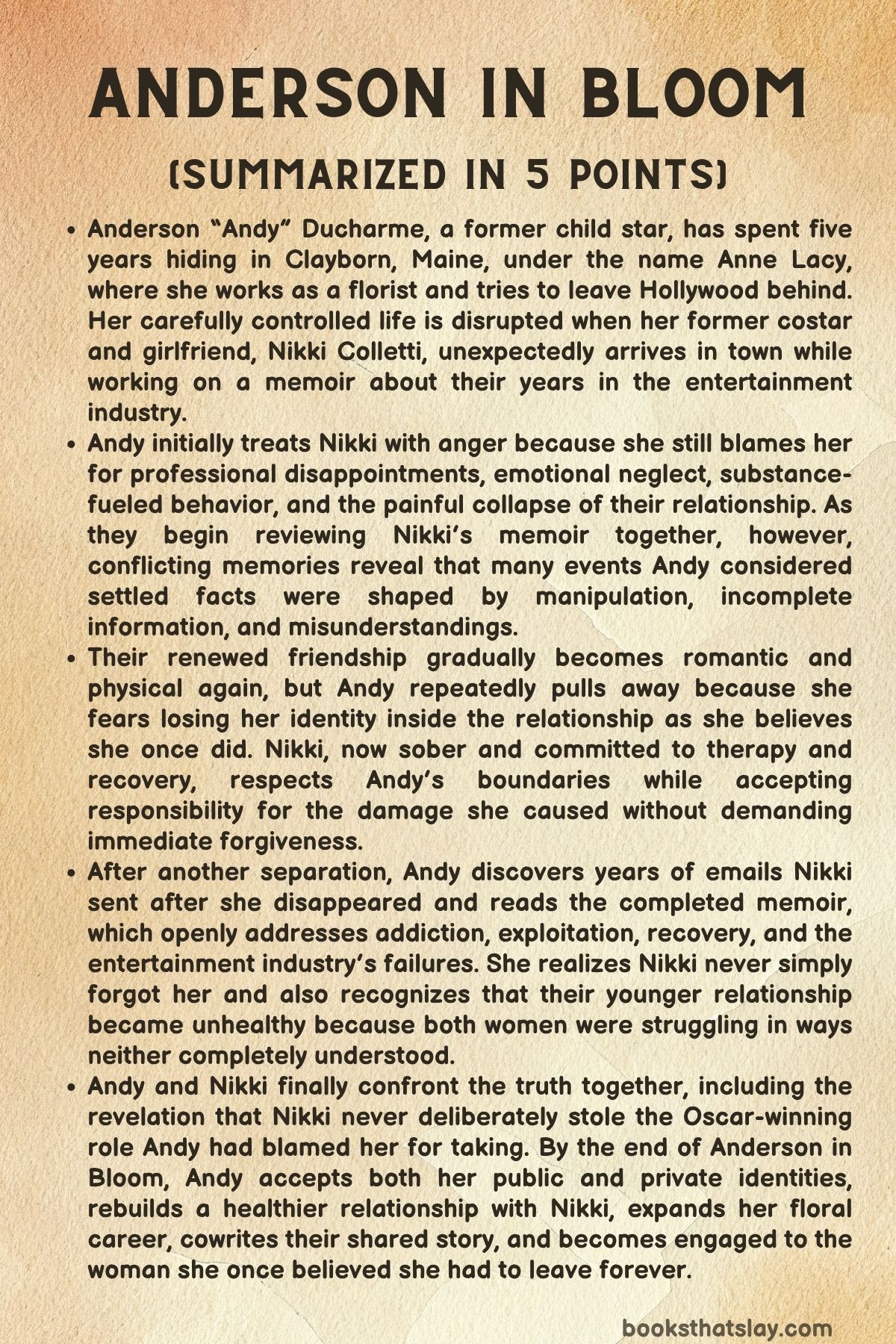
At its center is former child star Anderson “Andy” Ducharme, who has spent five years hiding under the name Anne Lacy in a small Maine town after abandoning Hollywood and her famous former girlfriend, Nikki Colletti. When Nikki unexpectedly reappears, Andy is forced to reconsider the breakup, the career disappointments she blamed on Nikki, and the version of herself she believed she had permanently left behind.
Summary
Five years after disappearing from Los Angeles, Anderson “Andy” Ducharme has built a private existence in Clayborn, Maine, under the name Anne Lacy, usually called Annie. Once a child actor on The Nikki and Andy Show, she now works as a florist at In Bloom Flowers and Gifts, lives above the shop, and has dedicated herself to learning the language of flowers rather than thinking about the entertainment career, financial troubles, and broken relationship she abandoned.
Her carefully protected life becomes unstable when a customer recognizes her from television. Soon afterward, Annie makes the mistake of searching online for her former costar and girlfriend, Nikki Colletti, and discovers that Nikki is preparing a memoir about growing up in Hollywood, causing fans to speculate that their relationship and breakup will finally be explained publicly.
Already frightened by what the memoir might reveal, Annie drunkenly texts Nikki after years of silence. Nikki responds immediately, making it clear that she has never forgotten Andy, but Annie blocks her again and tries to return to the life she has constructed.
That becomes impossible when Nikki unexpectedly walks into In Bloom. Annie initially hides from her, but Nikki returns the following morning, leading to their first face-to-face conversation in five years.
Nikki insists she did not deliberately track Annie down. She had already come to Clayborn to work on her memoir and rented one of the seaside cabins where the two of them had once vacationed during happier years, when they briefly dreamed of leaving Hollywood behind together.
Their meetings are filled with anger, sarcasm, jealousy, and obvious attraction. Nikki repeatedly orders expensive flower arrangements partly because she admires Annie’s work and partly because purchasing flowers gives her an excuse to return, eventually admitting that she wants Annie to help fact-check the memoir.
Annie initially sees the project as another way for Nikki to control their shared history, but she agrees to meet her at an old diner. There they discover that some of the events Annie has spent years treating as settled facts may have been misunderstood from the beginning.
Their memories of their original audition differ sharply. Each had been told that the other was effectively guaranteed a role, suggesting that the studio may have deliberately encouraged competition between two teenagers.
Nikki also explains that a remark Annie had interpreted as professional rivalry had actually been an early confession of attraction. Annie is shaken because accepting Nikki’s version would mean reconsidering the story she has told herself about how their relationship began and why it ultimately collapsed.
A conversation with her mother, Carly, creates further doubt. Carly remembers that Annie was often unhappy with acting long before Nikki became more successful and that some of Annie’s happiest conversations had been about flowers and Nikki rather than her career, forcing Annie to distinguish her anger at Nikki from her broader unhappiness with Hollywood.
Nikki continues visiting Clayborn and gradually becomes part of Annie’s routine. Her expensive flower orders unexpectedly improve In Bloom’s financial condition, while her willingness to listen and accept responsibility makes it harder for Annie to treat her as the selfish person she remembers.
The women begin reviewing the memoir together and confronting parts of their shared history. Nikki admits that she behaved terribly during years of substance use, while Annie starts seeing that Nikki’s partying, professional choices, and emotional distance cannot always be reduced to deliberate cruelty.
Their attraction repeatedly threatens the fragile relationship they are rebuilding. After nearly kissing, Annie becomes frightened and pushes Nikki away, convincing herself that Nikki is once again deciding how their relationship should progress.
Nikki respects Annie’s request and leaves Clayborn. Instead of feeling relieved, Annie becomes miserable, secretly watching Nikki’s social media and passing the cabins where she stayed.
When Nikki eventually returns, she reveals another important truth: she never actually slept with anyone else while they were together, although she allowed people to kiss and use her while she was intoxicated. Nikki does not excuse her actions and acknowledges the humiliation and pain they caused, explaining that her addiction had left her feeling disconnected from her own body.
Their renewed closeness leads Nikki to Annie’s apartment, where a disastrous evening with Regan and Johnny exposes how protective Annie’s friends have become. Johnny, remembering how emotionally devastated Annie was when she arrived in Maine, humiliates Nikki by revealing an intimate detail from the old relationship.
Annie recognizes that she has condemned Nikki for potentially exposing their private history while sharing private details herself. She follows Nikki to a bar and apologizes, leading both women to discuss the final days of their relationship more honestly.
They eventually sleep together, hoping physical closeness might provide closure. Instead it revives their emotional connection, and Annie becomes frightened when Nikki describes the encounter as an expression of love.
Nikki later explains that she began writing the memoir partly because she was forgetting details about Annie and needed some way to preserve the relationship she believed she had lost forever. She claims that much of her life since the breakup has been an attempt to become a healthier person, even when she believed Annie would never see the change.
Annie cautiously proposes that they begin again as friends rather than treating their present relationship as a continuation of their teenage romance. She also tells Nikki that genuine friendship cannot consist of Nikki apologizing constantly while Annie controls every interaction.
Their new arrangement slowly becomes more balanced. They joke, argue, spend time together, and allow each other to express difficult feelings without treating disagreement as immediate proof that the relationship is doomed.
Eventually they begin sleeping together again while insisting they are only friends. Their closeness increasingly contradicts that label, especially as Annie discovers how much of Nikki’s life she missed, including a serious car accident that occurred during their years apart.
The unresolved past eventually creates another crisis. While discussing Nikki’s old agent Eliza and the final period of their television career, Annie unloads years of resentment about Nikki’s parties, absences, addiction, and professional success.
Afterward, they use physical intimacy to escape the conflict. Annie suddenly realizes that this resembles the unhealthy pattern of their old relationship, when arguments were often followed by sex without addressing the underlying problem.
Nikki argues that their present relationship is different and accuses Annie of repeatedly inviting her close before pushing her away whenever emotional commitment becomes frightening. Annie finally admits that her deepest fear is not simply Nikki hurting her again but losing her own identity inside the relationship, so she asks Nikki to return to Los Angeles.
This time Annie refuses to chase Nikki immediately. With Johnny’s help, she recognizes that Nikki respected her boundary completely and that the present Nikki has not manipulated or pressured her.
Annie decides she needs to understand what she actually wants instead of responding from fear. She returns to therapy, focuses on her growing floral career, and begins separating love from nostalgia, resentment, codependency, and the desire for revenge.
More than a month later, Nikki sends Annie an elaborate floral message expressing regret, forgiveness, friendship, longing, love, and what Annie initially interprets as goodbye. The arrangement directs her toward an old email account she has not checked since her teenage years.
There she discovers years of messages Nikki sent after Annie disappeared. The emails describe loneliness, recovery, the Oscars, Nikki’s car accident, failed attempts to move forward, and her continuing hope that she might someday hear from Andy again.
Nikki also sends the completed memoir. Reading it overturns many of Annie’s assumptions because Nikki openly discusses addiction, industry exploitation, manipulation, and the ways Hollywood failed both young women.
Most importantly, Nikki removes stories about Annie that she had previously been given permission to include. She states that Anderson’s experiences belong to Anderson, proving that she does not intend to exploit their relationship for publicity.
Annie finally recognizes that she had turned Nikki into a single villain because doing so made leaving easier. Their relationship had genuinely become unhealthy, but Nikki had also been suffering, and neither woman had understood the full reality of the other’s experience.
Andy finally calls Nikki and admits that she does not want to learn about Nikki through a manuscript; she wants Nikki herself to tell her. Hours later, Nikki unexpectedly appears outside the flower shop in Maine rather than continuing with her planned trip.
They resist immediately returning to physical intimacy and instead sit down to have the conversation they should have had years earlier. Nikki reveals that she has been sober for years, regularly attends recovery meetings, works with a sponsor and therapist, and had been visiting the church across from In Bloom because meetings were held there.
The greatest misunderstanding concerns the Oscar-winning role Annie believed Nikki stole. Nikki reveals that Eliza submitted her without permission and that, when producers showed no interest in auditioning Andy, Nikki refused to read formally unless Andy was given an opportunity too.
Nikki concealed the truth because she believed Annie would find it less painful to blame her than to know Hollywood itself had rejected her. She also reveals that Oscar night became the lowest point of her addiction and that she entered rehabilitation immediately afterward.
Both women finally accept that love alone could not have saved their younger relationship. They needed years apart to establish identities, careers, boundaries, and healthier ways of coping before they could choose one another again.
Andy also stops treating “Annie” and “Andy” as two incompatible people. She suggests that she and Nikki rewrite the memoir together, combining their perspectives and openly acknowledging the years they spent apart, even though doing so means publicly revealing where Anderson Ducharme has been hiding.
Two years later, Andy has successfully united her former public identity with the life she created in Maine. In Bloom has expanded into Los Angeles, her floral work has attracted fashion-industry attention, and she and Nikki have cowritten a bestselling account of their history while also producing a documentary about childhood fame.
Regan and Johnny are preparing to marry, Nikki and Johnny have become friends, and Andy and Nikki are engaged after effectively proposing to each other. Andy chooses a future in which loving Nikki no longer means surrendering herself, finally understanding that she can be Anderson Ducharme, Annie the florist, and Nikki’s /partner at the same time.
Characters
Anderson “Andy” Ducharme / Anne “Annie” Lacy
Andy is the emotional center of Anderson in Bloom, and much of her development comes from realizing that the identity she created in Maine is not necessarily more authentic than the identity she abandoned in Hollywood. Becoming Anne Lacy gives her safety, work she genuinely loves, financial independence, and relationships that are not based on celebrity, but it also allows her to avoid unresolved pain rather than fully understand it.
Her anger toward Nikki is genuine and justified in many respects, particularly because she spent years neglected by a partner struggling with addiction and fame. At the same time, Andy has simplified the past by treating Nikki as the explanation for nearly everything that went wrong, including disappointments that were actually connected to exploitative agents, manipulative studios, unequal professional opportunities, and Andy’s own lack of passion for acting.
Andy’s greatest struggle is therefore not deciding whether Nikki deserves forgiveness. She must learn whether she can love another person without abandoning herself, and whether protecting herself has gradually become indistinguishable from refusing vulnerability.
Her return to therapy marks an important change because she stops measuring every decision against what Nikki wants. By the end of the book, reclaiming the name Anderson does not represent surrender to Hollywood; it represents accepting that Annie the florist and Andy the former actor are both real parts of her identity.
Her eventual willingness to cowrite the book, become publicly visible again, maintain her floral career, and build a life on both coasts demonstrates a healthier understanding of partnership. She can choose Nikki without disappearing inside Nikki’s career, which resolves the fear that dominated both their original breakup and their attempted reconciliation.
Nikki Colletti
Nikki initially appears in Anderson in Bloom through Andy’s resentful memories as the more successful actress, irresponsible partner, possible cheater, and person whose choices helped destroy their relationship. Her reappearance gradually complicates that picture because the adult Nikki is patient, sober, accountable, and remarkably willing to respect boundaries even when doing so causes her pain.
Her strongest characteristic is not perfection but accountability. She admits that substance use, constant partying, professional ambition, and emotional neglect injured Andy, and she does not demand forgiveness simply because addiction explains some of her behavior.
Nikki’s history also reveals how seriously she was harmed by the entertainment industry. Her body became something other people treated as public property, and her dependence on drugs and alcohol developed within an environment that rewarded her professional success while ignoring her deterioration.
Her memoir becomes evidence of her growth because she ultimately refuses to use Andy’s private experiences as entertainment. She removes stories she previously had permission to publish and treats her own experiences as the only history she has an unquestioned right to reveal.
Nikki’s sobriety further distinguishes her adult identity from the person Andy remembers. She attends meetings, has a sponsor, remains in therapy, and even considers whether reconnecting with Andy might become a substitute form of addiction, showing that she understands recovery requires more than simply avoiding substances.
Her love for Andy remains powerful, but her development lies in learning that loving someone does not give her permission to control their decisions. Her willingness to leave when asked, return only when invited, and eventually build a relationship around conversation and boundaries allows the romance to become something different from what they had as teenagers.
Regan
Regan represents the stable life Annie created after leaving Hollywood. As the owner of In Bloom and Annie’s closest friend, she provides emotional support, employment, companionship, and the ordinary sense of belonging Annie had been unable to find in Los Angeles.
Her protectiveness toward Annie is strong, but unlike Johnny’s early hostility, Regan is capable of adjusting her opinion when new evidence appears. She begins by distrusting Nikki because she knows how damaged Annie was when she arrived in Maine, yet she gradually recognizes that the woman visiting the flower shop does not perfectly match the villain Annie has described.
Regan is also important because she refuses to let Annie pretend indefinitely. She recognizes the obvious romantic connection between Annie and Nikki long before Annie is willing to acknowledge it, and she repeatedly encourages her friend to make decisions based on present reality rather than fear.
Her relationship with Johnny parallels Andy and Nikki’s in a quieter way. Regan and Johnny also risk allowing previous pain to prevent them from choosing a future together, and when they finally become a couple, their decision helps Andy recognize the cost of always protecting herself from possible loss.
By the end, Regan’s wedding becomes part of the image of stability Andy has created rather than escaped into. She remains a central part of Andy’s chosen family even after Andy reconnects with Nikki and reclaims her public identity.
Johnny
Johnny is one of Annie’s fiercest defenders because he remembers the emotionally exhausted woman who first arrived in Clayborn. His distrust of Nikki is therefore rooted less in celebrity prejudice than in fear that Annie will once again be devastated by the same person.
That protectiveness sometimes becomes excessive. During the disastrous pizza gathering, he deliberately humiliates Nikki by revealing a private sexual detail, crossing a boundary and treating his desire to protect Annie as permission to attack someone else.
Johnny nevertheless possesses the ability to reconsider his assumptions. When Annie later explains that Nikki respected every boundary she established and left only because Annie asked her to leave, he acknowledges that the present situation is different from the one he witnessed years earlier.
His advice is particularly valuable because he does not tell Annie that reconciliation is automatically the correct choice. He reminds her that loving Nikki does not require forgiveness on a deadline, while also allowing that she can attempt to repair the relationship if she concludes that fear rather than genuine danger caused her to end it.
Johnny’s eventual relationship with Regan also turns him into a quiet example of patience. By the ending, even his relationship with Nikki has changed enough for the two to become friends, demonstrating his capacity to release his old role as Annie’s permanent protector once he sees that she no longer needs protection in the same way.
Carly
Carly, Andy’s mother, serves as one of the earliest people willing to challenge the version of the past that Andy has repeated for years. She validates her daughter’s pain without automatically agreeing with every conclusion Andy has drawn from it.
Her memories are especially important because they separate Andy’s dissatisfaction with acting from the collapse of her relationship with Nikki. Carly remembers that Andy often seemed homesick and rarely spoke about acting with genuine enthusiasm, while conversations about Nikki or flowers made her noticeably happier.
Carly therefore helps Andy recognize that Nikki may have become the person onto whom she placed many different forms of resentment. This does not excuse Nikki’s behavior, but it prevents Andy from using Nikki as the sole explanation for an entertainment career she never truly wanted.
Her parental role is also defined by restraint. Rather than deciding what Andy should do, she suggests that hearing Nikki’s perspective may give her closure and allows her daughter to discover for herself whether that closure means separation or reconciliation.
Eliza
Eliza functions largely as an off-page influence, but her importance to Nikki and Andy’s history is substantial. As Nikki’s former agent, she represents a professional environment in which ambition, manipulation, and personal dependency became difficult to distinguish.
Andy remembers Eliza as someone Nikki repeatedly prioritized, making her symbolic of everything that seemed to pull Nikki away from their relationship. During one of their worst conflicts, Nikki effectively chose Eliza over Andy, a statement Nikki later barely remembers because of the severity of her substance use.
The eventual revelation about the Oscar-winning role significantly changes Eliza’s place in the story. Nikki explains that Eliza submitted her for the film without her knowledge, meaning the event Andy regarded as Nikki’s greatest betrayal was not actually initiated by Nikki.
Eliza therefore represents one of the larger systems that distorted the young women’s understanding of each other. Professional representatives and industry executives repeatedly created competition, controlled information, and encouraged circumstances that damaged relationships while benefiting careers.
Janet
Janet, Andy’s therapist, appears less frequently than the central characters, but her role becomes important once Andy stops treating reconciliation as something she can solve entirely through conversations with Nikki. Returning to therapy reflects Andy’s recognition that some of her fears exist independently of Nikki’s present behavior.
Through therapy, Andy begins distinguishing love from nostalgia, revenge, fear, codependency, and the desire to restore what has been lost. This process allows her to stop asking only whether Nikki has changed and begin asking whether she herself has developed healthier ways of entering a relationship.
Janet’s function in the story therefore supports one of its most mature ideas: personal healing cannot be transferred to a romantic partner. Nikki can apologize, change, remain sober, and behave responsibly, but Andy still has to examine her own defensive patterns before their relationship can succeed.
Elton
Elton represents the financial exploitation that helped make Andy’s Hollywood experience so destructive. As her former agent, he stole money from her and was eventually imprisoned, leaving Andy with poor finances despite having spent years as a recognizable television performer.
His limited presence is significant because it demonstrates that Andy’s losses cannot reasonably be blamed on Nikki alone. Her professional life was surrounded by adults and institutions capable of taking advantage of young performers who had little control over the financial structures built around them.
Elton therefore contributes to the novel’s broader examination of how former child stars can emerge from apparently successful careers without the money, stability, or power outsiders assume they possess. Andy’s floral career becomes particularly meaningful because it is the first professional life she builds largely on her own terms.
Gouda
Gouda, Annie’s cat, provides humor and domestic familiarity, but the animal also belongs firmly to the private identity Annie constructed in Maine. When Nikki first enters In Bloom, Gouda recognizes the tension immediately and nearly exposes Annie while she is hiding in the back of the shop.
Later, Gouda becomes part of the quiet apartment life Annie repeatedly reminds herself is valuable even without celebrity, wealth, or Nikki. The cat therefore reinforces the ordinary domestic world Annie has created and eventually learns she does not need to abandon simply because she chooses to reconnect with her former life.
Themes
Identity, Reinvention, and Self-Acceptance
Andy’s decision to become Anne Lacy begins as an act of survival. She leaves behind celebrity, career failure, financial exploitation, and a painful relationship, then creates a new identity around flowers, friendship, ordinary work, and anonymity.
The difficulty is that reinvention gradually becomes avoidance. In Anderson in Bloom, Andy initially behaves as though one identity must destroy the other: if she is Annie the florist, then Andy the actor must remain dead; if Nikki returns, then the independent life she created must somehow be threatened.
Her development comes from rejecting that false choice. Flowers are not merely an escape from acting but an authentic passion that existed even when she was young, while Anderson is not merely a celebrity identity imposed by Hollywood.
The ending therefore does not restore the person Andy was before she left Los Angeles. Instead, she accepts continuity between her past and present selves.
Her decision to publish alongside Nikki, work between Maine and Los Angeles, expand In Bloom, and appear publicly again demonstrates that self-acceptance can include contradictory histories. She can acknowledge fame without returning to the industry that harmed her, love Nikki without becoming dependent on Nikki’s career, and use both Anderson and Annie without treating either name as fraudulent.
Forgiveness Without Erasing Harm
Forgiveness in the story is never presented as pretending that the past was harmless. Nikki genuinely neglected Andy, prioritized parties and professional opportunities, struggled severely with addiction, and participated in a relationship dynamic that became unhealthy for both of them.
At the same time, Andy learns that holding Nikki responsible does not require preserving every assumption she made while angry. Several beliefs collapse once the women finally compare memories, including Andy’s convictions that Nikki deliberately stole a film role and easily moved on after their breakup.
Nikki’s approach to accountability becomes essential. She rarely asks Andy to excuse her because she was intoxicated or exploited herself; instead, she acknowledges that circumstances can explain behavior without removing its consequences.
Andy must undertake a similar process. Leaving Nikki may have been necessary, but disappearing deliberately and refusing any goodbye inflicted pain that she eventually recognizes as her responsibility.
Their eventual reconciliation works because forgiveness becomes mutual rather than something Nikki must earn while Andy remains permanently blameless. Both women can say that they were hurt and also admit that they caused hurt.
The story therefore treats forgiveness as a revision of understanding rather than a deletion of history. The past remains real, but it no longer has to dictate every judgment they make about the people they are now.
Love, Codependency, and Healthy Boundaries
Andy and Nikki never truly lack love. Even during their worst years, the emotional connection between them remains powerful, which is precisely why their relationship becomes so difficult to evaluate.
Their younger relationship demonstrates that love can coexist with unhealthy dependence. Nikki’s substance use and professional pressures repeatedly leave Andy waiting, worrying, and measuring her own life against Nikki’s behavior, while Nikki increasingly associates Andy with one of the few places where she still feels safe and emotionally real.
When they reunite, physical attraction immediately threatens to restore those old habits. Several times they use intimacy to postpone difficult conversations, and Andy eventually panics when she realizes how familiar the pattern feels.
What changes is their willingness to identify the pattern rather than pretend affection has solved it. Andy learns to establish boundaries, while Nikki learns to respect them without treating distance as rejection.
Nikki’s recovery work is particularly important because she consciously considers whether Andy herself could become another dependency. Andy similarly returns to therapy to determine whether her fear is protecting her or merely preventing connection.
Their final relationship succeeds not because they become inseparable but because they preserve separate careers, friendships, responsibilities, and identities. Love becomes sustainable only after both women accept that closeness should expand their lives rather than consume them.
Memory, Perspective, and the Stories People Tell About the Past
Andy and Nikki spend years remembering the same relationship in dramatically different ways. Their disagreements show how memory becomes shaped by resentment, fear, shame, addiction, and the explanations people create when they lack complete information.
The casting audition offers an early example. Each woman remembers being told something different, and only years later do they realize that professionals may have intentionally manipulated them into seeing each other as competitors.
The supposed theft of the Oscar-winning role becomes an even larger example. Andy constructs years of resentment around the belief that Nikki secretly took an opportunity from her, while Nikki has actually hidden the fact that she fought to secure Andy an audition.
The memoir gives this theme its clearest form because the project begins as Nikki’s attempt to preserve memories she fears losing. Once Andy becomes involved, however, both women discover how dangerous it is to treat a single perspective as complete truth.
Nikki eventually refuses to narrate Andy’s experiences for her, and Andy concludes that she would rather hear Nikki’s painful history directly than simply consume it from a manuscript. Their decision to write together reflects a new understanding that shared experiences can contain multiple legitimate perspectives.
The past cannot be rewritten, but its meaning can change when people finally exchange the information, emotions, and memories they once kept separate.