Book of Forbidden Words Summary, Characters and Themes
Book of Forbidden Words by Louise Fein is a historical novel about women whose intellectual ambitions collide with the restrictions imposed by their societies.
Moving between sixteenth-century Europe and 1950s America, the story connects three women through a dangerous manuscript that questions censorship, gender inequality, political authority, and the punishment of dissent. Lysbette Angiers writes the forbidden work, Charlotte Guillard risks her safety to preserve it, and centuries later Milly Bennett deciphers its secret language. Their experiences show how different eras can reproduce similar pressures, while books and ideas create a conversation that can survive beyond the lives of their authors.
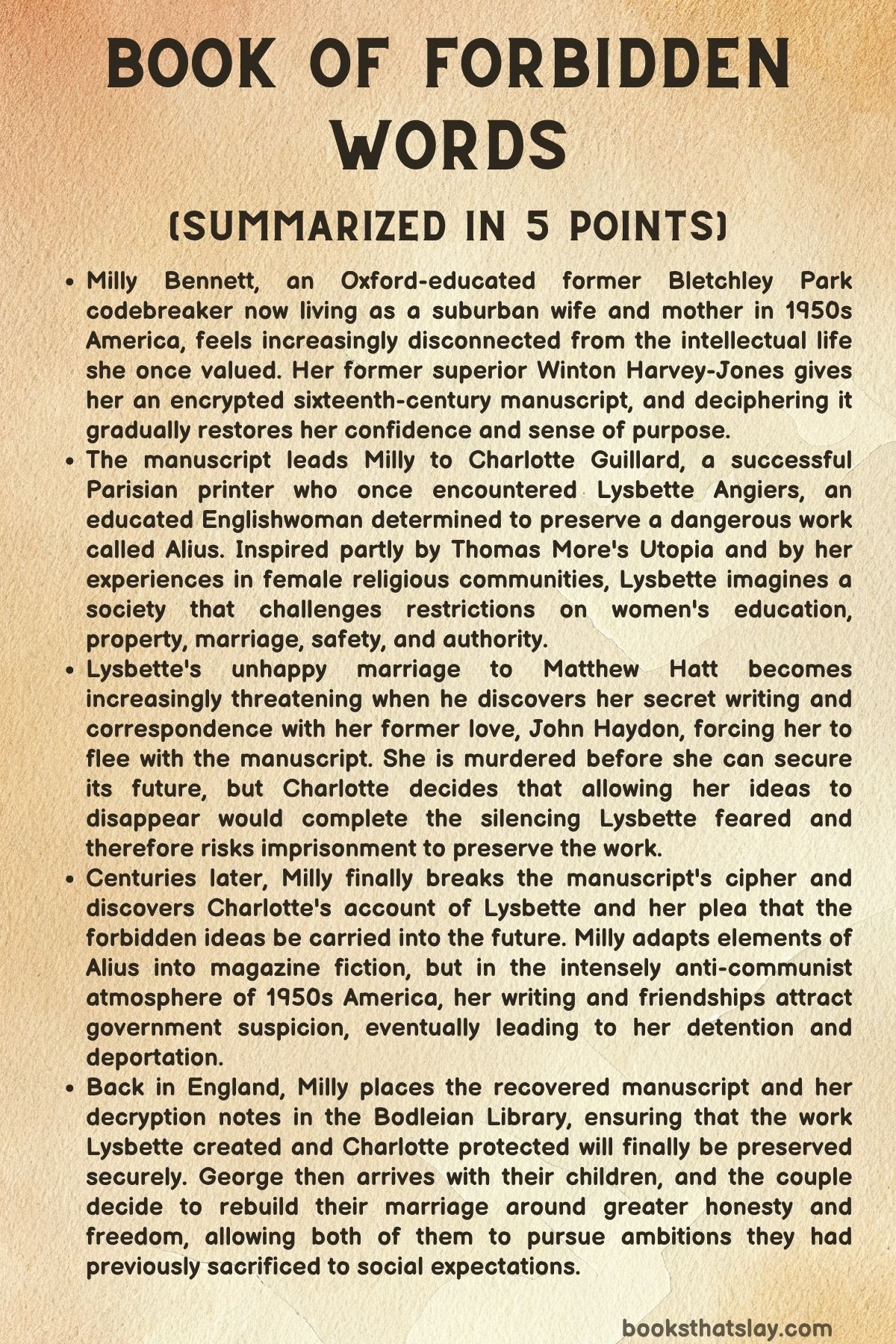
Summary
In 1952, Milly Bennett lives in Levittown, Long Island, with her American husband George and their children, Edward and Olive. Originally from England, she has never fully adjusted to a suburban world where women are expected to find fulfillment through housekeeping, motherhood, social gatherings, and maintaining the correct appearance.
Milly once studied Ancient Greek and Latin at Oxford and later performed important secret work at Bletchley Park during the Second World War. Her life changed after the war, however, and years devoted to marriage and children have left her feeling disconnected from the intelligent and ambitious woman she remembers being.
Her dormant intellectual life is reawakened when Winton Harvey-Jones, her former superior from Bletchley Park, unexpectedly visits. He explains that he possesses an old manuscript containing an unknown coded language, unusual illustrations, astrological designs, and repeated images of women, and he believes Milly may be uniquely qualified to decipher it.
Winton also reveals that he once tried to help Milly obtain intelligence work after the war, but officials rejected her because they assumed that a woman would eventually marry and leave employment. Milly learns that the career she thought had simply disappeared had actually been denied to her because of her gender.
Reluctantly at first, Milly accepts the manuscript. She hides it from George because explaining her qualifications would require revealing her wartime service, which she has been legally bound to keep secret.
The manuscript gradually becomes a source of excitement and purpose. As Milly studies its pictures and symbols, she recognizes that the prominent image of a sun may resemble a printer’s mark, leading her toward the sixteenth-century Parisian printing house known as the Soleil d’Or and its remarkable proprietor, Charlotte Guillard.
Charlotte’s story begins in Paris in 1552. She is an accomplished printer who controls a successful business despite operating in a profession dominated by men, and she regularly confronts commercial hostility, religious restrictions, and the danger of producing material authorities may regard as heretical.
One day, a frightened Englishwoman named Lysbette Angiers comes to Charlotte with a manuscript she has spent more than a decade writing. Lysbette believes its arguments could lead to accusations of heresy, sedition, sorcery, or worse, but she desperately wants copies printed so that the work cannot easily be destroyed.
Lysbette’s life explains why the manuscript matters so deeply to her. Orphaned as a child, she was taken into the household of Thomas More, who valued education and allowed her to study languages and classical texts alongside the other young people under his protection.
There she became close to John Haydon and fell in love with him. John introduced her to More’s Utopia, and the idea of using an imaginary society to question the real world became one of the foundations of her own later writing.
Their relationship was unacceptable to Alice More because Lysbette lacked money and status. After Alice discovered the young couple together, Lysbette was sent to Barking Abbey, effectively separating her from John and removing the possibility of an unsuitable marriage.
What initially felt like punishment gave Lysbette an unexpected education in female independence. At the abbey she saw women managing land, finances, charitable responsibilities, education, and communal affairs, contradicting claims that women naturally required male supervision.
Her friendship with Agnes further shaped her thinking, especially when Agnes described abuse and the social tendency to blame women who spoke about mistreatment. Lysbette began imagining a society where women’s safety, education, property, authority, and freedom were treated entirely differently.
Political events reinforced her conclusions. Thomas More’s execution demonstrated how dangerous disagreement with powerful rulers could become, while the destruction of the monasteries showed that even institutions considered permanent could be eliminated when political authority decided they no longer had a right to exist.
When Barking Abbey was dissolved, Lysbette lost another home and eventually returned to the circle surrounding More’s family. Without independent wealth, she was pressured into marriage with Matthew Hatt, a cloth merchant who valued her linguistic abilities partly because they were useful to his business.
Their marriage became increasingly oppressive. Lysbette continued working secretly on her imagined society, Alius, but Matthew eventually discovered evidence of her writing and correspondence with John, interpreting her independence as disobedience and her past affection as betrayal.
Alius had developed into a radical examination of marriage, education, violence, property, religion, government, and women’s social position. When Matthew became threatening, Lysbette understood that he could destroy both her work and her reputation by accusing her of immorality, witchcraft, or religious wrongdoing.
She fled with the manuscript, intending to seek help from Agnes and Charlotte. The journey ended in murder before she could complete her plan, leaving Charlotte to decide whether preserving Lysbette’s words was worth risking her own freedom.
Charlotte initially fears involvement, but reading Alius changes her position. She recognizes in Lysbette’s arguments many of the contradictions she herself has faced as a successful woman continually judged by standards that assume male authority.
She secretly arranges for the work to be preserved, disguising its nature and relying on trusted assistance. Authorities eventually raid her printing establishment, and Charlotte is imprisoned alongside Frédéric after an informant exposes their activities.
Charlotte survives interrogation partly because the authorities cannot easily interpret the Greek material involved. Her lawyer Riant also exposes the possibility that commercial enemies connected to the Paper Guild encouraged accusations against her because she had challenged their monopoly.
John Haydon later arrives with a letter from Lysbette explaining what should happen to her manuscript. He and Charlotte become allies in creating a system that will protect the text until a future reader can recover its meaning.
Four centuries later, Milly becomes that reader. After Winton dies, she continues the work and eventually notices that the manuscript’s astrological designs contain twenty-four symbol variations, corresponding to the ancient Greek alphabet.
Using these designs as a key, she finally deciphers the text. Charlotte identifies herself and explains that the manuscript preserves Lysbette’s dangerous work, condemning attempts to suppress knowledge and asking future readers to help the ideas survive.
The discovery transforms Milly’s private puzzle into a mission. She also begins writing for My Life magazine after editor Myra Bougas encourages her, first producing modern fables and later adapting ideas from Alius into fiction accessible to contemporary women.
Readers respond strongly. Letters arrive from women who recognize their own dependence, frustration, and sacrificed ambitions in the imaginary society, showing Milly that ideas written centuries earlier still speak directly to conditions in her own time.
Her activities become increasingly dangerous in an America obsessed with communist influence. The Minute Women encourage neighbors to watch one another, banned books disappear from libraries, and Milly’s friend Susan is targeted because of her politics, associations, private life, and willingness to make prohibited literature available.
When Susan is arrested and Milly’s own writing attracts official attention, Milly is questioned about Alius. George simultaneously discovers that she has secretly continued writing after promising him she would stop, forcing Milly to reveal her connection to Winton, her codebreaking abilities, and the manuscript.
But the manuscript and Milly’s decoding notebook have disappeared. Without physical evidence, her explanation sounds improbable even to George, and because she is not an American citizen, immigration law leaves her especially vulnerable.
Milly is detained at Ellis Island and threatened with deportation. To establish that she genuinely possessed the skills required to decipher the manuscript, she finally reveals information about her wartime service, breaking years of enforced silence because secrecy now threatens to separate her from her family.
Her appeal ultimately fails, and Milly is deported to Britain. George, hurt by years of concealed truths, cannot immediately promise that their marriage will survive, leaving Milly devastated by the possibility that she has lost both her American home and her daily relationship with her children.
In England, she stays with Aunt Tabatha, who urges her to see the upheaval as the beginning of another life. Milly decides to return the recovered manuscript and her notes to the Bodleian Library, where its historical importance is immediately recognized.
Milly asks to remain anonymous, satisfied that the words Lysbette wrote and Charlotte protected will finally be secure. She has completed a chain of preservation stretching across centuries and fulfilled the responsibility Winton placed in her hands.
When she returns to Aunt Tabatha’s home, she finds George, Edward, and Olive waiting for her. George has brought the children to England because he has realized that the family cannot continue without Milly.
The couple acknowledge that both had been living according to expectations that made them unhappy. George decides to leave banking and pursue his ambition to become a pilot, while Milly plans to complete the Oxford education interrupted by war.
Their future is not presented as a perfect version of Alius. Instead, they choose honesty, mutual freedom, and a marriage in which neither person must erase an essential part of themselves to preserve the appearance of domestic success.
Characters
Milly Bennett
Milly is the central modern protagonist of Book of Forbidden Words, and her development is shaped by the distance between what she knows she is capable of and the narrow role she has accepted. Her education, wartime codebreaking experience, linguistic skill, and curiosity make her intellectually formidable, yet postwar expectations have reduced the visible part of her identity to wife, mother, and suburban homemaker.
Her frustration never means that she does not love George or their children. What troubles her is the assumption that love for a family requires permanent abandonment of every ambition that belongs to her alone.
The manuscript gives Milly a route back to the part of herself she has neglected. Deciphering it restores her confidence, while writing for My Life allows her intelligence to move beyond private thought and influence other women.
Milly’s secrecy is also one of her important flaws. Some secrets are legally imposed through her wartime obligations, but others result from her fear of confronting George openly, and the accumulation of concealment eventually damages the trust between them.
Her detention and deportation force her to understand that political systems can define a person’s words regardless of that person’s intentions. By the end, she stops constructing her life around acceptance and instead begins creating a future in which family, education, work, and intellectual independence can exist together.
Lysbette Angiers
Lysbette is the intellectual source from which much of the novel’s conflict develops. Beginning as an orphan dependent upon Thomas More’s protection, she grows into a woman whose education teaches her to question structures that give other people authority over her future.
Her experience with John shows her early that intelligence does not eliminate social restrictions. She can read Greek, discuss philosophy, and understand complicated political ideas, yet poverty and gender still determine whether she is considered suitable for marriage.
Barking Abbey becomes crucial to her development because it provides practical evidence that women can successfully govern institutions and manage complicated responsibilities. Agnes’s experiences add a harsher lesson about the social protection given to abusive men and the vulnerability of women who challenge them.
Alius becomes Lysbette’s answer to these observations. Rather than merely complaining about individual injustices, she imagines an alternative social system and uses fiction to expose the assumptions behind marriage, authority, education, violence, property, and religion.
In Book of Forbidden Words, Lysbette is therefore both a victim of her age and a thinker capable of looking beyond it. Her murder silences her physically, but her determination to preserve Alius ensures that Matthew and the authorities surrounding her cannot determine the final fate of her ideas.
Charlotte Guillard
Charlotte is defined by competence, independence, caution, and an increasingly powerful sense of moral responsibility. She has survived as a woman controlling a major printing business by understanding when to challenge authority and when survival requires restraint.
Her initial refusal to print Lysbette’s manuscript is practical rather than cowardly. Charlotte knows that printers operate under surveillance and that a single accusation of heresy can destroy livelihoods, reputations, and lives.
Lysbette’s murder changes the ethical calculation. Once Charlotte understands that someone may have killed a woman partly to silence what she had written, preserving Alius becomes a way of refusing to cooperate with that erasure.
Charlotte’s decision is especially significant because she has wondered what legacy she can leave without children. By safeguarding another woman’s work, she ultimately discovers that preservation, intellectual courage, and the transmission of knowledge can form a legacy as meaningful as a biological inheritance.
Her later willingness to face imprisonment shows that she does not romanticize the danger of resistance. She understands the cost and acts anyway because allowing Lysbette’s work to disappear would mean accepting the principle that fear should determine which ideas survive.
George Bennett
George is not portrayed as a simple oppressive husband. He loves Milly, cares deeply for their children, and previously supported her through the painful period surrounding her mother’s illness.
His limitation is that he has absorbed a model of marriage in which a husband’s financial success should remove any need for his wife to work. Because he sees employment as a burden he can spare Milly, he initially fails to understand that intellectual work gives her something emotional and personal that financial comfort cannot replace.
George’s sense of betrayal after discovering Milly’s secrets is therefore understandable even when his earlier attitudes helped create the conditions for those secrets. The story allows both truths to exist: Milly had valid reasons to fear his reaction, and George has valid reasons to feel that important parts of his wife’s life were hidden from him.
His final decision to bring the children to England marks genuine change. He also abandons the secure career expected of him and chooses to train as a pilot, suggesting that both partners had been living according to roles that did not completely suit them.
Winton Harvey-Jones
Winton connects Milly’s wartime identity to the woman she becomes in Levittown. Unlike many people in her postwar life, he remembers her as an exceptionally capable codebreaker and immediately treats her intelligence as something valuable rather than inconvenient.
His admission that officials rejected Milly for postwar intelligence work gives her important knowledge about her past. She had interpreted the absence of opportunity as personal failure, whereas Winton reveals that institutional sexism played a decisive role.
The Van Hal manuscript is Winton’s final gift to Milly in more than a material sense. By trusting her with a puzzle others cannot solve, he restores the confidence that years of domestic isolation had weakened.
His death turns Milly’s curiosity into obligation. Continuing the investigation becomes her way of honoring someone who saw her abilities clearly when she had nearly stopped seeing them herself.
Susan Leeson
Susan represents intellectual freedom in Milly’s restrictive American environment. As a librarian who secretly preserves banned books, she treats access to literature as a principle worth defending even when doing so exposes her to suspicion.
Her friendship gives Milly an alternative to the socially controlled relationships of Levittown. Susan is interested in ideas, politics, literature, and genuine conversation rather than judging Milly according to domestic performance.
Her arrest demonstrates the real consequences of ideological fear. What initially appears to Milly as an argument over which books belong in libraries becomes a system capable of threatening a person’s employment, liberty, reputation, and personal safety.
John Haydon
John is Lysbette’s closest emotional and intellectual companion. His early friendship gives her affection, encouragement, and access to ideas that become fundamental to the creation of Alius.
Their love is important because it offers Lysbette a vision of companionship based partly on intellectual equality. Yet their inability to marry also demonstrates that affection cannot easily overcome the economic and social structures governing women’s lives.
Years later, John remains loyal to Lysbette’s final wishes. His journey to Paris and cooperation with Charlotte ensure that his role changes from lost romantic partner to guardian of the work that mattered most to the woman he loved.
The uncertainty surrounding Matthew Hatt’s later death adds a darker dimension to John. Charlotte suspects that he may have taken revenge, but his most lasting contribution remains his participation in preserving Lysbette’s intellectual legacy.
Thomas More
Thomas More is a complicated influence on Lysbette because he embodies both intellectual generosity and the limitations of his historical world. He rescues the orphaned girl, values her linguistic ability, supports female education, and surrounds her with books and debate.
His Utopia gives Lysbette the conceptual method she later adapts for her own purposes. She learns that an invented society can allow a writer to examine the flaws of the real one without presenting every argument as a direct political proposal.
More’s eventual execution also becomes a warning about the limits of intellectual freedom. His fate teaches Lysbette that education and status provide no permanent protection when conscience conflicts with concentrated political authority.
Alice More
Alice functions as one of the personal enforcers of the social order restricting Lysbette. Her opposition to Lysbette and John’s relationship comes primarily from concerns about wealth, suitability, inheritance, and family advancement.
She does not need to be personally cruel in every interaction to have enormous power over Lysbette. By helping determine where Lysbette lives and whom she may marry, Alice illustrates how women can participate in maintaining social structures that restrict other women.
Her later involvement in arranging Lysbette’s marriage to Matthew is especially significant. The match treats education and linguistic ability not as sources of independence but as qualities that increase Lysbette’s usefulness to a husband.
Agnes
Agnes is one of the most important influences on Lysbette’s understanding of women’s vulnerability and solidarity. Her account of abuse reveals the ease with which male authority can be protected while women who speak about mistreatment are disbelieved or condemned.
Her friendship also shows Lysbette the importance of women creating forms of protection for one another. Agnes offers practical support as well as intellectual influence, becoming one of the people Lysbette trusts with the future of her manuscript.
Even after their lives separate, Agnes remains part of the survival plan for Alius. Lysbette’s instruction that the work could be sent to her if printing proved impossible confirms the depth of that trust.
Matthew Hatt
Matthew represents the most personal form of coercive authority Lysbette encounters. Their marriage is founded less on mutual affection than on economic necessity and his recognition that her language skills can benefit his commercial interests.
As Lysbette continues writing privately, Matthew becomes increasingly threatened by the part of her life that he cannot control. Her manuscript and correspondence become evidence through which he can portray intellectual independence as marital disobedience.
His willingness to use accusations of immorality, religious wrongdoing, and possible witchcraft reveals the danger created when private power is reinforced by public prejudice. Lysbette understands that he can harm her not only physically but also by activating institutions already prepared to distrust unconventional women.
Myra Bougas
Myra provides Milly with a professional opportunity at precisely the moment when Milly has almost accepted that her intellectual life belongs to the past. She treats Milly’s education as relevant and valuable rather than as an unusual accomplishment that should be left behind after marriage.
Her offer to publish Milly’s writing gives Milly both creative purpose and personal income. The practical arrangement allowing Milly to cash checks also highlights how ordinary financial systems can reinforce dependence when married women lack money they control themselves.
Myra therefore becomes more than an editor. She is one of the people who helps Milly convert private frustration into public expression.
Doris Sykes
Doris initially appears as part of the Levittown social environment Milly finds intimidating. Her association with the Minute Women gradually exposes Milly to the political fear beneath apparently respectable suburban conformity.
Through Doris, Milly sees how ordinary citizens can become participants in surveillance. Neighbors are encouraged to monitor one another, and differences in politics, literature, sexuality, or social beliefs are treated as evidence of possible disloyalty.
Doris is not presented solely as a monster, however, because she later attempts to repair her relationship with Milly. Her character shows how people can participate in harmful movements while continuing to understand themselves as decent members of their communities.
Frédéric
Frédéric is Charlotte’s trusted collaborator in the dangerous attempt to preserve Lysbette’s work. His participation demonstrates that Charlotte cannot carry out the secret project entirely alone, especially within a printing establishment involving numerous workers.
His arrest beside Charlotte confirms the seriousness of his loyalty. He accepts personal risk in helping protect ideas that the authorities might condemn.
Antoine de Mouchy
Antoine de Mouchy represents institutional religious surveillance. His interrogation of Charlotte attempts to transform the seized material into proof of heresy, placing intellectual interpretation directly in the service of punishment.
His role illustrates how censorship operates through people who possess authority to define which interpretations are legitimate. Charlotte survives partly because she can exploit uncertainty about the Greek text and because her lawyer attacks the motives behind the accusation.
Riant
Riant provides Charlotte with the legal and strategic assistance necessary to survive her imprisonment. Rather than arguing only about abstract freedom, he investigates weaknesses in the prosecution and exposes the commercial interests that may lie behind the charges.
His role is important because it shows that accusations of religious wrongdoing can be manipulated for economic purposes. Rival businessmen can use political or religious institutions to attack someone whose commercial independence threatens them.
Aunt Tabatha
Aunt Tabatha becomes essential to Milly after deportation because she refuses to treat Milly’s ruined American life as proof that her future is over. She offers stability without demanding that Milly return to a passive role.
Her suggestion that Milly complete her Oxford degree redirects attention toward possibilities rather than losses. At a moment when Milly believes she may have lost her husband, children, and home, Aunt Tabatha reminds her that education and professional identity remain available.
Edward and Olive Bennett
Edward and Olive are central to Milly’s emotional choices even though they are too young to understand the political and marital conflicts around them fully. Her greatest fear during detention is not punishment for herself but permanent separation from her children.
They also complicate every decision she makes about independence. Milly does not seek freedom from motherhood; she wants a form of motherhood that does not require the disappearance of her other abilities.
Their reunion with her in England completes the family’s movement toward a different kind of life. George’s decision to bring them demonstrates that preserving the family ultimately requires change rather than simply restoring the old arrangement.
Mrs. Humphries
Mrs. Humphries represents the ambiguous nature of Levittown’s intense neighborliness. Her offers to help Milly with the children can be genuinely useful, but her questioning about Winton reveals how easily friendliness can become observation.
Through her, the novel establishes an environment in which private behavior attracts communal attention. That atmosphere later becomes more threatening when organized political movements encourage citizens to report supposedly suspicious neighbors.
Mr. Tompkins
Mr. Tompkins, the Bodleian curator, gives Milly something she has been denied repeatedly: immediate professional recognition of her achievement. He understands the historical importance of the manuscript and regards her decipherment as extraordinary work.
His response confirms that Milly’s years of secret effort were not merely a private obsession. By accepting the manuscript into the library and proposing her for an Oxford award, he helps transform hidden labor into acknowledged scholarship.
Themes
Censorship, Fear, and the Survival of Ideas
Across Book of Forbidden Words, censorship is shown not simply as the removal of objectionable books but as a wider system in which fear determines what people are permitted to read, write, discuss, and sometimes even think. Lysbette fears execution or denunciation because Alius questions accepted assumptions, while Charlotte knows that printing the manuscript could expose her entire business to accusations of heresy.
The same mechanism appears centuries later in Milly’s America through banned books, political investigations, the Minute Women, and Susan’s arrest. The vocabulary changes from heresy to communism, but the pattern remains recognizable: authorities define certain ideas as dangerous and then encourage institutions and ordinary citizens to isolate those associated with them.
The manuscript survives because individuals repeatedly refuse to accept that official condemnation should decide the life of an idea. Lysbette writes despite knowing the danger, Charlotte preserves the work despite imprisonment, John assists with its protection, Winton searches for its meaning, and Milly finally deciphers it.
The novel therefore treats preservation as an active form of resistance. A book survives not because history naturally protects important ideas but because people repeatedly choose to protect them, sometimes without knowing whether anyone in their own lifetime will understand why the effort matters.
Women’s Autonomy and the Roles Assigned to Them
Lysbette and Milly live four centuries apart, yet both discover that education does not automatically produce freedom. Lysbette can read classical languages and discuss philosophy, but her guardians can still separate her from John, send her to an abbey, and later help arrange a marriage she accepts largely because she lacks independent wealth.
Milly faces a less openly coercive version of the same problem. She has an Oxford education and wartime experience solving problems of national importance, yet marriage and postwar culture encourage her to treat those accomplishments as irrelevant once she becomes a mother.
The female communities around both women provide alternative models. Barking Abbey shows Lysbette women managing property and institutions, while Susan, Myra, and other women encountered by Milly demonstrate forms of intellectual, professional, and political independence that challenge Levittown’s domestic ideal.
The theme is not an argument against marriage or motherhood. Milly loves her family, and Lysbette’s early hopes with John show that companionship itself is not the problem.
The conflict arises when social systems make dependence compulsory and treat women’s ambitions as less legitimate than men’s. Freedom becomes possible only when relationships allow women to remain complete individuals rather than rewarding them for suppressing parts of themselves.
Secrecy, Truth, and Identity
Secrets protect nearly every major woman in the story, but they also create serious emotional and practical consequences. Lysbette writes Alius secretly because open authorship could lead to destruction, while Charlotte relies on codes and concealed printing arrangements because preservation depends upon avoiding official attention.
Milly’s situation demonstrates the complicated moral nature of secrecy particularly clearly. Her silence about Bletchley Park is initially imposed by national security obligations, but that enforced secrecy helps create a habit of dividing her inner and outer lives.
She later conceals Winton’s manuscript, her writing, and her professional ambitions from George because she expects resistance. Those decisions allow her intellectual life to grow, but they simultaneously weaken the honesty required for her marriage to function.
The irony becomes severe when Milly needs the truth about her past to save herself. Because her greatest accomplishment has been hidden for years, authorities can treat her explanation of the manuscript as unbelievable.
The story therefore avoids presenting secrecy as either wholly noble or wholly destructive. Sometimes concealment is necessary for survival, yet prolonged concealment can distort relationships and erase achievement.
Milly and George’s final agreement to have no more secrets represents more than marital reconciliation. It signals their decision to build a life in which neither person should have to hide an essential ambition simply to preserve the relationship.
Fiction, Legacy, and Communication Across Generations
Alius begins with Lysbette’s realization that an imaginary society can make reality easier to question. Inspired by Utopia, she understands that fiction can create distance between a writer and a dangerous argument while also allowing readers to consider arrangements they might reject if presented as direct political demands.
Milly later repeats this process in another era. By adapting the ideas of Alius for My Life, she discovers that imaginary societies and modern fables allow women to recognize dissatisfaction they may struggle to describe directly.
The enthusiastic letters from readers demonstrate fiction’s ability to overcome isolation. Women who believe their frustrations are private discover that strangers have experienced similar conflicts between comfort, dependence, ambition, and social expectation.
Legacy is consequently defined through transmission rather than fame. Lysbette dies without seeing her manuscript influence the world, and Charlotte spends years ensuring that a future reader might eventually recover it.
Milly ultimately refuses personal publicity when she gives the manuscript to the Bodleian Library. What matters is not that one of the women receives permanent public recognition but that the ideas survive long enough to reach someone capable of continuing the conversation.
The story turns literature into communication across centuries. Words outlive the political authorities, marriages, institutions, fears, and social rules that once seemed powerful enough to silence them.