Angelfall by Susan Ee Summary, Characters and Themes
Angelfall by Susan Ee is a young adult post-apocalyptic fantasy about survival, loyalty, and uneasy alliances in a world ruined by angels. The story follows Penryn Young, a seventeen-year-old girl trying to protect her disabled younger sister and mentally ill mother after civilization collapses.
When angels attack and her sister is taken, Penryn is forced to work with Raffe, a wounded angel whose own enemies have cut off his wings. The book mixes danger, dark humor, family devotion, and tense romance while asking what people become when the old world is gone. It’s the first book of the Penryn & the End of Days series.
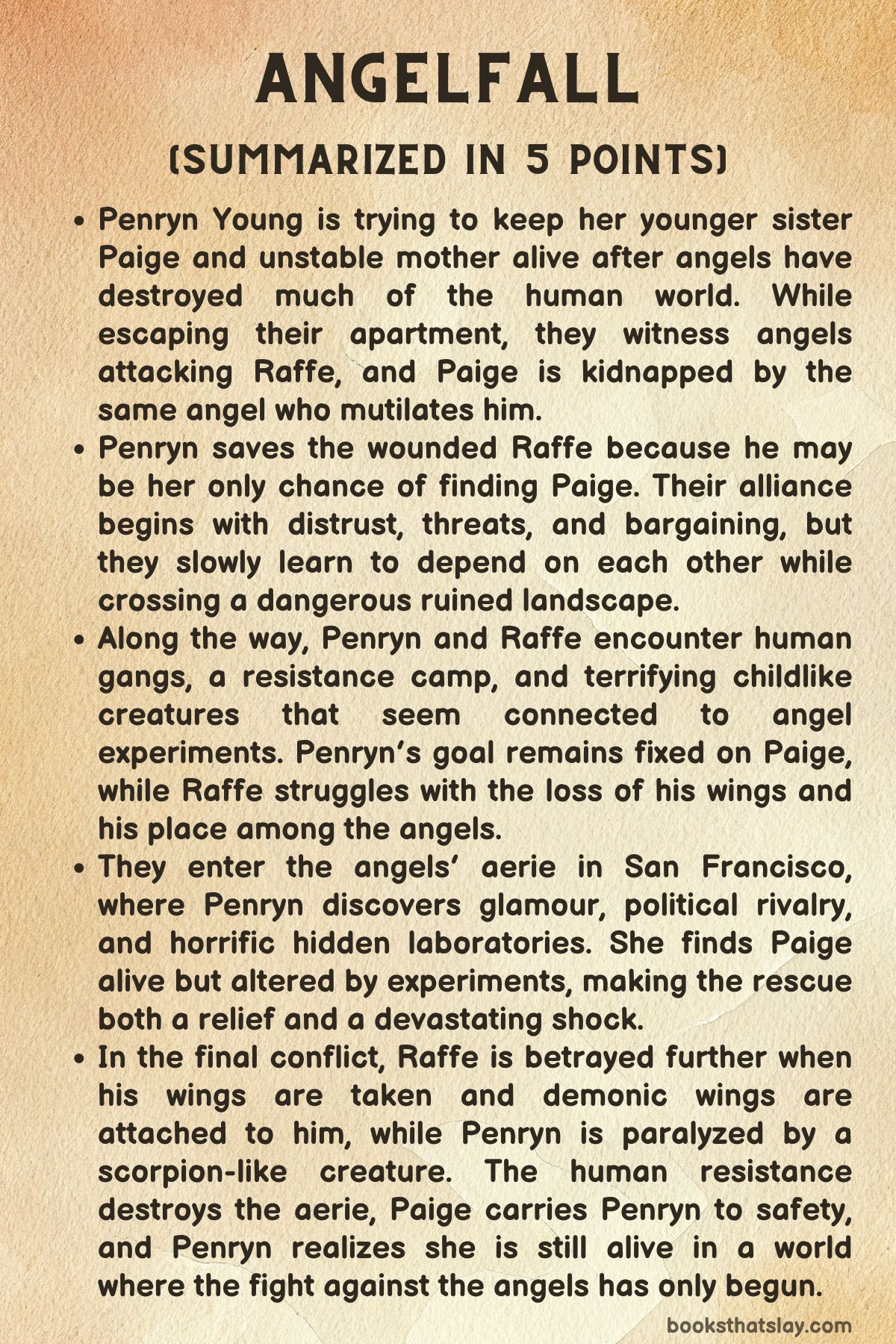
Summary
Penryn Young lives in a world that has fallen apart after angels descended and destroyed major cities. She is only seventeen, but she has become the practical head of her family.
Her mother struggles with severe mental illness and often behaves in frightening, unpredictable ways. Her younger sister Paige uses a wheelchair, so Penryn must think for all three of them every time they move.
Their apartment is no longer safe, and Penryn decides they need to leave under cover of night, when the streets are dangerous but slightly less exposed than during the day.
As they move through the ruins of Silicon Valley, the damage of the new world is everywhere. Abandoned cars block the roads, old phones lie useless on the ground, and gangs claim territory with warnings.
Penryn tries to keep her family quiet and focused, though her mother’s strange behavior makes every decision harder. Their journey changes completely when angels descend nearby.
Penryn has heard of angels attacking cities, but seeing them in person is different. They are beautiful, armed, and terrifying.
One angel, later known as Raffe, is attacked by a group of other angels. They cut off his wings in a brutal act of punishment.
Penryn would have stayed hidden, but Paige makes a small sound of pity, drawing attention. When the attackers notice them, Penryn acts without time to think.
She grabs Raffe’s sword and throws it to him, helping him fight. The moment gives Raffe a chance, but it also places Penryn’s family in greater danger.
A massive angel named Beliel takes Paige and flies away with her.
Penryn cannot accept that Paige is gone for good. Her mother disappears into the chaos, and Penryn is left with Raffe, who is badly wounded and near death.
She decides that the enemy of her enemy may be useful. If Raffe knows where angels go, he may be her only path to Paige.
She bandages him, loads him into Paige’s wheelchair, gathers his severed wings, and escapes with him.
For a while, Penryn hides with Raffe in an abandoned office building. He is weak, angry, and difficult, while she is desperate and unwilling to be intimidated.
Their relationship begins with threats and bargaining. Penryn wants information about Paige.
Raffe wants his wings and his sword. Neither fully trusts the other, but both understand that survival may require cooperation.
Penryn’s mother finds them, leaving behind signs of her disturbing presence. Penryn has long lived with fear of her mother’s illness, and the apocalypse has made that fear harder to manage.
Her mother can be loving one moment and dangerous the next. Still, Penryn cannot simply abandon her.
She has spent much of her life protecting Paige and managing their mother’s unstable behavior. Those responsibilities have made her tough, watchful, and skilled in self-defense.
After a gang invades the office building, Penryn and Raffe fight their way out. Their uneasy partnership grows stronger because they keep saving each other, even while arguing.
They travel through ruined neighborhoods, abandoned houses, and forested areas, trying to reach the angels’ aerie in San Francisco. Along the way, Penryn learns more about Raffe.
He is not simply a monster from the sky. He is proud, secretive, wounded, and cut off from the world he knew.
He also knows little about surviving on the ground without his wings.
Their journey brings them to a human resistance camp led by Obadiah West, called Obi. The camp is organized but rough, made up of people trying to build an army against the angels.
Obi wants to strike back, not necessarily to win one battle, but to prove humans can resist. Penryn and Raffe are held there because the camp cannot risk outsiders revealing its location.
Penryn meets the clever twins Dee and Dum, who notice everything and later become useful allies.
In the camp, Penryn’s fighting ability becomes public after she beats a man who harasses her. The people around her treat the fight almost like entertainment, a sign of how brutal life has become.
Dee and Dum offer to help her escape if she agrees to help with one of their schemes. Before things can play out fully, terrifying childlike creatures attack nearby soldiers.
Raffe recognizes that these beings are not normal angels. They resemble monstrous experiments, and their existence points to something deeply wrong behind the angels’ power.
Raffe tries to separate from Penryn, believing anyone close to him ends badly. Penryn follows anyway and is attacked by the strange creatures.
Raffe saves her, and the two continue toward San Francisco. They discover horrifying evidence of people being eaten alive and see signs that Penryn’s mother has passed through the same areas.
Penryn keeps pushing forward because Paige remains her main purpose.
As they near San Francisco, Penryn and Raffe disguise themselves to enter the aerie, which is located in a former hotel. The place is shocking.
Angels dress in glamorous old-fashioned clothing, drink, party, and surround themselves with human servants and women hoping to be admitted. Penryn also sees her mother outside the entrance, working with cattle prods and frightening people while lost in her own beliefs.
Penryn cannot stop to save her, because Paige must come first.
Inside the aerie, Raffe moves carefully to avoid being recognized. Penryn learns that he is not just any angel, but Raphael, a major figure in angel politics.
After the death of Gabriel, the position of Messenger has become a source of conflict. Raffe and Uriel are both possible candidates, but Raffe’s missing wings make him vulnerable.
Many believe he may have fallen, especially because rumors connect him to monstrous children.
Raffe contacts Josiah, an angel who once served him, and then Laylah, a beautiful angel scientist who may be able to reattach his wings. Laylah agrees to perform surgery, but Penryn distrusts her.
Raffe knows he has little choice. Without wings, he has lost not only flight but also status, safety, and part of his identity.
While Raffe goes to Laylah, Penryn searches for Paige. With help from one of the twins, she enters the lower levels of the hotel.
Her mother joins her there, and together they discover a hidden laboratory filled with nightmarish experiments. Human beings are being fed to scorpion-like creatures in glass tanks.
Children’s bodies are stacked nearby, marked by surgery and cruel modifications.
Penryn finally finds Paige among the bodies. Paige is alive, but changed.
She has been stitched, altered, and given metal teeth. The reunion is both a relief and a horror.
Penryn loves her sister, but she is forced to face what has been done to her. When an angel attacks Penryn, Paige saves her by tearing into him with her new teeth, then returns to her childlike self and calls Penryn by an old nickname.
The lab erupts into chaos. Penryn frees a trapped woman and one of the scorpion creatures.
Raffe appears, fighting Beliel, the angel who stole his wings. The truth is worse than Penryn expected: Beliel now wears Raffe’s angel wings, while Raffe has been given demonic-looking bat wings.
The change is meant to destroy Raffe politically and spiritually. His own sword rejects him when he tries to hold it, but Penryn can use it, and she attacks Beliel herself.
During the fight, a scorpion creature stings Penryn. She becomes paralyzed, unable to speak or move.
Raffe believes she is dying and is devastated. Uriel arrives and stops Beliel from killing Raffe immediately, preferring to ruin him first by making him appear fallen.
Raffe destroys the lab in rage, then carries Penryn out, even though doing so risks exposing himself.
Above, the resistance attack is underway. The hotel has become a battlefield, with humans striking back against angels.
Raffe brings Penryn to Obi’s people and leaves her with her family because he cannot remain among humans in his altered form. The resistance believes Penryn is dead and wants to abandon her, but Paige carries her to safety.
As the humans flee, the aerie explodes and collapses. The survivors cheer because, for the first time, they have won a visible victory against the angels.
Penryn, still trapped in her body, understands that humanity has entered open war. Later, she sees Raffe flying above, watching over them before being driven away by gunfire.
At last, Penryn begins to recover from the paralysis. She cannot move fully yet, and others still think she is dead, but she knows she is alive.
Paige is alive too, and Raffe is somewhere in the sky. In a ruined world, that is enough to keep her going.
Characters
Penryn Young
Penryn Young is the central force of the book, a seventeen-year-old girl who has been pushed into adulthood long before she is ready. Her defining quality is responsibility: she protects her younger sister Paige, manages the dangers caused by her mother’s mental illness, and makes survival decisions in a world where hesitation can cost lives.
Penryn is not fearless in a simple sense; she is often terrified, exhausted, hungry, and unsure. What makes her compelling is that she acts anyway.
Her courage comes from attachment rather than pride. Paige’s kidnapping gives her a purpose so intense that she is willing to bargain with an angel, travel through ruined territory, enter the aerie, and face horrors that would break many people.
Penryn’s toughness is rooted in her past. Her mother forced her into self-defense training, and what once seemed excessive becomes one of the reasons she survives.
She is physically capable, but her real strength lies in adaptation. She can fight gang members, lie convincingly, assess danger quickly, and use whatever resources are available.
At the same time, she is not emotionally hardened beyond feeling. She worries about her appearance around Raffe, feels guilt over her mother, mourns the loss of Paige’s wheelchair, and is shaken by the suffering she witnesses.
In Angelfall, Penryn represents human endurance without turning into a cold action figure. She is brave, sarcastic, loving, and flawed, and her humanity matters because the world around her constantly tries to strip people of it.
Raffe / Raphael
Raffe begins the story as an enemy figure, an angel caught in a violent attack by his own kind. His severed wings immediately place him in a state of humiliation, vulnerability, and rage.
As Raphael, he has status and power among angels, but as Raffe on the ground, he is wounded, dependent, and forced to rely on a human girl he would normally keep at a distance. This reversal is central to his character.
He is proud, secretive, and often cutting in his speech, yet the loss of his wings exposes a deep grief that he rarely names directly.
Raffe’s relationship with Penryn develops through conflict rather than instant trust. He mocks her, withholds information, and tries to push her away, but his actions repeatedly show concern.
He saves her from the creatures in the woods, comforts her after nightmares, helps her enter the aerie, and carries her back to her family when he believes she is dead. His emotional restraint is partly personal and partly cultural.
Angels are forbidden from becoming involved with humans, and Raffe has built his identity around discipline and distance. His attraction to Penryn threatens not only his beliefs but also his political standing.
Raffe is also important because he complicates the image of angels as simple villains. He does not fully understand why the angels have acted as they have, and he is disturbed by the experiments and corruption he sees.
His agnosticism makes him especially interesting: although he belongs to a heavenly order, he does not blindly accept divine certainty. His forced transformation, when demonic wings are attached to him, becomes both physical punishment and symbolic exile.
He is left caught between categories, no longer accepted by angelic power but not truly human either.
Paige Young
Paige Young is Penryn’s younger sister and the emotional center of Penryn’s journey. At the beginning of the book, Paige is vulnerable because she uses a wheelchair and depends on Penryn for movement and protection.
Yet she is not written only as helpless. Her kindness is what first exposes the family to danger when she reacts with pity to Raffe’s suffering.
That moment shows her innocence but also her moral sensitivity. She sees pain and responds to it, even in a world where compassion can be dangerous.
Paige’s abduction transforms the story into a rescue mission, but her later return changes the emotional meaning of that mission. When Penryn finds her, Paige has been surgically altered and made frightening.
Her metal teeth, stitched body, and violent hunger turn her into a visible victim of angelic experimentation. The horror is not simply that Paige has been changed; it is that Penryn must decide whether the sister she loves is still present within the altered body.
Paige’s use of Penryn’s childhood nickname answers that question in a painful way. She is changed, but she is not gone.
Paige also challenges ideas about innocence. After her transformation, she can kill with terrifying force, yet she remains emotionally childlike and attached to her family.
Her character shows that survival may leave marks that cannot be undone. Penryn’s love for Paige becomes more difficult, but also more meaningful, because she chooses not to abandon her when love is no longer easy or comforting.
Penryn’s Mother
Penryn’s mother is one of the most unsettling and unpredictable figures in the novel. Her schizophrenia is untreated in the collapsed world, and her behavior shifts between protective, frightening, absurd, and strangely effective.
She carries rotten eggs, marks clothing with stars, speaks of demons, and leaves disturbing signs behind her. At times she seems detached from reality, but at other times her paranoia helps her survive dangers that more rational people miss.
The book does not present her only as an obstacle. She is a source of fear for Penryn, but she is also a mother who loves her daughters in ways distorted by illness and trauma.
Her past with Paige is shadowed by guilt. The circumstances around Paige’s paralysis remain painful and unclear, and Penryn carries deep suspicion and fear because of it.
This makes the family dynamic tense. Penryn loves her mother, but she also cannot fully trust her.
Their relationship has been shaped by care, resentment, duty, and survival. Penryn has become the adult in the family partly because her mother cannot consistently fill that role.
At the same time, Penryn’s mother repeatedly survives situations that should kill her. She appears near the office building, at the aerie gates, and in the underground areas beneath the hotel.
Her strange logic gives her access to places others might avoid. She can be comic in a dark way, but the comedy never erases the sadness of her condition.
She represents the burden of loving someone who is both vulnerable and dangerous.
Obi / Obadiah West
Obi is the leader of the human resistance camp and serves as a contrast to Penryn’s individual mission. While Penryn is focused on saving Paige, Obi is thinking about humanity as a whole.
He wants to organize people, build an army, and strike back against the angels in a way that gives humans hope. His leadership is practical rather than sentimental.
He feeds people, creates order, and maintains discipline, but he also refuses to release Penryn and Raffe because their freedom could endanger the camp.
Obi’s moral position is complex. He is not cruel for pleasure, but he accepts harsh methods as necessary.
He allows fights to happen because he believes people will behave more carefully if they know no one will rescue them from foolish choices. He sees individuals as part of a larger struggle, which makes him admirable and troubling at the same time.
His refusal to prioritize Paige’s rescue frustrates Penryn, but from his point of view, one child cannot outweigh the survival of the resistance.
Obi’s importance grows during the attack on the aerie. His plan proves that humans are not merely victims waiting to be hunted.
He gives people a structure for resistance and turns scattered fear into collective action. In Angelfall, Obi represents organized human defiance, the belief that even a broken species can fight back if people are willing to risk everything together.
Dee and Dum
Dee and Dum are the redheaded twins who bring cleverness, humor, and uncertainty into the story. Their chosen names suggest their refusal to be trapped by the old world’s rules.
In the resistance camp, they function as observers, schemers, and information brokers. They notice details others miss, hear conversations, and turn chaos into opportunity.
Their offer to help Penryn escape in exchange for staging a fight shows both their opportunism and their usefulness.
The twins are not traditional heroic figures. They are playful, evasive, and always seem to be running some kind of private plan.
Yet they repeatedly help Penryn at key moments. One of them appears inside the aerie as a servant, showing how deeply the resistance has infiltrated angel-controlled spaces.
Their ability to move between roles makes them valuable in a world where survival depends on flexibility.
They also add energy to the darker parts of the book. Their humor does not remove the danger, but it gives the human side of the story a sense of wit and improvisation.
They suggest that resistance is not only about weapons and speeches. Sometimes it is about listening, sneaking, lying well, and knowing when to open the right door.
Beliel
Beliel is one of the clearest antagonistic forces in the book. He is physically brutal, politically ambitious, and personally sadistic.
His first major act is the mutilation of Raffe, cutting off his wings and taking Paige in the process. This establishes him as a figure of violence and humiliation.
He does not merely want to defeat Raffe; he wants to degrade him.
His later return with Raffe’s wings attached to his own body makes him even more disturbing. The wing swap is not only a bodily violation but a political move.
By giving Raffe demonic wings, Beliel helps create the appearance that Raffe has fallen. He understands that reputation matters among angels and that destroying someone’s image can be as useful as killing him.
This makes him dangerous beyond physical strength.
Beliel also exposes the cruelty within angelic politics. He is not acting like a noble warrior carrying out divine justice.
He acts out of rivalry, ambition, and contempt. His treatment of Penryn as Raffe’s supposed human weakness shows how he uses emotional bonds as weapons.
He sees love and loyalty as vulnerabilities to exploit.
Uriel
Uriel is dangerous because his cruelty is polished rather than openly chaotic. He appears charming, controlled, and even kind on the surface, but the fear of the women around him reveals the truth beneath that public face.
He is politically intelligent and knows how to use appearances. Unlike Beliel, who often relies on force, Uriel understands timing, reputation, and manipulation.
His role in the angelic power struggle is central. With Gabriel dead, the position of Messenger has become a prize, and Uriel is one of the leading contenders.
He knows that killing Raffe too soon could turn him into a martyr. Instead, he prefers to let Raffe be seen as fallen, damaged, and unworthy.
This shows Uriel’s strategic mind. He does not simply want Raffe dead; he wants him discredited.
Uriel’s mockery of Raffe’s grief over Penryn shows his emotional emptiness. He treats affection as evidence of weakness and uses it to shame his rival.
His character represents corruption hidden beneath elegance. He is frightening because he understands both heavenly politics and human fear, and he uses both without remorse.
Laylah
Laylah is a scientist, surgeon, and power player within the angelic world. She is beautiful and controlled, but her beauty contrasts sharply with the horror of her work.
Her laboratory reveals the full extent of the cruelty behind the angels’ presence on earth. The altered children, the scorpion-like creatures, and the living victims in tanks suggest a mind that treats bodies as materials rather than lives.
Her interaction with Raffe shows that she knows her own value. She is one of the few who may be able to restore his wings, and she uses that need as leverage.
Her flirtation and bargaining are not signs of warmth; they are tools. She understands that Raffe has few options, and she makes him pay for that vulnerability.
Laylah’s character is important because she shifts the book’s horror from battlefield violence to medical violation. The danger is not only that angels can kill humans openly.
It is that they can experiment on them in hidden rooms, rename them specimens, and erase their personhood. Through Laylah, the story shows a form of evil that is clean, organized, and professional.
Josiah
Josiah is a minor but important figure because he reveals the political stakes surrounding Raffe. As an angel who once served under him, Josiah carries traces of loyalty, fear, and self-preservation.
He does not openly betray Raffe, but he is also not brave enough to fully protect him. His behavior shows how dangerous the angelic hierarchy has become.
Even those who respect Raffe are afraid of being associated with him.
Through Josiah, Penryn and the reader learn more about Raffe’s true identity, the vacancy left by Gabriel’s death, and the rumors that Raffe may have fallen. Josiah’s reluctance to discuss the kidnapped children also suggests that he knows more than he is willing to say.
His fear is revealing. Whatever is happening inside the aerie is powerful enough to silence even angels.
Josiah is not a villain in the direct sense, but he is morally compromised. He helps Raffe reach Laylah, yet his caution protects himself first.
His character shows how corrupt systems survive: not only through monsters like Beliel, but through fearful people who know something is wrong and still choose safety over truth.
Anita
Anita is a smaller character, but she plays a useful role in exposing the social dynamics of the resistance camp. She is attractive, confident, and interested in Raffe, which immediately places her in tension with Penryn.
Her planned fight with Penryn is shaped by the camp’s rough entertainment culture, where violence becomes spectacle and women can be pushed into humiliating roles for profit.
Anita’s importance is less about her personal development and more about what she reveals around Penryn. Penryn’s response to Anita shows her jealousy, embarrassment, and quick thinking.
By provoking Anita at the right moment, Penryn protects Raffe’s secret and creates the distraction she needs. Anita becomes part of the messy, improvisational way Penryn survives.
She also reflects how quickly social behavior adapts after collapse. Even in a resistance camp fighting angels, old patterns of rivalry, attraction, performance, and public judgment remain.
Anita’s presence reminds the reader that the apocalypse has changed the world, but it has not erased human vanity or competition.
Boden
Boden is the guard who harasses Penryn and becomes her opponent in the camp fight. He represents the kind of ordinary human threat that survives alongside supernatural danger.
The angels may be the grand enemy, but men like Boden show that human cruelty has not disappeared. He abuses what little power he has, targets Penryn sexually, and expects intimidation to work.
Penryn’s defeat of Boden is important for her standing in the resistance camp. Until then, many people see her as a captive girl or an outsider.
After the fight, they understand that she is dangerous in her own right. The scene also shows the practical value of her training and her refusal to accept victimhood.
Boden’s role is brief, but it matters because the book does not let human beings appear automatically noble just because angels are worse. The human side contains bravery, organization, humor, and loyalty, but also exploitation and brutality.
Boden embodies that uglier side.
The Politician / Uriel’s Public Mask
The angel Penryn first notices as a politician-like figure stands out because of his ability to appear kind while inspiring terror. This public mask is part of Uriel’s danger.
He smiles warmly, approaches smoothly, and presents himself with social ease. Yet the women around him are afraid, which tells Penryn that charm in the aerie cannot be trusted.
This version of Uriel matters because it shows how power disguises itself. Open violence is easy to recognize, but polished authority can be more difficult to challenge.
Penryn’s instinctive discomfort around him proves her ability to read emotional truth beneath appearances. In a place filled with glamour, music, and formal clothing, her survival depends on noticing fear.
The Scorpion Creatures
The scorpion-like beings are not characters in the usual emotional sense, but they are central to the book’s horror. They are living evidence that someone among the angels has been creating unnatural weapons or experimental life forms.
Their bodies combine angelic, human, and monstrous qualities, making them difficult to categorize. That uncertainty is part of what makes them frightening.
They also connect several parts of the story: the strange childlike attackers in the woods, the victims in the tanks, the mutilated children, and Paige’s transformation. Their existence suggests that the war between humans and angels is not only military.
It is biological, experimental, and deeply invasive. Bodies are being changed into tools.
The creature that stings Penryn changes the course of the ending. Its venom leaves her paralyzed and makes others believe she is dead.
Through that moment, the creatures become more than background horror. They directly force Raffe to reveal his grief and force Paige to carry Penryn back to the human survivors.
Themes
Survival and the Cost of Responsibility
Survival in this story is not only about staying alive; it is about deciding what parts of the self can be preserved when the world rewards ruthlessness. Penryn survives because she is practical, trained, observant, and willing to make hard choices, but her survival is tied to responsibility rather than self-interest.
She is not trying to save herself alone. Paige and her mother are always part of her calculations, even when protecting them makes escape harder.
This gives her courage a moral weight. She cannot run freely because love keeps pulling her back into danger.
The ruined world constantly pressures people to abandon the weak, the injured, and the inconvenient. Penryn’s refusal to abandon Paige, even after Paige has been altered into something frightening, becomes one of the clearest statements of the book.
Responsibility is painful because it does not end when the person being protected changes. It may become harder, less rewarding, and more frightening, but Penryn continues anyway.
Angelfall presents survival as a test of loyalty under pressure. The question is not just who can live through disaster, but who can live through it without surrendering the bonds that make life worth defending.
Humanity Against Inhuman Power
The conflict between humans and angels is not a simple battle between weak and strong. It is a struggle between a shattered species and a superior force that has become arrogant, divided, and morally rotten.
The angels possess flight, weapons, beauty, and political hierarchy, while humans are hungry, displaced, and poorly organized. Yet the humans still find ways to resist.
Obi’s camp shows the beginning of collective defiance, where people with little training attempt to become an army because submission is no longer acceptable. The attack on the aerie matters because it changes the emotional balance of the war.
Humans see that angels can be hurt, surprised, and forced to retreat. That knowledge is powerful.
At the same time, the book does not idealize humanity. Humans form gangs, harass one another, turn fights into entertainment, and sometimes behave with cruelty.
Their value lies not in purity but in their capacity to choose resistance despite fear and failure. Against angelic power, humanity’s greatest weapon is not strength but refusal: refusal to disappear quietly, refusal to stop loving, refusal to accept that beauty and authority are the same as goodness.
The Corruption of Beauty and Authority
Angels traditionally suggest holiness, protection, and moral order, but the story overturns that expectation by making beauty deeply suspicious. The angels are physically magnificent, but their actions are often cruel, political, and predatory.
Their elegance at the aerie, with formal clothing, music, parties, and glamorous surroundings, hides laboratories, mutilated children, and human suffering. This contrast is one of the book’s strongest ideas.
Evil does not always arrive looking ugly or chaotic. Sometimes it arrives dressed well, speaking smoothly, and claiming power through hierarchy.
Uriel’s polished charm and Laylah’s beautiful appearance are especially important because both conceal terrifying moral emptiness. Raffe complicates the pattern because he is also beautiful and powerful, yet capable of loyalty, doubt, and grief.
This prevents the theme from becoming simplistic. The issue is not beauty itself, but the trust people place in appearances.
Penryn survives partly because she learns to read beyond surfaces. She notices fear in women who should appear privileged, weakness beneath angelic confidence, and humanity inside damaged bodies.
The book repeatedly asks readers to distrust spectacle and look instead at actions, choices, and the treatment of the vulnerable.
Family, Loyalty, and Unconditional Love
Family in the novel is messy, frightening, and sometimes painful, but it remains one of the strongest reasons characters keep going. Penryn’s family is far from ideal.
Her mother’s illness has caused trauma, fear, and uncertainty. Paige’s disability has placed practical demands on Penryn from a young age.
After Paige is taken and later transformed, the family becomes even more complicated. Yet the bond does not vanish.
Penryn’s love is not soft or easy; it is active, stubborn, and often angry. She loves Paige enough to cross dangerous territory, enter the aerie, and face the truth of what has been done to her.
She loves her mother in a more conflicted way, balancing care with caution because her mother can be both protective and dangerous. Raffe’s growing loyalty to Penryn mirrors this theme from outside the family structure.
He tries to deny attachment, but his actions reveal it. The story suggests that love is not proven by perfect feelings.
It is proven by return: returning for the wounded, the changed, the difficult, and the nearly lost. Loyalty becomes meaningful because it survives horror rather than avoiding it.