Anger Is Only a Shadow Summary, Characters and Themes
Anger Is Only a Shadow by Elizabeth Acevedo is a young adult novel about Liliana “Lil” Pantaleon-Ortiz, a teenager caught between juvenile detention, family crisis, friendship, inherited stories, and her own dangerous impulses.
At its center is Lil’s struggle to understand what strength actually means. She has long associated survival with hardness, loyalty, secrecy, and quick action, but her brother Aldwin’s mental-health crisis forces her to reconsider those beliefs. Through confinement, books, new friendships, family conflict, and painful consequences, Lil gradually learns that restraint, honesty, vulnerability, and accepting help can demand more courage than rebellion.
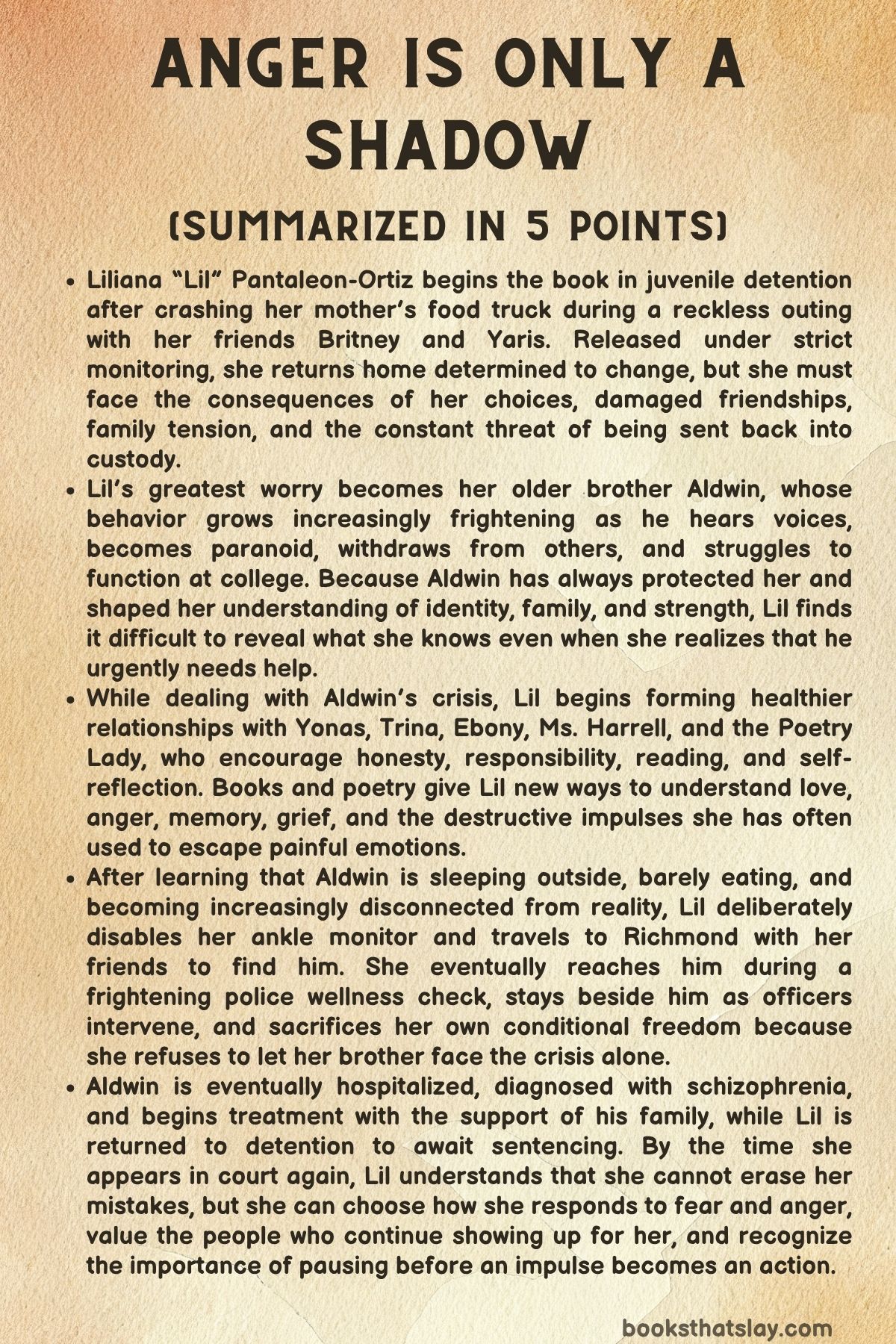
Summary
Liliana “Lil” Pantaleon-Ortiz begins the story inside the Youth Services Center, where confinement has already taught her a new set of survival rules. She understands which staff members can be trusted, when attention is dangerous, and how quickly a person must adapt when privacy, freedom, and ordinary choices disappear.
Her humor masks fear. The cramped rooms, secondhand uniforms, locked doors, and constant monitoring remind her that she has lost control over nearly every part of her daily life, yet she is determined not to appear vulnerable. Much of her idea of toughness comes from her older brother Aldwin, who has always taught her how to protect herself while also remaining connected to family and heritage.
At the center, Lil begins participating in poetry workshops led by a woman she calls the Poetry Lady. An embarrassing reaction to strawberry milk nearly exposes her to ridicule, but the Poetry Lady quietly protects her, and that gesture makes Lil more willing to participate.
Writing becomes an unexpected means of self-examination. In a poem about where she comes from, Lil admits that she wishes she could associate herself with softness and good choices, while instead she sees a pattern of recklessness in her behavior. Her memories of Aldwin remain especially important because he has always helped shape her confidence, her understanding of identity, and her sense of belonging.
Lil also develops a tentative connection with Shantrice, another detained girl who has been incarcerated much longer and faces transfer into the adult prison system. Shantrice recognizes Lil’s ability as a writer, but Lil also witnesses how quickly institutional responses can turn physical when Shantrice becomes distressed during a workshop.
The Poetry Lady encourages the girls to see their wounds without reducing themselves to those wounds. Lil is struck by this possibility because she already fears that her mistakes are becoming the only story anyone will tell about her. At night, she thinks about ancestral stories, especially the Taíno narratives Aldwin has shared with her, using them as a way to imagine guidance through uncertainty.
The reason for Lil’s detention is eventually revealed. She stole her mother’s food truck, went driving with her friends Britney and Yaris, consumed an edible, continued driving after it affected her, and crashed.
At her arraignment, her family arrives to support her. Her attorney, Ms. Stokes, persuades the judge to release her to her parents under strict restrictions, including a GPS ankle monitor, curfew, geographical limits, and supervision by a case manager. Another serious violation could lead to far worse consequences.
Freedom, however, does not restore normal life. Lil is deeply worried about Aldwin, who has recently behaved in ways she cannot explain. During the summer she saw him talking to people no one else could see, becoming suspicious of neighbors and roommates, withdrawing from familiar relationships, and expressing frightening beliefs.
Aldwin unexpectedly left college and came home, but his behavior there only increases Lil’s fear. He searches her room, suspects that his bed has been intentionally altered, and accuses her of taking his money. The brother who once made Lil feel protected now seems frightened by threats she cannot perceive.
When Aldwin quickly returns to college, Lil tries to convince her parents that something is seriously wrong. Ma wants to believe he is simply overwhelmed, while Papi emphasizes that Aldwin is an adult who must manage parts of his own life. Their hesitation leaves Lil feeling that she alone understands the urgency.
The situation becomes even more painful because Lil is already grieving changes in another family member. Abuela has dementia and increasingly forgets the people around her, although older stories, Nahua words, and memories sometimes remain accessible. Lil begins thinking about memory as one of the invisible structures holding a family together and wonders what love becomes when recognition and identity are altered.
Returning to school brings other losses into focus. Britney remains detained, while Yaris has been sent to the Dominican Republic and eventually tells Lil that her aunt does not want her maintaining contact with friends from DC.
Lil realizes that the friendships she depended on were also tied to some of her most reckless behavior. Losing them hurts, but it also creates space for relationships that operate differently.
One of those relationships develops with Yonas Kassa, a boy Lil has admired for years. He does not immediately condemn her for the ankle monitor or her arrest. Ms. Harrell, a school administrator, also treats Lil with unusual kindness and lends her Toni Morrison’s Beloved, while the Poetry Lady has already given her bell hooks’s All About Love.
Books begin arriving in Lil’s life when she most needs language for feelings she cannot easily name. They do not solve her problems, but they help her think about love, responsibility, memory, and self-worth.
Meanwhile, Lil’s fear about Aldwin intensifies. She feels guilty because she noticed his disturbing behavior months earlier but protected his secrets. Aldwin had always protected her, including during a frightening incident with a boy who touched and struck her, so speaking about him feels like betrayal.
Lil also recognizes that her own reckless choices were partly attempts to escape emotions she did not know how to manage. Cutting her hair, spending more time with Britney and Yaris, stealing, breaking rules, and eventually taking the food truck all offered moments of emotional release without addressing the fear beneath them.
At school, Katrina Rivera challenges Lil directly. Katrina tells her that they have never become friends because Lil seems committed to destroying herself, while Katrina is trying to gather reasons to keep building a future.
The accusation hurts because Lil knows it contains truth. She wants to imagine herself as a changed person, but she does not yet trust her own ability to stop before impulse becomes action.
Then one of Aldwin’s roommates contacts her and confirms that he has been talking to people who are not present, confusing names, and behaving so erratically that earlier roommates had complained. Lil finally shows Ma the evidence.
Ma drives to Richmond to confront the situation at Aldwin’s university, but because he is an adult, the institution cannot simply release information or force him to see her. On her return journey, Ma hits a deer. Although she avoids serious injury, the accident damages the food truck again, and Lil immediately blames herself for setting the events in motion.
Lil’s guilt and helplessness drive her toward another reckless decision. She secretly leaves home after curfew to attend a party, risking her release conditions.
At the party, Katrina and Ebony confront her over rumors concerning Britney. Lil nearly responds violently but stops herself. That pause matters because it demonstrates that change is possible even before it becomes consistent.
Yonas later shows similar restraint when Lil impulsively tries to kiss him. Instead of humiliating her, he clearly explains his boundaries. Lil begins understanding that affection does not have to depend on chaos or immediate gratification.
Yet she still violates her monitoring restrictions after transportation delays prevent her from reaching home on time. Her father is devastated and eventually lies to her case manager to protect her from immediate consequences. Lil receives another warning and understands that her family cannot keep absorbing the cost of every impulsive decision.
A quieter family outing later gives Lil another model of care. At the Wharf, Ma notices Lil’s recurring problems with dairy and buys her medication. The gesture affects Lil because it reveals how closely her mother has been observing her even during a period filled with conflict.
Aldwin finally calls Lil in the middle of the night, frightened by nightmares, monsters, and threatening sensations. Lil does not challenge him aggressively. Instead, she turns to a Taíno story Aldwin once taught her and uses it to reach the part of him that still trusts her.
She persuades him to schedule an appointment with university counseling. For a moment, Lil believes she has found the correct solution.
The appointment does not produce the simple recovery she hoped for. Aldwin tells the counselor about the voices, but when she recommends further evaluation rather than agreeing that the voices are objectively real, he feels rejected.
He asks Lil to confirm his perceptions. Lil refuses to lie, telling him she believes in him and believes that his fear is real without claiming that everything he perceives is real. Aldwin ends the conversation, and Lil is devastated.
Unable to tolerate her helplessness, Lil secretly drinks her father’s rum. Once again, emotional pain pushes her toward an action that temporarily overwhelms thought rather than resolving what frightens her.
Still, healthier connections are developing around her. Katrina sincerely apologizes and becomes Trina, a genuine friend rather than simply someone Lil has admired from a distance. Ebony remains suspicious because she cares about Britney, but Lil gradually earns the chance to begin again with her as well.
Yonas becomes one of the first people outside Lil’s family to hear the full truth about Aldwin. He does not try to provide an easy answer. He listens while Lil cries and speaks for hours.
A visit with Trina and Yonas to the Library of Congress gives Lil a glimpse of another kind of future. Trina has ambitions of becoming an archivist, while Yonas plans to train as an electrician. Their goals make Lil recognize how little she has allowed herself to imagine beyond immediate danger.
Her own wish is simpler: she wants to remain free.
Lil also confronts the unequal consequences surrounding the crash. Britney remains detained even though Lil has been released, and Britney’s mother is exhausted by work, legal struggles, and her daughter’s absence.
When Lil asks Ms. Cannon whether she is angry, Ms. Cannon admits that she is, but her anger is directed at nearly everyone involved, including herself and the systems surrounding the girls. Lil recognizes that anger can be the outward shape of deeper sorrow.
That realization changes how she sees both other people and herself. Anger is no longer merely aggression. It can be grief, fear, shame, helplessness, or love that has nowhere safe to go.
As Aldwin disappears further from ordinary communication, Lil becomes determined to reach him personally. She finds money hidden in his old bed and begins planning a trip to Richmond.
Her new friends become part of that plan when Trina mentions visiting VCU. Lil sees an opportunity to travel there without her parents realizing what she intends to do.
At the same time, Abuela unexpectedly recognizes Lil during one of her clearer days. Lil initially withdraws because she knows the recognition may disappear again, but Tía Blanca tells her that refusing happiness simply because it will end creates another kind of loss.
Lil returns inside and chooses to accept the moment. That decision parallels the larger change taking place in her: she is beginning to tolerate uncertainty rather than always escaping it.
Her relationship with Yonas also deepens. During a date at the National Museum of Natural History, he tells her about growing up in foster care and about the foster family that offered to adopt him without withdrawing their love when he declined.
Lil begins seeing that dependable love allows another person to make complicated choices without immediately disappearing.
Then Aldwin reveals that he has been sleeping outdoors on campus, barely eating and avoiding his dorm because he feels unsafe there. Lil finally tells her parents everything.
Ma and Papi admit they have also witnessed behavior that frightened them, but they fear that forcing help on Aldwin may make him disappear completely. Lil decides that waiting is no longer acceptable.
She asks Trina to let her accompany the VCU trip and, importantly, tells her the truth about why she wants to go. This is a significant change from Lil’s earlier habit of hiding her intentions.
She deliberately allows her ankle monitor to lose power, leaves school, and travels toward Richmond with Trina and Ebony. Yonas unexpectedly joins them because he understands the true purpose of the trip.
Lil knows that crossing outside the monitor’s range could destroy her chances in court. Nevertheless, she believes reaching Aldwin is worth risking her own freedom.
In Richmond, Lil searches unsuccessfully until Aldwin finally calls from his dorm bathroom. He is terrified while people shout outside.
Lil calmly gets his location and room number. By the time she and her friends arrive, police are already there after a wellness check escalated.
Aldwin is surrounded by officers, frightened and reacting to people or sensations others cannot perceive. Lil approaches him using the familiar voice of the sister he has always loved and protected.
He recognizes her immediately. When an officer attempts to stop Lil, Aldwin rushes toward her and admits that he is scared.
Police force both siblings to the floor. Lil cannot make the voices disappear, control the officers, or guarantee what happens next, but she refuses to abandon Aldwin in the moment when he is most afraid.
Aldwin is taken for counseling and further evaluation, while Lil is taken into police custody because authorities discover her juvenile record and the violation of her release conditions. Her parents have already traveled to Richmond after searching desperately for both children.
Even while angry and frightened, Ma stays beside Lil through processing. Papi remains with Aldwin.
Before Lil is taken back to detention, she speaks with her brother by video. Rather than debating the reality of the voices, she tells him that his family’s love is real and that anything urging him to cut himself off completely from that love should be treated with suspicion.
Ma then follows the police vehicle transporting Lil back to the Youth Services Center. She cannot prevent the consequence, but she refuses to let her daughter face it entirely alone.
Back in detention, Lil finds both Shantrice and Britney. Her reunion with Britney proves that love can survive guilt, unequal consequences, anger, and distance.
Lil later learns that Aldwin has been involuntarily hospitalized after severe sleep deprivation and is diagnosed with schizophrenia following his episode of psychosis. Treatment is difficult because Aldwin does not want medication to erase everything he experiences.
The family begins learning how to support him without treating him as though his identity has disappeared. They participate in therapy, educate themselves, spend time together, and create practical ways for Aldwin to trust them during future episodes.
Lil continues waiting for her own sentencing. She watches Shantrice turn eighteen while incarcerated and prepare for transfer into the adult prison system, a painful reminder that legal adulthood does not necessarily mean freedom.
When Lil finally returns to court, she is surrounded by family, friends, teachers, and people who have chosen to support her. Aldwin is there too, visibly changed but present.
Lil imagines the people around her as a personal library, each carrying something she can learn from when she lacks the words herself. Her final understanding of identity is therefore wider than her mistakes.
She remains impulsive, angry, loving, uncertain, and unfinished, but she has discovered the importance of the brief space between feeling and action. In that space, she can listen, ask for help, reconsider, leave danger, return to people she loves, and choose what kind of person she wants to become.
Characters
Liliana “Lil” Pantaleon-Ortiz
Lil is the emotional and narrative center of Anger Is Only a Shadow, and her development depends on the tension between the person she believes herself to be and the person she gradually learns she might become. She enters the story convinced that toughness is essential to survival, yet her understanding of toughness has been distorted by fear, secrecy, loyalty, and a hunger for immediate freedom.
Her recklessness is not presented as simple rebellion. She steals, breaks rules, takes dangerous chances, drinks, violates curfew, and eventually disables her ankle monitor, but these actions often emerge when she feels trapped by emotions she cannot control.
Lil is unusually self-aware without initially being capable of turning that awareness into consistent behavior. She knows she makes bad decisions, recognizes that Britney and Yaris helped reinforce some of her destructive habits, and understands that fear about Aldwin contributed to her desire for escape.
The central change in Lil is her discovery of the pause between impulse and action. When she nearly fights after being confronted at the party, she stops herself; when she is tempted to steal again, she walks away; when she begins forming new friendships, she learns that accountability can occur without humiliation.
Her relationship with literature also becomes important. Poetry, bell hooks, Toni Morrison, and Roque Dalton give her ways to think about experiences that previously existed only as anger or confusion.
Most importantly, Lil learns that protecting someone does not always mean hiding the truth or personally fixing the problem. Her journey to Richmond is reckless and carries serious consequences, but it also grows out of genuine fear for Aldwin and demonstrates how fiercely she loves.
By the end, she no longer defines herself entirely through the crash, her arrest, or other people’s expectations. She accepts that she contains good and bad choices simultaneously and that strength can mean listening, remaining present, accepting limits, and allowing others to help.
Aldwin Pantaleon-Ortiz
Aldwin is one of the most consequential figures in Anger Is Only a Shadow because Lil’s understanding of strength, identity, protection, and family has been shaped largely through him. Before his crisis, he exists in Lil’s mind as the older brother who taught her how to dress with confidence, understand her racial and cultural identity, defend herself, and remain connected to ancestral stories.
That earlier role makes his deterioration especially frightening. Lil has built part of her own stability around the assumption that Aldwin is the person who knows what to do, so seeing him become suspicious, frightened, isolated, and uncertain destabilizes her sense of the family itself.
His experience is portrayed from Lil’s perspective rather than reduced to a plot device. She sees him hear voices, misidentify people, develop frightening beliefs, stop sleeping properly, avoid his dorm, and eventually become so overwhelmed that a police wellness check turns into a physical confrontation.
Yet the story does not erase Aldwin after his diagnosis. His schizophrenia becomes part of his life, but his family works to understand him without treating every part of his altered perception as something that must simply be rejected.
His resistance to medication reflects his fear that treatment could erase experiences that now feel tied to his sense of self. The family therefore has to learn a form of care that combines safety with respect.
Aldwin’s relationship with Lil is reciprocal. He has spent years protecting her, but his crisis reverses their roles and forces Lil to become the person who reaches toward him when he is frightened.
The sealed letter he writes to his future self is especially important because it represents trust created during a clearer period. He gives a future version of himself permission to believe Ma, Papi, and Lil when his own perceptions may tell him not to.
Ma
Ma carries an enormous amount of practical and emotional responsibility in the family. In Anger Is Only a Shadow, she is simultaneously the mother of a teenager facing court, a young adult son in crisis, and baby Omaris, while also dealing with financial pressure and the consequences of the damaged food truck.
Her initial response to Aldwin is partly denial. She wants to believe that he is overwhelmed rather than experiencing something more serious, not because she does not care but because accepting another major crisis would mean acknowledging that the family cannot solve everything through endurance.
Once the evidence becomes impossible to ignore, however, Ma acts decisively. She contacts the university and drives to Richmond herself despite being uncomfortable with long-distance driving.
Her accident demonstrates the physical consequences of carrying too much fear and urgency at once. Lil interprets the crash through guilt, but Ma never allows that guilt to become the final definition of their relationship.
Ma can also be harsh. Her comment that Abuela’s dementia may make it easier because Abuela cannot remember Lil’s behavior wounds her daughter deeply, and their arguments reveal how exhausted both of them have become.
At the same time, Ma’s quieter actions show sustained attention. Buying medication after noticing Lil’s problems with dairy becomes meaningful precisely because Lil realizes her mother has been observing and caring even during moments of anger.
Her behavior after Lil is arrested in Richmond is particularly revealing. She remains beside her daughter through processing and follows the police car back toward detention, showing that consequences do not cancel parental presence.
Papi
Papi expresses love through protection, discipline, work, and practical action, although he often struggles to discuss emotional crises directly. His early interpretation of Aldwin’s difficulties as a problem associated with becoming a man shows the limitations of his framework for understanding what his son is experiencing.
He also initially believes that because Aldwin is an adult, he should be responsible for handling parts of his own life. That position frustrates Lil, who sees a danger that ordinary expectations about independence cannot address.
Papi’s relationship with Lil contains similar contradictions. He becomes furious when she violates curfew and briefly tries to remove her bedroom door, showing how badly her choices have damaged his trust.
Yet when her case manager becomes involved, he lies to protect her. His decision demonstrates how parental fear can produce conflicting impulses: he wants Lil to experience consequences, but he is also terrified of losing her to the juvenile system.
Papi is capable of tenderness that sometimes appears indirectly. His comment to Trina and the others that Lil is a good kid who deserves good friends embarrasses her, but it also reveals that he has not reduced his daughter to her mistakes.
When the Richmond crisis occurs, he stays with Aldwin while Ma stays with Lil. The division of responsibility allows both children to have a parent present during frightening institutional encounters.
Yonas Kassa
Yonas represents a form of care built on consistency rather than excitement. In Anger Is Only a Shadow, his importance comes partly from the contrast between his behavior and Lil’s older understanding of intimacy, which was often connected to impulsiveness, risk, or the fear that people might disappear.
He does not condemn Lil for wearing an ankle monitor, but neither does he encourage her reckless decisions. When she attempts an impulsive kiss after the party, he establishes a boundary without humiliating her.
Later, when Lil tells him about Aldwin, he gives her something she rarely receives: space to speak without being corrected, judged, or immediately offered a solution. His willingness to listen allows Lil to experience honesty as relief instead of danger.
Yonas’s foster-care background also explains his concern with dependability. He has declined adoption because he still hopes his biological mother may return, but his foster family responds by leaving the possibility open rather than withdrawing affection.
That experience helps Lil understand why Yonas fears becoming attached to someone who might suddenly vanish. It also gives her a model of love that can survive uncertainty without becoming controlling.
His decision to travel to Richmond with Lil is complicated because he knows the trip could worsen her legal situation. Nevertheless, he refuses to let her face the crisis alone.
Yonas therefore becomes significant not because he rescues Lil but because he consistently accompanies her while still maintaining an identity and boundaries of his own.
Katrina “Trina” Rivera
Trina first functions as a mirror Lil does not want to face. Her accusation that Lil appears committed to destroying herself hurts because it identifies the self-destructive pattern Lil has been trying to avoid naming.
Trina is also defined by deliberate self-construction. She expects other people to respect her identity, seeks opportunities such as her Library of Congress internship, and imagines a future for herself with clarity.
Her eventual apology is important because Lil requires her to say it directly. Their friendship begins not through pretending the earlier judgment never happened but through accountability.
Once the friendship is established, Trina proves dependable. She invites Lil into a social world built around school, internships, goals, conversation, and mutual support rather than rule-breaking.
When Lil tells her the truth about Aldwin and asks to join the VCU trip, Trina does not dismiss the danger. She makes room for Lil and later refuses to leave her alone during the confrontation.
Trina’s role therefore demonstrates the difference between a friend who merely shares experiences and one who can challenge, apologize, remain present, and support another person without making recklessness the foundation of the relationship.
Ebony
Ebony’s initial hostility toward Lil comes from loyalty to Britney. Because Britney remains detained while Lil has been released, Ebony sees Lil’s freedom as connected to an injustice affecting someone she cares about.
Her resentment is understandable even when her assumptions are incomplete. Lil could defend herself by blaming Britney for providing the edible, but she refuses to shift responsibility simply to protect her reputation.
Their relationship changes when Lil helps Ebony with her hair but first asks her to apologize for the insults and judgments she has made. Lil also accepts her own role in what happened to Britney rather than demanding complete innocence.
That exchange establishes a more honest foundation between them. Ebony is able to reconsider Lil because Lil no longer needs to present herself as either entirely guilty or entirely blameless.
Her participation in the Richmond trip later places her within Lil’s emerging network of friends who remain beside one another during serious consequences, not only during enjoyable moments.
Britney
Britney represents both genuine friendship and the danger of relationships built around shared recklessness. She was one of Lil’s closest companions before the crash and was involved in the sequence of decisions that led to the food truck accident.
Her continued detention becomes a source of guilt and confusion for Lil. Two girls involved in the same event receive sharply different outcomes, forcing Lil to confront the fact that consequences are not always distributed equally.
Lil refuses to publicly blame Britney even though Britney supplied the edible. That choice reflects loyalty but also growing maturity, because Lil recognizes that another person’s role does not erase her own decision to continue driving.
Britney is also humanized through Ms. Cannon’s exhaustion and grief. Her empty room, her mother’s extra work shifts, and the failed attempts to secure release show how detention affects an entire family.
When Lil returns to the Youth Services Center and finds Britney there, they immediately embrace. Their reunion shows that the relationship cannot be reduced to the reckless behavior they shared.
Britney therefore remains part of Lil’s life without the novel pretending that friendship automatically excuses harmful influence.
Yaris
Yaris is physically absent for much of the later story but remains emotionally significant. After the crash she is sent to the Dominican Republic, creating a sudden break in the trio of Lil, Britney, and Yaris.
When Lil finally reaches her, Yaris explains that her aunt does not want her maintaining contact with the friends associated with her trouble in DC. The rejection hurts Lil because it transforms her into someone another family considers dangerous.
At the same time, Lil can understand why Yaris accepts the restriction. Both girls recognize that their friendship included patterns that made reckless choices easier.
Yaris therefore becomes associated with one of the painful realities of growth: affection can remain genuine even when continuing a relationship in its previous form may be harmful.
Her absence also forces Lil to experience loneliness long enough for new relationships to become possible.
Abuela
Abuela gives the story one of its strongest connections between memory, family history, and identity. Her dementia creates a different kind of loss from Aldwin’s crisis, yet both experiences make Lil confront the fear of loving someone whose relationship to reality or recognition is changing.
Even as Abuela loses recent memories and sometimes fails to recognize relatives, older language and inherited stories remain accessible. Her recollections of resistance and family history connect Lil to generations that existed before her own mistakes.
Lil initially finds Abuela’s clearer days almost unbearable because hope creates the possibility of renewed loss. When Abuela recognizes her and uses the special name Teicuh, Lil retreats rather than enjoy the moment.
Tía Blanca teaches her that avoiding good moments because they may disappear is also a form of loss. Lil eventually returns and accepts the temporary gift of being known.
Abuela therefore helps Lil understand that love cannot depend on permanence. Something can be valuable even when it cannot be preserved indefinitely.
Tía Blanca
Tía Blanca is one of the family’s quiet stabilizing figures. She helps with practical responsibilities, supports Abuela, assists when the household is overwhelmed, and carries caregiving burdens Lil does not initially recognize.
Her most important conversation with Lil concerns Abuela’s good days. Lil wants to protect herself from disappointment by refusing to enjoy a temporary return of recognition.
Tía Blanca explains that those moments are what help her survive the harder periods. Her perspective challenges Lil’s tendency to avoid emotional pain through withdrawal or impulsive action.
She teaches Lil that hope and grief can exist together. Accepting happiness does not make later loss easier, but rejecting happiness does not prevent loss either.
Ms. Harrell
Ms. Harrell represents an adult authority figure who responds to Lil with proportion rather than immediate suspicion. When Lil lands in the dean’s office, Ms. Harrell does not treat every mistake as proof that she is irredeemable.
Her decision to lend Lil Beloved is especially significant because it strengthens Lil’s growing connection to literature. Their discussions gradually resemble a small book club, allowing Lil to experience intellectual attention at a time when many adults know her mainly through discipline and court involvement.
Ms. Harrell’s presence in court near the end demonstrates that her concern extends beyond her professional obligation. By showing up, she confirms to Lil that adults outside her immediate family can choose to remain invested in her future.
The Poetry Lady
The Poetry Lady is one of the first adults to recognize Lil’s inner life during confinement. She protects Lil from humiliation during the milk incident without drawing attention to what she is doing, and that act creates enough trust for Lil to engage seriously with writing.
Her workshops introduce the idea that pain can be acknowledged without becoming the entirety of a person’s identity. That lesson eventually becomes central to Lil’s ability to see herself as more than a reckless teenager with a juvenile record.
She also gives Lil All About Love and encourages her to continue writing after detention. The book becomes part of Lil’s later thinking about responsibility, self-worth, and the difference between love as feeling and love as action.
Even after Shantrice’s emotional outburst leads to physical restraint, the Poetry Lady returns to the lesson rather than abandoning the group. Her consistency shows the girls that disruption does not automatically mean rejection.
Shantrice
Shantrice exposes one of the harshest realities surrounding Anger Is Only a Shadow. She is intelligent enough to appreciate Lil’s poetry and emotionally complex enough to be affected deeply by discussions of wounds, yet she remains trapped within a system preparing to move her from juvenile confinement into adult incarceration.
Her outburst during the poetry workshop reveals how easily distress becomes institutional confrontation. She overturns a table, and staff respond by physically restraining and isolating her, leaving Lil troubled by the amount of force involved.
Shantrice’s later eighteenth birthday carries bitter irony. The legal transition into adulthood does not bring freedom; instead, it brings transfer into an adult facility in Pennsylvania.
Her ability to walk away with composure after the girls sing to her does not make the situation less brutal. It shows how practiced she has become at surviving circumstances she did not design.
Shantrice serves as a warning about what prolonged confinement can mean for a young person. Her fate also shadows Lil’s legal uncertainty, reminding her that the juvenile system contains consequences extending far beyond one bad night.
Ms. Cannon
Ms. Cannon gives Lil one of her clearest lessons about anger and grief. She is exhausted by Britney’s detention, working additional shifts and living with the emotional emptiness created by her daughter’s absence.
When Lil asks whether she is angry, Ms. Cannon refuses an easy answer. She is angry with Lil, Britney, Yaris, the police, herself, absent adults, circumstances, and broader failures surrounding the girls.
Her honesty matters because she does not transform anger into cruelty. She can acknowledge Lil’s responsibility while also recognizing that blame cannot repair what has happened.
When she puts an arm around Lil, both characters are able to occupy the same emotional space without pretending that forgiveness means forgetting consequences. Her response becomes one of the clearest expressions of the story’s central idea that anger often exists because something valuable has been hurt or lost.
Ms. Stokes
Ms. Stokes functions as Lil’s legal advocate and as a practical reminder that consequences are becoming increasingly serious. She successfully argues for Lil’s release to her parents after the first detention period, but that release comes with strict monitoring and clear warnings.
Her role prevents Lil from imagining that family support alone can erase legal consequences. Every later violation therefore carries added weight because Lil knows someone has already argued that she deserves another opportunity.
When Lil is arrested again in Richmond, Ma immediately contacts Ms. Stokes, showing how legal advocacy remains part of the family’s effort to protect Lil without denying what she has done.
Ms. Isra
Ms. Isra embodies the supervisory side of Lil’s conditional freedom. Through curfews, location limits, permissions, and warnings, she represents the system that allows Lil to remain outside detention while still controlling significant parts of her life.
Lil often experiences the ankle monitor and restrictions as physical reminders that she is not entirely free. At the same time, Ms. Isra gives permissions for activities when appropriate and provides opportunities for Lil to demonstrate responsibility.
After Papi covers for Lil’s curfew violation, Ms. Isra gives another final warning. When Lil later disables the monitor and leaves for Richmond, the trust underlying that arrangement collapses.
Her arrival with police to return Lil to custody makes the consequences unavoidable. She therefore represents neither a personal villain nor a rescuer but the institutional structure governing Lil’s release.
Omaris
Omaris is too young to direct the story, but the baby plays an important symbolic and emotional role within the family. Caring for Omaris repeatedly requires Lil to stop focusing entirely on herself and respond to someone else’s immediate needs.
Lil’s observations about babies gradually learning that they are separate from their caregivers also connect to her own development. She has spent much of her life defining herself through family, friends, Aldwin, and other people’s reactions.
As she changes, she begins discovering that loving others does not require dissolving her own identity into theirs. Omaris quietly reinforces the story’s questions about connection, dependence, separation, and becoming an individual.
Themes
Anger as the Surface of Grief
Anger repeatedly appears as a visible emotion covering something harder to express. Anger Is Only a Shadow develops this idea through Lil, Ms. Cannon, Shantrice, Ma, Papi, and even Aldwin, all of whom react strongly when fear, sorrow, shame, or helplessness becomes overwhelming.
Lil’s anger frequently protects her from emotions she does not know how to tolerate. Fighting, rule-breaking, stealing, reckless driving, and drinking all create moments when action replaces vulnerability.
Ms. Cannon gives the theme its clearest expression when she admits that she is angry in almost every direction after Britney’s detention. Beneath that anger is exhaustion, grief, self-blame, fear for her daughter, and rage at circumstances she cannot reverse.
The same pattern appears within Lil’s family. Ma becomes harsh when overwhelmed by legal expenses and Aldwin’s crisis, while Papi reacts to Lil’s curfew violation by trying to remove her bedroom door.
Their anger does not mean love has disappeared. Instead, love has become entangled with fear because each family member knows how much can be lost.
Lil’s growth therefore requires her to become curious about what exists underneath anger. Once she can identify fear, sadness, guilt, loneliness, or love beneath the immediate emotion, she becomes more capable of choosing her response rather than obeying the first impulse.
Love as Action and Presence
Love is repeatedly tested by situations in which affection alone cannot solve anything. Lil loves Aldwin deeply, but loving him does not allow her to cure his psychosis, confirm every perception he experiences, or protect him from institutional intervention.
What she can do is remain present. During his frightened phone calls, she listens; during the police confrontation, she approaches him; when officers force them down, she stays close enough for him to know he is not alone.
The same distinction appears in Ma’s relationship with Lil. Ma cannot prevent Lil from returning to detention after the Richmond trip, but she can stay beside her during processing and follow the police vehicle carrying her daughter away.
Yonas offers another version of love through boundaries and reliability. He refuses an impulsive kiss when the moment is wrong, listens when Lil needs to talk, and joins the journey to Richmond because he understands how serious the situation has become.
Even Ms. Cannon demonstrates love that survives anger. She does not deny Lil’s role in Britney’s suffering, but she still offers physical comfort.
The novel therefore treats love as behavior rather than simply intensity of feeling. Showing up, listening, setting boundaries, telling difficult truths, accepting consequences, and refusing abandonment become some of its strongest expressions.
Identity, Memory, and Inherited Stories
Lil spends much of the story asking what makes a person remain themselves when memory, behavior, circumstances, and perception change. Abuela’s dementia makes this question literal because she gradually loses recognition of people she loves while older language and ancestral stories remain.
Aldwin creates a different version of the same uncertainty. As his thoughts and perceptions change, Lil fears that the brother she knew may be disappearing.
The family’s inherited stories provide continuity when ordinary certainty fails. Nahua and Taíno narratives connect Lil and Aldwin to histories larger than their immediate crises, giving them symbols through which fear can be discussed when direct explanation becomes difficult.
Names also matter. Lil insists on the shortened name Aldwin gave her, while Abuela’s use of Teicuh during a clear moment carries emotional power because recognition is tied to language.
Books become another form of inheritance. The Poetry Lady, Ms. Harrell, and the Little Free Library place texts into Lil’s hands, and those texts offer ideas she can add to the stories already carried by her family.
By the end, identity is not treated as a fixed description determined by a single action, diagnosis, memory, or mistake. Lil can be the girl who crashed the food truck and the girl who learns restraint; Aldwin can have schizophrenia and remain a beloved brother; Abuela can forget and still belong completely to the family.
Freedom, Choice, and the Pause Before Action
Freedom initially means escape to Lil. Anger Is Only a Shadow repeatedly shows her seeking relief through movement, rule-breaking, parties, stolen objects, reckless driving, alcohol, and eventually a forbidden trip to Richmond.
The ankle monitor makes this conflict physical. It allows Lil to live outside detention while constantly reminding her that her movements are restricted and that another bad decision could send her back.
Yet the book gradually complicates her idea of freedom. Acting on every desire is not true independence when the impulse itself is controlling her.
Lil begins changing when she discovers that restraint can also be an act of power. She stops herself from fighting, resists stealing, demands sincere apologies rather than exploding, tells Trina the truth about Aldwin, and eventually recognizes that she does not have to become whatever her strongest immediate emotion tells her to become.
The journey to Richmond complicates this development because it is both reckless and loving. Lil knowingly risks her freedom, but unlike the food-truck crash, the choice has a serious purpose and is made with awareness of consequences.
Her final insight therefore does not divide life neatly into good and bad decisions. Instead, she values the pause before action—the moment in which instinct can become choice.
That pause is the freedom she has been searching for. It gives her the chance to decide whether to fight or walk away, hide or speak, isolate herself or accept help, and repeat the person she has been or begin becoming someone different.