A Study in Drowning Summary, Characters and Themes
A Study in Drowning by Ava Reid is a gothic fantasy that blurs the line between myth, literature, and reality. It follows Effy Sayre, a young woman navigating a world that denies her both academic and creative legitimacy.
Denied access to the literature college because of her gender, she studies architecture instead, though her true devotion lies with the works of her nation’s most revered writer, Emrys Myrddin. When Effy wins a contest to design a manor in his honor, she journeys to the desolate coast where his family lives. There, she becomes entangled in mysteries of authorship, power, and the haunting presence of the Fairy King, forcing her to confront not only Myrddin’s legacy but also her own voice and agency.
Summary
Effy Sayre is the only female student at her architecture college, where she is mocked and belittled by her male peers. Though she studies architecture, her heart belongs to literature, a field barred to women.
Her lifelong admiration for the legendary author Emrys Myrddin fills the void, along with her belief in the old magic of the Fair Folk described in his works. When she sees a poster announcing a design contest for Hiraeth Manor, a new home for Myrddin’s archives and family, she seizes the opportunity despite the hostility surrounding her.
At the library, Effy discovers that every nonfiction text about Myrddin has been checked out by Preston Héloury, an Argantian literature student—an infuriating reminder of how easily a foreign man can study what she loves, while she is excluded. Meanwhile, her isolation deepens, and she relies on sleeping pills to keep nightmares of the Fairy King at bay.
When Myrddin’s son, Ianto, declares her the winner of the contest, Effy receives permission to travel to Saltney, a storm-battered coastal region, to begin the project. Though her friend Rhia warns her, and her predatory adviser Corbenic belittles her, she departs alone.
Upon arrival, she endures eerie sights, including a bone-crowned figure in the mist, and is housed in a damp, iron-bolstered guesthouse near the crumbling manor.
The next morning, Effy meets Preston, the Argantian who monopolized the Myrddin books. Their relationship begins with sharp conflict over culture, authorship, and Myrddin’s legacy.
Preston is aloof and argumentative, but also startlingly well-read, and their debates hint at a reluctant kinship. Ianto, meanwhile, welcomes Effy with charm laced with menace, showing her the decaying manor, whose flooded basement holds Myrddin’s archives.
The house itself, on a half-drowned cliff, seems cursed and impossible to save. Effy realizes why no seasoned architect accepted the task—yet she steels herself, seeing in it both danger and possibility.
Initially, Effy resolves to abandon Hiraeth after one unsettling night. At the train station, however, her mother coldly refuses to let her return home.
Stranded between rejection and duty, Effy encounters Preston again. He proposes an alliance: they will coauthor his thesis, which challenges Myrddin’s authorship of his most famous novel, Angharad.
Though it feels like betrayal, Effy agrees, recognizing the chance to break into the literature world at last. Their partnership deepens as they study Myrddin’s letters, uncovering inconsistencies that suggest his works may have been stolen.
Effy feels torn between loyalty to her idol and the unsettling truth Preston uncovers.
Ianto grows increasingly sinister, pressing Effy with uncomfortable attention and veiled threats. One night, while driving her recklessly, his form shifts into that of the Fairy King.
Terrified, Effy escapes, but the encounter convinces her the myths she once half-believed may be real. Later, she confides in Preston about her childhood encounter with the Fairy King, who once claimed her as his own.
Though Preston listens with compassion, he doubts the supernatural explanation, focusing instead on evidence of Myrddin’s corruption. Their uneasy alliance strengthens nonetheless, and together they travel to visit Colin Blackmar, an elderly writer connected to Myrddin.
At Blackmar’s estate, they uncover letters that suggest Myrddin engaged in an affair with Blackmar’s daughter and stole her words to create Angharad. The discovery shakes Effy, who sees her idol crumbling into a man sustained by exploitation and theft.
Blackmar himself, along with his editor guest Marlowe, exposes further corruption within the literary world. At a party, Marlowe humiliates Effy, but Preston rescues her, solidifying their closeness.
They return to Hiraeth with letters and diaries that hold proof of the true authorship of Angharad.
As storms batter the coast, Effy and Preston face Ianto’s wrath. He reveals their deception and drags Preston toward a sacrificial drowning to preserve the house, echoing old legends.
Effy discovers that Ianto is fully possessed by the Fairy King, who has pursued her since childhood. The Fairy King demands her submission and offers her power, but Effy resists.
With cunning, she forces him to face his reflection in a shard of glass, unraveling his glamour and destroying him. Though the manor collapses into the sea, Effy escapes and rushes to free Preston, aided by the mysterious appearance of Angharad herself—alive and long hidden.
Angharad reveals the final truth: she was the true author of the novel Angharad, but Emrys Myrddin and others suppressed her, stealing her work and silencing her. Myrddin and his son were also vessels for the Fairy King, who warped them into cruel shadows of themselves.
Effy and Preston resolve to honor Angharad by compiling her letters and diaries into a thesis that restores her authorship. They return to Caer-Isel with their work titled Uncovering Angharad.
At the literature college, the dean attempts to silence Effy because of her gender. But transformed by her ordeal, she refuses.
She forces acknowledgment of her coauthorship and secures the dismissal of her abusive professor, Corbenic. In doing so, she becomes the first woman admitted to the literature college, breaking the barriers that excluded her and women like Angharad.
The novel closes with Effy and Preston, now in love, envisioning a future built on truth and resilience. Effy knows shadows of the Fairy King may linger, but she has already proven her strength.
For the first time, she claims her own story, ensuring that Angharad’s voice—and her own—will never again be silenced.
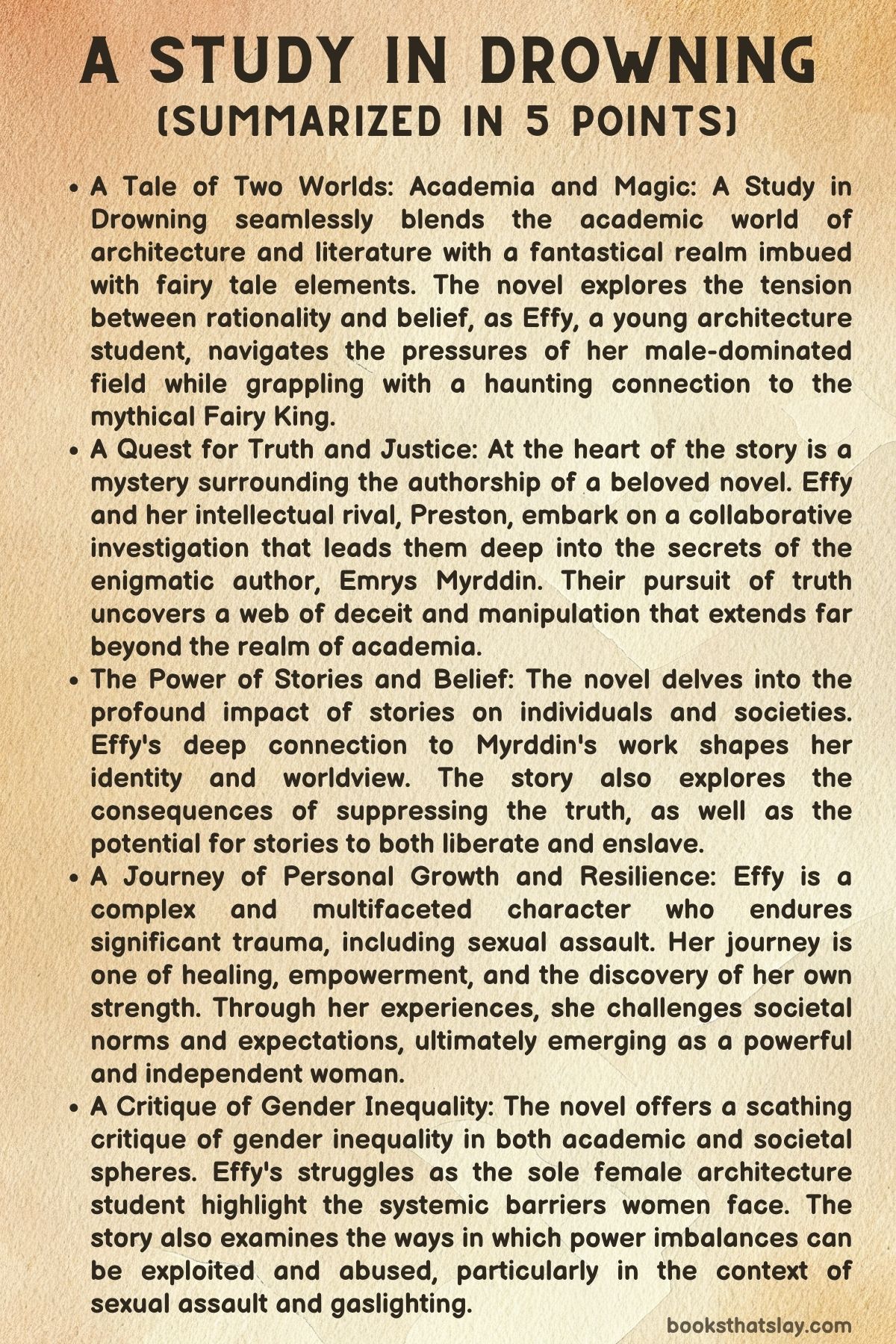
Characters
Effy Sayre
Effy Sayre is the heart of A Study in Drowning, a young woman navigating the suffocating restrictions of a patriarchal academic world. She begins as the only female student at her architecture college, a position that renders her constantly mocked and diminished, leaving her isolated and fragile.
Effy’s deep admiration for Emrys Myrddin and her secret yearning to study literature reveal her as a dreamer bound by rules designed to silence women. Her dependency on sleeping pills and recurring visions of the Fairy King point to a mind haunted by trauma, suppressed potential, and lingering vulnerability.
Over the course of the narrative, Effy transforms from a fearful, hesitant girl into a resilient figure who confronts not only the physical dangers of Hiraeth but also the oppressive forces of sexism, exploitation, and supernatural threat. By uncovering Angharad’s stolen authorship and securing her own place in the literature college, Effy reclaims her agency, embodying defiance against silencing and erasure.
Her arc is one of self-assertion and survival, where she learns to stand in her truth and rebuild her identity on foundations of strength rather than fear.
Preston Héloury
Preston Héloury is initially presented as Effy’s adversary, an Argantian literature student whose nationality alone sparks resentment in her. He is serious, aloof, and uncompromising in his pursuit of truth, particularly his thesis that questions the authenticity of Myrddin’s authorship.
Yet beneath his sharp exterior lies a scholar marked by integrity and compassion. He challenges Effy’s blind devotion to Myrddin, urging her to see beyond nationalist myth and to value truth over idolization.
Though their relationship begins in hostility, their dynamic gradually evolves into one of intellectual partnership and emotional intimacy. Preston respects Effy’s intelligence when others deny it, going so far as to fight for her inclusion as coauthor of their work.
His rational skepticism about the Fairy King often clashes with Effy’s lived experience of magic, but his steadfast loyalty provides her with grounding stability. Preston embodies the role of a partner who sees Effy not as an anomaly or burden, but as an equal, offering her both companionship and the possibility of love built on respect.
Ianto Myrddin
Ianto Myrddin, son of the celebrated author, is one of the most unsettling figures in the story. Outwardly charming and hospitable, he carries an undercurrent of menace that grows increasingly apparent as the narrative progresses.
He is both heir to Myrddin’s decaying legacy and vessel to something far darker—the Fairy King himself. Ianto’s instability, veering from warmth to violence, reveals how deeply corrupted he has become by the supernatural presence entwined with his family.
His insistence on preserving Hiraeth and his father’s memory is less about devotion and more about entrapment, reinforcing the oppressive structures that suffocate Effy. Ultimately, Ianto is consumed by the Fairy King, his individuality erased in service of an ancient, parasitic power.
His character highlights the generational cycle of abuse, secrecy, and possession, showing how the Myrddin name has been both weapon and curse.
Emrys Myrddin
Though long dead, Emrys Myrddin looms over the entire novel as both cultural icon and hidden villain. To Effy, he initially represents the pinnacle of artistry, a figure she reveres almost religiously.
However, the truth gradually unravels this illusion. Myrddin is revealed as a manipulator who not only appropriated the work of Angharad but also colluded with Marlowe and others to silence her voice.
His legacy rests on theft and exploitation, raising questions about authorship, power, and the suppression of women in creative fields. More than a mere man, Myrddin becomes a symbol of the patriarchal structures that consume female genius for male glory.
His house, rotting on the cliffside, serves as a metaphor for his false legacy—grand on the surface, but hollow and collapsing underneath.
Angharad
Angharad emerges late in the novel as the true author of the novel Angharad, and her presence reshapes the entire narrative. For years, she was trapped in silence, her voice suppressed by Emrys Myrddin and the corrupt literary establishment.
She is both survivor and victim, a woman who endured possession, theft, and fear while secretly protecting her truth. Her revelation validates Effy’s instincts and provides a lineage of female resistance against the forces that sought to erase them.
Angharad represents not only the stolen genius of women but also the possibility of reclamation. By entrusting her truth to Effy and Preston, she ensures her story will finally break free of the shadows.
Her character underscores themes of authorship, survival, and intergenerational solidarity, as Effy continues her fight where Angharad’s voice had been silenced.
The Fairy King
The Fairy King is the embodiment of ancient, consuming power, haunting Effy’s dreams from childhood and manifesting fully through Ianto. He is alluring and terrifying, offering power, permanence, and belonging while demanding submission and sacrifice.
His pursuit of Effy reflects not only supernatural menace but also the insidiousness of predatory control. The Fairy King thrives on possession—of bodies, of homes, of legacies—ensnaring men like Emrys and Ianto to maintain his dominion.
Yet when confronted with his own reflection, his glamour collapses, exposing him as frail and pitiful. His destruction by Effy symbolizes the defeat of both literal and figurative monsters: the specter of patriarchal domination, inherited trauma, and the silencing of women’s truths.
Rhia
Though her role is smaller, Rhia provides an important contrast to Effy’s isolation. As her friend and confidante before Effy departs for Hiraeth, Rhia represents normalcy, concern, and the emotional support Effy sorely lacks in her family life.
Her warnings about Master Corbenic and encouragement to stay safe show her as a voice of reason, one who recognizes the dangers Effy faces in a hostile world. Rhia’s presence, though limited, underscores what Effy could have had if her environment were kinder: genuine friendship untainted by manipulation or oppression.
Master Corbenic
Master Corbenic exemplifies the institutional corruption Effy must navigate. As her academic adviser, he abuses his position with predatory behavior and condescension, belittling her efforts while subtly exerting control.
He embodies the systemic barriers that prevent women from flourishing in male-dominated spaces, using authority to intimidate and silence rather than to nurture growth. By the end, Effy’s victory over Corbenic—forcing his dismissal—signals not only her personal triumph but also a broader strike against the entrenched misogyny of the academic system.
Wetherell
The barrister Wetherell is a peripheral but atmospheric figure who deepens the gothic unease of the novel. He serves as the intermediary between Effy and the Myrddin household, guiding her through treacherous landscapes both literal and metaphorical.
His presence in the early chapters reinforces the sense of dread surrounding Hiraeth, where even mundane interactions feel steeped in secrecy and menace. Though not central to the plot, Wetherell’s role contributes to the oppressive atmosphere that defines Effy’s early days at the manor.
Themes
Gender and Exclusion in Academia
One of the most striking themes in A Study in Drowning is the persistent exclusion of women from intellectual and creative spaces. Effy’s place as the only female student at her architecture college highlights a world that regards her presence as an aberration.
The restrictions she faces, such as being barred from studying literature despite her passion, expose the arbitrary barriers that institutions impose on women. Her interactions with professors and male peers reveal an undercurrent of dismissal and condescension that constantly undermines her ambitions.
This exclusion is not limited to education but extends into the broader culture, where women’s contributions are silenced or stolen. The revelation that Angharad herself was the true author of the famed work attributed to Emrys Myrddin becomes a devastating example of how women’s creativity is appropriated and erased to preserve patriarchal authority.
Through Effy’s eventual triumph—claiming her right to be recognized in the literature college—the book underscores both the toll of systemic exclusion and the necessity of breaking those structures to reclaim voice, dignity, and authorship. The theme resonates with the broader reality that survival within such environments demands not only resilience but also transformation of the institutions themselves.
The Weight of Myth and National Identity
The novel is saturated with myths—particularly those surrounding the Fairy King and the celebrated works of Emrys Myrddin—that reflect a nation’s obsession with storytelling as a means of shaping identity. Effy’s devotion to Myrddin’s literature and her near-religious awe of his mythic world represent how national myths can shape personal identity, becoming both a refuge and a prison.
The conflict between Llyr and Argant also illustrates how literature is politicized, as both sides attempt to claim ownership over narratives to bolster their cultural authority. Preston’s thesis challenges these notions, questioning whether Myrddin is truly the author of his nation’s most iconic text.
This undermining of literary myth carries political consequences, since exposing Myrddin as a fraud destabilizes the cultural foundations built upon his reputation. At the same time, Effy’s recurring visions of the Fairy King blur the line between folklore and reality, suggesting that myths, whether real or imagined, wield power not only over culture but over the psyche.
The theme emphasizes the tension between stories as tools of control and stories as paths to liberation, reminding readers that myths, once unchallenged, can become cages for entire societies.
Abuse, Manipulation, and Predation
Throughout A Study in Drowning, Effy’s journey is marked by encounters with figures who wield their authority to manipulate, exploit, or control her. Master Corbenic represents the abuses of academic power, preying on her vulnerability under the guise of mentorship.
Ianto Myrddin embodies a more insidious form of predation, at first presenting himself with charm, only to reveal coercive and violent impulses. His physical intimidation, sudden shifts in demeanor, and eventual unveiling as the vessel of the Fairy King embody the theme of exploitation masked by power and tradition.
The revelation that Myrddin himself stole Angharad’s voice and legacy shows how manipulation is not only personal but systemic, baked into the cultural and literary structures that uphold men’s reputations at the expense of women’s lives. Effy’s struggle against these predatory forces highlights how survival is not simply a matter of endurance but of dismantling the mechanisms of exploitation.
The theme forces readers to confront the realities of how abuse thrives under institutional protection, and how reclaiming truth becomes an act of resistance against both individual predators and the systems that shield them.
The Fragility and Strength of Identity
Effy’s character arc demonstrates the complex interplay between fragility and strength in the shaping of identity. She begins as a young woman defined by her devotion to Myrddin’s works and her struggles with anxiety, isolation, and dependency on sleeping pills.
Her history as a child nearly claimed by the Fairy King haunts her, instilling a sense of being marked, othered, and precarious. Yet her journey to Hiraeth forces her to confront not only the myths that shaped her but also the truths buried beneath them.
As she uncovers Angharad’s erasure and witnesses the destruction of the Fairy King, Effy comes to recognize that her fragility has never meant weakness. Instead, it is her sensitivity to both stories and injustices that allows her to see truths others overlook.
By the end, she builds a new identity rooted not in idolizing false figures but in her own agency, scholarship, and resilience. Her eventual recognition as the first woman admitted into the literature college symbolizes this transformation, where fragility evolves into a new foundation for strength.
The theme underscores that identity is not fixed but constructed, and that survival requires reclaiming one’s story from forces that seek to define it for you.
Truth, Authorship, and the Power of Stories
Central to the novel is the question of who has the right to tell stories and what happens when truth is obscured. Effy’s idolization of Myrddin is gradually dismantled as she learns of his theft of Angharad’s work, exposing how literary fame often rests on silenced voices.
Preston’s thesis, titled Execution of the Author, directly challenges the myth of authorship, pushing Effy to consider the possibility that her greatest hero was not a creator but a usurper. The tension between truth and falsehood becomes a battle not only over literary legacy but over history itself, since myths shape cultural memory.
Angharad’s final emergence, her voice restored, exemplifies how recovering suppressed truth is both painful and liberating. Effy’s choice to title the final thesis Uncovering Angharad signals that scholarship can be more than preservation—it can be an act of justice.
The theme insists that stories are never neutral: they can either perpetuate oppression or dismantle it. The recovery of Angharad’s authorship serves as a reminder of the responsibility borne by those who inherit stories, and of the redemptive power that comes from choosing truth over tradition.