Animal’s People Summary, Characters and Themes
Animal’s People by Indra Sinha is a fierce, darkly comic novel about survival after industrial disaster. Set in the fictional Indian city of Khaufpur, it follows a nineteen-year-old boy known as Animal, whose spine was twisted by poison released from an American company’s factory.
Speaking in his own raw, restless voice, Animal tells a story of anger, desire, loyalty, shame, and stubborn hope. The book is rooted in the aftermath of the Bhopal gas tragedy, but it also asks larger questions about justice, dignity, poverty, and what it means to be human.
Summary
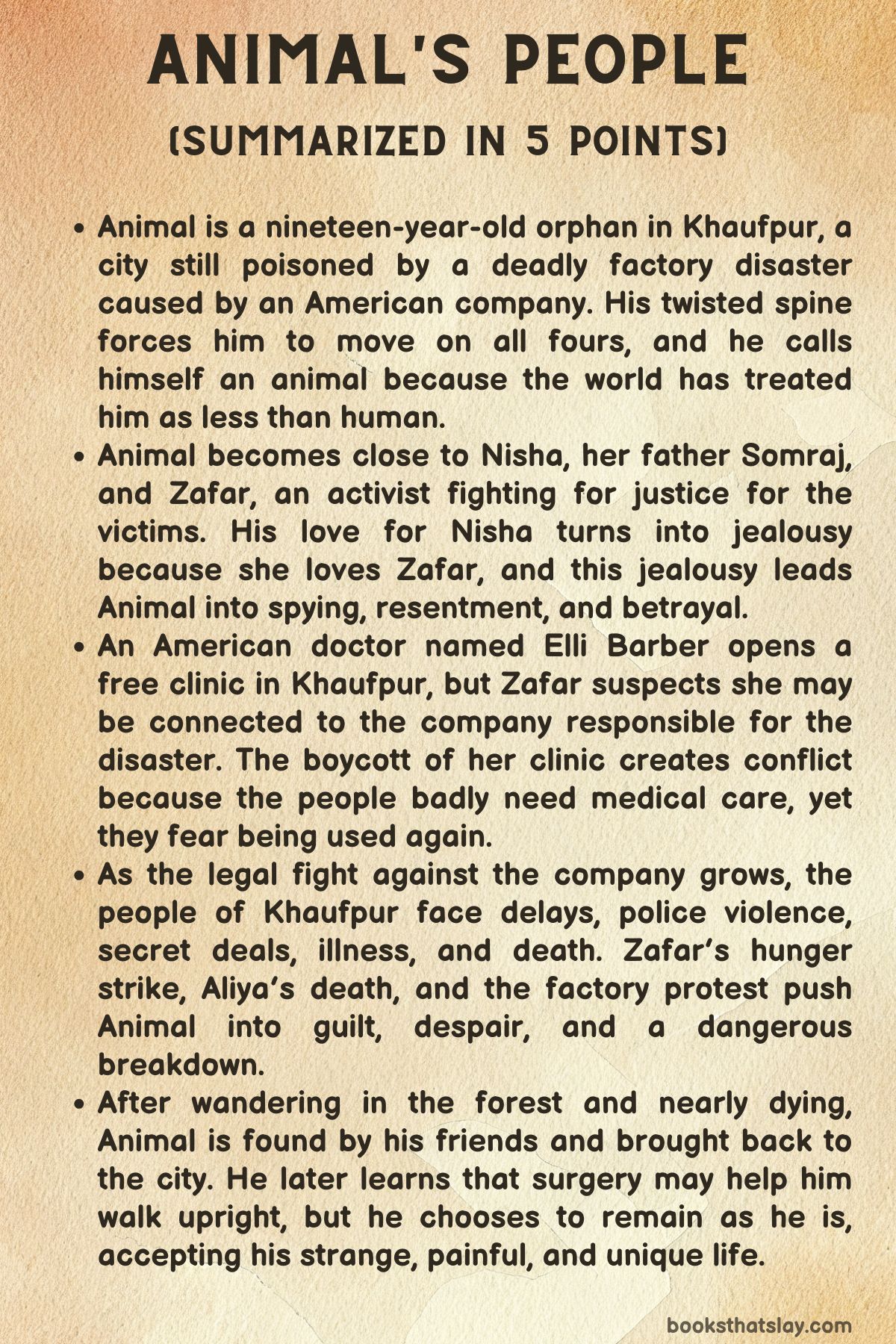
Animal’s People is narrated by Animal, a nineteen-year-old orphan in Khaufpur, an Indian city poisoned years earlier by a deadly leak from an American chemical company’s factory. Animal does not remember walking upright.
As a child, his back twisted so badly that he learned to move on all fours. Other children mocked him, called him Animal, and the name remained.
He grows up angry at the human world, bitter toward anyone who walks on two legs, and suspicious of outsiders who come to Khaufpur seeking stories.
Animal begins speaking into tapes after a foreign journalist asks him to tell his life in his own words. He agrees only because he wants his voice preserved without being cleaned up or made respectable.
From the start, he refuses pity. He calls the reader “Eyes” and insists that he will speak as he chooses.
Animal lives among people still suffering from the factory disaster. The company, called the Kampani, has never properly answered for the deaths, illnesses, birth defects, and ruined lives it caused.
The abandoned factory still poisons the land and water. Animal sleeps there at times and imagines the ghosts of the dead inside its pipes.
He believes that if the Kampani had maintained the factory, he might have had parents, a normal body, and a different life.
His closest emotional ties are with Ma Franci, an elderly French nun who raised him and calls him son, and with Nisha, the kind daughter of Somraj, a once-famous singer whose lungs were damaged by the gas. Nisha treats Animal as ordinary, teaches him to read, and brings him into the orbit of Zafar, a charismatic activist who fights for the people of Khaufpur.
Zafar is admired almost like a saint because he organizes relief, challenges politicians, and keeps pressure on the Kampani to face trial. Animal respects Zafar but also hates him because Zafar is handsome, noble, and loved by Nisha.
Animal’s love for Nisha becomes one of his deepest pains. He knows she sees him as a friend, not as a possible husband.
His desire twists into jealousy, spying, and resentment. He watches Nisha and Zafar, imagines what they may be doing together, and tries to interfere with Zafar’s health by secretly giving him pills bought from a scam artist.
Animal’s actions are often selfish and cruel, yet the story never treats him as simple. He is wounded, funny, loyal, ashamed, and desperate to be wanted.
The political struggle in Khaufpur intensifies when a new American doctor, Elli Barber, arrives and opens a free clinic. Many people need treatment, but Zafar suspects the clinic may be connected to the Kampani.
He fears it will collect medical data that can be used to deny responsibility for the disaster. A boycott begins.
Animal likes Elli and believes she may help him walk upright, but he is torn between hope for himself and loyalty to Zafar’s cause.
Elli is frustrated by the distrust she faces. She has come with medical skills and a desire to help, but she does not understand why people who are suffering would avoid treatment.
Through Animal, she sees the poverty of Khaufpur more closely, while Animal sees how outsiders look at his world with pity. Their relationship is uneasy.
Animal wants her approval and dreams that she might cure him, but he also resents her power to make him hope.
Somraj and Elli first seem opposed, each believing the other is trying to drown out their music. Over time, they begin to understand each other.
Somraj explains that the people distrust Americans because the Kampani has escaped responsibility for years. Elli insists she is not working for the company.
Their conflict softens into affection, and eventually they fall in love. Nisha struggles with this because she does not want her father to build a new life after so much loss.
Meanwhile, the legal case against the Kampani appears to make progress. A judge orders that the company’s American bosses must come to court.
Khaufpur celebrates, believing that justice may finally be possible. But the Kampani’s lawyers arrive, meet government officials, and appear to be arranging a deal that would protect the company.
Zafar organizes protests. Police violence follows, and the people’s anger grows.
Animal’s inner conflict worsens when he sees Elli at a hotel with one of the Kampani’s American lawyers. The lawyer kisses her and tells her she can come home.
Animal believes Zafar was right all along and that Elli has betrayed everyone. He struggles over whether to reveal what he saw, since Elli may still be his chance at surgery.
Later, it emerges that the lawyer is Elli’s ex-husband, Frank. She went to him not as an ally of the Kampani but to pressure him into delaying the secret deal.
She agreed to return to America after the hearing, but not to return to him.
As Khaufpur grows hotter during Nautapa, suffering increases. A little girl named Aliya becomes seriously ill.
Animal carries her to Elli despite his anger, burning his hands and feet on the ground. Elli treats Aliya, but the child later dies, deepening the city’s grief.
Around the same time, Zafar decides to begin a hunger strike with Farouq and others. He refuses food and water, intending to resist the secret deal with his own body.
Nisha is furious and terrified, arguing that he cannot fight if he is dead. Animal, full of guilt over having weakened Zafar with poison pills, confesses what he has done.
Zafar laughs instead of condemning him, showing both affection and exhaustion.
The day of the hearing brings another betrayal: the judge has been transferred, and the case is postponed. The Kampani lawyers avoid accountability.
A protest erupts at the factory, and people storm the grounds. Some want to burn the factory, but Animal warns that the chemicals could kill the city again.
Police attack the protestors. Animal bites a police officer who strikes Nisha and is badly beaten.
Somraj, usually opposed to violence, also strikes the officer and is beaten too.
Rumors spread that Zafar has died, and Animal’s world collapses. Aliya is dead.
Ma Franci has wandered out believing the final judgment has come. Nisha, overwhelmed, rejects Animal when he asks her to marry him.
Convinced that everything he loves is gone, Animal swallows the remaining poison pills. In hallucination and despair, he runs through the city as fires burn and panic spreads.
He rescues the preserved deformed fetus he calls Khã-in-the-Jar from Elli’s burning clinic but drops the jar at the factory, forced to confront the horror it represents.
Animal wanders into the forest, sick and hallucinating. He tries to become fully animal, stripping away human signs and searching for a place beyond people.
Yet when he injures a lizard and cannot bring himself to eat it, the lizard tells him that this mercy proves he is human. Alone, starving, and feverish, Animal sees visions of his parents, Nisha, Elli, Farouq, Zafar, Ma Franci, and the Kampani’s representatives.
His anger empties into grief.
After eight days, Zafar, Farouq, Jara the dog, and others find him alive. Zafar has not died.
The hunger strike ended when the Chief Minister promised not to make the secret deal. During the chaos, poisonous gas was released at the hotel where politicians and Kampani lawyers were meeting, exposing the corruption on camera.
A mysterious woman in a black burqa is suspected of causing it, though no one knows who she was.
Animal learns that Ma Franci, Huriya, and Hanif died while trying to help others. Their deaths are honored by the people.
Life in Khaufpur continues with both loss and stubborn endurance. Elli, Somraj, and Nisha return from America, and there are two weddings: Elli marries Somraj, and Nisha marries Zafar.
The legal fight is still delayed, the factory still stands, and people are still sick. Justice remains unfinished.
Animal receives word that doctors in America may be able to operate on his back. Yet after telling his story into the tapes, he decides he does not want to become one ordinary man among millions.
His body is painful and marked by disaster, but it is also his own. He can climb, carry children, and live in a way no one else can.
He chooses to remain Animal, to help free Anjali from prostitution, and to accept a life that is damaged but still worth living.
Characters
Animal
Animal is the central voice of Animal’s People, and his character is built around injury, anger, desire, humor, and a fierce refusal to be pitied. His twisted spine makes him move on all fours, and because of this he is treated as less than human by many people around him.
Yet the book does not present him as a passive victim. Animal is sharp, vulgar, observant, funny, resentful, and often morally troubling.
He lies, spies, insults people, and even poisons Zafar out of jealousy, but these actions come from a life shaped by abandonment, humiliation, and physical pain. His repeated claim that he is an animal is both a defense and a protest.
It protects him from the shame of being rejected by humans, but it also accuses society of having forced him outside ordinary human belonging.
Animal’s love for Nisha reveals his deepest vulnerability. He wants to be seen not as a damaged body but as someone capable of love, desire, and marriage.
His longing for surgery is tied less to medical recovery than to the hope that he might become worthy of Nisha. This makes his relationship with Elli complicated, because she represents the possibility of physical change, while also reminding him of the power outsiders hold over people like him.
By the end of the novel, Animal’s decision not to undergo surgery is not simple resignation. It is an act of self-acceptance.
He chooses the life he has, not because it is easy, but because it is his. His character arc moves from self-hatred toward a rough, hard-won peace.
Zafar
Zafar is the moral and political center of the community, a man admired for his courage, discipline, and devotion to justice. He leads the fight against the Kampani and gives the people of Khaufpur a sense of direction in a world where courts, officials, and corporations repeatedly fail them.
In Animal’s People, Zafar is almost saintlike in the eyes of others, but the book carefully keeps him human. He is principled, inspiring, and self-sacrificing, yet he can also be stubborn, suspicious, and dangerously willing to turn suffering into a political weapon.
His boycott of Elli’s clinic shows both his strength and his flaw: he understands the long history of betrayal, but his caution also keeps sick people away from treatment.
Zafar’s relationship with Animal is one of the richest in the book. Animal resents him because Zafar has Nisha’s love and public admiration, but Zafar repeatedly treats Animal with trust and respect.
When Animal confesses to poisoning him and spying on him, Zafar responds with laughter rather than revenge. This reaction reveals his generosity, but also his fatigue.
His hunger strike suggests both heroism and despair. He wants justice so badly that he is willing to die for it, yet the book questions whether martyrdom can truly serve the living.
Zafar represents political commitment at its noblest and most troubling: he gives the poor a voice, but he also risks sacrificing his own life and the emotional lives of those who love him.
Nisha
Nisha is compassionate, intelligent, and emotionally strong, but she is not merely a symbol of kindness. She is one of the few people who treats Animal as normal, and that simple refusal to pity him has a deep effect on him.
She teaches him, includes him, worries about him, and gives him a sense of belonging. Because of this, Animal turns her kindness into romantic hope, even though she never encourages it in that way.
Nisha’s role in the book shows how kindness can be misread by someone starved of affection.
Her relationship with Zafar reveals another side of her character. She admires his courage but fears the endlessness of his struggle.
She wants a life beyond protest, illness, and sacrifice. Her dream of moving away, growing vegetables, and raising children is not selfish; it is a longing for ordinary peace after years of inherited disaster.
When Zafar chooses a hunger strike, Nisha’s anger exposes the emotional cost of political heroism. She understands justice, but she also understands that love cannot survive if the beloved keeps offering himself to death.
Her rejection of Animal’s marriage proposal is painful but necessary. She refuses to become the answer to his suffering.
Nisha’s strength lies in her honesty, even when that honesty wounds others.
Elli Barber
Elli Barber enters the story as an outsider whose motives are doubted from the beginning. As an American doctor opening a free clinic in Khaufpur, she carries the burden of national and corporate association even though she personally hates the Kampani.
Her character is important because she shows the difficulty of helping across lines of class, race, nationality, and history. Elli wants to heal people, but she initially fails to understand why the people mistrust her.
To her, refusing medical care seems irrational. To the people of Khaufpur, caution is a survival instinct built from years of lies, poison, and legal evasion.
Elli is not a savior figure. The book makes her sincere but imperfect.
She can be impatient, wounded by rejection, and unaware of how her pity sounds to those who have lived with poverty all their lives. Her relationship with Animal is especially complex.
She sees his injury medically, while he experiences her gaze as exposure. At the same time, she gives him hope that his body might be changed.
Her romance with Somraj deepens her connection to Khaufpur, but it also complicates the politics around her. Her meeting with her ex-husband Frank makes her appear guilty, though she is actually trying to delay a corrupt agreement.
Elli stands for imperfect solidarity: she cannot fully share the people’s suffering, but she can choose to stand with them.
Somraj
Somraj is one of the most dignified and quietly sorrowful figures in the novel. Before the disaster, he was a celebrated singer, but the poison destroyed his lungs and silenced the full power of his art.
His personal losses are immense: his wife and infant son died, his career was damaged, and his body remains a reminder of that night. Yet Somraj is not defined only by grief.
He remains thoughtful, observant, and deeply attuned to sound. His belief that the world is full of music gives the book one of its most important ways of understanding suffering and connection.
Somraj’s relationship with Animal is gentle and respectful. He recognizes Animal’s unusual power of hearing and speaks to him seriously, which gives Animal a rare form of adult respect.
His relationship with Elli develops from misunderstanding into love. At first, each thinks the other is trying to overpower them musically, but this conflict becomes a form of communication.
Somraj’s love for Elli shows that damaged lives can still open toward tenderness. At the same time, his concern for the boycott reveals his moral caution.
He does not want to betray the community, even when he personally needs care. Somraj represents art, endurance, and the possibility of renewed life after devastation.
Ma Franci
Ma Franci is Animal’s closest mother figure and one of the book’s most tragic spiritual characters. A French nun who stayed in Khaufpur to serve others, she lost her ability to understand Hindi and English after the disaster and now believes that most speech around her is meaningless noise.
This linguistic isolation makes her seem mad to others, but her madness also carries a strange moral clarity. She believes the world is moving toward an apocalypse because, from her point of view, the end of the world already began in Khaufpur.
For Animal, Ma Franci is love without condition. She calls him son, protects him, and remains one of the few people whose affection he trusts.
Her bond with him is not sentimental; it is practical, daily, and rooted in shared abandonment. When others try to send her back to France, Animal experiences the threat as the possible loss of his only mother.
Her final actions confirm the depth of her compassion. She goes out during danger not to save herself but to help others.
Ma Franci’s character joins faith, confusion, sacrifice, and maternal love. She may misunderstand the world around her, but she understands the duty to care for the suffering.
Farouq
Farouq begins as a rough, mocking presence, often teasing Animal and challenging his claim that he is not human. He is physically bold, socially confident, and connected to local power through his gangster uncle.
At first, he seems like another person who uses Animal’s difference as a reason to insult him. Yet Farouq becomes more complex as the story progresses.
He helps Zafar because Zafar once helped his family, which shows that his loyalty has real roots.
His relationship with Animal changes after the coal-walking episode. Farouq carries Animal across the coals, saving him from humiliation and danger, and later the two move toward friendship.
Farouq’s bluntness often hurts Animal, but it also challenges Animal’s self-protective identity. He sees that Animal’s claim to be an animal is partly a way to avoid responsibility and emotional risk.
During the hunger strike, Farouq’s willingness to suffer beside Zafar shows his courage and loyalty. He is not polished or idealistic in the same way Zafar is, but his love for his friends becomes unmistakable.
Farouq represents the kind of loyalty that grows through insult, rivalry, shared danger, and finally grief.
Jara
Jara, Animal’s dog, is more than a companion; she is part of Animal’s sense of home. Because Animal often sees himself as outside the human world, his bond with Jara carries special meaning.
She does not judge his body, his language, his poverty, or his anger. Her loyalty is immediate and physical, and this makes her one of the few beings with whom Animal can exist without shame.
Jara also strengthens the question at the center of Animal’s identity. If Animal calls himself an animal, then his relationship with an actual animal reveals both similarity and difference.
He shares her closeness to the ground, her survival instincts, and her place among the rejected spaces of the city. Yet his grief, guilt, longing, and moral hesitation show that he cannot fully escape being human.
When Jara appears during moments of crisis, she represents the simple love that keeps Animal attached to life. She is not a decorative animal figure; she is a living reminder that care can exist without language.
Khã-in-the-Jar
Khã-in-the-Jar is one of the strangest and most symbolic figures in the book. Preserved in a jar, this deformed fetus represents the unborn, the damaged, and the evidence of what poison does beyond the first night of disaster.
To Animal, Khã becomes a companion, a voice, a hallucinated friend, and a disturbing mirror. He is both grotesque and wise, both comic and horrifying.
Through him, the book gives form to the hidden consequences of industrial violence.
Khã’s two heads and unfinished body suggest futures that were ruined before they could begin. His conversations with Animal often sound absurd, but they carry serious meaning.
He tells Animal that there are two Animals: the bent one the world sees and another imagined self who stands upright. This idea exposes Animal’s divided identity.
Khã also asks to be released, which connects him to the dead of Khaufpur and to the demand that the truth not remain sealed away. When Animal finally breaks the jar, the act is chaotic and frightening rather than cleanly heroic.
Khã represents the burden of memory: the disaster cannot be hidden in laboratories, files, courts, or jars forever.
Anjali
Anjali, the young prostitute, is a minor character in terms of plot but important in Animal’s emotional development. She first appears as someone who calls Animal handsome, giving him a kind of recognition he rarely receives.
Because Animal is consumed by sexual longing and shame, his encounter with Anjali could have been written only as desire, but the book turns it into something more reflective. When he wakes beside her, he does not simply use her.
Instead, he asks about her life and begins to see her as another person trapped by social and economic forces.
Anjali’s presence helps Animal think differently about bodies. He has spent much of the story seeing women through hunger, fantasy, and frustration, but with Anjali he has a moment of awe rather than conquest.
He recognizes the sacredness of the female body as the source of life, even while understanding how men have degraded her. His later wish to use his saved money to free her shows a shift in him.
It is not a perfect or uncomplicated rescue fantasy, but it does show that Animal’s love has expanded beyond Nisha and beyond himself.
Huriya
Huriya is part of the poor community that bears the continuing effects of the factory disaster. She is closely connected to Ma Franci and is the grandmother of Aliya.
Through Huriya, the book shows the daily labor of survival among those who have little protection from illness, hunger, and contaminated surroundings. She is not a public leader like Zafar, but her life carries the quiet weight of the community’s suffering.
Her importance grows near the end, when she joins Ma Franci in trying to help others during danger. Huriya’s death turns her into one of the ordinary people whose courage often goes unrecorded.
The book honors her not because she makes speeches or leads protests, but because she acts when others are in need. Her character reminds the reader that disaster is lived most heavily by families, caregivers, grandparents, and neighbors whose sacrifices rarely appear in official histories.
Hanif
Hanif is Aliya’s grandfather and Huriya’s husband, and his role is marked by grief, poverty, and devotion. He belongs to the group of people whose lives are shaped not by large political decisions in public view but by the private suffering those decisions produce.
His care for Aliya reveals his tenderness, while his refusal to leave her after death shows the depth of his love and despair.
Hanif’s character becomes especially painful when Aliya dies. The image of him holding her body after she has been dressed beautifully to confuse the angel of death is one of the book’s most devastating moments.
It reflects a grief so deep that it turns to ritual, imagination, and denial. Hanif represents the human cost of delayed justice.
For men like him, legal hearings and political promises matter only because children continue to fall ill and die. His death with Huriya and Ma Franci places him among those whose love leads them into danger.
Aliya
Aliya is a child whose illness and death reveal the ongoing violence of the disaster. She is not merely a symbol of innocence; she is a specific child loved by her grandparents and known to the community.
Her sickness shows that the factory’s poison is not confined to the past. It continues through water, soil, bodies, and generations.
Her condition also exposes the terrible consequences of mistrust. Elli may be able to help her, but the fear surrounding the clinic delays care and deepens the tragedy.
Aliya’s death breaks through many of the political arguments in the book. Debates about strategy, loyalty, boycott, and evidence suddenly become painfully concrete.
A child is dead, and no explanation can soften that fact. Her death also pushes Animal further into despair, helping trigger his collapse.
Aliya represents the future stolen from Khaufpur. Through her, the book shows that environmental crime does not end when the first victims are counted; it continues in the bodies of children who were never responsible for any of it.
Chunaram
Chunaram is a practical, opportunistic figure who moves between locals and outsiders. He brings the Australian journalist to Animal and understands that stories can be turned into money.
His chai shop also functions as a social space where people gather, talk, watch television, and argue. Through Chunaram, the book shows how survival in Khaufpur often requires compromise, performance, and small acts of calculation.
He is not presented as evil, but he is not idealistic either. Unlike Zafar, he is not driven by justice; unlike Animal, he is not consumed by wounded pride.
He represents the everyday hustler who knows how to get by in a damaged city. His presence also helps expose Animal’s suspicion of journalists and foreigners.
Chunaram’s willingness to arrange access to Animal’s story raises questions about who profits from suffering and who controls the way pain is narrated.
Faqri
Faqri is Animal’s scam-artist friend, and his role exposes the informal economy that grows around poverty. He sells dubious pills and powders, performs street tricks, and survives through deception.
His comic energy makes him entertaining, but his actions also have serious consequences. The pills he sells Animal turn out to contain datura, and Animal’s use of them on Zafar becomes one of his gravest betrayals.
Faqri’s character shows how desperation can blur moral boundaries. He is not a grand villain; he is one of many people trying to survive in a place where formal systems have failed.
Yet his casual fraud causes real harm. Through him, the book suggests that corruption does not exist only in corporations and governments.
It also appears in small acts among the poor, though these acts arise from very different conditions. Faqri reflects the damaged moral environment created when people are abandoned to scarcity.
Jarnalis
Jarnalis, the foreign journalist, is important because he frames Animal’s act of storytelling. He arrives believing that the stories of small people can matter, but Animal immediately distrusts him.
To Animal, journalists come to feed on suffering, take stories, and leave. His suspicion is not baseless.
Khaufpur has been seen, reported on, pitied, and then forgotten by outsiders many times.
Yet Jarnalis also gives Animal the chance to speak in his own words. This makes his role ambiguous.
He is part of the outside gaze Animal resents, but he also enables Animal’s voice to reach beyond Khaufpur. Animal’s insistence that the story must remain his own words becomes a form of resistance against being edited into respectability.
Jarnalis therefore represents both exploitation and possibility. He raises a central question of the book: can the suffering of the poor be told to outsiders without being stolen from them?
Zahreel Khan
Zahreel Khan, the Minister for Poison Relief, represents official hypocrisy and political failure. His title suggests care for the victims, but his actions show indifference, vanity, and complicity.
He appears more interested in managing appearances than in confronting the Kampani or protecting the people. His reaction to contaminated water, his evasive conduct, and his closeness to power reveal a system in which public office becomes a shield against responsibility.
As a character, Zahreel Khan is not psychologically deep in the same way Animal or Zafar is, but he is politically important. He embodies the state’s betrayal of its own citizens.
The people of Khaufpur do not suffer only because an American company poisoned them; they suffer because their own officials repeatedly fail to defend them. Zahreel Khan gives that betrayal a face.
Through him, the book criticizes the way bureaucracy can turn disaster relief into delay, denial, and performance.
Frank
Frank, Elli’s ex-husband and a lawyer connected to the Kampani, represents polished corporate power. He is not shown as a monster in an obvious way, and that is precisely what makes him disturbing.
He can speak affectionately to Elli while serving the interests of a company accused of mass harm. His ordinary manners make him part of the book’s critique of respectable evil.
Damage on a huge scale is not always carried out by visibly cruel people; it can be defended by educated professionals in hotels, offices, and courts.
Frank’s relationship with Elli also reveals the moral divide that ended their marriage. Elli rejected the life of comfort and compromise that he represents.
When he asks her to come home, he is asking her not only to return to America but to return to a world where professional success can be separated from human consequence. His character shows how corporate wrongdoing survives through distance.
He does not have to breathe Khaufpur’s air or drink its water, yet his work helps protect those responsible.
The Kampani Lawyers
The Kampani lawyers are the public face of a faceless corporation. They arrive in Khaufpur not to heal, confess, or repair, but to avoid accountability.
Their evasive answers, private meetings, and confidence show how law can be used against justice. The head lawyer’s insulting gesture of giving money to a suffering woman captures the arrogance of corporate power.
He treats human pain as an inconvenience, something to be dismissed with cash and charm.
These lawyers matter because they show that the Kampani’s violence did not end with the gas leak. The legal defense, the delays, the secret negotiations, and the refusal to appear in court are all extensions of the original harm.
They turn time itself into a weapon. Every postponement means more sick people, more deaths, and more exhaustion among the survivors.
In Animal’s People, the lawyers are not merely legal professionals; they are agents of organized forgetting.
Inspector Fatlu
Inspector Fatlu represents the violence of local authority. His brutality during the factory protest shows how the state often protects property and power more quickly than it protects wounded citizens.
When he strikes Nisha, Animal’s rage erupts and he bites off the officer’s ear. This moment is shocking, but it also reflects the desperation of people who have been beaten, ignored, and silenced for years.
Fatlu’s character shows how injustice is enforced at street level. The Kampani may be distant and international, but its interests are protected by local police, politicians, and courts.
Fatlu does not need to understand the whole structure in order to serve it. His baton becomes part of the same system as the corporate lawyer’s argument and the minister’s delay.
Through him, the book shows that power reaches the poor not as an abstract idea, but as physical force.
Themes
Justice, Delay, and Corporate Power
In Animal’s People, justice is not absent because the truth is unknown; it is absent because powerful people know how to delay, deny, and outlast the poor. The Kampani’s responsibility is clear to the people of Khaufpur, whose bodies, families, water, and land carry the evidence.
Yet the company remains distant, protected by borders, lawyers, officials, and procedure. The court case becomes a symbol of hope, but also of exhaustion.
Each hearing, postponement, transfer, and secret negotiation teaches the victims that law can be used to avoid justice as easily as to deliver it. The novel shows that corporate violence does not end with a single disaster.
It continues through refusal to appear in court, refusal to clean the factory, refusal to compensate survivors, and refusal to admit the full damage. Zafar’s activism challenges this system, but even his courage cannot easily defeat a company with no single face.
The book’s anger comes from this imbalance: the poor must suffer publicly, while the powerful hide behind institutions. Justice becomes not only a legal demand but a fight against being erased.
The Meaning of Being Human
Animal’s body places him outside the ordinary category of the human in the eyes of society, but the story repeatedly questions who truly deserves to be called human. Animal moves on all fours, uses crude language, follows desire, and often insists he is not one of the human people.
Yet he loves, grieves, jokes, feels guilt, protects others, and finally shows mercy even when starving. The book uses his character to challenge easy definitions of humanity based on appearance, posture, manners, or social respectability.
Farouq argues that Animal hides behind the animal identity to avoid responsibility, and this criticism is partly true. Calling himself an animal allows Animal to reject shame before others can impose it on him.
At the same time, the label exposes how cruelty from others has shaped his self-image. The lizard scene in the forest is especially important because Animal’s refusal to eat a helpless creature becomes proof of his human feeling.
The novel suggests that humanity is not a fixed status given by the body. It is tested through compassion, responsibility, memory, and the ability to recognize another being’s pain.
Love, Desire, and Possession
Love in the book is rarely clean or easy. Animal’s love for Nisha is mixed with longing, jealousy, shame, and a desire to possess what he cannot have.
He wants Nisha to see him as a man, but he also spies on her, resents her love for Zafar, and imagines that a repaired body might make him worthy of marriage. His desire is painful because it grows from real loneliness, yet it also leads him into violation and betrayal.
Zafar and Nisha’s relationship shows another kind of strain: love tested by political sacrifice. Nisha wants a future with Zafar, but Zafar’s willingness to die for the cause makes her feel abandoned by his heroism.
Somraj and Elli’s love offers a gentler counterpoint. Both are wounded adults who find companionship after loss, but even their relationship must pass through mistrust, politics, and community suspicion.
Ma Franci’s love for Animal is the most unconditional, while Animal’s final wish to help Anjali shows his capacity for care expanding beyond romantic obsession. The book presents love as powerful but morally complicated.
It can heal, distort, demand, free, or wound, depending on whether it respects the other person’s freedom.
Poverty, Dignity, and the Outsider’s Gaze
Khaufpur’s poverty is not shown as a background condition; it shapes how people eat, sleep, seek treatment, argue, love, and survive. Yet the book is careful not to reduce the poor to objects of pity.
Animal reacts angrily when Elli looks at his living conditions with sorrow because he hears in that pity a judgment from someone who can leave. His response reveals one of the novel’s central tensions: outsiders may feel compassion, but their gaze can still make the poor feel exposed and diminished.
Elli’s clinic is useful and sincere, but her inability to understand the boycott at first shows the limits of good intentions without historical knowledge. Journalists, doctors, officials, and foreign helpers all risk turning Khaufpur’s suffering into something they interpret from above.
Against this, the people insist on dignity through speech, humor, suspicion, protest, and stubborn loyalty to one another. Poverty does not make them passive.
They debate strategy, protect each other, mock power, and demand accountability. The story argues that dignity is not granted by outsiders through charity.
It already exists among the people, even when their lives are marked by illness, filth, hunger, and loss.