Apex Hides the Hurt Summary, Characters and Themes
Apex Hides the Hurt by Colson Whitehead is a sharp, satirical novel about names, identity, history, and the stories people try to cover up. The book follows an unnamed naming consultant who is hired to rename a small Midwestern town caught between its past and its ambitions.
As he studies the town’s history, he also confronts the hidden damage in his own life, especially the professional triumph that led to his physical and emotional collapse. Whitehead uses humor, irony, and social observation to show how language can sell an illusion, but cannot erase pain, injustice, or memory.
Summary
The story follows an unnamed man whose life has been built around the power of names. He works as a nomenclature consultant, a specialist hired to create names for products, companies, and brands.
For him, naming is not a small or decorative task. A good name can change how people feel about an object.
It can make something ordinary seem desirable, modern, trustworthy, or necessary. He has spent years shaping the language of commerce, learning how a single word can hide weakness, suggest value, and create attachment.
At the beginning of the novel, he is no longer the confident professional he once was. He has left his job after a personal and physical collapse that he only gradually explains.
He lives in isolation, avoids public life, and carries himself with the emotional distance of someone who has shut down. He walks with a limp, although doctors have told him the limp should not exist in the way it does.
His injury began with a damaged toe, but the lasting effects are tied as much to denial and shame as to the body itself.
His former boss, Roger Tipple, contacts him with a freelance assignment. A town in the Midwest needs a new name, and its leaders cannot agree on what it should be called.
The consultant accepts partly because he has nothing else to do and partly because some part of him wants to know whether he still has his old gift. He travels to the town of Winthrop and checks into its worn, old-fashioned hotel.
From the beginning, the place seems caught between preservation and decay. It has a formal charm, but also a neglected quality, as if it has been waiting too long for someone else to decide its future.
The town council has three members, each with a different vision. Mayor Regina Goode is a Black woman whose family descends from the town’s original settlers.
She wants the name to reflect the town’s deeper history, especially the story of the freed people who first founded the settlement. Lucky Aberdeen is a white tech entrepreneur who has moved into town with plans for economic renewal.
He wants to rename the place New Prospera, a name meant to attract investors, new residents, and business attention. Albert Winthrop, known as Albie, is the descendant of the white industrialist whose family name the town currently bears.
He wants to keep the name Winthrop because it protects his family’s legacy, even though that legacy is fading.
The consultant learns that the town’s current name does not tell the whole story. Before it was Winthrop, it was called Freedom.
It had been founded by formerly enslaved Black people who were searching for a place where they could live under their own authority. Over time, that founding story was reduced, softened, or pushed aside in official accounts.
The Winthrop family history presents Sterling Winthrop as the central figure, a man who made money through barbed wire and helped turn the town into a place of industry and order. The original Black settlers are treated as a minor detail rather than the foundation of the community.
As the consultant speaks with the town’s residents, he notices how each person uses names to claim power. Albie speaks as if the town naturally belongs to the Winthrops, even though his own life is in decline.
His estate is neglected, his wealth is mostly gone, and his importance seems more ceremonial than real. Lucky speaks in the language of progress, opportunity, and reinvention.
He sees the town as a platform for growth and markets it to visitors as a place where they can buy property before its value rises. Regina speaks from a longer memory.
She knows the town’s racial lines, family histories, and buried injuries. She understands that changing a name can either reveal history or hide it again.
The consultant also spends time with the bartender at the hotel, whom he privately names Muttonchops. The bartender is skeptical of the entire renaming effort.
His view is simple: changing the name will not change the place. This idea stays with the consultant because it challenges the principle on which his career has been built.
He has always believed that names can alter perception. But in Winthrop, he begins to see the limits of that belief.
A name can reframe a thing, but it cannot transform what people refuse to face.
The consultant’s own past appears in fragments. He remembers how he entered the naming profession almost by chance, answering an advertisement for an exciting new field.
At first, he was quiet in meetings, unsure of himself, but he soon discovered that names came naturally to him. His talent made him valuable.
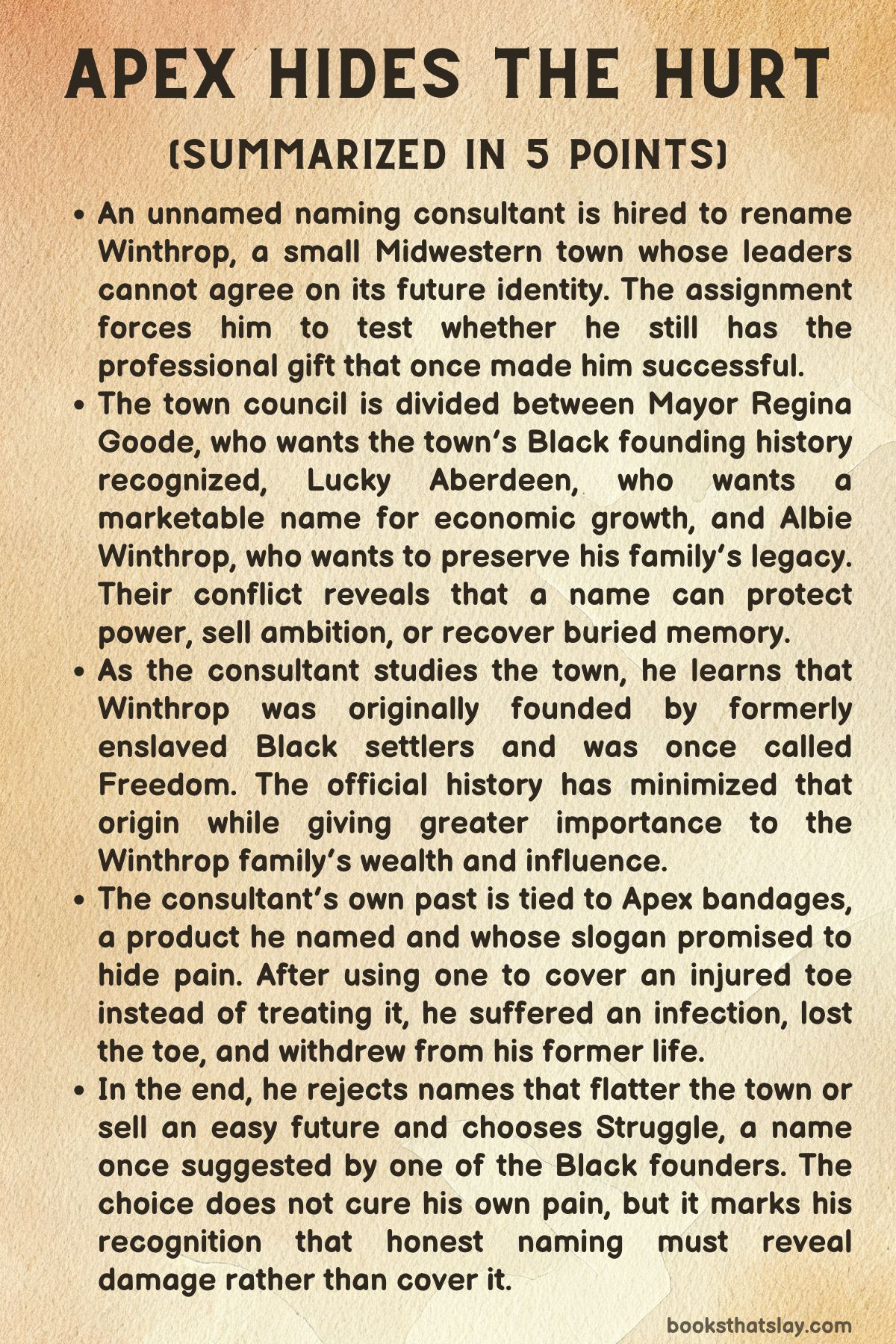
He rose in the company, earned respect, and became one of the best in his field. His greatest success was naming a line of adhesive bandages Apex.
The name was strong, clean, and marketable. The campaign became famous, especially because the bandages were made in various skin tones and advertised with the promise that Apex hides the hurt.
That slogan becomes central to the novel’s meaning. Apex bandages are designed to make wounds disappear from view.
They do not heal the wound by being seen; they hide it by matching the surface around it. The consultant once admired this idea as brilliant marketing.
Later, it becomes connected to his own damage. After injuring his toe, he covers it with an Apex bandage that matches his skin so well he can almost ignore the injury.
He keeps covering the wound instead of treating it. He stubs the toe repeatedly, fails to inspect the damage properly, and allows infection to worsen.
During a company retreat, he steps into contaminated swamp water, which makes the situation more dangerous. Still, he continues masking the injury.
His physical condition deteriorates. He grows feverish, sick, and disoriented, but he tries to maintain appearances.
He attends a professional awards event even though his body is breaking down. When he finally removes the bandage and sees the swollen, foul-smelling toe, he still delays proper care.
His collapse leads to hospitalization and the amputation of the toe. Afterward, he resigns from his job and shuts himself away from people who might care about him.
He refuses visits from his girlfriend, boss, and coworkers. He tells himself that he prefers solitude, but he also feels the pain of not being missed enough.
In Winthrop, his personal history mirrors the town’s history. Both he and the town have relied on coverings.
He hid his wound beneath a product he had helped make famous. The town hid its origins beneath a name that honored a wealthy white family rather than the freed Black people who first created the settlement.
Lucky wants to apply another covering, New Prospera, which would make the place attractive to outsiders while ignoring the conflicts beneath the surface. Albie wants to preserve an old covering.
Regina wants recognition, but even her position is complicated by family history and political desire.
The consultant researches the town’s early days with help from Beverly, the librarian. She gives him an older version of the town history, less flattering to the Winthrops.
He learns that Abraham Goode and a man named Field were major figures among the original settlers. They helped establish the town council along with Winthrop, apparently believing they could control decisions through a two-to-one advantage.
But when the vote came to rename Freedom as Winthrop, Field was absent because he was ill, and the change passed. Regina later suggests that Winthrop may have bribed Goode, creating a betrayal that shaped the town’s future.
The consultant also reads a disturbing account from the settlers’ journey. A lost white child wandered into their camp, and the Black travelers feared they would be accused of kidnapping him.
A light-skinned man named White Jimmy returned the child, but the boy identified him with a racial slur, and soon after, white townspeople attacked the camp. The story shows the danger the settlers faced even before founding Freedom.
Their town was not born from comfort or simple hope. It came from fear, endurance, flight, and the need to survive.
Meanwhile, Lucky hosts a business conference that brings potential investors and homebuyers to Winthrop. He markets the town as the next big opportunity.
Visitors begin imagining themselves as early participants in a revival, buying property while it is still cheap. The consultant watches this process with a mix of admiration and unease.
Lucky is skilled at selling a future, but that future may push aside the people and histories already there. The town is being renamed not only in language, but also in ownership.
Regina shows the consultant the division between the white and Black parts of town. Old Winthrop has grander houses and a sense of inherited status.
The historically Black side has more modest homes, though signs of new wealth and gentrification are appearing. Street names preserve parts of the past, but they also reveal how memory is organized and contested.
The consultant begins to understand that the naming decision is not just symbolic. It is a battle over who gets to say what the town has been and what it will become.
At a barbecue held by Lucky at Aberdeen headquarters, the consultant briefly feels loose and cheerful, as if he is on the final night of a strange vacation. In a sudden burst of confidence, he climbs onto a table and announces that he has chosen a name.
Before he can fully complete the moment, he loses his balance and falls. The fall cuts through the performance and returns attention to his wounded body.
He is helped back to the hotel by Beverly, but he refuses to let her fully enter his private space.
Near the end, he thinks more clearly about the town and about the false promise of ownership through naming. People rename places to claim them, but the land and its history resist such simple possession.
He considers why the original town was not named after Goode and Field, and he learns more about Field’s role. Field had lost his family on the plantation and represented a harsher, more honest understanding of freedom.
His preferred name for the town had been Struggle. At first, the name seems too severe, but the consultant comes to see its truth.
Unlike Freedom, Winthrop, or New Prospera, Struggle does not flatter anyone. It does not hide the wound or sell a fantasy.
It admits that the town’s past and future are marked by conflict, survival, betrayal, ambition, and unfinished work.
The consultant chooses Struggle as the town’s new name, which the council must keep for one year under his contract. He leaves the decision in an envelope and prepares to leave.
He hopes, briefly, that making the right choice might change something in him, perhaps even release him from his limp. But his foot hurts more than before.
The ending refuses easy healing. Naming the truth matters, but it does not erase pain.
Apex Hides the Hurt closes with the recognition that wounds must first be seen before they can be understood, and that no name, however clever, can make history disappear.
Characters
The Unnamed Nomenclature Consultant
The unnamed protagonist is the central figure of Apex Hides the Hurt, and his lack of a personal name is one of the most important parts of his characterization. He has spent his career naming products, companies, and concepts for other people, yet the book withholds his own name, making him seem both powerful and strangely erased.
He understands language as a commercial tool: a good name can sell comfort, status, safety, and reinvention. Earlier in his life, this talent made him successful, admired, and professionally confident.
He could sense the emotional charge inside a word and shape that charge into a marketable identity. But by the time the story begins, he is damaged, withdrawn, and uncertain whether his gift still works.
His limp, caused by an amputated toe, is both a physical condition and a sign of deeper avoidance. The injury became serious because he kept hiding it beneath Apex bandages instead of treating it, which mirrors the way he has hidden emotional pain, professional shame, and personal failure.
In Winthrop, he is forced to examine the same habit on a larger scale. The town wants a new name, but each proposed name attempts to cover history rather than face it honestly.
His final choice shows that he has not fully healed, but he has learned to distrust easy disguises. He becomes a character who recognizes that language can reveal truth only when it stops trying to make pain look neat.
Mayor Regina Goode
Regina Goode is one of the strongest moral and historical presences in the book. As the town’s first Black mayor and a descendant of its original settlers, she carries a history that the official version of Winthrop has tried to reduce or soften.
Regina is polished, intelligent, and politically aware, but she is not only a public figure. She represents memory, inheritance, and the burden of correcting a story that has already been rewritten by power.
Her desire to rename the town is not simply sentimental. She wants recognition for the freed Black people who founded the place before it became associated with the Winthrop family.
Through her, the novel shows how history survives in family names, street names, neighborhoods, and personal memory, even when public records distort it. Regina’s tour of the town helps the protagonist understand that Winthrop is divided not only by race, but also by different claims to belonging.
She knows the emotional geography of the town: where Black families lived, where white wealth settled, and where new residents are beginning to alter the old balance. Yet Regina is not presented as pure or simple.
Her family’s past includes the possibility that Abraham Goode betrayed Field by siding with Winthrop. This makes her role more complex.
She fights for historical justice while also standing inside a family history that may include compromise and betrayal. Regina’s strength lies in her willingness to keep that past alive, even when it is uncomfortable.
Lucky Aberdeen
Lucky Aberdeen is the book’s image of entrepreneurial reinvention. He is energetic, casual, persuasive, and constantly focused on the next version of things.
As a tech businessman, he speaks the language of opportunity and future value. His preferred name for the town, New Prospera, reveals his worldview clearly.
He wants a name that sounds optimistic, profitable, and attractive to outsiders. To Lucky, the town is not mainly a historical place; it is a brand waiting to be relaunched.
His Help Tour brings potential investors and homebuyers to Winthrop, and he succeeds in making them imagine themselves as early participants in a coming boom. Lucky is not a cartoon villain.
He is charming and effective, and his plans may bring money and attention to a struggling town. But his vision is dangerous because it treats history as an obstacle to marketing.
He wants the town to become legible to investors, not necessarily truthful to itself. His confidence exposes one of the novel’s central tensions: progress can become another form of erasure when it asks people to forget what came before.
Lucky’s clothing, salesmanship, and language all suggest a man who builds identities out of surfaces. He believes that a new name can create a new reality, but the book challenges that belief by showing what his proposal leaves out.
Albert “Albie” Winthrop
Albie Winthrop is a fading heir to a name that once carried wealth and authority. He descends from the family whose name the town currently bears, yet his own life is marked by decline.
His estate is neglected, his marriage has ended, and the grandeur attached to the Winthrop name has become fragile and almost theatrical. Albie still behaves as if the town naturally belongs to his family’s legacy, but the people around him do not fully honor that assumption.
Some avoid him, and his gestures of friendliness often seem unanswered. This makes him both comic and sad.
He is attached to the past, but the past he defends is selective. When he speaks about the original Black settlement, he minimizes it, describing it as if it were not a real town until Winthrop influence arrived.
His attitude reveals how inherited power often rewrites beginnings to make itself seem inevitable. Albie’s connection to the protagonist through Quincy, their shared elite college, also shows how institutions help preserve trust among privileged men.
Even when Albie’s material power has weakened, he still benefits from old networks and old assumptions. In Apex Hides the Hurt, he stands for a version of history that wants to remain respectable without admitting the violence, theft, and manipulation that helped create its respectability.
Beverly
Beverly, the librarian, plays an important role as a keeper of records and hidden truths. She is not as politically loud as Regina or as commercially forceful as Lucky, but her knowledge changes the protagonist’s understanding of the town.
Through her, he gains access to an older and less flattering version of Winthrop’s history. This matters because Beverly represents the kind of truth that survives in archives, local memory, and documents that official institutions may prefer to ignore.
She is also important because she briefly awakens the protagonist’s desire and curiosity. His attraction to her surprises him, since he has been emotionally and physically shut down for months.
This does not turn Beverly into a simple romantic figure; rather, it shows that his time in Winthrop is loosening parts of him that had gone numb. She helps him after his fall, but he still refuses to let her fully enter his private space.
That refusal shows the limit of his recovery. Beverly offers care, knowledge, and connection, yet the protagonist remains guarded.
Her character quietly connects research, intimacy, and truth-telling. She helps uncover what has been covered, but she cannot make the protagonist accept help before he is ready.
Muttonchops
The bartender, whom the protagonist privately names Muttonchops, is one of the sharpest voices in the story. His actual name matters less to the protagonist than the nickname the protagonist assigns him, which already reveals the narrator’s habit of categorizing people through names.
Muttonchops is skeptical, blunt, and unimpressed by the renaming project. His statement that changing the name will not change the place cuts through the ambitions of all three council members.
He understands something that the protagonist has spent his career avoiding: language can influence perception, but it cannot automatically alter reality. As a descendant of one of the original families, he has a personal stake in the town’s history, but he does not present that stake in polished political language.
His attitude is rougher and more cynical than Regina’s, yet it carries its own authority. He sees the Help Tour, the investors, and the naming debate as parts of a familiar pattern in which outsiders and elites try to remake a place without truly understanding it.
Muttonchops also serves as a counterweight to the protagonist’s professional faith in branding. He is not seduced by clever names, and his presence keeps reminding the reader that ordinary residents must live with the consequences of symbolic decisions.
Abraham Goode
Abraham Goode is not present in the main action, but his choices shape the town’s entire history. As one of the leaders of the original Black settlement, he represents ambition, survival, and compromise.
Along with Field, he helped establish the community that was first called Freedom. His role becomes more troubling when the protagonist learns that the council structure may have been designed so Goode and Field could outvote Winthrop, but that plan failed when Field was absent and the name Winthrop was approved.
Regina suggests that Winthrop may have bribed Goode, which turns Abraham into a morally complicated ancestral figure. He may have helped build a free Black town, yet he may also have participated in the decision that erased its founding name.
Abraham’s importance lies in this uncertainty. He is not only a symbol of Black leadership; he is also a reminder that oppressed communities can contain conflict, ambition, weakness, and betrayal.
Through him, the novel resists making history clean. The past is not divided neatly between innocent victims and obvious villains.
Abraham Goode’s legacy is powerful because it contains both achievement and possible surrender.
Field
Field is one of the most meaningful absent figures in the book. Like Abraham Goode, he belongs to the town’s founding history, but he comes to represent a more severe and honest vision of freedom.
He had lost his family under slavery, and that loss shapes the way he understands the world. Unlike names such as Freedom or New Prospera, his preferred name, Struggle, refuses comfort.
It does not promise completion, success, or easy healing. It names the condition through which the settlers lived and through which the town continues to live.
Field’s absence from the decisive council vote is crucial. Because he is ill and not present, the town loses the name that might have preserved a harder truth.
His lack of descendants also matters. Without family to protect his memory, his role becomes easier to erase.
Yet by the end, his vision returns through the protagonist’s decision. Field becomes the moral center of the town’s buried history, not because he wins in his own lifetime, but because his rejected name proves to be the most truthful one.
In the logic of Apex Hides the Hurt, Field stands for the wound that cannot be hidden forever.
Roger Tipple
Roger Tipple, the protagonist’s former boss, belongs mostly to the world the protagonist has left behind. He is the person who brings the freelance assignment to him, pulling him out of isolation and placing him back inside the work of naming.
Roger represents the corporate culture in which the protagonist once thrived. That world valued cleverness, elite credentials, client lists, and the ability to turn language into profit.
His connection to the protagonist is professional rather than deeply intimate, but it carries the weight of a former life. Roger’s call matters because it tests whether the protagonist can return to the skill that once defined him.
At the same time, Roger is tied to the system that helped create the protagonist’s downfall. The protagonist’s success with Apex gave him status, but it also became part of the personal disaster he tried to hide.
Roger is not responsible for that disaster, but he represents the world of surfaces, campaigns, and professional performance from which the protagonist has retreated. His role is small but necessary: he opens the door between the protagonist’s damaged present and the talent he has tried to abandon.
Jack and Dolly Cameron
Jack and Dolly Cameron represent the outsiders who are drawn to Winthrop through Lucky’s promise of opportunity. They are not deeply developed as individuals, but they are important as examples of how branding works on ordinary people.
Jack is interested in the town’s old-fashioned charm and tradition, yet he is also open to Lucky’s argument that the place needs a more modern identity. His willingness to buy property shows how quickly language and atmosphere can turn a real town into an investment fantasy.
The Camerons see Winthrop partly as a place with character and partly as a chance to get in early before values rise. Through them, the book shows how gentrification often begins with admiration.
Newcomers may appreciate the look, history, or affordability of a place, but their arrival can still change it in ways that displace or silence existing residents. Jack and Dolly are not malicious, but their interest is shaped by the market.
They help reveal the danger in Lucky’s vision: once a town is successfully renamed and resold, the people who built its history may become background decoration.
Bridget
Bridget, the protagonist’s former girlfriend, appears through memories of his collapse. Her role is important because she shows what his emotional life looked like before he fully withdrew.
The disastrous evening he spends with her while his infected toe worsens reveals his inability to be honest about his condition. He tries to continue performing normal life, even when his body is signaling crisis.
Bridget becomes part of the world he shuts out after hospitalization. He refuses visits from her, just as he refuses visits from his boss and coworkers.
This refusal suggests shame, fear, and a desire to control how others see him. Bridget is not given the same depth as the town’s major figures, but she helps expose the protagonist’s pattern of avoidance.
He would rather disappear than be witnessed in weakness. Her presence in the book reminds us that his injury is not only professional or symbolic.
It damages his capacity for intimacy. He cannot let another person see the wound, either physically or emotionally, and that refusal leaves him isolated.
White Jimmy
White Jimmy appears in the historical account of the lost white child, and though his role is brief, it is deeply revealing. As a light-skinned Black man sent to return the child safely, he stands at the center of a terrifying racial situation.
The freed travelers understand that even an innocent encounter can become deadly if white townspeople choose to read it as a crime. White Jimmy’s attempt to help does not protect him from racial hatred.
When the child identifies him with a slur, the danger becomes immediate, and the group must flee. His experience captures the vulnerability of Black people in a world where innocence offers no safety.
The episode also explains why the founding of the town cannot be understood through a simple celebratory name like Freedom. Freedom exists under threat.
White Jimmy’s moment in the story helps give Field’s preferred name, Struggle, its full force. He shows that the settlers’ journey was marked not only by hope but by fear, accusation, and violence.
Themes
Naming, Branding, and the Limits of Language
Names carry enormous power in the novel, but that power is shown to be unstable. The protagonist has built his career on the belief that the right name can transform perception.
A weak product can seem trustworthy, a plain object can seem necessary, and a town can be made to sound prosperous or historic through a carefully chosen word. This professional belief shapes the way he sees almost everything.
He instinctively renames people in his own mind, judges businesses by their signs, and reads places as if they are campaigns waiting to be improved. Yet the town of Winthrop exposes the limits of this worldview.
Each proposed name carries an agenda. Winthrop protects inherited white prestige, New Prospera sells a future of development, and Freedom honors the town’s Black origins while still sounding almost too clean for the pain behind it.
The final choice, Struggle, matters because it does not beautify the town for public approval. It admits conflict rather than covering it.
The book suggests that language becomes most honest when it stops functioning as packaging. A name can distort reality, but it can also force reality into view when chosen without fear.
Hidden Wounds and the Refusal to Heal
The protagonist’s injured toe is one of the clearest symbols in Apex Hides the Hurt, but it works because it is also painfully literal. He hurts himself, covers the wound with a bandage that matches his skin, and then continues to ignore the damage until infection destroys part of his body.
The bandage does exactly what the advertisement promises: it hides the hurt. But hiding pain is not the same as treating it.
His physical decline becomes a pattern for his emotional life. After the amputation, he withdraws from work, romance, friendship, and public existence.
He refuses visitors because being seen in a damaged state feels worse than loneliness. The town behaves in a similar way.
Its public identity covers the injury of historical erasure. Its current name hides the Black settlement that came before.
Lucky’s proposed name would hide the old wound beneath optimism and money. Albie’s attachment to Winthrop hides the violence of inheritance behind tradition.
The novel argues that untreated wounds do not disappear; they deepen. Even the protagonist’s final honest decision does not cure his limp.
Truth is necessary, but it is not magic. Recognition begins healing, but it does not erase consequence.
Race, History, and Erasure
The town’s history is a struggle over who gets remembered and who gets reduced to a footnote. The official story favors the Winthrop family and treats the original Black settlers as secondary figures, even though they founded the place before Sterling Winthrop’s name took over.
This is not only a matter of local pride. It shows how racial power rewrites public memory.
The freed settlers created a community out of danger, movement, and hope, but later histories reshape that beginning to make white industry seem like the true origin of the town. Regina Goode’s role is important because she carries a counter-memory.
She knows the town’s Black neighborhoods, family lines, and buried stories. The older history book and the story of the lost white child reveal how much violence and fear surrounded the settlers’ search for safety.
The renaming debate therefore becomes a fight over historical truth. Keeping Winthrop means preserving a name that covers displacement.
Choosing New Prospera means inviting another wave of erasure through development. Even Freedom, though historically accurate, risks simplifying the brutal conditions under which the settlement began.
Struggle becomes the most honest name because it remembers the cost of survival.
Commerce, Progress, and Gentrification
The novel treats economic progress with suspicion, especially when it arrives dressed as opportunity. Lucky Aberdeen’s plan for the town is persuasive because it offers practical benefits: investment, attention, tourism, new residents, and rising property values.
His Help Tour creates excitement by making outsiders feel that they have discovered a place before everyone else. This is how gentrification often presents itself, not as conquest, but as improvement.
Visitors admire the town’s charm, affordability, and potential, yet their arrival threatens to change the very community they find appealing. The protagonist notices the signs of this shift when he sees new kinds of wealth appearing in historically Black neighborhoods.
The town’s future is being sold before its past has been properly acknowledged. Commercial language makes this process sound clean.
Words like prosperity, opportunity, and renewal suggest benefit for everyone, but the book asks who gains and who is pushed aside. Lucky’s vision is not empty; it may bring real change.
The danger is that change guided mainly by branding and investment will repeat the old pattern of renaming: claim the place, repackage it, and treat existing history as a marketing detail rather than a living inheritance.