April Morning Summary, Characters and Themes
April Morning by Howard Fast is a historical coming-of-age novel set in Lexington, Massachusetts, at the start of the American Revolutionary War. The story follows Adam Cooper, a teenage boy who begins one ordinary day feeling misunderstood by his strict father and uncertain about his place in the world.
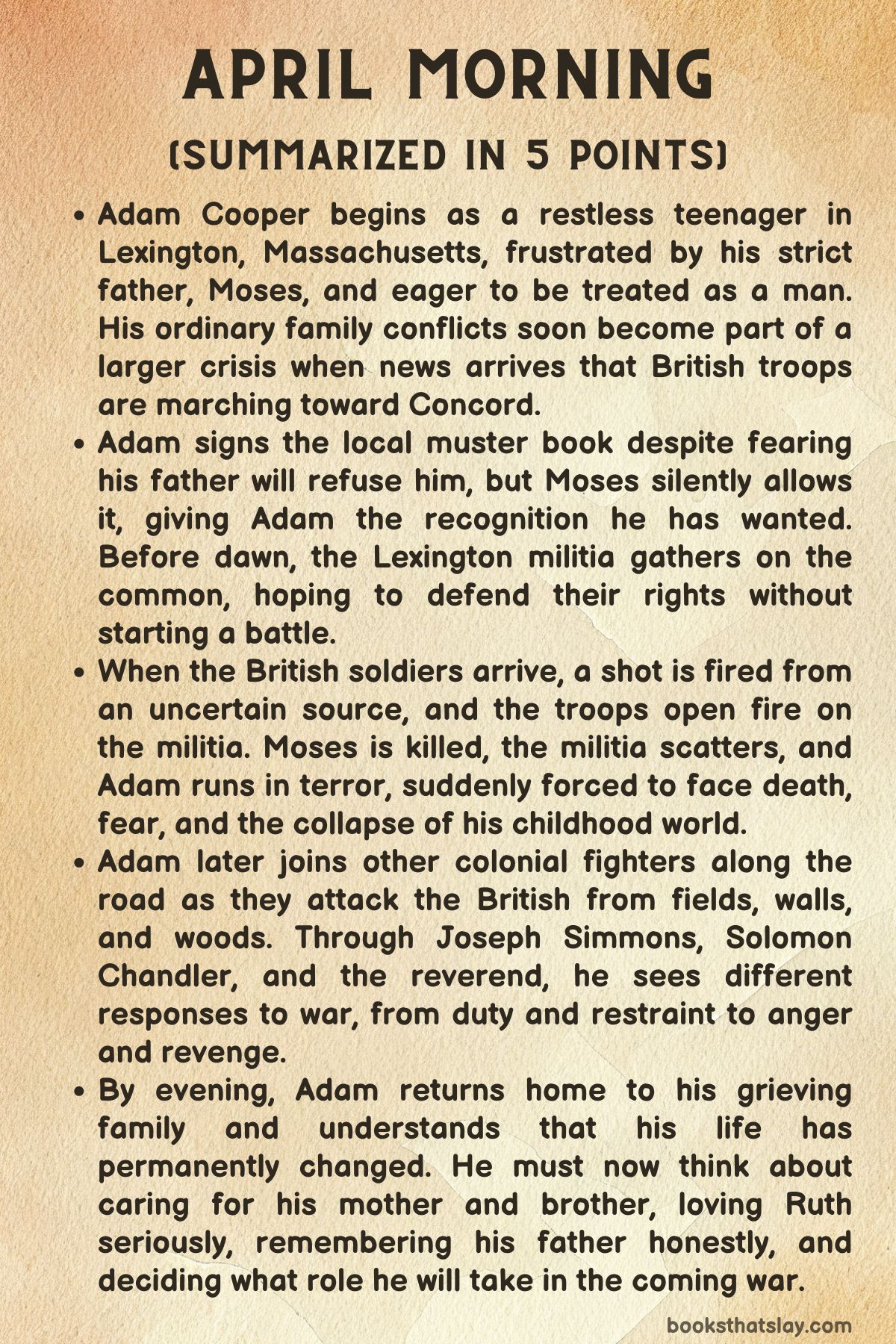
By the next night, after the first bloodshed between colonial militia and British troops, Adam is forced to face death, fear, duty, love, and responsibility. The novel is both a personal story about growing up and a vivid account of how history can change ordinary lives in a single day.
Summary
April Morning begins on the Cooper family farm in Lexington, Massachusetts, where fifteen-year-old Adam Cooper feels trapped between childhood and manhood. His father, Moses Cooper, is a stern, intelligent, argumentative man who demands discipline, reason, and usefulness from his son.
Adam is doing chores, but Moses criticizes him for being slow and careless. Adam’s mother, Sarah Cooper, also expects more from him, reminding him that Moses supposedly used his spare moments as a boy to memorize scripture.
Adam feels judged by everyone in the house. His younger brother Levi watches him closely and sometimes uses what he sees against him.
When Adam mutters a folk charm at the well to guard against evil thoughts, Levi overhears and threatens to tell their father. Adam knows Moses will treat the charm not only as foolish but as proof that Adam lacks sense.
To Moses, superstition is ignorance, and ignorance is almost a moral failure.
Adam goes to his grandmother, Granny Cooper, for sympathy. He questions her about religion and belief, pointing out that some respected men in the community do not seem especially good.
Granny understands that Adam is testing ideas, but she warns him not to use doubt as a weapon against other people’s faith. Adam is not trying to hurt anyone; he is trying to understand why adults say things that do not always match what they do.
At dinner, the tension between Adam and Moses comes into the open. Moses discovers that Adam spoke the charm at the well and scolds him in front of the family.
Moses is not angry because the words were religiously offensive; he is angry because they show, in his view, a lazy mind. Granny defends Adam and warns Moses against pride.
The argument ends when Joseph Simmons, their neighbor and relative, arrives.
Joseph brings a document he has written for the local Committee on the Rights of Man. Moses and Joseph discuss politics, rights, and the growing conflict with Britain.
Moses objects to parts of Joseph’s wording, especially his use of God to justify political claims. Moses believes people must reason their way to rights rather than simply attach sacred language to their arguments.
The men leave for a committee meeting, and Adam asks to go along, but Moses refuses. He says Adam is not yet a man.
Hurt, Adam asks his mother why his father hates him. Sarah insists Moses loves him, but Adam is unable to see the difference between love and harshness.
That evening, Adam visits Ruth Simmons, Joseph’s daughter and the girl he loves. Ruth is kind, patient, and more emotionally steady than Adam.
He tells her about his quarrel with his father and his humiliation at being kept from the meeting. Ruth comforts him, though she also tries to calm his anger.
Their walk through the town shows the strictness of their community, where neighbors notice and judge young people who are alone together after dark. Adam and Ruth argue briefly about one of Adam’s uncles, but affection soon softens the moment.
Adam imagines leaving Lexington and going to sea, but Ruth tells him such a choice would make her terribly lonely.
Back home, Adam finds Levi cleaning his fowling piece. Levi talks excitedly about killing a British soldier, but Sarah rebukes him for speaking lightly about human death.
Later, as Adam lies in bed, he overhears his parents talking. Sarah tells Moses that Adam thinks his father does not love him.
Moses is shocked and angry at first, but Granny says Moses has been too stubborn, just as his own father once was. Moses gradually admits that he may have been too hard on Adam.
He decides he must show his son love more clearly. Hearing this, Adam falls asleep feeling better than he has all day.
During the night, Levi wakes Adam after a frightening dream of a red sky and death. Adam tries to reassure him, but then they hear hoofbeats and a rider shouting in the distance.
The household wakes. News spreads that British troops have crossed the Charles River and are marching toward Concord, likely to destroy colonial arms and supplies.
Adam wants to go to the common to hear what is happening. Sarah wants him to stay home, but Granny supports him, and Adam goes.
On the common, the men of Lexington debate what to do. The British force is far larger than anything the town can raise.
Some urge caution, including the reverend, who fears that a small militia cannot stand against trained soldiers. Moses, though he dislikes military thinking, argues that the men must assemble as a sign of their rights and dignity.
They are not seeking battle, but they cannot simply hide. His words move the crowd, and the militia decides to muster.
Adam helps ring the church bells, then goes to Buckman’s tavern to sign the muster book. Moses is one of the men recording names.
Adam fears his father will shame him by refusing to let him sign. When Adam gives his name, Moses realizes what is happening.
The room grows silent. Adam waits, expecting rejection.
Instead, Moses quietly allows him to sign. In that moment, Adam gains public recognition as one of the men.
Ruth sees him sign and worries that he may be killed. Adam walks her home and tries to reassure her.
When he returns, he hears his parents arguing. Sarah believes Adam is still a boy.
Moses says that if he had stopped Adam, he would have lost him in another way. Moses understands that Adam’s pride and identity now require respect.
When Adam enters, Moses speaks to him as someone who must take life seriously, including his intentions toward Ruth. Moses then helps him prepare his gun.
The two leave together for the common.
Before dawn, father and son stand among the militia. Moses puts his arm around Adam’s shoulders, a rare gesture of tenderness, and warns that Adam may soon have heavy responsibilities.
The men continue to discuss their course of action. Simon Casper, who has military experience, advises them to stand ready with cocked guns, but Moses and others object.
They do not want to start a war by accident. The militia decides to stand in formation as a public defense of liberty, not as an attacking force.
As daylight comes, the British soldiers appear. Their numbers, weapons, and discipline make the militia’s weakness clear.
Major Pitcairn orders the British forward. Adam suddenly understands that this is no longer talk, politics, or practice.
Something terrible and real is happening. A shot rings out, though no one knows who fired it.
The British open fire. Moses is among the first men killed.
The scene collapses into terror. The militia scatters.
Adam runs, falls into a ditch, vomits, and sees men cut down. He sees Captain Jonas Parker bayoneted.
Overwhelmed by fear and shock, he hides in a smokehouse. Levi later finds him there and tells him Moses is dead.
Sarah and Granny have already found the body. Granny, furious and grieving, has even spat in the face of a British soldier who offered help.
Levi tells Adam that Granny wants him to hide in the woods behind Joshua Simmons’s house.
After sleeping briefly, Adam wakes to nearby British soldiers. When they leave, he runs for the woods.
Two soldiers see him, and one fires, but the gun misfires. Adam escapes over a wall and meets Solomon Chandler, an armed colonial who offers help.
Adam tells him what happened in Lexington and breaks down over his father’s death. Chandler does not shame him for crying.
Instead, he tells Adam that he has lost his youth and become a man in only a few hours.
Chandler guides Adam through the countryside. He gives him food and teaches him to look at the British soldiers not as invincible figures but as tired, vulnerable men.
They meet other colonials gathering to resist the British retreat from Concord. Adam repeats the story of Lexington, insisting that the militia did not fire first.
At Ashley’s Pasture, more men assemble, including Joseph Simmons and the reverend. Adam is relieved to find them alive.
The mood among the militia is strange. Men cook, smoke, talk, and organize themselves while violence continues nearby.
Joseph shares food with Adam and tells him that Adam may come to him as he would to a father. This offer matters deeply because Moses is gone and Adam’s world has changed.
News arrives that the British have occupied Concord and destroyed supplies. Soon shots are heard.
Chandler urges the men to repay the British for the killings in Lexington. The reverend objects to the idea of killing in God’s name, saying that no one kills for God’s cause and can only ask forgiveness.
Chandler is practical and fierce; he believes there is no time for debate. The militia prepares to strike.
When the British come along the road, the colonials fire from cover. Adam fires too.
The British charge, and Joseph pulls him away. Adam feels fear, confusion, and a strange relief at still being alive.
He sees death up close, including a young British soldier whose body reminds him of Levi. The sight sickens him.
Adam begins to understand that enemy soldiers are also boys, brothers, and sons.
Adam and Joseph continue fighting in small groups, firing from walls and fields, then moving before the British can respond. Adam grows tired of battle and asks whether they have done enough.
Joseph explains that they are not fighting merely to avenge Moses. They are fighting because their land, homes, and way of life are under threat.
This distinction shapes Adam’s understanding of the war. Revenge burns hot and fades; defense of a home requires endurance.
The fighting spreads along the road toward Lexington and Boston. The British are harassed again and again by militia groups who know the terrain.
Adam sees different kinds of courage and different kinds of cruelty. Chandler seems to take pleasure in killing, which troubles Adam.
Others, like Joseph, fight because they believe they must, not because they enjoy it. When a wounded British cavalryman expects to be killed, a colonial doctor treats him instead.
The moment shows Adam that even in war, men can choose mercy.
By afternoon, rumors say Lexington is burning, and Adam fears for his home. He and Joseph move toward the village.
The militia considers larger attacks, but the British are strongest when met in the open, so the colonials continue their hit-and-run tactics. Adam fires once more, then realizes his shot is useless at that distance.
Exhausted, he crawls away and falls asleep. Joseph and the reverend later find him, having feared he was dead.
Adam returns home to an emotional welcome. Levi cries when he sees him.
Sarah embraces him; she had been told Adam was killed. Ruth is there too, watching him with relief and love.
The house is full of neighbors, grief, food, and anxious talk. Adam is brought to the room where Moses’s body lies.
Looking at his father’s corpse, Adam understands that the body no longer contains the man he knew. He decides not to remember Moses that way.
Adam learns that the British took the family’s horses, which means the farm will face serious hardship. He tells Levi they must grow up now and take responsibility.
Later, Adam helps carry Moses’s coffin to the meetinghouse, where other dead men have been laid. Passing the common, he sees the marks of the morning’s violence and knows his childhood is over.
At the meetinghouse, Joseph advises Adam not to turn Moses into a saint in memory. Moses had strengths and faults, and Adam must remember the whole man or lose the truth of him.
Joseph also tells Adam that a new muster is being prepared for the siege of Boston. Adam must decide whether to join the larger war or remain home to care for his family.
Joseph has his own difficult choice, since Lexington needs him as a blacksmith.
That evening, Adam walks across the common and remembers childhood games once played there. Those games had seemed exciting because they imitated war, but now real war has stripped them of innocence.
At home, the women insist he eat. Levi has cleaned Adam’s gun again and now looks at him with new respect.
Ruth joins Adam when he takes candles to the meetinghouse. She asks what battle was like and whether he killed anyone.
Adam says he does not think he did. He admits that for a short time he wanted to, but he could not keep enough hatred in himself.
Ruth is relieved.
The reverend meets Adam and tells him that he now sees him as a man. He reminds Adam that his first duty may be to his mother, not to the army.
Adam and Ruth place the candles in the meetinghouse, then leave. At Ruth’s door, she asks if he loves her.
Adam thinks carefully and says yes. Ruth promises that her love will not change, even if the war lasts a long time.
Back home, Adam performs the chores Moses used to do. The ordinary work of the farm now belongs partly to him.
Granny helps Sarah to bed, and Adam faces the quiet house as someone changed by the day’s events. He is unsure whether he will join the coming fight, but he knows he can no longer think as a child.
He goes to bed thankful that the terrible day has ended, aware that his life, his family, and his country have entered a new and uncertain future.
Characters
Adam Cooper
Adam Cooper is the central character of April Morning, and the book follows his rapid movement from restless boyhood into a painful, premature adulthood. At the beginning of the story, Adam is dissatisfied with nearly everything around him: his chores, his father’s criticism, the limits placed on him by adults, and the feeling that no one truly understands him.
He wants to be treated as a man, but he does not yet fully understand what manhood demands. His impatience, wounded pride, and tendency to question inherited beliefs make him a believable adolescent rather than a simple heroic figure.
Adam is curious about God, justice, politics, love, and death, but his questions often come out as arguments or complaints because he lacks the maturity to handle them calmly.
His relationship with Moses is the emotional center of his development. Adam thinks his father hates him because Moses is harsh, demanding, and rarely tender in an obvious way.
Yet Adam also wants Moses’s approval more than almost anything else. When Moses allows him to sign the muster book, Adam receives the recognition he has been craving, but the cost of that recognition becomes terrible almost immediately.
After Moses is killed, Adam is forced to understand that becoming a man is not about public pride or proving courage. It means grief, responsibility, moral judgment, and the burden of choice.
Adam’s experience in battle changes him deeply. He begins with fear and confusion, then briefly feels the excitement of survival, but he cannot become someone who enjoys killing.
His reaction to the dead British soldier shows that his humanity remains intact even after violence has entered his life. By the end of the story, Adam is not fully grown in the ordinary sense, but he has crossed a line he can never uncross.
He must help care for his family, think seriously about Ruth, and decide whether to join the wider war. His character matters because he shows how history does not only happen to famous leaders; it also reshapes ordinary young people who are forced to grow up in a single day.
Moses Cooper
Moses Cooper is Adam’s father, and he is one of the most intellectually forceful figures in the novel. He is stern, rational, proud, politically serious, and often difficult to live with.
Moses dislikes superstition, empty religious language, and shallow thinking. When Adam speaks a folk charm at the well, Moses is not mainly offended by the religious nature of the act; he is offended because he sees it as ignorance.
This reveals a great deal about him. Moses believes that human beings should use reason, discipline, and moral courage rather than hiding behind habit or fear.
He is not an easy father, but he is not a careless or cruel one.
His problem is that his love is often hidden behind correction. Moses wants Adam to become thoughtful, strong, and responsible, but he expresses this desire through criticism.
As a result, Adam experiences his father’s standards as rejection. The tragedy of Moses’s character is that he begins to realize this too late.
When Sarah tells him that Adam thinks he is unloved, Moses is shaken. His later decision to allow Adam to sign the muster book shows that he understands Adam’s need for dignity.
Moses could have refused him, but doing so would have broken something between them. Instead, he silently accepts Adam’s claim to manhood.
Moses is also important as a political and moral thinker. Although he dislikes military behavior, he argues that the men of Lexington must stand together when British troops approach.
He does not want war, but he refuses humiliation. His position is not based on hatred of the British but on a belief in rights and civic responsibility.
His death on the common is devastating because it comes just after he and Adam begin to move toward a better understanding of each other. Moses remains powerful in the book even after his death because Adam must decide how to remember him: not as a saint, not as a tyrant, but as a flawed, brave, demanding man who died standing for what he believed.
Sarah Cooper
Sarah Cooper, Adam’s mother, is a steady and emotionally intelligent presence within the Cooper household. She understands the tensions between Moses and Adam better than either of them does.
While Moses focuses on discipline and principles, Sarah notices the wounds those principles can leave when they are expressed too harshly. She tells Adam that his father loves him, even when Adam cannot believe it, and she later tells Moses that Adam feels unloved.
In doing so, she becomes the bridge between father and son, giving voice to emotions that the men of the household struggle to express directly.
Sarah’s strength lies in her practical care. She manages the home, feeds the family, worries over her children, and tries to hold the household together during moments of fear and disorder.
Her objection to Adam joining the militia is not weakness; it is the response of a mother who understands that public ideas about honor can demand the lives of boys who are not ready to die. After Moses is killed, Sarah’s world is violently altered.
She loses not only her husband but also the structure around which the family has been organized. Yet the story shows that she continues to function, receiving neighbors, managing grief, and relying on Adam in a new way.
Sarah also helps define what responsibility means outside the battlefield. The men may speak of rights and war, but Sarah represents the home that must survive after the speeches and fighting.
Her presence reminds the reader that the Revolution is not only a matter of public action; it enters kitchens, bedrooms, farms, and family relationships. By the end of April Morning, Sarah’s grief forces Adam to recognize that his first duty may not be glory or revenge but care.
Through her, the book shows that courage can be quiet, domestic, and enduring.
Levi Cooper
Levi Cooper is Adam’s younger brother, and his role in the story shows childhood at an earlier and more innocent stage than Adam’s. At first, Levi appears mischievous and irritating.
He overhears Adam’s charm at the well and threatens to tell Moses, making him seem like a typical younger sibling who enjoys having power over an older brother. He is also fascinated by guns and speaks excitedly about killing a redcoat, which reveals how easily children can turn war into fantasy before they understand what death actually means.
Yet Levi is not merely comic or childish. His nightmare of a red sky and death introduces the atmosphere of fear that settles over the family before the British arrive.
His dream may not be treated as prophecy by Adam, but it reflects the emotional truth of the night: something violent is coming, and the children sense it before they can fully understand it. Levi’s later actions show bravery and loyalty.
He finds Adam after the massacre, tells him what has happened, and carries messages from the family. He has seen enough to know that the danger is real.
After Moses’s death, Levi’s relationship with Adam changes. He begins to look up to Adam as the man of the house, cleaning his gun and depending on him for direction.
This shift is important because it shows that Adam’s new role is not symbolic only. Levi needs him.
The family structure has changed, and Levi’s childhood is also damaged by the violence of the day. While Adam experiences the central coming-of-age, Levi’s character shows the wider effect of war on younger children who watch adults die, homes change, and older siblings become substitutes for lost parents.
Granny Cooper
Granny Cooper is one of the wisest and sharpest figures in the Cooper family. She is old, direct, observant, and unafraid to challenge Moses when she thinks he is wrong.
Her authority does not come from political office or physical power but from age, experience, and moral clarity. She understands Adam’s nature more gently than Moses does.
When Adam asks questions about God and hypocrisy, Granny does not always approve of his tone, but she recognizes that he is thinking and struggling rather than merely being wicked or foolish.
Her defense of Adam during Moses’s criticism is one of her most important moments. She warns Moses against pride, suggesting that his confidence in reason can itself become a kind of arrogance.
Granny sees what Moses misses: that correction without tenderness can damage a child. She also helps Adam gain permission to go to the common when the alarm is raised, showing that she respects his desire to witness and participate in public life.
She does not treat him as helpless, even though she knows he is young.
After Moses is killed, Granny’s grief appears as fierce anger. Her act of spitting in the face of a British soldier who offers help is not polite or measured, but it is honest.
It reveals the depth of her loss and her refusal to accept comfort from those she sees as responsible for the violence. Granny embodies an older, harder kind of endurance.
She has lived long enough to see through false dignity, empty talk, and cowardice. Her role in the book is to balance reason with instinct, discipline with compassion, and public ideals with the raw truth of grief.
Ruth Simmons
Ruth Simmons is Adam’s romantic interest, but she is more than a simple symbol of young love. She represents emotional steadiness, tenderness, and moral sensitivity.
Adam often comes to her when he feels misunderstood, and she gives him sympathy without encouraging his worst impulses. When he complains about Moses, Ruth listens, but she also tries to soften his anger.
She understands Adam’s pride and insecurity, yet she does not allow his feelings to dominate her completely.
Ruth’s relationship with Adam shows the difference between childish desire and mature love. Their courtship contains affection, attraction, impatience, and restraint.
Adam is drawn to her beauty and comforted by her loyalty, but he must learn that loving Ruth means more than wanting her attention. By the end of the novel, when she asks whether he loves her, Adam answers after serious thought.
This matters because he is no longer speaking from passing emotion alone. His answer comes after death, fear, and responsibility have changed his understanding of life.
Ruth also experiences violence directly. She witnesses the killing of Jonas Parker, which means she is not sheltered from the brutality that transforms Adam.
Her relief when Adam says he did not sustain hatred during battle shows her moral importance. She wants him alive, but she also wants him to remain humane.
Ruth’s promise that her love will not change, even if the war lasts forever, gives Adam emotional stability at a moment when everything else is uncertain. In the story, she stands for the future Adam might still have if war does not consume him entirely.
Joseph Simmons
Joseph Simmons is Ruth’s father, Moses’s neighbor and relative, and one of the book’s clearest examples of principled adulthood. He is a blacksmith, a Committeeman, and a man of strong conscience.
His estrangement from his brothers because of their investment in a slave ship shows that his morality is not limited to public speeches about liberty. He is willing to suffer family division for what he believes is right.
This makes him one of the more ethically grounded characters in the story.
Joseph becomes especially important to Adam after Moses’s death. He offers Adam food, guidance, and emotional support, even telling him that Adam may come to him as he would to a father.
This offer is not sentimental; it is practical and deeply compassionate. Joseph understands that Adam has lost both a parent and the structure of his boyhood.
He does not try to replace Moses, but he helps Adam survive the first terrible hours after the loss.
In battle, Joseph is brave but not bloodthirsty. He fights because he believes the colonists must defend their homes and liberties, not because he enjoys violence.
This separates him from Solomon Chandler, whose anger and pleasure in killing disturb Adam. Joseph teaches Adam that the war cannot be reduced to revenge.
Moses’s death matters, but the fight is larger than personal grief. Joseph’s advice about remembering Moses honestly is also crucial.
He warns Adam not to turn his father into a perfect figure after death, because doing so would erase the real man. Joseph’s wisdom lies in balance: he is moral without being self-righteous, brave without being cruel, and loving without being soft.
Solomon Chandler
Solomon Chandler is an armed colonial fighter who meets Adam after the massacre and helps guide him into the wider conflict. He is practical, confident, and experienced in a way Adam is not.
When Adam is frightened and grieving, Chandler gives him food, steadies him, and teaches him to look carefully at the British soldiers instead of imagining them as unstoppable. This guidance helps Adam regain some control over himself.
Chandler is therefore useful to Adam’s survival and early education in war.
At the same time, Chandler is morally troubling. He encourages hardness and speaks of repaying the British for what they have done.
His use of scripture to justify killing shows how easily religious language can be turned toward violence. The reverend challenges this view, insisting that killing cannot simply be claimed as God’s work.
Through Chandler, the book presents one possible response to atrocity: anger sharpened into revenge.
Adam gradually sees that he and Chandler are not the same. Chandler seems to take satisfaction in killing British soldiers, while Adam cannot maintain that kind of hatred.
This contrast is essential to Adam’s moral development. Chandler is not shown as useless or cowardly; he is effective, brave, and helpful.
But his character raises the question of what war does to the human spirit. He represents the danger that righteous resistance can become pleasure in violence.
Adam learns from him, but he also learns that he does not want to become him.
The Reverend
The reverend is a thoughtful and morally cautious figure who serves as a voice of conscience during the crisis. When the men of Lexington first debate what to do about the approaching British troops, he urges restraint.
His caution is not cowardice; it comes from a realistic understanding of the militia’s weakness and the danger of unnecessary bloodshed. He knows that seventy or so local men cannot defeat a large professional force in open battle.
His role becomes especially important when others try to give violence a sacred justification. When Chandler claims that the men are fighting for God, the reverend objects.
He argues that no one kills in God’s cause and that a person who kills can only ask forgiveness. This gives the novel one of its clearest moral boundaries.
The reverend recognizes that resistance may become necessary, but necessity does not make killing pure or holy.
He also recognizes Adam’s transformation. When he later tells Adam that he sees him as a man, the statement carries weight because the reverend is not easily carried away by public excitement.
He also reminds Adam that duty to family may matter more than joining the siege of Boston. In this way, the reverend challenges narrow ideas of courage.
He suggests that moral responsibility includes restraint, care, and humility. His character keeps the story from treating war as simple glory.
Jonas Parker
Jonas Parker is the militia captain in Lexington and a symbol of local courage, martial pride, and public duty. Earlier in the story, Moses clashes with him over military matters and over Parker’s reliance on a dream to predict good weather.
This disagreement shows the difference between Parker and Moses. Parker is more comfortable with military identity and symbolic gestures, while Moses trusts reason and dislikes martial thinking.
Yet both men ultimately stand on the common when the British arrive.
Parker’s death is one of the most brutal images in the book. He is bayoneted during the British attack, and both Adam and Ruth are affected by the sight or knowledge of it.
His killing destroys any childish idea of war as a game. Parker may not be explored as deeply as Adam, Moses, or Joseph, but his presence matters because he represents the local militia tradition that suddenly becomes real.
He is not a distant officer in a grand campaign; he is a known man from the community, killed in a place associated with ordinary village life.
Through Parker, the story shows how quickly civic symbols become human losses. A militia captain may stand for resistance, but when violence begins, titles fall away and what remains is a body on the ground.
His death helps mark the end of innocence for Adam, Ruth, and Lexington itself.
Simon Casper
Simon Casper is a militia member with prior military experience from the French and Indian War. His importance lies in the practical perspective he brings before the British arrive.
Unlike many of the men, he has some understanding of combat and the need for readiness. His advice that the militia should stand with guns fully cocked reflects a soldier’s instinct to prepare for immediate danger.
Moses and others disagree with him because they fear an accident could start the very war they are trying to avoid. This disagreement is important because Simon is not foolish; his advice makes sense from a military standpoint.
Yet the situation on Lexington common is not purely military. The militia wants to make a political and moral statement without firing first.
Simon’s character therefore highlights the tension between preparation and provocation.
Although he is a smaller character, Simon helps clarify the confusion of the morning. The men are not united by a single clear plan.
They are improvising under pressure, trying to balance honor, fear, restraint, and self-defense. Simon represents the practical soldierly voice within a group that is still trying to avoid becoming an army.
Major Pitcairn
Major Pitcairn is the British officer who commands the troops as they confront the Lexington militia. He appears mainly from Adam’s limited viewpoint, which makes him feel distant, powerful, and threatening.
He is not developed as a private person; instead, he represents imperial authority in motion. His orders and the disciplined advance of the British troops transform the common from a local meeting place into a battlefield.
Pitcairn’s role is important because he embodies the machinery of empire rather than personal villainy alone. The British soldiers are frightening because they act as a trained body under command.
Yet the uncertainty over who fires the first shot complicates any simple reading of the moment. The book does not need to turn Pitcairn into a melodramatic villain.
His presence is enough to show how state power can arrive in a village and change private lives forever.
Through him, the conflict becomes visible. Until the British appear, much of the story consists of talk: family arguments, political documents, committee meetings, and debates over rights.
Once Pitcairn orders the advance, words give way to gunfire. He is a historical force seen through the eyes of a frightened boy who suddenly understands that political conflict has become deadly.
Abel Loring
Abel Loring is Adam’s friend and a young militia member positioned near him on the common. He is only slightly older than Adam, which makes his presence important.
Adam is not surrounded only by seasoned adults; he is standing with boys and young men who are barely prepared for the violence about to reach them. Abel helps show that the first confrontation involves an entire community, including its youth.
Although Abel is not developed in great detail, his closeness to Adam in age strengthens the coming-of-age aspect of the book. The militia line is not an abstract political formation.
It contains neighbors, relatives, friends, and boys who have grown up together. Abel’s presence reminds the reader that Adam’s experience is personal and communal at once.
The violence that follows does not only kill individuals; it wounds the shared life of the town.
Alan Becket
Alan Becket is a military leader from Sudbury who enters the story during the colonial pursuit of the British. He brings a more organized tactical vision than many of the local fighters.
His argument that the militia should take advantage of the situation and make a stand near Lexington and Menotomy shows that the conflict is expanding beyond spontaneous local anger. Men from different towns are beginning to think in broader military terms.
Becket’s presence marks a shift from immediate reaction to organized resistance. The colonials are no longer only responding to the deaths in Lexington or the destruction in Concord.
They are considering how to damage the British force and shape the next stage of the conflict. This matters because Adam is witnessing the birth of a larger war.
Becket represents the move from scattered defense to collective strategy.
He is not as emotionally central as Joseph or Moses, but he helps widen the scale of the story. Through him, Adam sees that the events of the day are not confined to his family or village.
The fighting belongs to a larger movement that will demand decisions from many communities and many men.
Doctor Cody
Doctor Cody appears briefly but meaningfully when a wounded British cavalryman is treated rather than killed. His action stands in contrast to the revenge-driven impulses that appear elsewhere in the story.
At a time when anger against the British is intense, Cody’s decision to bind the soldier’s wound shows that mercy can survive even in battle.
His role is important because he demonstrates a form of courage different from firing a weapon. The wounded soldier expects death from the colonials, but Cody responds as a healer.
This moment complicates the moral world of April Morning. The British have killed men in Lexington, and the colonials are fighting back, but not every enemy is to be treated as an object of hatred.
Cody’s care reminds Adam, and the reader, that war tests not only bravery but humanity.
Mrs. Cartwright
Mrs. Cartwright is a neighbor whom Adam dislikes, and her role is small but revealing. When she leads Adam to Moses’s body and tells him to pay his respects, her words strike Adam as intrusive and false.
She represents a kind of social behavior that can feel proper on the surface but emotionally insensitive underneath. In a house full of grief, she tries to manage Adam’s response according to convention.
Adam’s reaction to her shows how much he has changed. Earlier, he might have submitted to adult authority or complained inwardly.
Now he tells her to leave the room. This is not mere rudeness.
It is Adam claiming the right to face his father’s death privately and honestly. Mrs. Cartwright helps create one of the moments where Adam rejects empty social performance.
He does not want to be told how to mourn, and he refuses to let someone else define what respect for Moses should look like.
Themes
Coming of Age Through Loss
Adam’s movement into adulthood does not happen through ceremony, achievement, or patient instruction. It happens through shock.
At the beginning of the book, he wants to be treated as a man mainly because he resents being dismissed as a child. He wants access to adult spaces, adult decisions, and adult respect.
Signing the muster book seems to offer that recognition, especially because Moses allows it in front of the other men. Yet the real cost of manhood arrives almost immediately when Adam watches his father die and is forced to confront fear, helplessness, and responsibility.
His earlier complaints about chores and parental criticism become small beside the reality of death and war.
The story’s treatment of coming of age is severe because it shows that adulthood is not simply freedom from authority. Adam gains responsibility before he is emotionally ready for it.
He must think about his mother’s welfare, Levi’s dependence on him, Ruth’s love, the farm’s future, and the possibility of joining a war that has only just begun. By the end, he has not become perfectly wise or fearless.
Instead, he has become aware of consequence. The child who wanted to prove himself has become a young man who understands that every choice may carry grief.
This makes his growth convincing, because maturity is shown not as confidence but as the ability to face pain without escaping into fantasy.
Fathers, Sons, and the Difficulty of Love
The relationship between Adam and Moses gives the story much of its emotional force. Moses loves Adam, but his love often arrives in forms Adam cannot recognize.
He corrects, criticizes, instructs, and challenges. Adam experiences this as rejection, while Moses sees it as preparation.
The tragedy is that both are partly right. Moses does want his son to become thoughtful and strong, but he underestimates how deeply his harshness wounds Adam.
Adam wants his father’s respect, but he is too hurt and proud to see the concern beneath Moses’s severity.
This theme becomes especially powerful because Moses begins to understand the problem before his death. When he learns that Adam believes himself unloved, he is shaken.
His later acceptance of Adam at the muster book is a quiet but major act of recognition. He does not make a speech or embrace Adam publicly; he simply allows him to stand among the men.
That silence means a great deal. The father gives the son dignity, and the son receives the approval he has long wanted.
But death interrupts any fuller reconciliation.
After Moses dies, Adam must decide how to remember him. Joseph warns him not to turn Moses into a saint, because false perfection would erase the real man.
This is one of the book’s mature insights: love does not require pretending that the dead had no faults. Adam’s task is to hold together Moses’s sternness, pride, courage, intelligence, and hidden tenderness.
In doing so, he begins to understand adult love as something imperfect but real.
War, Violence, and Moral Confusion
The violence in April Morning is never treated as clean or glorious. Before the British arrive, war exists for some characters as talk, imagination, politics, or boyish fantasy.
Levi can speak about killing a redcoat because he has no true understanding of death. Adam can desire manhood without understanding that public courage may lead to bloodshed.
Once the first shots are fired, all such illusions collapse. The common becomes a place of panic, smoke, bodies, and terror.
Adam runs, vomits, hides, and survives by instinct. His fear is not presented as shameful; it is one of the most honest responses in the story.
As the day continues, the moral situation becomes more complicated. The British have killed men in Lexington, and the colonials have reason to resist.
Yet the book does not allow revenge to become simple righteousness. Solomon Chandler urges hardness and seems to take pleasure in killing, while Joseph fights from duty rather than bloodlust.
The reverend insists that killing cannot be sanctified by claiming God’s approval. Doctor Cody’s treatment of a wounded British soldier adds another layer, showing that mercy remains possible even when anger is justified.
Adam’s own response captures this confusion. He briefly wants to kill, then discovers he cannot sustain hatred.
When he sees a dead British soldier who looks young enough to resemble Levi, the enemy becomes human. The theme does not deny the necessity of resistance, but it questions what violence does to those who practice it.
The story asks whether people can defend their homes without losing their moral selves.
Liberty, Duty, and the Burden of Choice
The political conflict in the story is rooted in ideas of liberty, rights, and self-government, but the book makes those ideas personal rather than abstract. Moses and Joseph discuss rights as serious moral and civic matters, not as slogans.
The Committeemen argue over documents, records, and public action because they understand that liberty must be defended through reason, memory, and collective responsibility. Moses’s insistence on keeping records shows that political action needs witnesses.
The town wants its choices to matter not only in the moment but in history.
Yet the story also shows that liberty is costly. The men of Lexington do not gather because they believe they can defeat the British army in open battle.
They gather because refusing to appear would mean accepting power without protest. Their stand is symbolic, but it becomes deadly.
After blood is shed, the meaning of duty changes. Adam must decide whether duty calls him toward the siege of Boston or back to his mother and family.
Joseph faces a similar conflict because he is needed as both a fighter and a blacksmith. The reverend reminds Adam that serving one’s family may be as honorable as joining the army.
This theme is powerful because it refuses easy answers. Public causes demand sacrifice, but private responsibilities are not lesser.
Liberty is not presented as a grand word detached from ordinary life. It affects who milks the cows, who comforts the grieving, who repairs tools, who joins the militia, and who stays behind.
The burden of choice falls on individuals who must act without certainty.