Aru Shah and the End of Time Summary, Characters and Themes
Aru Shah and the End of Time by Roshani Chokshi is a fantasy adventure rooted in Hindu mythology, centered on twelve-year-old Aru Shah, a sharp, insecure girl who lives in a museum and often lies to feel accepted. When one lie pushes her to light a cursed lamp, she releases a dangerous being called the Sleeper and stops time across the world.
Aru soon learns she is a reincarnated Pandava, born with divine power and an impossible task. The book mixes humor, myth, friendship, family secrets, and self-discovery as Aru learns that courage can begin with a mistake. It’s the 1st book of the Pandava series by the author.
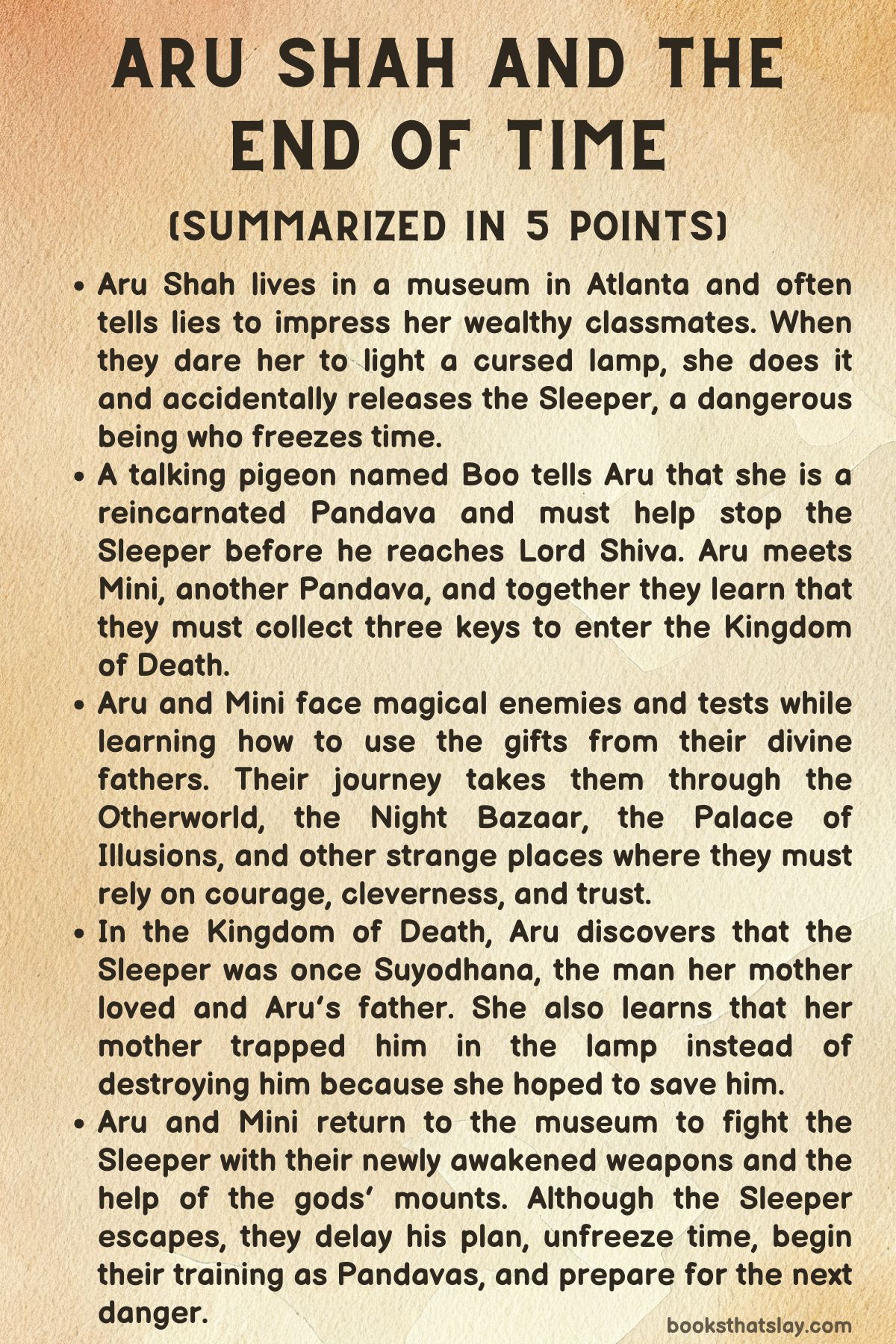
Summary
Twelve-year-old Arundhati “Aru” Shah lives with her mother, Krithika, in the Museum of Ancient Indian Art and Culture in Atlanta. Her mother is a respected curator and archaeologist, often busy with work and travel, while Aru spends much of her time among museum exhibits, especially the Hall of Gods.
Aru does not come from the same kind of wealth as many of the students at her private school, and she often makes up stories to impress them. One of those lies concerns a trip to Paris that her mother once promised but never managed to arrange.
During autumn break, three classmates arrive at the museum and challenge Aru about her lies. Embarrassed and desperate to prove that at least one of her stories is true, Aru takes them to see a cursed lamp.
She tells them that the lamp once rested on the battlefield of Kurukshetra and that lighting it will awaken the Sleeper, a being who can bring about the end of time by reaching Lord Shiva. The students dare her to light it.
Wanting to save face, Aru does. A shadow rises from the lamp, speaks her name, and everything changes.
Aru wakes to find the lamp gone and time frozen. Her classmates are motionless, and so is her mother, trapped in mid-motion.
A stone elephant in the museum comes alive, and from it emerges a talking pigeon who announces that he has been sent to guide the Pandava who lit the lamp. Aru learns that the Pandavas, the heroic brothers from the Mahabharata, are reborn in every generation.
Because she was able to light the lamp, she must be one of them. The pigeon, who grudgingly allows her to call him Boo, explains that the Sleeper has nine days to reach Shiva.
If he succeeds, time will end forever.
Boo leads Aru through a magical passage inside the elephant to find another awakened Pandava. They arrive at the home of Yamini Kapoor-Mercado-Lopez, known as Mini.
Mini is nervous, careful, health-conscious, and better informed about her divine identity than Aru. Unlike Aru, Mini’s family knew about the Pandavas and had taken her to the Otherworld before.
The two girls do not immediately seem like ideal heroes, but they are all the world has. With Boo’s help, they travel to the Court of Sky to meet the Council of Guardians.
There, Aru and Mini face the Claiming, a test that reveals which gods are their divine fathers. Aru is claimed by Indra, king of the heavens and lord of thunder, making her the reincarnation of Arjuna.
Mini is claimed by Dharma Raja, god of justice and death, making her the reincarnation of Yudhishtira. Aru receives a golden orb, and Mini receives a compact mirror.
The Council explains their quest: the Sleeper seeks celestial weapons to awaken Shiva. To stop him, the girls must enter the Kingdom of Death and look into the Pool of the Past, where they can learn how to defeat him.
But to enter the Kingdom alive, they must first collect three keys: a sprig of youth, a bite of adulthood, and a sip of old age.
Their first test leads them to a strange beauty salon run by Madame Bee, who appears glamorous but is actually a dangerous asura. Mini’s mirror reveals the truth beneath illusion: the beautiful salon is filled with bones and trapped victims.
The first key, the sprig of youth, is hidden in Madame Bee’s hair. Aru and Mini discover that their gifts can do more than they thought.
Aru’s orb produces blinding light, while Mini’s mirror can both reveal truth and create illusions. Together, they trick Madame Bee into destroying herself and claim the first key.
Soon after, the Sleeper nearly catches them. He knows Aru and speaks bitterly about her mother, calling them both deceitful.
Boo leads the girls away and seeks help from Valmiki, the sage and author of the Ramayana, who gives them a mantra to hide them from the Sleeper. The group then travels to the Night Bazaar, a magical marketplace hidden inside what looks like an ordinary Costco.
There, they visit the Court of the Seasons and receive useful gifts, including a freezing bracelet, restorative sweets, a pendant that can strike any target, and a headband that makes others forget something important.
The second key is hidden in the Library of A–Z, a place containing books on everyone and everything. There, the Sleeper appears in human form, and Aru notices that he has one blue eye and one brown eye, like the man in the photograph her mother kept.
He reveals that Krithika once trapped him in the lamp. He also exposes Boo’s true identity: Boo is Shakhuni, a figure from the Mahabharata who once helped bring ruin to the Pandavas through a rigged game of dice.
Boo refuses to join the Sleeper, who takes him captive. Mini, hurt after learning that Aru lit the lamp only to impress her classmates, leaves alone with the second key.
Aru remains in the library and finds the gods’ missing mounts trapped as tiny clay figures in a birdcage the Sleeper forgot. She frees them, and Indra’s seven-headed horse carries her toward the third key.
She reunites with Mini near the Ocean of Milk, where they find a cauldron of halahala poison and a Shiva statue. The third key, the sip of old age, is hidden there.
In a place where magic will not work, the girls use quick thinking to release fire over the poison, leaving behind a goblet from which Aru drinks. The three keys combine into a doorway to the Kingdom of Death.
Inside the Kingdom, Mini must speak as the daughter of death to gain entry. The girls pass two guardian dogs by distracting them, then reach Chitrigupta, the cosmic record-keeper.
He gives them karma tokens, watered-down soma, a wisdom cookie, and a pen that allows them to contact him. He tells them where to find the celestial weapons and the Pool of the Past.
Their path leads through tests of perception and memory, including the Palace of Illusions, the forgotten home of the Pandavas. The palace doubts that the girls are true Pandavas, but Aru and Mini each pass its trials.
As a gift, it gives them tiles that can offer shelter and protection.
The girls then meet Shukra, guardian of the Bridge of Forgetting. To cross, they are expected to surrender their memories.
Aru refuses and uses the season pendant to shatter Shukra’s mirrors, causing his memories to be taken instead. As punishment, he curses her, saying that when it matters most, she will forget something important.
Beyond the bridge, Aru and Mini enter the Chamber of the Astras, hidden inside a huge celestial whale shark. Their gifts finally transform into true weapons: Aru’s orb becomes Indra’s vajra, and Mini’s mirror becomes Dharma Raja’s danda.
At the Pool of the Past, Aru learns the truth about her family. Her mother once loved Suyodhana, the man destined to become the Sleeper.
Krithika knew that fate would turn him into a threat, but she believed there might be a way to save both him and Aru. Instead of destroying him, she trapped him in the lamp using something that was not metal, wood, or stone, and neither dry nor wet.
Aru realizes that the vajra meets those conditions, meaning it can defeat him.
Aru and Mini leave the Kingdom of Death and return to a world still frozen by the Sleeper’s power. With only one day left, they summon the celestial mounts and return to the museum, where they prepare a trap.
Mini creates an illusion of Krithika to distract the Sleeper, and the mounts attack. For a time, it seems the plan may work, but the gods call their mounts back, leaving the girls vulnerable.
The Sleeper threatens Mini and Boo, forcing Aru to drop the vajra. He tells Aru that he only wanted freedom from fate and tempts her to join him.
Aru uses the palace tile to protect herself and regains the vajra, but the Sleeper shows her a vision of the future in which Mini and other sisters turn against her. He says that killing him will make that future come true.
Aru remembers everything she has survived and decides that she is already a hero, but her doubt weakens her strike. The vajra stops short, and the Sleeper escapes.
Aru believes she has failed, but Boo explains that she still prevented the Sleeper from reaching the Kingdom of Death by the new moon, which means his plan has been delayed. Time begins again, and Krithika rushes to Aru.
In the aftermath, Aru and Mini accept training from the Council, and Boo pledges himself to them despite his past. Aru also faces her classmates again, this time using Chitrigupta’s pen to defend herself from their mockery.
Life does not return to normal. Aru and Mini begin lessons in strategy, etiquette, and folklore, while the Otherworld prepares them for what comes next.
A mysterious theft alarms the gods, and a wolf girl appears outside the museum carrying a glowing bow and arrow. Boo reveals that she is another of Aru and Mini’s sisters, setting the stage for their next quest.
Characters
Aru Shah
Aru Shah is the central character of Aru Shah and the End of Time, and her journey begins with a mistake rooted in loneliness, insecurity, and the need to be seen. She is clever, funny, imaginative, and quick with words, but she also lies because she feels small beside classmates who seem richer, cooler, and more impressive.
Her decision to light the lamp is not heroic at first; it comes from embarrassment and pride. This makes her an interesting heroine because the book does not present courage as something clean or perfect.
Aru becomes brave after causing harm, and much of her growth comes from accepting responsibility for what she has done. She is also deeply shaped by her relationship with her mother.
Krithika’s absences and secrecy leave Aru with questions about her identity, especially about her father. When Aru learns that she is the daughter of Indra and a reincarnation of Arjuna, she does not immediately become confident.
Instead, she struggles with doubt, guilt, and the fear that she is not worthy of the role placed on her. Her greatest strength is not physical power but perception.
She notices patterns, thinks creatively under pressure, and uses imagination as a weapon. By the end of the book, Aru has not become flawless, but she has become more honest with herself.
She learns that heroism is not about never failing; it is about choosing to act even after failure.
Mini
Mini, whose full name is Yamini Kapoor-Mercado-Lopez, is Aru’s first Pandava sister and one of the most important emotional anchors in the story. At first, she appears timid, anxious, and overly concerned with germs, diseases, and danger.
Her fears are often used for humor, but they also show how deeply aware she is of the world’s risks. Mini is the daughter of Dharma Raja, the god of justice and death, which initially horrifies her because she dreams of becoming a doctor.
This contradiction makes her character especially meaningful. She associates death with harm, but her divine inheritance connects death to justice, truth, balance, and moral clarity.
Mini’s instinct to speak up when something is wrong has made her unpopular in ordinary life, yet that same trait becomes one of her strongest heroic qualities. She is cautious where Aru is impulsive, thoughtful where Aru improvises, and morally direct where Aru sometimes hides behind jokes or lies.
Her friendship with Aru develops through tension as well as trust. When Mini learns that Aru caused the disaster by lying, she feels betrayed, and her anger is justified.
Still, she returns, reconciles, and continues the quest. Mini’s arc shows that bravery can exist inside fear.
She is not brave because she is fearless; she is brave because she keeps going while afraid.
Boo
Boo, first appearing as a sharp-tongued pigeon guide, provides comic irritation, mythological knowledge, and emotional depth. He begins as a reluctant mentor who often complains about Aru and Mini’s lack of training, discipline, and heroic polish.
His impatience hides both fear and regret. The reveal that he is actually Shakhuni gives his character a darker history.
In the Mahabharata, Shakhuni is associated with deception and the game of dice that helped bring ruin to the Pandavas. In this book, Boo’s role as the guide of the new Pandavas becomes a form of penance.
He is not simply a funny side character; he is someone trying to become better than his past. His loyalty matters because it is chosen, not automatic.
When the Sleeper tempts him to return to old loyalties, Boo refuses, showing that change is possible even for someone with a stained history. His relationship with Aru and Mini also softens over time.
He scolds them, but he protects them, teaches them, and eventually earns their trust. Boo represents one of the book’s clearest ideas about redemption: a person’s past matters, but it does not have to be the final truth about them.
Krithika Shah
Krithika Shah, Aru’s mother, is a mysterious and emotionally complicated presence in the novel. At first, she appears as a busy curator and archaeologist whose work often keeps her away from her daughter.
Aru loves her but also feels hurt by her absences and secrecy. As the story unfolds, Krithika becomes far more than a distant parent.
She is revealed to be one of the panchakanya, a reincarnated member of a sisterhood charged with protecting and raising the Pandavas. Her past relationship with Suyodhana, the man who becomes the Sleeper, gives her character a tragic moral burden.
She knew he was tied to a terrible prophecy, yet she loved him and hoped there might be a way to save him. Instead of destroying him, she imprisoned him in the lamp, choosing containment over death.
This decision is both loving and dangerous. Krithika’s secrecy causes pain, especially for Aru, but the book presents her as a mother trying to protect her child from an impossible truth.
Her love is imperfect, but real. She is a character caught between duty, love, prophecy, and hope, and her choices shape the entire conflict.
The Sleeper
The Sleeper is the main antagonist of Aru Shah and the End of Time, but he is not written as a simple monster. He is dangerous, manipulative, bitter, and capable of cruelty, yet his history makes him more complex.
Before becoming the Sleeper, he was Suyodhana, the man Krithika loved and Aru’s father. His anger comes from feeling trapped by fate.
He believes that destiny turned him into a villain and that Krithika and Aru are part of the chain that imprisoned him. This makes him especially dangerous to Aru because he attacks not only her body but also her sense of self.
He calls her a liar, reminds her of her mistakes, and uses visions of the future to weaken her confidence. His greatest weapon is doubt.
He wants Aru to believe that heroism is fake, that fate cannot be resisted, and that love only leads to betrayal. At the same time, the book does not excuse his actions.
His pain is real, but he chooses harm, control, and revenge. Through him, the story examines what happens when fear of destiny turns into rage against everyone connected to it.
Madame Bee
Madame Bee is one of the first major enemies Aru and Mini face, and she helps establish the book’s interest in illusion, beauty, and hidden danger. She appears as a stylish salon owner, surrounded by glamour and charm, but Mini’s mirror reveals the horror beneath the surface.
Her salon is not a place of transformation in a positive sense; it is a trap where she collects beauty and leaves victims behind. As Brahmasura, she carries the power to burn what she touches, turning beauty into ash.
Madame Bee’s role is brief but important because she forces Aru and Mini to use intelligence rather than strength. They cannot simply overpower her.
They must observe, interpret, and trick her using the mirror and Aru’s orb. She also introduces the pattern of monsters who are connected to vanity, desire, and distorted self-image.
Her defeat gives the girls their first proof that they can survive this quest, even without formal training.
Urvashi
Urvashi is one of the celestial guardians and represents the polished, judgmental side of the divine world. She is graceful and powerful, but she is also dismissive toward Aru and Mini.
Her first reaction to the girls is not warmth or encouragement but doubt. She does not believe they look or act like heroes, and her attitude reflects a larger problem in the story: people often judge worth by appearance, confidence, tradition, or reputation.
Urvashi’s skepticism makes Aru and Mini feel even more unprepared, but it also creates pressure that pushes them to prove themselves. As a teacher of dance and etiquette later in the book, she represents discipline, refinement, and the expectations placed on the Pandavas.
Her character is not villainous, but she is not comforting either. She shows that the divine world can be rigid and condescending, especially toward young girls who do not match old ideas of heroism.
Hanuman
Hanuman is one of the most encouraging and morally generous figures in the book. Unlike Urvashi, he treats Aru and Mini with more patience and seriousness, even when they seem untrained.
His presence carries strength, wisdom, and warmth. He also gives one of the book’s important reflections when he speaks about being cursed to forget his own strength until someone reminded him.
This idea speaks directly to Aru and Mini’s journey. They have power, but they do not fully know how to believe in it yet.
Hanuman understands that strength is not always obvious to the person who possesses it. As a mentor, he helps connect the girls to a larger heroic tradition without making that tradition feel unreachable.
He is also practical, protective, and alert to danger, especially when the theft in the Otherworld signals a new crisis. His character offers reassurance that the girls are not alone, even when their quest forces them to make their own choices.
Valmiki
Valmiki appears as a strange, memorable helper whose past carries an important lesson about transformation. He is known as the author of the Ramayana, but Boo also explains that he began life as a murderer before changing his path.
This background makes him a meaningful figure in a story filled with questions about identity and redemption. Valmiki’s presence suggests that greatness does not always come from a pure beginning.
People can change, and stories themselves can preserve that change. He asks for a day of the girls’ lives in exchange for help because he wants to write their story, which also emphasizes the value of narrative.
Aru and Mini are not only living through events; they are becoming part of a larger mythic record. Valmiki’s mantra helps them hide from the Sleeper, but his deeper importance lies in showing that past wrongdoing does not erase the possibility of wisdom.
Shukra
Shukra, the guardian of the Bridge of Forgetting, is one of the book’s most unsettling figures because his story turns beauty into a warning. He was once unbearably ugly, but he was loved by his wife, Irsa, who saw him with compassion and acceptance.
As he became more beautiful, he became obsessed with his reflection and increasingly resentful of her. His desire for beauty destroyed his ability to love, and in rage he killed the one person who had truly accepted him.
In the present, he guards a bridge built from stolen memories, surrounded by mirrors that protect him from forgetting. Shukra’s character connects vanity, regret, and memory.
He knows what he has done, and his punishment is to remain trapped with that knowledge. When Aru breaks his mirrors and causes his memories to be taken, she saves herself and Mini, but the act leaves her morally uneasy.
Shukra’s curse also has lasting consequences, proving that even necessary actions can carry a cost.
Chitrigupta
Chitrigupta, the cosmic record-keeper, brings order, humor, and moral accounting into the Kingdom of Death. He keeps records of karma and helps guide Aru and Mini through the rules of the realm.
Unlike many other divine figures, he is kind to the girls and seems genuinely pleased to see them succeed. His role is important because he treats their status as female Pandavas not as a problem, but as something remarkable.
He gives them tools, information, and encouragement, including karma tokens and a pen through which they can contact him. Chitrigupta also helps clarify the stakes of the story by explaining that Pandavas awaken in times of calamity.
He connects Aru and Mini’s personal quest to a wider cycle of cosmic danger. His presence makes the Kingdom of Death feel less like pure terror and more like a place governed by rules, records, and consequences.
Aiden Acharya
Aiden Acharya has a smaller role in this book, but his introduction suggests future importance. He appears as a new boy at Aru’s school and lives across from the museum.
Aru’s awkward reaction to him shows her continued social insecurity, even after everything she has survived. More importantly, Aiden sees the wolf girl near the museum, which implies that he may not be an ordinary human.
His presence adds mystery to the ending and hints that Aru’s world is expanding beyond her bond with Mini and Boo. Aiden also helps bridge Aru’s ordinary school life and her mythological life.
The fact that he notices something supernatural suggests that future conflicts may not remain hidden from people around her.
Themes
Identity and Self-Worth
Aru’s struggle with identity begins in ordinary life, before any gods, demons, or quests appear. She feels inferior to her wealthy classmates, so she invents stories to make herself seem more interesting.
Her lies are not random acts of cruelty; they come from a fear that her real life is not impressive enough. Once she learns that she is a reincarnated Pandava and the daughter of Indra, that insecurity does not disappear.
In fact, the heroic label makes her feel even more inadequate because she does not match her idea of what a hero should be. Mini faces a similar problem from a different angle.
She is overlooked, underestimated, and often treated as weak, even though she has deep moral strength. The book shows identity as something discovered through action, not titles.
Being a Pandava gives the girls a legacy, but it does not automatically give them confidence. They become more secure by making choices, surviving mistakes, protecting each other, and learning what their powers mean.
Aru Shah and the End of Time suggests that self-worth is not proven by looking impressive to others. It grows when characters begin to recognize the value already present in their own minds, instincts, and loyalties.
Truth, Lies, and Responsibility
Aru’s first major action is a lie that becomes real in the worst possible way. She lights the lamp because she wants her classmates to stop humiliating her, but that moment forces her to confront the difference between pretending and taking responsibility.
The book does not treat lying as a harmless habit, nor does it reduce Aru to being a bad person because she lies. Instead, it examines why people lie, what lies protect, and what damage they cause.
Aru lies because she wants belonging, but her lie releases the Sleeper, freezes time, endangers her mother, and damages Mini’s trust. The moral weight of the story comes from Aru having to act after causing the crisis.
She cannot undo the choice, and she cannot hide from it forever. The Sleeper also uses truth in a cruel way.
He exposes Aru’s secret not to heal anyone but to isolate her and weaken her. This makes the theme more complex: truth can free, but it can also be weaponized.
Real growth comes when Aru stops using lies as armor and begins facing the consequences of her choices. Responsibility becomes the first true step in her heroism.
Friendship and Chosen Sisterhood
Aru and Mini’s relationship is central to the emotional movement of the story. They do not begin as effortless friends.
Aru is disappointed when Mini does not match her fantasy of a powerful heroic sibling, while Mini is wary, anxious, and hurt by the feeling that people always leave her behind. Their bond forms under pressure, through danger, fear, arguments, and acts of trust.
What makes their friendship meaningful is that it is tested. Mini’s anger after learning the truth about the lamp matters because trust has been broken.
Her decision to return matters just as much because forgiveness in the book is not automatic; it is chosen after pain. The idea of sisterhood here is not based on blood.
Aru and Mini are connected through divine inheritance and shared destiny, but their true bond develops through loyalty. They learn to value each other’s differences.
Aru brings imagination, boldness, and quick thinking, while Mini brings caution, knowledge, and moral steadiness. Together they become stronger than either would be alone.
The arrival of another Pandava sister near the end suggests that this chosen family will keep growing, but the foundation is built through Aru and Mini learning to stand beside each other.
Fate, Free Will, and Redemption
The story repeatedly asks whether characters are bound by the roles assigned to them. Aru is told she is a Pandava, the Sleeper is tied to a prophecy, Boo carries the history of Shakhuni, and Krithika is bound to her duty as one of the panchakanya.
Each of them must decide whether identity and destiny are fixed or whether choices still matter. The Sleeper believes fate has trapped him, and his bitterness turns into violence.
He wants to reject destiny, but he does so by harming others and trying to control the future. Boo offers a different answer.
His past is marked by betrayal, yet he chooses loyalty and service. His redemption is not based on pretending the past never happened; it is based on acting differently now.
Krithika also resists the cruelest version of fate by refusing to destroy the man she loves, though her choice creates new dangers. Aru’s final confrontation with the Sleeper brings the theme into focus.
She is frightened by the future he shows her, but she still chooses to act as a hero. The book does not claim that fate is easy to escape.
It suggests that even inside prophecy, people remain responsible for what they choose to become.