Ashlords by Scott Reintgen Summary, Characters and Themes
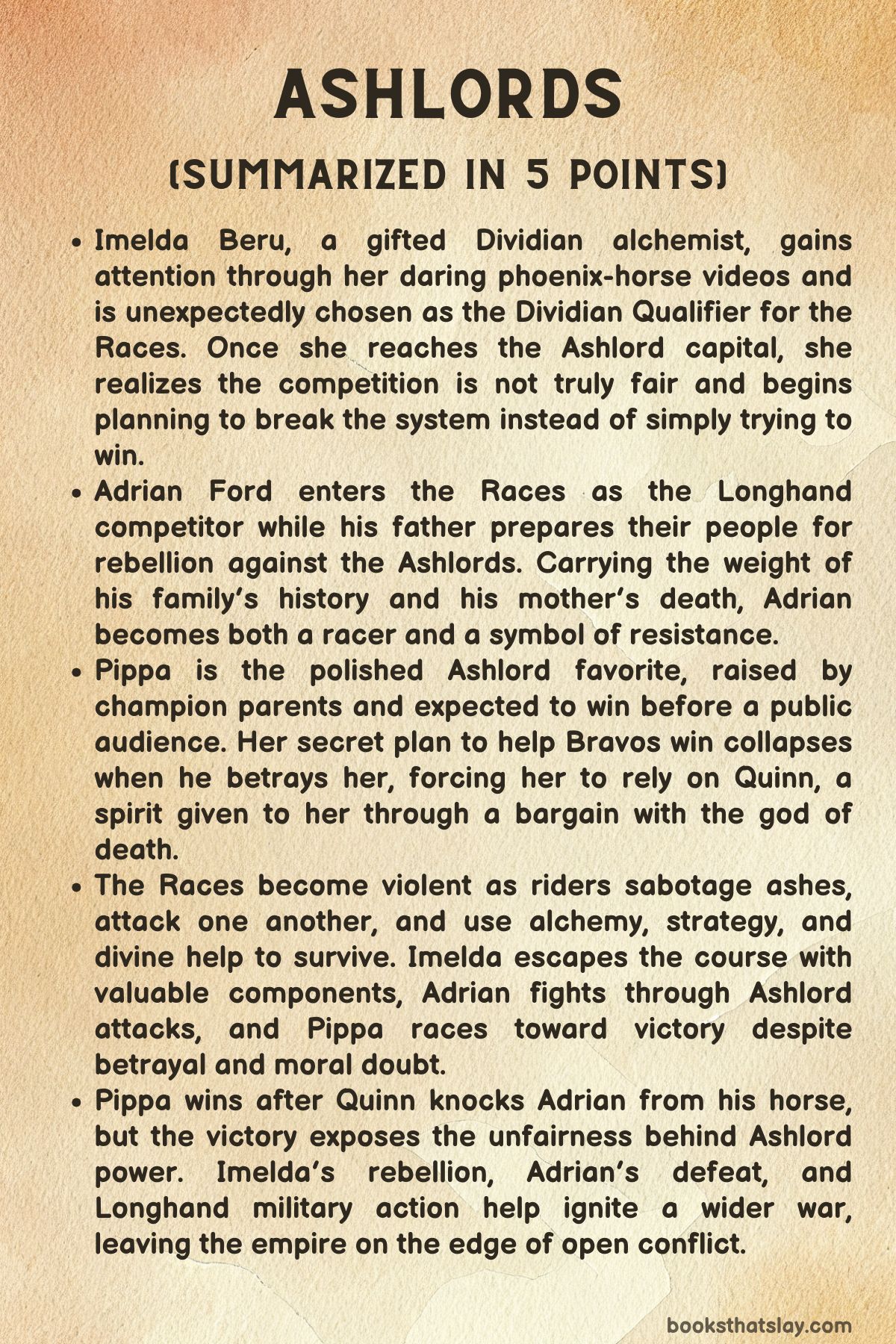
Ashlords by Scott Reintgen is a young adult fantasy novel set in an empire built on class division, spectacle, and magical horse racing. The story follows three central riders: Imelda, a Dividian alchemist chosen as an unlikely competitor; Adrian, a Longhand rebel carrying the hopes of his people; and Pippa, the polished Ashlord favorite raised to win.
At the center of the book is a deadly race involving phoenix horses, alchemy, politics, and divine interference. Beneath the competition lies a larger conflict between oppressed peoples and the ruling Ashlords, turning the race into the spark for rebellion.
Summary
Ashlords begins in a divided empire where the ruling Ashlords control wealth, power, religion, and the famous Races. These Races are not ordinary horse races.
Riders compete on phoenix horses that die at sunset, burn to ash, and are reborn at sunrise through alchemical mixtures chosen by their riders. A clever rider must not only be fast and brave but must also understand powders, terrain, strategy, and the dangerous habits of other competitors.
Imelda Beru, a Dividian girl, practices alchemy and riding with her best friend, Farian. Because Dividians face discrimination, she has few places where she can train freely.
Martial, a former race winner, gives her access to his ranch, where she films daring riding videos under the online name “the Alchemist.” One of these videos shows her performing a risky rebirth trick in which her phoenix horse vanishes during a fall and reappears beneath her just before she hits the ground. The video becomes wildly popular, bringing Imelda attention she never expected.
At the same time, Adrian Ford, known as the Longhand, is preparing for a very different role. He belongs to a people who once rebelled against the Ashlords and were brutally punished.
His father, Ben, is gathering leaders for a second rebellion, and Adrian is expected to become a symbol of Longhand strength. Adrian learns more about the violence done to his family, including the execution of his mother, and begins to understand that his race is part of a larger political plan.
Pippa, the Ashlord favorite, lives in the public eye. She is the daughter of two former champions and has been trained to speak, smile, perform, and win.
Her image is managed carefully by her publicist, but a scandal threatens her reputation. To shift attention away from herself, her team pushes the idea that the Dividian scholarship spot in the Races has unfairly favored boys.
This publicity helps Imelda become the official Dividian Qualifier.
Imelda is taken to Furia, the Ashlord capital, where the richness of the empire shocks her. She sees that Dividians exist there mostly as servants and begins to understand how separate her life has been from Ashlord privilege.
Though she has dreamed of the Races, she also realizes that the system was never designed for someone like her to win. Her training begins, but she is far behind the other riders in combat and formal preparation.
Adrian also arrives in Furia and is shown a secret extraction team of people he can trust if the race turns deadly. His interview before the public is hostile, but he uses confidence and boldness to unsettle the crowd.
Pippa watches the other competitors carefully and sees Adrian as her greatest challenge. During the public display of horses and rebirths, each rider reveals the first form of their phoenix.
Pippa brings polished skill and experience, Adrian chooses a fierce and threatening rebirth, and Imelda selects an unusual form called Changing Skies, which can defy gravity.
Before the race begins, the riders are shown the course. Pippa studies it with discipline and spots a hidden route that she plans to use with Bravos, her secret lover.
Publicly, they pretend to be rivals, but privately they intend to work together, and Pippa has decided she will let Bravos win so they can share a future. Imelda, however, struggles to memorize the map.
Something about it seems familiar, and she realizes the course is near mountains she once visited. Rather than trying to play the Ashlords’ game, she decides to break it.
The gods of the Ashlords also move behind the scenes. Adrian is visited by the Dread, a god who offers protection.
Adrian distrusts him, but the god gives him a healing boon anyway. Pippa is taken by her mother to meet the Madness, the god of death.
Through blood sacrifice, Pippa is given a spirit named Quinn to help her during the race. Pippa is horrified to learn that her mother used similar divine help to win in the past, but once the gift is given, she cannot avoid its consequences.
The race begins with speed, strategy, and violence. Pippa and Bravos deliberately fall behind so they can take the hidden safer route.
Imelda stays alive by using Changing Skies, riding along walls and canyon edges in ways the course was not meant to allow. Adrian charges ahead and uses the power of his phoenix to intimidate and injure rivals.
Alliances form, competitors test one another, and the first day ends with riders preparing their horses’ ashes for rebirth.
At night, the race becomes even more dangerous. Riders can attack camps and poison ashes, ruining a competitor’s next horse.
Adrian finds Imelda’s camp nearby and knocks her unconscious, hiding her away. He then pretends her ashes are his, drawing attackers to him.
A group of Ashlord riders, led by Thyma, beats him badly and poisons the ashes. Thanks to the Dread’s unwanted protection, Adrian survives.
Imelda wakes to find her ashes poisoned with wormwood, which causes her horse to suffer visions and run itself to death. She manages to ride for a while, but the horse collapses, forcing her to continue on foot.
Pippa also suffers betrayal. Bravos, whom she loves and trusts, poisons her ashes, leaving her with a blind horse.
Quinn, the spirit, helps Pippa regain control. Pippa accepts that Bravos has chosen victory over her and changes her strategy.
She rides through dangerous caves to make up time, relying on her memory of the course and Quinn’s guidance. Inside the caves, she finds Etzli trapped after a disaster.
Quinn insists on saving her. Pippa first resists, but then returns and helps rescue Etzli, showing that Quinn is beginning to affect her sense of loyalty and mercy.
Meanwhile, Imelda carries out her true plan. She uses her alchemy and riding skill to escape the official racecourse entirely, scaling the race barriers and fleeing toward the Gravitas Mountains with valuable components she selected before the race.
Ashlord officials chase her, but mountain rebels arrive to help. Among them is Bastian, a young rebel with a prosthetic arm.
Imelda realizes that her theft and escape have become more than personal defiance. She has given the Dividian rebels a symbol and a practical resource.
Adrian, still in the race, deals with Capri, one of the riders who helped attack him. During a night fight, Capri is badly injured, and Adrian keeps him alive to avoid being blamed for murder.
Capri later tries to steal Adrian’s purebred phoenix horse despite Adrian’s warnings. The horse burns Capri to death, leaving Adrian shaken but still determined.
He continues after Bravos and Revel, while the race narrows toward its final stage.
As the last day approaches, Pippa names her final horse Revenge and rides hard to catch the leaders. Revel, Bravos, Adrian, and Pippa converge near the finish.
Bravos tries to stop Pippa, but she fights back, breaking his wrist and knocking him from his horse. Revel also attacks, and the final stretch becomes a contest between Pippa and Adrian.
They are nearly even when Quinn intervenes, knocking Adrian down and allowing Pippa to cross the finish line first.
Pippa wins the Races, but the victory feels corrupted. Quinn is freed and returns to her own world, ready to begin her own fight against the gods.
Adrian knows that Pippa’s divine help changed the outcome. In the carriage after the race, Pippa tends Adrian’s wounds according to an old tradition, and the two speak with anger and reluctant understanding.
Adrian sees the Ashlord reliance on gods as proof of injustice. Pippa defends her people’s rule but begins to realize that the race has helped start something terrible.
That wider conflict has already begun. At Gig’s Wall, Imelda and the Dividian rebels face an Ashlord assault.
The battle is brutal, but Longhand forces arrive and help defeat the Ashlords. Their involvement confirms that rebellion has become war.
Imelda learns that the Longhands did not come only for her; they had already formed plans with the mountain rebels. Her actions gave them a reason to strike openly.
After the race, Adrian is taken away under the claim that he caused Capri’s death, but the arrest is staged by allies. The Longhands plan to use the public evidence of divine interference and Ashlord injustice to fuel the rebellion.
Adrian is troubled rather than triumphant. He has seen how easily hatred can make one side resemble the other.
Pippa is prepared for her new role as an Ashlord champion in wartime. The Brightness, another god, tells her that she will be a leader in the army.
Etzli, Revel, and Bravos join her, though Bravos’s presence disgusts her after his betrayal. Pippa chooses to bury her doubts and accept the Ashlord call to rule through fire and blood.
Imelda, away from the race and the capital, considers a quieter future, but the world around her is changing too quickly for peace to feel simple. Martial later sells most of the stolen components and gives Farian his share of the money, which Imelda wanted him to use for his education and dreams.
Farian worries that Imelda’s actions made the Dividian look like cheaters, but Martial understands the deeper truth: for one moment, her defiance gave her people unity and hope.
Ashlords ends with the race finished but the true conflict just beginning. Pippa has victory, Adrian has become a symbol, and Imelda has helped light the first fire of rebellion.
Characters
Imelda Beru
Imelda Beru is one of the most important characters in the book because she represents talent that has been ignored, underestimated, and contained by an unfair society. As a Dividian girl, she begins the story far from the privilege of the Ashlord riders, practicing wherever she can and relying on skill, creativity, and Farian’s help rather than elite training.
Her identity as “the Alchemist” shows both her intelligence and her hunger to be seen on her own terms. She understands phoenix rebirths not as a polished aristocratic tradition but as a craft, something built from patience, risk, and instinct.
This makes her different from the other racers, who often treat alchemy as part of a larger system of status.
Imelda’s journey is not simply about wanting to win the Races. At first, she dreams of competing because the race has always symbolized greatness, freedom, and recognition.
Once she reaches Furia, however, she sees the truth more clearly. The Races are not a fair contest; they are a public performance controlled by the Ashlords, designed to give the oppressed just enough hope without allowing real power.
This realization changes her goal. Instead of trying to become an exception who succeeds inside a broken system, she decides to damage the system itself.
Her decision to steal valuable components and escape the course shows her growth from ambitious outsider to deliberate rebel. She does not act out of simple anger; she acts because she recognizes that playing by the rules will only make her useful to the people who control those rules.
Imelda’s intelligence is practical and bold. She studies the course, understands the terrain, anticipates how the public will react, and trusts Martial with the secret parts of her plan.
Her rebellion is not reckless in the sense of being thoughtless, though it is dangerous and costly.
Emotionally, Imelda is also marked by loyalty. Her connection to Farian, Martial, and her family gives her choices real weight.
She knows that escape means losing her old life, possibly forever. Her actions may help her people, but they also place others in danger.
This makes her victory complicated. She becomes a symbol of Dividian defiance, but she is not untouched by fear, guilt, or uncertainty.
By the end of the story, Imelda stands as a character who refuses to be a decorative underdog. She rejects the role assigned to her and proves that resistance can begin with one person refusing to perform obedience.
Adrian Ford
Adrian Ford is a physically powerful and emotionally burdened character whose role in the novel is shaped by history, family expectation, and political violence. As the Longhand competitor, he enters the Races carrying more than personal ambition.
His father and his people see him as a weapon, a symbol, and a possible spark for rebellion. Adrian has been trained to be strong, observant, disciplined, and hard to intimidate, but beneath that controlled exterior is a young man trying to understand whether he is choosing his path or simply becoming what others need him to be.
His relationship with his father is central to his character. Ben Ford teaches Adrian the history of the Longhands and the cruelty of the Ashlords, especially the Purge and the death of Adrian’s mother.
This history gives Adrian a moral reason to hate the empire, but it also traps him in inherited rage. He wants justice, yet he is surrounded by people who are prepared to turn him into a tool of war.
His strength is admired, but that admiration often reduces him to an image rather than a person.
During the Races, Adrian proves that he is not only strong but also strategic. He notices small details, distrusts false allies, survives sabotage, and understands the violent logic of the competition.
He is willing to fight brutally when necessary, but he is not without conscience. His handling of Capri reveals this conflict clearly.
Capri helped attack him, yet when Capri is badly injured, Adrian keeps him alive because he refuses to become a murderer within the rules of the race. Later, when Capri dies after trying to steal Adrian’s horse, Adrian is horrified rather than satisfied.
This reaction shows that Adrian’s moral center has not been fully consumed by revenge.
Adrian’s connection to the Dread complicates him further. The god’s protection saves his life, but Adrian resents being touched by divine power without consent.
Unlike the Ashlords, who often treat bargains with gods as a natural extension of power, Adrian sees divine involvement as manipulation. His anger after Pippa wins is not only about losing; it is about seeing once again that the system bends toward those already favored by gods, status, and tradition.
By the end of the book, Adrian becomes a revolutionary symbol even though he is uneasy with what that means. Others use his defeat as proof of Ashlord injustice, and the Longhand rebellion begins moving openly toward war.
Adrian’s tragedy is that he understands the need to resist but also sees how resistance can become another form of cruelty. He is one of the most morally tense figures in Ashlords, caught between justice and vengeance, courage and manipulation, personal conscience and public myth.
Pippa
Pippa is one of the most layered characters in the book because she begins as the polished face of Ashlord superiority but gradually reveals fear, longing, pride, and emotional confusion beneath that surface. She has been raised to win, to perform, and to represent her family’s legacy.
As the daughter of two former champions, she understands the Races not only as a competition but as a stage on which every gesture matters. Her interviews, public lines, branding, and confidence are all carefully shaped.
She knows how to speak to fans, how to control attention, and how to appear untouchable even when she is privately shaken.
Her relationship with Bravos exposes the vulnerable side of her character. Pippa believes deeply in their future together and is willing to let him win because she imagines love as more valuable than personal glory.
This choice shows that she is not simply vain or power-hungry. She wants a life beyond performance.
Yet her trust is built on illusion. Bravos’s betrayal forces her to face the truth that the values of the Ashlord world have shaped him as much as they have shaped her.
He chooses victory over love, and that betrayal changes Pippa’s emotional direction.
Pippa’s bond with Quinn is equally important. At first, Quinn is a gift forced upon her by her mother and the god of death.
Pippa does not choose this arrangement freely, which makes the divine aid feel like another form of control. Over time, however, Quinn becomes more than a tool.
She challenges Pippa’s selfishness, especially when Etzli needs help in the caves. Through Quinn, Pippa begins to experience loyalty and compassion in ways that do not fit neatly into Ashlord values.
Their relationship gives Pippa moments of growth, but that growth remains incomplete.
Pippa’s greatest flaw is her loyalty to the worldview that raised her. Even when she sees the cruelty of the system, she often defends it.
She understands that the Ashlords use gods, blood, fear, and spectacle to remain dominant, but she has difficulty imagining a world where they do not rule. Her victory is therefore hollow.
She wins the race, but the win is stained by divine interference, betrayal, and the coming war. When she accepts the Brightness’s call to become a military leader, she chooses power over doubt.
Pippa is compelling because she is neither a simple villain nor a pure heroine. She is brave, skilled, intelligent, and capable of tenderness, but she is also proud, defensive, and deeply shaped by privilege.
Her tragedy is that she has enough awareness to feel the cracks in her world but not enough freedom, or not enough courage yet, to fully reject it.
Farian
Farian is Imelda’s closest friend and one of the emotional anchors of the story. He is not a racer, a general, or a public champion, but his presence matters because he reflects the ordinary Dividian hopes that surround Imelda’s rise.
He helps film her videos, calculates their earnings, supports her talent, and believes in her when she struggles to believe in herself. Through Farian, the book shows how ambition is rarely individual.
Imelda’s dream is carried by friendship, shared work, and the small acts of support that happen away from the public stage.
Farian’s role also reveals the cost of Imelda’s rebellion. He benefits from the money she sends back, but he also mourns the change in her life.
His reaction after the Races is complicated. He worries that her actions will make the Dividian look dishonest, which shows how deeply oppressed people can internalize the fear of being judged by those in power.
Martial has to remind him that the system was already dishonest long before Imelda broke its rules. Farian’s discomfort is realistic because rebellion often looks frightening to those who must live with the consequences.
He also represents the future Imelda wants to protect. The money Martial gives him is meant to help him attend school and pursue his dreams.
This makes Farian more than a side companion; he becomes proof that Imelda’s theft has a practical purpose. She is not taking wealth for vanity.
She is redirecting resources from an empire that hoards them toward people who were denied opportunity.
Farian’s grief, loyalty, and uncertainty make him a quiet but important character. He shows that not everyone responds to revolution with immediate confidence.
Some people need time to understand that survival under injustice is not the same as peace.
Martial
Martial is a former Race winner whose experience gives him authority, but his importance comes from how he uses that authority. Unlike the Ashlord elite, he opens space for Imelda to practice and develop her gift.
His ranch becomes one of the few places where a Dividian rider can train with some dignity. He recognizes Imelda’s talent before the empire does, and his belief in her carries more honesty than the public attention she later receives.
Martial understands both the glamour and the ugliness of the Races. Because he once won, he knows that the competition rewards brilliance but also serves power.
He does not romanticize the system as much as younger characters might. When Imelda shares her true plan, Martial is shocked, but he also understands why she would choose it.
His willingness to help her marks him as a mentor who respects her agency rather than trying to control her.
His later conversation with Farian is one of his strongest moments. Martial explains that the Dividian live at the mercy of the Ashlords and are never allowed to rise too high.
This shows that he sees Imelda’s actions not as simple cheating but as resistance against a rigged order. He recognizes the symbolic power of her escape: for a brief moment, Dividian people saw someone refuse the role assigned to them.
Martial is practical, loyal, and politically aware. He helps turn Imelda’s daring into material benefit by selling the stolen components and giving Farian his share.
In this way, he becomes part of the bridge between symbolic rebellion and real change. He does not seek glory, but without him, Imelda’s plan would not have had the same reach or effect.
Bravos
Bravos is a character defined by charm, ambition, and betrayal. At first, he appears to be Pippa’s secret partner, someone who shares her desire for a future beyond the public hostility they perform.
Their private relationship suggests intimacy and trust, especially because Pippa plans to let him win. Yet Bravos reveals that his love is weaker than his hunger for victory.
By poisoning Pippa’s ashes and leaving her with a blind horse, he shows that he has absorbed the most ruthless values of the race.
His betrayal is powerful because it does not come from a stranger. Pippa already expects rivals to attack her; she does not expect the person she loves to treat her as an obstacle.
Bravos’s action exposes the emotional damage caused by a society that worships winning above loyalty. He may care for Pippa in some limited way, but he cares more about glory, status, and his own future.
As a racer, Bravos is physically dangerous and aggressive. His choice of a spiked hunting horse reflects his combative nature.
He does not rely only on speed or cleverness; he is willing to harm others directly. This makes him a natural product of the Ashlord competition, where violence is not an accident but part of the spectacle.
By the final stretch, Bravos becomes almost pathetic. He tries to stop Pippa, but she breaks his wrist and throws him from the center of the contest he tried to steal.
His embarrassment afterward shows that he has lost more than the race. He has lost Pippa’s trust, dignity, and any claim to honorable ambition.
Bravos functions as a warning about what happens when love is shaped by a culture that teaches people to prize victory above human connection.
Quinn
Quinn is one of the most unusual and meaningful characters in the novel because she enters the story as a supernatural aid but becomes a moral force in her own right. She is given to Pippa through the Madness, and at first she appears to be part of the Ashlord system of divine advantage.
However, Quinn is not merely a tool. She has her own history, pain, and goal.
She wants freedom from the underworld and from the gods who have controlled her.
Her relationship with Pippa changes both characters. Quinn helps Pippa survive after Bravos betrays her, guiding the blind horse and keeping Pippa moving when despair could have ended her race.
She is practical and brave, but she also has a stronger instinct for mercy than Pippa initially does. When Etzli is trapped in the caves, Quinn refuses to abandon her.
This moment is crucial because Quinn pushes Pippa toward a choice that has no clear strategic benefit. She reminds Pippa that winning is not the only measure of action.
Quinn also reveals the darker side of the Ashlord gods. The spirits used in the Races are not neutral gifts; they are beings with their own suffering.
Quinn’s desire for Pippa’s blood shows how power in the underworld mirrors power in the living world. Everyone is trying to survive systems built on sacrifice and domination.
Her final act, knocking Adrian from his horse, secures Pippa’s victory but also complicates it. Quinn helps Pippa win, yet her own victory is freedom.
When she disappears, she is not simply leaving the story; she is beginning a struggle of her own. Quinn’s character adds depth to the book’s treatment of power by showing that even those used as instruments can reclaim purpose.
Ben Ford
Ben Ford is Adrian’s father and one of the driving forces behind the Longhand rebellion. He is a leader shaped by loss, memory, and rage.
His speeches about Longhand history are meant to inspire resistance, but they also reveal how deeply he has built Adrian’s life around revenge. Ben does not merely want his son to race; he wants him to embody the pain of an entire people.
His revelation about Adrian’s mother is a turning point because it gives Adrian a more personal understanding of Ashlord cruelty. Ben uses truth as a weapon, and while the truth matters, the timing and purpose of his revelation are also strategic.
He wants Adrian to feel the weight of history so strongly that he cannot step away from the rebellion. This makes Ben both sympathetic and troubling.
Ben’s motives are understandable. His people suffered extreme violence, and his desire for freedom is legitimate.
Yet he also risks turning Adrian into a sacrifice for the cause. The Dread’s words make Adrian question whether his father is fully honest about the danger ahead.
This doubt is important because it prevents Ben from being seen only as a noble revolutionary. He is a father, a victim, a leader, and a manipulator at the same time.
Ben represents the burden of inherited conflict. He carries the past so intensely that he can no longer separate justice from war.
Through him, the story asks whether liberation movements can avoid reproducing the same hardness they oppose.
Prama
Prama, Pippa’s mother, is a former champion whose influence over Pippa is intense and damaging. She represents the older generation of Ashlord winners who understand the hidden machinery behind public glory.
To the outside world, Prama is a legendary victor. Privately, she knows that victory can be bought through blood, gods, and secrecy.
Her decision to take Pippa to the Madness reveals how normalized cheating and divine bargains have become among the powerful.
Prama’s most revealing flaw is that she does not give Pippa a choice. She believes she is protecting her daughter and strengthening her chances, but she also violates Pippa’s agency.
This mirrors the larger Ashlord worldview: power decides what is best, then expects obedience. Prama cannot imagine that Pippa might prefer an honest race or even an honest loss.
She assumes winning is the highest form of care.
Her past victory also becomes morally unstable once Pippa realizes that her mother received similar help. Prama’s legend rests on hidden unfairness, which makes her a symbol of Ashlord history itself.
The empire presents dominance as earned greatness, while concealing the divine and political advantages that protect it.
Prama is not portrayed as someone without love. She wants Pippa to survive and win.
But her love is shaped by fear, pride, and the belief that power must be secured at any cost. She passes this belief to her daughter, even as Pippa partly resents it.
Ayala
Ayala is the Ashlord official who escorts and supports Imelda, and she occupies an interesting position in the book. She is connected to the system, yet she appears genuinely invested in helping Dividian competitors receive a fairer chance.
She gives Imelda equipment, information, encouragement, and training opportunities. Her belief in equality seems sincere, especially because she has chosen work connected to the Qualifier program rather than more prestigious paths.
At the same time, Ayala’s role has limits. She can help Imelda prepare, but she cannot make the Races truly fair.
This makes her a character caught between reform and complicity. She believes in improving the system from within, while Imelda eventually sees that the system itself is designed to prevent real equality.
Ayala’s support matters, but it cannot erase the structural disadvantages Imelda faces.
Her relationship with Imelda is marked by care and professionalism. She asks whether Imelda truly wants to enter the Races, giving her a moment of choice before the machinery of competition takes over.
Yet even that choice is shaped by pressure, publicity, and empire politics. Ayala may want Imelda to succeed, but she also participates in the process that turns Imelda into a public symbol.
Ayala’s importance lies in this tension. She is not cruel, but she is limited by the institution she serves.
Through her, the book shows that good intentions inside an unjust system may help individuals but cannot always transform the system itself.
Bastian
Bastian is a young Dividian rebel who becomes important after Imelda escapes the racecourse. He is practical, brave, and already committed to organized resistance.
His prosthetic arm marks him physically as someone who has suffered and adapted, while his leadership at Gig’s Wall shows that he has earned the trust of others. He is not merely reacting to Imelda’s rebellion; he and his group are already part of a larger struggle.
His connection with Imelda is immediate because he understands the political meaning of what she has done. While Imelda begins by thinking of her plan as a way to break the Races and claim resources, Bastian sees how it fits into wider resistance.
He helps her understand that stealing from the empire is not only personal defiance but an act that can support a movement.
Bastian is also emotionally significant for Imelda. His warmth and admiration offer her a possible place among people who understand her anger.
Yet he does not reduce her to a symbol. He invites her to stay with the rebels but does not force her.
This respect makes him different from many authority figures in the story.
At Gig’s Wall, Bastian’s leadership becomes serious and costly. He prepares for battle, directs defenses, and mourns the dead afterward.
He represents the price of rebellion as much as its hope. Through him, resistance is shown not as romantic adventure but as a community willing to fight, lose people, and continue.
Antonio Rowan
Antonio Rowan is a disciplined military figure whose loyalty is to the Longhand cause. He helps Adrian prepare for the dangers surrounding the Races by introducing him to the small group of people he can trust.
This shows Antonio’s strategic mind. He understands that the race is not only a sporting event but a battlefield filled with spies, poison, and political traps.
His later appearance after the battle of Gig’s Wall reveals another side of him. As a leader in the Longhand forces, Antonio treats rebellion as an organized war effort, complete with rules, taxes, and demands.
When he asks Imelda to surrender part of the stolen components, he is thinking like a commander rather than a liberator. His logic is practical: war requires resources.
But to Imelda and Bastian, his demand feels like another powerful group trying to claim what a Dividian girl risked everything to take.
Antonio is not presented as evil, but he is hard and utilitarian. He shows that oppressed groups, once organized for war, can also create structures of authority that pressure individuals.
His anger when Imelda tricks him suggests pride as well as discipline.
As a character, Antonio broadens the political landscape. He reminds the reader that rebellion is not pure simply because its cause is just.
It needs leaders, supplies, strategy, and sometimes morally uncomfortable choices.
The Dread
The Dread is one of the Ashlord gods and serves as a figure of fear, temptation, and manipulation. His encounter with Adrian is unsettling because he does not simply threaten him; he offers protection.
This makes him more dangerous than a straightforward enemy. He understands Adrian’s vulnerability and speaks to his doubts about his father, the rebellion, and the likelihood that the Ashlords will try to kill him.
The Dread’s gift of healing is especially important because Adrian does not consent to it. By saving Adrian, the god creates a debt-like connection even while claiming patience.
This reflects how divine power operates in the story: it rarely arrives without motive. The gods do not simply bless people; they position them, influence them, and wait for useful outcomes.
For Adrian, the Dread represents the danger of accepting power from a corrupt source. Adrian hates the Ashlords partly because of their relationship with gods, so being helped by one places him in a morally uncomfortable position.
The Dread’s protection saves his life, but it also makes Adrian wonder whether he can remain independent from the forces trying to use him.
The Dread’s role is not large in terms of appearances, but his influence is significant. He reveals that the gods are invested in the coming war and that human conflicts are also opportunities for divine gain.
The Madness
The Madness is the god of death and one of the most disturbing forces in the story. His role in giving Pippa a spirit exposes the hidden religious foundation beneath Ashlord power.
The scene involving blood sacrifice shows that victory in the Races is not based only on training, wealth, or courage. It is also tied to secret bargains with gods who profit from human dependence.
The Madness is frightening not only because of his appearance and power but because of how accepted he is by characters like Prama. To Pippa, the ritual feels shocking and invasive.
To Prama, it is part of what serious winners do. This contrast reveals the moral corruption at the heart of Ashlord greatness.
Their champions are celebrated publicly, while the private methods behind their success remain hidden.
Through Quinn, the Madness’s cruelty becomes more personal. The spirits he gives are not empty magical aids.
They are trapped beings seeking freedom and power in the underworld. His gifts therefore depend on the suffering and use of others.
This makes him a symbol of exploitative power, where every advantage is built on someone else’s lack of choice.
The Madness also helps explain why the coming war feels larger than politics. The gods are not distant myths; they actively shape events.
His involvement in Pippa’s victory becomes one more reason the race cannot be seen as fair.
The Brightness
The Brightness appears as a divine authority linked to Ashlord rule, public obedience, and war. His presence causes instinctive submission, showing how deeply religious power is built into the empire’s structure.
He is not only worshipped; he commands the atmosphere around him. When people bow, the gesture reflects both faith and fear.
His most important role comes after Pippa’s victory, when he prepares her for leadership in war. He has her appearance altered to look darker and more dangerous, turning her from a racing champion into a symbol of military power.
This shows how quickly the Ashlord system converts public figures into instruments of state violence. Pippa’s win is not allowed to remain personal.
It becomes political property.
The Brightness understands image as power. He wants Pippa to look the part before she acts the part.
This connects him to the empire’s larger use of spectacle, from interviews to the Races themselves. Ashlord rule depends on being seen as glorious, terrifying, and inevitable.
As a character, the Brightness embodies the cold confidence of empire. He does not need to argue much because he assumes obedience.
His presence at the end of Ashlords confirms that the gods are not background forces; they are active participants in preserving domination.
Etzli
Etzli is one of the Ashlord competitors and serves as a strong example of disciplined rivalry. She is viewed as consistent and composed, which makes her dangerous in a race filled with reckless ambition.
Unlike louder or more dramatic riders, Etzli’s strength lies in control. Other competitors notice her calm, and that calm becomes a form of threat.
Her use of a spirit shows that she, too, benefits from divine interference, placing her within the hidden unfairness of the Ashlord system. However, her later vulnerability in the caves complicates her role.
When she is trapped and her spirit sacrifices himself to save her, she becomes more than just another rival. Her danger gives Quinn and Pippa a moral test, forcing them to decide whether mercy matters in a contest built around winning.
Etzli’s presence helps show that not every Ashlord competitor is identical. She is privileged, but she is also capable of fear, loss, and dependence on others.
Her rescue becomes one of the moments where the race briefly stops being only a competition and becomes a human crisis.
Though she is not as central as Pippa, Adrian, or Imelda, Etzli adds depth to the field of racers. She represents competence within the Ashlord world, but her near-death experience also reveals that even favored competitors can be swallowed by the dangers their society celebrates.
Revel
Revel is a skilled Ashlord rider associated with speed, competitiveness, and hidden advantage. He is one of the racers Pippa studies carefully, and his reputation as a high-speed rider makes him a serious threat.
His racing style reflects confidence and technical ability, but his choices also reveal the dishonesty beneath Ashlord competition.
Like Pippa and Etzli, Revel receives help from a spirit. This becomes especially important when Adrian notices a flash of protection around him.
Revel’s divine assistance contributes to Adrian’s later argument that the race is fundamentally unfair. Revel may be talented, but his talent is supported by secret supernatural aid unavailable to others on equal terms.
Revel also shows the instability of alliances among Ashlord riders. When Bravos seeks cooperation against Adrian, Revel turns on Bravos instead.
This betrayal mirrors the wider culture of the race, where temporary alliances are always vulnerable to ambition. No one can fully trust anyone because victory is treated as the highest good.
By the final stretch, Revel remains dangerous, but his horse collapses before the finish. His failure shows that even speed and divine assistance cannot guarantee control.
He represents the Ashlord racer as a figure of skill, pride, and treachery, shaped by a system where every advantage is permitted if it can be hidden or justified.
Capri
Capri is a secondary character whose role becomes important because of his interactions with Adrian. At first, he appears as part of the hostile Ashlord group that attacks Adrian at night.
This places him among those willing to use group violence to enforce hierarchy and keep the Longhand competitor from succeeding. His actions reflect the casual cruelty encouraged by the Races.
After Capri is gravely injured, his character shifts from aggressor to burden. Adrian must choose whether to abandon him or keep him alive.
Capri’s helplessness forces Adrian into a moral test. The same person who helped leave Adrian for dead now depends on Adrian’s mercy.
This reversal gives Capri narrative importance beyond his own personality.
His accusation that Adrian is just like the Ashlords strikes at Adrian’s deepest fear. Even though Capri is not morally innocent, his words matter because they challenge Adrian’s self-image.
Adrian wants to be better than the people he opposes, but the race repeatedly pushes him toward brutality.
Capri’s death after trying to steal Adrian’s purebred horse is both tragic and self-inflicted. Adrian warns him, but Capri refuses to believe that a Longhand could possess or control such a horse.
His disbelief is rooted in prejudice, and that prejudice kills him. Capri’s character shows how arrogance can become fatal when it blinds a person to another’s strength.
Thyma
Thyma is one of the more openly violent racers, and her role emphasizes the physical danger of the competition. She attempts to force Imelda into the wall during the race, showing how easily skill can turn into attempted destruction.
For riders like Thyma, the Races are not only about speed but domination.
Her attack on Adrian during the night further reveals her function as an enforcer of Ashlord superiority. She participates in the group effort to punish and possibly kill him, making her part of the system’s informal violence.
Even when murder is officially forbidden, the culture of the race allows brutality to flourish as long as it can be disguised as competition.
Adrian’s injury of Thyma is significant because it removes her as a threat and proves that he is not easy prey. Her defeat also shifts the balance of fear.
The Ashlord riders expect to intimidate him, but he survives and retaliates.
Thyma is not deeply developed emotionally, but she is useful as a representation of the race’s cruelest habits. She shows what happens when prejudice, competition, and physical power are allowed to operate together without meaningful restraint.
Oxanos
Oxanos is the Ashlord overseer who humiliates Imelda’s family during her birthday celebration. His role is brief but important because he represents everyday oppression rather than the grand spectacle of the Races.
He arrives at a family gathering and uses a supposed noise violation as an excuse to exert power. His demand that Imelda dance with him is designed as a cultural insult, not a harmless request.
Imelda’s response reveals her courage before she ever enters the Races. By choosing the Contested and defeating Oxanos through the dance itself, she turns his insult into public embarrassment.
This moment foreshadows her later rebellion. She does not defeat power by meeting it on its own terms alone; she uses cultural knowledge, performance, and nerve to reverse the situation.
Oxanos shows that Ashlord domination is not abstract. It enters homes, celebrations, customs, and family spaces.
His behavior helps explain why Imelda’s later defiance matters so much. The empire’s cruelty is not limited to battlefields or official contests; it shapes ordinary life.
Though Oxanos is not a central character, he gives the reader an early view of the arrogance Imelda is resisting. His humiliation is small compared with later events, but it is emotionally satisfying because it shows Imelda refusing shame before she has any public power.
Zeta
Zeta, Pippa’s publicist, represents the machinery of image management surrounding Ashlord fame. She is practical, strategic, and focused on controlling public reaction.
When Pippa’s scandal threatens her reputation, Zeta immediately looks for a way to redirect attention, eventually using the issue of the Dividian Qualifier to change the conversation.
Her actions show how moral language can be used for public relations. Supporting Imelda appears progressive on the surface, but for Pippa’s team it is also a distraction from scandal.
This does not mean the issue of unfairness is false; rather, Zeta’s strategy shows how powerful people can use real injustice when it benefits them.
Zeta helps build the public version of Pippa. She understands that fame in this world depends on timing, slogans, interviews, and emotional manipulation.
Pippa’s confidence is partly manufactured through people like Zeta, who protect the brand even when the person behind it is frightened.
As a character, Zeta is not cruel in a dramatic way, but she is morally flexible. She is part of the soft power of the Ashlord world, where stories, headlines, and public sympathy are managed as carefully as horses and weapons.
Themes
Power, Inequality, and Controlled Opportunity
The society of Ashlords is built on unequal access to resources, training, history, and belief. The Races appear to offer glory to anyone skilled enough to win, but the structure beneath them favors the ruling class at every stage.
Ashlord riders inherit better horses, better equipment, better coaching, public support, and hidden divine assistance. Imelda’s entry as the Dividian Qualifier seems like progress, yet the position is designed to provide limited hope without threatening the hierarchy.
She is allowed to compete, but not truly expected to win. This kind of controlled opportunity is one of the book’s sharpest criticisms of power.
The empire does not need to exclude everyone completely; it only needs to include a few people under conditions it controls, so the system can appear fair while remaining deeply unequal. Imelda’s eventual refusal to finish the race on those terms exposes the lie behind symbolic inclusion.
Her escape shows that representation without real power can become another form of containment. The theme also appears through Adrian, whose people are feared and punished because they threaten Ashlord dominance.
Both Imelda and Adrian reveal that the empire’s fairness is performative. The rules exist to protect those who wrote them, and true resistance begins when characters stop mistaking permission for freedom.
Spectacle, Fame, and Public Performance
The Races are not only a sport; they are a national performance that turns violence into entertainment and competitors into symbols. Every rider is watched, judged, marketed, and discussed.
Pippa understands this world better than anyone because her life has been shaped by interviews, slogans, fan reactions, and reputation management. Her public self is polished and controlled, while her private self is anxious, romantic, and increasingly uncertain.
Imelda’s rise also begins through spectacle, as her videos make her visible to a society that would otherwise ignore her. Fame gives her opportunity, but it also turns her into something the Ashlords can use.
Adrian, too, becomes a public figure. His body, confidence, and survival are read politically by both supporters and enemies.
The theme becomes darker because the public loves the drama of danger without fully confronting the cruelty behind it. Horse deaths, sabotage, injuries, rivalries, and betrayals become part of the show.
The circular screens and online chatter create distance between suffering and audience pleasure. The book suggests that spectacle can make injustice easier to accept because it packages harm as excitement.
Yet spectacle can also be turned against power. Imelda uses cameras to make her rebellion visible, and Adrian’s public defeat helps fuel Longhand anger.
The same audience that helps sustain the empire can also witness its corruption.
Rebellion, Justice, and the Cost of Resistance
Resistance in the novel is necessary, but it is never simple or clean. The Dividian and Longhand characters have clear reasons to resist Ashlord rule.
Their histories include discrimination, violence, humiliation, and systematic exclusion. Imelda’s theft and escape from the racecourse feel justified because the Races themselves are unfair and exploitative.
Adrian’s role in the Longhand rebellion is also grounded in real suffering, especially the Purge and his mother’s execution. Yet the book refuses to present rebellion as painless heroism.
Every act of resistance creates consequences for others. Imelda’s escape helps inspire Dividian unity, but it also brings Ashlord soldiers to Gig’s Wall and leads to deaths among the rebels.
Adrian wants freedom for his people, but he worries that war may turn the Longhands into a mirror of the Ashlords. His discomfort after Capri’s death and his unease at becoming a symbol show that justice can be corrupted by revenge if people stop questioning their own methods.
Bastian and Antonio offer two different faces of resistance: one rooted in community defense, the other in military necessity. The theme gains force because no character can remain innocent once conflict begins.
The book argues that rebellion may be morally necessary, but it also demands vigilance, sacrifice, and the courage to ask what kind of future is being built.
Gods, Cheating, and Moral Compromise
Divine power in the story is not presented as pure blessing. The gods offer help, protection, victory, and influence, but their gifts carry moral danger.
Pippa receives Quinn through a blood ritual arranged by her mother, and this gift changes the outcome of the race. Adrian receives protection from the Dread without asking for it, which leaves him angry and suspicious.
The Ashlords’ relationship with their gods reveals how deeply unfairness is built into their idea of greatness. Champions are celebrated as if they win through discipline and superiority, while hidden bargains give them advantages others do not have.
This makes cheating more than a personal flaw; it becomes an institution. Prama’s past victory, Pippa’s spirit, and Revel’s protection all show that Ashlord success depends on secret forms of aid.
At the same time, the theme is morally complicated because the spirits themselves are not lifeless tools. Quinn is enslaved by divine forces and seeks freedom.
Her help allows Pippa to win, but her own story exposes the cruelty of the gods who use both the living and the dead. The book asks whether power gained through compromise can ever remain clean.
Pippa’s victory brings glory, but it also leaves doubt, guilt, and war behind. Divine assistance may solve immediate problems, but it deepens the corruption of the world that accepts it.